by Tom Gurney
Tom Gurney BSc (Hons) is an art history expert with over 20 years experience
Published on October 6, 2016 / Updated on March 15, 2026
Email: tomgurney1@gmail.com / Phone: +44 7429 011000
Garden at Sainte-Adresse (1867) by Claude Monet
Garden at Sainte-Adresse is one of Claude Monet's most striking early masterpieces and holds an interesting connection to the artist's love of Japanese art. Today, it hangs in the Metropolitan Museum, New York.
Painted in 1867, the work depicts a sunlit garden terrace overlooking the English Channel at Sainte-Adresse, a seaside resort near Le Havre on the Normandy coast. Monet knew this region well, holidaying and working in the area many times across his lifetime.
Situated on the rising slopes above the sea, the garden offered a commanding view across the Channel and the busy maritime routes that connected the ports of Normandy with England and northern Europe.
The painting shows four elegantly dressed figures enjoying a peaceful afternoon in a flower garden. Two people sit facing the sea while two others stand near the terrace railing looking out across the water.
The figures are widely believed to represent members of Monet's family, including his father Adolphe Monet. Beyond the garden, sailing boats drift across the horizon beneath a bright summer sky.
- Artwork Title: Garden at Sainte-Adresse (Jardin à Sainte-Adresse)
- Artist: Claude Monet
- Year: 1867
- Medium: Oil on canvas
- Dimensions: 98 x 129 cm
- Location Painted: Sainte-Adresse, Normandy, France
- Current Location: Metropolitan Museum of Art, New York
- Art Movement: Impressionism (Early Phase)
- Subject: Garden terrace overlooking the sea
- Exhibited: Fourth Impressionist Exhibition, 1879
Technique
As one of his earlier works it still retains some of the smooth lines and contours of the established style of the time, against which he and his fellow artists were rebelling. But even at this early stage in his career, he was developing a more natural style, with misty smoke trails disappearing into the clouds on the horizon, and gloriously vivid splurges of summer flowers.
The long shadows suggest Monet was painting the scene in the late afternoon, but the bright summer sun still shines through. The sunlight reflecting from the white surfaces in the foreground of the picture has an intense and brilliant luminescence.
By setting up his easel to work at a higher level, looking down on the garden and the sea beyond, Monet was able to paint the garden terrace, the sea and then the sky as three distinct bands. This can be summarised as followed:
- The garden terrace in the foreground, filled with bright flowerbeds and decorative flags.
- The sea stretching across the middle distance, dotted with sailing boats and passing ships.
- The sky above the horizon, filled with soft clouds and bright summer light.
This layered arrangement emphasises the calm openness of the coastal landscape while also giving the composition a strong decorative structure. The viewpoint is slightly elevated, allowing the viewer to look down onto the garden while also gazing outward across the sea.
Monet in Sainte-Adresse
Claude Monet spent the summer of 1867 in Sainte-Adresse, a fashionable seaside resort located just north of Le Havre. The artist was highly familiar within this region, having spent much of his childhood in and around various locations in Normandy.
The garden depicted in the painting belonged to relatives of Monet's cousin and overlooked the busy shipping lanes of the English Channel. There would be plenty of inspiration here for Monet, his challenge was to mould it into just the right composition. The view toward the sea, with sailboats and distant ships, reflects the maritime culture of Normandy during the nineteenth century, though much of this view still remains the same today.
Monet was having family issues at the time of this work, though was able to produce several key works during this period. His father disapproved of elements of his lifestyle, and Claude continued to struggle for financial success as an artist.
Family Connection
Monet's wonderful representation of a picturesque summer scene; Garden at Sainte-Adresse was painted in 1867 and
It was painted when the artist was a young man, spending the summer with his family at Sainte-Adresse, a seaside resort on the Normandy coast of France.
The man and woman sitting upright and formal with their backs to the viewer are thought to be Monet's father and the wife of a more distant relative.
The younger couple standing close to the water are also thought to be relatives, so that the scene appears to be one of a blissful family holiday, although at the time Monet was facing great uncertainty and his father disapproved of Camille Doncieux; Monet's companion who went on to become his wife.
Inspiration
Monet's inspiration for this approach came from his informal teacher; Eugène Boudin, and also from his admiration of Japanese prints, which he collected.
The print Turban-shell Hall of the Five-Hundred-Rakan Temple by Katsushika Hokusai may have directly influenced Monet's use of this three tier framework, with its multiple perspectives.
In a similar style to the Japanese print, Monet created three horizontal zones in Garden at Sainte-Adresse, emphasising the two dimensional aspect of the painting. Indeed, Monet's friend and fellow impressionist; Renoir, referred to the painting as "The Japanese one with little flags."
Monet then added his own unique impressionist flair into this broad, three band, structure, linking the red shades of the flags in the top band with the red flowers in the bottom band, and the particular blue at the top of the sky with the lilac blue hues at the base of the flower beds.
Large Images and Details of Garden at Sainte-Adresse (1867) by Claude Monet
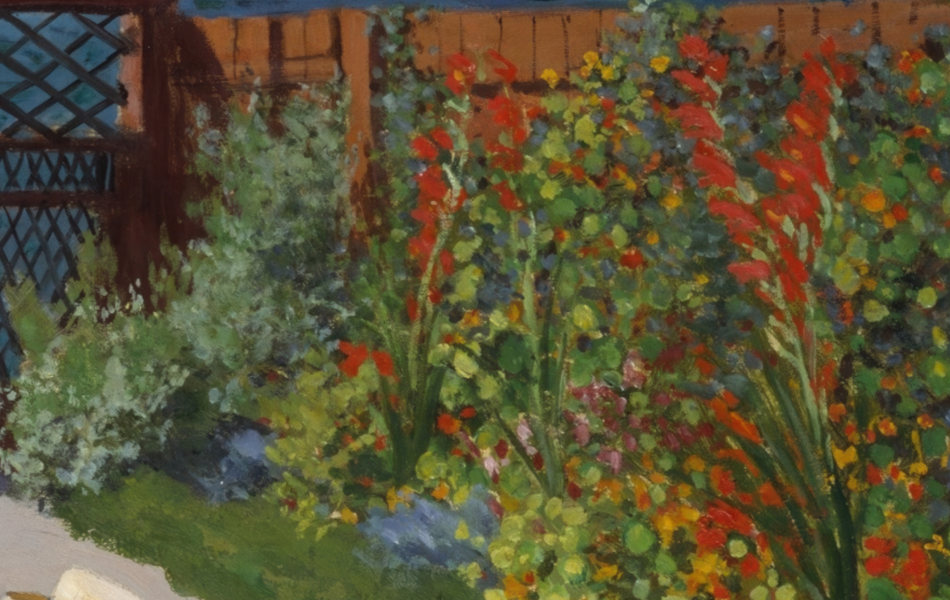
Detail of the flowers running across the right hand side of Garden at Sainte-Adresse, showing Monet's use of vertical constructs to balance his composition.
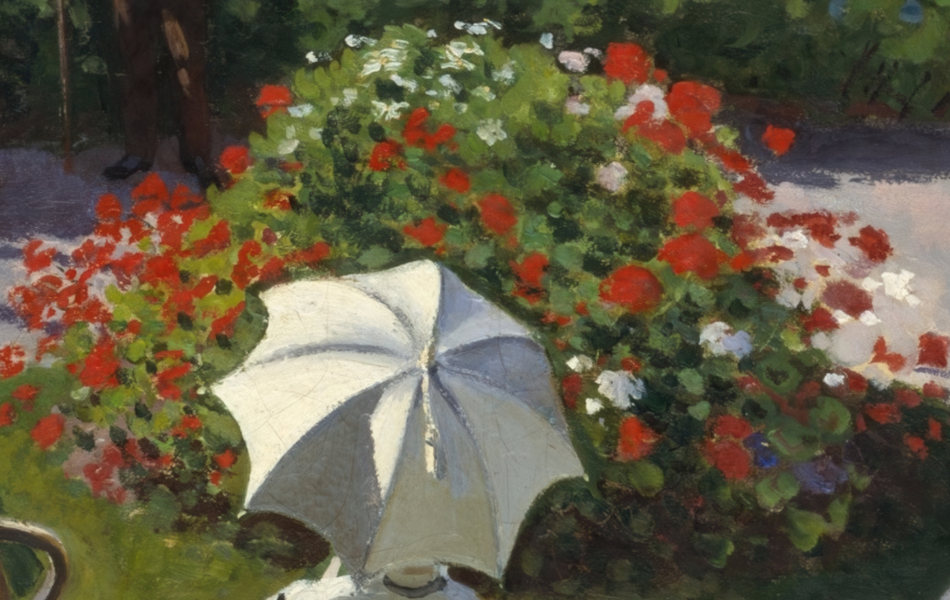
Foreground flower beds in Garden at Sainte-Adresse. Monet used vibrant reds and yellows to create a striking contrast with the blue sea beyond.
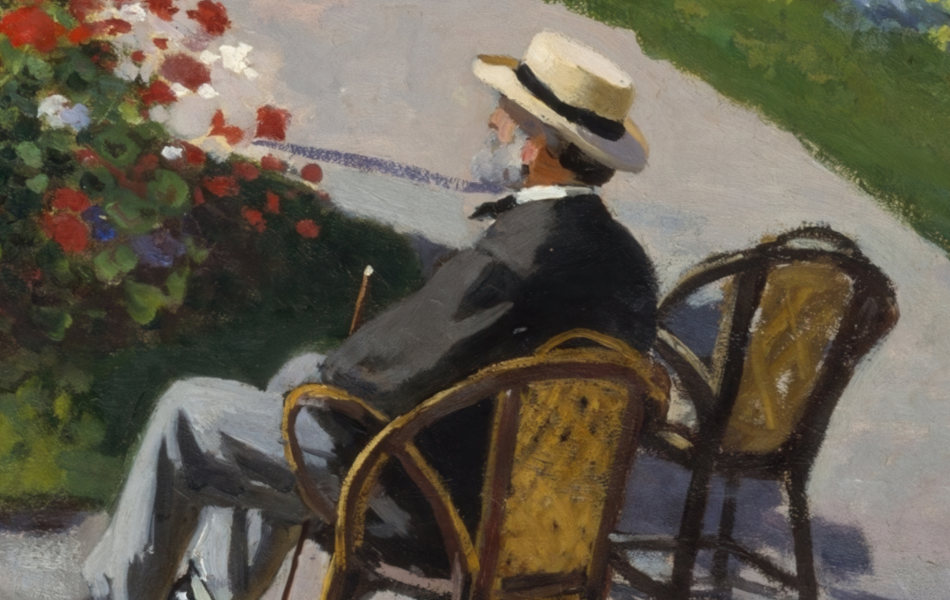
Seated figures overlooking the sea. The man is widely believed to represent Monet's father, Adolphe Monet.
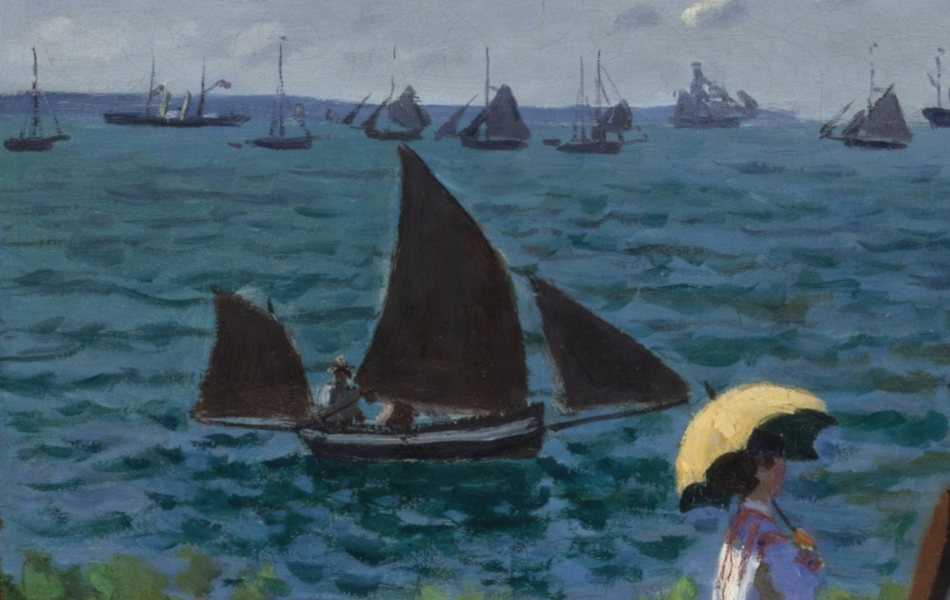
Detail of the sailing boats in the English Channel beyond the terrace, reflecting Monet's interest in maritime scenes along the Normandy coast.
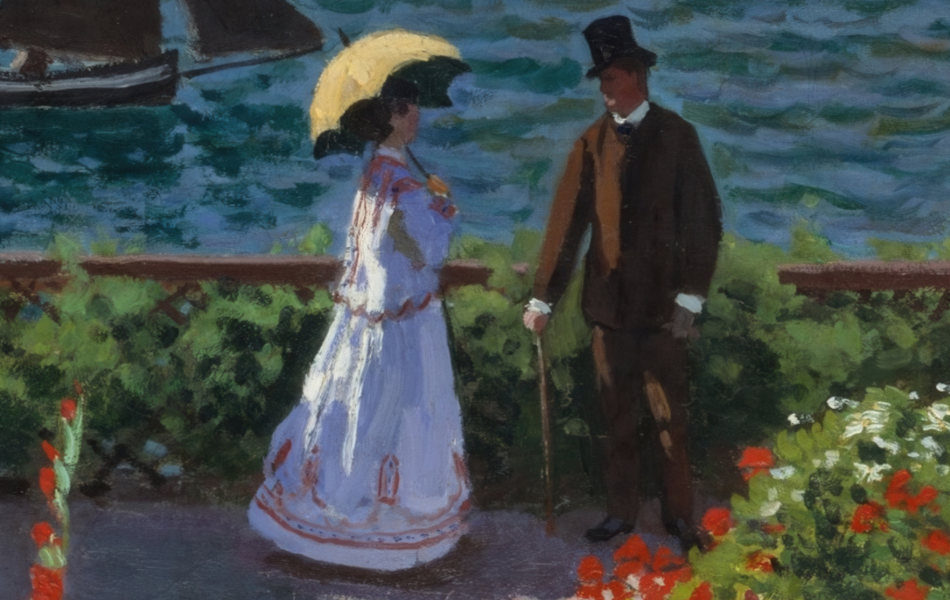
Couple relaxing by the sea, in smart clothing
Japanese Influence: A Comparison between Monet's Garden at Sainte-Adresse (1867) and Hokusai's Sazai Hall (circa 1830-1832)
Art historians have long connected the compositions of Claude Monet's Garden at Sainte-Adresse (1867) and the Japanese woodblock print Sazai Hall of the Five Hundred Rakan Temple by Katsushika Hokusai - we include them both below, so you can make your own visual comparison.
Several quotes exist around Monet's work which strengthen this connection - Monet describing it as his "Chinese painting with flags", whilst Renoir termed it his friend's "Japanese painting". Monet, as with a number of other Impressionist artists, is known to have collected Japanese prints, and studied their technical qualities.
Whilst the content of these two works is completely different, impacted by cultural variations in fashion, architecture and so much more, there is still an undeniable similarity in how both works are structured.
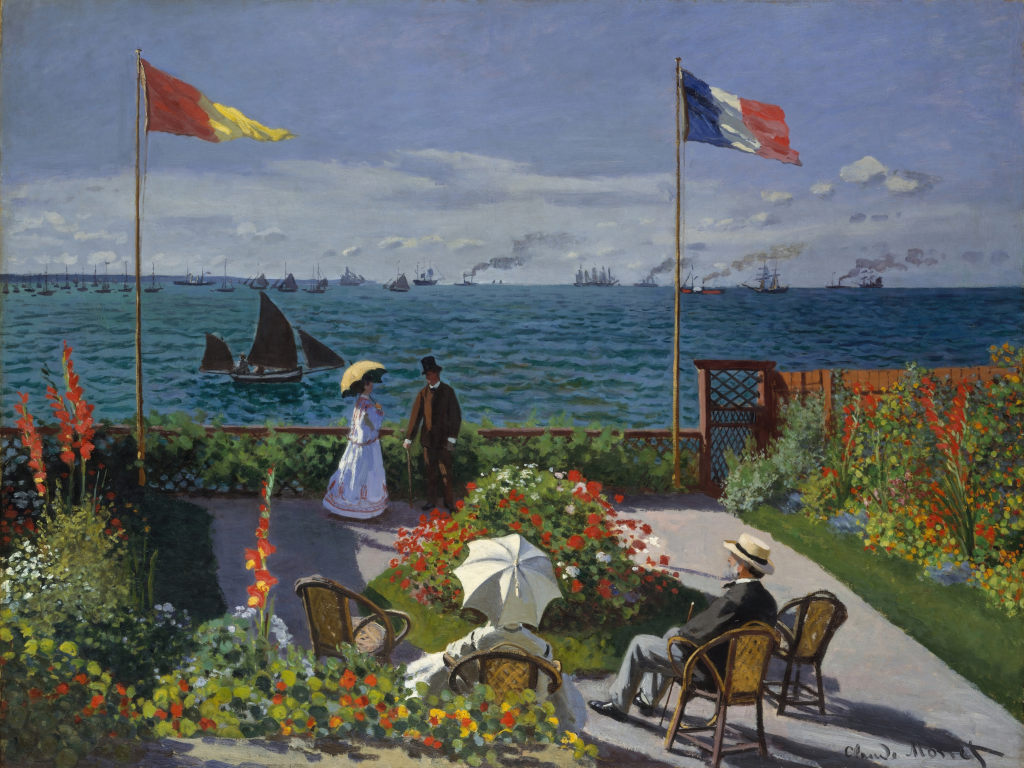
Garden at Sainte-Adresse, 1867, Claude Monet
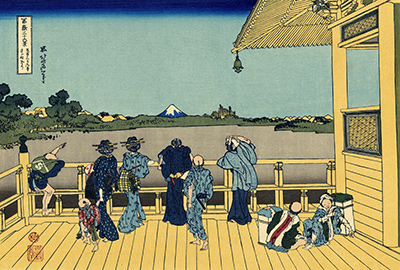
Turban-shell Hall of the Five-Hundred-Rakan Temple, Hokusai, 1830, Thirty-six Views of Mount Fuji Series
Direct Comparison
The clearest similarities are in the way in which the scene is divided horizontally, apportioning areas for the foreground, sea and sky. There are then elements of screening which comes in from the left and right at around 45 degree angles.
The elements in the far distance are roughly the same height, though Monet swaps Japanese mountains for ships with plumes of smoke.
Use of Figurative Art
Additionally, these is a similar use of figures, some stood tall looking out, others sat down. In Hokusai's print visitors lean against the railing of the Sazai Hall balcony while gazing toward Mount Fuji. In Monet's painting two standing figures look out across the English Channel while others sit nearby among the flowerbeds. Their presence helps to draw different sections of each artwork together.
The figures in the painting represent the comfortable middle-class lifestyle emerging in France during the late nineteenth century. Scenes of fashionable leisure—gardens, seaside resorts, and boating—became popular subjects among the Impressionists.
In Garden at Sainte-Adresse, Monet captures a quiet moment of relaxation on the Normandy coast. The fluttering flags, distant ships, and summer flowers evoke the atmosphere of a seaside holiday, reflecting the changing rhythms of modern life.
Compositional Technique
European art would normally try to provide a single vanishing point, rather than areas of interest horizontally. Both artists use structure from other angles to control the composition, such as fencing.
A further technical decision, which many may miss because of its relative subtlety, is the viewpoint taken by both artists - namely just above the foreground elements. This allows the background to become more open and visible and changes the balance of each work. Both Monet and Hokusai took this course of action. This was another Japanese artistic innovation rarely seen in the work of European painters.
Comparisons can also be made in terms of colour - the influence of Japanese aesthetics can also be seen in Monet's use of colour. The bright reds of the garden flowers echo the red flags that line the terrace, creating a decorative rhythm across the foreground.
While Monet painted with oil on canvas rather than ink and woodblock printing, his arrangement of strong colour zones—green garden, deep blue sea, pale sky—creates a visual clarity reminiscent of the flat colour planes characteristic of ukiyo-e prints.
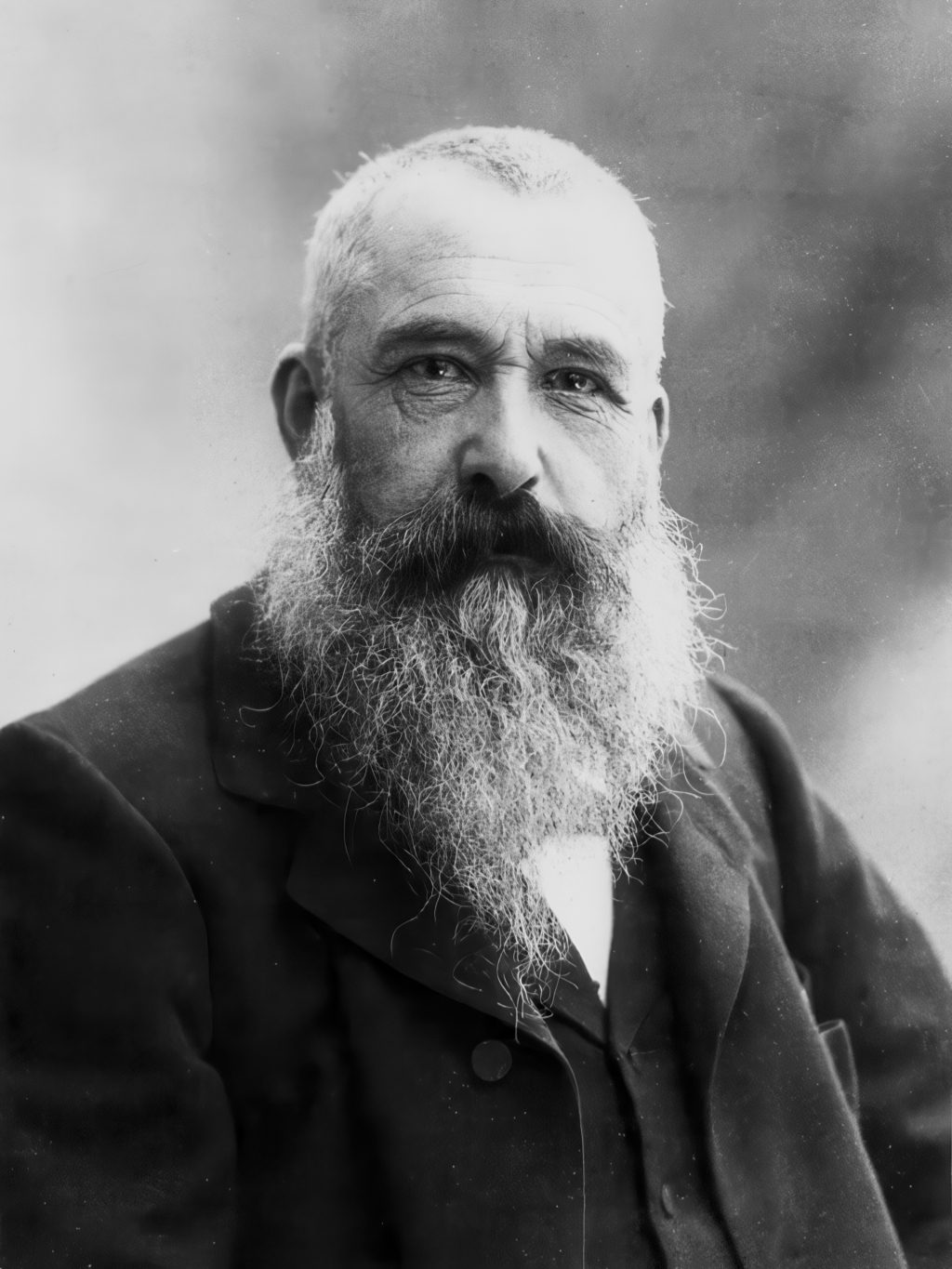
The Chinese painting in which there are flags.
Japonisme and the Impressionists
The comparison of these two works is just the tip of the iceberg - Japonisme is the term coined to describe the influence of Japanese art on European artists at around this time. Many Impressionists collected Japanese prints after trade opened up between these two regions. The influence of Japanese art would remain visible throughout Monet's career, eventually shaping the design of his famous Japanese-style garden at Giverny.
In later decades and generations the influence would spread to the Art Nouveau and Post-Impressionist eras too.
The Real Location of Monet's Garden at Sainte-Adresse
Claude Monet painted Garden at Sainte-Adresse in the summer of 1867 while staying in the coastal resort of Sainte-Adresse near Le Havre in Normandy.
The scene was almost certainly painted from the garden terrace of a house known as Le Coteau. The property belonged to relatives of Monet's cousin in the Lecadre family, with whom the artist stayed during this period.
From this elevated position Monet could observe sailing vessels moving across the horizon and the changing light on the water throughout the day. The view across the sea was expansive, and on clear days it was even possible to glimpse the distant coastline around Honfleur across the Seine estuary.
Monet's Adjustments to the Scene
In order to tailor the environment to his artistic needs, Monet made a number of small changes to the garden before commencing his painting. The garden is likely to have been less organised and formal than found here - seaside gardens tend to work with the blustery conditions and not aim for such precision.
Additionally, the brightly coloured flags lining the terrace may have been added or emphasised to create visual rhythm and to echo the red tones of the flowers in the foreground. It is also highly unlikely that the ships in the background would have been so perfectly arranged as this at the time that Monet composed the work.
The View Today
Sadly, the exact garden pictured by Monet does not exist today. However, the surrounding environment remains entirely recognisable. Indeed, the same view point can be enjoyed today, albeit without this particular garden in the foreground. You will see the same broad horizon line and maritime setting that appear in Monet's painting.
Exhibition History
Exhibited at the Fourth Impressionist Exhibition in Paris, 1879
Garden at Sainte-Adresse (Jardin à Sainte-Adresse) was exhibited at the Fourth Impressionist Exhibition in Paris, 1879, despite the artist having completed it over a decade earlier.
This prominent work has been exhibited in many museums and galleries aside from its current home in New York. It is rare for it to return to European shores, but it has featured in exhibitions in France, Belgium and Switzerland at various points in its lifetime, as well as a good variety of US cities.
Where is Monet's Garden at Sainte-Adresse Today?
Monet's Garden at Sainte-Adresse from 1867 is today housed at the Metropolitan Museum of Art in New York, as part of its permanent collection.
The painting was purchased by The Met on December 1, 1967, roughly a century after it was first completed by the artist. Thomas Agnew & Son are believed to have helped finance the purchase on the museum's behalf, from a Christie's auction.
Address of the Painting Today
Please check ahead of visiting, but the address of The Met is as follows:
The Metropolitan Museum of Art,
1000 5th Ave,
New York,
NY 10028,
United States
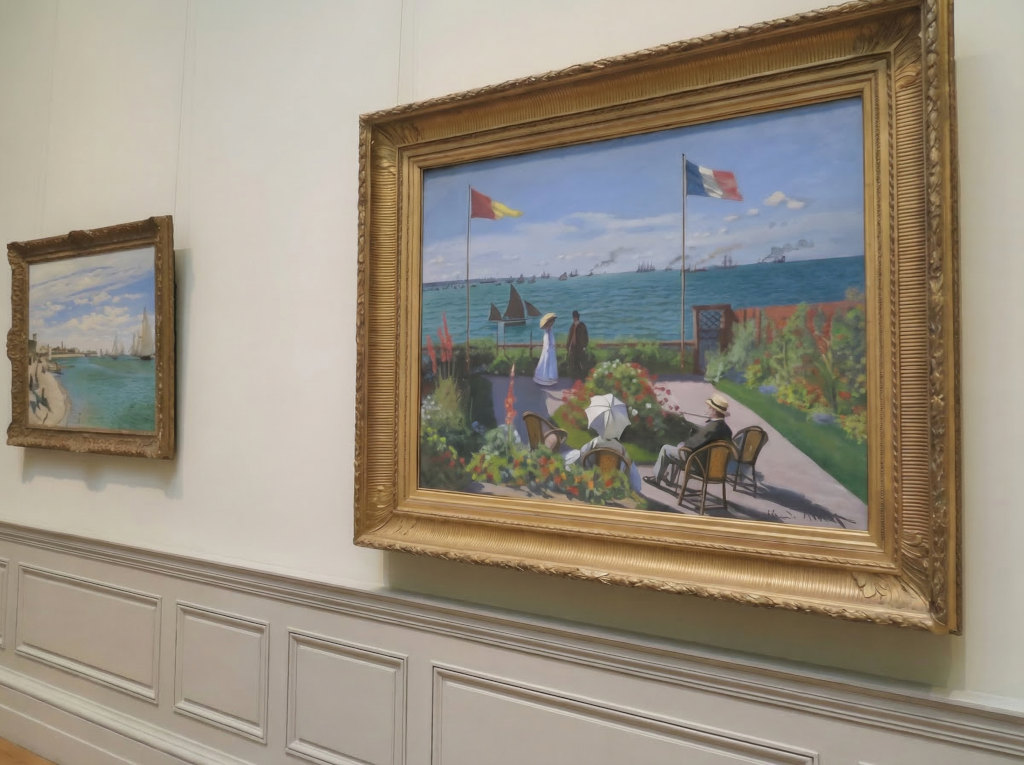
Monet's Garden at Sainte-Adresse, 1867, on Display at The Metropolitan Museum of Art, New York, USA
Legacy of the Painting
Garden at Sainte-Adresse stands at an important moment in Monet's career. Painted before the Impressionist movement had fully emerged, the work reveals the artist experimenting with colour, composition, and modern subject matter.
At the same time, the painting foreshadows many themes that would later define Monet's art: gardens filled with flowers, coastal landscapes and the shimmering interplay of light and colour.
More than a century later, the painting remains a vivid celebration of summer on the Normandy coast and an early glimpse of the revolutionary artistic vision that would soon transform modern painting.