


 by
Tom Gurney
Tom Gurney BSc (Hons) is an art history expert with over 20 years experience
Published on October 6, 2016 / Updated on October 23, 2026
Email:
tomgurney1@gmail.com
/ Phone:
+44 7429 011000
Camille on the Beach at Trouville
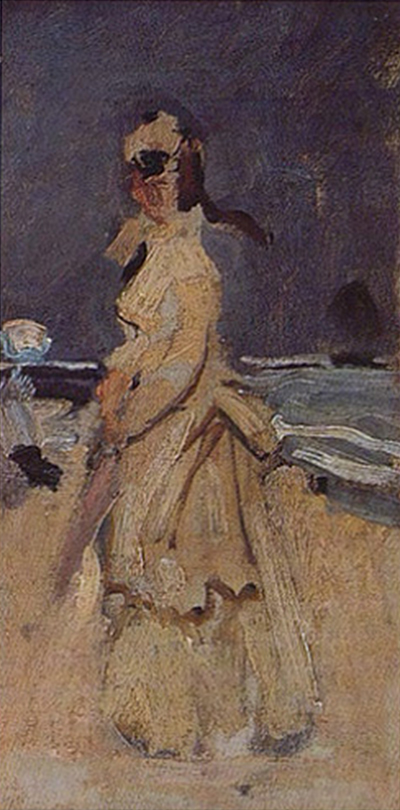
Camille stands almost the full height of a narrow canvas, her pale dress set against a dark blue-grey background and bands of breaking water. Monet's Camille on the Beach at Trouville , catalogued by the Musee Marmottan Monet as Camille sur la plage , dates from 1870. Only 30 by 15 centimetres, it is an intimate oil painting rather than a large seaside portrait. The museum's inventory number is 5038; its catalogue raisonne number is Wildenstein 161. [1] [2]
At a Glance
A narrow canvas organised around one figure
The painting is twice as high as it is wide. That simple proportion determines how the scene is encountered: Camille's figure, from hat to hem, becomes its principal vertical structure.
There is very little empty space beside her. The beach and water remain visible, but they do not expand into the broad panorama found in Monet's boardwalk scenes. Instead, the coast is fitted around the person standing nearest the viewer.
Her body turns slightly, and her head is directed back towards us. The pose gives the silhouette more variation than a rigid frontal stance would allow. A projecting fold behind the hip and the uneven edges of the skirt make the figure feel placed within the air rather than pasted onto a background.
The small scale also changes the demands on description. A few marks must carry the weight of a hat, a face or a complicated fold. The painting does not attempt to reproduce every surface with equal precision. Its emphasis falls on the figure's overall presence and the contrast between light clothing and darker surroundings.
The dress is a landscape of folds
Camille's dress occupies much of the lower half. Cream and pale ochre passages are divided by grey-brown strokes that suggest seams, folds and areas turned away from the light.
The bodice appears more contained than the skirt. Below the waist, fabric opens into broader shapes, with a gathered projection at the back and an irregular band of trimming above the hem. The long skirt approaches the sand without a sharply drawn boundary at every point.
These changes prevent the pale clothing from becoming one flat, bright shape. Some passages are warmer, others cooler or darker; the eye moves among them to understand the body's turn beneath the fabric.
The treatment is selective. Dark lines emphasise a few structural divisions, while lighter strokes merge elsewhere. Monet describes how a dress catches light and bends around a person, rather than presenting a dressmaker's diagram.
The surrounding sand shares some of the clothing's warm tones. That similarity connects figure and setting, even as the darker upper background makes Camille's head and shoulders stand out.
A partially concealed face
The face is small in relation to the full figure, and a dark band at eye level makes it harder to read. Pale marks around the hat contrast with darker material and a ribbon-like shape extending towards the right.
The effect is not that of a formal studio portrait in which eyes, expression and physiognomy receive the most exacting attention. Camille is recognisable as the painting's subject through its title and history, but the painted face remains abbreviated.
That distinction matters. Identifying a sitter does not give us access to her thoughts at the moment represented. The dark material across her face is not evidence of grief, hostility or a particular emotional exchange with the painter.
The head's turn nevertheless introduces a sense of contact. It interrupts the body's sideways direction, as if the figure has become aware of somebody looking. A small shift in orientation is enough to make the pose active without supplying a story or an invented conversation.
The sea behind the portrait
White strokes cross the middle distance behind Camille, indicating bands of surf against cooler water. They are among the most decisive horizontal marks in a strongly vertical picture.
A dark triangular sail appears at the right. Its compact shape gives the background a marine scale and distance without demanding a large area of sea. At the left edge, part of another beachgoer is cut off, including a light hat and darker clothing.
This cropping makes the scene feel larger than the narrow canvas. Other people and activities continue beyond its borders, even though Camille receives the main emphasis. The painting is intimate but not isolated from public seaside life.
The dark upper field and pale lower sand create a simple tonal division. Within it, the white surf links the light dress to the setting. Portrait and coast are not separate subjects assembled in layers; their colours and directions continually affect one another.
Camille and Monet at Trouville in 1870
Monet stayed at Trouville with Camille during the summer after their marriage on 28 June 1870. The Musee d'Orsay documents that context in its account of his separate Hotel des Roches Noires . [4]
The Trouville paintings range from busy resort panoramas to close studies of people. This narrow portrait chooses the latter approach: one familiar figure becomes the means of examining dress, light and the coastal environment.
Its scale and informality should not be mistaken for insignificance. A small canvas can concentrate a relationship between person and place more closely than a sweeping view of the whole beach. Here, the limited space makes each surrounding element count.
The Marmottan's 2025 publication describes the work as a portrait of Monet's first wife that he kept until the end of his life. [3] That documented attachment gives it a personal history, without requiring us to turn every brushstroke into a confession.
Not the similarly titled Yale painting
Yale University Art Gallery owns another Camille on the Beach at Trouville , a horizontal canvas measuring 38.1 by 46.4 centimetres. Its collection publication describes Camille seated near the picture plane with a parasol, and a shoreline cutting diagonally across the composition. [5]
The Marmottan painting discussed here is instead the small upright, full-length figure. Its dimensions, image and inventory number distinguish it securely, despite the closely related English titles.
This is especially important when reading accounts of technique. Observations about the ground layers of Yale's picture, or sand identified in London's separate beach painting, cannot simply be applied to this object.
The comparisons are still valuable when their limits remain clear. They show Monet making several compositional choices around a familiar sitter: seated close-ups, a narrow standing figure and different proportions of person, sea and sky. Their differences are more revealing than treating them as interchangeable illustrations of a honeymoon.
Camille as an outdoor figure beyond Trouville
Monet returned to the relationship between Camille, clothing and moving air in Woman with a Parasol - Madame Monet and Her Son , painted in 1875 and now at the National Gallery of Art. There, she stands on a grassy hill with Jean behind her and a parasol raised overhead. [6]
The comparison should not collapse five years or turn a hillside into a beach. What it reveals is the continuing usefulness of a familiar model for exploring light on pale clothing and the place of a figure outdoors.
The Trouville portrait is much narrower and more restrained in its surroundings. Its marine background supplies just enough information to locate Camille, while the later picture gives much more room to grass, sky and the raised parasol. Each setting produces a different balance.
From the family collection to Marmottan
The painting passed through Michel Monet's collection and entered the Musee Marmottan Monet through his 1966 bequest. The object record also notes an atelier stamp on the back of the canvas, rather than a front-facing handwritten signature to be sought in the image. [1] [2]
In 2025-26, the museum brought this portrait and another Trouville work into dialogue with the coastal paintings of Jean-Baptiste Secheret. [3] That exhibition was a later interpretation of the collection, not the origin of the painting's title or date.
The portrait's appeal remains unusually concentrated. A small area of paint holds a whole figure, a fragment of social life and a recognisable shore. Its scale encourages close looking, while its omissions leave room for the viewer to recognise how much can be suggested without being laboriously described.
Frequently Asked Questions
The Musee Marmottan Monet in Paris, inventory 5038. [1]
It measures 30 by 15 centimetres, making it a very small, narrow upright canvas. [1]
No. Yale's similarly titled painting is a separate horizontal composition, 38.1 by 46.4 centimetres. [5]
Discussion
Look again at the images and ideas explored in Camille on the Beach at Trouville. These editorial prompts invite your observations.
Reader Insights
Compare the dark lines describing the dress with the white bands of surf.
Consider how the narrow format changes your encounter with the sitter.
Notice the cropped figure at the left and the small sail at the right.
Join the Conversation
Share a detail, comparison or question about Camille on the Beach at Trouville below.
References
- Musee Marmottan Monet , Camille sur la plage, 1870, inventory 5038; object dimensions, medium, reverse stamp and Michel Monet bequest. View source .
- Daniel Wildenstein / Wildenstein Plattner Institute , Monet catalogue raisonne, volume II, 1996, entry 161, printed pages 76-77; exact identity and family provenance. View source .
- Musee Marmottan Monet , Monet / Secheret: Paysages d'eau, 2025-26 press publication; portrait retained by Monet and later exhibition dialogue, pages 2, 5 and 7. View source .
- Musee d'Orsay , Hotel des Roches Noires, Trouville; separate 1870 painting and context for Monet and Camille's summer stay. View source .
- Yale University Art Gallery , A Selection of European Paintings and Sculpture, catalogue entry 9, Camille on the Beach at Trouville; separate Whitney-collection canvas and its composition. View source .
- National Gallery of Art , Woman with a Parasol - Madame Monet and Her Son, 1875; later outdoor figure comparison. View source .







