


 by
Tom Gurney
Tom Gurney BSc (Hons) is an art history expert with over 20 years experience
Published on October 6, 2016 / Updated on October 23, 2026
Email:
tomgurney1@gmail.com
/ Phone:
+44 7429 011000
La Plage de Trouville
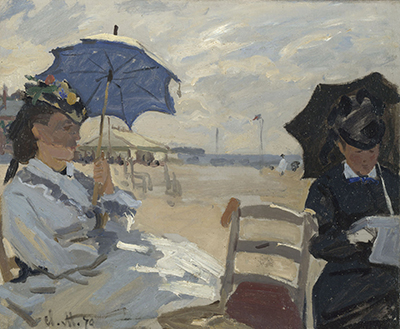
La Plage de Trouville, known in English as The Beach at Trouville, is Claude Monet's close view of two women seated beneath parasols in 1870. It belongs to the National Gallery in London, inventory NG3951. [1] The pale dress and blue parasol on the left contrast sharply with the dark clothing on the right. An empty chair between the women opens a narrow view towards the beach beyond.
At a Glance
Two women close to the viewer
The women occupy far more space than the beach itself. Their bodies are cut by the lower and side edges, while the parasols rise into the cloudy sky. The effect is intimate: we are close enough to notice a raised hand or the turn of a hat, but not given a formally arranged double portrait.
Camille is on the left. The identity of her companion remains uncertain; the National Gallery records several proposed identifications, including Madame Boudin and a member of Camille's or Monet's family. [1] The uncertainty should remain part of the account rather than being replaced with a confident name.
The left figure's pale dress spreads across the foreground in broad folds. On the right, black clothing forms a more compact mass beneath a dark parasol. These are strongly different shapes, yet both figures are joined by the shared need for shade.
The gap between them is equally important. It prevents the two bodies from closing the composition completely and gives the distant beach a way into the picture.
Parasols and coastal light
The blue underside of Camille's parasol is one of the painting's largest areas of colour. Its ribs radiate from the centre, making a structure that is much more clearly described than the features of the face below.
The dark parasol on the right has a different outline, its uneven edge standing against the lighter sky. Together, the two canopies create a second, nearer layer above the women. The sky is not simply behind the figures; parts of it are blocked, framed or echoed by these portable shelters.
Bright strokes across the white dress suggest the strength of the light outside the shade. The shaded face remains muted, however. Monet does not make every feature equally visible simply because it belongs to a sitter.
This uneven distribution of detail makes the light convincing. The brightest passages are conspicuous because neighbouring areas are comparatively subdued. A few broad contrasts communicate the experience of glare and shelter more effectively than a uniformly detailed description would.
A beach beyond the chairs
Behind the foreground figures, sand opens towards a low strip of sea. Small people and beach equipment are reduced to brief marks, while a faint line of buildings helps establish the resort setting.
The empty chair provides a middle distance of its own. Its pale rails are larger and more definite than the remote holidaymakers but less dominant than the dresses. The repeated bars help bridge the change of scale from nearby figures to distant shore.
The sea occupies relatively little space. This is not chiefly a study of waves or a dramatic maritime view. Its subject is the experience of being at the seaside: seated, dressed, shaded and surrounded by the open air.
The clouds are handled in grey, cream and blue rather than left as an unbroken background. Their movement of colour answers the varied marks on the dress below. Sky and costume are different materials, but Monet connects them through the visible activity of the brush.
Sand in the paint
Grains of sand embedded in the paint are evidence that Monet worked on the picture at least partly on the beach. [1] They are a material connection with the setting, not proof that the entire canvas was completed in one sitting.
That distinction is useful when looking at the broad handling. Rapid-looking marks can describe a passing effect without telling us exactly how many sessions were needed. The surface preserves decisions, not a stopwatch record of the painter's movements.
The dress contains abrupt transitions from white to grey-blue shadow. The face is established with a small number of dark and warm touches. Such economy leaves the surface visibly active, but it does not make the figures unrecognisable or the composition unconsidered.
The apparent informality is supported by a clear arrangement of large masses: pale figure, dark figure, two parasols and the interval of sand between them. The painting's energy comes from the relation between this underlying order and the abbreviated description of particulars.
Trouville in the summer of 1870
Monet visited Trouville with Camille and their son Jean after the couple married in June 1870. The Musee d'Orsay places its Hotel des Roches Noires painting within the same visit. [4]
The hotel view and this small beach scene offer different ways of describing the resort. One emphasises its architecture, terrace and flags; the other brings the holiday experience down to the scale of seated companions. The connection is a shared place and period, not an identical subject.
The small canvas also leaves much outside the frame. Jean is not visibly portrayed beside the women, and no account of the family's entire holiday can be recovered from their poses. A seemingly ordinary scene can be personal without functioning as a complete family document.
Even the French title is broad. La Plage de Trouville names the setting, but the distinctive close-up and the inventory number identify this particular painting among Monet's several views of the shore.
Boudin's beach scenes as a comparison
Eugene Boudin had made fashionable seaside visitors a recurring subject. The National Gallery describes his Beach Scene, Trouville of 1873 as a frieze-like arrangement of people, their coloured clothes set against silvery sea and sky. [3]
That comparison helps clarify Monet's decision here. Rather than spreading a group along the shore at a distance, he places two figures close to the front. Their clothing and parasols become major forms, and the beach is glimpsed around them.
Both approaches take modern leisure seriously as a subject. Neither requires a shipwreck, battle or extraordinary event to justify a coastal painting. Ordinary visitors and the conditions around them are enough.
The relationship should not be reduced to a claim that Monet merely copied Boudin. It is more revealing to compare the painters' different distances from their subjects and the different visual rhythms those distances allow. Monet's encounter is compressed and immediate; Boudin's groups can read as a broader social gathering.
A small painting with an independent identity
The catalogue raisonne records the signature and date as the initials Cl. M. followed by 70. It also traces the painting's acquisition through the Courtauld Fund in 1924 for the Tate, followed by its transfer to the National Gallery in 1961. [2]
Its small size does not diminish the ambition of the viewpoint. Cropped bodies, differently coloured parasols and a briefly indicated shore make a scene that is both legible and unusually close.
Within Monet's coastal work, La Plage de Trouville is valuable for that concentration. A modest section of beach becomes a study of how people occupy light and shade, and of how a few large shapes can hold an entire outdoor experience together.
Frequently Asked Questions
The 1870 two-woman beach scene in the National Gallery, London, NG3951. [1]
No. Her identity is uncertain. [1]
That Monet worked on the canvas at least partly outdoors on the beach. [1]
In 1924, through the Courtauld Fund. It transferred from the Tate to the National Gallery in 1961. [2]
Discussion
Look again at the images and ideas explored in La Plage de Trouville. These editorial prompts invite your observations.
Reader Insights
How does the empty chair affect the space between the women?
Which is more strongly described: the parasols or the faces?
How would the picture change if the figures were seen from farther away?
Join the Conversation
Share a detail, comparison or question about La Plage de Trouville below.
References
- National Gallery , London, The Beach at Trouville, 1870, NG3951: identity, companion uncertainty and sand in the paint. View source .
- Daniel Wildenstein , Monet: Catalogue raisonne, 1996, volume II, W158, pp. 75-76, Wildenstein Plattner Institute digital edition. View source .
- National Gallery , London, Eugene Boudin, Beach Scene, Trouville, 1873, NG6312: a separate comparative work. View source .
- Musee d'Orsay , Hotel des Roches Noires. Trouville, 1870: Monet's family visit and another view of the resort. View source .







