


 by
Tom Gurney
Tom Gurney BSc (Hons) is an art history expert with over 20 years experience
Written on November 8, 2026 / Updated on November 8, 2026
Email:
tomgurney1@gmail.com
/ Phone:
+44 7429 011000
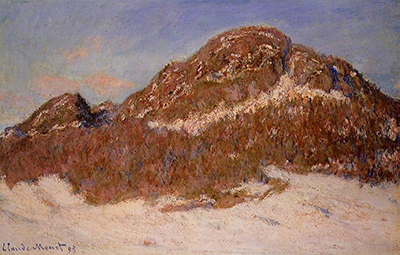
Mount Kolsaas, Sunlight Effect (1895)
Claude Monet’s Mount Kolsaas, Sunlight Effect turns a Norwegian winter landscape into a meeting of warm colour, dark woodland and pale snow. Painted in 1895, the oil on canvas measures 65 by 100 centimetres and is catalogued as Wildenstein 1409. The signature and date appear at the lower left. Its particular arrangement of mountain, trees and snow distinguishes it from other versions of the same subject.[1][2]
At a Glance
A Norwegian winter in 1895
Monet travelled to Norway in the winter of 1895, when his stepson Jacques Hoschedé was living there with his Norwegian wife. The journey brought family concerns together with the search for new painting subjects. The National Gallery of Victoria’s chronology describes his fascination with the snowy landscape and Mount Kolsaas. This was a northern excursion during his established career, rather than an episode from his youth.[2][3]
The mountain became a recurring subject during the visit. In the account accompanying this painting, Christie’s describes the move from Christiania, now Oslo, to the area of Sandvika. Wildenstein associates the principal group of mountain views with a position near Helgerud, north of Bjørnegård. A repeated viewpoint gave Monet a familiar structure against which to consider different light and weather conditions. Recognition and variation could develop together: the mountain remained identifiable while its appearance offered further possibilities.[1][2]
The mountain and the frame
The broad format gives the mountain room to extend across the picture, but the highest mass rises to the right of centre. A smaller prominence at the left prevents the silhouette from becoming a simple triangle. Between them, changes in the ridge guide the eye across the skyline. The result combines a strong, memorable outline with an uneven rhythm. The mountain feels substantial without being reduced to a single geometric emblem.
The foreground works differently. Its pale, sloping surface has relatively few emphatic interruptions, leaving space between the viewer and the wooded mountain. The dark band of trees occupies that interval and gives the rocky summit something to rise above. Looking from the lower edge towards the crest, the eye passes through areas of very different density. Open snow, clustered marks and broken rock establish depth through contrast rather than through a prominent road or human story.
Sunlight and the relationship of colours
The title directs attention to sunlight, but its effect is distributed through the whole scene. Warm brown, rust and pink passages dominate much of the mountain and woodland, while cooler blue and violet notes appear in the sky and snow. These colours are best understood in relation to one another. A pale passage seems cooler or warmer according to what surrounds it, and a darker area can intensify the apparent brightness of the snow beside it.
The sky contains touches of warmer cloud as well as blue. This gives it a connection with the mountain instead of leaving it as an unrelated backdrop. Similar relationships operate below: light passages on the slopes link the summit with the snowfield, while darker marks interrupt an otherwise continuous pale surface. The picture’s coherence depends on these exchanges across its separate zones. Its warmth does not require the viewer to imagine summer; colour and a recognisably wintry subject coexist.
Snow, woodland and brushwork
The wooded band is built from repeated, mostly upright marks. Seen together, they suggest the crowded growth on the slope; considered separately, they remain conspicuous touches of paint. The snow offers a quieter counterweight. Small strokes and changes of tone prevent it from becoming an empty white shape, yet it does not compete with the density of the trees. Alternating between these passages changes the pace of looking, from accumulation to relative openness.
Snow also makes the mountain easier to read. Pale streaks follow breaks and inclines in the darker mass, so the surface is described by interruptions as much as by continuous modelling. The viewer can recognise a slope while remaining aware of separate marks. That balance is important to the painting’s effect: the landscape seems present, but so does the act of painting it. Its energy comes from the relationship between the distant subject and the visible arrangement of colour.
One painting among related views
The catalogue distinguishes this Sunlight Effect, W1409, from works given descriptions such as clear weather, misty weather, evening and snowstorm. These are individual canvases, with separate histories, rather than alternative names for one object. The group offers a useful way to think about Monet’s serial practice. Repeating the mountain does not remove the need for a new arrangement of tones and marks on each canvas; it makes those decisions more visible through comparison.[1]
Similarly named museum paintings require particular care. The Musée d’Orsay records a Mount Kolsaas dated 1895 under inventory RF 1967 7; that is Wildenstein 1415, not the sunlit painting reproduced here. The Marmottan work listed as inventory 5100 is another version, Wildenstein 1406. Their collections and acquisition records belong to those particular objects. The W1409 number, dimensions and lower-left signature provide a clearer identification than a general title containing only the mountain’s name.[1][4][5]
Kolsaas and the idea of Mount Fuji
The Norwegian mountain also entered Monet’s thinking through Japanese imagery. The National Gallery of Victoria notes that Kolsaas reminded him of woodblock views of Mount Fuji. Christie’s relates this association to Hokusai’s mountain images and to Monet’s comments about the Norwegian setting. The connection is a reminder that looking at a new place can involve memories of pictures already known. It does not mean that Monet had visited Japan or that this landscape illustrates a Japanese location.[2][3]
In this canvas, a firm silhouette and a broad division between sky, mountain and foreground help explain why such comparisons can be productive. Yet the irregular ridge, wooded slopes and changing colours remain specific to the Norwegian subject. The painting can be considered alongside Japanese mountain imagery without being treated as a copy of an unidentified print. The most useful comparison concerns how a mountain can organise a picture while light and surface handling keep its appearance active.
Exhibitions and documented ownership
This painting appeared as number 32 in Monet’s exhibition at Durand-Ruel in Paris in May 1895. The Christie’s record also lists its inclusion in Stockholm in 1897, Paris in 1900, and the Monet in Norway exhibition that travelled from Stavanger to Paris and Copenhagen in 1995–1996. These entries trace the public life of a particular canvas across different periods. They should be distinguished from a general history of all Monet’s Norwegian paintings.[1][2]
The documented ownership history includes Durand-Ruel’s purchase from Monet in April 1900, Jean d’Alayer, dealers in Amsterdam and New York, and the Staley collection. Wildenstein records the Christie’s sale of 30 April 1996, lot 38. That historical trail helps connect names and dates to the same work. It does not establish a present owner or a current public display, so the painting should not be assigned to a museum merely because a related Kolsaas view is held there.[1][2]
Looking again at the sunlight effect
A useful starting point is to follow the outline of the mountain, then compare the warmth within that outline with the cooler surrounding areas. Next, look at the forest and the snow as contrasting painted surfaces. Neither has to be described in exhaustive detail to become convincing. Finally, step back from individual marks and notice how the broad arrangement holds together. The painting moves between the solidity of a recognisable mountain and the changing relationships through which it is seen.
Frequently Asked Questions
No. He made several views in different conditions. Each canvas has its own catalogue identity and ownership history.[1]
Discussion
Consider how Monet makes a snowy mountain feel warm in colour. These editorial prompts invite your own observations.
Reader Insights
Where do warm and cool colours meet most clearly in this painting?
How does the wooded band change your reading of the pale foreground?
What becomes easier to notice when this sunlight effect is compared with another mountain view?
Join the Conversation
Share a detail, comparison or question about Mount Kolsaas, Sunlight Effect below.
References
- Daniel Wildenstein / Wildenstein Plattner Institute — Claude Monet, catalogue raisonné, volume III, 1996, W1409, printed pp. 585–586; related entries W1406 and W1408–W1418. View source
- Christie’s — Le mont Kolsaas, effet de soleil, W1409, object details, provenance, exhibitions and lot essay. View source
- National Gallery of Victoria — Monet timeline, 1895, Norwegian visit, Jacques Hoschedé and the Mount Fuji association. View source
- Musée d’Orsay / Ministère de la Culture — Le Mont Kolsaas en Norvège, RF 1967 7, W1415; a different version. View source
- National Gallery of Victoria — Monet’s Garden media booklet, 2013, list of works: Marmottan Mount Kolsaas, inventory 5100; a different version. View source







