


 by
Tom Gurney
Tom Gurney BSc (Hons) is an art history expert with over 20 years experience
Published on October 6, 2016 / Updated on October 23, 2026
Email:
tomgurney1@gmail.com
/ Phone:
+44 7429 011000
Camille Monet on a Garden Bench
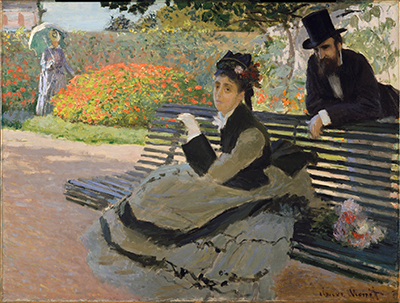
Camille Monet on a Garden Bench shows the artist's wife seated in the garden of their home at Argenteuil in 1873. The painting belongs to The Metropolitan Museum of Art. [1] Camille turns towards the viewer while a top-hatted man leans over the bench behind her. A note in her gloved hand and a bouquet beside her give the encounter an unresolved, suggestive quality.
At a Glance
Three figures in a garden
Camille is the largest and most immediately accessible figure. Her pale skirt spreads across the foreground, its dark borders making a series of curves that contrast with the bench's narrow, straight slats. She is seated sideways rather than squarely facing the painter.
The man occupies the upper right. His dark coat and high hat give him a weight that balances the large area of Camille's dress. One pale glove rests against the bench, bringing a small, bright accent into his otherwise shadowed figure.
Farther away, a woman stands near the flowers with a parasol. Her small scale establishes distance and keeps the encounter on the bench from filling the entire garden. She also introduces another direction of movement and attention.
These three positions do not add up to an easily readable conversation. Camille looks outwards, the man inclines towards her, and the distant figure remains apart. The painting lets us see the arrangement clearly while withholding the words, if any, being exchanged.
A fashionable sitter
The Met connects Camille's velvet and damask ensemble with a style illustrated in the March 1873 issue of La Mode Illustree. [1] Dress is therefore part of the painting's modern setting, not a neutral covering that can be ignored once the sitter has been named.
The costume has a strongly designed silhouette. Dark fabric around the torso and sleeves sets off the lighter skirt, while bands of trim carry the eye across its folds. The small hat, white gloves and carefully arranged clothing make this a dressed, socially presentable appearance within a private garden.
The Fashion Institute of Technology's study of an 1872 Pingat visiting dress offers a useful comparison for the period's layered skirts, contrasting fabrics and elaborate trimming. [6] It does not establish that Camille's own outfit was made by Pingat.
For Monet, these contrasts also provide painting problems: a pale fold changes colour in shadow, black trim breaks a broad light surface, and fabric turns across a seated body. Fashion and composition work together, rather than belonging to separate parts of the picture.
The note and the bouquet
Camille's hand is raised near her chest, holding a small note. Its pale shape is conspicuous against the darker sleeve and bodice. The bouquet lies farther to the right, where its coloured flowers interrupt the green bench.
Both objects invite narrative interpretation. A letter suggests news; flowers suggest a visit or gift. Yet neither object supplies a readable message or identifies its giver. Their significance is partly produced by the way they are placed near the two main figures.
Gary Tinterow's Met acquisition essay connects the scene cautiously with the death of Camille's father in September 1873. Monet wrote to Pissarro about bad news and the family's need to go into mourning. The essay also notes that the man was later identified as a neighbour, perhaps visiting to offer sympathy. [2]
This is a plausible interpretation, not a recovered transcript of an event. It is more accurate to describe the scene as possibly associated with bereavement than to claim that the note definitely announces the death or that the bouquet's purpose is known. The man's identity should not simply be replaced with Monet's.
The Argenteuil setting
The garden belongs to Monet's first home at Argenteuil , where domestic life became a recurring subject. Gloria Groom's Art Institute of Chicago study explains that the family rented the house from late 1871 until the summer of 1874, during a period when Durand-Ruel's purchases had improved Monet's finances. [5]
Here, the garden is not a remote stretch of countryside. Flower beds, gravel and a bench form a cultivated outdoor room. The orange-red blossoms behind Camille and the man supply a broad, warm band of colour that is quite different from the dark clothing in front.
The view includes enough space for a distant walker and a glimpse of the house, but it is tightly framed around the bench. A private garden can offer both seclusion and social encounter: the family can sit outdoors, receive a visitor and remain close to home.
The flowers do not merely decorate the background. They help separate the two main figures from the more distant woman, while the intervening path makes the depth of the garden legible.
Bench, shadow and brushwork
The bench is a strong structural device. Its repeated slats run behind Camille and beneath the man, joining them within a continuous pattern even though their poses are different. The diagonal also moves the eye from the open foreground towards the upper right.
Monet varies the handling of surfaces. The skirt is built from broad passages broken by dark edging; the geranium bed is an accumulation of small, bright touches; the bench uses repeated linear marks. The picture remains recognisable without every leaf or fold being equally described.
Light is distributed unevenly. The path and flowers receive warmer illumination, while the bench sits beneath patches of shade. This makes the garden feel open to sunlight without turning the whole scene into a uniformly brilliant outdoor study.
The dark figure of the man can attract attention before Camille's face does. Looking again, however, the pale dress, glove and note draw us back towards her. That movement between two figures contributes to the scene's uncertainty more effectively than an explicit illustration of grief would.
A possible companion painting
The National Gallery of Art's 1990 annual report describes a reunion of this work with Monet's Camille, Son, and Nurse in Garden, then in the Buhrle family collection. It observes that their similar date, subject and scale, together with their compositions, suggest that they may have been intended as a pair. [4]
The suggestion is valuable without being conclusive. A comparison places the bench scene among Monet's studies of family life in the same garden, rather than treating it as an isolated puzzle. It also shows how different human groupings could transform a familiar setting.
Within Monet's portraits , the painting occupies a position between likeness and everyday scene. Camille is identifiable, but the surrounding visitor, flowers and note prevent her appearance from being the picture's only subject.
Collection history and an open ending
The catalogue raisonne records the painting's passage through European and American collections before Walter and Leonore Annenberg acquired it in 1974. [3] It entered the Met through their collection in 2002. [1]
Its continuing interest rests partly on the balance between specificity and reserve. A particular woman, a fashionable dress and a recognisable garden are presented with considerable clarity. The emotional meaning of their encounter is less secure.
That uncertainty is not a defect to be solved by inventing dialogue. The painting rewards attention to what can be seen: the spacing of the figures, the turning body, the raised hand, the flowers and the shadowed bench. Together, they make a quiet garden scene feel psychologically complex.
Frequently Asked Questions
Camille Doncieux, Monet's wife. [1]
The Met identifies him as a neighbour, not the artist. [1]
That is a museum-supported possibility associated with the death of Camille's father, not a certain account of the event. [2]
The Metropolitan Museum of Art, accession 2002.62.1. [1]
Discussion
Look again at the images and ideas explored in Camille Monet on a Garden Bench. These editorial prompts invite your observations.
Reader Insights
Does your eye move first to Camille, the man or the flowers?
How do the note and bouquet change an otherwise ordinary garden scene?
What does the bench's repeated pattern contribute to the composition?
Join the Conversation
Share a detail, comparison or question about Camille Monet on a Garden Bench below.
References
- The Metropolitan Museum of Art , Camille Monet on a Garden Bench, 1873, 2002.62.1. View source .
- Gary Tinterow , Camille Monet on a Garden Bench, Recent Acquisitions: A Selection, 2001-2002, The Metropolitan Museum of Art Bulletin, volume 60, no. 2, p. 30. View source .
- Daniel Wildenstein , Monet: Catalogue raisonne, 1996, volume II, W281, p. 120, Wildenstein Plattner Institute digital edition. View source .
- National Gallery of Art , Annual Report 1990, p. xii: the garden paintings reunited. View source .
- Gloria Groom , The Artist's House at Argenteuil, 1873, Art Institute of Chicago scholarly catalogue, Cat. 15: the household and garden. View source .
- Wenhui Yue , 1872 - Emile Pingat, Visiting Dress, Fashion History Timeline, Fashion Institute of Technology: period costume comparison. View source .







