


 by
Tom Gurney
Tom Gurney BSc (Hons) is an art history expert with over 20 years experience
Published on October 6, 2016 / Updated on October 23, 2026
Email:
tomgurney1@gmail.com
/ Phone:
+44 7429 011000
Camille Monet on Her Deathbed
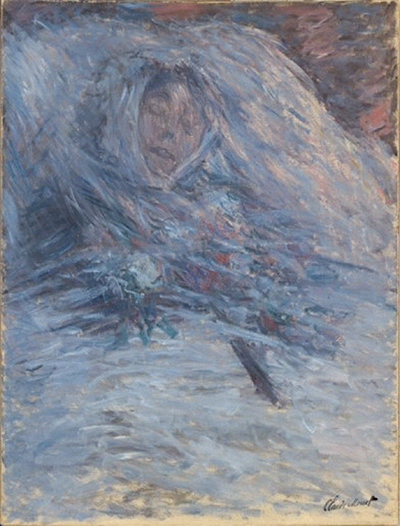
Camille Monet on Her Deathbed is a posthumous portrait of the artist's first wife, painted in 1879 and now held by the Musee d'Orsay. [1] [2] Her face emerges from a closely woven field of blue, grey, violet and pale pink. The picture combines an intensely personal subject with the painter's attention to changing colour and the visible marks of the brush.
At a Glance
- Artist Claude Monet
- French title Camille sur son lit de mort
- Date 1879
- Medium Oil on canvas
- Dimensions 90 x 68 cm
- Collection Musee d'Orsay
- Inventory RF 1963 3. [1]
A portrait made after Camille's death
Camille died on 5 September 1879, aged thirty-two. The National Gallery of Victoria's chronology explicitly identifies the painting as Monet's portrayal of his wife after her death. [2] The closed eyes and immobile face therefore do not depict a sitter resting or waiting for an approaching event.
The Rouen museums' account places the loss within a family with two children, Jean and Michel, and explains that the work remained with Monet. [3] Its subject belongs to the domestic circumstances of his biography , but the picture gives very little description of the surrounding room.
There is no group of mourners, elaborate bedside narrative or detailed interior. Monet brings the viewer close to the body and allows the face, coverings and strokes of colour to occupy almost the entire canvas. That restricted field is one reason the encounter can feel so immediate.
The face within the painted surface
Camille's head occupies the upper portion of the tall canvas. Dark touches identify the closed eyes, nose and mouth, but these features are not enclosed by a hard, continuous contour. Blue and grey strokes move across and around them.
The face remains recognisable even as it seems to merge with the surrounding fabric. This tension gives the portrait much of its force. We can locate an individual person, yet the ordinary separation between flesh, clothing and background has become unstable.
The lower half is more open and less immediately descriptive. Pale, broadly worked passages are interrupted by darker diagonals and scattered coloured touches. These marks draw the eye downwards before it returns to the more concentrated facial features.
The vertical format also limits our distance from the subject. Unlike a landscape with a horizon and successive planes, the picture offers little opportunity to look away into a larger setting. Its principal space is the shallow interval between the viewer and the reclining figure.
Blue-grey colour, warmer accents and the veil
The dominant colours are cool, but the picture is not simply a uniform blue image. Rose and violet appear around the head and across the coverings. Warmer reddish-brown passages near the top contrast with the paler areas below. Small yellow and cream touches interrupt the blue-grey field.
These differences are important to how the subject is seen. The face does not stand out through a dramatic spotlight. It becomes visible through the accumulation of relatively small changes in tone and colour.
The Rouen museums relate the transparent covering to a mourning custom involving a wife's wedding veil. [3] In visual terms, its translucent effect permits the face and the fabric to be read together rather than as completely separate surfaces. Flowers near the body add another element to the arrangement without becoming a richly detailed bouquet.
The image can suggest stillness, but the brushwork itself is active. Long and short strokes cross, overlap and change direction. The contrast between an unmoving subject and an animated surface prevents the painting from becoming a conventionally smooth or idealised memorial.
What Monet later told Clemenceau
A frequently repeated account comes from Georges Clemenceau's Claude Monet: Les Nympheas, published in 1928. Clemenceau presents a conversation in which Monet recalled finding himself almost automatically studying colour changes in the face of a dead woman he loved. The account mentions blue, yellow and grey, and describes the unsettling persistence of the painter's visual habits. [4]
This is a later, witness-reported recollection, not a letter written at Camille's bedside. The publication date does not establish the exact date of their conversation, and Clemenceau does not present himself as having witnessed the painting's creation.
Read with those distinctions in mind, the passage offers an important perspective. Personal attachment and professional habits of looking did not simply replace one another. Monet remembered their uncomfortable coexistence. It does not follow that he felt nothing, or that every visible stroke can be translated into a particular emotion.
The tradition of the last portrait
The Musee d'Orsay included the painting in Le dernier portrait in 2002. The exhibition examined images made after death, including paintings, drawings, photographs and death masks. Such objects often remained among relatives and friends, helping them preserve a final likeness and construct a memory of the deceased. [5]
That context makes the act of painting Camille less isolated than it can appear to a modern viewer. Monet did not invent the practice of recording a loved one's appearance after death. His work belongs to a larger history of mourning images.
Its distinctive quality lies in how it performs that task. Rather than offering a polished, sharply bounded likeness, it leaves a highly visible record of looking and painting. The face is preserved through a surface that continually reminds us of the difficulty of fixing its appearance.
Camille as model and individual
Camille appears throughout Monet's earlier figure paintings. The Stadel Museum's discussion of her role considers the variety of ways he represented her, from a prominently dressed model to a smaller figure in an outdoor setting. [6] The range is more revealing than reducing her to an anonymous source of colour.
Comparing this work with Woman in the Green Dress makes the difference especially clear. In one, the standing figure and costume assert their presence; in the other, the reclining face is partly absorbed into the surrounding brushwork.
The deathbed portrait cannot recover everything about Camille's life or her own understanding of the relationship. It is one representation made by her husband, not a complete account of the woman. Keeping that limit in view allows the picture's personal importance to be acknowledged without replacing her history with sentimental invention.
A private painting and its public history
The name at the lower right is a stamp, not Monet's painted autograph. The Orsay record identifies it as a cachet, and the Rouen account explains the use of such stamps by Michel Monet after his father's death. [1] [3]
The work passed through Michel's collection and that of Katia Granoff, whose 1963 gift brought it into the French national collections. It was assigned to the Musee d'Orsay in 1986. [1] Its later exhibition history has placed a private image before a much wider audience.
The Frick's study of Monet's Vetheuil paintings cautions against treating the appearance of his landscapes as a simple reflection of the hardships he experienced in 1879. [7] A similar caution is useful here. Bereavement is essential to the subject, but it does not explain every formal decision or provide a single key to all his later work. The painting remains both a memorial to Camille and a demanding example of Monet's technique .
Frequently Asked Questions
The museum chronology identifies it as a portrait made after her death in September 1879. [2]
The Musee d'Orsay, Paris, inventory RF 1963 3. [1]
Clemenceau reported Monet's later recollection in Claude Monet: Les Nympheas, published in 1928. [4]
Discussion
Look again at the images and ideas explored in Camille Monet on Her Deathbed. These editorial prompts invite your observations.
Reader Insights
How do the face and surrounding fabric remain distinct despite their overlapping colours?
What does the active brushwork add to an image of stillness?
How does knowing the history of posthumous portraits affect your response?
Join the Conversation
Share a detail, comparison or question about Camille Monet on Her Deathbed below.
References
- Musee d'Orsay , Camille sur son lit de mort, 1879, RF 1963 3, object record and provenance. View source .
- National Gallery of Victoria , Monet chronology, 1879, Camille's death and posthumous portrait. View source .
- Reunion des Musees Metropolitains Rouen Normandie , Camille sur son lit de mort, family, veil and stamp. View source .
- Georges Clemenceau , Claude Monet: Les Nympheas, 1928, chapter II, printed pages 19-20, original French text. View source .
- Musee d'Orsay , Le dernier portrait, 2002 exhibition, mourning and final likenesses. View source .
- Paula Schwerdtfeger , Camille. Camille., Stadel Museum, 2015, Monet's representations of Camille. View source .
- The Frick Collection , Claude Monet's Vetheuil in Summer, 1998 exhibition introduction, painting and personal circumstances. View source .







