


 by
Tom Gurney
Tom Gurney BSc (Hons) is an art history expert with over 20 years experience
Published on October 6, 2016 / Updated on October 23, 2026
Email:
tomgurney1@gmail.com
/ Phone:
+44 7429 011000
Self-Portrait with a Beret
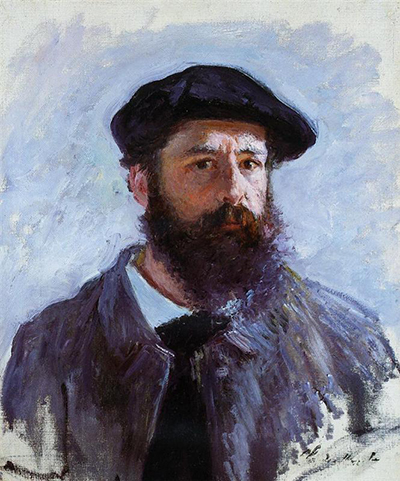
Claude Monet painted Self-Portrait with a Beret in 1886. This oil on canvas, recorded in a private collection, presents the artist at close range against a pale blue background. The Giverny museum's 2026 exhibition described the smock and beret as the appearance of a painter at work rather than a formally dressed public figure. The image is compact, concentrated and unusually direct. [1]
At a Glance
- Artist Claude Monet
- Date 1886
- Medium Oil on canvas
- Dimensions 56 x 46 cm
- Collection Private collection, as recorded in the Giverny museum's 2026 exhibition. [1]
- Subject The artist's own likeness
The face and the beret
Monet's head is turned a little, but the eyes look towards the viewer. That slight difference between the angle of the face and the direction of the gaze prevents the portrait from becoming a flat, symmetrical presentation. One side catches more light; the other recedes into warmer, deeper shadows.
The black beret forms a broad, irregular shape above the forehead. Its edge is not a smooth geometric outline. Small changes in the paint suggest folds and weight, while cooler touches keep the dark form from becoming a single blank patch. Below it, the brow, nose and cheek are described through adjoining areas of colour.
The beard provides another kind of surface. Brown passages mingle with cooler grey and blue strokes, so its fullness emerges from changes of direction and tone rather than from the careful description of every hair. The moustache covers much of the mouth, leaving the eyes especially important to the encounter.
A furrowed brow can suggest concentration, but it cannot tell us exactly what Monet was thinking. The picture presents an expression, not a transcription of his private thoughts. Its force comes from the relationship between a recognisable face and the visible means by which that face has been painted.
Working clothes and an uncluttered setting
The grey-violet smock spreads across the lower half of the canvas. A white collar and dark neckcloth separate the head from the clothing, making a small but important group of contrasting shapes beneath the beard. Long, slanting strokes suggest the garment's folds without giving every seam equal attention.
There is no elaborate studio setting. We do not see a finished landscape hanging behind him, an easel standing at his shoulder or an array of brushes offered as professional attributes. The beret, loose clothing and handling of the paint carry the suggestion of a working artist without those additional props.
The blue background also avoids the specificity of an identifiable room. Its broad strokes vary in direction and density; lighter areas remain around the head and shoulders. The figure seems both solidly present and surrounded by a surface still open to the movement of the brush.
These choices make the portrait intimate without making it informal in every respect. Monet has selected a pose, a crop and a costume. The image is an act of self-presentation as well as an observation of his appearance. What looks unceremonious has nonetheless been organised carefully.
A professional identity in 1886
The date places the portrait at a consequential moment in Monet's career . He had rented his home at Giverny in 1883, but his professional life was not confined to the village. The French Ministry of Culture's account of the last Impressionist exhibition describes a group whose members were pursuing increasingly different paths. Monet was not among the seventeen artists in that final group exhibition of 1886. He instead participated in Georges Petit's international exhibition. [2]
This does not mean that he had abandoned the pictorial interests associated with Impressionism. It shows that artistic identity and exhibition allegiance were not the same thing. An artist could retain a recognisable practice while seeking a different audience or a more advantageous setting for his work.
The Musee Rodin records that Monet and Renoir showed paintings at Petit in 1886 alongside Rodin's sculpture. Their shared exhibition world would develop further, culminating in the major Monet-Rodin presentation of 1889. This is useful context for the self-portrait's year, not evidence that the portrait itself hung in those exhibitions. [5]
Private likeness, widening audience
Paul Durand-Ruel's role also helps explain the professional setting. The Philadelphia Museum of Art's study of the dealer emphasises his promotion of individual artists through solo exhibitions, including Monet's 1883 retrospective and his later presentation of the Poplars. Such displays helped make an artist's distinctive development visible, rather than offering only one or two pictures within a large mixed exhibition. [3]
In 1886, Durand-Ruel's New York venture opened another important avenue. The Musee du Luxembourg describes the favourable reception and the need to move the exhibition into larger premises. American collecting did not transform every aspect of Monet's fortunes overnight, but it became an important part of the growing market for his paintings. [4]
The self-portrait belongs beside this changing public position without being reduced to a celebration of success. Its plain setting and working dress offer no obvious display of wealth. A viewer encounters the painter's attention and the substance of paint before any claim to social distinction.
Nor was the picture simply a product made for that new market. According to the Giverny museum's account, Monet did not sell it during his lifetime, and his son Michel subsequently kept it throughout his own life. The distinction between the market around an artist and the history of an individual canvas is essential here. [1]
Colour, likeness and visible brushwork
The face gains warmth partly through its contrast with the cooler background. Pink and ochre-coloured passages around the forehead and cheek stand against pale blues, while darker brown marks establish the eye sockets and beard. Colour describes form, but also makes the painted surface active.
Different areas receive different kinds of attention. The eyes need only small, decisive marks; the beard depends on a denser accumulation; the smock allows longer and more exposed strokes. The unfinished-looking margins around the clothing make those changes particularly easy to see. They do not by themselves establish whether Monet considered the picture complete.
It is therefore misleading to oppose Impressionist handling to accurate likeness as though the artist had to choose between them. The portrait depends on both. Its broad marks would carry little personal force without the particular face, and the likeness would have another character if every trace of the brush were suppressed.
What remains visible is a sequence of pictorial decisions. We can describe the contrast of warm and cool passages or the broken edges of a sleeve without pretending to know the exact pigment recipe, the order of every layer or the duration of a sitting. Those questions require evidence beyond appearance.
The later self-portrait
Monet returned to his own image in the distinct Portrait de l'artiste of 1917, now in the Musee d'Orsay collection. That canvas is larger, at 70.5 x 55 cm, and entered the French national collection through Georges Clemenceau's gift in 1927. Its record belongs to that later picture, not to the privately owned 1886 work. [6]
The comparison reminds us how much can change within the apparently simple format of a head and shoulders. A later image need not repeat the same relation between costume, background and facial modelling. Neither portrait should be treated as a timeless emblem detached from its own date and history.
Within Monet's portraits , Self-Portrait with a Beret is especially compelling because it brings the observer into the place normally occupied by the subject. The artist who spent so much time looking at landscapes and people makes himself available to the same scrutiny. The result is neither a complete autobiography nor a clinical account of his vision. It is a painted likeness whose immediacy rests on its selective, deliberate construction.
Frequently Asked Questions
In 1886. [1]
The Giverny museum's 2026 record identifies it as privately owned. [1]
56 cm high by 46 cm wide. [1]
No. The Orsay painting dates from 1917 and has a different collection history. [6]
Discussion
Look again at the images and ideas explored in Self-Portrait with a Beret. These editorial prompts invite your observations.
Reader Insights
How do the beret and loose smock shape your impression of the painter?
Which parts of the portrait seem most closely observed, and which most freely painted?
Does the plain background make the encounter feel more intimate or more formal?
Join the Conversation
Share a detail, comparison or question about Self-Portrait with a Beret below.
References
- Musee des impressionnismes Giverny , Monet in Giverny: Before the Water Lilies, 1883-1890, 2026 press pack, pp. 12 and 22. View source .
- French Ministry of Culture , 1886: Huitieme exposition. View source .
- Philadelphia Museum of Art , Discovering the Impressionists: Paul Durand-Ruel and the New Painting, 2015. View source .
- Musee du Luxembourg , Paul Durand-Ruel et l'impressionnisme: la consecration de l'intuition. View source .
- Musee Rodin , Claude Monet: Autour de la galerie Georges Petit. View source .
- Musee d'Orsay , Portrait de l'artiste, 1917, RF 2623. View source .







