


 by
Tom Gurney
Tom Gurney BSc (Hons) is an art history expert with over 20 years experience
Published on October 6, 2016 / Updated on October 23, 2026
Email:
tomgurney1@gmail.com
/ Phone:
+44 7429 011000
Chrysanthemums
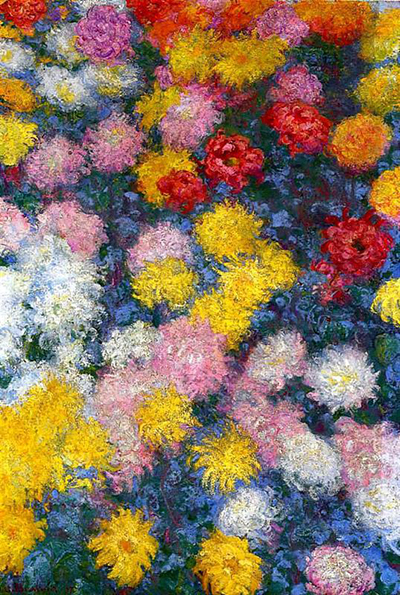
Claude Monet's Chrysanthemums fills a tall canvas with flowers and foliage, leaving no visible vase, tabletop or horizon. Dated 1897, this painting is catalogued as Wildenstein 1498 and measures 130.1 by 88.5 centimetres in its 2007 sale record. [1] Pink, white, yellow and red blossoms overlap across a blue-green ground, making the viewer attend to differences of colour and petal shape rather than a conventional room or garden view.
At a Glance
- Artist Claude Monet
- Date 1897
- Medium Oil on canvas
- Dimensions 130.1 x 88.5 cm
- Catalogue number Wildenstein 1498
- Collection posture Private collection in the 2007 sale record. [1]
Which Chrysanthemums is this?
Monet returned to chrysanthemums more than once, so the shared title can conceal important differences. The painting discussed here belongs to a group of four canvases dated 1897, numbered 1495-1498 in the Wildenstein catalogue. The catalogue records the group's appearance at Georges Petit's gallery in June 1898. [2]
Two of these compositions are horizontal and two vertical. Each offers a different arrangement of flowers rather than a second name for one object. The tall format of this example encourages the eye to travel up and down among the blossoms, without a strong horizontal line to establish a distant setting.
Dating the group also requires some care. The catalogue suggests autumn 1897 as a possible period of execution, but notes a letter showing Monet working on a flower painting in November 1896. [2] The signed date is secure; a precise account of every stage of work is less certain.
A field of flowers without a container
The image begins and ends within the flowers. Blooms are cut by the upper, lower and side edges, implying that the mass continues beyond what Monet has chosen to show. There is no border of bare earth, garden wall or path to contain them.
That cropping changes the viewer's relationship to the subject. Instead of standing back to inspect a bouquet as an object on a table, we encounter flowers at close range. Large white and pink heads occupy the left and lower parts, while sharper red and yellow accents punctuate the upper and right-hand areas.
The composition still contains depth. Some blossoms overlap their neighbours, and darker blue-green passages suggest foliage behind them. Yet those recesses do not open into a broad landscape. They remain small intervals between nearer forms. The picture holds the eye near its surface while allowing each flower enough rounded presence to remain recognisable.
Colour creates movement across the canvas
Yellow is especially active because it appears in several separated clusters. A bright group near the centre draws attention, but other yellow heads pull the eye towards the lower left and upper edge. No single bloom can retain attention for very long.
The reds work differently. They are more compact and concentrated, particularly on the right, where their warmer colour stands against the surrounding cooler foliage. Pale pink and white flowers create broader, softer passages between these stronger accents.
The blue-green ground is therefore not an empty background. It separates neighbouring heads, deepens the lighter petals and prevents the warmer colours from merging into one continuous band. Small openings of dark colour are as important to the rhythm as the flowers themselves.
These relationships make the painting varied without making it random. Repetition gives it coherence, while unequal intervals and changing flower sizes prevent the composition from becoming a mechanically repeated decorative pattern.
Petals and the visible work of the brush
The flowers do not all receive the same kind of mark. Some appear as rounded, tightly gathered heads; others spread out in finer, curling or spiky strokes. Monet's handling differentiates them without describing every petal with a hard outline.
The yellow blossoms are particularly useful to follow. Their long, radiating touches can remain visible as strokes of paint while also suggesting the flower's irregular fringe. In the paler blooms, small variations of pink, blue and cream prevent white from becoming a single flat area.
Looking closely and then stepping back produces two related experiences. At one distance, the broken marks are prominent. At another, those marks gather into clustered flowers and a dense bed of foliage. This is an example of Monet's technique making recognition depend on the interaction of touches, rather than on a complete preliminary outline of every form.
Hokusai and the appeal of close floral views
Monet's interest in Japanese prints offers a valuable context for these compositions. The Minneapolis Institute of Art brought the 1897 chrysanthemum group into conversation with Hokusai's Large Flowers prints in its 2025 exhibition. The museum emphasised their expressive use of space and the cultural connections between Japan and France. [3]
The comparison is more useful than a claim that Monet copied one print exactly. Flowers can fill a picture, approach its edges and become a pattern while retaining their individual shapes. Both a print and an oil painting can explore those possibilities through very different materials.
The relationship with Hokusai does not remove Monet's own observation or arrangement. It helps explain why a close floral subject could offer a serious compositional experiment, rather than merely a smaller alternative to landscape painting.
Caillebotte, gardening and remembrance
Another important comparison is Gustave Caillebotte's 1893 painting White and Yellow Chrysanthemums, Garden at Petit Gennevilliers, now in the Musee Marmottan Monet. The museum records that Martial Caillebotte gave it to Monet in 1894, after his brother Gustave's death. [4]
The gift connected a shared interest in gardening with a personal act of remembrance. Marmottan also notes that critics have interpreted Monet's later chrysanthemum panels as a tribute to his friend. [4] That remains an interpretation, not a statement of intention written on this canvas.
The connection enriches the painting without fixing a single emotional message. Its flowers can be exuberant in colour while also inviting thoughts about cultivation, friendship and loss. Nothing in the visible arrangement proves that Monet felt tranquil, sorrowful or reconciled with his life at the moment of painting. The evidence supports a meaningful artistic relationship, not access to his private thoughts.
An earlier bouquet is a different painting
The Metropolitan Museum of Art owns another Chrysanthemums, dated 1882, accession 29.100.106. That work presents flowers in a vase and belongs to Monet's earlier floral still lifes . Its appearances at Durand-Ruel in 1883 and with Les XX in Brussels in 1886 concern that separate canvas, not the 1897 painting here. [5]
The contrast makes the later experiment clearer. A vase gives flowers a visible base and separates the bouquet from its surroundings. In this canvas, those supporting objects disappear. The flowers occupy the whole field and do not depend on a tabletop to establish their position.
The 1897 work was shown at Georges Petit in 1898 as catalogue number 61. Durand-Ruel acquired it from Monet in March 1907. [1] This documented exhibition history places it within Monet's mature career, well before the final decades associated with his largest water-lily decorations.
Flowers and the decorative imagination
The Musee de l'Orangerie's presentation of Impressionist decoration treats close floral views as part of a wider exploration of framing, pattern and domestic space. It connects gardening and decoration with the later ambition of Monet's Water Lilies. [6]
That context helps explain the scale of the Chrysanthemums without requiring a specific commission or intended room. At more than a metre in height, the canvas can make a flower subject physically assertive. Its importance does not depend on turning the blossoms into symbols or treating them only as preparation for the pond paintings.
Within Monet's Giverny work , this is a concentrated encounter with abundance. The absence of a horizon gives the flowers unusual freedom, while the distribution of colour prevents that abundance from dissolving into an undifferentiated mass. The painting offers a sustained study of how individual blossoms can form a larger pictorial whole.
Frequently Asked Questions
It is signed and dated 1897 and catalogued as Wildenstein 1498. [1]
No. The Met owns a separate vase painting, accession 29.100.106. [5]
The 2007 sale record identifies a private collection. It does not establish current public display. [1]
Discussion
Look again at the images and ideas explored in Chrysanthemums. These editorial prompts invite your observations.
Reader Insights
Which colour first draws your eye, and where does it lead next?
How does the absence of a vase affect the way you see the flowers?
Do the individual blooms or the overall pattern seem more important?
Join the Conversation
Share a detail, comparison or question about Chrysanthemums below.
References
- Christie's , Chrysanthemes, Wildenstein 1498, 2007 sale record, details, provenance and exhibitions. View source .
- Daniel Wildenstein , Monet catalogue raisonne, volume III, printed pages 628-630, group 1495-1498, WPI digital edition. View source .
- Minneapolis Institute of Art , Notes on a Flower: Chrysanthemums in Japan and France, 2025, used with its Hokusai-Monet exhibition context. View source .
- Musee Marmottan Monet , Gustave Caillebotte, Chrysanthemes blancs et jaunes, Jardin du Petit Gennevilliers, inventory 5061. View source .
- The Metropolitan Museum of Art , Claude Monet, Chrysanthemums,1882,29.100.106, separate earlier painting. View source .
- Musee de l'Orangerie , Impressionist Decorations,2022, detailed presentation, Flowers and Gardens. View source .







