


 by
Tom Gurney
Tom Gurney BSc (Hons) is an art history expert with over 20 years experience
Published on February 28, 2016 / Updated on October 23, 2026
Email:
tomgurney1@gmail.com
/ Phone:
+44 7429 011000
Claude Monet Still Life Paintings
Claude Monet's still lifes bring his attention to colour and surface into an arranged setting. A basket, a cloth, cut flowers or fruit can offer as many differences of texture and reflected light as an outdoor view. These pictures also challenge an easy division between spontaneous landscape and deliberate studio work: one fruit painting preserves evidence of drawing and revision, while a bouquet begun in 1881 was revisited decades later. [1] [3] [6]
At a Glance
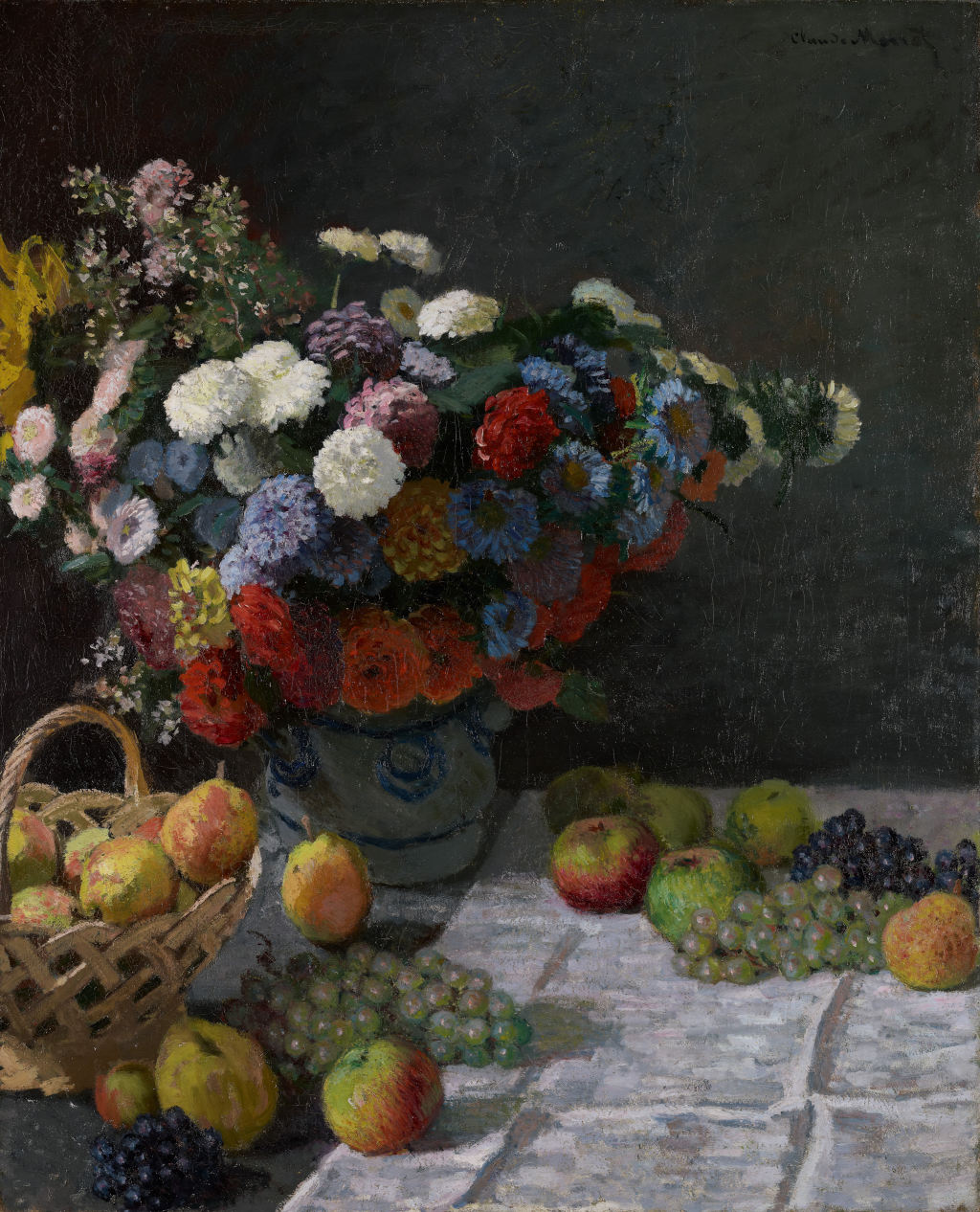
- Illustrated work Still Life with Flowers and Fruit, 1869; Getty Museum, 83.PA.215 [1]
- Fruit comparison Separate Apples and Grapes canvases in The Met and Art Institute of Chicago [2] [3]
- Floral example Bouquet of Sunflowers, 1881; The Met [4]
- Another flower subject Chrysanthemums, 1878; Musee d'Orsay [5]
- Extended working history The Courtauld's Vase of Flowers was begun in 1881 and reworked around 1920 [6]
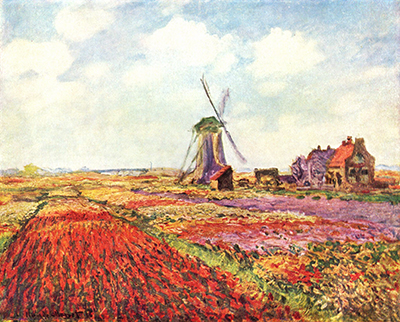
- Genre boundary An arranged bouquet is a still life; a field of growing tulips remains a landscape
An arranged subject, not a lesser artistic problem
Still life removes the need for a broad horizon or a moving crowd, but it does not remove the problems of painting. An apple must occupy space; a bunch of grapes must read as a cluster without every fruit being equally distinct; a flower has to emerge from colour and touch.
The objects also create relationships that can be adjusted. A vase may stand behind scattered fruit, a basket can introduce a diagonal, and the edge of a cloth can organise the foreground. The scene can look abundant or informal while remaining carefully composed.
A productive period of Monet's still-life painting came in the late 1870s and early 1880s. The Courtauld's collection catalogue notes that commercial considerations probably contributed to his attention to flower pictures, but treats that motive as a possibility rather than a complete explanation. [7]
The paintings deserve attention for their individual solutions, not only for the circumstances that made them saleable. They let Monet compare forms and surfaces at close range, with subjects whose relative position could be controlled more readily than a passing cloud or a moving boat.
Flowers and fruit in 1869: the studio learns from outdoor looking
The Getty's Still Life with Flowers and Fruit , dated 1869, is the work illustrated here. It was painted in the studio, while Monet's experiments around Bougival were also developing his outdoor practice. The museum connects the two through his handling of forms, colour and light. [1]
The bouquet rises from a patterned vase against a dark ground. Fruit spreads across the pale cloth below, with a basket entering from the left. The arrangement combines a strong vertical mass with smaller forms distributed across the table.
The Getty distinguishes broad, flatter strokes in the cloth from sketchier apples and dense touches in the petals. [1] The varied handling is important: different surfaces do not all require the same kind of mark.
The cloth gives the colours room to register. Red and green fruit, dark grapes and the more crowded bouquet are held against a broad light area. The painting moves between separate objects and a larger pattern of colour.
Its studio setting therefore does not separate it from Monet's interest in light . It offers another place to investigate how one colour changes in the company of another.
Apples and Grapes: a title shared by different canvases
The Met's Apples and Grapes , dated 1879-80, belongs to a group of tabletop arrangements made when bad weather kept Monet indoors. The museum cites a November 1879 observation by Marthe Hoschede that he was working on fruit pictures. [2]
The Art Institute of Chicago holds another Apples and Grapes , signed and dated 1880. The shared title should not conceal the fact that these are separate canvases with different dimensions and histories. [3]
Fruit lends itself to comparison because familiar shapes can remain recognisable through considerable variation in touch. A round apple can be built from changes of tone rather than a continuous outline; grapes can gather into a mass while highlights identify only some of their surfaces.
The table and cloth matter just as much. Their angle determines how the fruit seems to rest, spread or press towards the viewer. The basket introduces another texture, contrasting its constructed edges with the less regular forms it contains.
A still life may have a limited set of objects, but changing their arrangement can alter the whole experience of weight and space.
Technical study reveals preparation and revision
Chicago's scholarly examination of its fruit canvas found traces of charcoal drawing near parts of the table, basket and fruit. It also records a changed table edge and an apple added over the cloth. [3]
This evidence is a useful corrective to the idea that Monet never drew or always applied the whole picture immediately. A finding on one work cannot describe every painting, but it can disprove an absolute claim.
The catalogue contrasts the built-up paint of foreground fruit with thinner washes behind it. [3] That difference lets the objects gain presence without every part of the picture carrying the same material weight.
Such evidence also makes the apparently simple arrangement more interesting. The finished surface contains decisions about emphasis and placement that were not all settled at the beginning.
These are questions of technique as well as subject. The study of a fruit picture can reveal a working process just as complex as that of a large landscape, though the scale and visual demands are different.
Sunflowers: a garden subject brought into a vase
Monet's Bouquet of Sunflowers at The Met dates from 1881. The flowers grew beside the path to his garden at Vetheuil, and the canvas was shown at the 1882 Impressionist exhibition. The museum records contemporary praise for its energetic technique. [4]
A cut bouquet changes how a garden plant is encountered. Instead of being one element within a larger outdoor space, the flower heads occupy a concentrated arrangement in relation to their vessel and background.
Their variety can become a subject in itself: some heads face more directly towards the viewer, while others turn away or overlap. The stems and leaves join those directions into a larger mass.
The work also reminds us not to identify every sunflower painting with Van Gogh. The Met cites an 1888 letter in which Van Gogh discussed Gauguin's response to Monet's example. [4] That is evidence of an artistic conversation, not a reason to collapse the two artists' works into one story.
Monet's bouquet belongs to the specific flower painting of the early 1880s, with its own scale, handling and exhibition history.
Chrysanthemums and the importance of exact objects
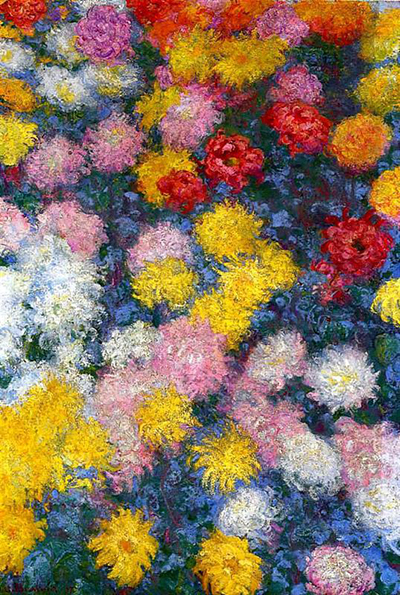
The Orsay's Chrysanthemums is dated 1878 and identified by inventory RF 1951 36. It entered Dr Paul Gachet's collection in December of that year and was later given to the French state by his son. [5]
A precise record matters because flower titles are easily repeated across works, artists and translations. The name of a plant alone does not establish the collection, date or appearance of a particular canvas.
It also keeps visual comparison honest. A flower's dense head, small petals and gathered leaves ask for different treatment from a smooth piece of fruit. Comparing a bouquet with a fruit arrangement can reveal how Monet varies the scale and direction of his touches.
The point is not to rank one subject above another. A pale bloom, a dark leaf and the interval of background between them each contribute to the painting's structure. Even a compact flower picture can offer several distinct kinds of painted surface.
Following exact museum records allows those differences to remain attached to the right work rather than to a generic category called Monet flowers.
A bouquet with an unusually long working history
The Courtauld's Vase of Flowers began in 1881, but Monet set it aside and returned to it around 1920. The gallery notes later paint applied over long-dried passages before the work was finally signed and sold. [6]
This is a particularly clear warning against treating a flower picture as the record of one short session. The subject may be perishable, while the painting can continue to develop long after the original flowers have gone.
The gallery identifies the bouquet as mallows and draws attention to the off-centre vase and high viewpoint. [6] Those choices unsettle the ordinary stability of a tabletop arrangement.
A later intervention does not make the earlier work irrelevant. It places different moments of judgment on one surface. The finished painting can contain both the initial arrangement and the artist's much later response to it.
The example broadens our view of Monet's practice without supplying another universal formula. Other bouquets have different histories; the value of this one lies in the evidence for its particular development.
Where still life ends and garden painting begins
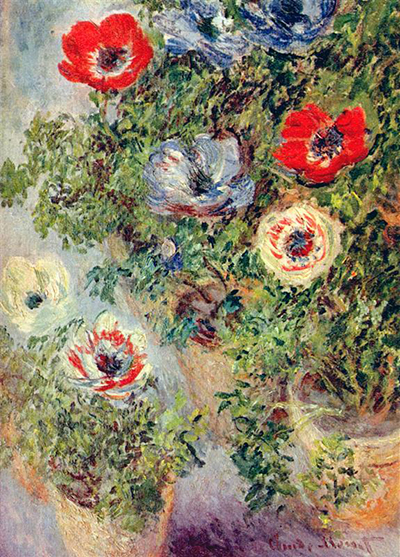
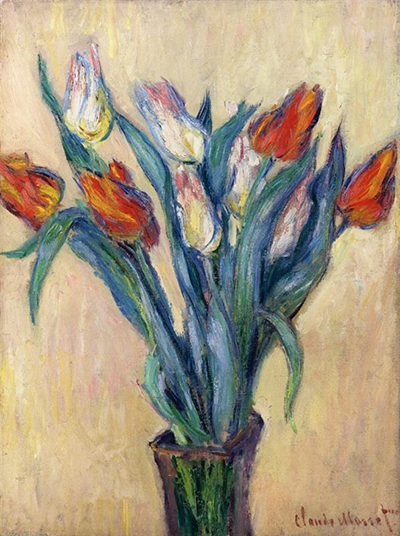
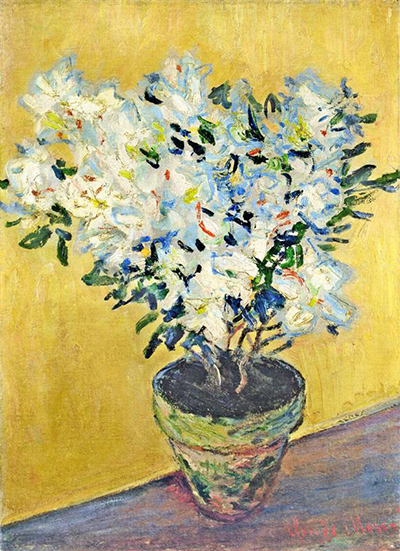
A vase of cut flowers and a field of growing flowers share colour and botanical subjects, but they organise space differently. The vase belongs to an arrangement of objects; the field extends into a landscape with its own ground, distances and horizon.
That is why a tulip-field painting should not be renamed a still life simply because flowers dominate it. Likewise, the Giverny pond and Water Lilies involve a cultivated environment, water and reflections, not a tabletop bouquet.
There are nevertheless useful comparisons to make. Dense flowers can produce patterns that compete with depth, and a carefully arranged still life can appear less stable than expected. Similar visual questions can occur in different genres without making those genres identical.
For close looking, begin with the container or support: a vase, basket, cloth or table. Then examine how the flowers and fruit exceed, obscure or depend on that structure. Finally, compare the varied handling of their surfaces.
Monet's still lifes repay this attention because they join material specificity with an active painted surface. Ordinary objects become opportunities for decisions about colour, placement, texture and the time spent looking.
Flower Paintings and Related Landscapes
Frequently Asked Questions
No. The Courtauld's Vase of Flowers was reworked decades after it was begun. [6]
It remains a landscape of growing plants, rather than an arranged bouquet or tabletop subject.
Discussion
Look again at the images and ideas explored in Claude Monet Still Life Paintings. These editorial prompts invite your observations.
Reader Insights
Compare the treatment of fruit, cloth and petals within one arrangement.
Consider what the basket or vase contributes to the composition.
Look at how a later revision changes the idea of a spontaneous flower painting.
Join the Conversation
Share a detail, comparison or question about Claude Monet Still Life Paintings below.
References
- J. Paul Getty Museum , Still Life with Flowers and Fruit, 1869, 83.PA.215; studio setting and varied handling. View source .
- The Metropolitan Museum of Art , Apples and Grapes, 1879-80, accession 57.183; indoor working context and related arrangements. View source .
- Art Institute of Chicago , Gloria Groom with Genevieve Westerby, Monet scholarly catalogue, Cat. 17, Apples and Grapes, 1880, accession 1933.1152; preparation and revision. View source .
- The Metropolitan Museum of Art , Bouquet of Sunflowers, 1881, accession 29.100.107; Vetheuil flowers, exhibition and later responses. View source .
- Musee d'Orsay , Chrysanthemums, 1878, RF 1951 36; exact object and provenance. View source .
- Courtauld Gallery , Vase of Flowers, begun 1881, P.1932.SC.275; later reworking and composition. View source .
- The Courtauld Collection , collection catalogue, Vase of Flowers entry; the sustained still-life activity of 1878-82 and possible market considerations. View source .







