


 by
Tom Gurney
Tom Gurney BSc (Hons) is an art history expert with over 20 years experience
Published on October 6, 2016 / Updated on October 23, 2026
Email:
tomgurney1@gmail.com
/ Phone:
+44 7429 011000
White Azaleas in a Pot
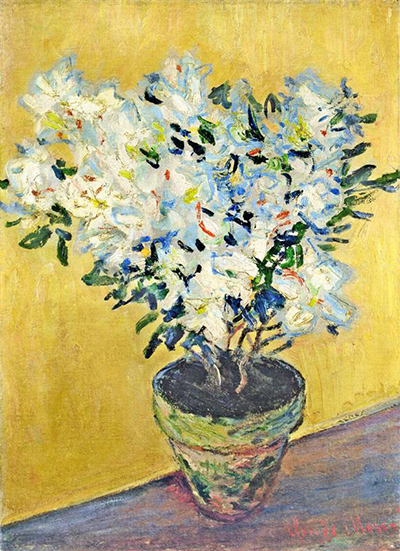
White Azaleas in a Pot shows a single flowering plant against a bright yellow ground. The composition is catalogued by Daniel Wildenstein as Pot d'azalees blanches, number 948, with a date of 1885. [1] The wide canopy of pale flowers and the smaller, dark-mouthed pot give this compact canvas a clear structure, while its decorative history connects it to Paul Durand-Ruel's Paris home.
At a Glance
- Artist Claude Monet
- Catalogue title Pot d'azalees blanches
- Date 1885 in Wildenstein's 1996 catalogue
- Medium Oil on canvas
- Dimensions 50.5 x 37 cm
- Catalogue number Wildenstein 948
- Collection Private collection in the historical catalogue. [1]
Which white-azalea painting is this?
Monet painted more than one white-azalea composition for the decorative project associated with Durand-Ruel. Similar English titles can obscure the differences. The present picture, number 948, has a single plant rising above a pot whose dark opening is clearly visible. A diagonal division separates the yellow background from the surface supporting it. [1]
Number 929, Azalees blanches en pot, is a separate work. Its composition includes an additional cluster of flowers at the lower left, and its pot and branches are arranged differently. [2] The 2006 Sotheby's sale record for that picture should not be mistaken for the ownership history of number 948. [3]
The distinction is valuable beyond catalogue administration. It shows Monet returning to a related subject while changing its balance and silhouette. A flower type and an approximate size do not make two canvases interchangeable.
A small canvas for a decorated interior
Durand-Ruel commissioned Monet to create decorative paintings for doors in his apartment at 35 rue de Rome, Paris. The project began in 1882 and continued over several years. The panels were canvases fitted into architectural spaces, not paintings applied directly to the wooden doors. [3]
Wildenstein reproduces number 948 with a historical photograph of a decorated door. The white-flowered plant appears in its lower row, beneath taller floral compositions. [1] Its compact format therefore had a particular role within a larger arrangement.
Seen in that setting, the broad crown of flowers supplies a dense patch of light colour, while the pot gives it a firm lower centre. Seen independently, the canvas remains coherent as a still life . Its original function and its individual composition can be considered together without reducing it to an architectural accessory.
A flowering crown above an open pot
The plant occupies most of the upper part of the image. Its branches spread outwards from a narrow central area, supporting a canopy much wider than the container beneath it. Some blooms approach the left edge, while a spray of dark leaves projects towards the right.
This asymmetry stops the arrangement from becoming a rigid triangle. The crown has gaps and uneven edges through which the yellow background remains visible. Those openings allow the separate branches and leaf clusters to register.
The pot has a strong oval mouth. Its dark interior provides an abrupt contrast with the pale flowers and the light surrounding ground. Curving trunks emerge from that opening and connect the container to the spreading plant above.
The pot is not merely a neutral support. Its green, reddish and yellow marks repeat colours scattered through the foliage and blossoms. It forms a smaller, denser counterpart to the larger mass above it.
Why the white flowers contain so much colour
The flowers read as white, but many of their edges and internal passages are blue. Cream, yellow and occasional red touches interrupt the pale petals. The strongest blue marks help define folds and separate neighbouring blossoms that might otherwise merge into one light area.
Dark green leaves provide another kind of separation. They are often more compact and sharply contrasted than the flowers. Their pointed shapes punctuate the softer, irregular outlines of the petals.
The yellow background changes the effect of those colours. It surrounds the cooler blues and makes the white areas seem brighter without requiring every flower to be painted in pure white. Small red accents introduce warmth within the plant itself, linking it to the surrounding colour.
The result depends on the relationship between the whole bouquet and the ground, as well as on individual blooms. Monet gives the eye enough distinct forms to recognise the azalea while allowing closely packed passages to combine at a distance.
The diagonal ledge and the upright format
Near the bottom, the supporting surface rises diagonally towards the right. This sloping boundary introduces a different direction from the mostly upright stems and the spreading branches. The pot seems securely placed even though the surrounding space is described with very few details.
There is no elaborate room, window or collection of household objects. The restricted setting keeps attention on the plant's silhouette and the contrast between yellow and blue-grey.
The upright canvas also permits the crown and pot to be read as one connected form. There is enough space beside the lower trunk for the background to show through, while the crowded flowers fill much of the area above. This alternation between open and dense passages gives the small picture a more varied rhythm than a uniformly filled floral pattern would provide.
Flowers, decoration and Durand-Ruel's collection
The Musee de l'Orangerie's exhibition Impressionist Decorations placed Monet's door panels within a wider practice of creating art for domestic interiors. Flowers were especially adaptable subjects, capable of bringing garden imagery into rooms and responding to unusual formats. [4]
The National Gallery's account of Inventing Impressionism explains that Durand-Ruel welcomed visitors to his apartment and used his personal collection to show paintings in a more intimate setting than a gallery. Its 2015 exhibition reconstructed one of the decorated doors. [5]
This history gives the azalea canvas a context that the title alone cannot supply. It was connected to a collector's interior and to the presentation of modern painting in daily life. Monet's Vase of Tulips offers another solution within the same broader commission, with long leaves and separate flower heads replacing the azalea's dense canopy.
Date, ownership and looking closely
Wildenstein's 1996 catalogue dates number 948 to 1885 and records Durand-Ruel's purchase from Monet in that year. It later places the work in a French private collection around 1959. [1] That historical entry does not establish a present owner or guarantee public access.
The date situates the painting well before Monet's final decades. Its colour should not be explained automatically through late-life visual difficulties, and its subject does not demonstrate a wish to inspire a younger generation. The commission supplies a documented purpose without requiring such a story.
Looking closely instead reveals a varied technique : longer marks in the branches, compact dark leaves, broken blue-white petals and broader strokes in the ground. Each contributes to a recognisable potted plant. The painting's interest lies in this particular coordination of colour and form, as well as in its place among Monet's decorative experiments.
Frequently Asked Questions
Wildenstein's 1996 catalogue dates number 948 to 1885. [1]
No. The decorative project used canvases fitted into doors. [3]
The historical catalogue records a private collection; current public display is not established here. [1]
Discussion
Look again at the images and ideas explored in White Azaleas in a Pot. These editorial prompts invite your observations.
Reader Insights
How does the dark pot opening balance the white flowers?
Which colours keep the pale blossoms distinct from one another?
How does the diagonal supporting surface affect the upright plant?
Join the Conversation
Share a detail, comparison or question about White Azaleas in a Pot below.
References
- Daniel Wildenstein , Monet catalogue raisonne, 1996, volume II, printed pages 352-353, number 948 and door photograph, WPI digital edition. View source .
- Daniel Wildenstein , Monet catalogue raisonne, volume II, printed page 347, number 929, different white-azalea composition. View source .
- Sotheby's , Azalees blanches en pot, 2006, lot 2, separate work number 929 and general account of the decorative commission. View source .
- Musee de l'Orangerie , Impressionist Decorations, 2022, Flowers and Gardens section. View source .
- National Gallery , London, Inventing Impressionism, 2015 exhibition announcement, Durand-Ruel's apartment and reconstructed door. View source .







