


 by
Tom Gurney
Tom Gurney BSc (Hons) is an art history expert with over 20 years experience
Published on October 6, 2016 / Updated on October 23, 2026
Email:
tomgurney1@gmail.com
/ Phone:
+44 7429 011000
Vase of Tulips
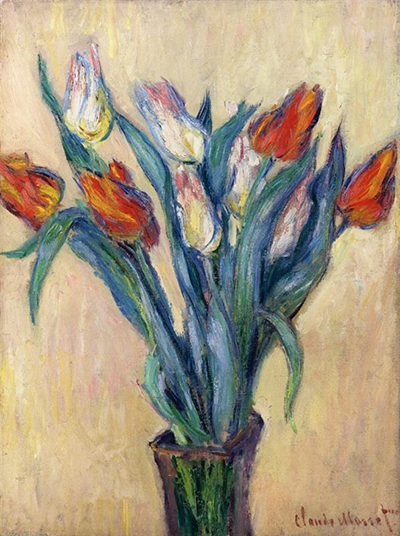
Vase of Tulips is a compact flower painting with an architectural history. Completed in 1885, Claude Monet's canvas belonged to the decorative scheme commissioned for the doors of Paul Durand-Ruel's Paris apartment. It is catalogued as Wildenstein 942. [1] [2] Red-orange and pale tulips rise from a dark vessel against a light ground, their long leaves helping to organise the narrow, upright composition.
At a Glance
- Artist Claude Monet
- Date 1885
- Medium Oil on canvas
- Dimensions 50.3 x 37.5 cm, 2006 sale record
- Catalogue number Wildenstein 942
- Original patron Paul Durand-Ruel
- Collection posture Private collection in the 2006 sale record. [1]
A painting made for a room
The commission began in 1882, when Durand-Ruel asked Monet for paintings to decorate the doors in his apartment at 35 rue de Rome, Paris. Sotheby's records this particular canvas among the works completed in 1885. Although described as panels, the paintings were made on canvas, allowing them to be moved rather than painted permanently onto the wooden doors. [1]
This setting changes how the subject can be understood. The vase is not simply an independent still life later chosen to fit an interior. Its shape, size and floral imagery belonged to a coordinated decorative project.
The Musee de l'Orangerie's account of Impressionist decoration places such door paintings within a wider interest in bringing flowers and gardens into domestic spaces. [3] Their purpose did not make them artistically insignificant. A restricted format could encourage inventive decisions about scale, cropping and the balance between a flower and its surrounding ground.
The vase and the rising fan of leaves
The vessel is placed low in the picture, its base continuing beyond the bottom edge. The visible rim gathers the stems into a narrow opening. Above it, the leaves spread in several directions, creating a much wider shape than the container beneath them.
This contrast gives the arrangement a clear upward movement. The eye can begin at the dark vase, follow the long greens and blues, and arrive at the separate flower heads. Some leaves curve outwards before turning back, while others stand more directly upright.
The flowers are not arranged as a perfectly symmetrical bunch. The red bloom at the far left bends towards the edge, while another red flower extends towards the right. Between them, paler heads rise at different heights. The unequal spacing gives the bouquet a lively outline without destroying the compact structure established by the vase.
Red, white and a light surrounding ground
The red-orange tulips provide the strongest warm accents. Their petals include darker red and cooler passages, so they do not become flat, uniformly coloured shapes. The paler flowers contain blue, mauve and yellow touches as well as cream or white.
Those differences help separate the blooms from the pale background. A white tulip could easily disappear against a light ground, but its darker edges and coloured interior keep it visible. The long leaves also provide a contrasting framework around the lighter petals.
The background is not entirely blank. Vertical strokes and small shifts of yellow, cream and pink give it a quiet activity. It remains less insistent than the bouquet, allowing the flowers to stand forward.
The result is a study of colour relationships, but not an abandonment of the subject. Leaves remain recognisable as leaves and tulips as tulips. Monet changes the degree of description from one passage to another while maintaining the coherence of the arrangement.
Brushwork fitted to different forms
Long strokes are especially prominent in the leaves. Their direction helps convey the length and flexibility of the plant, and their darker blue-green passages strengthen the bouquet's central structure. Shorter, more broken marks describe the petals.
The difference matters because the painting does not depend on a single signature stroke repeated everywhere. The vase needs weight, the leaves need continuity and the blossoms need enough variation to suggest folded or opening petals. Each receives a related but distinct treatment.
A close view reveals the marks of the brush, while a more distant view brings them together as a bunch of flowers. That relationship is more useful for understanding Monet's technique than an unsupported claim about a particular pigment or a predetermined order of paint layers. The visible surface tells us how the image is organised; laboratory findings would be needed to establish its complete material history.
Seeing it beside the other door paintings
Wildenstein's catalogue reproduces Vase of Tulips alongside another small tulip composition and a photograph of decorated doors. The neighbouring Three Pots of Tulips is a separate work, numbered 941, not an alternative title for this canvas. [2]
The historical photograph is a reminder that individual panels once participated in a larger arrangement. Flower paintings occupied different positions within the door's framework, and their proportions responded to those spaces. The White Azaleas in a Pot offers another example from the broader commission.
Seen alone, Vase of Tulips can be appreciated as a complete composition. Seen within the decorative project, its upright structure and simplified surroundings acquire an additional function. It could contribute colour and botanical variety to a room while remaining distinct from the neighbouring flowers. Neither way of looking cancels the other.
Durand-Ruel as patron and host
Durand-Ruel's home was also a place where visitors encountered his personal collection. The National Gallery's account of Inventing Impressionism explains that the apartment allowed him to present paintings in a domestic setting, different from the formal atmosphere of a gallery. A reconstructed decorated door formed part of the 2015 exhibition. [4]
That history gives the tulip panel a particular social context. It belonged to a room used for living, collecting and showing art, not simply to an anonymous wall.
Flavie Durand-Ruel's study of the dealer also places Monet's door still lifes among acts of support undertaken when business was difficult. [5] The commission joins artistic experimentation with the practical relationship between a painter and a committed buyer. It does not support a claim that Monet intended this particular bouquet as an inspirational message to younger artists.
A mature flower painting, not an old-age allegory
The 1885 date places the work in Monet's early Giverny years, well before the late period most closely associated with his largest water-lily decorations. Its lively handling does not need to be explained through failing eyesight, and the pale background does not establish a story of flowers struggling to survive.
Monet's later Chrysanthemums would fill the canvas with blossoms and foliage, dispensing with the visible container. The comparison shows how varied his floral still lifes could be. Here, the vase and the clear surrounding ground remain essential to the arrangement.
The sale record lists later appearances in still-life and Monet exhibitions, including Paris shows in 1908 and 1928. [1] Its exhibition history thus extends beyond its original interior. The painting retains both identities: a particular bouquet considered closely, and one component of a decorative project that brought Monet's flowers into everyday domestic space.
Frequently Asked Questions
No. It is oil on canvas, made for installation within the decorative scheme. [1]
Wildenstein 942. Other tulip compositions have separate numbers. [2]
The 2006 sale record identifies a private collection. Current public display is not established by that record. [1]
Discussion
Look again at the images and ideas explored in Vase of Tulips. These editorial prompts invite your observations.
Reader Insights
How does the low vase support the wider spread of flowers above it?
Which colour differences keep the pale tulips visible?
Does imagining the painting within a decorated door change your response to its format?
Join the Conversation
Share a detail, comparison or question about Vase of Tulips below.
References
- Sotheby's , Claude Monet, Vase de tulipes, 2006, lot 8, Wildenstein 942, object details, commission, provenance and exhibitions. View source .
- Daniel Wildenstein , Monet catalogue raisonne, volume II, printed 350-351, entry 942 and historical door photograph, WPI digital edition. View source .
- Musee de l'Orangerie , Impressionist Decorations, 2022, detailed presentation, Flowers and Gardens. View source .
- National Gallery , London, Inventing Impressionism, 2015 exhibition announcement, Durand-Ruel's apartment and reconstructed door. View source .
- Flavie Durand-Ruel , Paul Durand-Ruel: ami et marchand des artistes de son temps, Academie des beaux-arts, 2013 lecture, printed page 50. View source .







