


 by
Tom Gurney
Tom Gurney BSc (Hons) is an art history expert with over 20 years experience
Published on October 6, 2016 / Updated on October 23, 2026
Email:
tomgurney1@gmail.com
/ Phone:
+44 7429 011000
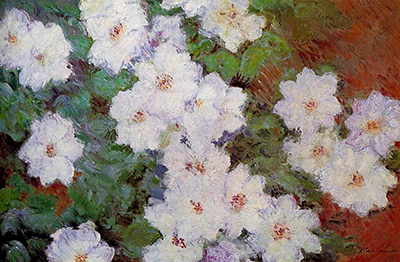
Clematis, 1887
Clematis surrounds the viewer with pale flowers. White and violet-tinged blooms spread across the wide canvas, leaving small openings into the surrounding leaves and warm background. The later catalogue dates this painting to 1887. [1]
At a Glance
Flowers without a distant landscape
There is no sky, horizon or garden path to establish an extensive setting. Monet brings the flowers close enough that they become the picture's principal structure. Several heads are cut by the edges, suggesting growth continuing beyond the frame.
This is not an arrangement of stems in a vase. The blooms belong to a mass of foliage, and their overlapping forms make it difficult to trace any one flower back to a separate stalk.
The largest pale groups occupy the middle and lower portions. Smaller openings between them reveal green leaves, darker shadows and passages of reddish brown. The eye moves across these interruptions rather than settling on a single central specimen.
The still-life overview considers other ways Monet made flowers a concentrated subject. Clematis retains a connection to growing plants while borrowing the close attention that can make a modest still life seem expansive.
White made from many relationships
The flowers initially read as white, but their surfaces are varied. Pale mauves and cooler bluish touches appear beside warmer cream and faint pink. Darker centres help the flower heads stand out without requiring continuous outlines around every petal.
Near the right side, the warm brown field makes the pale blooms especially conspicuous. Elsewhere, a flower lies against green foliage, producing a different contrast.
The same general colour can therefore behave differently in separate parts of the painting. One head seems cool and shadowed, another bright and open, even though both belong to the pale cluster.
Edges are also uneven. Some petals separate clearly from the background; others merge with neighbouring flowers or dissolve into short, broken marks. This alternation keeps the surface active.
The effect does not depend on identifying a precise pigment recipe. What is visible is an arrangement of contrasts: light against dark, cool against warm, and comparatively distinct forms against more ambiguous patches.
An early Giverny garden subject
The Musee des impressionnismes Giverny's 2026 chronology places Monet's first paintings of his own Giverny garden in summer 1887, when he selected peonies and clematis as motifs. He had moved to the property in 1883 and was still a tenant; he bought it in 1890. [4]
That sequence matters. The flower painting belongs to an early stage of his relationship with the place, not to the fully developed water garden familiar from later pictures.
The museum's account presents these years as a period of experimentation with the village and its surroundings. Fields, riverbanks and garden plants offered different possibilities, rather than forming a simple programme that was complete from the start. [4]
Clematis makes the narrowing of attention particularly clear. Instead of showing a property, a building or a broad stretch of countryside, it concentrates on the visual density of one flowering growth.
The Giverny garden article follows the longer development of the site. This canvas reveals how much Monet could find before the garden reached its later form.
Gardening and composition
The official history of the Clos Normand describes an initial orchard and vegetable garden that Monet gradually transformed. Planting, colour groupings and the arrangement of beds became part of his sustained work on the place. [6]
A garden gives a painter choices before the canvas is begun. Plants can be encouraged to climb, flowers can be grouped and colours can be brought into proximity. Painting then makes another selection through distance, framing and emphasis.
Clematis is especially selective. We do not see the full support on which the plant grows or a plan of its bed. A restricted area is allowed to fill the canvas.
The warm background remains visible in places, but it does not become an independent architectural subject. Its role is largely to hold and interrupt the flower pattern.
This exchange between cultivation and looking helps explain why the painting is more than a decorative record of an attractive plant. It transforms a fragment of the garden into a self-contained field of colour.
A different White Clematis
Monet also painted an upright White Clematis in 1887. The National Gallery of Victoria's exhibition list identifies that separate work as belonging to the Musee Marmottan Monet, inventory 5011, through Michel Monet's 1966 gift. [5]
The horizontal canvas discussed here should not inherit that museum credit. Sotheby's distinguishes it from the upright picture, identifying the two as different catalogue entries. [1]
The distinction is useful even when titles are translated or shortened. A flower name alone does not identify a unique painting, especially when an artist returned to the same subject.
Format also changes the viewing experience. This wide canvas lets the pale heads spread laterally, with groups distributed across the full width. Its cropped edges make the growth feel continuous rather than neatly contained.
The Painting Series guide explores repetition elsewhere in Monet's work. Here, related flower subjects need to be considered as individual arrangements, not interchangeable illustrations of a single title.
Changing titles and dates
The early catalogue history preserves some uncertainty. In William C. Seitz's 1960 exhibition catalogue, this picture appears as Flowers, catalogue number 44, lent by Edward Gilbert. The list dates it 1890, while an erratum suggests it might be as early as 1885. [2]
The original publication and MoMA archive also establish the exhibition year as 1960. A later record's reference to 1961 should not displace that contemporary evidence. [2] [3]
These differences do not mean that every date belongs to a different canvas. The lender, dimensions and catalogue references connect the records, while later research and cataloguing account for changing descriptions.
They do show why an old label should not be repeated without comparison. The later description records a stamped signature, not an artist-inscribed date. [1]
For this work, the earlier alternatives remain part of its documentation, rather than competing dates that can be silently combined.
From the studio to public comparison
The painting passed through the artist's estate and Michel Monet before later dealers and private collectors. The 2009 catalogue records a preceding London sale in 1998. [1]
Its inclusion in Seasons and Moments brought the flower subject into a broad exhibition of Monet's changing approaches to nature. MoMA records the New York presentation from March to May 1960. [3]
Looking at Clematis beside later Water Lilies paintings can reveal a meaningful resemblance: plants and colour occupy much of the picture, while conventional distance becomes less important. That is a comparison of visual effects, not proof that one canvas dictated the other works.
The flowers remain recognisable. Their individuality, however, is continually balanced against the larger pattern made by pale petals, dark centres, leaves and background.
Clematis rewards both ways of looking. It offers the closeness of particular blooms and the broader pleasure of a surface whose colours keep changing their relationships.
Frequently Asked Questions
No. Marmottan's upright White Clematis is a separate work, inventory 5011. [5]
Not by the cited 2009 private-collection record. [1]
Discussion
Look again at the images and ideas explored in Clematis, 1887. These editorial prompts invite your observations.
Reader Insights
Compare flowers against the warm background with those against green leaves.
Follow the cropped blooms around the edges of the canvas.
Consider the balance between recognisable petals and the overall colour pattern.
Join the Conversation
Share a detail, comparison or question about Clematis, 1887 below.
References
- Sotheby's , Claude Monet, Clematites, Impressionist and Modern Art Evening Sale, 2009, lot 44; exact image, dimensions, 1887 attribution and catalogue history. View source .
- William C. Seitz / Museum of Modern Art , Claude Monet: Seasons and Moments, 1960, catalogue 44, printed page 61 and errata; Flowers, Edward Gilbert collection and historical dating. View source .
- Museum of Modern Art , Claude Monet: Seasons and Moments, exhibition archive; 9 March to 15 May 1960. View source .
- Musee des impressionnismes Giverny , Avant les nympheas: Monet decouvre Giverny, 1883-1890, 2026 press dossier; curatorial account and chronology, especially printed pages 4-6 and 9-11. View source .
- National Gallery of Victoria , Monet's Garden, 2013, list of works; White Clematis, 1887, Musee Marmottan Monet, inventory 5011, a separate upright painting. View source .
- Maison et jardins de Claude Monet , Le Clos Normand; the development of the flower garden. View source .







