


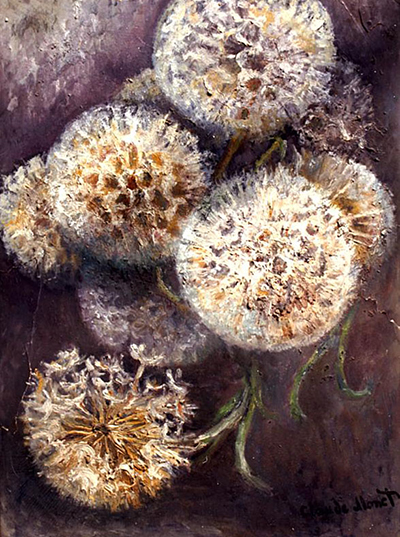
Dandelions, attributed to Claude Monet. Date and authorship remain unverified; see the attribution note below.
 by
Tom Gurney
Tom Gurney BSc (Hons) is an art history expert with over 20 years experience
Published on October 6, 2016 / Updated on October 23, 2026
Email:
tomgurney1@gmail.com
/ Phone:
+44 7429 011000
Dandelions (Attributed to Claude Monet)
Dandelions is a close-up flower painting circulated under Claude Monet's name. Four pale seed heads stand against a dark, purplish background, their delicate filaments contrasting with the heavier painted surface. Online listings commonly date it around 1900, but that date and the artist attribution should be treated as reported claims rather than settled facts. [1] The picture can be examined for its colour and composition while keeping the separate question of authorship open.
At a Glance
- Title Dandelions; also listed as Flowers
- Artist Attributed to Claude Monet; not independently established here
- Reported date Around 1900 / early twentieth century
- Reported medium Oil on cardboard
- Reported dimensions 79.3 x 58 cm
- Ownership Private ownership reported; current collection unverified
Looking at the four seed heads
The image is organised around four rounded heads at different heights. The highest is partly cut by the upper edge. Two larger, fuller forms occupy the middle, while the lowest appears more open and uneven. Their arrangement gives the narrow upright picture a staggered rhythm rather than the symmetry of a carefully balanced bouquet.
Green stems turn through the darker ground. The pale heads are not uniform white discs: cream, yellow-brown and grey marks interrupt their surfaces, leaving small darker intervals between the filaments. These broken edges make the plants seem fragile, although the individual touches of paint can look quite substantial.
The background offers little information about a room or landscape. There is no clearly described vase, table or horizon to establish where the plants stand. This concentration makes the contrast between the seed heads and their surroundings especially important. These observations describe what is visible in the reproduction. They cannot establish the original paint texture, its condition, the sequence of working, or the identity of the painter.
Dandelion clocks, not spores
The familiar white globe is a seed head, often called a dandelion clock. The Royal Horticultural Society distinguishes the yellow flower heads from the later silvery structures that carry seeds on the wind. Dandelions do not disperse spores in the way the older description of this painting suggested. [3]
That botanical distinction helps explain the picture's visual effect. A rounded head may look almost solid from a distance, yet its form depends on many fine, separated elements. The more irregular lower head invites comparison with the fuller forms above it. It can suggest dispersal and passing time, but that is a possible reading of the image, not evidence of an intention recorded by Monet.
What the published descriptions actually identify
DailyArt lists the work as oil on cardboard, measuring 79.3 by 58 centimetres, with a date around 1900. [1] An Arsani catalogue describes a work of the same title and dimensions as early twentieth century, noting a signature at the lower right and labels on the reverse. These are the auctioneer's descriptions, not findings from a museum examination made for this article. [2]
An inscription resembling an artist's name is a feature to investigate, not sufficient proof of authorship. A small reproduction cannot show whether it belongs to the original paint layer or was added later. Nor should the general label 'Impressionist' be used as an authentication test: a dark ground, broken marks or a flower subject could occur in pictures by different painters.
The reported Ilya Ehrenburg connection
The Arsani account links the picture to the writer Ilya Ehrenburg. It reports a label referring to his collection and a later gift in 1953. A label can be relevant evidence, but the reported wording does not by itself demonstrate when it was attached, who wrote it, or how the picture first entered that collection. [2]
Provenance means the history of an object's ownership and movement. Getty explains that researchers reconstruct it through sale catalogues, correspondence, inventories and physical marks, including labels. It also acknowledges that genuine objects can have gaps in their histories. [4] The useful distinction is therefore between an incomplete history and a false history. The first does not automatically prove the second. For Dandelions, independently traceable documents connecting the reported transfers would be more informative than repeating the ownership story without qualification.
Auction publicity and the six-million-dollar figure
A report published on 29 October 2011 announced a Kharkiv auction and, quoting the organisers, gave a starting price of six million US dollars for Dandelions. That is evidence of an advertised asking level, not a verified hammer price or completed transaction. [5]
DailyArt later describes a six-million-dollar sale to an undisclosed buyer. [1] The difference matters: an announcement before bidding and a documented sale result are different kinds of record. Without a reliable result confirming the transaction, the figure should not become an established sale price in the painting's history.
An April 2015 news item again advertised Dandelions in Kharkiv and repeated the organisers' statement that national examinations supported the attribution. The short report did not reproduce those examinations. [6] It records what was being claimed publicly, but does not allow a reader to assess the experts' methods or conclusions independently.
Why attribution needs more than resemblance
The National Gallery of Art uses 'attributed to' to signal uncertainty about a proposed artist. It distinguishes that phrase from more specific categories such as workshop, follower or circle. Those terms are not interchangeable. [7] Here, qualified wording records an unresolved Monet claim; it does not propose an alternative painter or assign the picture to a Monet workshop.
The College Art Association describes attribution practice as drawing together art-historical documentation, stylistic assessment and technical evidence. Its guidance also stresses the importance of examining the original object and being clear about the limits of an opinion based on photographs. [8]
For this picture, the underlying examination reports, their dates, the identification photographs and the basis of their conclusions would matter. A statement that reports exist is not equivalent to making their evidence available. Equally, the absence of an independently verified report here does not justify calling the painting a forgery. The article is an account of an unresolved attribution, not an authentication certificate or a rejection issued by a Monet specialist.
Dating the picture and the Giverny story
Monet's well-documented life at Giverny provides context, but cannot supply a date or location for every flower picture associated with his name. The Musee des impressionnismes Giverny's chronology places his arrival in 1883 and purchase of the house in 1890. [9] These were separate events.
The auction narrative confuses stages in that history. [2] Such an error is a reason to check its background carefully, not a scientific test of the painting. It also means that a confident account of Monet choosing these particular plants in his own garden would go beyond the evidence. No identified letter, dated study or verified contemporary record presented here connects this image to a particular sitting at Giverny.
A useful comparison with established flower paintings
Monet's accepted still lifes offer a firmer starting point for studying his treatment of flowers. The Metropolitan Museum of Art identifies Bouquet of Sunflowers as an oil on canvas of 1881, object 29.100.107. Its account connects the flowers to his garden at Vetheuil and records the painting's appearance in the 1882 Impressionist exhibition. [10]
That comparison is valuable because the museum record supplies a specific object, date and exhibition context. It should not be used to transfer the Sunflowers painting's documentation to Dandelions. Similar subject matter does not make two objects equally well documented.
The visual questions are still worth asking. Does the painter group flowers into one dense mass or isolate separate heads? How do light marks meet the darker ground? What does the surrounding space contribute? The technique guide explores such questions across established Monet works without assuming one fixed formula for his entire career.
What could clarify the attribution
The Wildenstein Plattner Institute maintains Monet research resources and a revised catalogue project. Its current online introduction states that the digital catalogue focuses on pastels. [11] Dandelions is reported as an oil painting, so failure to find it in that pastel resource would not demonstrate that it had been rejected from Monet's painted oeuvre.
A stronger assessment would connect the exact object to published scholarship, inspectable provenance and appropriate technical examination. Until then, the most informative approach is to preserve the attribution warning, identify who made each claim, and separate the image's observable qualities from an artist biography. Readers can appreciate the fragile shapes and unusual colour relationships without being asked to accept an authorship that the available evidence has not settled.
Frequently Asked Questions
This article does not establish that. It discusses an attribution reported in auction and online records, with the limitations stated prominently.
A contemporary report gives that figure as the starting price. A verified completed sale at that amount has not been established here. [5]
No. An unresolved attribution is not a finding of forgery.
Discussion
Look again at the images and ideas explored in Dandelions (Attributed to Claude Monet). These editorial prompts invite your observations.
Reader Insights
How do the fuller seed heads compare with the more open lower form?
What evidence would help distinguish an auction description from an independently supported attribution?
How does the dark background affect the apparent delicacy of the seed heads?
Join the Conversation
Share a detail, comparison or question about Dandelions (Attributed to Claude Monet) below.
References
- DailyArt , Dandelions, published listing and reported date, medium and ownership. View source .
- Arsani , auction catalogue, lot 18, printed pages 32-33; auctioneer attribution and provenance claims, not independently established here. View source .
- Royal Horticultural Society , Dandelion, flower and seed-head identification. View source .
- J. Paul Getty Museum , Research on Museum Collection Provenance, methods and gaps in ownership histories. View source .
- Kharkiv News Online , 29 October 2011, auction announcement reporting the starting price and organiser claims, in Russian. View source .
- Glavnoe , 23 April 2015, exhibition and auction announcement reporting organiser claims, in Russian. View source .
- National Gallery of Art , Notes to the User, attribution terminology; general method, not a ruling on Dandelions. View source .
- College Art Association , Authentications and Attributions, scholarly and technical evidence; general guidance, not an assessment of this painting. View source .
- Musee des impressionnismes Giverny , Avant les nympheas: Monet decouvre Giverny, 1883-1890, 2026 institutional chronology. View source .
- Metropolitan Museum of Art , Bouquet of Sunflowers, 1881, 29.100.107, comparison only. View source .
- Wildenstein Plattner Institute , Claude Monet research resources and scope of the digital pastel catalogue; not an attribution decision on Dandelions. View source .







