


 by
Tom Gurney
Tom Gurney BSc (Hons) is an art history expert with over 20 years experience
Published on October 6, 2016 / Updated on October 23, 2026
Email:
tomgurney1@gmail.com
/ Phone:
+44 7429 011000
Still Life with Anemones
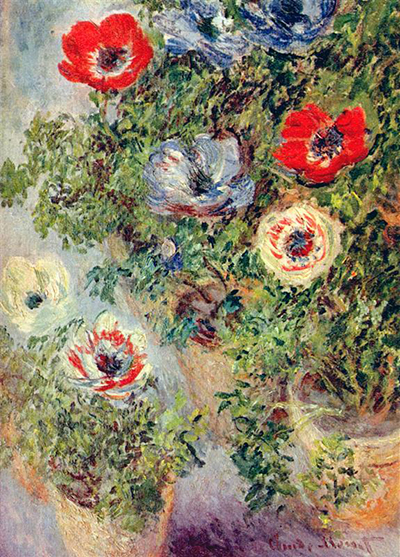
Still Life with Anemones, also recorded as Anemones in a Pot, is a small vertical oil painting by Claude Monet. Dated 1885 and catalogued as W930, it belonged to the decorative ensemble made for the Paris apartment of his dealer Paul Durand-Ruel. Its close-packed flowers have a lively, almost overflowing presence, but they also formed part of a carefully planned interior. [1] [2]
At a Glance
- Artist Claude Monet
- Date 1885
- Medium Oil on canvas
- Dimensions 48.9 x 35.6 cm, in the cited auction record
- Catalogue Wildenstein 930
- Original setting Lower right of Door B in the Durand-Ruel decorative ensemble. [1]
Flowers brought close
Two bright red blooms establish the strongest accents in the upper part of the painting. One faces us near the left edge; another opens towards the right. Their dark centres interrupt the red with small, tightly concentrated areas of contrast. Around them, blue and pale flowers make the colour arrangement more varied than a simple opposition of red and green.
A cool flower near the centre-left is built from curved, separate strokes. Farther down, cream petals carry red streaks towards a darker centre. These paler blooms answer the stronger flowers above without repeating their shape exactly. Some turn outwards, while others seem partly concealed among leaves and stems.
The cropping matters. Flowers at the top are cut by the edge, and foliage presses against the sides. There is little empty space in which to set the arrangement at a comfortable distance. Instead, the viewer encounters a dense piece of growing life, with individual blooms emerging from a restless, interwoven mass.
That proximity is different from a botanical illustration. The flowers remain recognisable, but each petal is not separately described. Their changing orientation and the varying weight of the brushmarks are more important to the composition than a complete inventory of plant parts.
Pots, ground and uncertain depth
At first, the flowers can obscure the objects supporting them. Looking lower down reveals warm terracotta containers, partly screened by trailing greenery. Christie's describes four pots within the composition. Their curved forms and earthy colour give the arrangement a material base even where their outlines are difficult to follow. [1]
The background is much less definite. A pale grey-blue area remains visible at the left, while lavender and violet passages occupy the lower field. There is no prominently drawn table edge dividing a tabletop from a wall. Pots, leaves and background meet through changes of colour and stroke rather than through a rigid framework of lines.
This makes depth feel compressed, but not absent. One flower overlaps another; leaves cross the rims; a pot recedes behind the foliage. The eye moves through a shallow succession of forms without finding the broad spatial opening familiar from Monet's landscapes.
The lower violet also balances the cooler notes near the top. It prevents the red flowers from dominating every part of the picture and helps draw attention back through the greenery. The humble containers thus participate in a larger colour structure, rather than serving merely as accessories to the blossoms.
Colour and the touch of the brush
The leaves are not rendered as one continuous green surface. Yellow-green, darker green, brown and blue touches break it into shifting patches. Against this busy network, the relatively broad red petals gain clarity. Their force depends partly on the difference between their concentrated colour and the more fragmented surroundings.
The pale flowers receive another treatment. Short red, blue and grey marks separate the light passages, allowing the eye to assemble a bloom from discontinuous strokes. Close inspection reveals paint marks; at a greater distance, those marks cohere into flowers, stems and foliage.
This is a useful example of broken colour, but it does not prove that Monet never mixed his paints. Nor can a reproduction establish the order in which every layer was applied. What is visible is the contrast between sharply asserted accents and more loosely connected passages.
The flowers seem animated because their shapes turn in different directions and the marks change pace across the surface. There is no need to imagine a documented gust of wind. The movement belongs first to the painting: a sequence of bright centres, curling contours and trailing stems that keeps the eye in motion.
A painting made for a door
The catalogue raisonne traces the Durand-Ruel project to a commission in May 1882. It developed over several years as Monet worked on flowers and fruit for the dealer's apartment at 35 rue de Rome. After moving to Giverny , he continued the project alongside the establishment of his garden. Larger panels were delivered by the end of 1883, with further work following in 1884 and 1885. [2]
The historical reconstruction places this anemone canvas in the lower-right compartment of Door B. [1] Seen alone, it can appear to be an independent study of potted flowers. In the door arrangement, its proportions and concentration of colour also answered neighbouring panels.
That setting introduces another scale of viewing. A visitor could examine the flowers closely, but could also perceive the doors as part of a furnished room. The canvas had to work as a small image and as one element in a decorative ensemble. Its abundance was therefore not simply uncontrolled growth transferred to paint.
The dealer's home and Monet's still lifes
Durand-Ruel's apartment was both a family home and a place where visitors could see his personal collection. The Musee du Luxembourg's account of the dealer explains how this domestic display complemented his gallery activity. Monet's floral decorations belonged to an environment in which modern painting could be experienced as part of everyday surroundings, rather than only on a temporary exhibition wall. [3]
The commission also had precedents within Monet's work. The Metropolitan Museum of Art identifies a substantial group of floral still lifes from 1878 to 1883, including paintings that achieved critical and commercial recognition. Its Chrysanthemums of 1882 is a separate canvas, not this anemone panel, but it demonstrates that flowers were already an ambitious subject for him. [4]
LACMA's discussion of Asters likewise connects still-life painting with professional choices and the market for Monet's work, not just with days when bad weather prevented outdoor painting. [5] The anemones belong within that broader activity. Their decorative purpose does not reduce them to a minor diversion from landscape: they test how colour, texture and shallow space can organise an entire image.
What the records establish
The published sale history begins with Durand-Ruel's acquisition from Monet in 1885. It subsequently names Mrs J. Lefebure in Paris, Susan Seidel in New York and the collectors who acquired the painting around 1997 before its later auction appearance. Those historical records should not be mistaken for a verified present-day museum location. [1]
The catalogue number is especially helpful because Monet painted other anemone subjects in different formats. A small horizontal flower panel and a wider still life cannot be substituted for this tall arrangement merely because their titles sound similar. W930 identifies the work whose pots and blooms fill this particular narrow canvas.
Its interest lies in that specificity. The red flowers supply immediate brilliance, but the close view also rewards attention to the quieter relationships below: violet ground, ochre containers and trailing foliage. Together they turn a compact decorative painting into a sustained study of crowded colour and living form.
Frequently Asked Questions
The cited record dates W930 to 1885. [1]
It is an oil painting on canvas, although it was installed within a door ensemble. [1]
Discussion
Look again at the images and ideas explored in Still Life with Anemones. These editorial prompts invite your observations.
Reader Insights
Which flowers remain distinct when you look at the painting from a distance?
How do the pots and violet ground affect the brighter upper blooms?
Does knowing the original door setting change your understanding of the composition?
Join the Conversation
Share a detail, comparison or question about Still Life with Anemones below.
References
- Christie's , Claude Monet, Anemones en pot, W930: object details, provenance and decorative setting. View source .
- Daniel Wildenstein , Monet: Catalogue raisonne, 1996, volume II, W930 and the Durand-Ruel door panels, pp. 343-349, Wildenstein Plattner Institute digital edition. View source .
- Musee du Luxembourg , Paul Durand-Ruel: Le pari de l'impressionnisme, 2014-2015 exhibition guide, Chez Monsieur Paul Durand-Ruel. View source .
- The Metropolitan Museum of Art , Claude Monet, Chrysanthemums, 1882, object 29.100.106. View source .
- Los Angeles County Museum of Art , Claude Monet, Asters, 1880, curatorial notes. View source .







