


 by
Tom Gurney
Tom Gurney BSc (Hons) is an art history expert with over 20 years experience
Published on October 6, 2016 / Updated on October 23, 2026
Email:
tomgurney1@gmail.com
/ Phone:
+44 7429 011000
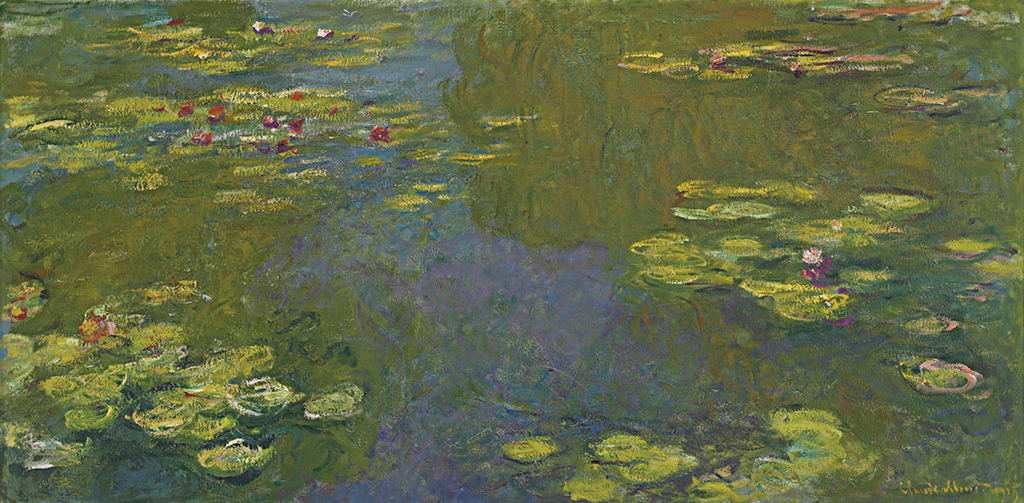
Le Bassin aux Nympheas, 1919
Le Bassin aux Nympheas means The Water-Lily Pond. This article concerns the signed 1919 canvas catalogued as W.1890, measuring 100.4 by 201 centimetres and documented in the Miller estate sale of 2008. Its identity is distinct from the many other paintings bearing similar titles. [1]
At a Glance
A channel of reflected blue
A winding blue-violet area opens through the green near the centre. It might initially resemble a path, but there is no solid walkway: it belongs to the water and its reflections.
Its edges are irregular. Floating pads enter from both sides, while darker strokes suggest reflected growth extending into the open colour.
The shape does not recede like a straight road with a fixed destination. It broadens, narrows and turns, offering a route for the eye rather than a route through the garden.
This distinction is important to the painting's space. We can recognise a pond without being able to measure how far away each passage lies.
The Painting Water article explores how reflections complicate a landscape view. Here the central opening makes that complication visible: what seems deepest can also be read as colour lying across the same surface as the lily pads.
Green is not a single colour
Much of the canvas is green, but that description can conceal its variety. Yellow-green rims catch light around some pads; elsewhere the colour darkens towards olive or shifts into blue.
The upper middle contains downward marks that differ from the flatter, broader forms of the leaves. Together they suggest the coexistence of reflected vegetation and floating plants.
In the lower left, larger pads create a crowded mass. Smaller groups on the right balance that weight without forming a symmetrical pattern.
Pink, red and pale flower accents interrupt these fields. Their brightness depends partly on the quieter tones around them, and they never become a continuous floral border.
The painting therefore rewards a second look after its subject has been recognised. First one sees water lilies; then one notices that each group is made differently, with changing degrees of definition.
The visible marks can be energetic without being a simple record of emotion. Their directions and relationships organise the picture, whether or not a viewer experiences the result as tranquil.
A particular choice in 1919
In August 1919 Monet told the Bernheim-Jeune dealers about a new group of landscapes, while setting the large decorations aside until winter. Charles Stuckey's chronology records the subsequent purchase of four approximately one-by-two-metre Water Lilies canvases that autumn. [3]
The Met's acquisition bulletin relates the same correspondence to work that offered a change from the demands of the decorative project. [4] The distinction is useful without turning the paintings into casual diversions. They were substantial works, pursued seriously.
The Met's own Water Lilies of 1919 is a separate member of the quartet, with its own dimensions and collection history. [2]
For W.1890, the signature and date belong to a canvas that Monet allowed into circulation. That provides a firmer historical point than a general claim that every late pond painting stayed in the studio.
The Painting Series guide explains why repetition should be understood through particular groups and decisions, rather than one undifferentiated total.
Observation and the demands of scale
At approximately two metres wide, the canvas is large enough to establish a broad field of vision, yet smaller than the monumental panels of the decorations. Scale affects how its scattered forms are read.
From a distance, the plant groups and central blue opening form a relatively clear arrangement. Close to the surface, the smaller strokes and overlapping colours become more insistent.
The late project involved both outdoor observation and studio revision. Temkin and Lawrence describe Monet moving between these settings and reworking large paintings over extended periods. [6]
The National Gallery's technical account of other late canvases also describes the specially equipped Giverny studio, with roof lighting and supports suited to enormous painted surfaces. [5]
Those sources establish a demanding working environment, not a universal method for every canvas. They do not prove that W.1890 was made in one sitting, nor supply a laboratory analysis of its pigments. The Technique article separates such evidence from what can be inferred by looking.
The pond as a cultivated subject
Monet's pond was an environment he had helped construct. In 1893 he acquired additional land and diverted the Ru, a branch of the Epte, to create the water garden. Planting and maintenance sustained the setting. [7]
This background gives the painted abundance a different meaning from untouched wilderness. Observation began with a place shaped by choices about water, plants and their arrangement.
The canvas then makes further choices. It leaves out the house, bridge and most of the banks. No figure tells us how high we stand or which direction we face.
The Giverny garden can be described as a physical place, but the painting is not a complete plan of it. Its crop concentrates attention on relationships between floating forms and reflected growth.
The central blue is consequently not an escape from nature into an unrelated design. It is part of the visual uncertainty that water itself can produce, selected and organised within a painted rectangle.
A sale history rather than a museum identity
The documented provenance traces W.1890 from Bernheim-Jeune through Durand-Ruel-related ownership and later American collections, including Norton Simon and the Miller family. [1]
Those names help identify this particular canvas; they should not be borrowed for another Water-Lily Pond because the title matches.
A private painting can have a substantial public record through exhibitions, published catalogues and sales. That does not make it a permanent museum exhibit, nor establish its present location.
The distinction also changes the questions one can answer. Date, dimensions, catalogue number and documented past ownership can be stated confidently. A current display promise cannot be made from a historical auction record.
The Reception article considers the wider circulation of Monet's work. This canvas shows why an account of artistic development and an account of collecting need to be related without being confused.
Related to, but not part of, the Orangerie installation
Monet's donation to France developed from the offer made after the Armistice in November 1918. The eventual Orangerie installation opened in 1927, after his death, and comprises eight compositions arranged in two elliptical rooms. [8]
W.1890 belongs to the same late investigation of the pond, but it is not one of those installed panels. Its sale and subsequent ownership form a different history.
The comparison nevertheless clarifies the picture's ambition. A view without a conventional horizon can suggest a space extending beyond the canvas, while the wide format encourages the eye to move laterally.
One need not claim that this painting was a miniature model of the final rooms, or that its exact arrangement was transferred intact to a mural. The relation is a shared investigation of water, reflected light and the viewer's shifting attention.
The Water Lilies overview provides the broader framework without dissolving the individual paintings into a single work.
Recognisable nature and an unstable view
The lilies remain identifiable, and the colours can be read as a pond reflecting its surroundings. Yet the picture withholds the stable landmarks that would turn it into an easily navigated landscape.
Its width encourages a scan from one cluster to the next. Its central opening then draws attention back towards the middle, where floating forms and reflections meet.
That movement is not resolved by deciding that the work is either realistic or abstract. The interest lies in how recognisable leaves can also become broad colour shapes, and how open water can seem both shallow and deep.
W.1890 gives those questions a specific form. The concentrated plant masses, interrupted blue channel and small bright flowers make a painting that can be recognised quickly, but not exhausted by that first recognition.
Frequently Asked Questions
The signed 1919 canvas catalogued as W.1890, documented in the 2008 Miller estate sale. [1]
No. The Met canvas is a distinct painting, accession 1998.325.2. [2]
No. It is part of the painted water and reflected space.
Discussion
Look again at the images and ideas explored in Le Bassin aux Nympheas, 1919. These editorial prompts invite your observations.
Reader Insights
Follow the changing width and edges of the central blue-violet passage.
Compare the larger lower-left lily pads with the smaller groups on the right.
Consider how a familiar pond becomes difficult to measure without a horizon or visible bank.
Join the Conversation
Share a detail, comparison or question about Le Bassin aux Nympheas, 1919 below.
References
- Christie's , Le Bassin aux nympheas, 1919, W.1890, Miller estate, London, 24 June 2008, lot 16; exact object record and provenance. View source .
- The Met , Water Lilies, 1919, 1998.325.2; a distinct member of the quartet sold to Bernheim-Jeune. View source .
- Charles F. Stuckey / Art Institute of Chicago , Monet chronology, page 250; August and autumn 1919 working and sale context. View source .
- The Metropolitan Museum of Art Bulletin , Recent Acquisitions, 1998-1999, volume 57, number 2, page 60; Monet's 1919 correspondence and the related Met canvas. View source .
- Ashok Roy , Monet's Palette in the Twentieth Century: Water-Lilies and Irises, National Gallery Technical Bulletin 28, 2007, pages 58-60; comparative studio and material context. View source .
- Ann Temkin and Nora Lawrence, MoMA , Claude Monet: Water Lilies, 2009, pages 5-7; observation and studio revision. View source .
- Maison et jardins de Claude Monet , Water lily pond; the cultivated setting. View source .
- Musee de l'Orangerie , The Water Lilies by Claude Monet; the separate donation and installation. View source .







