


 by
Tom Gurney
Tom Gurney BSc (Hons) is an art history expert with over 20 years experience
Published on October 6, 2016 / Updated on October 23, 2026
Email:
tomgurney1@gmail.com
/ Phone:
+44 7429 011000
Water-Lilies with Reflections of Green Grasses
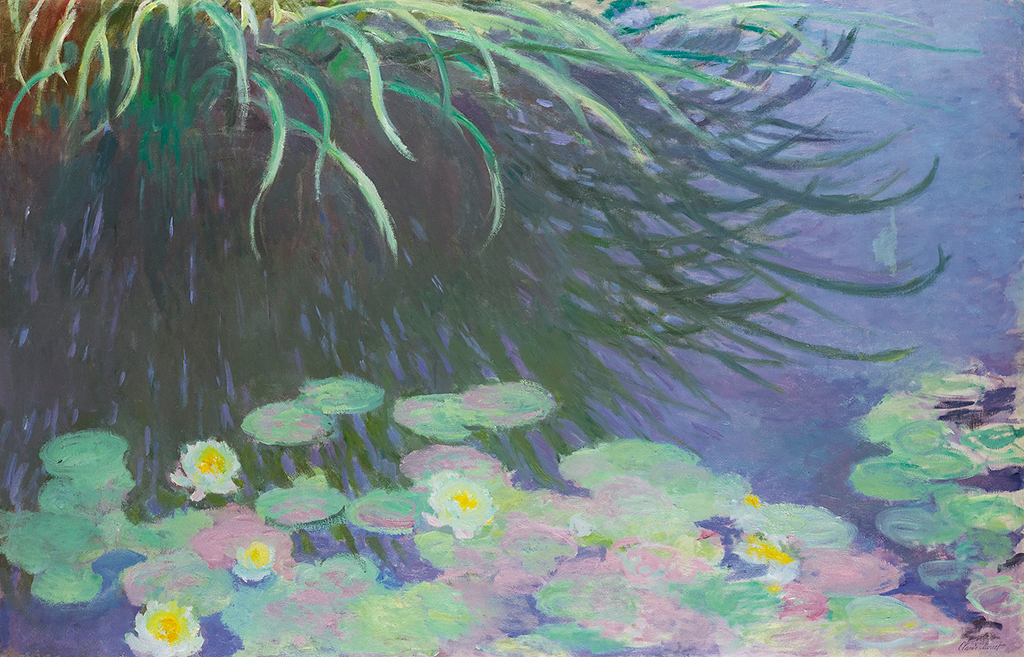
Water-Lilies with Reflections of Green Grasses is also known as Nympheas avec reflets de hautes herbes, or Water Lilies, Reflections of Tall Grasses. Recent museum exhibitions date this large canvas to 1897, rather than the 1914-17 range familiar from older cataloguing. The Musee des impressionnismes Giverny's illustrated 2025 record identifies the painting with the Nahmad Collection. Its sweeping grasses and pale floating flowers make it an important example of Monet's early experiments with the pond as a pictorial world. [1]
At a Glance
Why the date matters
The change in dating alters the painting's position in Monet's work . Sotheby's 2013 catalogue placed it in 1914-17, among the large water-garden paintings of his later career. By the Kimbell Art Museum's 2019 exhibition, however, curator George Shackelford was discussing it as a work probably made in 1896 or 1897, belonging to the first group devoted to the pond's surface. The Giverny museum used 1897 in 2025. [1] [2] [3]
That earlier placement is especially striking because of the picture's scale. At two metres wide, it does not look like a modest preliminary encounter with a newly discovered subject. Its expansiveness suggests that the pond offered possibilities beyond a conventional small landscape from an early stage.
The older date remains part of the painting's publication history, but it no longer provides a sound basis for explaining every feature as a consequence of Monet's final years. In particular, the loose handling and violet-green colour relationships should not automatically be attributed to wartime circumstances or deteriorating eyesight. The more useful question is how the picture participates in a developing idea of decorative painting.
Grasses above a floating field of lilies
Long, narrow leaves enter from the upper left and sweep across the top of the canvas. Some are pale and strongly lit; others merge with darker green curves. Below them, the water carries descending marks and lengthened reflections. These two directions, the bending leaves and the falling strokes beneath them, generate much of the picture's movement.
The lower area is organised differently. Rounded lily pads gather into overlapping clusters, with mint green, lilac and pink spreading across their broad surfaces. Small flowers rise out of the clusters, their yellow centres surrounded by pale petals. Their concentrated brightness interrupts the softer passage from one leaf to another.
The contrast is both botanical and pictorial: narrow ribbons against flattened discs, dark passages against luminous patches, descending lines against forms that seem to spread sideways. The viewer can recognise plants, yet also follow an arrangement of curves and colour without needing to identify every species.
An open stretch of blue-violet water towards the upper right prevents the painting from becoming uniformly crowded. The eye moves away from the densely layered pads into this quieter area, then returns along the arcs of the grasses. That circulation makes the broad rectangle feel active even though the pond itself appears still.
Reflection is not the same as shadow
The Kimbell's commentary draws attention to the unusually glassy water and the way it mirrors the curving leaves. Its reading depends on the relationship between vegetation and its reflected image, rather than on a dramatic disturbance of the surface. The water is an active part of the composition precisely because it can seem almost motionless. [3]
A cast shadow and a reflection describe different effects. The dark forms here should not all be treated as the silhouettes of grasses blocking sunlight. Some repeat or extend shapes above the water; others combine with passages of reflected light and colour. Monet makes their boundaries difficult to isolate.
Nor does the image offer a complete map of the bank. Much of the vegetation enters from beyond the frame, and there is no continuous horizon separating land from sky. A viewer senses a nearby edge through the hanging leaves, but cannot securely reconstruct an exact position in the garden from that clue alone. The close framing gives enough information to suggest a place while withholding the wider view.
A garden made for sustained looking
The water garden was a constructed environment, not a pond Monet simply happened to find beside his house. In 1893 he acquired additional ground and sought permission to create a basin supplied from a branch of the Epte. The Musee des impressionnismes Giverny describes his planting of coloured water lilies obtained from the Latour-Marliac nursery. A further enlargement followed in 1901. [5]
The revised 1897 dating places this painting before that later expansion. It belongs to a moment when the relatively young garden was already generating ambitious pictures. Gardening and painting were connected activities: the arrangement of water and planting created opportunities for repeated observation, while each composition selected only a fragment of that environment. [5]
Here, the selection excludes the path around the pond, the house and any human figure. The garden's organisation remains important, but it is encountered indirectly through the meeting of leaves, water and reflections. The result is neither a planting diagram nor a general view of Giverny . It is a deliberately restricted field of attention.
An early decorative ambition
The 2023 Monet en pleine lumiere exhibition at the Grimaldi Forum gave the painting a particularly significant role. Its account related the canvas to Monet's early idea, described in 1897, for water paintings arranged around a circular room. The exhibition presented it as a surviving prototype associated with that lost early decorative ensemble. This is a curatorial interpretation of its place in the project, not a claim that the canvas forms part of the installation now at the Orangerie. [4]
The distinction matters. A prototype can explore the scale, cropping and visual continuity of an idea without being physically incorporated into its eventual realisation. Here, forms cut by the edges imply that the pond continues beyond the rectangle. The painting can be read as one portion of a much larger watery environment.
The Orangerie's history traces the decorative conception from the late 1890s to the renewed large project of 1914 and the eventual installation in 1927. Its account also distinguishes views that retain the pond's edge from compositions occupied almost entirely by water, flowers and reflected surroundings. The grasses canvas sits productively between these modes: vegetation gives a sense of proximity, while the absence of a horizon loosens ordinary landscape space. [6]
Ownership, exhibitions and the limits of the record
The 2013 auction catalogue traced the work from Monet to his son Michel, then to Katia Granoff in the 1950s and subsequently to the consigning owners. It also recorded a Claude Monet stamp at the lower right. A stamped name should not be described as proof that the artist personally signed or stamped the finished canvas. [2]
The painting was listed in the 2011 Wadsworth Atheneum exhibition Monet's Water Lilies: An Artist's Obsession. The museum's account describes a show bringing together public and private loans to explore the range of Monet's approaches, supplemented by photographs of the garden. It was an exhibition loan, not evidence that the Wadsworth owned this particular canvas. [2] [7]
The more recent Nahmad exhibition record supplies a secure modern collection reference. It does not imply that the work is permanently available in a public gallery. [1] Its continuing interest lies less in a sale price than in the questions it raises about painting water , the beginning of the Water Lilies cycle, and the emergence of a decorative idea whose history extends over decades.
Frequently Asked Questions
It measures 130 cm high by 200 cm wide and is painted in oil on canvas. [1]
No. The Grimaldi Forum related it to an early decorative project, not to the physical panels installed at the Orangerie. [4]
The Giverny museum's 2025 exhibition material identifies it with the Nahmad Collection. [1]
Discussion
Look again at the images and ideas explored in Water-Lilies with Reflections of Green Grasses. These editorial prompts invite your observations.
Reader Insights
How do the sweeping grasses and rounded lily pads create different kinds of movement?
What changes when this canvas is understood as an early experiment rather than a late painting?
Does the absence of a horizon make the pond feel deeper or flatter?
Join the Conversation
Share a detail, comparison or question about Water-Lilies with Reflections of Green Grasses below.
References
- Musee des impressionnismes Giverny , La Collection Nahmad: De Monet a Picasso, 2025 press dossier, pp. 4 and 25. View source .
- Sotheby's , Nympheas avec reflets de hautes herbes, Impressionist and Modern Art Evening Sale, London, 5 February 2013, lot 20. View source .
- Kimbell Art Museum , Monet: The Late Years, 2019 audio-guide transcript, stop 501, commentary by George Shackelford. View source .
- Grimaldi Forum Monaco , Monet en pleine lumiere, 2023 press dossier, p. 18. View source .
- Musee des impressionnismes Giverny , Le jardin de Monet a Giverny. View source .
- Musee de l'Orangerie , History of the Water Lilies cycle. View source .
- Wadsworth Atheneum Museum of Art , Monet's Water Lilies: An Artist's Obsession, 2011. View source .







