


 by
Tom Gurney
Tom Gurney BSc (Hons) is an art history expert with over 20 years experience
Published on October 6, 2016 / Updated on October 23, 2026
Email:
tomgurney1@gmail.com
/ Phone:
+44 7429 011000
The Water-Lily Pond, 1917-1919
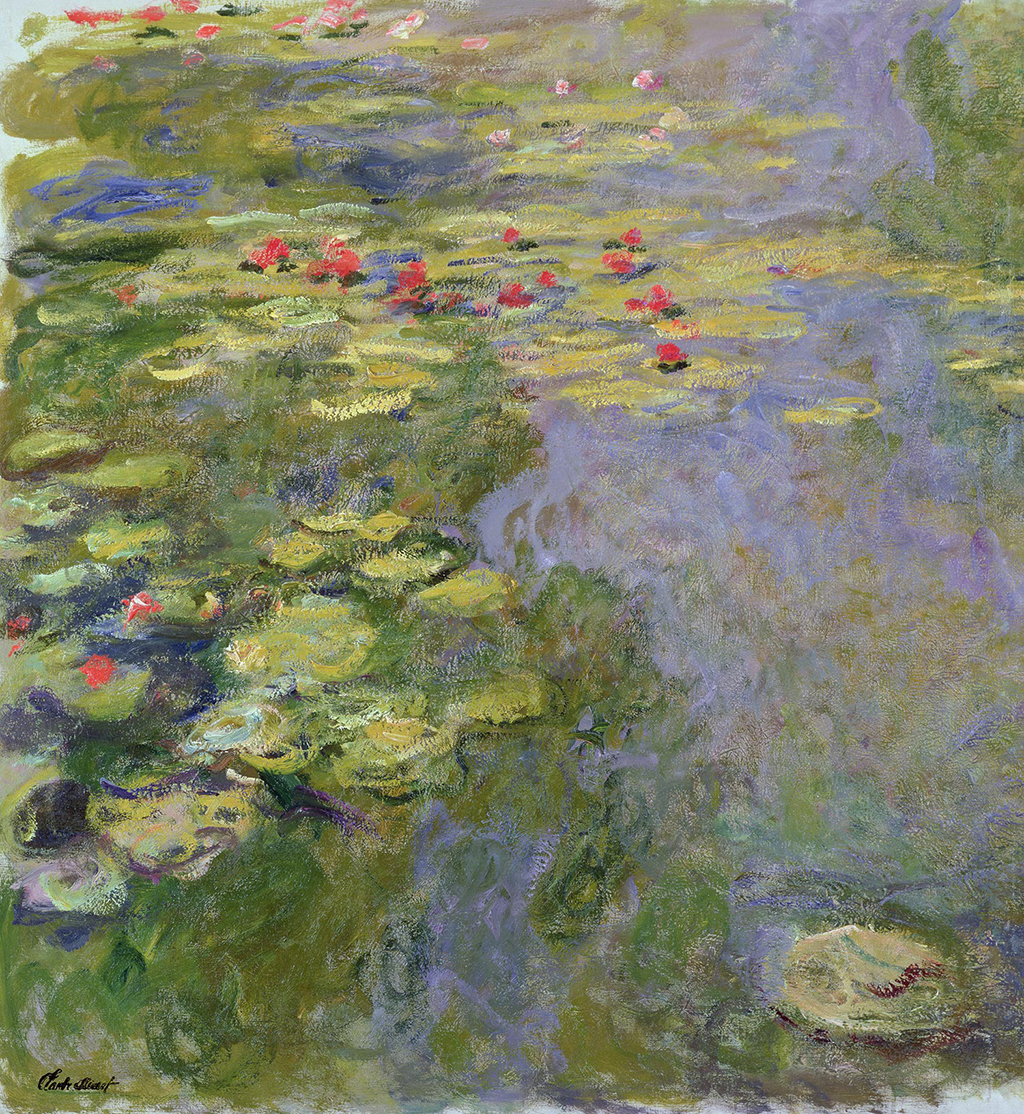
The Water-Lily Pond in the Musee Marmottan Monet is a surviving fragment, not a complete vertical composition. Dated 1917-1919, it is inventory 5165. Its missing right-hand portion is essential to understanding the view we see today. [1]
At a Glance
A fragment of a wider pond
The museum relates the canvas's loss to damage from shell fragments during the Second World War. About eighty centimetres disappeared from the right-hand side. An old photograph and a related Swiss picture help recover the original arrangement. [1]
This changes how we read the present edges. The lily pad near the lower right can seem like an isolated final accent. It once belonged to a wider movement that continued beyond the surviving canvas.
A painting's format is usually part of its composition, but here it also records later history. The compact rectangle remains visually compelling without representing all of Monet's original design.
Two unequal fields of colour
The left half is crowded with floating leaves, while a more open purple-blue field occupies much of the right. Their meeting is irregular rather than a straight division.
Green forms push into the cooler area at several levels. In response, patches of blue and violet interrupt the green, so neither field reads as a solid, unbroken block.
This makes the painting more complex than an arrangement of flowers against a background. The apparent background has its own brushwork, changes of tone and suggestions of reflected growth.
A narrow dark passage near the lower centre helps make the nearby pads seem brighter. Elsewhere, yellow-green marks catch the eye without defining a clear boundary between one leaf and the next.
The Painting Water article explores the difference between a water surface and reflected space. In this fragment, the two are hard to hold apart for long: the eye recognises floating plants, then slips into the coloured depths between them.
Red blossoms and an isolated pad
The small red flower marks are especially noticeable because much of their surroundings belongs to cooler or more muted colour families. Their effect depends as much on separation and contrast as on size.
A loose sequence crosses the upper part of the canvas. Some touches gather together; others stand apart, allowing the green and purple to remain visible between them.
The large pad low on the right behaves differently. Its broad, pale surface attracts attention without matching the intensity of the red accents. A few darker marks give it weight while leaving its outline broken.
These differences create several speeds of looking. The bright flowers register quickly, the leaf masses take longer to distinguish, and the open water invites the eye to wander.
The fragment has no people, boat or bridge to establish a narrative. Its events are changes in colour, direction and density. The subject is still recognisable, but recognition does not bring the act of looking to an end.
From a garden view to a painted field
No horizon divides land from sky, and no bank gives us a firm foothold. The picture excludes much of the information that would normally locate a landscape viewer.
This was a cultivated pond, not an untouched wilderness. Monet had acquired the water-garden land in 1893, arranged its water supply and planting, and employed sustained maintenance. [6]
Yet a painting need not describe every feature of the place that produced it. By concentrating on a section of water, Monet could make a familiar garden difficult to measure or navigate.
The Giverny garden provides the physical setting. The canvas transforms it into relationships whose scale is less certain: a patch of reflected foliage can compete with a cluster of leaves, although they occupy different kinds of space.
The Water Lilies overview follows that sustained investigation. This example is particularly instructive because its later loss makes us aware of both the represented pond and the physical limits of the surviving painting.
Related canvases and changing scale
The Art Institute of Chicago's scholarly catalogue places its own late Water Lily Pond within a campaign of nineteen canvases. Their original formats were horizontal, either about 130 by 200 or 100 by 200 centimetres. [3]
The catalogue relates that group to Monet's development of the much larger decorations. It is useful context for understanding how an apparently small section of pond could become a substantial painted environment.
It is not permission to transfer every technical finding from Chicago's canvas to the Marmottan fragment. The works have different material histories.
Nor should every late Water Lilies title be treated as the name of one interchangeable picture. Dimensions, collection identifiers and the visible arrangement of plants and reflections are all necessary to distinguish them.
The Painting Series guide considers this relationship between a repeated subject and individual decisions. Repetition offered a framework for experiment, not a requirement to produce identical results.
A studio practice, not a fixed recipe
The broken, energetic marks can suggest speed, but appearance alone cannot tell us how long a canvas took to make. Ann Temkin and Nora Lawrence describe a late practice involving outdoor observation, studio work and repeated revision over extended periods. [5]
The result need not preserve a single instant untouched. Different passages can carry different kinds of attention, from broad sweeps to smaller accents.
Ashok Roy's technical study of other late Monet paintings also describes the large Giverny studio, its controlled roof lighting and the equipment needed to manage expansive canvases. [4]
His discussion shows why the palette should not be reduced to one simple list or a universal sequence of layers. Historical accounts and scientific examination answer related but different questions.
For this fragment, a reproduction lets us examine colour relationships and visible marks. It does not identify a pigment, prove an underlying sketch or explain the palette solely through Monet's eyesight. The Technique article keeps those distinctions in view.
Works retained and works sold
This painting remained within the family before entering the museum through Michel Monet's 1966 bequest. [1] The Marmottan collection as a whole preserves a major body of the artist's studio work, including late garden canvases. [2]
Retention should not be turned into a claim that Monet refused to sell every recent pond painting. The Met's separate Water Lilies of 1919 belonged to a quartet purchased by the Bernheim brothers. [7]
The contrast is revealing. Paintings of related subjects could be destined for sale, retained for further consideration or associated with the decorative project. Their subsequent histories were not uniform.
The Reception article considers how audiences and institutions encountered Monet's work. For this object, the family-to-museum history matters alongside the visible evidence of physical loss, without reducing the canvas to either a market story or a biographical illustration.
Looking at what survives
The fragment can be enjoyed as a concentrated meeting of greens, violets and red accents, but the knowledge of its wider origin prevents an important misunderstanding. Its present boundaries are not simply a final compositional choice by the artist.
At the same time, awareness of loss need not turn every mark into evidence of damage. The remaining surface still offers a rich range of painted forms and movements.
One can begin with the large pad at the lower right, follow the more crowded leaves towards the left, and then look back through the open violet area. Each route brings a different balance of floating surface and reflected depth into focus.
The work is therefore both an image of water and an object with a history. Reading those two together gives a fuller account than treating it as a generic example of loose Impressionist brushwork.
Frequently Asked Questions
The Marmottan Museum's surviving fragment, inventory 5165, dated 1917-1919. [1]
No. Part of the canvas's right side was lost after wartime damage. [1]
No. That is a distinct canvas with a different collection history. [7]
No. Late pond paintings could involve prolonged studio revision. [5]
Discussion
Look again at the images and ideas explored in The Water-Lily Pond, 1917-1919. These editorial prompts invite your observations.
Reader Insights
Compare the dense green forms on the left with the open violet passages on the right.
Follow the red flower marks and then the large pale pad near the lower edge.
Consider how knowing that the canvas is a fragment changes your reading of its boundaries.
Join the Conversation
Share a detail, comparison or question about The Water-Lily Pond, 1917-1919 below.
References
- Musee Marmottan Monet , Le Bassin aux nympheas, 1917-1919, inventory 5165; identity, wartime loss and provenance. View source .
- Musee Marmottan Monet , Claude Monet collection; Michel Monet's bequest and the studio holdings. View source .
- Art Institute of Chicago , Monet Paintings and Drawings, catalogue 47, Water Lily Pond; related campaign and original formats. View source .
- Ashok Roy , Monet's Palette in the Twentieth Century: Water-Lilies and Irises, National Gallery Technical Bulletin 28, 2007, especially pages 58-60; comparative material and studio context. View source .
- Ann Temkin and Nora Lawrence, MoMA , Claude Monet: Water Lilies, 2009, pages 5-7 and 14-17; late working practice and reception. View source .
- Maison et jardins de Claude Monet , Water lily pond; cultivated setting and maintenance. View source .
- The Met , Water Lilies, 1919, 1998.325.2; a distinct work made for sale. View source .







