


 by
Tom Gurney
Tom Gurney BSc (Hons) is an art history expert with over 20 years experience
Published on October 6, 2016 / Updated on October 23, 2026
Email:
tomgurney1@gmail.com
/ Phone:
+44 7429 011000
The Water Lily Pond in the Evening
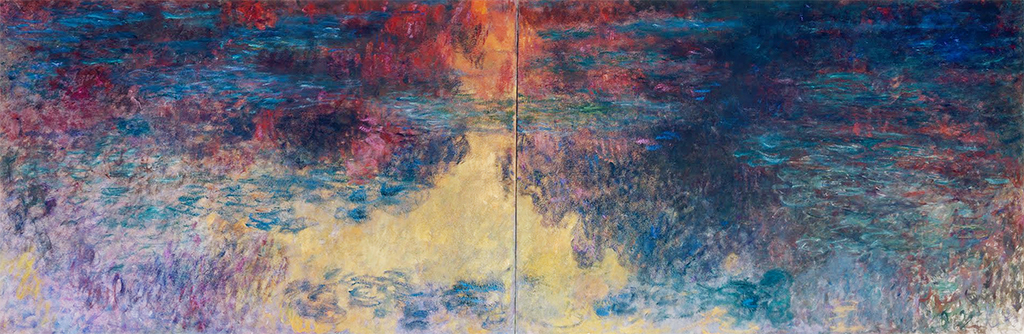
The Water Lily Pond in the Evening is a two-part painting in the Kunsthaus Zurich, catalogued as Le Bassin aux nympheas, le soir . The museum currently dates it to 1914-22. Across its broad surface, a luminous central passage interrupts dense blue, violet and reddish reflections. [1]
At a Glance
Reflected light rather than a view of the sky
The brightest passage runs towards the join between the two canvases. It narrows as it rises and expands near the lower edge, where pale colour meets darker, more scattered marks.
This can initially suggest an opening into a distant landscape. Yet there is no visible horizon, and the small floating forms return attention to the surface of a pond.
What seems to be above the water is encountered through reflection. Sky and vegetation enter the same field as the plants resting on it.
The title supplies an evening association, but the painting does not show a clearly outlined setting sun. Its effect comes from relationships between colours and densities rather than an illustrated clock time.
Looking for a single identifiable object therefore gives only a partial account. The Water Lilies overview introduces the wider motif; here, the central light and its uneven surroundings make a particularly forceful arrangement.
Two panels, six metres in total
The full composition measures two metres high and six metres wide, not six metres for each half. [1] Its centre join is a useful physical landmark, even though the painted relationships continue across it.
The two halves are not mirror images. The left opens towards paler passages below, while the right contains a heavier concentration of blue and dark reflected forms.
Small horizontal marks interrupt longer strokes, creating a surface that changes pace as the eye crosses it. The join divides the support without cancelling the composition's continuity.
Scale changes the way these marks can be read. In a small reproduction, many strokes merge into broad masses. In front of a large painting, a spectator can attend to only a portion in detail at any one moment.
That makes looking an activity extended through time. The image is not exhausted by recognising a pond or by locating the seam.
A garden made for prolonged observation
Monet's water garden began with an additional land purchase in 1893. Diverted water from a small branch of the Epte supplied the pond, while planting and maintenance shaped its changing appearance. [6]
The site offered repeated access to a subject in which light and reflection could transform familiar features. A return to the same place need not produce the same picture.
In this composition, the garden is not presented as an overall plan. Paths, buildings and enclosing boundaries have little role in organising what is seen.
Instead, a limited field becomes visually expansive. Reflections introduce space that does not have to be measured by a road or a receding line of trees.
The Giverny garden history explains the setting. It is important to distinguish that cultivated environment from the painting's construction: a canvas can rearrange what prolonged observation made available.
Observation and extended studio work
The broad museum date range should not be treated as a continuous diary of painting sessions. It identifies a period, not the year or hour in which every visible stroke was applied.
Ann Temkin and Nora Lawrence describe the late decorative project as a practice combining outdoor observation with work in a large studio, moving between canvases and revising them over years. [4]
This account helps explain the density of the painted surface without reducing it to an impulsive outburst. An energetic mark can belong to a slowly reconsidered arrangement.
Nor does the apparent difficulty of recognising a flower prove that the work was abandoned unfinished. The formal effect and an artist's decision about completion are different questions.
The technique discussion examines the distinction between visible handling and documented process. Here, layered colour sustains both the suggestion of a place and awareness of the paint through which that place is encountered.
What the 1986 conservation account records
A Kunsthaus annual report gives unusually concrete evidence about the diptych's physical construction. In 1986 it was being prepared for the Monet Water Lilies exhibition in Basel. [3]
The report describes two canvases, each two by three metres, with a thick and heavy paint layer supported by very fine fabric. Local tension cracks and separation between layers made transport a demanding task.
Conservators worked on protection and support, consulting colleagues including Peter Berkes from Basel. Their problem was not simply how to fit a large painting through a doorway, but how to move a vulnerable material structure.
This is a historical account, not a statement of the work's condition today.
It also cautions against reading expressive paint as purely spontaneous gesture. Whatever its visual energy, the accumulated surface has weight, and the relationship between that weight and its support becomes part of the object's history.
How the painting came to Zurich
The collection record traces the painting from Claude Monet to his son Michel, followed by purchase and donation by Emil Georg Buehrle in 1952. [1]
The Kunsthaus's contextual history adds that director Rene Wehrli visited Giverny in 1951 and saw an opportunity to acquire late works. Buehrle agreed to fund purchases for the museum through resources associated with its planned extension. [2]
The account distinguishes the gift from the building's later opening in 1958. It also places Buehrle's patronage within the museum's wider discussion of his arms-manufacturing business and its institutional connections.
These contexts should be acknowledged without treating all paintings associated with the collector as having one interchangeable ownership history.
For the Evening diptych, the documented chain through the artist's estate is the relevant starting point. Its arrival in Zurich belongs to a history of collecting and museum choices, not simply the inevitable recognition of an already universally admired masterpiece.
A new audience for the late paintings
Zurich's interest formed part of a wider reconsideration of Monet after the Second World War. Temkin and Lawrence describe late canvases included in the 1952 Kunsthaus retrospective and Wehrli's reading of them as precedents for abstraction. [4]
Another Swiss institution, Kunst Museum Winterthur, records acquiring its distinct White and Yellow Water Lilies in the same year. [7]
The coincidence is informative, but it does not make every Water Lilies painting part of one acquisition or justify a claim that none had entered museums before.
Later appreciation also changes the questions asked of the Evening diptych. A viewer interested in abstraction may notice the expansive field and the difficulty of fixing every mark to a named object.
That response does not prove Monet intended to become a later Abstract Expressionist. The reception article follows how institutions and subsequent artists can find new meanings in work made under different circumstances.
Keeping related pond paintings distinct
The Kunsthaus also owns The Water Lily Pond with Irises , another large 1952 gift. Its inclusion in the museum's 2004-05 garden exhibition helps show the importance of related pond compositions in the collection. [8]
The shared place and donor do not make it the Evening diptych. Titles, identifiers and the painted arrangement remain essential distinctions.
The Orangerie's installation in Paris is different again: eight compositions assembled for two oval rooms, with its own donation history. [5]
The Orangerie guide considers that environment. The Zurich painting should not be described as a panel removed from it.
Returning to this diptych, the strong central light does not settle its space once and for all. It draws the eye towards an opening, while the plants and layered strokes keep bringing it back to the surface. That sustained uncertainty is more revealing than calling the painting simply realistic or abstract.
Frequently Asked Questions
Two metres high and six metres wide overall. [1]
1914-22. Some older descriptions begin the range in 1916. [1]
Emil Georg Buehrle, in 1952. [1]
No. It records observations and transport preparation in 1986. [3]
Discussion
Look again at the images and ideas explored in The Water Lily Pond in the Evening. These editorial prompts invite your observations.
Reader Insights
Follow how the light passage crosses the division between the canvases.
Compare the work's surface effects with its documented material construction.
Consider how later interest in abstraction can alter a painting's reception.
Join the Conversation
Share a detail, comparison or question about The Water Lily Pond in the Evening below.
References
- Kunsthaus Zurich , Le Bassin aux nympheas, le soir, 1952/0064; current collection record. View source .
- Kunsthaus Zurich , Weapons and Art; the 1951 visit, acquisitions and institutional context of Buehrle's patronage. View source .
- Kunsthaus Zurich , Annual report 1986, page 41; the two-part painting's construction and preparation for Basel. View source .
- Ann Temkin and Nora Lawrence, MoMA , Claude Monet: Water Lilies, 2009, pages 5-7 and 16-18; late working practice and the 1952 reception. View source .
- Musee de l'Orangerie , History of the Water Lilies cycle; the separate French ensemble. View source .
- Maison et jardins de Claude Monet , Water lily pond; the cultivated setting. View source .
- Kunst Museum Winterthur , Nympheas blancs et jaunes; a distinct painting acquired in 1952. View source .
- Kunsthaus Digilab , Monet's Garten, 2004-05; related works in the garden exhibition. View source .







