


 by
Tom Gurney
Tom Gurney BSc (Hons) is an art history expert with over 20 years experience
Published on October 6, 2016 / Updated on October 23, 2026
Email:
tomgurney1@gmail.com
/ Phone:
+44 7429 011000
Water-Lily Pond with Irises
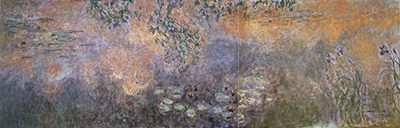
Water-Lily Pond with Irises is one of Claude Monet's monumental late paintings of his garden at Giverny. The Kunsthaus Zurich records this oil on canvas as Le Bassin aux nympheas avec iris, dated 1914/1922. At two metres high and six metres wide, it transforms the pond into an extensive field of flowers, reflected foliage and light. [1]
At a Glance
- Artist Claude Monet
- Date 1914/1922
- Medium Oil on canvas
- Dimensions 200 x 600 cm
- Collection Kunsthaus Zurich
- Inventory 1952/0010. [1]
A pond without a horizon
The painting does not offer a conventional view across a garden. There is no distant skyline against which to measure the trees, and no path leading us comfortably towards the pond. Instead, water occupies the pictorial field. Flowers, leaves and reflections provide the clues by which we begin to understand its space.
Near the lower centre, clusters of water-lily pads gather around small touches of pink and red. Above them, the surface becomes more open and luminous. Darker foliage appears towards the upper edge, while long, narrow leaves and purple flowers interrupt the right-hand side. These recognisable forms keep the scene attached to a particular kind of place even when other passages are difficult to separate into objects.
The distinction between water and reflection is deliberately unstable in the experience of looking. A pale passage can seem like depth beneath the surface, light falling upon it, or sky mirrored from above. There is no need to settle every ambiguity before enjoying the composition. Its spaciousness depends partly on those different readings remaining available.
The painting has a strong horizontal reach, but it is not organised as three identical sections. The more definite plant forms give weight to certain areas; elsewhere, the eye moves through comparatively open passages. This uneven distribution creates a rhythm across the width rather than a repeated decorative pattern.
Why the six-metre width matters
A small reproduction makes the painting easy to see all at once. Its actual dimensions produce a different encounter. The Art Museums of Switzerland catalogue emphasises that the spectator discovers this work by moving in front of it, rather than absorbing it as a single, bounded view. The twelve-square-metre surface challenges the familiar idea of a painting as a window. [2]
That change of scale affects individual marks as well as the overall scene. A passage that reads as a soft blend in a reduced image can occupy a substantial area of canvas. Conversely, a small flower becomes a point of orientation within a surface that extends well beyond it. The relation between detail and expanse is essential to the picture's character.
Looking from a distance encourages us to connect the pale areas and darker fringes into a broad visual movement. Looking more closely draws attention to separate strokes, interrupted edges and shifts of colour. Neither distance supplies the whole experience. The image asks for an alternation between recognising a pond and noticing how paint makes that recognition possible.
Its width does not simply make a garden scene more impressive. It changes the viewer's relationship to the subject, replacing the concentrated glimpse with a sustained exploration.
Irises, lilies and reflected foliage
The title brings together plants with different pictorial roles. The lilies sit upon the water, their pads forming irregular, low-lying groups. The irises rise in more upright, wiry shapes. Their leaves and flowers provide a counterweight to the long horizontal sweep of the canvas.
At the right, the iris stems and leaves can appear almost drawn into the surrounding atmosphere. They are distinct enough to recognise, but their outlines are not sealed off from adjacent colour. This allows the plant forms to participate in the surface's movement instead of becoming a botanical diagram placed in front of it.
Reflected foliage introduces a third kind of vegetation. It appears in broken, hanging shapes, suggesting trees outside the immediate frame. The actual garden therefore extends beyond what Monet directly includes. We infer part of that larger setting through its reflection rather than through a separate view of the bank.
The flowers also help us read scale and position. Without them, some of the broad, intermingling passages might seem almost non-representational. Their presence repeatedly returns the eye to the pond. The painting moves between these possibilities without abandoning its natural subject.
A garden made for looking
This was not an untouched landscape discovered by chance. Monet developed the water garden at Giverny over many years. The Musee des impressionnismes Giverny describes his purchase of a lower parcel of land in 1893, his plans to supply a pond from a branch of the Epte, and his planting of coloured water lilies obtained from Latour-Marliac. The pond was enlarged in the early twentieth century. [3]
Gardening and painting were connected, but they were not identical activities. Cultivating the site gave Monet a setting that could be revisited and altered; composing a picture still required selection. This canvas does not catalogue every feature of the garden. It excludes most of the surrounding architecture and concentrates attention on water and vegetation.
That distinction explains why the painting can be intensely specific without functioning as a map. We recognise a cultivated pond, yet cannot reconstruct the complete garden from it. The artist has turned a place into a pictorial arrangement whose spaces and intervals have their own demands.
The monumental late project
The broad dating belongs to the period in which Monet renewed his plans for large decorative paintings. The Musee de l'Orangerie's history identifies 1914 as a decisive return to that ambition. Its account also describes work divided between outdoor observation and the large, naturally lit studio, with panels repeatedly reconsidered. The late pictures were not simply enlarged records of one brief outdoor session. [4]
That context is important when considering the Water Lilies , but it does not establish the sequence of every brushstroke in the Zurich canvas. The date 1914/1922 should not be read as proof that Monet worked continuously on this one painting for eight years. Nor can the surface alone reveal the precise intervals between campaigns of work.
What it does show is an ambitious balance between particular plants and an expansive painted environment. The subject remains close to Monet's home, while the format greatly enlarges what a view of that subject can become.
Zurich and the Orangerie are distinct histories
The famous French state gift developed through Monet's offer in 1918 and the agreement signed in 1922. The Orangerie's eight great compositions, assembled from panels, opened to the public in 1927 in two oval rooms. That installation is a related monumental undertaking, not the present location or acquisition history of Water-Lily Pond with Irises. [4]
The Kunsthaus record traces this canvas from Monet to his son Michel, who held it from 1926 until 1952. Emil Georg Buhrle purchased it in 1952 and donated it to the Zurich collection that year. These dates explain the museum's credit line without turning the work into one of the panels donated to France. [1]
The distinction matters because a shared subject does not make the individual paintings interchangeable. Here, the irises, the disposition of the lily pads and the extended open water form a particular composition. Its collection history is equally particular. Together, those features allow us to appreciate a specific canvas within Monet's much larger exploration of the pond.
Frequently Asked Questions
It belongs to the Kunsthaus Zurich, inventory 1952/0010. [1]
Two metres high by six metres wide. [1]
The museum dates it 1914/1922. [1]
Discussion
Look again at the images and ideas explored in Water-Lily Pond with Irises. These editorial prompts invite your observations.
Reader Insights
Which plants first help you recognise the space as a pond?
How might moving along a six-metre canvas change your experience of it?
Where does the image seem most clearly descriptive, and where most open to interpretation?
Join the Conversation
Share a detail, comparison or question about Water-Lily Pond with Irises below.
References
- Kunsthaus Zurich , Le Bassin aux nympheas avec iris, object record 1952/0010. View source .
- Art Museums of Switzerland / Switzerland Tourism , Le Bassin aux nympheas avec iris. View source .
- Musee des impressionnismes Giverny , Le jardin de Monet a Giverny. View source .
- Musee de l'Orangerie , History of the Water Lilies cycle. View source .







