 by Tom Gurney
Tom Gurney BSc (Hons) is an art history expert with over 20 years experience
Published on June 19, 2020 / Updated on October 27, 2026
Email: tomgurney1@gmail.com / Phone: +44 7429 011000
Above the Clouds at Sunrise: Introduction
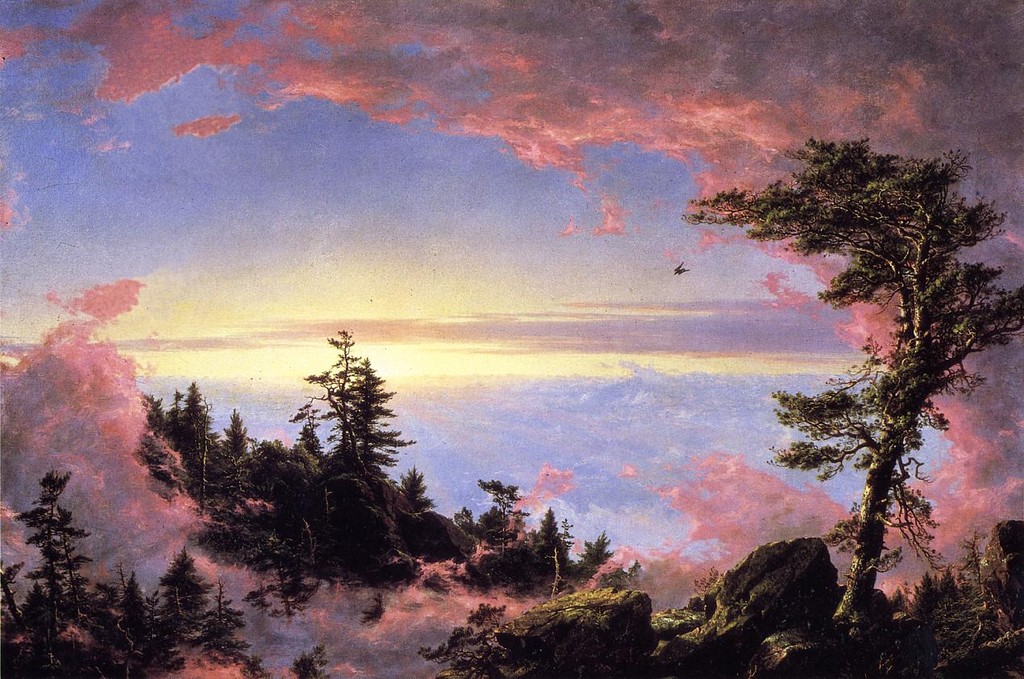
In Above the Clouds at Sunrise, the valley disappears beneath mist while trees and rocks remain close enough to touch. Painted in 1849, this early landscape by Frederic Edwin Church turns a Catskill mountain prospect into an encounter with light, height and uncertain distance. Its theatrical colour is held together by sharply observed foreground forms. The Metropolitan Museum of Art’s current loan record identifies the oil painting as belonging to a private collection in New York.[1]
At a Glance
- ArtistFrederic Edwin Church
- TitleAbove the Clouds at Sunrise
- Date1849
- MediumOil on canvas
- Dimensions69.2 × 102.2 cm
- LandscapeAssociated with an eastward Catskill view across the Hudson Valley
- Current collection creditPrivate Collection, New York, c/o Fine Art Brokers
- Met loan numberL.2026.3
This work across Church’s career
Tamaca Palms
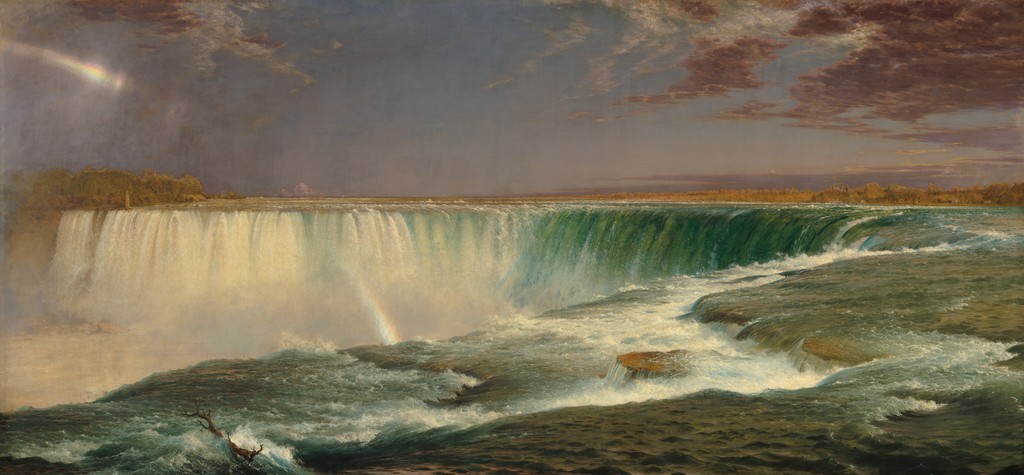
1854Niagara
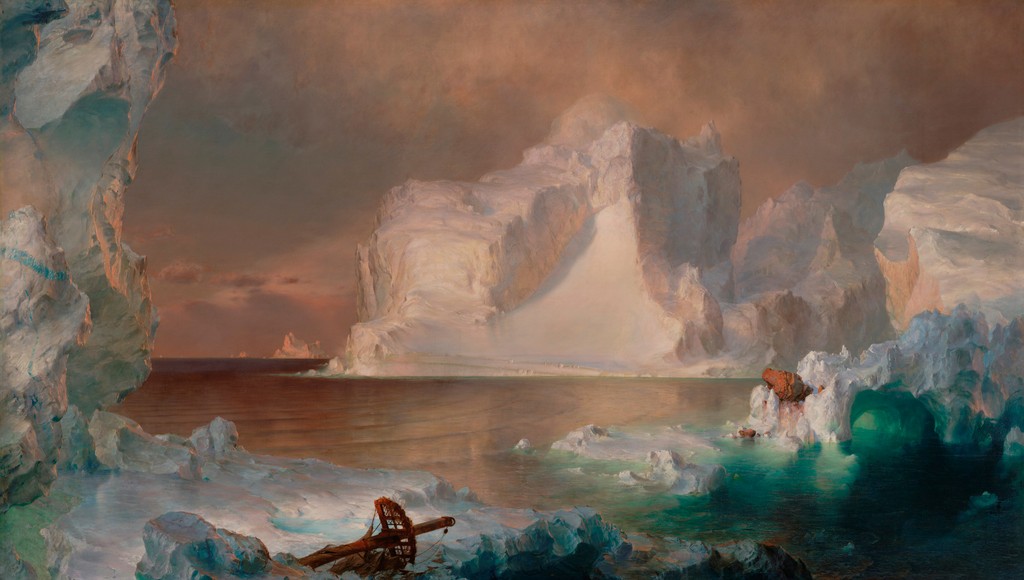
1857The Icebergs
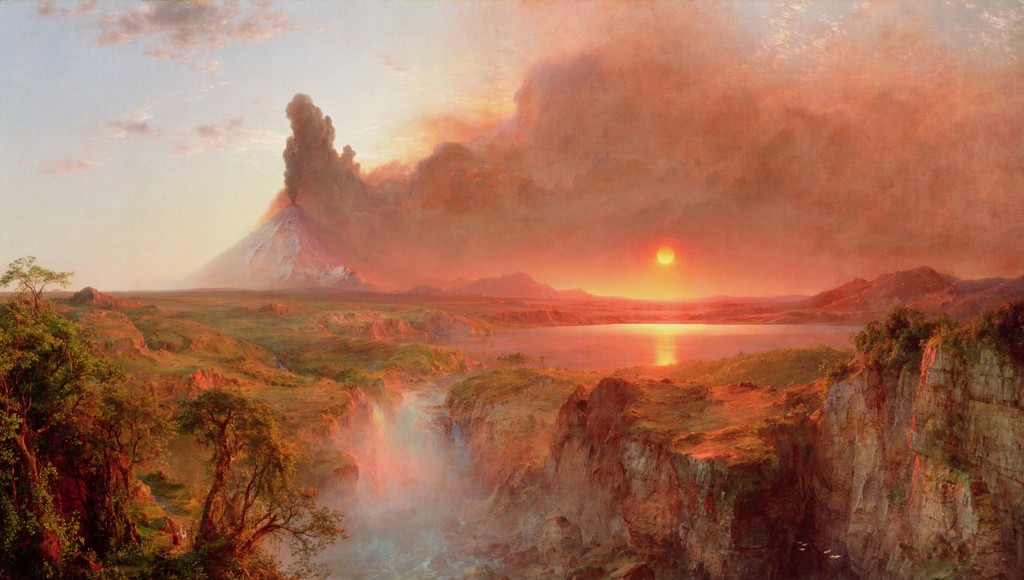
1861; foreground mast added between mid-1862 and early 1863Cotopaxi
1862Aurora Borealis
1865The Parthenon
1871The Aegean Sea
About 1877Contents
- A Catskill sunrise seen from above
- Rocks, trees and a frame of pink cloud
- How light creates distance
- An ambitious picture from Church’s early career
- Spiritual associations and Romantic landscape
- Comparing Church with Caspar David Friedrich
- Where is Above the Clouds at Sunrise?
A Catskill sunrise seen from above
The scene has been associated with the eastward view from the vicinity of the Catskill Mountain House. Franklin Kelly discusses that connection in the National Gallery of Art’s Church catalogue; John K. Howat explains that Kelly and Gerald L. Carr identified the prospect using surviving preliminary sketches. The association places the picture within a landscape visited by artists and tourists, rather than an entirely imaginary mountain world.[2][3]
That location helps explain the picture’s unusual spatial arrangement. We look outward from a high, wooded ledge, across a lower region concealed by cloud. The foreground and the bright horizon are available to the eye, but much of the land between them is hidden. Church makes the interruption central to the experience: the atmosphere occupies the space where a conventional panorama might show fields, roads or a river.
The title describes the spectator’s elevation as well as the hour. Some mist curls among the nearer trees, while a broader blue veil stretches beyond them. Being above the clouds does not mean standing entirely outside their movement. Church brings the vapour around the ledge itself, allowing the scene to feel both open and enveloping.
The hotel association also complicates a first impression of untouched solitude. The painting offers no conspicuous building or visitor to explain how the view was reached. Its composition concentrates attention on the natural spectacle, while its historical setting connects that spectacle with an established place for looking at the mountains. A viewer can appreciate that distinction without treating every visible rock as a precisely mapped landmark.
Rocks, trees and a frame of pink cloud
The foreground gives the eye somewhere firm to stand. Angular rocks occupy the lower right, with green growth catching the light across their upper surfaces. Above them rises an irregular tree whose branches extend into the sky. Its dark trunk and broken outline hold together the right side of the composition, counterbalancing the looser masses of cloud.
On the left and nearer the centre, pointed evergreen crowns overlap one another. Their silhouettes remain readable against the mist, even where the ground beneath them becomes difficult to follow. Some trees appear close and substantial; others are reduced to thin vertical marks. These changes of visibility suggest successive distances without requiring a fully exposed valley floor.
Pink vapour winds through the lower trees and rises along the sides. Related colour appears in the cloud canopy overhead. The effect is a frame made from moving atmosphere: rock and vegetation anchor it, but its edges are constantly softened by mist. Howat describes the foreground as participating in a twisting arrangement around the distant sunrise, linking the detailed natural forms to the picture’s larger drama.[3]
A small bird is visible in the open sky near the large tree. Its scale is easily missed beside the heavy trunk, yet it introduces a living movement across the gap toward the light. Howat draws attention to the relationship between this bird, the tree and the luminous distance. The detail invites a slower reading after the first broad impression of coloured cloud.
The tree should not be reduced to a single symbolic meaning. Visually, its uneven limbs, hanging growth and dense crown create a strong contrast with the smoother horizontal bands beyond. Church’s design gains energy from this opposition between near, textured matter and distant, shifting air. The foreground remains rough enough to make the view feel precarious even when the horizon appears calm.
How light creates distance
The brightest zone lies near the horizon, where pale yellow light spreads beneath a thin horizontal cloud band. Above it the sky becomes cooler; below it the valley is submerged in blue and lavender atmosphere. Pink accents connect the lower mist with the upper clouds, carrying the sunrise colour through several parts of the canvas.
These colour relationships do much of the work usually performed by visible landforms. Dark trees tell us what is near. Cooler, less distinct forms suggest what lies farther away. The yellow opening supplies a destination for the gaze, although the intervening landscape cannot be inspected with the same certainty as the foreground.
The painting therefore combines two kinds of attention. Close looking reveals particular branches, rock faces and patches of vegetation. A more distant glance joins them into a sweeping arrangement of shadow and illumination. Howat interprets that combination of natural detail and commanding composition as an early statement of an approach Church would develop in his larger later landscapes.[3]
Nothing in this effect requires the mist to be a literal sea. That familiar comparison conveys how vapour conceals the lower ground and makes the trees appear to emerge from it. The distinction matters because Church’s subject is an atmospheric transformation of a mountain landscape, with solid terrain still present beneath the cloud.
Watch: Frederic Edwin Church
Choose a film to explore the artist’s work, its interpretation and its wider setting.
Frederic Edwin Church's "The Icebergs" on the Move at the DMA
Follow the Dallas Museum of Art as it moves Church’s large painting The Icebergs.
Watch on YouTubeAn ambitious picture from Church’s early career
The year 1849 belongs to an important stage in Church’s professional emergence. Debora Rindge’s chronology records his election as a full member of the National Academy of Design that year and lists Above the Clouds at Sunrise at the American Art-Union as number 22. Kelly places the work among the ambitious landscapes through which Church expanded his reputation in New York.[2]
The Art-Union mattered as an exhibition and patronage organisation. Its galleries brought paintings before an audience beyond an artist’s immediate circle, while its purchases supported painters. For this canvas, the setting is particularly relevant: the daring atmospheric effect was presented to people who might admire it, question it or compare it with their own experience of mountain weather.
Kelly recounts a March 1849 review in The Albion that defended Church’s observation of nature while anticipating that many spectators would find the image implausible. The criticism, as reported in the catalogue, identifies a productive tension in the painting. An extraordinary scene could look invented precisely because an unfamiliar natural effect exceeded the viewer’s expectations.[2]
This reception helps explain why accuracy and drama need to be considered together. The picture did not have to choose between being recognisably based on nature and being emotionally powerful. Its challenge was to make the heightened spectacle convincing through relationships of light, scale and foreground detail. Readers interested in the broader development of that approach can follow Church’s biography.
Spiritual associations and Romantic landscape
The sunrise can suggest renewal, emergence or the beginning of a world. Kelly explores a reading in which the animated trees, swirling mist and streaming light evoke creation. He also places the mountain sunrise beside imagery in William Cullen Bryant’s poetry, where dissolving mist could prompt thoughts about the relationship between individual life and a larger whole.[2]
These are interpretations of the picture’s possibilities. They help explain how a nineteenth-century audience could move from observing weather to considering spiritual or philosophical questions. They do not establish an exclusive meaning for every branch or cloud, or require the whole painting to function as a fixed religious code.
The work’s force rests partly in that openness. The same concealment that creates spatial uncertainty can also encourage reflection. A viewer sees clear natural objects close at hand and an immense illuminated distance that remains only partly knowable. Church gives that contrast a visible form without adding a narrative figure to explain the response.
Comparing Church with Caspar David Friedrich
Both Howat and Kelly connect Above the Clouds at Sunrise with the Romantic landscapes of Caspar David Friedrich. A particularly useful comparison is Wanderer above the Sea of Fog, now in the Hamburger Kunsthalle, whose current museum dating is around 1817.[2][3][4]
Friedrich places a man with his back to us on a rocky summit. He looks across pale fog toward isolated mountain forms. The figure makes the act of contemplation visible, inviting us to consider the scene through another person’s stance. Church offers a comparable encounter with height and concealed distance, but lets rocks, trees and the opening of light organise our position.
The difference becomes clear when the paintings are viewed together. Friedrich’s dark figure dominates the centre of a vertical canvas. Church’s wider format spreads attention between the near vegetation and the horizon; the bird is a fleeting accent rather than a human intermediary. Similar atmospheric subjects support distinct ways of drawing the spectator into a landscape.
Kelly explicitly cautions against turning this resemblance into a claim of direct influence. His comparison places Church within an international Romantic concern with nature and human perception. It is useful because it widens the context in which the American painting can be understood, while preserving the difference between a visual parallel and an established historical connection.[2]
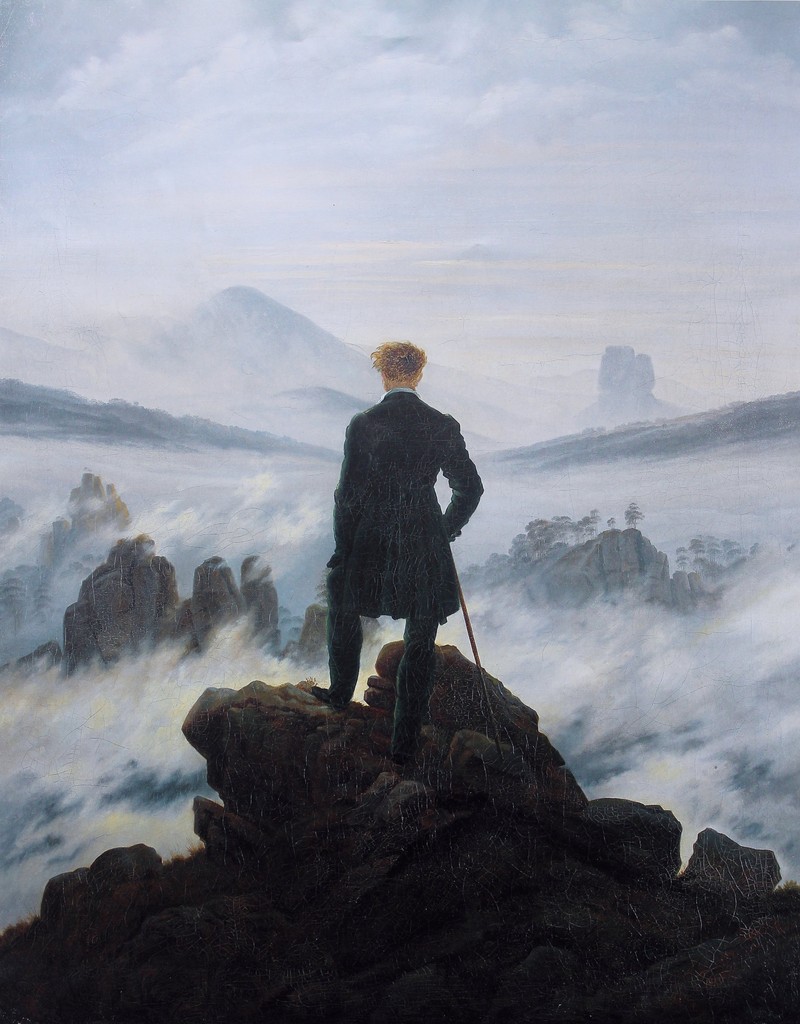
Caspar David Friedrich, Wanderer above the Sea of Fog, circa 1817. Oil on canvas. Hamburger Kunsthalle. Public-domain reproduction by Cybershot800i via Wikimedia Commons. A Romantic comparison; direct influence on Church has not been established. Caspar David Friedrich, Wanderer above the Sea of Fog, circa 1817. Hamburger Kunsthalle. Public-domain photographic reproduction by Cybershot800i, via Wikimedia Commons.. Image source. Public domain: faithful 2D reproduction; PD-old-100-expired. Resized; full source proportions retained.
Where is Above the Clouds at Sunrise?
Older museum catalogues identify the painting with the Warner Collection of Gulf States Paper Corporation in Tuscaloosa, Alabama. The Met’s current record instead credits a private collection in New York and identifies the work as a loan. That distinction separates historical collection information from the present institutional record: a painting shown at the Met on loan is not thereby part of its owned collection.[1][2]
Artworks directory
A documented selection of Church’s works discussed across these articles, together with identified prints after his designs. This is not a catalogue raisonné. Repeated titles and aliases are reconciled; studies remain distinct from finished paintings. Some dates remain unconfirmed. Other makers are named where a print adapts Church’s work.
| Name | Date | Medium |
|---|---|---|
| Above the Clouds at Sunrise | 1849 | Oil on canvas |
| The Aegean Sea | About 1877 | Oil on canvas |
| The Andes of Ecuador | 1855 | Oil on canvas |
| Aurora Borealis | 1865 | Oil on canvas |
| Autumn in North America | Circa 1856 | Oil on board |
| Coast Scene | 1852 | Oil on canvas |
| Cotopaxi | 1862 | Oil on canvas |
| A Country Home | 1854 | Oil on canvas |
| El Khasné, Petra | 1874 | Oil on canvas |
| El Rio de Luz | 1877 | Oil on canvas |
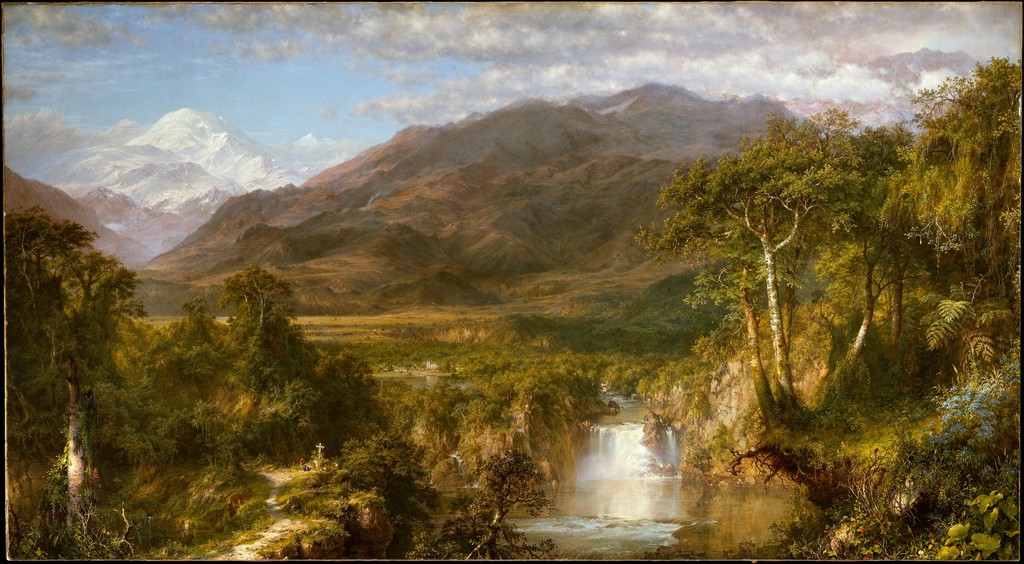
| The Heart of the Andes | 1859 | Oil on canvas |
| The Icebergs | 1861; foreground mast added between mid-1862 and early 1863 | Oil on canvas |
| Jerusalem from the Mount of Olives | 1870 | Oil on canvas |
| Mount Ktaadn | 1853 | Oil on canvas |
| Our Banner in the Sky | 1861 | Oil paint over lithograph on paper, laid down on cardboard |
| The Parthenon | 1871 | Oil on canvas |
| Rainy Season in the Tropics | 1866 | Oil on canvas |
| Storm in the Mountains | 1847 | Oil on canvas |
| Syria by the Sea | 1873 | Oil on canvas |
| Tamaca Palms | 1854 | Oil on canvas |
| Tropical Scenery | 1873 | Oil on canvas |
| Twilight in the Tropics | 1874; signed and dated, according to Bonhams’ catalogue | Oil on canvas |
| Twilight in the Wilderness | 1860 | Oil on canvas |
| View of Cotopaxi | 1857 | Oil on canvas |
| Niagara | 1857 | Oil on canvas |
| Magdalena River, New Granada, Equador | 1853 | Graphite heightened with white on wove paper |
| Tamaca Palm, Colombia or Ecuador | May–October 1853 | Graphite on gray laid paper |
| Mixed Sketches with a Champan, Río Magdalena, Colombia | May 1853 | Graphite on gray laid paper |
| Study for Rainy Season in the Tropics | 1865–1866 | Graphite on ruled notepad paper |
| Al-Khazneh, Petra (study) | February–March 1868 | Oil and graphite on tan paperboard |
| The Great Fall, Niagara (Charles Risdon, after Church) | 1874 impression | Hand-coloured chromolithograph on paperboard |
| The Heart of the Andes (William Forrest, after Church) | 1862 | Engraving in black on wove paper |
| Our Heaven Born Banner (William Bauly, adapting Church’s motif) | circa 1861 | Colour lithograph |
| A Tropical Moonlight (wood engraving after Church) | 1879 publication | Wood engraving in American Painters |
| Off Iceberg, Newfoundland | June 1859 | Oil and graphite on paperboard |
| Parthenon at Night, Athens | April 1869 | Oil and graphite on tan paperboard |
| Jerusalem from the Mount of Olives (study) | 1 April 1868 | Oil and graphite study |
| Horseshoe Falls (study) | December 1856–January 1857 | Oil on paper mounted to canvas |
| Niagara Falls, from the American Side | 1867 | Oil on canvas |
| Study for The Heart of the Andes | 1858 | Oil study |
| Mount Chimborazo through Rising Mist and Clouds | 1857 | Oil study |
| Cotopaxi Erupting, Viewed from Quito, Ecuador | June 1857 | Oil and graphite on tan paperboard |
| Cotopaxi (painted for Cyrus Field) | 1855 | Painting |
| Chimborazo | 1864 | Painting |
| Twilight, A Sketch | 1858 | Oil on canvas |
| View of Baalbek | 1868 | Oil and pencil on board |
| Three Bedouins | Date unconfirmed | Oil study |
| Coast Scene, Mount Desert (later canvas) | 1863 | Painting |
| The Wreck | Date unconfirmed | Painting |
| Grand Manan Island, Bay of Fundy | Date unconfirmed | Painting |
| Summer in South America | circa 1853 | Painting |
| Evening in Vermont | Date unconfirmed | Painting |
| Home by the Lake | Date unconfirmed | Painting |
| Storm in the Blue Mountains, Jamaica | August 1865 | Painting |
| The Natural Bridge, Virginia | 1852 | Painting |
| The Vale of St. Thomas, Jamaica | 1867 | Painting |
| Tequendama Falls, near Bogota, New Granada | Date unconfirmed | Painting |
| Sunrise in Syria | Before the 1876 exhibition | Painting |
| Cuernavaca (oil study; descriptive title) | 1898 | Oil study |
| Olana window design (descriptive title) | Date unconfirmed | Watercolour and graphite |
| Olana dining-room stencil sketch (descriptive title) | Date unconfirmed | Oil and graphite |
| Olana house (with Calvert Vaux) | 1870–1872; later additions | Architecture |
| Olana designed landscape | From 1860; developed over decades | Designed landscape |
Frequently Asked Questions
In 1849, early in his career and before his first South American journey.
Scholarly catalogues associate the painting with an eastward view across the Hudson Valley from near the Catskill Mountain House.
The paintings have been compared for their elevated viewpoints and mist-covered landscapes. Kelly treats the resemblance as a Romantic parallel and cautions that direct influence has not been established.
Its current record describes a loan from a private collection in New York. Display and loan arrangements can change; consult the museum record before planning a visit.
Discussion
Look again at the images and ideas explored in Above the Clouds at Sunrise. These editorial prompts invite your own observations.
Reader Insights
How do the rocks and trees anchor a view otherwise filled with cloud?
Where does the sunrise colour make the greatest change to your sense of distance?
What does the comparison with Friedrich help you notice, while keeping the artists’ histories distinct?
Join the Conversation
Share a detail, comparison or question about Above the Clouds at Sunrise below.
References
- The Metropolitan Museum of Art, Above the Clouds at Sunrise, current loan record.
- National Gallery of Art, Frederic Edwin Church, 1989: Franklin Kelly, pp. 39–40 and notes 23–28, p. 70; Debora Rindge, p. 159; catalogue 7, pp. 22 and 200.
- John K. Howat, Above the Clouds at Sunrise, in American Paradise: The World of the Hudson River School, 1987, pp. 239–240.
- Hamburger Kunsthalle, Caspar David Friedrich: Kunst für eine neue Zeit, museum dating and collection identification for Wanderer über dem Nebelmeer.
- Splash image source.
Frederic Edwin Church, Above the Clouds at Sunrise, 1849. Oil on canvas, 69.2 × 102.2 cm. Private Collection, New York, c/o Fine Art Brokers. Public-domain reproduction via Wikimedia Commons (source ArtRenewal.com, uploaded by Keraunoscopia). Frederic Edwin Church, Above the Clouds at Sunrise, 1849. Private Collection, New York, c/o Fine Art Brokers. Public-domain reproduction via Wikimedia Commons, source ArtRenewal.com; uploaded by Keraunoscopia.. Image source. Public domain: faithful 2D reproduction; PD-old-100-expired. Resized; full source proportions retained.