 by Tom Gurney
Tom Gurney BSc (Hons) is an art history expert with over 20 years experience
Email: tomgurney1@gmail.com / Phone: +44 7429 011000
Niagara: Introduction
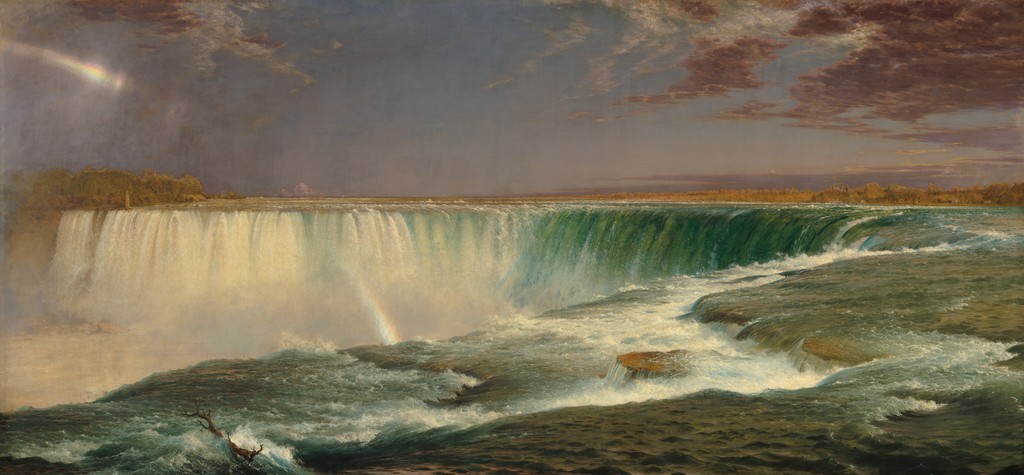
Frederic Edwin Church's Niagara places the viewer above rushing water, close enough to the brink to feel the pull of the falls. Painted in 1857, the enormous horizontal view of Horseshoe Falls helped establish Church's international reputation. At nearly 2.3 metres wide, it invites a broad scan as well as close inspection. Its achievement lies in the combination of carefully observed detail with a viewpoint constructed for the painting: near rapids, distant shoreline and falling water occupy one continuous, almost engulfing field. [1]
The picture also had a remarkable life beyond Church's studio. A paid exhibition, publicity, reproductive prints and touring brought a single landscape to successive audiences. Now in the National Gallery of Art, Washington, it belongs to the Corcoran Collection. Understanding its success means looking at both the canvas and the ways people encountered it. A landscape drawn from a famous tourist destination became an attraction in its own right. [2]
At a Glance
- ArtistFrederic Edwin Church (1826–1900)
- TitleNiagara
- Date1857
- MediumOil on canvas
- Dimensions101.6 × 229.9 cm
- SubjectA constructed panoramic view of Horseshoe Falls
- CollectionNational Gallery of Art, Washington, Corcoran Collection
- CreditMuseum Purchase, Gallery Fund, 1876
- Accession2014.79.10
Object information follows the National Gallery of Art's collection record. [1]
This work across Church’s career
Tamaca Palms
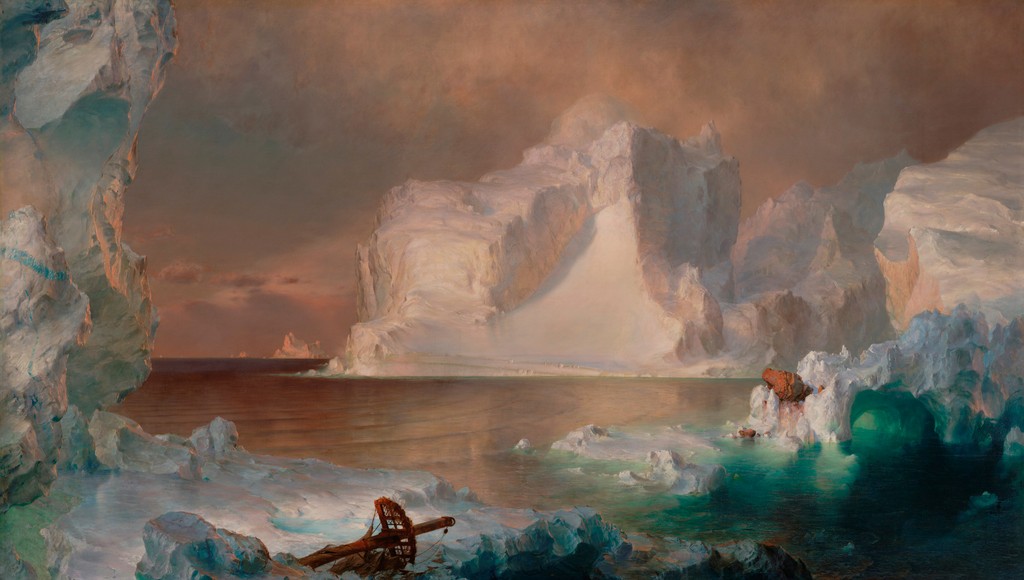
1854The Icebergs
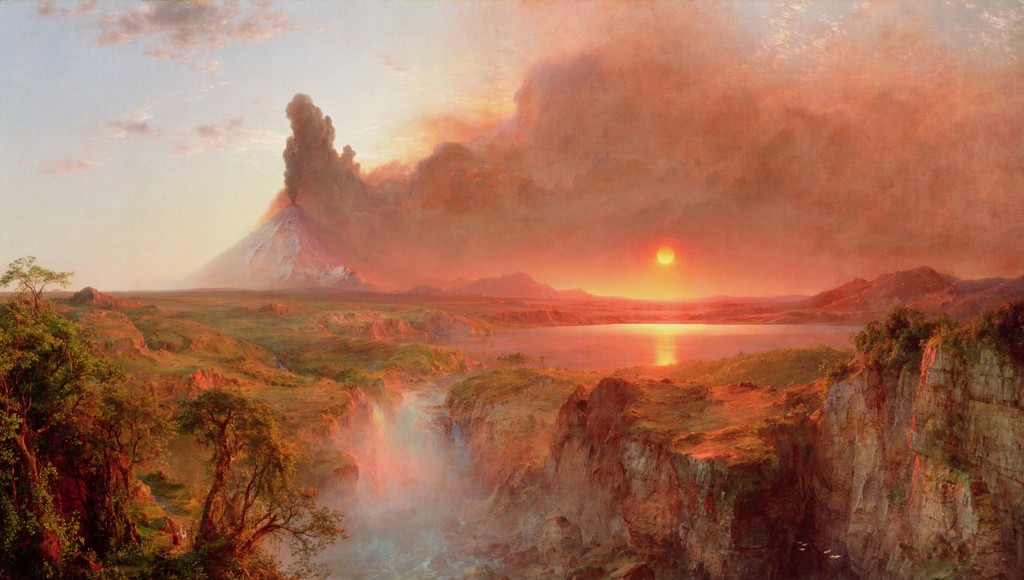
1861; foreground mast added between mid-1862 and early 1863Cotopaxi
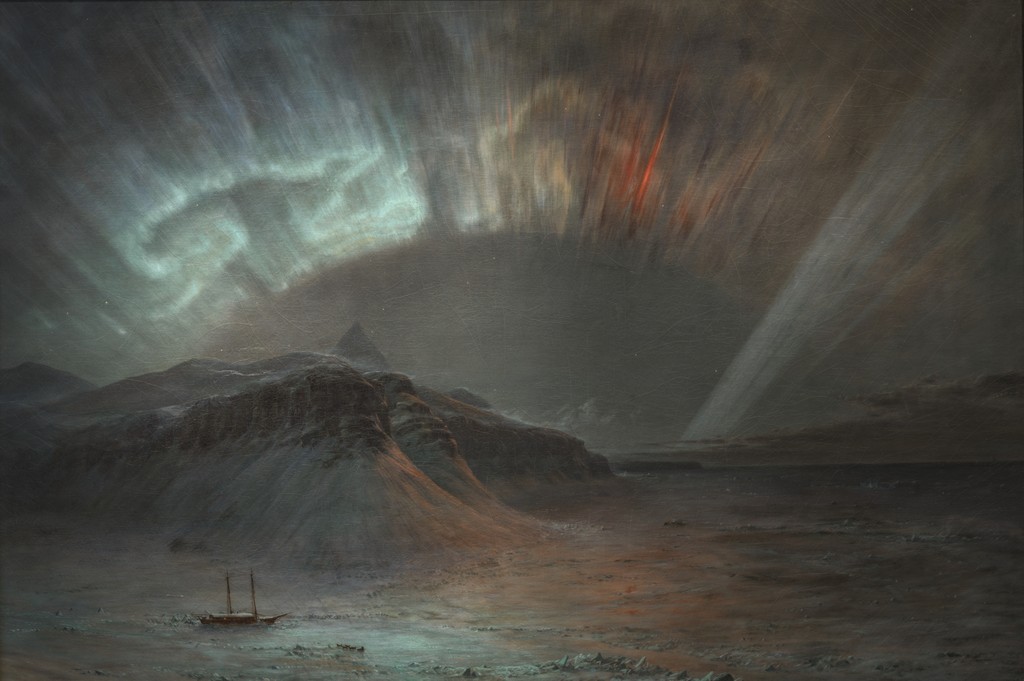
1862Aurora Borealis
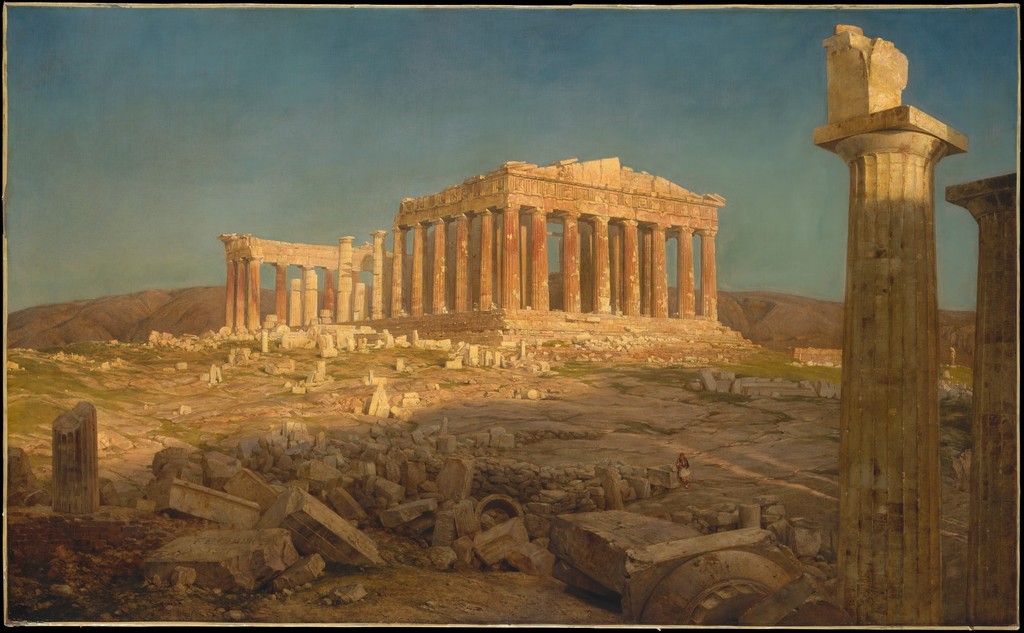
1865The Parthenon
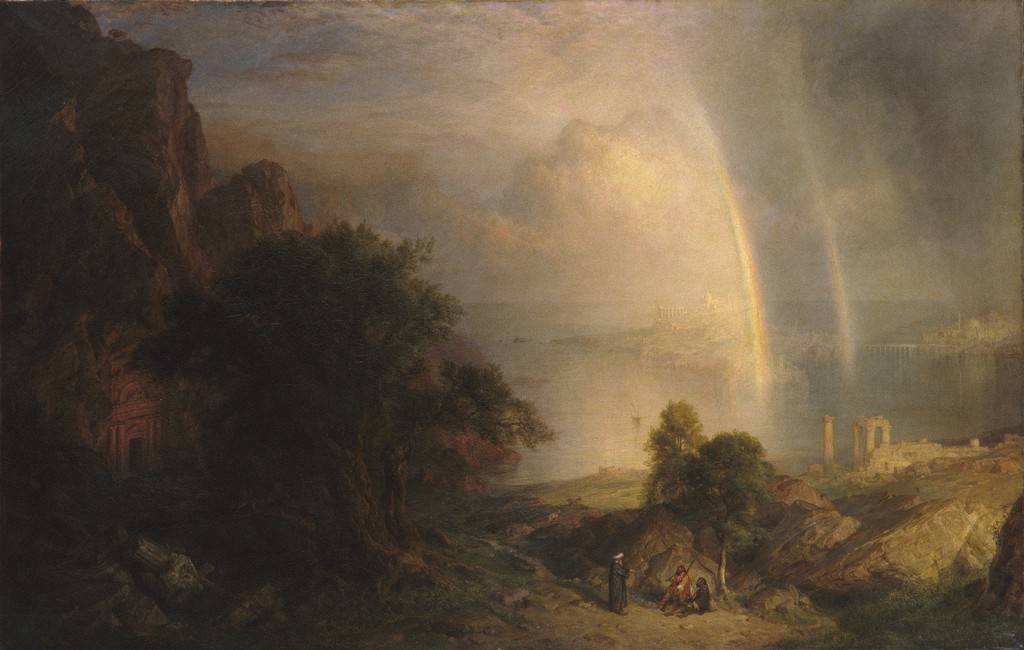
1871The Aegean Sea
About 1877Contents
- A View without a Safe Foreground
- Observation, Studies and the Studio
- Water, Mist and the Broken Rainbow
- Small Details within the Panorama
- A Breakthrough in an Established Career
- From Painting to Public Attraction
- Touring, Reception and Reproductions
- Nature and National Identity
- Owners, the Corcoran and the National Gallery
- Annotated details
A View without a Safe Foreground
The first surprise is where Church seems to position us. Water reaches the lower edge of the canvas, leaving no broad patch of dry ground on which an imaginary spectator could stand. A familiar landscape arrangement, with a path or bank leading gently into the distance, would make this scene easier to enter. Church instead begins with the rapids. The eye has already crossed the threshold into the river before it reaches the great descending curtain.
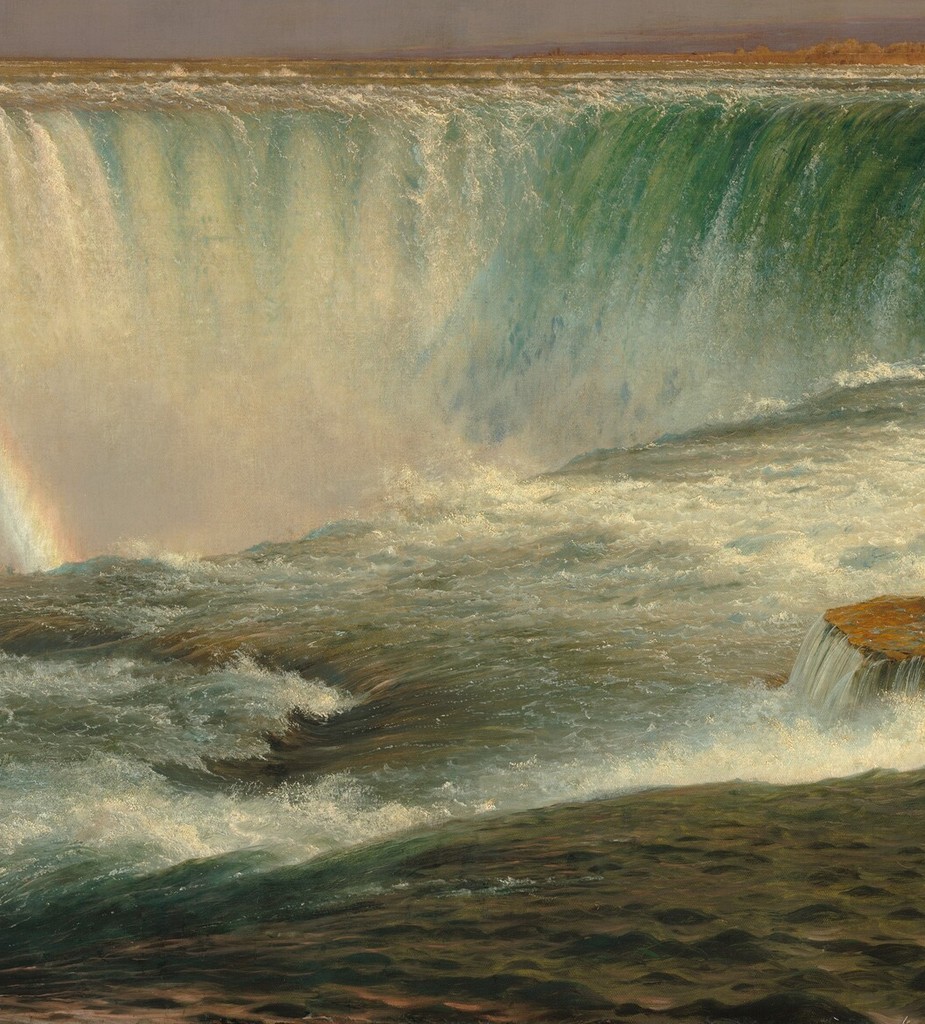
The foreground is nevertheless highly articulated. Dark green currents break into white foam; shelves interrupt the flow; a small branch appears close to the lower edge. A brown rock rises near the centre-right, with water streaming around it. These separate incidents give the near water weight and texture. They also make its movement legible: the surface slides, collides, curls and spills rather than presenting a uniform white band.
Across the composition, the long brink bends away and returns toward the far shore. Green water approaches it in thick, rounded folds before becoming pale vertical streaks. The transition gives an impression of volume passing over an edge, with the foam below partly disappearing into mist. There is no need for a painted arrow or a prominent figure to explain the direction of movement. The changing shapes of the water carry the viewer's attention.
In the museum's audio discussion, curator Sarah Cash explains that Church brings the near and far sides of the falls into a view unavailable to an ordinary human observer. The picture's immediacy therefore rests on a deliberate spatial construction. It gathers experiences of the place into a single encounter, giving us an unusually comprehensive view while making our imagined footing less secure. [1]
Annotated Details from Niagara
The numbered points draw attention to visible features discussed in this article. Look from each detail back to the full composition. Frederic Edwin Church, Niagara, 1857, oil on canvas, 101.6 × 229.9 cm. National Gallery of Art, Washington, Corcoran Collection (Museum Purchase, Gallery Fund, 1876), 2014.79.10. NGA Open Access, CC0. Source image. CC0 / NGA Open Access. Numbered overview resized; detail crops added from the source master. No recolouring.
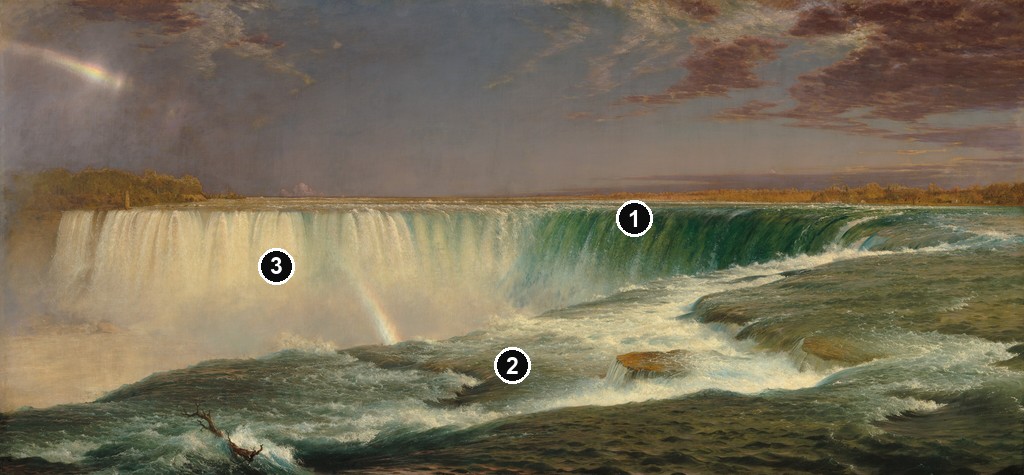
Details from NIAGARA
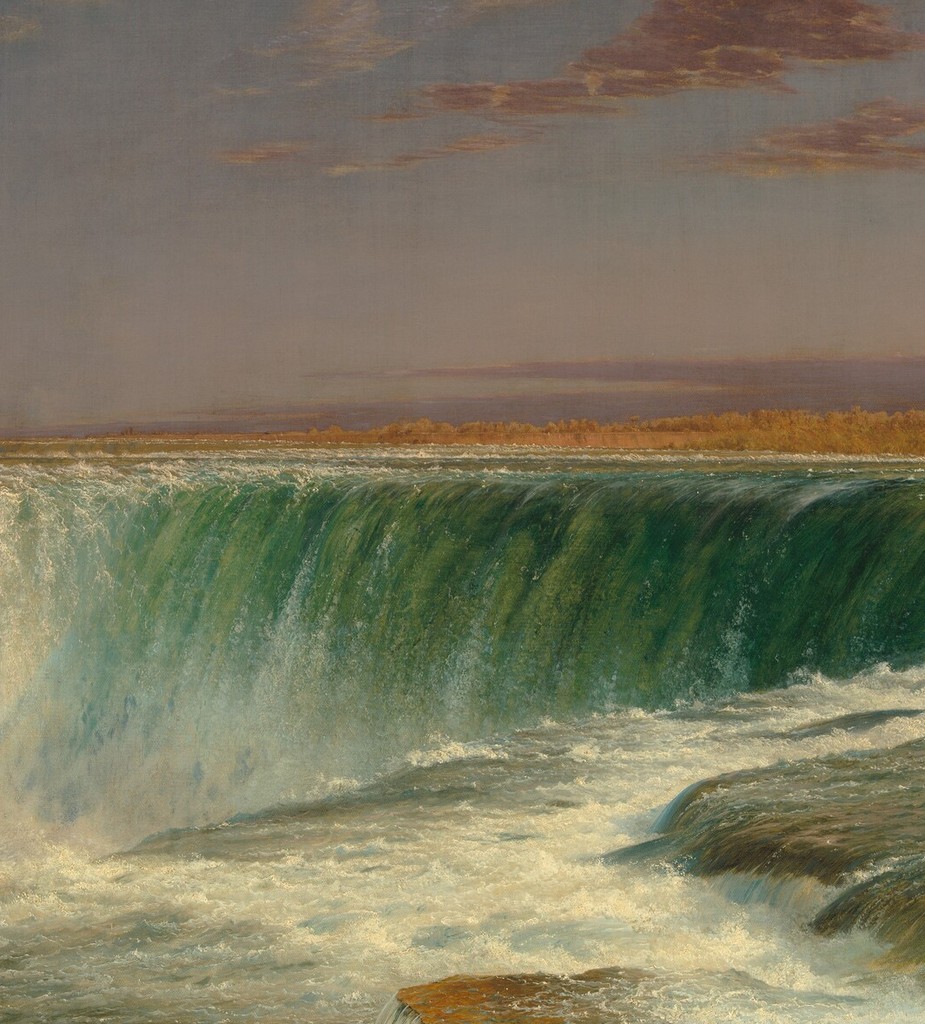
These crops come directly from the verified source images. They preserve the original colours or printed tones; the numbered overview is a separate aid to looking.
Curving brink
Green water curls over the curved edge before dropping away. The change from the near surface to the falling sheet makes the brink especially forceful.
Near foam
Pale foam breaks across darker moving water. Its irregular forms keep the foreground active rather than providing a safe place to stand.
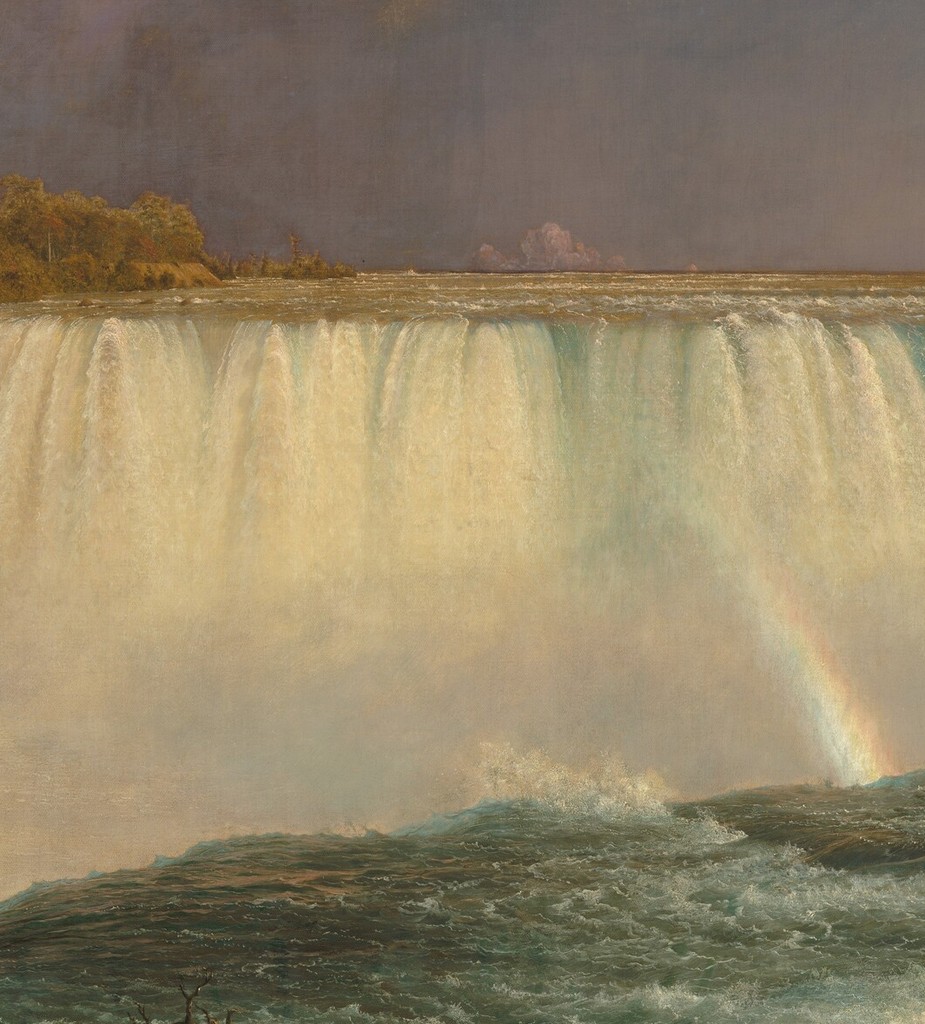
Mist and rainbow
Mist softens the falling water and carries part of the rainbow. The atmospheric passage differs from the more sharply described waves nearby.
Observation, Studies and the Studio
Church prepared Niagara through repeated visits and studies in 1856. Franklin Kelly's catalogue account identifies pencil drawings and oil sketches made at different times, followed by further compositional work. This sequence matters because the finished painting does not reproduce one field sketch. Church used observations as material for an arrangement developed in the studio, adjusting what a viewer would see and how different parts would fit together. [3]
One especially useful comparison is Horseshoe Falls, the oil study dated December 1856–January 1857 at Olana. Painted on paper mounted to canvas, it belongs to the preparatory process immediately preceding the great picture. The Smithsonian's Humboldt exhibition describes this study as a demonstration of Church's growing command of rapidly flowing water. It also places that achievement against criticism of his earlier handling of water. Niagara gave a demanding subject a conspicuous place at the centre of his practice. [4]
The distinction between field observation and studio design helps explain the apparent paradox of the finished view. Individual effects can appear convincing even when their combined position is unusual. A green curl at the brink, the broken texture of foam and the softness of suspended spray encourage recognition. The panoramic arrangement makes those effects available together. Accuracy here concerns a persuasive experience of the falls as much as the recording of one fixed position.
Kelly describes Church widening the field of vision and lowering the near edge in the final composition. That adjustment makes the foreground rapids more assertive while preserving the far side of the falls. The change is small to describe but fundamental to the spectator's experience. A conventional overlook becomes a sweeping visual presentation whose scale and continuity are controlled by the painter. [3]
Water, Mist and the Broken Rainbow
Looking slowly reveals that the brightest parts of the painting serve different purposes. The foreground foam describes turbulent water near us. The distant white curtain establishes the far side of the fall. Between them, mist softens the space below the brink. These passages overlap in colour, yet their textures and positions distinguish solid flow from dispersed spray. Church makes white a means of describing several conditions rather than one repeated highlight.
The rainbow introduces another kind of visibility. Its upper fragment appears against the mist at the left, then its coloured arc becomes visible again lower down, close to the curtain of water. It is not drawn as an uninterrupted decorative arch across the sky. The gaps help it appear embedded in changing air and spray. Its restrained colours also connect the light above the river with the turbulent depth below.
The sky offers a quieter pattern of movement. Darker clouds enter from the upper sides; thinner passages allow lighter colour to appear between them. Against these shifting forms, the distant banks make an almost continuous horizontal strip. That stable line gives the water's rolling and descending shapes something to work against. Looking from sky to shore to rapids changes the painting's pace, from broad atmosphere to increasingly particular movement.
The central green water is crucial to that transition. Its rounded crest has a density unlike the open sky and a smoothness unlike the foam. Near the right, brighter seams and darker folds give the river an uneven surface as it approaches the drop. A reproduction viewed at a small size can merge these effects. At closer range, the differences explain how the landscape produces its sensation of motion.
Small Details within the Panorama
It is easy to remember Niagara as water filling the entire world. The far shores complicate that impression. Trees and small buildings remain visible, and Kelly identifies Terrapin Tower among the distant features. Church's setting has signs of human occupation, although their scale makes them subordinate to the falls. Describing the painting as completely untouched wilderness would miss what is actually present. [3]
These details also establish distance. A building that occupies very little of the canvas encourages us to reconsider the amount of space between the foreground and the opposite bank. The great curtain is not merely a nearby wall of white paint: it stretches across an extensive landscape. Human structures supply a quiet measure of the natural feature without becoming the principal subject.
The branch below makes a different comparison possible. It lies within the viewer's immediate visual territory, while the remote buildings belong to the far horizon. Both are small objects, but their contrasting positions bracket the scene. Between them, water seems to accelerate and then vanish over the brink. The near branch need not carry an assigned symbolic meaning to contribute to the composition's scale and precariousness.
Another revealing exercise is to follow the edge of the falling water from left to right. Its direction changes gradually, with different parts seen at different angles. The extended curve binds a broad canvas together. Rather than selecting a single spectacular splash, Church makes the continuous brink the organising shape, giving individual incidents a place within the whole.
A Breakthrough in an Established Career
Church already had significant successes before Niagara. In his 1989 retrospective essay, Franklin Kelly traces the development from composed North American landscapes to the expansive Andes of Ecuador of 1855. Church had learned how to connect close observation with a broad imaginative arrangement. Niagara brought that ambition to a subject whose identity many spectators already knew, making recognisability an especially important part of the challenge. [5]
The earlier Tequendama Falls, near Bogota, New Granada had drawn criticism of its falling water. Kelly discusses that response alongside Church's later achievement at Niagara, where the depiction of flow became one of the most admired features. The comparison offers a more useful account of development than treating the 1857 canvas as an isolated arrival of genius. Water was a difficult pictorial problem to which Church returned with new observation and sustained compositional work. [5]
Kelly also distinguishes Niagara's independent exhibition from the settings in which Church had previously shown major works. The canvas could stand as the principal attraction rather than compete with neighbouring paintings in a crowded exhibition. That arrangement made looking at one landscape into an event. It joined Church's artistic development to a change in the way he presented his work to the public. The term “Great Picture,” used in scholarship about this practice, describes that exhibition model as well as the ambition of an individual painting. [5]
The difference helps explain why a familiar natural subject could have such impact. Visitors were invited to give an already famous place unusually concentrated attention. A long look could move from recognition of the falls to awareness of the painting's decisions: its near edge, panoramic breadth and sequences of detail. The subject supplied familiarity; the artist's arrangement supplied an experience that ordinary familiarity did not exhaust.
From Painting to Public Attraction
The first exhibition opened at Williams, Stevens & Williams in New York in May 1857. The firm purchased both the painting and its copyright for $4,500, and visitors paid twenty-five cents to see it. This arrangement joined possession of the original to the possibility of selling reproductions. The picture's public debut was consequently part of an organised commercial presentation, with income potentially coming from more than the sale of a canvas. [2]
The National Gallery's account describes Church inviting journalists to see the painting in his studio before the exhibition. Public interest was cultivated in advance. A pamphlet and opportunities to order prints extended the encounter beyond the gallery visit. For the artist and dealers, the painting's power as a spectacle and its usefulness as a reproducible image belonged to the same enterprise. [2]
This setting changes how the painting's scale can be understood. A visitor could devote attention to one work as the main attraction, moving between an overall view and its details. The long canvas gives those two distances different rewards. From farther away, the sweep of the brink dominates; closer inspection reveals foam, small landmarks and the fine transitions of mist. Its visual structure supports sustained examination.
The exhibition also brought the falls to people who had not travelled there. A painting could offer recognition to a visitor familiar with Niagara and discovery to one who knew it only through descriptions or smaller images. Church's picture joined the appeal of a famous destination to the concentrated experience of looking at an ambitious original. Its public success depended on both kinds of audience.
Watch: Frederic Edwin Church
Choose a film to explore the artist’s work, its interpretation and its wider setting.
Frederic Edwin Church's "The Icebergs" on the Move at the DMA
Follow the Dallas Museum of Art as it moves Church’s large painting The Icebergs.
Watch on YouTubeTouring, Reception and Reproductions
After New York, Niagara was shown in Britain, with London exhibitions in 1857 and 1858 and further British touring. American venues followed, including Washington. The National Gallery's exhibition history also records its appearance at the Paris Exposition Universelle in 1867. It was an international work of American landscape painting before entering a permanent museum collection. [1]
The museum quotes a contemporary response describing it as “Niagara, with the roar left out!” Kelly identifies the response in the Home Journal of 9 May 1857. The phrase captures a particular kind of praise: paint seemed capable of recalling enough of the falls to make their missing sound the obvious remaining difference. It is an account of the picture's effect on a viewer, rather than a measurement of its literal geographical accuracy. [3]
Reproductive prints changed the terms of that experience. They could carry the composition into homes and other settings, giving the painting a presence far beyond a temporary exhibition. Yet the original's breadth and detailed surface made a different demand on attention. Recognising the composition through a print and standing before the canvas were related encounters whose scale and material conditions differed.
That distinction is useful today, too. A familiar digital image can make Niagara appear instantly comprehensible. Looking longer at the original composition reveals tensions between breadth and detail, distance and proximity, smooth water and scattered foam. The picture remains more than a memorable outline of a waterfall. Its visual argument unfolds through the relationships among these different passages.
Nature and National Identity
In the Smithsonian's Humboldt exhibition, Niagara is discussed as a natural feature carrying national and cultural significance. The curatorial account connects Church's expanded panoramic form with Alexander von Humboldt's interest in strengthening the impressions received from nature. That connection places the painting within a larger ambition: landscape could bring many observed phenomena into a presentation that encouraged a sense of their relationship. [6]
The painting offers a strong example of that ambition without requiring every feature to illustrate a passage from Humboldt. Water, light, atmosphere and land appear together, each with its own visible behaviour. The broad format encourages us to connect them. Mist belongs to the falls, the rainbow belongs to light in that mist, and distant land supplies a scale against which the moving water can be understood.
National interpretation also needs geographical and historical care. Niagara straddles the United States and Canada, and the museum identifies the region as Haudenosaunee homeland. Its modern audio interpretation discusses another history of the destination: free African American waiters at the Cataract House hotel helped enslaved visitors escape to Canada. That account adds human meaning to a place often celebrated chiefly as a natural wonder. [1]
The painting does not depict those escapes, and the account does not establish Church's intention to represent them indirectly. It does, however, prevent the quiet distant banks from being mistaken for a complete history of the site. A landscape can foreground the force of water while leaving much of the lived experience around it outside the picture. The museum's interpretation helps us recognise that difference.
Owners, the Corcoran and the National Gallery
The painting's ownership history extended well beyond its first dealers. The National Gallery records its forfeiture to Brown Brothers and a December 1861 benefit effort involving Tiffany & Company before ownership by John Taylor Johnston. In 1876, the Corcoran acquired it from the sale of Johnston's collection for $12,500. These transactions place the picture within successive commercial, private and institutional settings. [1]
Kelly cautions that surviving correspondence does not establish William Wilson Corcoran's personal role in directing the museum's purchase. The institutional acquisition should therefore be distinguished from a documented personal commission or gift by its founder. The collection credit identifies a museum purchase through the Gallery Fund. Such distinctions may seem small beside the painting's visual drama, but they clarify how a famous original reached a public collection. [3]
In 2014, Niagara entered the National Gallery of Art as part of the Corcoran Collection. Older books naturally identify it with the Corcoran Gallery of Art; the current owning record belongs to the National Gallery. The accession number, 2014.79.10, provides an unambiguous way to distinguish this canvas from Church's other paintings of the falls. [1]
A Painting Church Revisited
The canvas did not remain entirely outside the artist's care after its sale. Kelly's catalogue notes report that Church repainted the sky after dark streaks appeared, first during Johnston's ownership and later after its acquisition by the Corcoran. The notes refer to correspondence culminating in a letter dated 28 August 1886. This account documents a later return to an already celebrated work. [3]
The history reminds us that the image seen today also has a material life. Kelly's account documents interventions, rather than identifying every layer now visible. A reproduction alone cannot reconstruct those changes. Church's relationship with Niagara included the practical care of a painted surface long after the composition had won an international audience. [3]
Other Great Pictures and Another Niagara
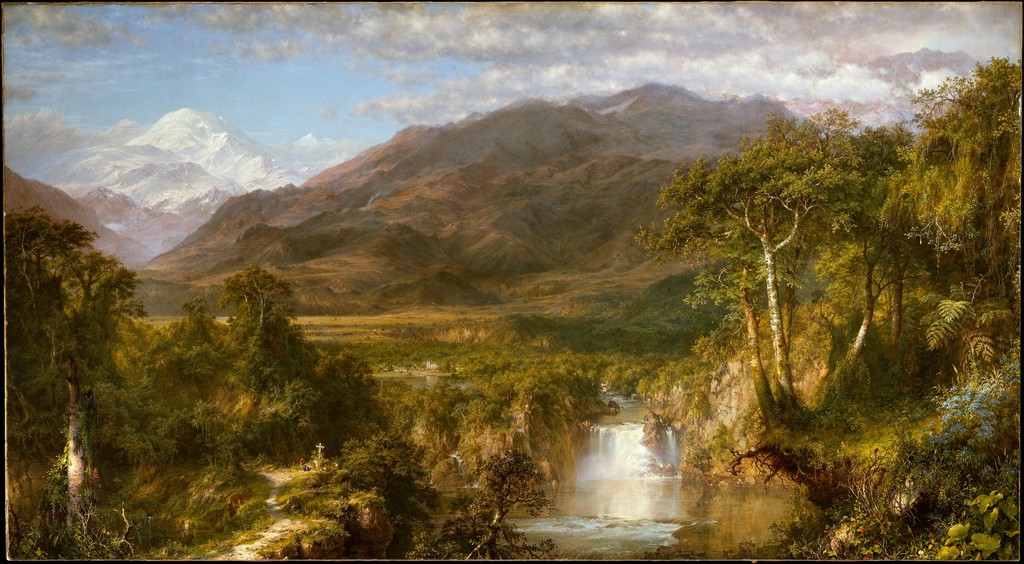
Two years after Niagara, Church's Heart of the Andes offered a different expansive landscape, bringing a wide range of tropical and mountain detail into a great exhibition picture. The subjects invite contrasting ways of looking. In Niagara, the rushing river and curved brink repeatedly draw attention back to one dominant action. Heart of the Andes spreads interest among many places and forms within its broad view. Their ambition includes both detailed observation and the sustained engagement of a spectator. [7]
Church also returned to Niagara as a subject. Niagara Falls, from the American Side, painted in 1867, is a separate canvas in the National Galleries of Scotland. Its dimensions, 257.5 × 227.3 cm, make its proportions markedly different from the long 1857 painting. The Scottish record documents a Knoedler commission and John S. Kennedy's gift in 1887. The two works have distinct histories, viewpoints and visual emphases. [8]
Keeping their identities separate makes the earlier achievement clearer. The 1857 Niagara concentrates on the experience of a broad, continuous brink and an unstable imagined position above the river. Returning to its foreground after considering the other great pictures reveals how much depends on that decision. The panorama's authority comes from joining carefully described phenomena to an arrangement that makes the familiar place newly absorbing.
Artworks directory
A documented selection of Church’s works discussed across these articles, together with identified prints after his designs. This is not a catalogue raisonné. Repeated titles and aliases are reconciled; studies remain distinct from finished paintings. Some dates remain unconfirmed. Other makers are named where a print adapts Church’s work.
| Name | Date | Medium |
|---|---|---|
| Above the Clouds at Sunrise | 1849 | Oil on canvas |
| The Aegean Sea | About 1877 | Oil on canvas |
| The Andes of Ecuador | 1855 | Oil on canvas |
| Aurora Borealis | 1865 | Oil on canvas |
| Autumn in North America | Circa 1856 | Oil on board |
| Coast Scene | 1852 | Oil on canvas |
| Cotopaxi | 1862 | Oil on canvas |
| A Country Home | 1854 | Oil on canvas |
| El Khasné, Petra | 1874 | Oil on canvas |
| El Rio de Luz | 1877 | Oil on canvas |
| The Heart of the Andes | 1859 | Oil on canvas |
| The Icebergs | 1861; foreground mast added between mid-1862 and early 1863 | Oil on canvas |
| Jerusalem from the Mount of Olives | 1870 | Oil on canvas |
| Mount Ktaadn | 1853 | Oil on canvas |
| Our Banner in the Sky | 1861 | Oil paint over lithograph on paper, laid down on cardboard |
| The Parthenon | 1871 | Oil on canvas |
| Rainy Season in the Tropics | 1866 | Oil on canvas |
| Storm in the Mountains | 1847 | Oil on canvas |
| Syria by the Sea | 1873 | Oil on canvas |
| Tamaca Palms | 1854 | Oil on canvas |
| Tropical Scenery | 1873 | Oil on canvas |
| Twilight in the Tropics | 1874; signed and dated, according to Bonhams’ catalogue | Oil on canvas |
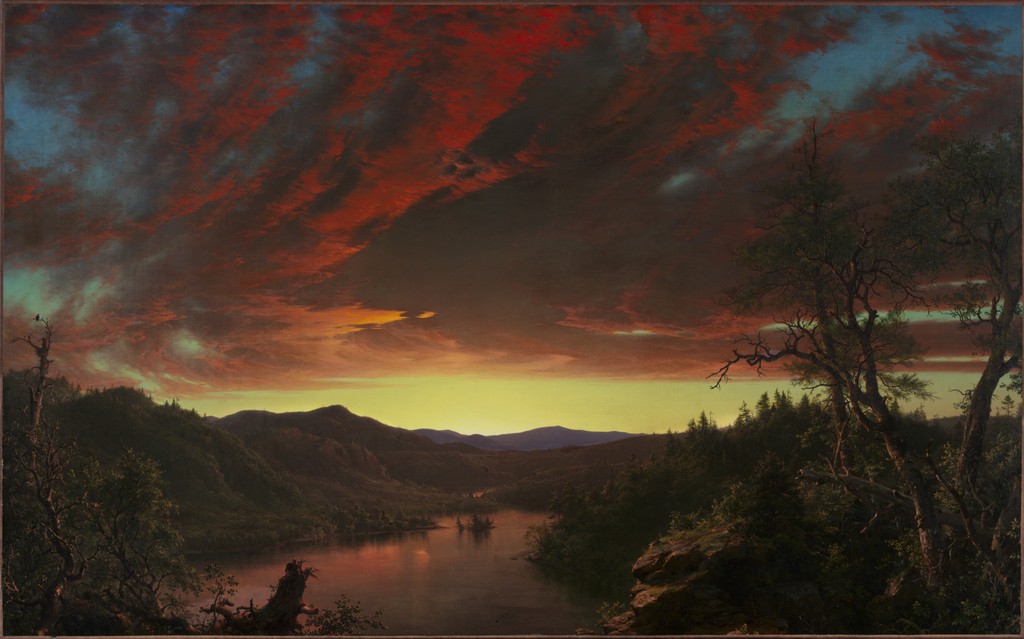
| Twilight in the Wilderness | 1860 | Oil on canvas |
| View of Cotopaxi | 1857 | Oil on canvas |
| Niagara | 1857 | Oil on canvas |
| Magdalena River, New Granada, Equador | 1853 | Graphite heightened with white on wove paper |
| Tamaca Palm, Colombia or Ecuador | May–October 1853 | Graphite on gray laid paper |
| Mixed Sketches with a Champan, Río Magdalena, Colombia | May 1853 | Graphite on gray laid paper |
| Study for Rainy Season in the Tropics | 1865–1866 | Graphite on ruled notepad paper |
| Al-Khazneh, Petra (study) | February–March 1868 | Oil and graphite on tan paperboard |
| The Great Fall, Niagara (Charles Risdon, after Church) | 1874 impression | Hand-coloured chromolithograph on paperboard |
| The Heart of the Andes (William Forrest, after Church) | 1862 | Engraving in black on wove paper |
| Our Heaven Born Banner (William Bauly, adapting Church’s motif) | circa 1861 | Colour lithograph |
| A Tropical Moonlight (wood engraving after Church) | 1879 publication | Wood engraving in American Painters |
| Off Iceberg, Newfoundland | June 1859 | Oil and graphite on paperboard |
| Parthenon at Night, Athens | April 1869 | Oil and graphite on tan paperboard |
| Jerusalem from the Mount of Olives (study) | 1 April 1868 | Oil and graphite study |
| Horseshoe Falls (study) | December 1856–January 1857 | Oil on paper mounted to canvas |
| Niagara Falls, from the American Side | 1867 | Oil on canvas |
| Study for The Heart of the Andes | 1858 | Oil study |
| Mount Chimborazo through Rising Mist and Clouds | 1857 | Oil study |
| Cotopaxi Erupting, Viewed from Quito, Ecuador | June 1857 | Oil and graphite on tan paperboard |
| Cotopaxi (painted for Cyrus Field) | 1855 | Painting |
| Chimborazo | 1864 | Painting |
| Twilight, A Sketch | 1858 | Oil on canvas |
| View of Baalbek | 1868 | Oil and pencil on board |
| Three Bedouins | Date unconfirmed | Oil study |
| Coast Scene, Mount Desert (later canvas) | 1863 | Painting |
| The Wreck | Date unconfirmed | Painting |
| Grand Manan Island, Bay of Fundy | Date unconfirmed | Painting |
| Summer in South America | circa 1853 | Painting |
| Evening in Vermont | Date unconfirmed | Painting |
| Home by the Lake | Date unconfirmed | Painting |
| Storm in the Blue Mountains, Jamaica | August 1865 | Painting |
| The Natural Bridge, Virginia | 1852 | Painting |
| The Vale of St. Thomas, Jamaica | 1867 | Painting |
| Tequendama Falls, near Bogota, New Granada | Date unconfirmed | Painting |
| Sunrise in Syria | Before the 1876 exhibition | Painting |
| Cuernavaca (oil study; descriptive title) | 1898 | Oil study |
| Olana window design (descriptive title) | Date unconfirmed | Watercolour and graphite |
| Olana dining-room stencil sketch (descriptive title) | Date unconfirmed | Oil and graphite |
| Olana house (with Calvert Vaux) | 1870–1872; later additions | Architecture |
| Olana designed landscape | From 1860; developed over decades | Designed landscape |
Frequently Asked Questions
The 1857 painting belongs to the National Gallery of Art, Washington, as part of the Corcoran Collection, accession 2014.79.10. [1]
He used drawings and oil studies from visits to the falls to develop a studio composition. The finished view combines and adjusts observed features rather than reproducing one sketch or a single straightforward viewpoint. [3]
Different textures make the water, foam, falling sheets and mist convincing. Church also constructed a view combining the near and far sides of the falls. Its realism is an artistic effect rather than proof that a spectator could stand at exactly this position. [1]
Williams, Stevens & Williams exhibited it in New York in May 1857, charging twenty-five cents. British and American touring and reproductive prints subsequently expanded its audience. [2]
Discussion
Look again at the images and ideas explored in Niagara. These editorial prompts invite your own observations.
Reader Insights
Where does the painting make you imagine standing in relation to the brink?
Which small detail most changes your impression of the rushing water’s scale?
How does the separate 1867 Niagara painting help you notice the distinctive arrangement of this 1857 canvas?
Join the Conversation
Share a detail, comparison or question about Niagara below.
References
- National Gallery of Art. Niagara, 1857, 2014.79.10. Object details, provenance, exhibition history and audio interpretation with Sarah Cash and Sara Capen.
- National Gallery of Art. “The 19th-Century Blockbuster: Frederic Edwin Church's ‘Niagara’”, 4 August 2023.
- Franklin Kelly, “Niagara,” in Sarah Cash, ed., Corcoran Gallery of Art: American Paintings to 1945, 2011, pp. 112–115; notes p. 263. The Home Journal response of 9 May 1857 is quoted and identified in this catalogue; the original newspaper issue was not consulted.
- Smithsonian American Art Museum. Horseshoe Falls, December 1856–January 1857, online gallery for Alexander von Humboldt and the United States: Art, Nature, and Culture, 2020.
- Franklin Kelly, “Frederic Edwin Church,” in Frederic Edwin Church, National Gallery of Art, 1989, pp. 48–52.
- Smithsonian American Art Museum. Niagara, online gallery for Alexander von Humboldt and the United States: Art, Nature, and Culture, 2020.
- Kevin J. Avery. Church's Great Picture: The Heart of the Andes. Metropolitan Museum of Art, 1993, pp. 9–11, 28–29, 33–36.
- National Galleries of Scotland. Niagara Falls, from the American Side, 1867, NG 799. Collection record and interpretation by John Leighton.
- Splash image source.
Frederic Edwin Church, Niagara, 1857. Oil on canvas, 101.6 × 229.9 cm. National Gallery of Art, Washington, Corcoran Collection (Museum Purchase, Gallery Fund, 1876), 2014.79.10. Image source. CC0 / NGA Open Access. Resized; full source proportions retained.