 by Tom Gurney
Tom Gurney BSc (Hons) is an art history expert with over 20 years experience
Email: tomgurney1@gmail.com / Phone: +44 7429 011000
Style and Technique: Introduction
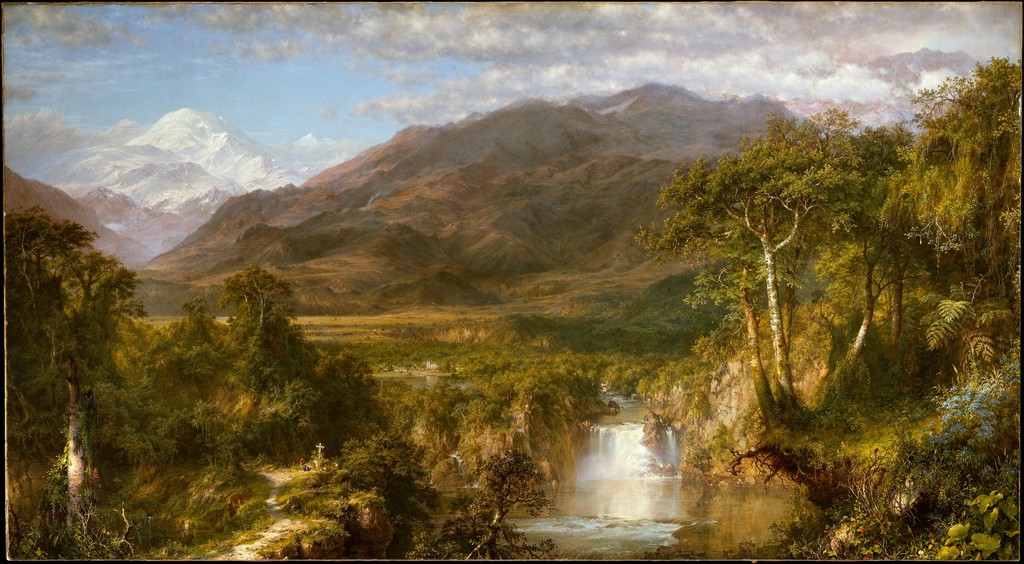
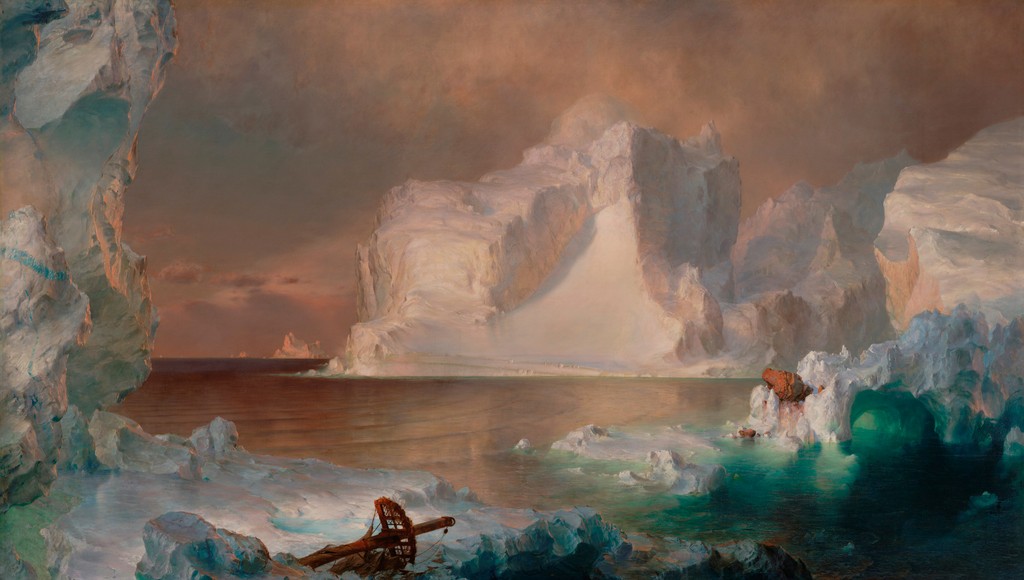
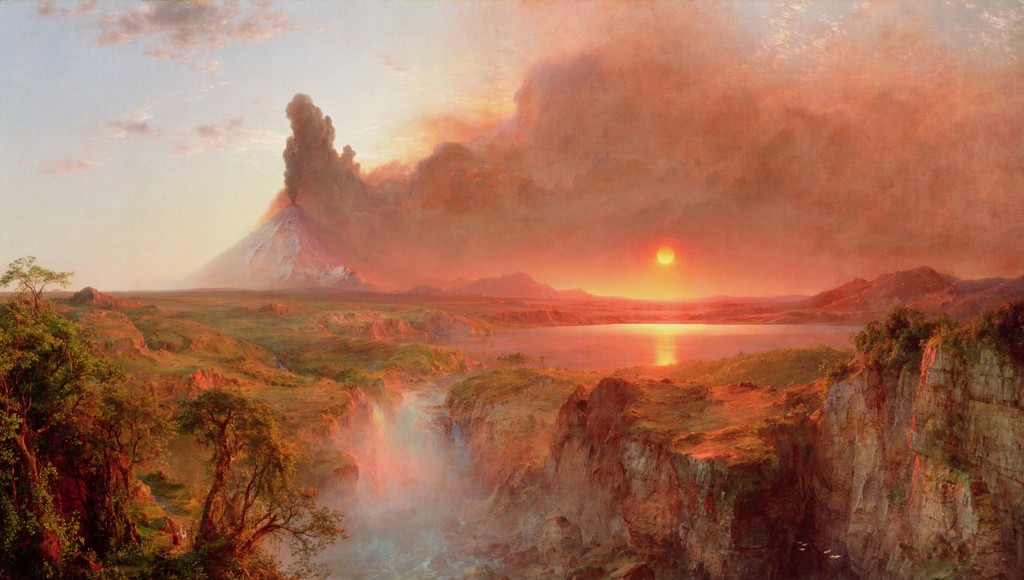
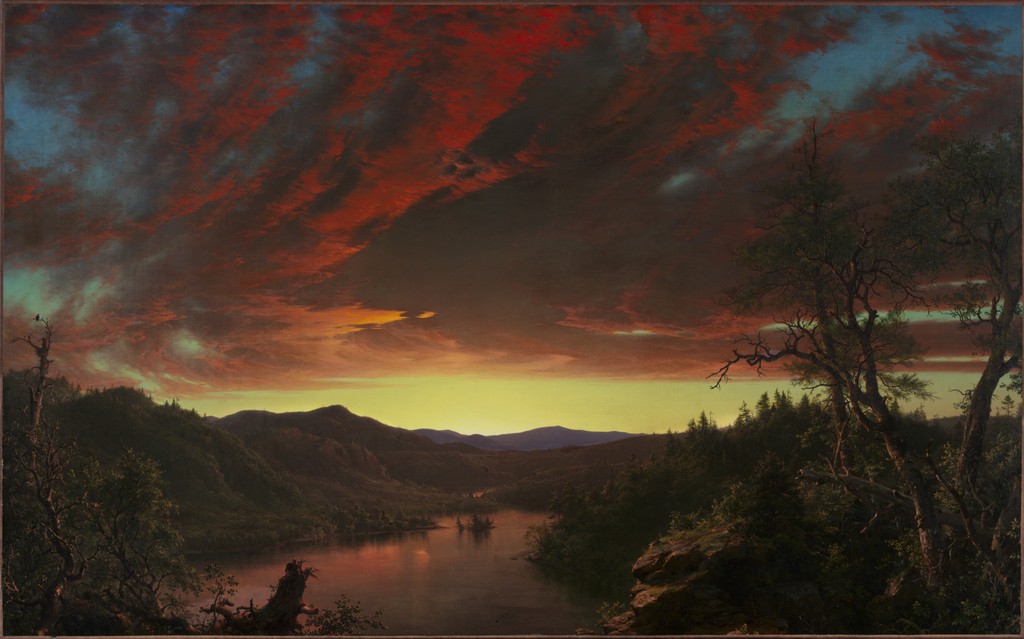
Frederic Edwin Church made landscapes that reward two kinds of attention. From a distance, a waterfall, mountain or shaft of sunlight gives the picture its direction. Close looking reveals smaller structures: the arrangement of palm fronds, the edge of a rock, or a reflection broken across moving water. His achievement lies in making those levels work together. Detail supplies interest, while composition gives the viewer a route through it.
Surviving working sheets help explain that relationship. A palm drawing records particular forms; a small landscape sketch tests an arrangement; an oil study gives different areas different degrees of finish. Finished canvases add another kind of evidence. Their viewpoints and contrasts show how Church organized an experience, while conservation accounts reveal material choices that a reproduction alone cannot establish.
At a Glance
- Working mediaGraphite drawings and oil studies, including oil and graphite on paperboard
- CompositionSelection and combination of observed forms, testing of spatial arrangements
- Finished effectDetailed foregrounds, controlled contrasts, expansive or enclosing viewpoints
- Material evidencePublished conservation account for El Rio de Luz
- Changes over timeRecorded artist repairs and later conservation treatments
- Useful comparisonsTamaca palm drawing and painting, Petra oil study, Rainy Season study, Niagara
Contents
- Training and the composed landscape
- Observing a palm and placing it in a landscape
- Different degrees of finish in an oil study
- Testing a composition on ruled paper
- Niagara and the construction of a viewpoint
- Detail and the larger pattern of light
- Paint layers in El Rio de Luz
- Artist repairs and changes in appearance
- Comparing working marks and finished effects
- Annotated details
Training and the composed landscape
Church began studying with Thomas Cole in 1844. Franklin Kelly explains the importance of that training through Cole’s combination of observation and imaginative composition. Nature supplied forms, but the finished landscape could give them a larger expressive purpose. Church developed a distinct emphasis on clarity and closely described detail within that inheritance.[1]
That combination helps explain why realism is an incomplete description of his method. A convincingly drawn tree can belong to a deliberately arranged landscape. The viewer’s confidence in its leaves or trunk does not establish that every surrounding feature was visible from one place. Accuracy at the level of a particular form and invention at the level of the whole picture can coexist.
Kelly also places Church’s South American landscapes in relation to Alexander von Humboldt’s ideas. Close study of nature could support a painting that expressed the character of a region through a wider synthesis. The purpose extended beyond reproducing a single geographical view.[1] This distinction is useful when comparing drawings with finished canvases. A study can preserve a feature that the painting relocates, enlarges or places beside other features.
The result need not look artificial. Church’s pictures often offer so many plausible relationships between light, form and distance that their construction becomes easy to overlook. Looking for his decisions means considering where the largest masses sit, how openings lead into distance, and which details receive emphasis. Those questions reveal composition without reducing the landscape to a diagram.
Annotated Details from Style and Technique
The numbered points draw attention to visible features discussed in this article. Look from each detail back to the full composition. Each image keeps its own identity, date and medium in the caption below.
Tamaca Palm, Colombia or Ecuador
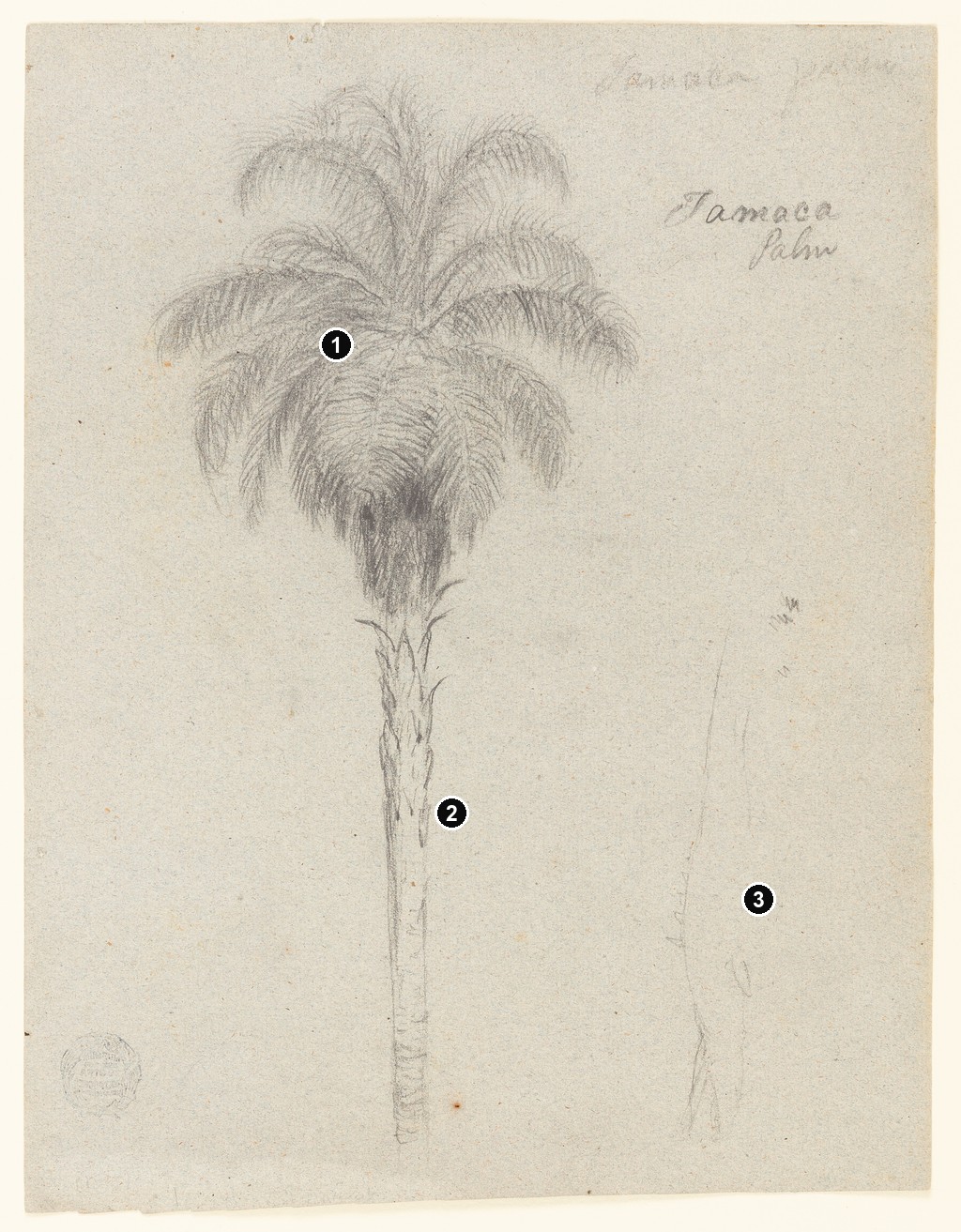
Frederic Edwin Church, Tamaca Palm, Colombia or Ecuador, May–October 1853, graphite on gray laid paper, 28.2 × 21.5 cm. Cooper Hewitt, Smithsonian Design Museum, Gift of Louis P. Church, 1917-4-107. Smithsonian Open Access, CC0 1.0. Source image. CC0 1.0 Universal. Numbered overview resized; detail crops added from the source master. No recolouring.
Al-Khazneh, Petra
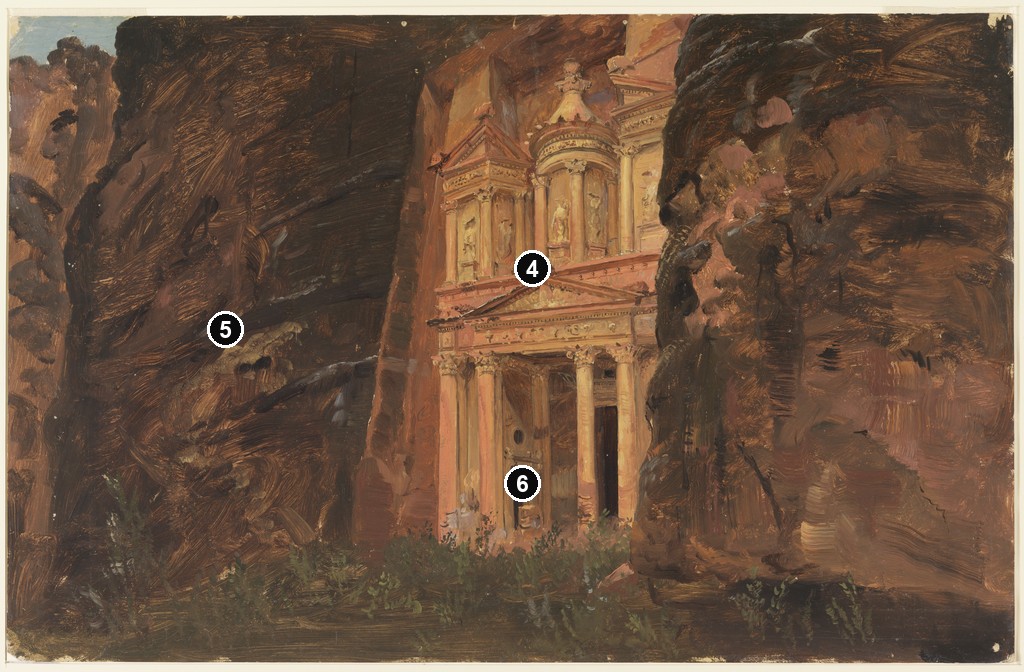
Frederic Edwin Church, Al-Khazneh, Petra, February–March 1868, oil and graphite on tan paperboard, 32.8 × 50.8 cm. Cooper Hewitt, Smithsonian Design Museum, Gift of Louis P. Church, 1917-4-485-a. Smithsonian Open Access, CC0 1.0. Source image. CC0 1.0 Universal / Smithsonian Open Access. Numbered overview resized; detail crops added from the source master. No recolouring.
Study for Rainy Season in the Tropics
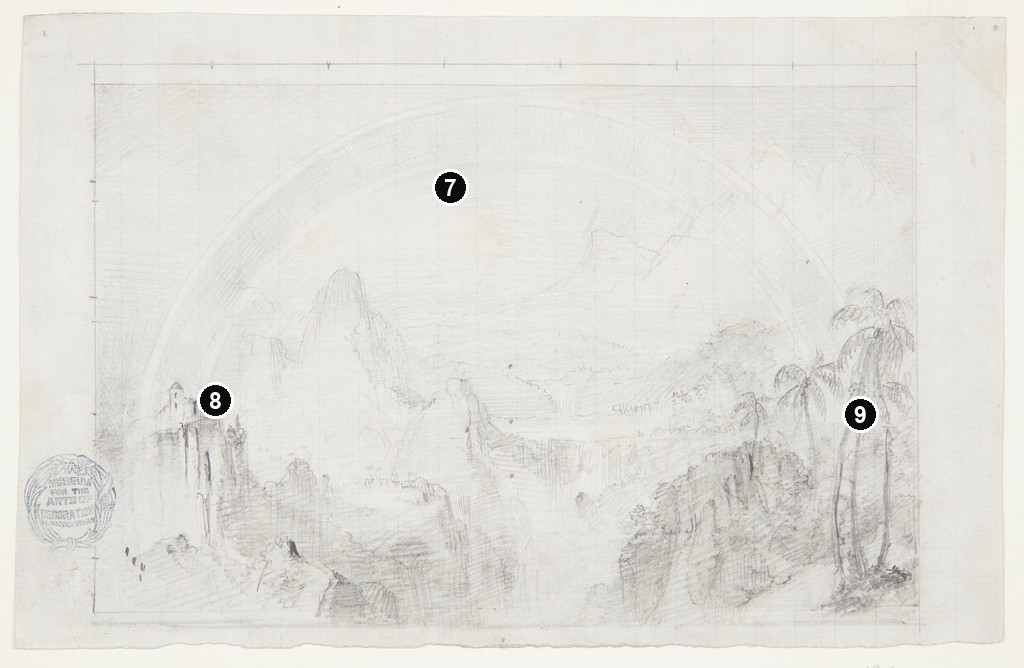
Frederic Edwin Church, Study for Rainy Season in the Tropics, 1865–1866, graphite on white notepad paper ruled in blue ink, 13.4 × 20.6 cm, recto. Cooper Hewitt, Smithsonian Design Museum, Gift of Louis P. Church, 1917-4-771. Smithsonian Open Access, CC0 1.0. Source image. CC0 1.0 Universal. Numbered overview resized; detail crops added from the source master. No recolouring.
Niagara
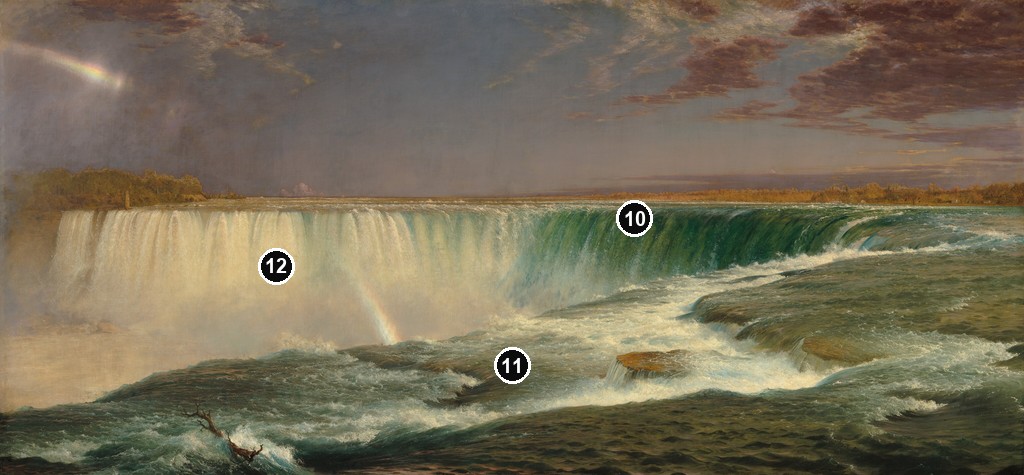
Frederic Edwin Church, Niagara, 1857, oil on canvas, 101.6 × 229.9 cm. National Gallery of Art, Washington, Corcoran Collection (Museum Purchase, Gallery Fund, 1876), 2014.79.10. NGA Open Access, CC0. Source image. CC0 / NGA Open Access. Numbered overview resized; detail crops added from the source master. No recolouring.
El Rio de Luz (The River of Light)
Frederic Edwin Church, El Rio de Luz (The River of Light), 1877, oil on canvas, 138.1 × 213.7 cm. National Gallery of Art, Washington, Gift of the Avalon Foundation, 1965.14.1. NGA Open Access, CC0. Source image. CC0 / NGA Open Access. Numbered overview resized; detail crops added from the source master. No recolouring.
.jpg)
Details from STYLE AND TECHNIQUE
These crops come directly from the verified source images. They preserve the original colours or printed tones; the numbered overview is a separate aid to looking.
Tamaca Palm, Colombia or Ecuador
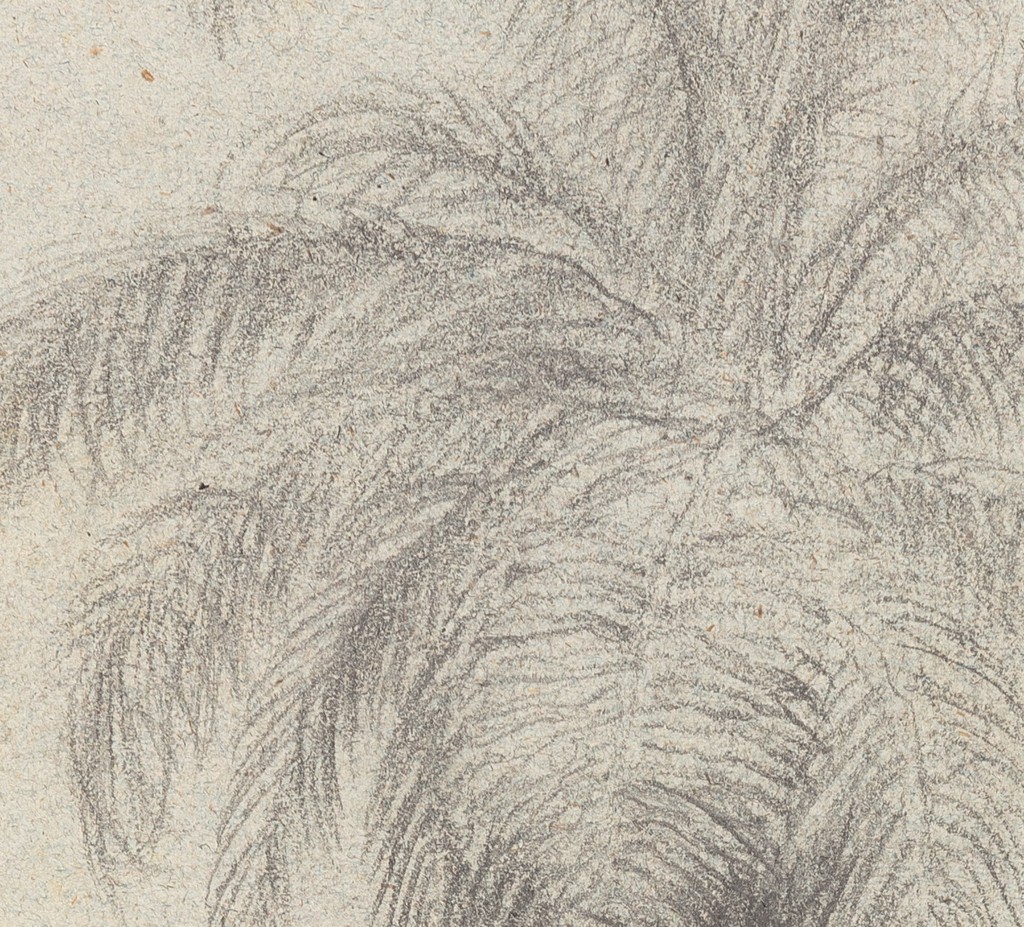
Palm crown
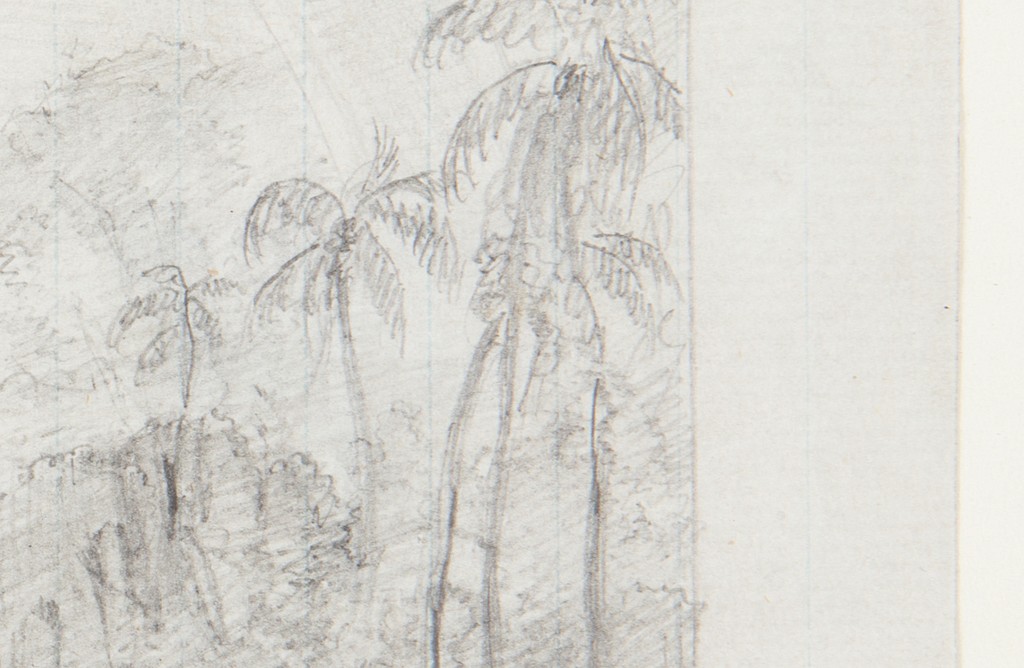
Curved graphite strokes follow the spreading fronds. Darker hanging clusters gather beneath the crown.
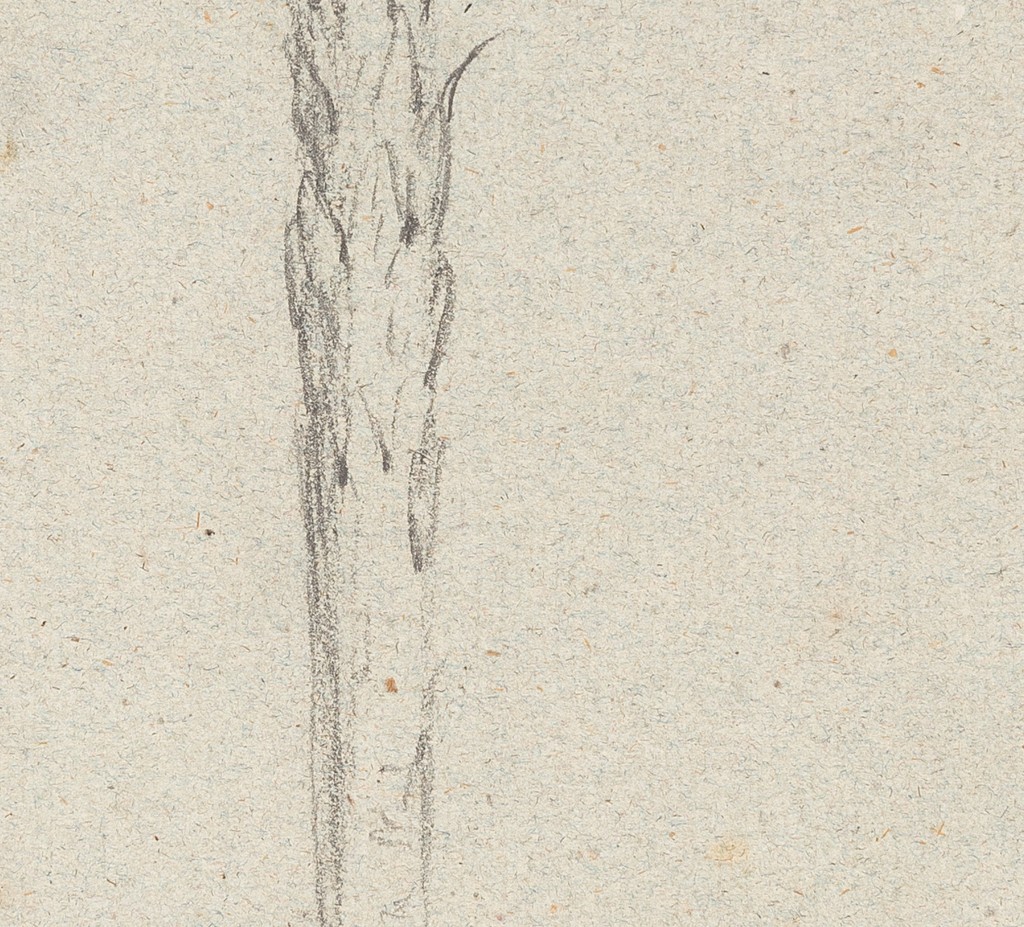
Slender trunk
The long trunk crosses lightly marked paper. Its narrow form makes the concentrated crown appear fuller.
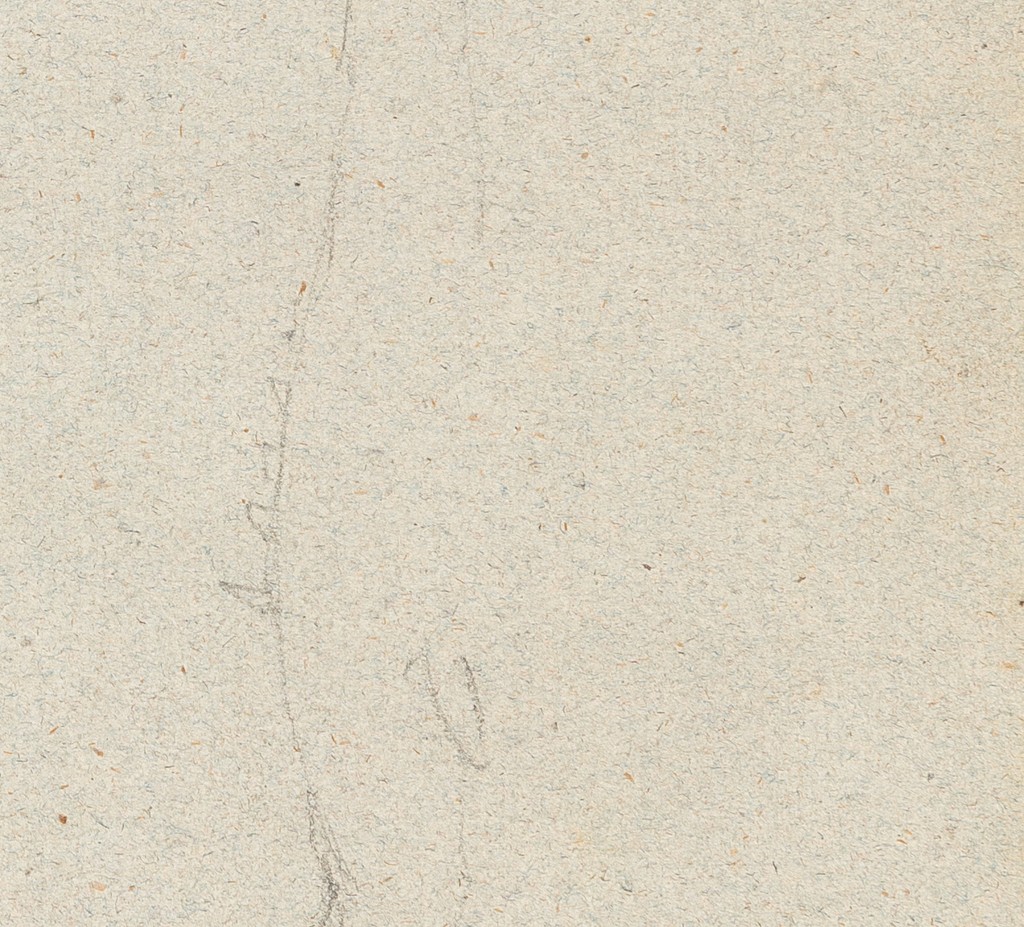
Fainter neighbouring palm
A second palm is indicated much more lightly at the right. The unequal finish shows different degrees of attention within one sheet.
Al-Khazneh, Petra
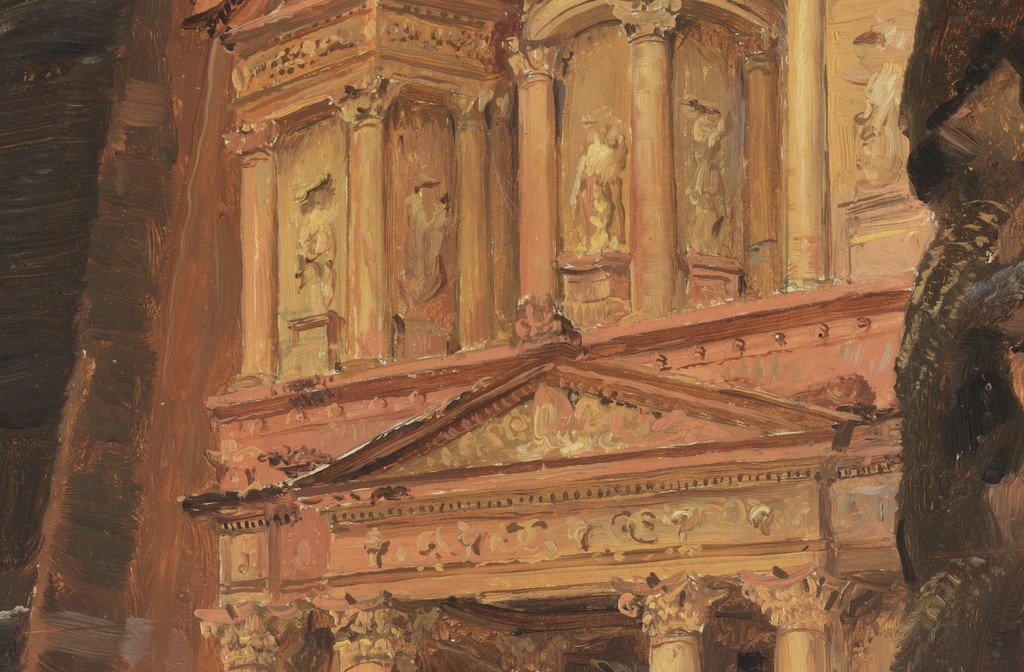
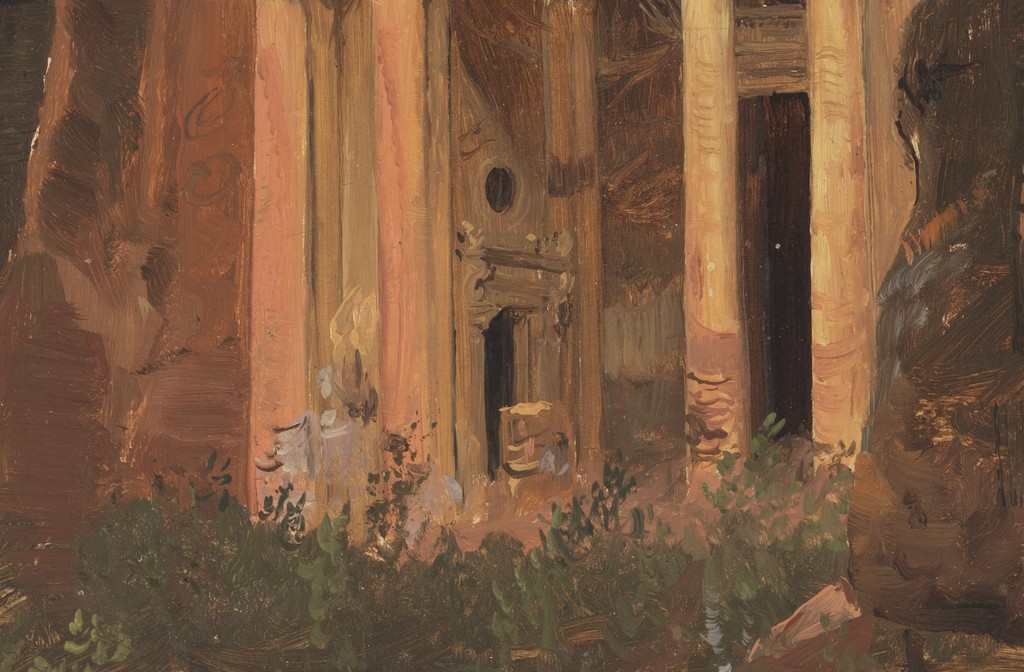
Carved façade
Controlled marks describe the columns and upper structure of the carved building.
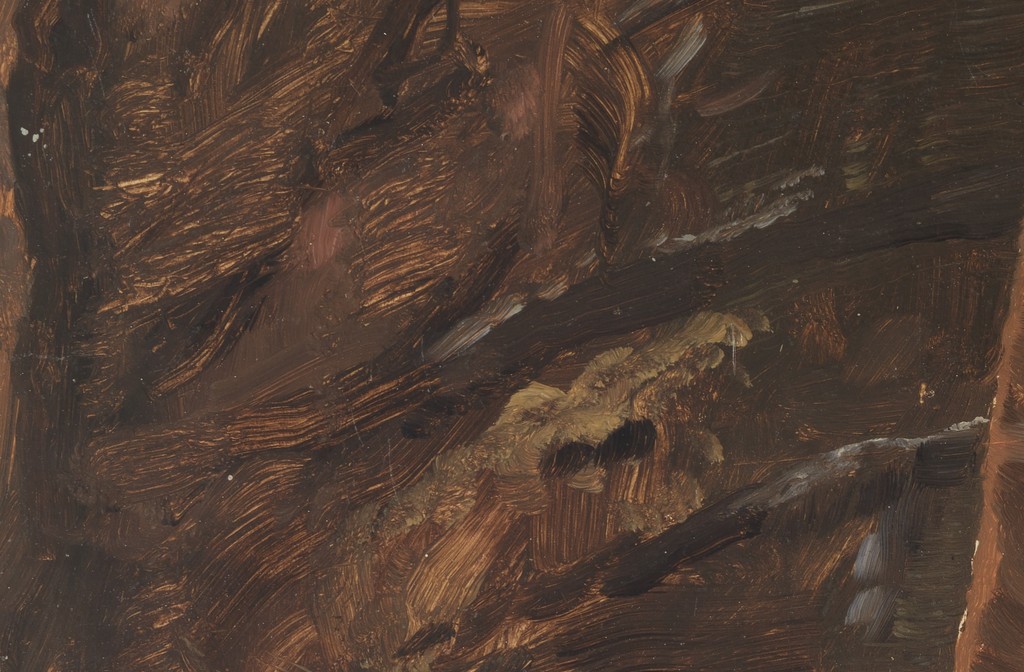
Surrounding rock
Broader strokes follow the irregular canyon walls. Their handling differs from the architecture’s repeated forms.
Lower doorway
A dark doorway anchors the lower part of the façade. Smaller green patches and uneven stone complicate the area around it.
Study for Rainy Season in the Tropics
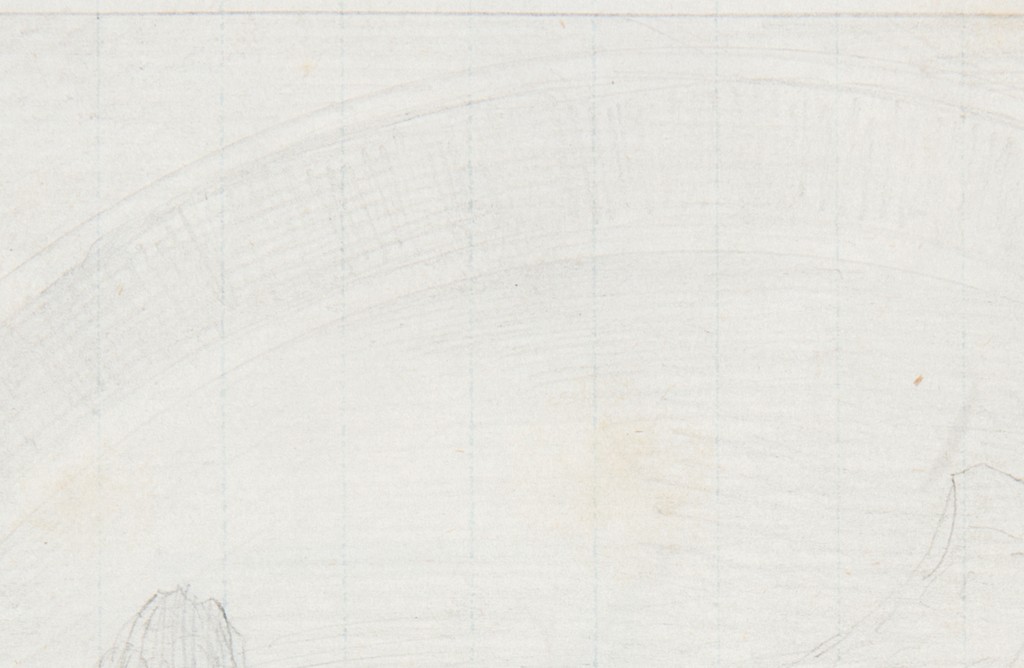
Double arcs
Two broad arcs organise the landscape before colour distinguishes their surfaces. The ruled paper remains visible behind the graphite.
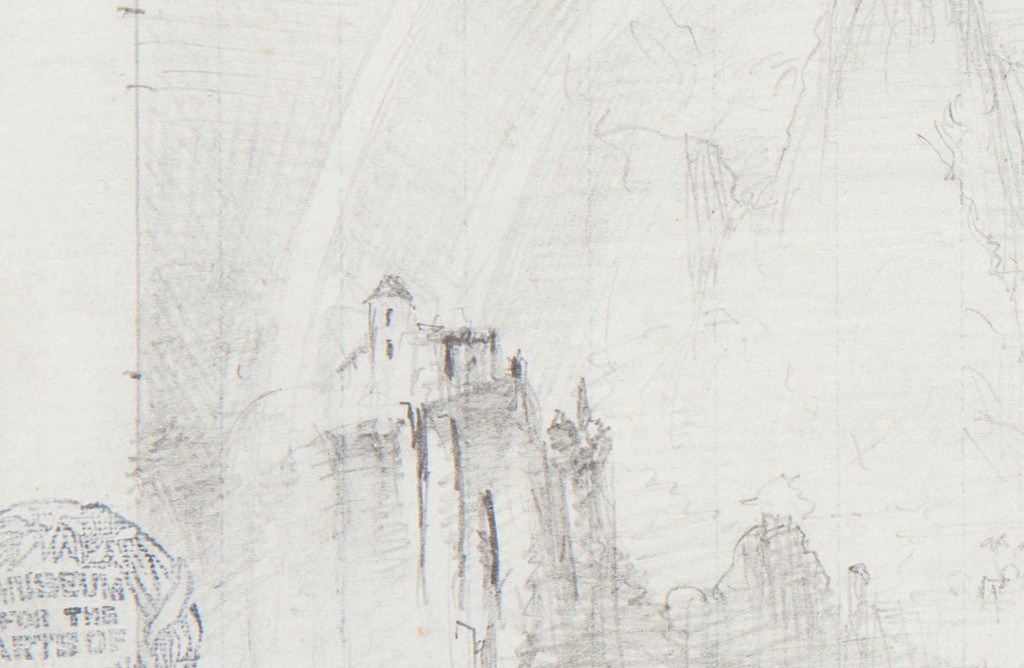
Cliff-side building
A small building appears above the cliff at the left. Compare its presence here with the corresponding area in the finished painting.
Right palms
Palms establish the near right side of the proposed composition. Their placement relates them to the arcs and descending terrain.
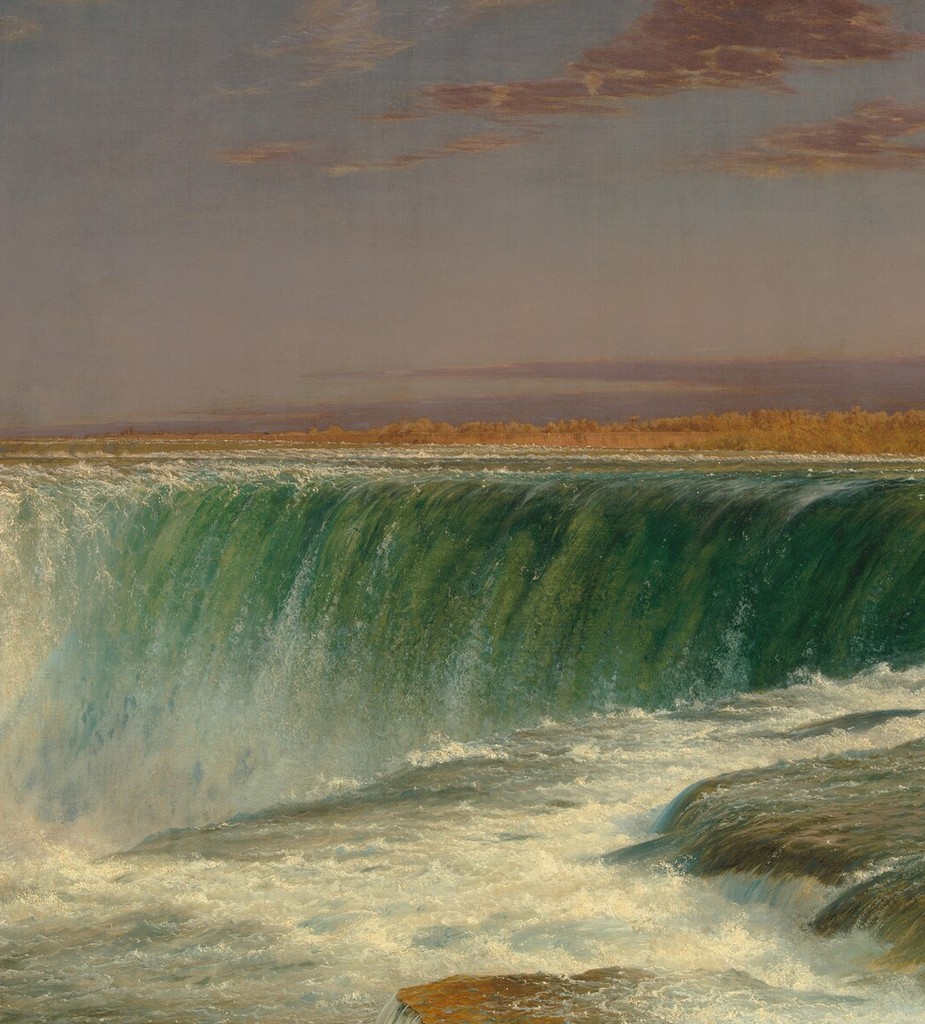
Niagara
Curving brink
Green water curls over the curved edge before dropping away. The change from the near surface to the falling sheet makes the brink especially forceful.
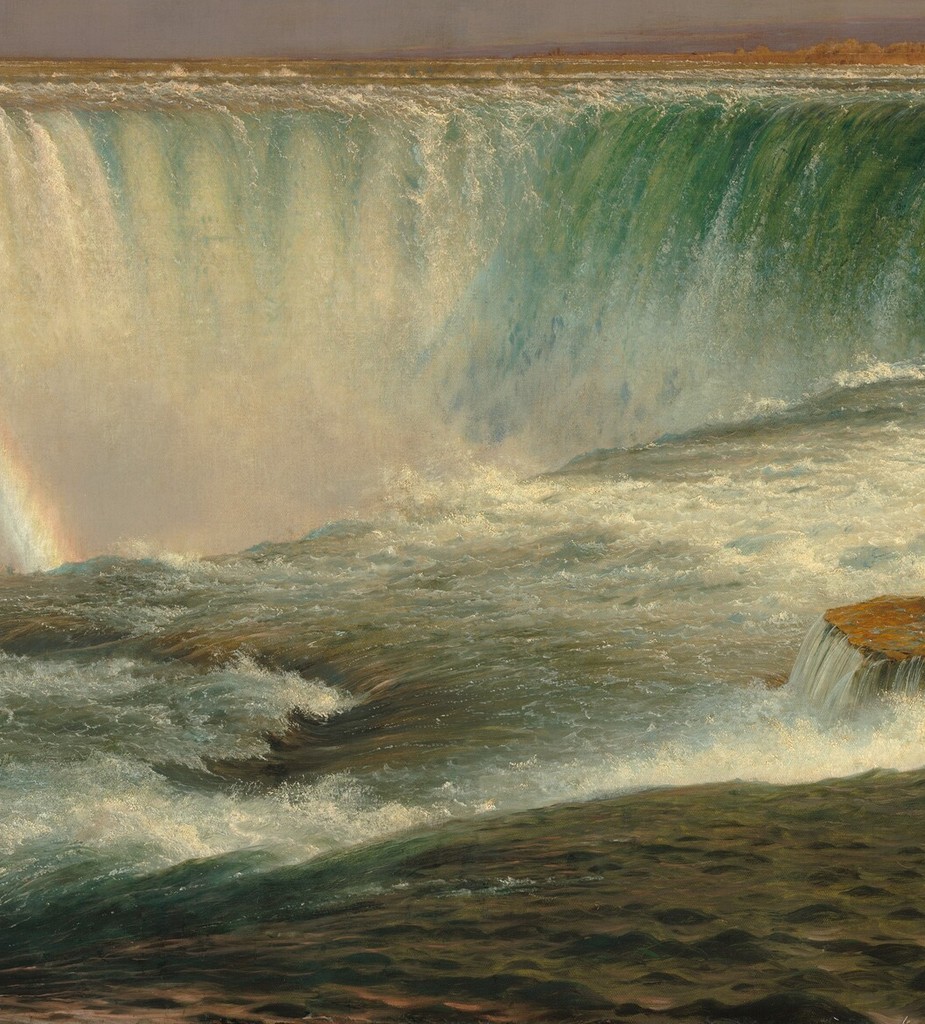
Near foam
Pale foam breaks across darker moving water. Its irregular forms keep the foreground active rather than providing a safe place to stand.
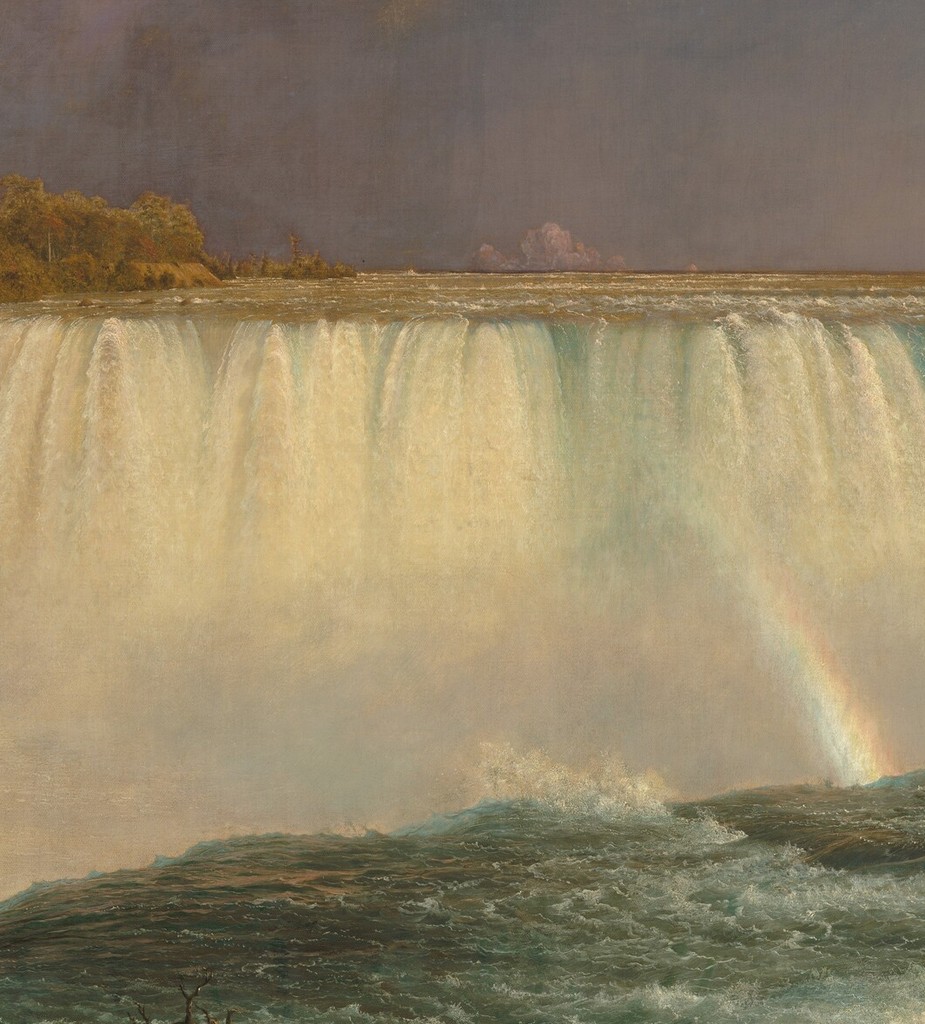
Mist and rainbow
Mist softens the falling water and carries part of the rainbow. The atmospheric passage differs from the more sharply described waves nearby.
El Rio de Luz (The River of Light)
Near canopy
Dense foliage and a large trunk shelter the near riverbank. Their varied dark forms contrast with the quieter opening beyond.
 Detail 13 near-canopy.jpg)
Sun through mist
A pale sun appears through an atmospheric veil. Its soft boundary differs from the sharper vegetation nearby.
 Detail 14 sun-through-mist.jpg)
Vertical reflection
The sun’s reflection draws a bright vertical route across the river. Its narrow glow helps connect the distance to the foreground water.
 Detail 15 vertical-reflection.jpg)
Observing a palm and placing it in a landscape
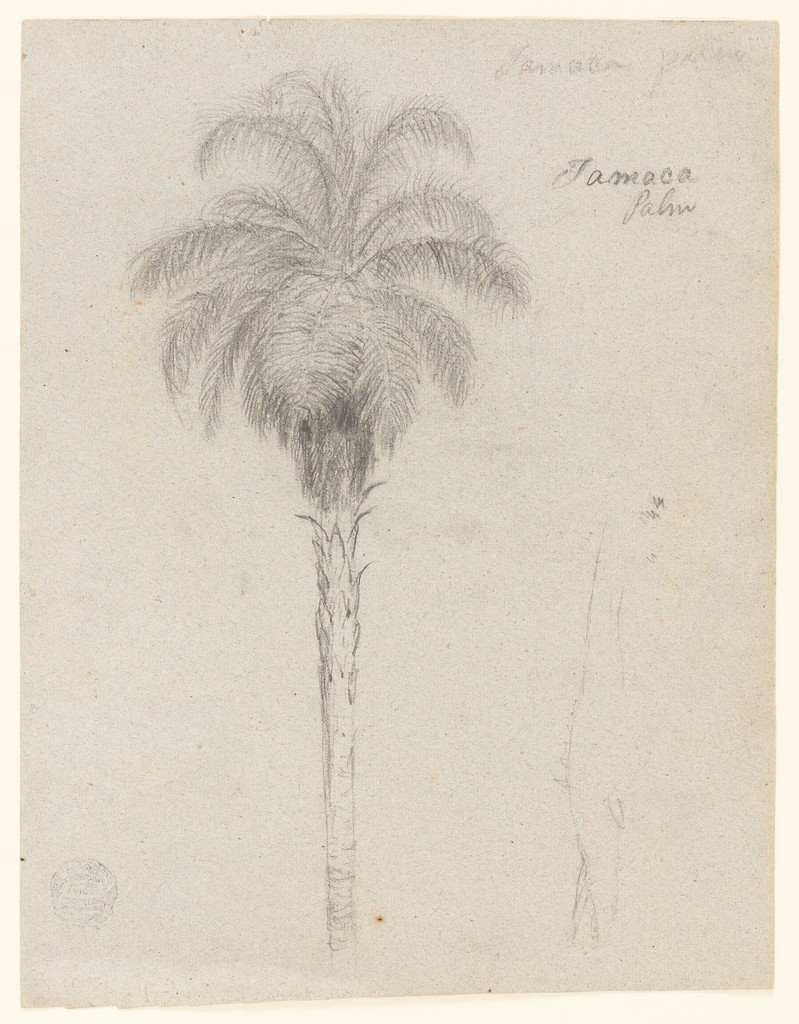
The Cooper Hewitt holds Church’s graphite drawing Tamaca Palm, Colombia or Ecuador, dated May–October 1853. Its current record identifies gray laid paper and dimensions of 28.2 by 21.5 centimetres.[2] The drawing isolates a palm against the open sheet. Its upright trunk leads into a dense crown, where hanging and spreading fronds form an irregular outline. The unfilled surroundings give that outline unusual prominence.
The sheet invites a different kind of looking from the finished Tamaca Palms. In graphite, the tree’s structure carries most of the interest. Variations in the marks distinguish the trunk from the fronds, while the areas between leaves remain part of the drawing. Paper shows through the crown, so the tree is described through both marks and gaps. Colour and an extensive setting are unnecessary for that particular investigation.
Kelly relates this study to the tallest palm at the left of the 1854 painting.[3] In the canvas, that tree becomes part of a larger group beside the river. Nearby foliage thickens the bank, while the open water and distant mountain expand the setting around it. Its role changes: the palm contributes a recognizable form and a strong vertical within the wider arrangement.
Comparing the two also makes scale a practical question. A large palm near the viewer gives the mountain something to stand beyond. Its dark crown sits against a lighter sky, making its silhouette easy to read. The study helps us attend to the form itself; the painting makes that form organize distance and contrast. Tamaca Palms develops those relationships across the whole river landscape.
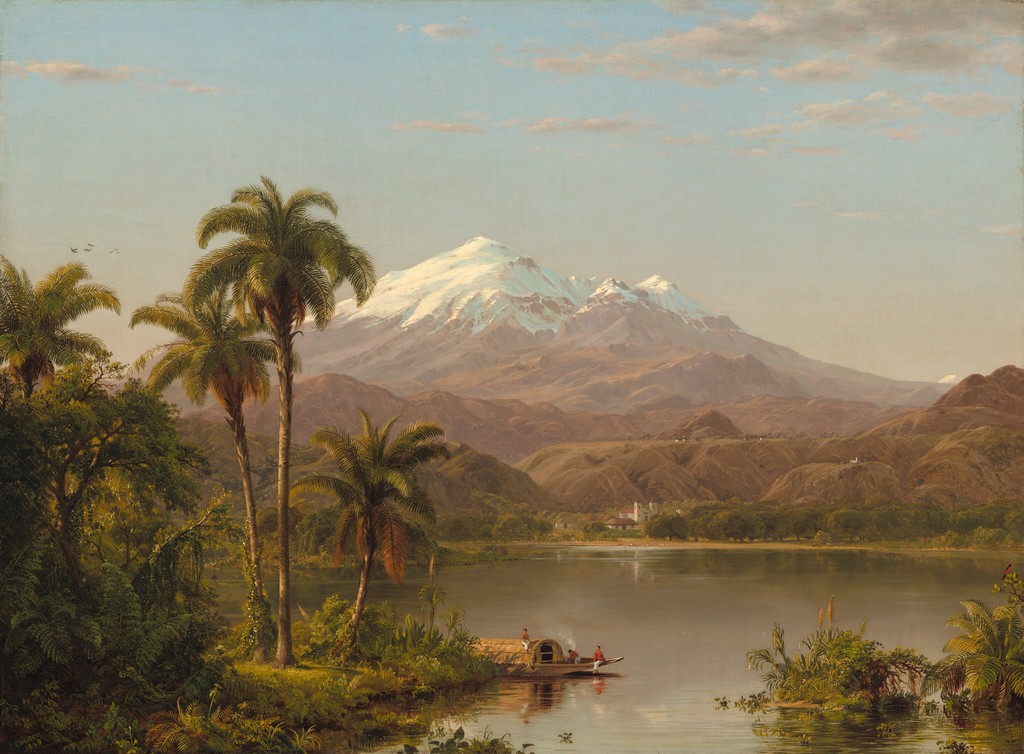
Frederic Edwin Church, Tamaca Palms, 1854, oil on canvas, 67.9 × 91.3 cm. National Gallery of Art, Washington, Corcoran Collection (Gift of William Wilson Corcoran, 1869), 2014.79.11. NGA Open Access, CC0. Image source. CC0 / NGA Open Access. Resized; full source proportions retained.
Different degrees of finish in an oil study
Church’s Al-Khazneh, Petra study offers another approach to working from a subject. The Cooper Hewitt dates it to February–March 1868 and records oil and graphite on tan paperboard, measuring 32.8 by 50.8 centimetres.[4] The horizontal support contains the warm architectural facade, dark enclosing rocks, a small opening of sky and touches of green below.
The architecture receives more internal definition than much of the surrounding rock. Columns and divisions of the facade remain recognizable, while wider marks gather the rock into substantial masses. That difference is visible within one image. It prevents a simple equation between a study and uniformly loose handling: Church could describe a chosen part carefully while leaving another part broader.
The contrast has a compositional consequence. Dark rock makes the warmer facade stand out, and the open sky provides a separate area of light and colour. The building does not need equal sharpness everywhere around it to become the focus. Its structure becomes legible through the relationship between detailed and broadly described areas.
This is a useful distinction when discussing finish. Finish concerns how a passage is developed and what it contributes to the image; it is not a count of tiny marks. In the Petra study, the facade and rocks serve different purposes. A smooth reproduction can still reveal broad and narrow handling, but it cannot tell us the full order of paint application. The visible study establishes a range of attention within Church’s working practice, without supplying a recipe for every later canvas.
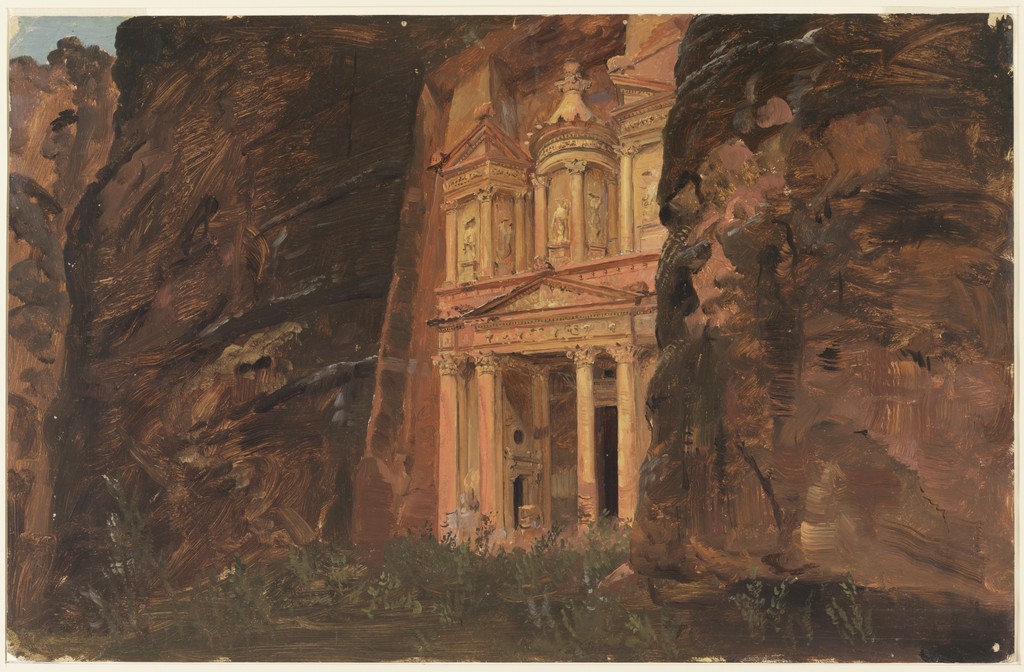
Frederic Edwin Church, Al-Khazneh, Petra, February–March 1868, oil and graphite on tan paperboard, 32.8 × 50.8 cm. Cooper Hewitt, Smithsonian Design Museum, Gift of Louis P. Church, 1917-4-485-a. Smithsonian Open Access, CC0 1.0. Image source. CC0 1.0 Universal / Smithsonian Open Access. Resized; full source proportions retained.
Testing a composition on ruled paper
The Study for Rainy Season in the Tropics is a compact graphite drawing on white notepad paper ruled in blue ink. The museum dates it to 1865–1866 and identifies it as made in the United States, with South America as the depicted place.[5] Those distinctions matter: this is evidence of arranging a South American landscape during work on the picture, rather than a dated record of standing before that complete view in the tropics.
On the recto, two large arcs span mountains and a watercourse. Palms occupy the right, and a building stands near the edge of the high cliff at the left. The drawing concentrates attention on relationships between major elements. The arcs bridge the width of the sheet; the cliff and palms create unequal sides; the opening through the centre permits distance.
Compared with the finished Rainy Season in the Tropics of 1866,[6] the building on the left cliff is a conspicuous difference. The finished reproduction gives that area to the rocks. The comparison therefore shows a compositional option that did not remain in the same form. It does not establish why Church changed it or a complete sequence of intermediate decisions.
The study’s small size makes its economy striking. Lines can test where an arc passes and where a mass begins without resolving the colour of mist or the detail of vegetation. In the finished painting, those relationships become a much fuller experience of light, weather and distance. Church’s drawings include this kind of planning alongside more concentrated observations of individual forms.
The ruled support remains visible through the graphite. Its blue lines belong to the paper, whereas the curved arcs and irregular mountain outlines belong to the drawing. Keeping that distinction in view helps separate the material Church worked on from the landscape he was arranging. The sheet carries both kinds of information at once. Its edges also show the limits within which the arrangement fits, allowing the two arcs to be understood across the complete width. A tightly cropped detail of a mountain would answer a different question from the full working sheet. To follow a compositional decision, it is often necessary to see the surrounding open paper as well as the marks themselves.
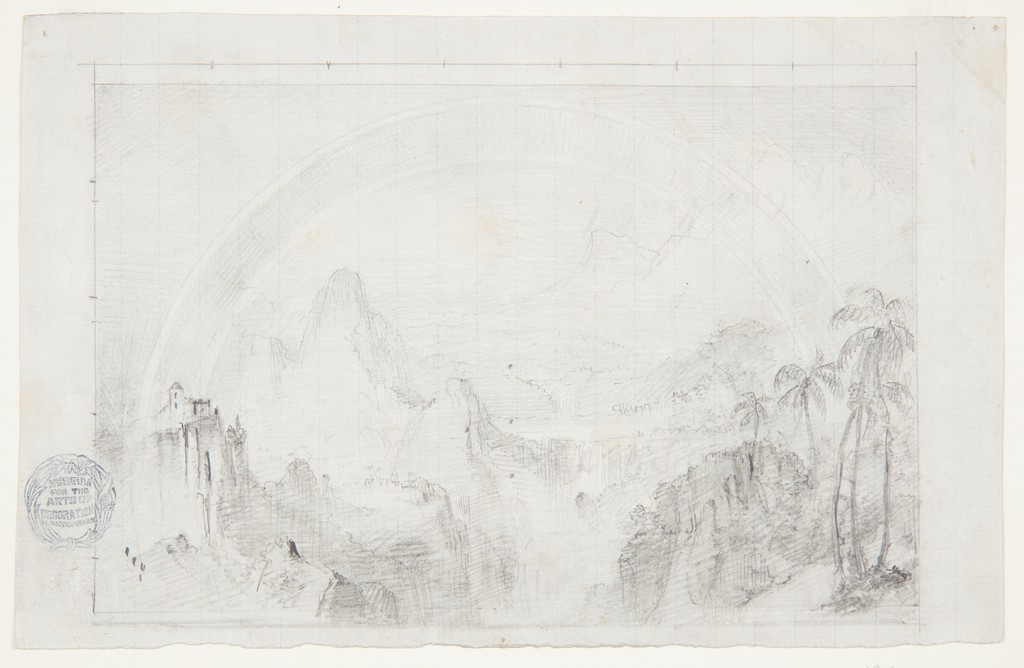
Frederic Edwin Church, Study for Rainy Season in the Tropics, 1865–1866, graphite on white notepad paper ruled in blue ink, 13.4 × 20.6 cm, recto. Cooper Hewitt, Smithsonian Design Museum, Gift of Louis P. Church, 1917-4-771. Smithsonian Open Access, CC0 1.0. Image source. CC0 1.0 Universal. Resized; full source proportions retained.
Niagara and the construction of a viewpoint
Niagara presents rushing water with a persuasive sense of proximity. The near water fills the lower part of the picture, and the broad curve of the falls draws attention across its width. There is little comfortable separation between the viewer and the brink. The visual experience begins among the moving water rather than from a clearly occupied viewing platform.
In the National Gallery’s audio account, curator Sarah Cash explains that Church brings the near and far sides of the falls into a view that the human eye could not see together in this way.[7] Her observation clarifies a major compositional choice. The picture’s convincing water does not make its total viewpoint an ordinary record of one stationary position.
Across the reproduction, changes in the water’s appearance carry that construction. Darker stretches are interrupted by pale turbulence. Near the brink, relatively continuous areas meet broken white passages; farther across, the curve changes the direction in which the water appears to move. The image gives the eye several different descriptions of the same material within a coherent space.
Mist creates another kind of boundary. It partly obscures what lies below the edge, allowing the falls to continue beyond what can be clearly seen. The distant banks supply a measure of scale, while their smaller details leave the foreground water dominant. These are observable relationships within the picture, rather than evidence of which brush or pigment Church used. The dedicated Niagara article considers the canvas’s exhibition history and broader meanings alongside this constructed viewpoint.
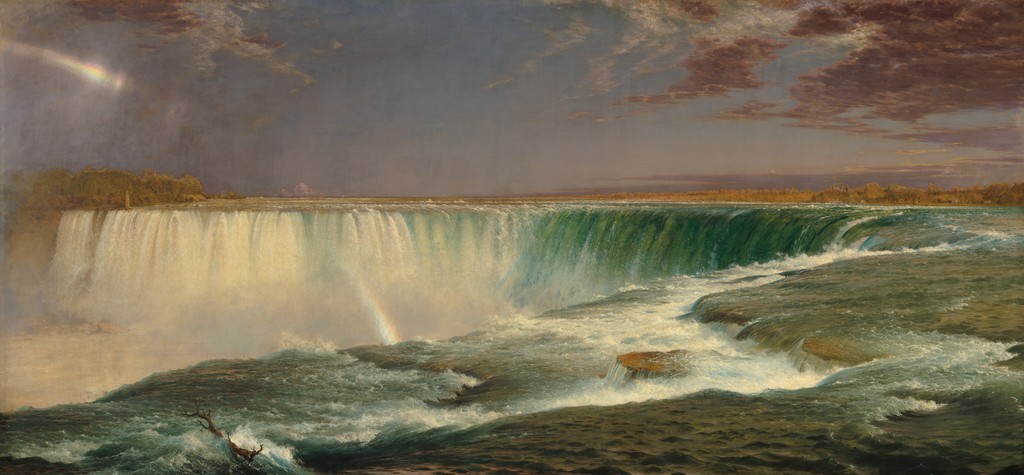
Frederic Edwin Church, Niagara, 1857, oil on canvas, 101.6 × 229.9 cm. National Gallery of Art, Washington, Corcoran Collection (Museum Purchase, Gallery Fund, 1876), 2014.79.10. NGA Open Access, CC0. Image source. CC0 / NGA Open Access. Resized; full source proportions retained.
Watch: Frederic Edwin Church
Choose a film to explore the artist’s work, its interpretation and its wider setting.
Frederic Edwin Church's "The Icebergs" on the Move at the DMA
Follow the Dallas Museum of Art as it moves Church’s large painting The Icebergs.
Watch on YouTubeDetail and the larger pattern of light
Tamaca Palms and El Rio de Luz show how close description can operate within different arrangements of light. In Tamaca Palms, the dark vegetation at the left borders a relatively open river. The far mountain rises against the sky, and the picture offers several stages of distance. The dark palm group remains distinct even when the image is viewed at a modest size.
El Rio de Luz has a more enclosing effect. Foliage and fallen wood occupy the near banks, while pale light appears across the water within the vegetation. The bright reflection provides a route into the middle of the picture. Much of the canopy remains dark enough to read as a continuous mass before its separate forms attract attention.
These relationships explain why detail alone cannot account for Church’s finish. If every leaf carried equal contrast, the eye would find it harder to distinguish the main opening from its surroundings. In these reproductions, the largest contrasts establish priorities. Smaller forms then reward closer attention inside those priorities. A passage can contain many recognizable details while still belonging to one larger dark or light area.
Atmospheric distance also depends on relationships across the picture. Distant forms can appear less distinct than near ones, and a bright opening can interrupt otherwise dark foliage. Such effects are visible in an image, but the means of producing them remain a separate material question. A soft-looking passage does not, by itself, prove glazing; a crisp-looking passage does not establish the physical thickness of the paint.
Paint layers in El Rio de Luz
The National Gallery’s 1996 catalogue published a technical account of the 1877 canvas now called El Rio de Luz, under the title Morning in the Tropics. It records a white ground, with a thin brown layer possibly laid over it. Most paint was thinly applied; dark passages contained multiple glazes, while highlights used thicker paint, including some impasto.[8]
A ground is the prepared base beneath the paint. A glaze is a thin, transparent layer of colour; impasto is paint thick enough to produce a raised surface. These terms describe different parts of a painting’s material construction. They should not be treated as interchangeable names for a luminous appearance. The catalogue gives them a specific basis in this canvas.
That account allows a more precise discussion than the impression that Church simply hid every brushstroke. Thin applications and thicker highlights could coexist within the same work. The distinction between them concerns physical handling, while their contribution to the finished image depends on position, colour and surrounding contrasts. The reproduction shows where the reflection and foliage attract attention, but it cannot reproduce every physical quality of those layers.
The same catalogue records treatment in 1988. Removing discoloured varnish and earlier restoration paint from the middle-distance trees exposed pentimenti formed by brushed underpainting that laid out major features. Those passages were subsequently inpainted to reduce visual disruption.[8]
Pentimenti are traces of earlier decisions in a painting. Inpainting is local restoration work, and has a different status from the artist’s original paint. Here, the distinction prevents confusion between Church’s compositional underpainting and later work intended to integrate its appearance. The findings belong to a published account of a particular treatment; they do not describe a new examination of the painting’s present condition. El Rio de Luz also has a wider history of titles, travel memories and interpretation.
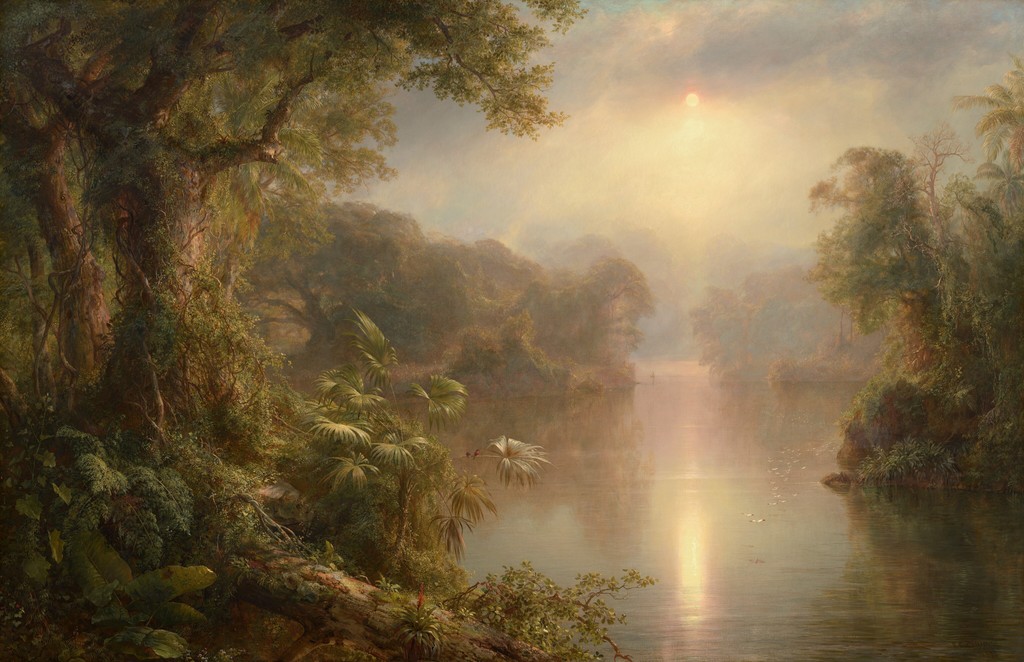
Frederic Edwin Church, El Rio de Luz (The River of Light), 1877, oil on canvas, 138.1 × 213.7 cm. National Gallery of Art, Washington, Gift of the Avalon Foundation, 1965.14.1. NGA Open Access, CC0. Image source. CC0 / NGA Open Access. Resized; full source proportions retained.
Artist repairs and changes in appearance
The surface of a finished painting can have a history after its first exhibition. Kelly’s account of Tamaca Palms describes Church’s repairs in 1877, following reports of streaking in the sky. Contemporary accounts discussed a repaired sky and scumbling that gave the mountains and middle ground greater haze. Scumbling uses a relatively opaque layer spread thinly over another passage, often letting some of what lies beneath remain visible.[3]
Kelly distinguishes that recorded intervention from the surface described in the 2011 catalogue. He argues that the present sky belongs to the original painting and suggests that later varnish removal may also have removed Church’s repainting. The removal date is uncertain. The Niagara entry likewise records more than one subsequent repainting of its sky.[3]
These histories complicate the idea that everything visible today represents one uninterrupted moment of making. An artist can return to a sold picture; a later treatment can affect an intervention; a published technical account can distinguish layers that are hard to separate by eye. Describing Church’s technique therefore involves both initial construction and the changing life of particular surfaces.
A research abstract by Joyce Zucker and Jaap Boon, published in 2007, addresses another complication. In Hudson River School paintings, bloom, haze and changes in translucency can be mistaken for intended effects. Their work included Church archive samples at Olana. For one sketch, the abstract identifies lead acetate as a probable cause of alteration, drawing on material and archival evidence.[9] That qualified finding concerns deterioration; it does not establish a standard additive used throughout Church’s work.
Comparing working marks and finished effects
Begin with the palm drawing and Tamaca Palms. Follow the trunk into the crown in the drawing, then locate the corresponding tall tree in the canvas. Notice how surrounding vegetation, sky and water change the job performed by its outline. The comparison makes observation and placement visible as related decisions.
Next, compare the Petra and Rainy Season studies. Petra uses colour and unequal degrees of detail to establish a focal area. Rainy Season uses graphite lines to organize a wide arrangement. Both are working images, but they answer different questions. Treating every study as a miniature version of a finished painting would obscure those differences.
Finally, look at Niagara and El Rio de Luz first as whole images, then more closely. Niagara’s wide curve and immediate water create one spatial experience; the River of Light’s enclosing banks and central reflection create another. Ask which contrasts remain clearest as the smaller details become difficult to see. This reveals how Church’s landscapes can sustain a broad design and a close encounter at the same time.
Artworks directory
A documented selection of Church’s works discussed across these articles, together with identified prints after his designs. This is not a catalogue raisonné. Repeated titles and aliases are reconciled; studies remain distinct from finished paintings. Some dates remain unconfirmed. Other makers are named where a print adapts Church’s work.
| Name | Date | Medium |
|---|---|---|
| Above the Clouds at Sunrise | 1849 | Oil on canvas |
| The Aegean Sea | About 1877 | Oil on canvas |
| The Andes of Ecuador | 1855 | Oil on canvas |
| Aurora Borealis | 1865 | Oil on canvas |
| Autumn in North America | Circa 1856 | Oil on board |
| Coast Scene | 1852 | Oil on canvas |
| Cotopaxi | 1862 | Oil on canvas |
| A Country Home | 1854 | Oil on canvas |
| El Khasné, Petra | 1874 | Oil on canvas |
| El Rio de Luz | 1877 | Oil on canvas |
| The Heart of the Andes | 1859 | Oil on canvas |
| The Icebergs | 1861; foreground mast added between mid-1862 and early 1863 | Oil on canvas |
| Jerusalem from the Mount of Olives | 1870 | Oil on canvas |
| Mount Ktaadn | 1853 | Oil on canvas |
| Our Banner in the Sky | 1861 | Oil paint over lithograph on paper, laid down on cardboard |
| The Parthenon | 1871 | Oil on canvas |
| Rainy Season in the Tropics | 1866 | Oil on canvas |
| Storm in the Mountains | 1847 | Oil on canvas |
| Syria by the Sea | 1873 | Oil on canvas |
| Tamaca Palms | 1854 | Oil on canvas |
| Tropical Scenery | 1873 | Oil on canvas |
| Twilight in the Tropics | 1874; signed and dated, according to Bonhams’ catalogue | Oil on canvas |
| Twilight in the Wilderness | 1860 | Oil on canvas |
| View of Cotopaxi | 1857 | Oil on canvas |
| Niagara | 1857 | Oil on canvas |
| Magdalena River, New Granada, Equador | 1853 | Graphite heightened with white on wove paper |
| Tamaca Palm, Colombia or Ecuador | May–October 1853 | Graphite on gray laid paper |
| Mixed Sketches with a Champan, Río Magdalena, Colombia | May 1853 | Graphite on gray laid paper |
| Study for Rainy Season in the Tropics | 1865–1866 | Graphite on ruled notepad paper |
| Al-Khazneh, Petra (study) | February–March 1868 | Oil and graphite on tan paperboard |
| The Great Fall, Niagara (Charles Risdon, after Church) | 1874 impression | Hand-coloured chromolithograph on paperboard |
| The Heart of the Andes (William Forrest, after Church) | 1862 | Engraving in black on wove paper |
| Our Heaven Born Banner (William Bauly, adapting Church’s motif) | circa 1861 | Colour lithograph |
| A Tropical Moonlight (wood engraving after Church) | 1879 publication | Wood engraving in American Painters |
| Off Iceberg, Newfoundland | June 1859 | Oil and graphite on paperboard |
| Parthenon at Night, Athens | April 1869 | Oil and graphite on tan paperboard |
| Jerusalem from the Mount of Olives (study) | 1 April 1868 | Oil and graphite study |
| Horseshoe Falls (study) | December 1856–January 1857 | Oil on paper mounted to canvas |
| Niagara Falls, from the American Side | 1867 | Oil on canvas |
| Study for The Heart of the Andes | 1858 | Oil study |
| Mount Chimborazo through Rising Mist and Clouds | 1857 | Oil study |
| Cotopaxi Erupting, Viewed from Quito, Ecuador | June 1857 | Oil and graphite on tan paperboard |
| Cotopaxi (painted for Cyrus Field) | 1855 | Painting |
| Chimborazo | 1864 | Painting |
| Twilight, A Sketch | 1858 | Oil on canvas |
| View of Baalbek | 1868 | Oil and pencil on board |
| Three Bedouins | Date unconfirmed | Oil study |
| Coast Scene, Mount Desert (later canvas) | 1863 | Painting |
| The Wreck | Date unconfirmed | Painting |
| Grand Manan Island, Bay of Fundy | Date unconfirmed | Painting |
| Summer in South America | circa 1853 | Painting |
| Evening in Vermont | Date unconfirmed | Painting |
| Home by the Lake | Date unconfirmed | Painting |
| Storm in the Blue Mountains, Jamaica | August 1865 | Painting |
| The Natural Bridge, Virginia | 1852 | Painting |
| The Vale of St. Thomas, Jamaica | 1867 | Painting |
| Tequendama Falls, near Bogota, New Granada | Date unconfirmed | Painting |
| Sunrise in Syria | Before the 1876 exhibition | Painting |
| Cuernavaca (oil study; descriptive title) | 1898 | Oil study |
| Olana window design (descriptive title) | Date unconfirmed | Watercolour and graphite |
| Olana dining-room stencil sketch (descriptive title) | Date unconfirmed | Oil and graphite |
| Olana house (with Calvert Vaux) | 1870–1872; later additions | Architecture |
| Olana designed landscape | From 1860; developed over decades | Designed landscape |
Frequently Asked Questions
The examples here include graphite on paper, oil and graphite on paperboard, and oil on canvas. They demonstrate different forms of working rather than a complete inventory of every material he used.
Studies could provide individual forms or test arrangements. The Tamaca palm drawing relates to a tree in the finished painting, while the Rainy Season study includes a cliff-edge building absent from the finished composition.
The National Gallery’s 1996 technical account records multiple glazes in dark passages of El Rio de Luz. That is documented evidence for this canvas, not a complete formula for every Church painting.
A reproduction can show composition and visible differences in handling. Physical layer structure, alteration and restoration require other evidence, including examination and published technical accounts.
Discussion
Look again at the images and ideas explored in Style and Technique. These editorial prompts invite your own observations.
Which comparison changes your understanding of Church most: the isolated palm becoming part of a landscape, the altered Rainy Season arrangement, or the constructed viewpoint in Niagara? Describe a visible relationship between the images that supports your answer.
Reader Insights
Where do you see the clearest difference between observation and arrangement?
How does the finish of a study affect what you can learn from it?
Which detail in a large landscape repays the closest look?
Join the Conversation
Share a detail, comparison or question about Style and Technique below.
References
- Franklin Kelly, Frederic Edwin Church and the National Landscape, National Gallery of Art, 1989, pp. 34–35 and 47–49.
- Cooper Hewitt, Smithsonian Design Museum, official open-access record for Tamaca Palm, Colombia or Ecuador, 1917-4-107.
- Franklin Kelly, Tamaca Palms and Niagara entries, in Sarah Cash, ed., Corcoran Gallery of Art American Paintings to 1945, 2011, pp. 108–109 and 114–115, notes pp. 262–263.
- Cooper Hewitt, Smithsonian Design Museum, official open-access record for Al-Khazneh, Petra, 1917-4-485-a.
- Cooper Hewitt, Smithsonian Design Museum, official open-access record for Study for Rainy Season in the Tropics, 1917-4-771.
- de Young museum, Rainy Season in the Tropics, 1866, museum-supplied object record on Google Arts & Culture.
- National Gallery of Art, Niagara, 1857, 2014.79.10, including Sarah Cash’s audio transcript.
- Franklin Kelly and others, American Paintings of the Nineteenth Century Part I, National Gallery of Art, 1996, p. 63, technical notes for Morning in the Tropics, now El Rio de Luz.
- Joyce Zucker and Jaap J. Boon, Opaque to transparent, AMOLF repository abstract and publication metadata, 2007; paper presented in 2006, pp. 33–41.
- Splash image source.
Frederic Edwin Church, Tamaca Palm, Colombia or Ecuador, May–October 1853, graphite on gray laid paper, 28.2 × 21.5 cm. Cooper Hewitt, Smithsonian Design Museum, Gift of Louis P. Church, 1917-4-107. Smithsonian Open Access, CC0 1.0. Image source. CC0 1.0 Universal. Resized; full source proportions retained.