 by Tom Gurney
Tom Gurney BSc (Hons) is an art history expert with over 20 years experience
Published on June 19, 2020 / Updated on October 27, 2026
Email: tomgurney1@gmail.com / Phone: +44 7429 011000
El Khasné, Petra: Introduction
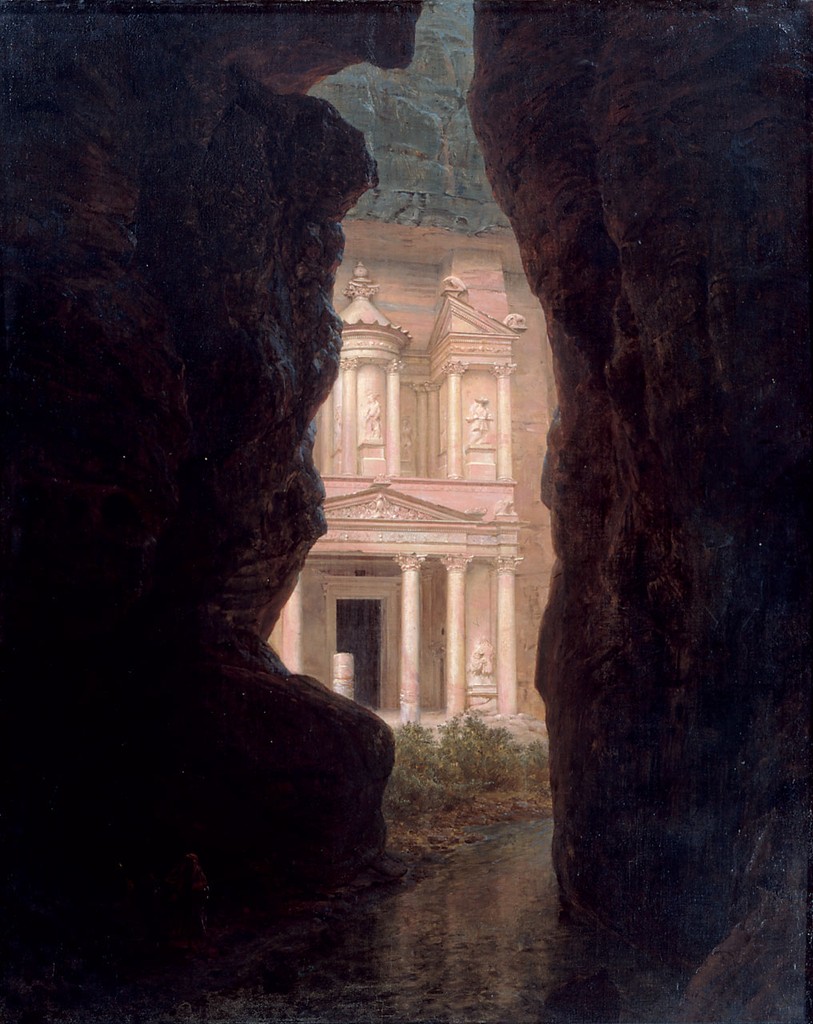
Frederic Edwin Church’s El Khasné, Petra turns a narrow opening between cliffs into a dramatic encounter with ancient architecture. Painted in 1874, six years after his visit, it shows the pale, elaborate façade of the Treasury at Petra beyond dark sandstone walls. The vertical canvas concentrates attention on a single monument, giving the approach almost as much importance as the building itself. The painting belongs to Olana State Historic Site, Church’s former home in New York’s Hudson Valley.[1]
At a Glance
- ArtistFrederic Edwin Church (1826–1900)
- TitleEl Khasné, Petra
- Date1874
- MediumOil on canvas
- Dimensions153.7 × 127.6 cm (60½ × 50¼ inches)
- CollectionOlana State Historic Site, Hudson, New York
- AccessionOL.1981.10
- SubjectAl-Khazneh, the Treasury at Petra, in present-day Jordan
- Related studyAl-Khazneh, Petra, February–March 1868, Cooper Hewitt, Smithsonian Design Museum
- Historical setting at OlanaAbove the sitting-room fireplace, securely documented by 1890
This work across Church’s career
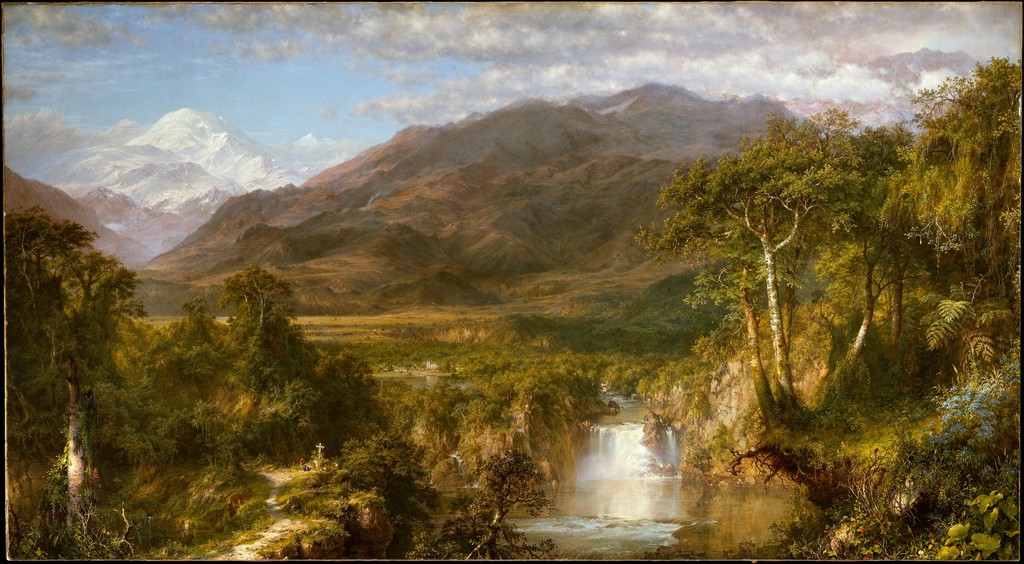
Tamaca Palms
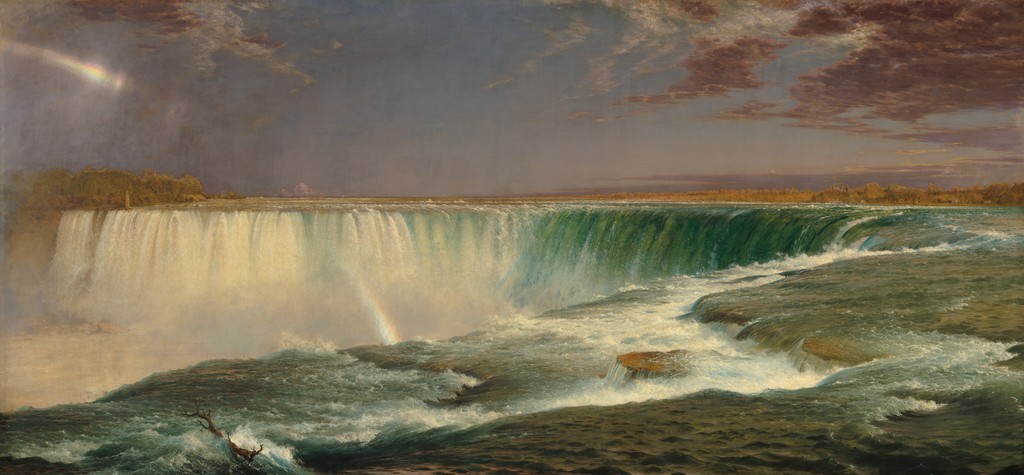
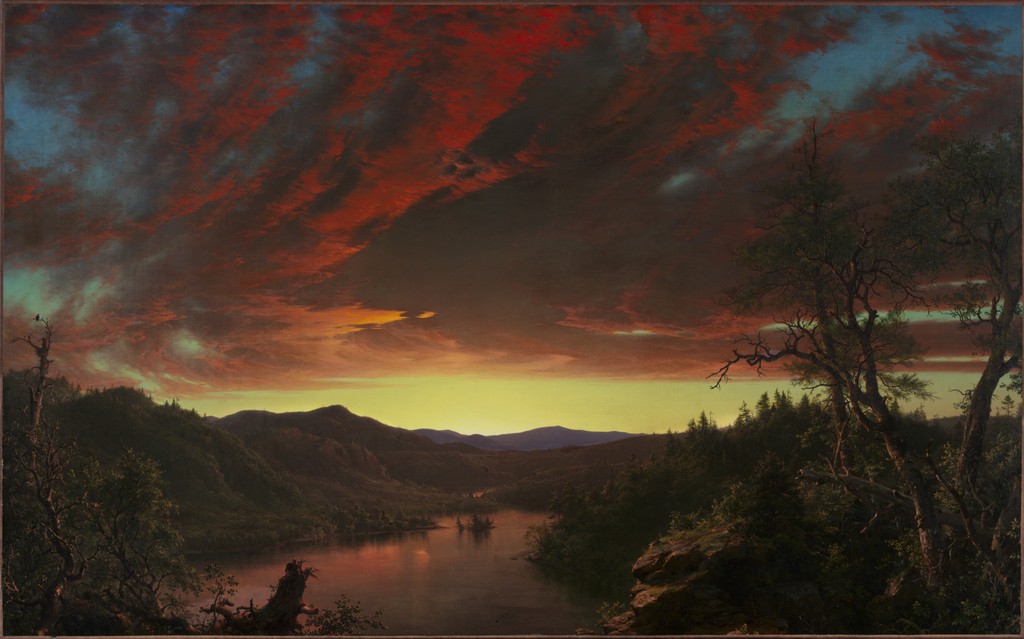
1854Niagara
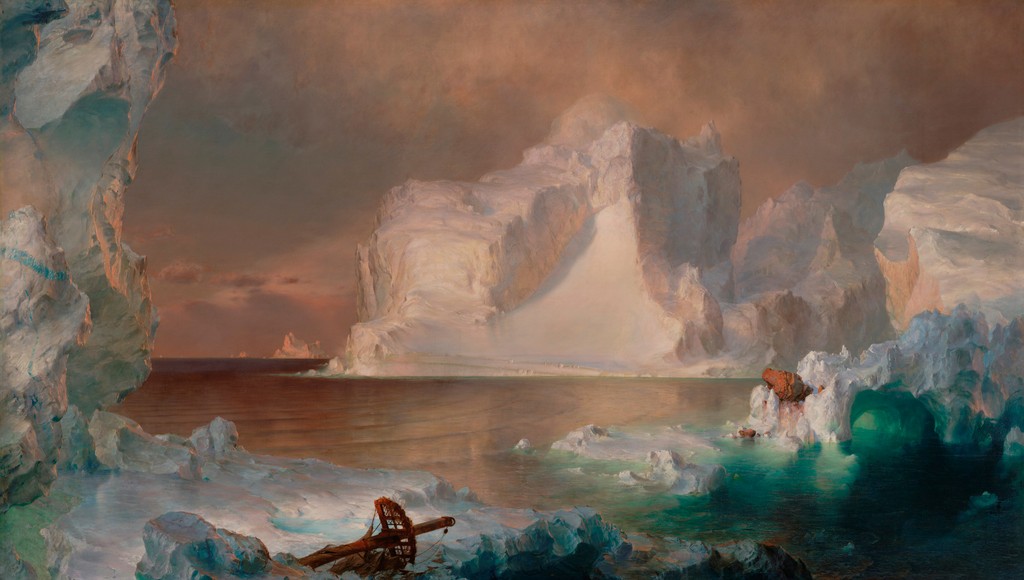
1857The Icebergs
1861; foreground mast added between mid-1862 and early 1863Cotopaxi
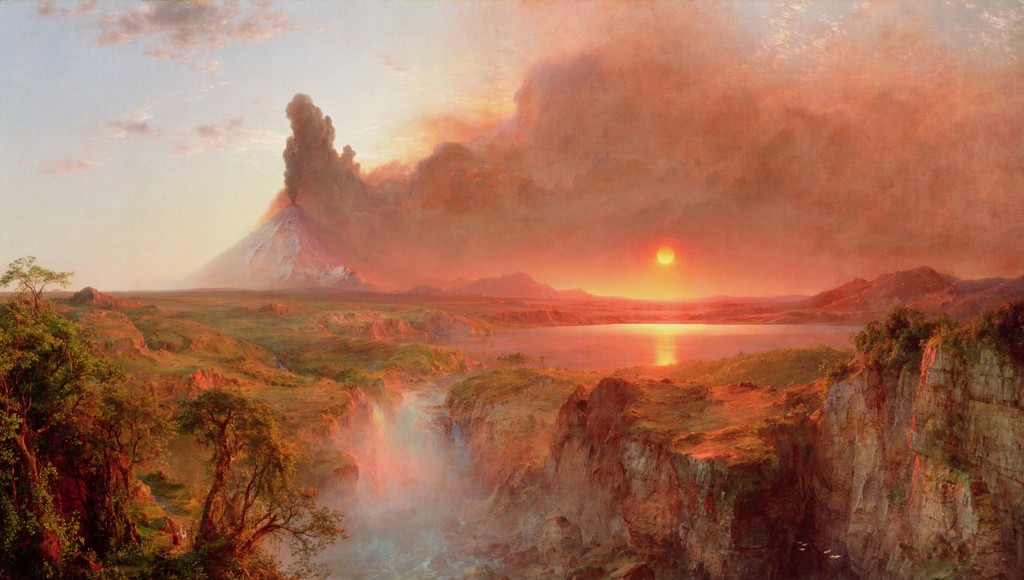
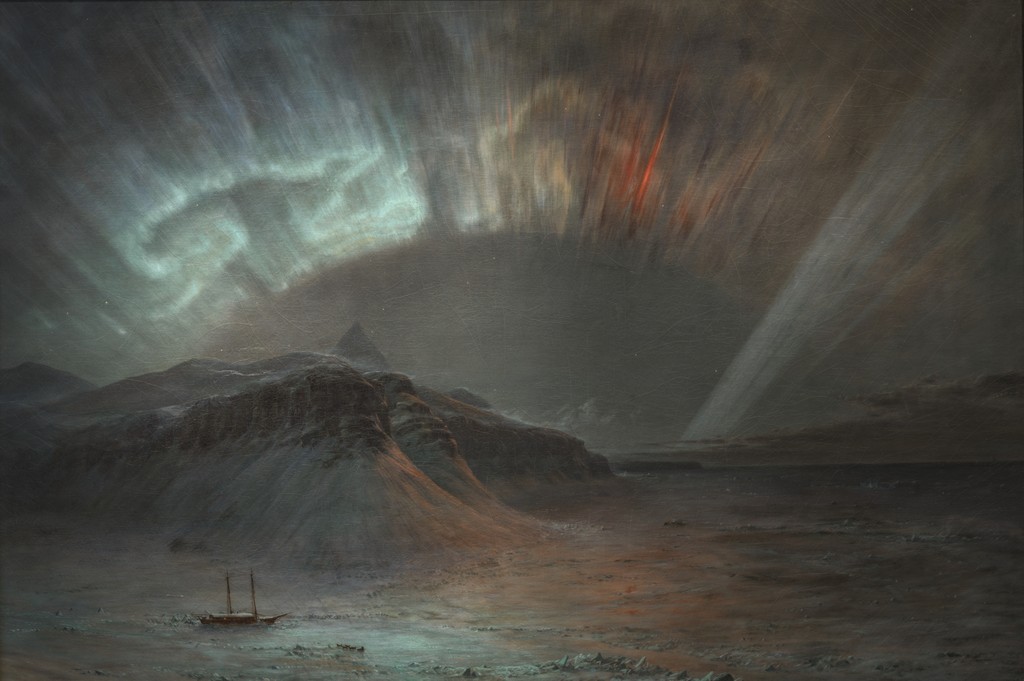
1862Aurora Borealis
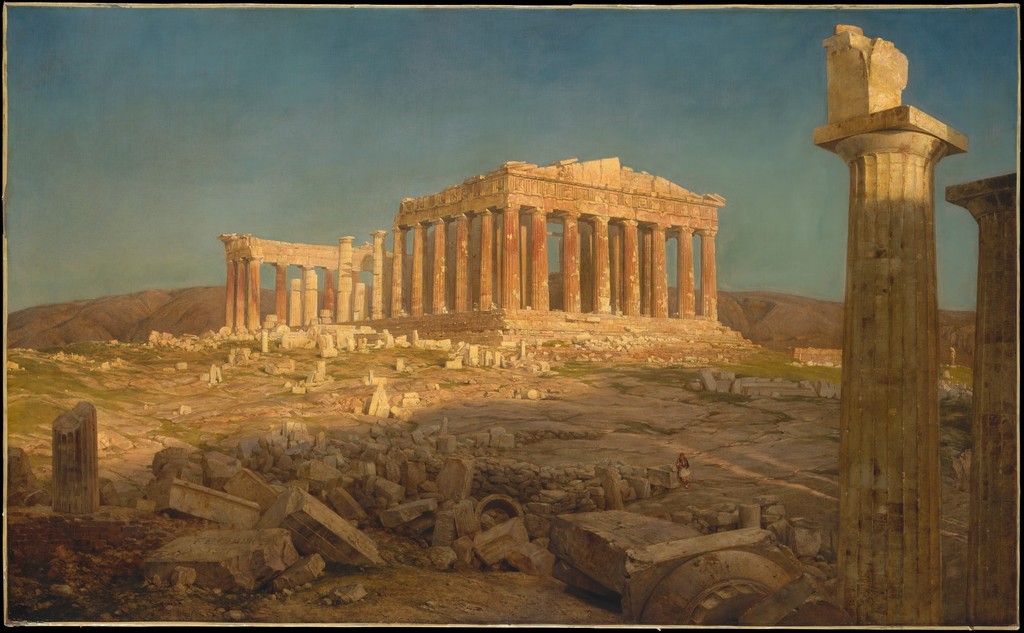
1865The Parthenon
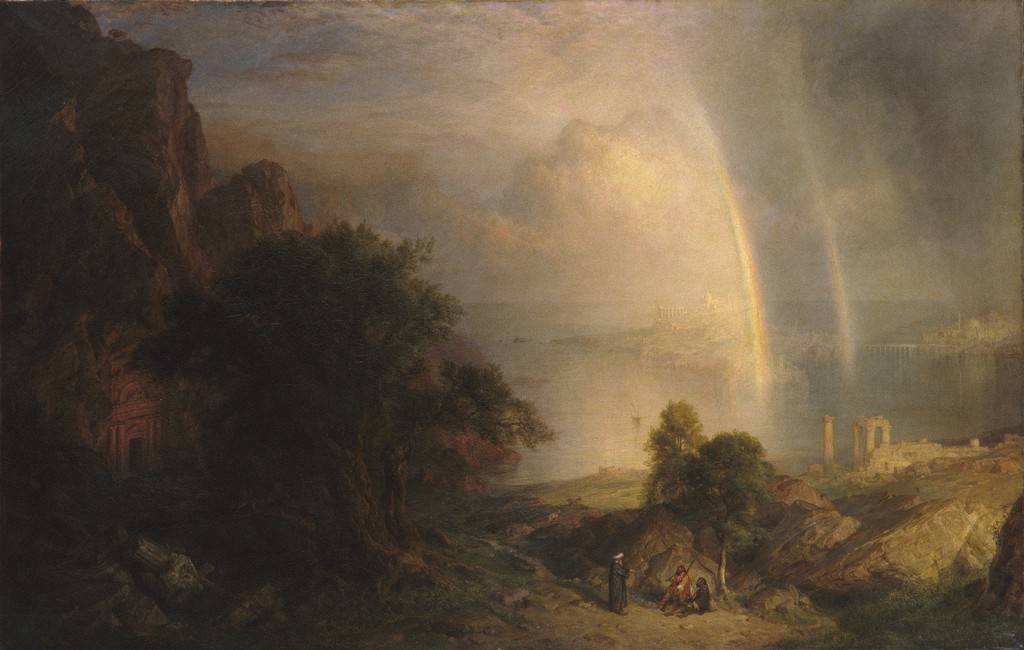
1871The Aegean Sea
About 1877Contents
- A building glimpsed through rock
- The Treasury and the Nabataeans
- Columns, ledges and irregular surfaces
- The foreground and the passage ahead
- Church’s February 1868 journal
- Travelling with local guides
- An oil and graphite study
- From the journey to the 1874 canvas
- The painting at Olana
- Comparing the view with a photograph
A building glimpsed through rock
The painting begins with obstruction. Close rock walls rise on both sides, taking up much of the canvas and leaving an uneven slit near the centre. Their dark surfaces are not matching curtains: the left projects into the view in a succession of rounded forms, while the right establishes a heavier, more continuous barrier. The passage seems to bend around these masses.
Beyond them, the Treasury appears in a much lighter register. Columns, pediments and sculptural niches emerge against the rock into which the façade was carved. Church leaves part of the architecture hidden, so its appearance feels like a discovery still taking place. The viewer receives enough information to recognise a complex structure, without an unobstructed survey of it.
The upright format reinforces that experience. Instead of following a skyline across a broad landscape, the eye climbs through the opening, from the lower doorway and columns to the upper ornamental forms. The cliff continues above the architecture, reminding the viewer that the monument occupies a place within a larger geological mass.
The Treasury and the Nabataeans
Al-Khazneh is an ancient Nabataean funerary monument. The Petra Development and Tourism Region Authority explains that its familiar name, the Treasury, derives from a legend about treasure concealed in the urn above the façade. Its precise date remains debated; it is commonly associated with the period of King Aretas IV, who ruled from 9 BC to AD 40. The authority identifies the façade’s Hellenistic influence and Corinthian capitals.[2]
Petra was a caravan city with an extensive system for distributing and storing water. UNESCO places its architecture within a meeting of Nabataean traditions and Hellenistic forms. The winding Siq was the principal approach from the east, rather than the whole city. Church’s picture isolates one encounter within a much larger settlement of monuments, passages and engineered terrain.[3]
That distinction changes how the painting is understood. The ornate surface is not a freestanding European building transplanted into a desert. It is carved into the same sandstone that surrounds it. Nature and architecture share their material, while their different treatment creates the scene’s central contrast.
Columns, ledges and irregular surfaces
The façade gives the eye a succession of measured forms. Vertical shafts support horizontal bands; triangular pediments and the rounded upper structure interrupt those simpler divisions. Even where the gorge conceals parts of the building, the visible details suggest an ordered arrangement continuing behind the rock.
The near walls offer a different rhythm. Their contours bulge, recede and turn abruptly. Coloured seams and worn surfaces run across them without following the façade’s architectural scheme. The contrast is therefore more than light against dark: it also places regular carving beside the irregular shapes of the surrounding cliffs.
Church allows those two systems to remain connected. Warm reddish tones occur in the shadowed walls as well as in the monument. The stone behind the upper façade carries horizontal bands, and the architecture seems to emerge from them. Its ornament is an alteration of the landscape’s substance, not an object floating against a separate background.
The foreground and the passage ahead
A narrow wet channel or stream runs along the bottom of the view, catching muted light as it leads toward the building. Stones and uneven ground break its course. Low vegetation gathers beyond the darkest foreground, where the passage opens a little before the façade. These small variations keep the approach from becoming a smooth theatrical aisle.
Two figures are faintly visible at the lower left. Their small scale helps convey the height of both the cliffs and the carved architecture. Because they stand in deep shadow, they can be overlooked when the bright façade commands attention. Returning to the foreground changes the scene from an apparently solitary view into a place occupied by people.
Their position also complicates the imagined movement through the picture. The eye can travel along the light in the channel, but the viewer remains on the shaded side of the opening. The encounter depends on seeing across that separation. Church offers visual access to the monument while preserving the physical difficulty and enclosure of its approach.
Church’s February 1868 journal
Olana publishes an excerpt from Church’s Petra journal, introduced by interpretive program assistant Paul Banks. It records the artist and his companions exploring the site on 24 and 25 February 1868. The transcription describes a twisting ravine, high overhanging cliffs and rocks marked by graded stripes, crossing colours and weathered, honeycombed forms.[4]
Church paid unusually close attention to the sandstone’s colours. He distinguished dark, weathered surfaces from the lighter reddish-salmon stone exposed in the architecture, and noted variations that a less experienced observer might miss. The journal helps explain why the finished painting’s apparently simple division between bright building and dark gorge contains many smaller changes of hue.
His description of the ornament was equally attentive: capitals, fruit and leaves, eagles and other sculpted animals entered his written observations. He described the building as “shining as if by its own internal light.” The phrase records an effect of colour and contrast, rather than a claim that the stone actually emitted light.[4]
The excerpt also contains practical observations about water, a small channel and surviving paving. Church made rapid sketches, including one in colour, before showers sent the party back to its tent. This was an encounter involving close study, changing weather and movement through the site, not a single uninterrupted moment of contemplation.[4]
Travelling with local guides
Art historian Mary Roberts’s 2022 study of Church and Olana places the Petra journey within its contemporary Ottoman setting. She stresses the travellers’ dependence on interpreters, local leaders and negotiated passage through Bedouin lands. Church’s excitement and unease belonged to that dependence; his own perspective did not explain the journey’s full social setting.[5]
The distinction matters when reading his dramatic descriptions. They preserve what caught his attention and what he feared, but they also reflect the assumptions of an American visitor. The ravine’s darkness can make the picture feel mysterious without turning the people who inhabited the region into a generalised source of danger.
Roberts interprets the two shadowed, armed men in the finished canvas in relation to Church’s remembered vulnerability. That is a scholarly reading of their role. Their presence can also be examined more immediately through scale, placement and visibility: human figures occupy the near darkness while architecture dominates the illuminated opening.[5]
Watch: Frederic Edwin Church
Choose a film to explore the artist’s work, its interpretation and its wider setting.
Frederic Edwin Church's "The Icebergs" on the Move at the DMA
Follow the Dallas Museum of Art as it moves Church’s large painting The Icebergs.
Watch on YouTubeAn oil and graphite study
A related work at Cooper Hewitt, Smithsonian Design Museum, records the Treasury in a broader, horizontal format. The museum dates Al-Khazneh, Petra to February–March 1868. It is oil and graphite on tan paperboard, measuring 32.8 × 50.8 cm, and was given by Louis P. Church. Its catalogue remains marked as research in progress.[6]
The study presents the architecture at an oblique angle, with broad rock masses on either side. A small pale patch appears at the upper left, while plants occupy the lower edge. The handling is open and rapid: strokes describing the rough cliffs remain visible, and details of the façade are concentrated within the wider expanse of stone.
Its warm ochres, reds and browns spread through much of the image. The finished canvas makes the architecture appear paler and separates it more decisively from the deep foreground shadows. The study’s horizontal breadth gives room to the enclosing rocks; the canvas’s vertical format makes the opening itself the organising feature.
Seeing the two works together makes the intervening decisions easier to recognise. Church retained the contrast between a carved façade and surrounding stone, but changed the proportions, emphasis and route of attention. The finished painting is a developed arrangement based on the journey, rather than an enlargement of every feature in this particular study.
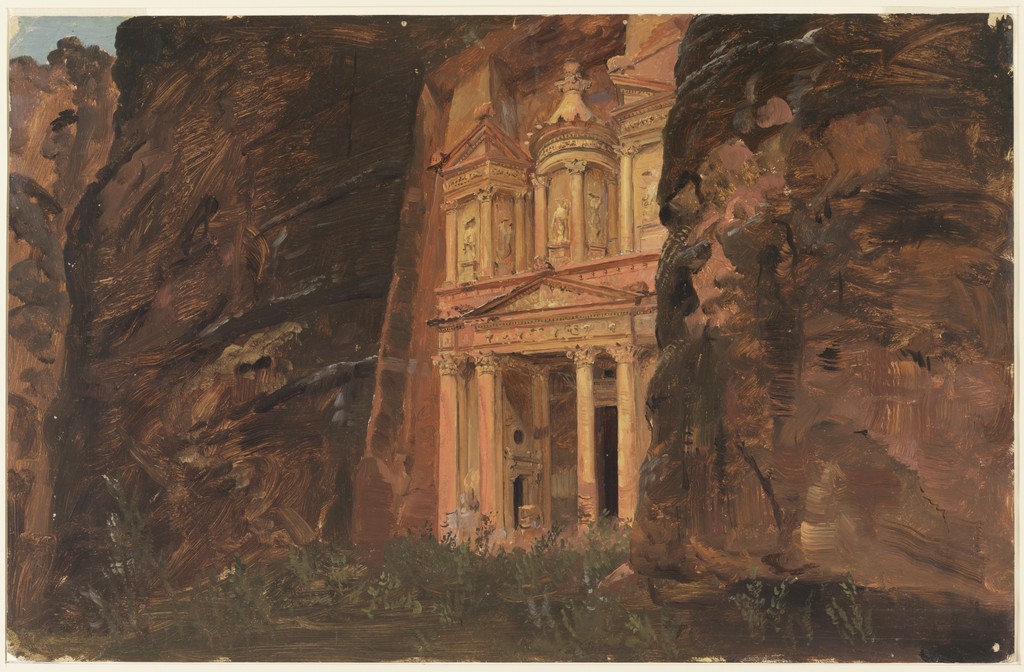
Frederic Edwin Church, Al-Khazneh, Petra, February–March 1868. Oil and graphite on tan paperboard, 32.8 × 50.8 cm. Gift of Louis P. Church. Image source. CC0 1.0 Universal / Smithsonian Open Access. Resized; full source proportions retained.
From the journey to the 1874 canvas
The six-year interval allowed the experience at Petra to become a studio painting. Debora Rindge’s chronology in the National Gallery’s Church catalogue records the canvas’s completion in 1874 and its exhibition that year at the National Academy of Design. It also lists a showing at the Chicago Academy of Design in spring 1875.[1]
Olana’s historic furnishing report adds that artist Benjamin B. Stone posed for the foreground figures, using clothing brought back from Church’s travels. It also reproduces a December 1874 newspaper account identifying the painting as Mrs. Church’s property. The report nevertheless notes a later sale listing, making its transition from exhibition picture to family possession more complicated than a simple account of a gift planned from the outset.[7]
The figures thus belong to the same process of selection and reconstruction as the landscape. Their painted setting evokes Petra, while their preparation included work at home. The canvas joins information gathered abroad with choices made for a finished picture intended to be seen elsewhere.
The painting at Olana
The furnishing report securely locates El Khasné, Petra above the sitting-room fireplace through an 1890 description. It treats an earlier location in the dining room or picture gallery as possible, rather than certain. This evidence encourages care about assuming that the painting occupied its familiar position immediately after completion.[7]
The report attributes the frame’s design to Church and identifies its maker as Knoedler and Company. It notes Mamluk revival ornament and the relationship between the picture’s palette, pink marble fireplace and surrounding decoration.[7] The frame gives the painted opening a further boundary within the room: natural rock, canvas edge and decorative surround establish successive ways of enclosing the view.
James Anthony Ryan’s essay in the 1989 catalogue examines the repeated colours connecting the painting with Olana’s interior. He interprets the house and its collections through family life and memories of travel.[1] This domestic setting adds another scale of experience. A monument approached during a distant journey becomes something encountered repeatedly within a familiar home.
Comparing the view with a photograph
Bernard Gagnon’s photograph of the Treasury from the Siq, dated 2010, shows how a nearby rock wall can hide most of the architecture while leaving a sharply defined glimpse of columns and carved ornament.[8] It offers a useful comparison with Church’s arrangement, although it records a different position and a much later moment.
In the photograph, the gap is extremely narrow and parts of the monument are cut off at the edges of the visible space. Church allows a more sustained examination of the façade, including the doorway and upper forms. The two images clarify how a small change in position can alter the balance between the enclosing walls and the structure beyond them.
The comparison also encourages attention to what the painting asks the viewer to do. Its opening holds the eye on the bright stone, but the enclosing darkness rewards a second, slower examination. Details that initially seem subordinate—the figures, stream, shrubs and coloured surfaces—gradually supply the encounter’s nearer dimensions.
Church’s Jerusalem from the Mount of Olives spreads a distant city across a panoramic landscape. El Khasné, Petra concentrates the experience into a restricted vertical view. Both make looking an active process, but here the monument’s partial concealment is central: the sight is memorable because the approach controls how much can be seen.
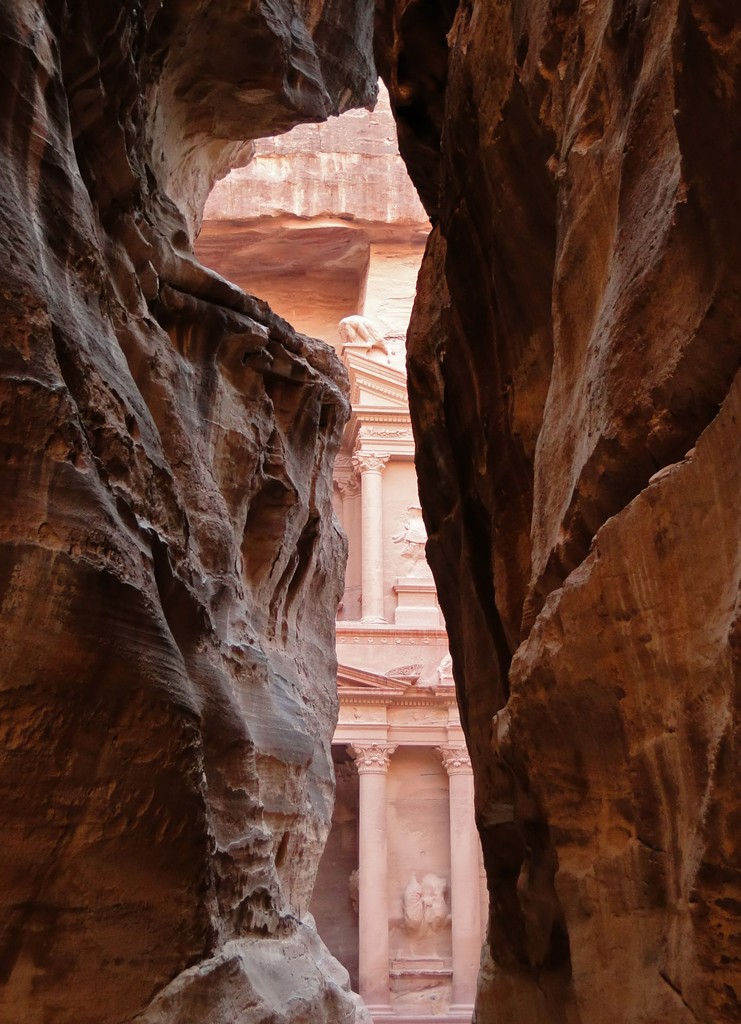
The Treasury seen from the Siq, 2010. Photograph by Bernard Gagnon; a different viewpoint from Church’s painting. Bernard Gagnon / Wikimedia Commons, CC BY-SA 3.0 Unported. Image source. CC BY-SA 3.0 Unported. Resized; full source proportions retained.
Artworks directory
A documented selection of Church’s works discussed across these articles, together with identified prints after his designs. This is not a catalogue raisonné. Repeated titles and aliases are reconciled; studies remain distinct from finished paintings. Some dates remain unconfirmed. Other makers are named where a print adapts Church’s work.
| Name | Date | Medium |
|---|---|---|
| Above the Clouds at Sunrise | 1849 | Oil on canvas |
| The Aegean Sea | About 1877 | Oil on canvas |
| The Andes of Ecuador | 1855 | Oil on canvas |
| Aurora Borealis | 1865 | Oil on canvas |
| Autumn in North America | Circa 1856 | Oil on board |
| Coast Scene | 1852 | Oil on canvas |
| Cotopaxi | 1862 | Oil on canvas |
| A Country Home | 1854 | Oil on canvas |
| El Khasné, Petra | 1874 | Oil on canvas |
| El Rio de Luz | 1877 | Oil on canvas |
| The Heart of the Andes | 1859 | Oil on canvas |
| The Icebergs | 1861; foreground mast added between mid-1862 and early 1863 | Oil on canvas |
| Jerusalem from the Mount of Olives | 1870 | Oil on canvas |
| Mount Ktaadn | 1853 | Oil on canvas |
| Our Banner in the Sky | 1861 | Oil paint over lithograph on paper, laid down on cardboard |
| The Parthenon | 1871 | Oil on canvas |
| Rainy Season in the Tropics | 1866 | Oil on canvas |
| Storm in the Mountains | 1847 | Oil on canvas |
| Syria by the Sea | 1873 | Oil on canvas |
| Tamaca Palms | 1854 | Oil on canvas |
| Tropical Scenery | 1873 | Oil on canvas |
| Twilight in the Tropics | 1874; signed and dated, according to Bonhams’ catalogue | Oil on canvas |
| Twilight in the Wilderness | 1860 | Oil on canvas |
| View of Cotopaxi | 1857 | Oil on canvas |
| Niagara | 1857 | Oil on canvas |
| Magdalena River, New Granada, Equador | 1853 | Graphite heightened with white on wove paper |
| Tamaca Palm, Colombia or Ecuador | May–October 1853 | Graphite on gray laid paper |
| Mixed Sketches with a Champan, Río Magdalena, Colombia | May 1853 | Graphite on gray laid paper |
| Study for Rainy Season in the Tropics | 1865–1866 | Graphite on ruled notepad paper |
| Al-Khazneh, Petra (study) | February–March 1868 | Oil and graphite on tan paperboard |
| The Great Fall, Niagara (Charles Risdon, after Church) | 1874 impression | Hand-coloured chromolithograph on paperboard |
| The Heart of the Andes (William Forrest, after Church) | 1862 | Engraving in black on wove paper |
| Our Heaven Born Banner (William Bauly, adapting Church’s motif) | circa 1861 | Colour lithograph |
| A Tropical Moonlight (wood engraving after Church) | 1879 publication | Wood engraving in American Painters |
| Off Iceberg, Newfoundland | June 1859 | Oil and graphite on paperboard |
| Parthenon at Night, Athens | April 1869 | Oil and graphite on tan paperboard |
| Jerusalem from the Mount of Olives (study) | 1 April 1868 | Oil and graphite study |
| Horseshoe Falls (study) | December 1856–January 1857 | Oil on paper mounted to canvas |
| Niagara Falls, from the American Side | 1867 | Oil on canvas |
| Study for The Heart of the Andes | 1858 | Oil study |
| Mount Chimborazo through Rising Mist and Clouds | 1857 | Oil study |
| Cotopaxi Erupting, Viewed from Quito, Ecuador | June 1857 | Oil and graphite on tan paperboard |
| Cotopaxi (painted for Cyrus Field) | 1855 | Painting |
| Chimborazo | 1864 | Painting |
| Twilight, A Sketch | 1858 | Oil on canvas |
| View of Baalbek | 1868 | Oil and pencil on board |
| Three Bedouins | Date unconfirmed | Oil study |
| Coast Scene, Mount Desert (later canvas) | 1863 | Painting |
| The Wreck | Date unconfirmed | Painting |
| Grand Manan Island, Bay of Fundy | Date unconfirmed | Painting |
| Summer in South America | circa 1853 | Painting |
| Evening in Vermont | Date unconfirmed | Painting |
| Home by the Lake | Date unconfirmed | Painting |
| Storm in the Blue Mountains, Jamaica | August 1865 | Painting |
| The Natural Bridge, Virginia | 1852 | Painting |
| The Vale of St. Thomas, Jamaica | 1867 | Painting |
| Tequendama Falls, near Bogota, New Granada | Date unconfirmed | Painting |
| Sunrise in Syria | Before the 1876 exhibition | Painting |
| Cuernavaca (oil study; descriptive title) | 1898 | Oil study |
| Olana window design (descriptive title) | Date unconfirmed | Watercolour and graphite |
| Olana dining-room stencil sketch (descriptive title) | Date unconfirmed | Oil and graphite |
| Olana house (with Calvert Vaux) | 1870–1872; later additions | Architecture |
| Olana designed landscape | From 1860; developed over decades | Designed landscape |
Frequently Asked Questions
He completed the oil painting in 1874, following his visit to Petra in February 1868.
It shows Al-Khazneh, commonly called the Treasury, an ancient Nabataean funerary monument at Petra in present-day Jordan.
It belongs to Olana State Historic Site in Hudson, New York. Its historical position above the sitting-room fireplace is securely documented by 1890.
The near walls of the Siq enclose the view and contrast with the lighter carved façade. Their shape makes the building appear through a narrow opening.
Olana’s furnishing report attributes the frame design to Church and identifies Knoedler and Company as its maker.
Discussion
Look again at the images and ideas explored in El Khasné, Petra. These editorial prompts invite your own observations.
Compare the painting, the 1868 study and the modern photograph. How does each opening determine what can be seen, and where does your eye go after first noticing the architecture?
Reader Insights
How does the rock passage control the first glimpse of the building?
Where do the irregular surfaces alter the apparent symmetry of the carved façade?
What does the foreground contribute to your sense of moving toward the Treasury?
Join the Conversation
Share a detail, comparison or question about El Khasné, Petra below.
References
- Frederic Edwin Church, National Gallery of Art, 1989. Catalogue 46, p. 122; Debora Rindge chronology, pp. 167 and 169; James Anthony Ryan, Frederic Church’s Olana: Architecture and Landscape as Art, pp. 141 and 144–45. Selected object details, chronology and interior interpretation.
- Petra Development and Tourism Region Authority, Al Khazna (The Treasury). Funerary interpretation, debated date, name and architectural features.
- UNESCO World Heritage Centre, Petra, property 326. Caravan city, water management, Nabataean and Hellenistic architecture, and the eastern Siq approach.
- Paul Banks, Church’s Time in Petra, Olana. Institutionally published transcription of Church’s journal, pp. 66–71, with introduction; handwritten original not reproduced here.
- Mary Roberts, Worlding on the Hudson: Frederic Church and Global Histories of Art, Art History 45, no. 3, 2022, pp. 518–544. Part 1, Journeys—Land Claims, and relevant notes: guides, travel, foreground figures and interpretation of Olana.
- Smithsonian Institution, Cooper Hewitt, Al-Khazneh, Petra, 1917-4-485-a. Exact study record; object details and image corroborated through the institution’s published Open Access metadata.
- Karen Zukowski, Historic Furnishings Report for Olana State Historic Site, Part 2, April 2001, pp. 410–414. Painting, foreground model, ownership and display evidence, attributed frame design and room setting; historical documents mediated through the report.
- Bernard Gagnon, View on Al Khazneh from al-Siq, Petra, Jordan, 2010, Wikimedia Commons. Modern photographic comparison; CC BY-SA 3.0 Unported.
- Splash image source.
Frederic Edwin Church, El Khasné, Petra, 1874. Oil on canvas, 153.7 × 127.6 cm. Olana State Historic Site. Olana State Historic Site, New York State Office of Parks, Recreation and Historic Preservation. Image source. Public domain / faithful reproduction of a two-dimensional public-domain painting. Resized; full source proportions retained.