 by Tom Gurney
Tom Gurney BSc (Hons) is an art history expert with over 20 years experience
Published on June 19, 2020 / Updated on October 27, 2026
Email: tomgurney1@gmail.com / Phone: +44 7429 011000
Syria by the Sea: Introduction
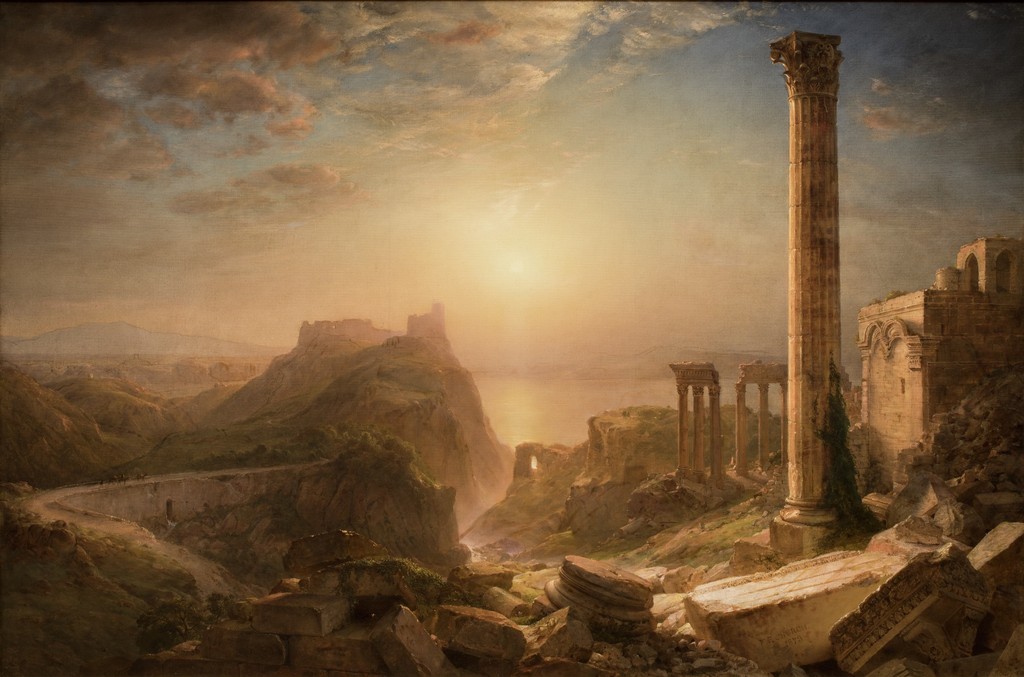
Frederic Edwin Church’s Syria by the Sea brings ancient ruins, a rugged coastline and brilliant evening light into one expansive landscape. Painted in 1873, the canvas places a towering column above fallen architectural fragments, while distant buildings dissolve into golden haze. It belongs to the Detroit Institute of Arts, where it entered the collection through the gift of Mrs. James F. Joy in 1910.[1] Its convincing atmosphere gives unity to a scene assembled from Church’s experience of travel and the traditions of landscape painting.
At a Glance
- ArtistFrederic Edwin Church (1826–1900)
- TitleSyria by the Sea
- Date1873
- MediumOil on canvas
- Dimensions142.2 × 215.9 cm (56 × 85 inches), unframed
- CollectionDetroit Institute of Arts
- Accession10.11
- CreditGift of Mrs. James F. Joy
- LandscapeComposed view drawing on studies around Baalbek and Damascus
- Early exhibitionCentury Association, New York, December 1873
This work across Church’s career
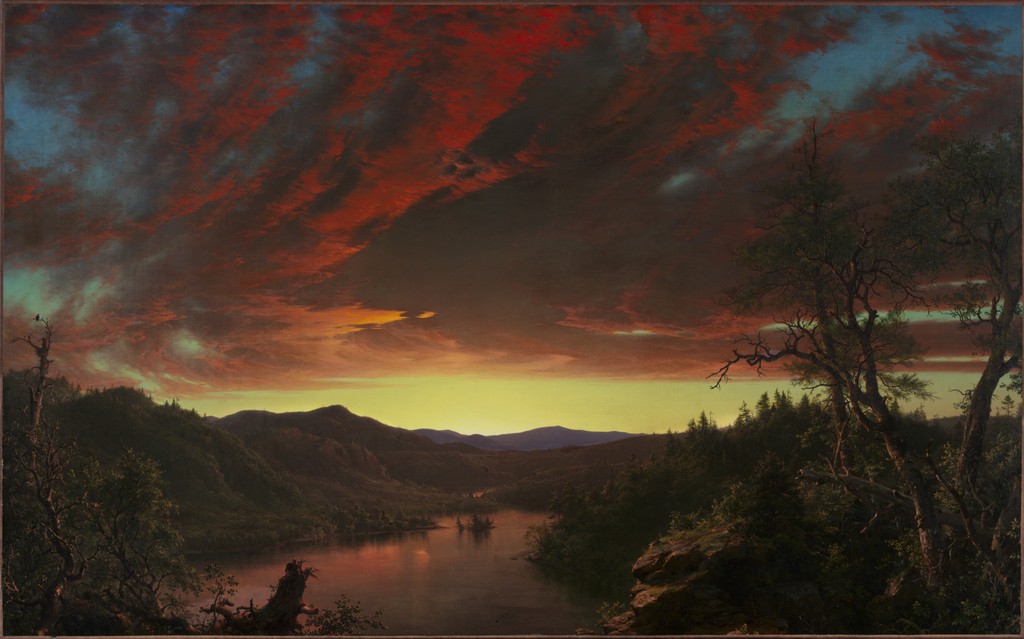
Tamaca Palms
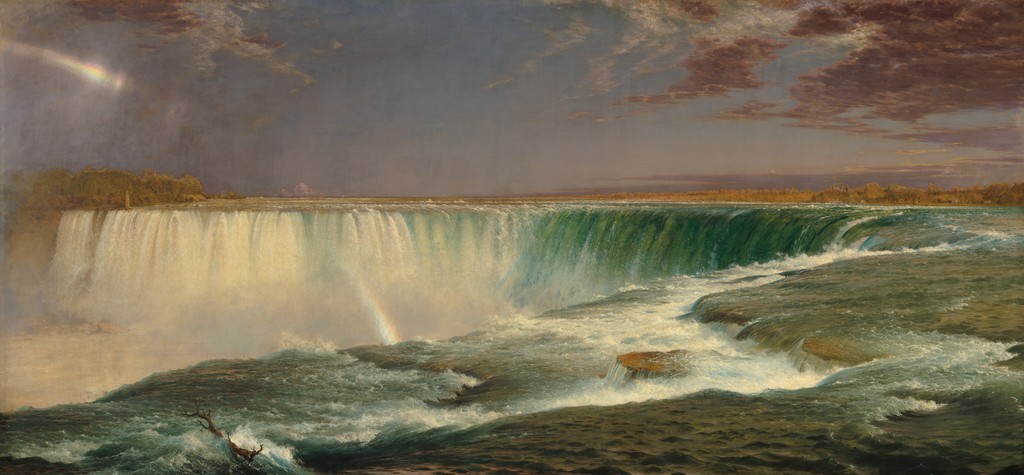
1854Niagara
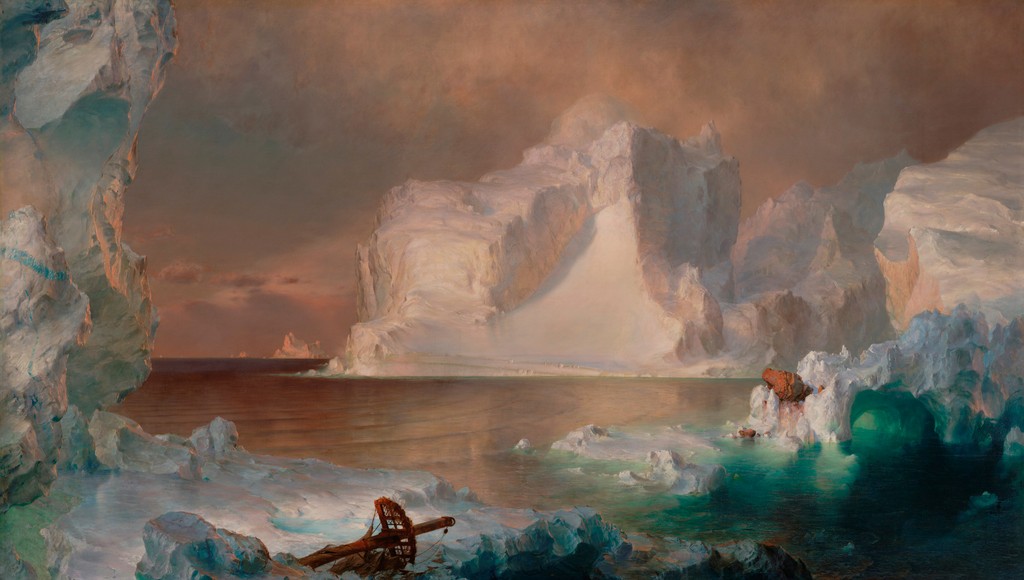
1857The Icebergs
1861; foreground mast added between mid-1862 and early 1863Cotopaxi
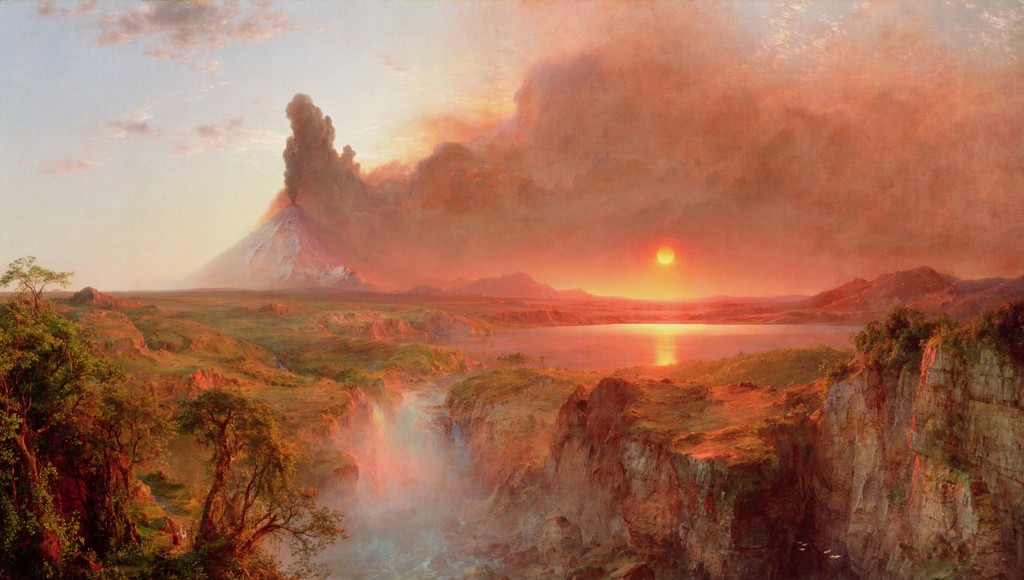
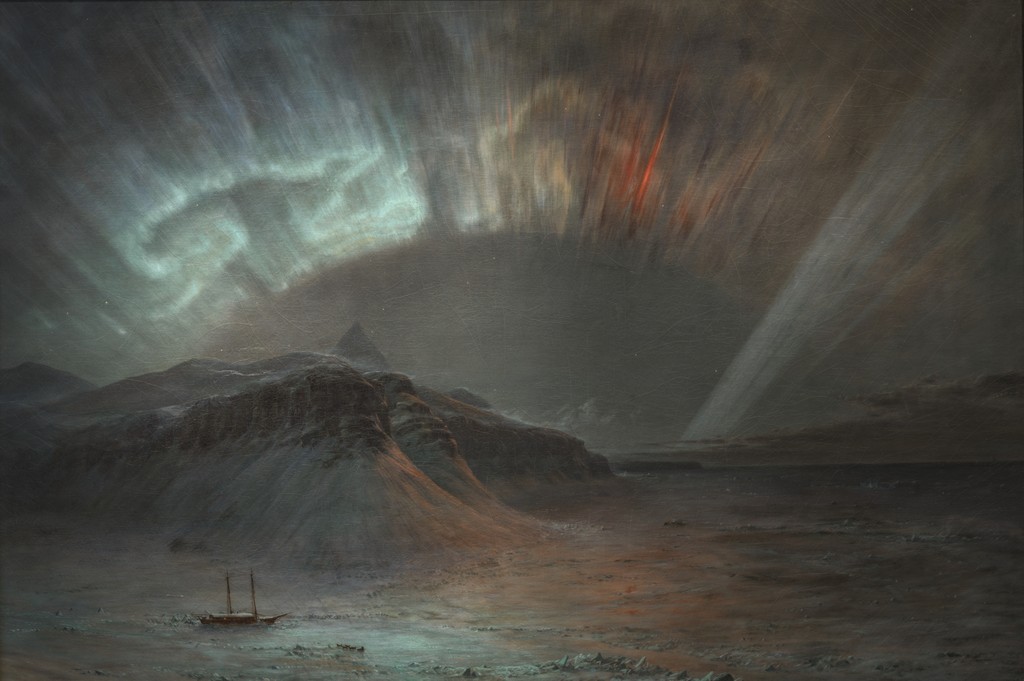
1862Aurora Borealis
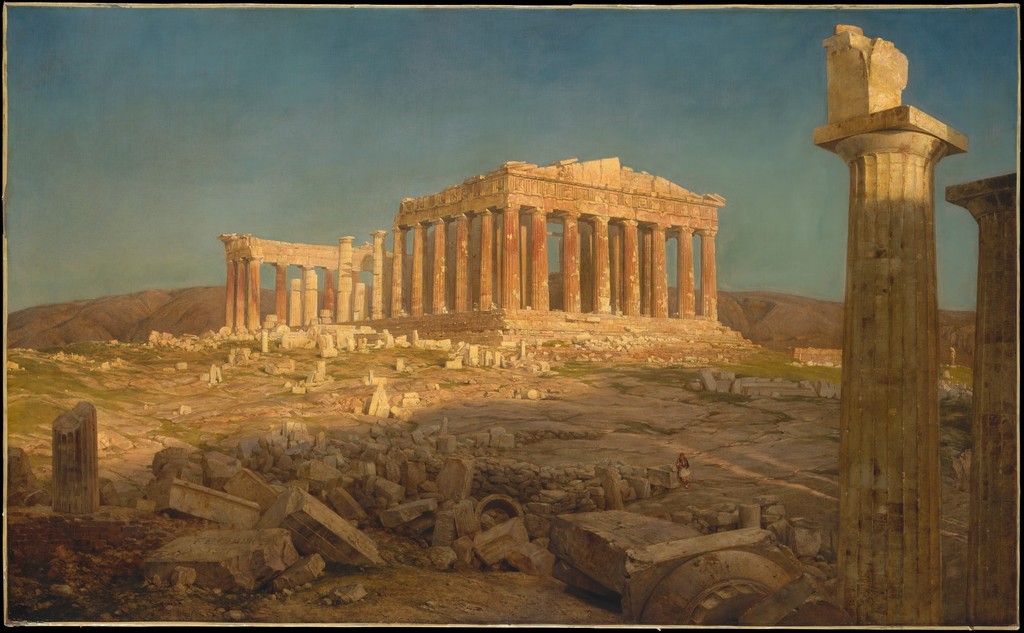
1865The Parthenon
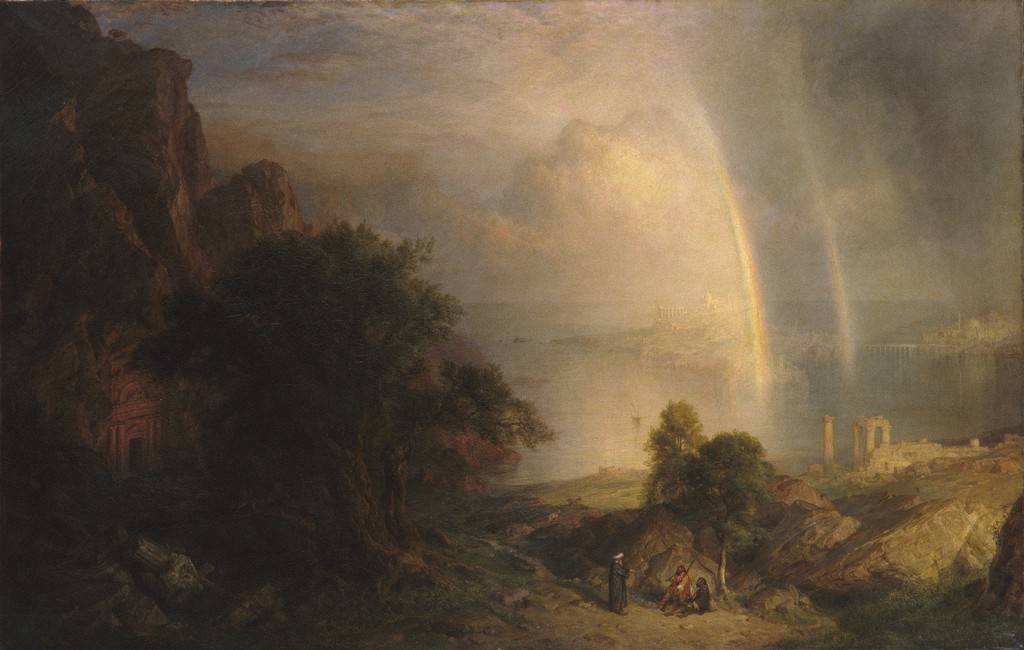
1871The Aegean Sea
About 1877Contents
- A landscape arranged around light
- A composed view of Syria
- The journey behind the picture
- A surviving study of Baalbek
- Baalbek’s Roman architecture
- Comparing the columns with a photograph
- Standing and fallen stone
- The route through the foreground
- Evening colour and the open sky
- Annotated details
A landscape arranged around light
The first impression is one of space held between substantial forms. On the right, a tall fluted column rises almost to the top of the canvas. On the left, a rocky ridge carries the remains of a large building. Between them, a cleft opens toward water and distant land, with the sun appearing low in the sky.
These features establish different kinds of distance. The nearest carved stones have sharp edges and strongly described surfaces. Smaller columns beyond the main shaft are still recognisable, but their details become less distinct. Farther away, the hilltop ruin is reduced to a silhouette, and the landscape beyond it merges with the atmosphere.
The composition invites the eye across those successive distances while repeatedly returning it to the foreground. A bright expanse of sky promises openness, yet the heavy column and scattered fragments make the viewer aware of standing among the remains of buildings. The landscape is both a prospect to examine and a place imagined from within.
Annotated Details from Syria by the Sea
The numbered points draw attention to visible features discussed in this article. Look from each detail back to the full composition. Frederic Edwin Church, Syria by the Sea, 1873. Oil on canvas, 142.2 × 215.9 cm. Detroit Institute of Arts, Gift of Mrs. James F. Joy, 10.11. Source image. Public domain / faithful reproduction of a two-dimensional public-domain painting. Numbered overview resized; detail crops added from the source master. No recolouring.
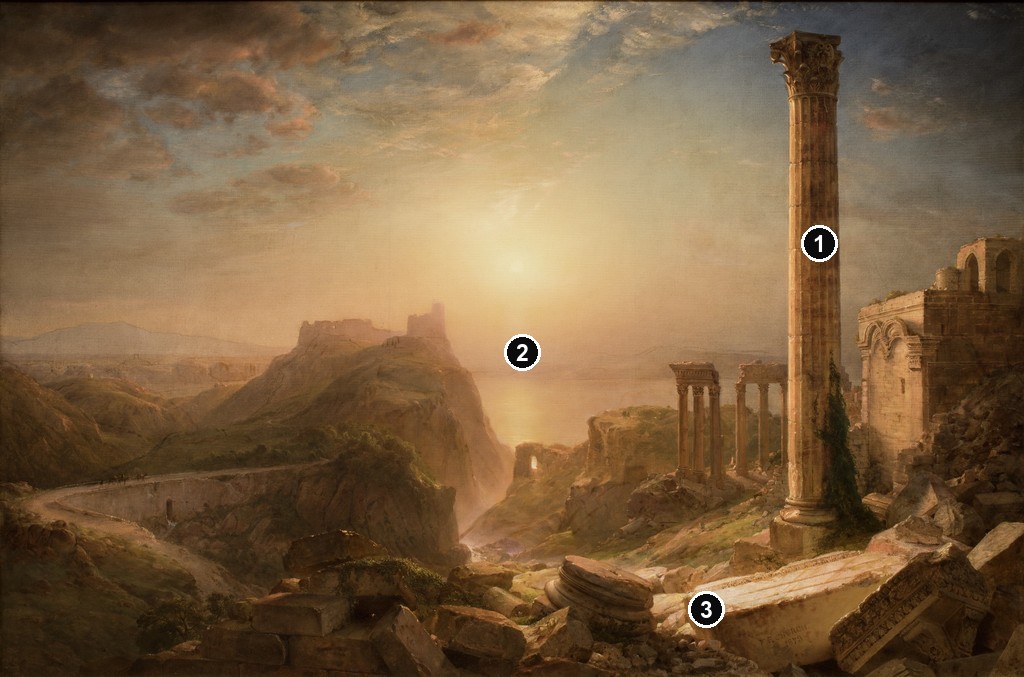
Details from SYRIA BY THE SEA
These crops come directly from the verified source images. They preserve the original colours or printed tones; the numbered overview is a separate aid to looking.
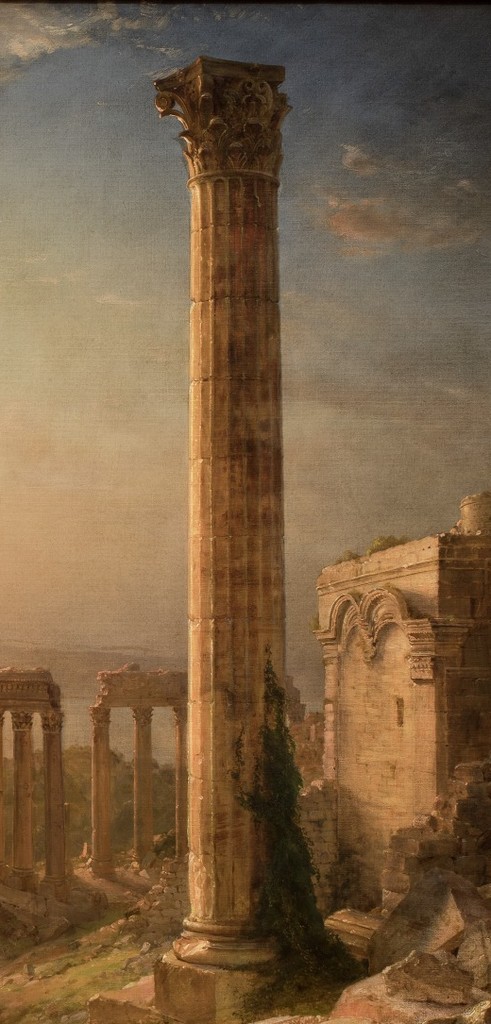
Tall fluted column
The tall column rises against the sky. Its repeated grooves and capital introduce architectural order into a wider landscape.
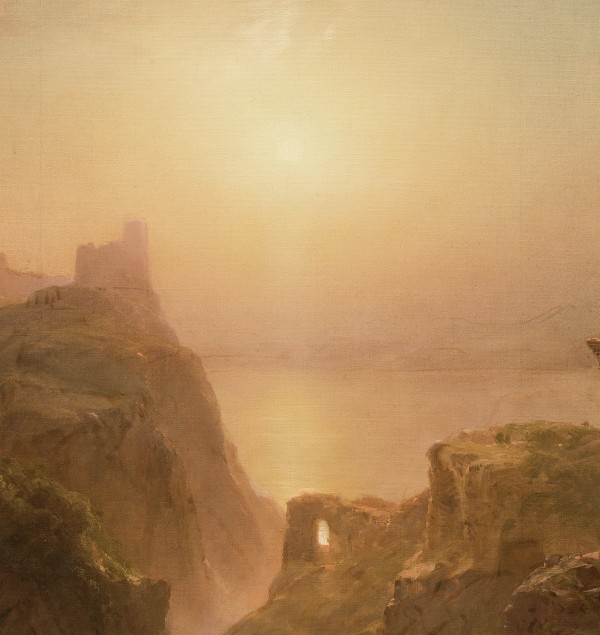
Sunlight and water
A bright interval joins the low sky and water. Compare this luminous route with the darker ruins around it.
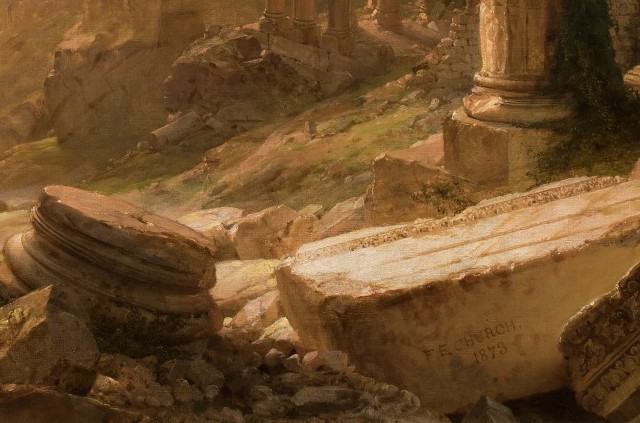
Fallen carved stone
Carved fragments lie close to the spectator. Their scale and broken surfaces make the standing columns feel farther away.
A composed view of Syria
Franklin Kelly’s essay in the National Gallery’s Church catalogue identifies Syria by the Sea as a composed landscape based on studies made around the ruins of Baalbek and Damascus.[2] That description explains why the picture combines convincing particulars with an elusive overall location.
The title should therefore be approached as the name of Church’s finished conception. It does not provide a precise address for every cliff, column and building. The painted coastline supplies an expansive setting for forms selected and rearranged by the artist. Searching for a single modern viewpoint would miss the relationship between his observations and the larger arrangement he developed from them.
The journey behind the picture
Church visited Damascus and Baalbek in the spring of 1868, several years before completing the canvas. Debora Rindge’s chronology places him in Damascus in late April and early May, and in Baalbek during May.[2] The interval separates the work of gathering observations from the decisions required for a large exhibition painting.
Olana’s institutional account places these visits within a nineteen-month journey through Europe and the Middle East, undertaken with Isabel Church, their young son Joseph and Isabel’s mother, Emma Carnes. The region was then part of the Ottoman Empire.[3] Present-day national boundaries do not describe the whole historical setting of the journey.
That setting also matters when considering the ruins. The ancient monuments existed within an inhabited region undergoing change. Church’s preference for weathered architecture and atmospheric distance selects particular aspects of it, rather than recording all of its contemporary life.
A surviving study of Baalbek
The Detroit Institute of Arts also holds Church’s View of Baalbek, dated 1868. It is oil and pencil on board, measuring 24.1 × 50.8 cm, and entered the museum through the Robert H. Tannahill Foundation Fund purchase, accession 2015.40.[4] This smaller work belongs to the period of his visit and offers a concrete counterpart to the later canvas’s scale.
Its existence helps make the process of observation tangible. Church could carry home drawings and painted records of structures encountered abroad, then return to them during subsequent work. The museum’s catalogue identifies the study without establishing that every feature of Syria by the Sea came directly from this particular board. The distinction leaves room for several observations to contribute to a single finished picture.
Baalbek’s Roman architecture
Baalbek stands in the northern Beqaa plain of present-day Lebanon. The German Archaeological Institute describes a major Roman temple group there, including the sanctuary of Jupiter and the comparatively well-preserved building traditionally called the Temple of Bacchus. The latter, constructed in the second century AD, survives to the level of its roof supports and retains elaborate architectural decoration.[5]
This history supplies context for Church’s interest in large columns, carved capitals and architectural fragments. It also prevents the painting’s setting from becoming confused with the actual site. Baalbek is inland; its temples are evidence for the architectural material Church studied, rather than a literal identification of the painted coastline.
Comparing the columns with a photograph
Alexandre Mounayer’s photograph of the Temple of Bacchus, taken in 2017, shows a row of substantial columns supporting a continuous entablature. Their ornate capitals can be examined against the darker masonry behind them. A visitor near the bases makes their great scale immediately apparent.[6]
Church’s tall foreground column is presented differently. It rises alone above the nearest debris, with sky surrounding much of its shaft and capital. Smaller groups beyond it suggest parts of a larger arrangement, but broken stone interrupts the continuity that is so prominent in the photograph.
The comparison reveals shared architectural vocabulary without making the two scenes interchangeable. The photograph’s visible shafts are relatively smooth, while Church gives his principal column pronounced vertical fluting. The modern image documents surviving structures from its own position. The painting uses isolation, recession and damage to create a particular encounter with ruins. Neither its viewpoint nor the origin of each fragment can be established simply by matching a Corinthian capital.
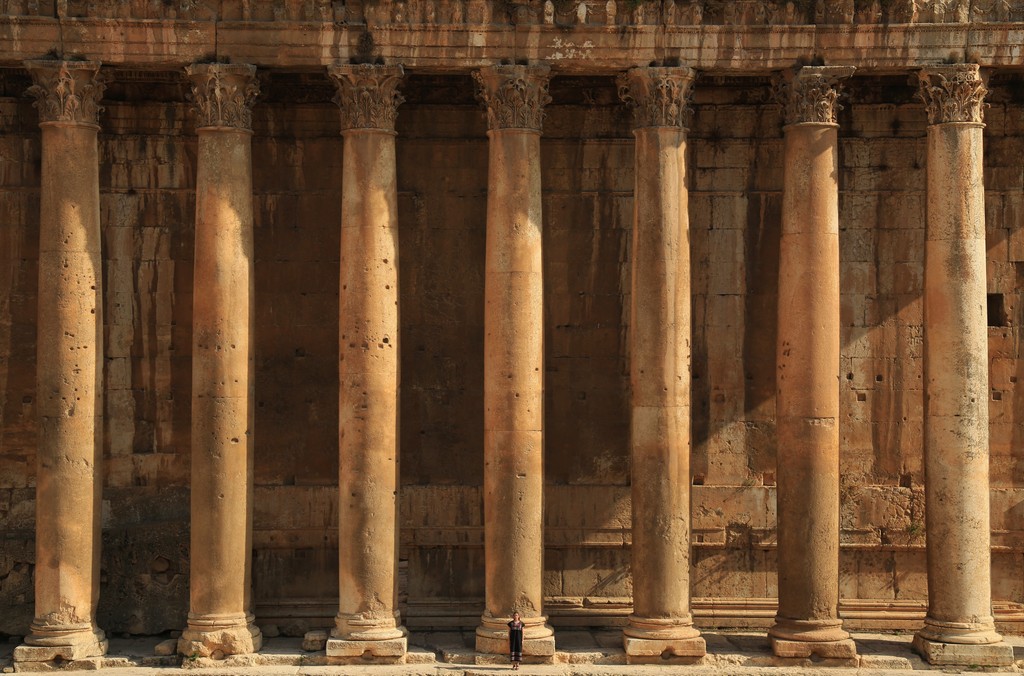
Columns of the Temple of Bacchus at Baalbek, Lebanon, 16 August 2017. Photograph by Alexandre Mounayer. A modern view of inland Baalbek, not the viewpoint of Church’s composed landscape. Alexandre Mounayer, Temple of Bacchus at Baalbek, 16 August 2017, via Wikimedia Commons; CC BY-SA 4.0; link source/licence and indicate resizing or cropping.. Image source. Creative Commons Attribution-ShareAlike 4.0 International. Resized; full source proportions retained.
Standing and fallen stone
The foreground contains more than a general scatter of rubble. A rounded architectural base or shaft section lies near the lower centre, while large pale blocks extend toward the right edge. On the nearest fragments, carved bands and mouldings survive even where their original architectural function has been lost.
The fallen pieces give weight to the painting’s historical subject. They once belonged to organised structures, but Church presents them at angles that no longer follow the upright column’s geometry. Horizontal, diagonal and curved forms gather around that surviving vertical, making the contrast between arrangement and disruption visible.
Vegetation softens parts of the transition between stone and ground. Green growth climbs beside the tall column and occupies ledges among the smaller ruins. It does not cover everything equally: exposed carved surfaces remain conspicuous, allowing the viewer to move between their ornament and the rougher terrain around them.
On the far right, an arched wall extends out of the picture. Its cropped position implies architecture continuing beyond the canvas. The scene therefore offers fragments at several scales, from individual fallen pieces to the partial remains of whole buildings.
Watch: Frederic Edwin Church
Choose a film to explore the artist’s work, its interpretation and its wider setting.
Frederic Edwin Church's "The Icebergs" on the Move at the DMA
Follow the Dallas Museum of Art as it moves Church’s large painting The Icebergs.
Watch on YouTubeThe route through the foreground
A curving masonry route crosses the lower left. Tiny travellers and animals occupy its upper edge, giving the landscape a modest but significant human presence. Their size makes the cliffs and ruins seem larger; their placement also supplies a possible way through a scene that initially appears dominated by obstacles.
The route turns around the landform rather than crossing the view in a straight line. The eye follows its bend toward the centre, where steep slopes fall into the illuminated cleft. That movement is quite different from the direct upward pull of the tall column.
The two directions work together. Architecture encourages attention to height and detail, while the path suggests movement across the ground. The travellers remain subordinate to the panorama, but they prevent the ruins from seeming wholly detached from human passage. Their small scale should not be mistaken for evidence that the surrounding region was empty.
Evening colour and the open sky
The sky occupies a large part of the canvas. Darker clouds gather along the upper edge, while warmer, more broken forms cross the open area below. Around the sun, pale yellow light spreads into a broad haze, reducing the contrast of distant buildings and land.
Church varies that effect across the scene. The nearest column retains a strongly described surface, with lit edges beside deeper shadows. The hilltop ruin is comparatively indistinct. Water catches the light between the rocky masses, linking the lower landscape to the brightness above it.
This handling makes atmosphere an organising element. Distance is expressed through changes in colour and visibility as well as through the diminishing size of objects. The viewer can examine carved stone close at hand, then look toward an expanse in which boundaries become uncertain.
The evening setting can encourage a reflective response to the ruins, but it does not establish a single prescribed meaning. Its more immediate achievement is to bring architecture, terrain, water and clouds within a continuous effect of light.
Ideal landscape and remembered travel
Katherine Manthorne’s review of the 2017–18 A Painter’s Pilgrimage exhibition places Syria by the Sea among Church’s idealized landscapes. She distinguishes their deliberately generalized locations from the apparently unified places presented in his earlier composite American scenes.[7]
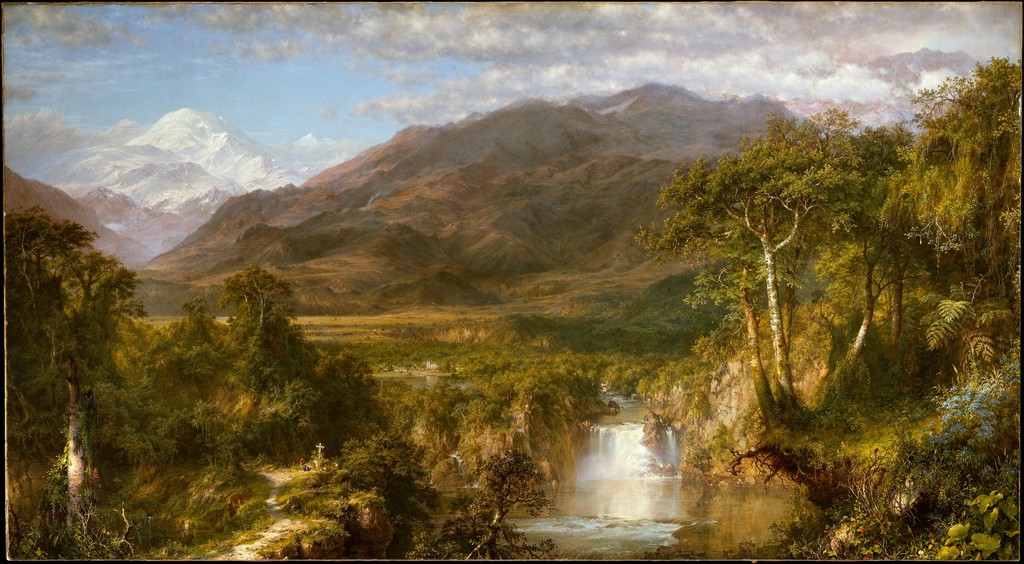
That comparison connects the work with The Heart of the Andes, in which observations gathered in different places also become a coherent panorama. The relationship is useful because it locates invention within Church’s established practice. Detailed observation and imaginative arrangement could operate together.
In Syria by the Sea, architectural remains bring human history visibly into that practice. Its forms can be inspected as stone, ornament and construction, while their broken condition invites thoughts about what preceded the present view. Manthorne interprets such landscapes in relation to the cultural meaning of ancient civilizations. That is a reading of their significance, rather than proof of a single message encoded in every ruin.
Turner, Claude and Thomas Cole
Kelly relates the recession into brilliant light to Turner’s Carthaginian pictures and, more distantly, Claude’s seaports. He also stresses the relevance of Thomas Cole’s Desolation, the final painting in The Course of Empire.[2]
These comparisons broaden the picture’s sources beyond travel. An isolated column, diminished architecture and a luminous distance can belong both to an observed landscape and to an established way of picturing the passage of time. Church’s scene brings such elements into a distinctive arrangement, with the column on the right balancing the massive landform on the left.
Signature, exhibition and ownership
Church signed and dated the picture on a stone fragment at the lower right. The museum records the inscription as “F. E. Church” with the date 1873.[1] Its placement incorporates the artist’s identifying mark into the painted material, encouraging a closer look at an area otherwise dominated by debris.
Rindge records the completed painting’s exhibition at New York’s Century Association in December 1873.[2] The date distinguishes its public appearance from the 1868 journey that helped furnish its subjects.
The museum’s provenance lists James Frederick Joy around 1873–74, Mrs. James F. Joy in 1886, and her gift to the Detroit Museum of Arts in 1910.[1] That documented sequence establishes the work’s route into the collection without requiring assumptions about its original price or the owners’ reasons for acquiring it.
Across the broad canvas, small details continue to reward examination: a traveller on the route, surviving carving on a fallen stone, the changing edges of distant buildings. They give substance to the larger effect of evening light. The scene holds together because those particulars remain connected to its expansive arrangement of land, architecture and sky.
Artworks directory
A documented selection of Church’s works discussed across these articles, together with identified prints after his designs. This is not a catalogue raisonné. Repeated titles and aliases are reconciled; studies remain distinct from finished paintings. Some dates remain unconfirmed. Other makers are named where a print adapts Church’s work.
| Name | Date | Medium |
|---|---|---|
| Above the Clouds at Sunrise | 1849 | Oil on canvas |
| The Aegean Sea | About 1877 | Oil on canvas |
| The Andes of Ecuador | 1855 | Oil on canvas |
| Aurora Borealis | 1865 | Oil on canvas |
| Autumn in North America | Circa 1856 | Oil on board |
| Coast Scene | 1852 | Oil on canvas |
| Cotopaxi | 1862 | Oil on canvas |
| A Country Home | 1854 | Oil on canvas |
| El Khasné, Petra | 1874 | Oil on canvas |
| El Rio de Luz | 1877 | Oil on canvas |
| The Heart of the Andes | 1859 | Oil on canvas |
| The Icebergs | 1861; foreground mast added between mid-1862 and early 1863 | Oil on canvas |
| Jerusalem from the Mount of Olives | 1870 | Oil on canvas |
| Mount Ktaadn | 1853 | Oil on canvas |
| Our Banner in the Sky | 1861 | Oil paint over lithograph on paper, laid down on cardboard |
| The Parthenon | 1871 | Oil on canvas |
| Rainy Season in the Tropics | 1866 | Oil on canvas |
| Storm in the Mountains | 1847 | Oil on canvas |
| Syria by the Sea | 1873 | Oil on canvas |
| Tamaca Palms | 1854 | Oil on canvas |
| Tropical Scenery | 1873 | Oil on canvas |
| Twilight in the Tropics | 1874; signed and dated, according to Bonhams’ catalogue | Oil on canvas |
| Twilight in the Wilderness | 1860 | Oil on canvas |
| View of Cotopaxi | 1857 | Oil on canvas |
| Niagara | 1857 | Oil on canvas |
| Magdalena River, New Granada, Equador | 1853 | Graphite heightened with white on wove paper |
| Tamaca Palm, Colombia or Ecuador | May–October 1853 | Graphite on gray laid paper |
| Mixed Sketches with a Champan, Río Magdalena, Colombia | May 1853 | Graphite on gray laid paper |
| Study for Rainy Season in the Tropics | 1865–1866 | Graphite on ruled notepad paper |
| Al-Khazneh, Petra (study) | February–March 1868 | Oil and graphite on tan paperboard |
| The Great Fall, Niagara (Charles Risdon, after Church) | 1874 impression | Hand-coloured chromolithograph on paperboard |
| The Heart of the Andes (William Forrest, after Church) | 1862 | Engraving in black on wove paper |
| Our Heaven Born Banner (William Bauly, adapting Church’s motif) | circa 1861 | Colour lithograph |
| A Tropical Moonlight (wood engraving after Church) | 1879 publication | Wood engraving in American Painters |
| Off Iceberg, Newfoundland | June 1859 | Oil and graphite on paperboard |
| Parthenon at Night, Athens | April 1869 | Oil and graphite on tan paperboard |
| Jerusalem from the Mount of Olives (study) | 1 April 1868 | Oil and graphite study |
| Horseshoe Falls (study) | December 1856–January 1857 | Oil on paper mounted to canvas |
| Niagara Falls, from the American Side | 1867 | Oil on canvas |
| Study for The Heart of the Andes | 1858 | Oil study |
| Mount Chimborazo through Rising Mist and Clouds | 1857 | Oil study |
| Cotopaxi Erupting, Viewed from Quito, Ecuador | June 1857 | Oil and graphite on tan paperboard |
| Cotopaxi (painted for Cyrus Field) | 1855 | Painting |
| Chimborazo | 1864 | Painting |
| Twilight, A Sketch | 1858 | Oil on canvas |
| View of Baalbek | 1868 | Oil and pencil on board |
| Three Bedouins | Date unconfirmed | Oil study |
| Coast Scene, Mount Desert (later canvas) | 1863 | Painting |
| The Wreck | Date unconfirmed | Painting |
| Grand Manan Island, Bay of Fundy | Date unconfirmed | Painting |
| Summer in South America | circa 1853 | Painting |
| Evening in Vermont | Date unconfirmed | Painting |
| Home by the Lake | Date unconfirmed | Painting |
| Storm in the Blue Mountains, Jamaica | August 1865 | Painting |
| The Natural Bridge, Virginia | 1852 | Painting |
| The Vale of St. Thomas, Jamaica | 1867 | Painting |
| Tequendama Falls, near Bogota, New Granada | Date unconfirmed | Painting |
| Sunrise in Syria | Before the 1876 exhibition | Painting |
| Cuernavaca (oil study; descriptive title) | 1898 | Oil study |
| Olana window design (descriptive title) | Date unconfirmed | Watercolour and graphite |
| Olana dining-room stencil sketch (descriptive title) | Date unconfirmed | Oil and graphite |
| Olana house (with Calvert Vaux) | 1870–1872; later additions | Architecture |
| Olana designed landscape | From 1860; developed over decades | Designed landscape |
Frequently Asked Questions
Church completed it in 1873, several years after visiting Damascus and Baalbek in 1868.
It is a composed landscape drawing on studies around Baalbek and Damascus. Its coastline and ruins should not be treated as a precise record of one modern viewpoint.
It belongs to the Detroit Institute of Arts, accession 10.11, through the gift of Mrs. James F. Joy in 1910.
The unframed canvas measures 142.2 × 215.9 cm, or 56 × 85 inches. Larger measurements sometimes cited include its frame.
No. The modern photograph shows actual temple architecture at inland Baalbek. It offers a comparison with the architectural forms in Church’s composed landscape.
Discussion
Look again at the images and ideas explored in Syria by the Sea. These editorial prompts invite your own observations.
Follow the curving route before looking back at the tall column. How do these two directions change your sense of entering the landscape? Compare the photograph’s continuous row of columns with Church’s standing and fallen forms.
Reader Insights
How does the light connect the ruins, land and water?
Which elements seem to form the strongest path through this composed view?
What does the surviving Baalbek study add to your understanding of the finished landscape?
Join the Conversation
Share a detail, comparison or question about Syria by the Sea below.
References
- Detroit Institute of Arts, Syria by the Sea, 10.11. Current object details, unframed dimensions, inscription, credit and provenance.
- Frederic Edwin Church, National Gallery of Art, 1989. Franklin Kelly, p. 67 and relevant notes on p. 75; catalogue 47, p. 123; Debora Rindge, chronology, pp. 167–169. Composed view, artistic comparisons, travel and December 1873 exhibition.
- Olana, Frederic Church: Artista global, 2026 institutional labels. Europe and Middle East introduction, paraphrased from Spanish: family journey and Ottoman context.
- Detroit Institute of Arts, View of Baalbek, 2015.40. Exact 1868 study record; no definitive preparatory relationship asserted here.
- German Archaeological Institute, Archaeological and architectural research in Baalbek, project introduction and overview; Margarete van Ess, Julia Nádor and Holger Wienholz, Baalbek, Libanon. Die Arbeiten des Jahres 2019, 2020, abstract. Temple context and Beqaa location; full excavation report not used.
- Alexandre Mounayer, Temple of Bacchus at Baalbek, 16 August 2017, Wikimedia Commons. Modern photographic comparison; CC BY-SA 4.0.
- Katherine Manthorne, review of Frederic Church: A Painter’s Pilgrimage and Costume & Custom: Middle Eastern Threads at Olana, Panorama 4, no. 2, 2018. Pages 5–6, idealized landscapes and composite views; associated exhibition book not directly consulted.
- Splash image source.
Frederic Edwin Church, Syria by the Sea, 1873. Oil on canvas, 142.2 × 215.9 cm. Detroit Institute of Arts, Gift of Mrs. James F. Joy, 10.11. Image source. Public domain / faithful reproduction of a two-dimensional public-domain painting. Resized; full source proportions retained.