 by Tom Gurney
Tom Gurney BSc (Hons) is an art history expert with over 20 years experience
Published on June 19, 2020 / Updated on October 27, 2026
Email: tomgurney1@gmail.com / Phone: +44 7429 011000
View of Cotopaxi: Introduction
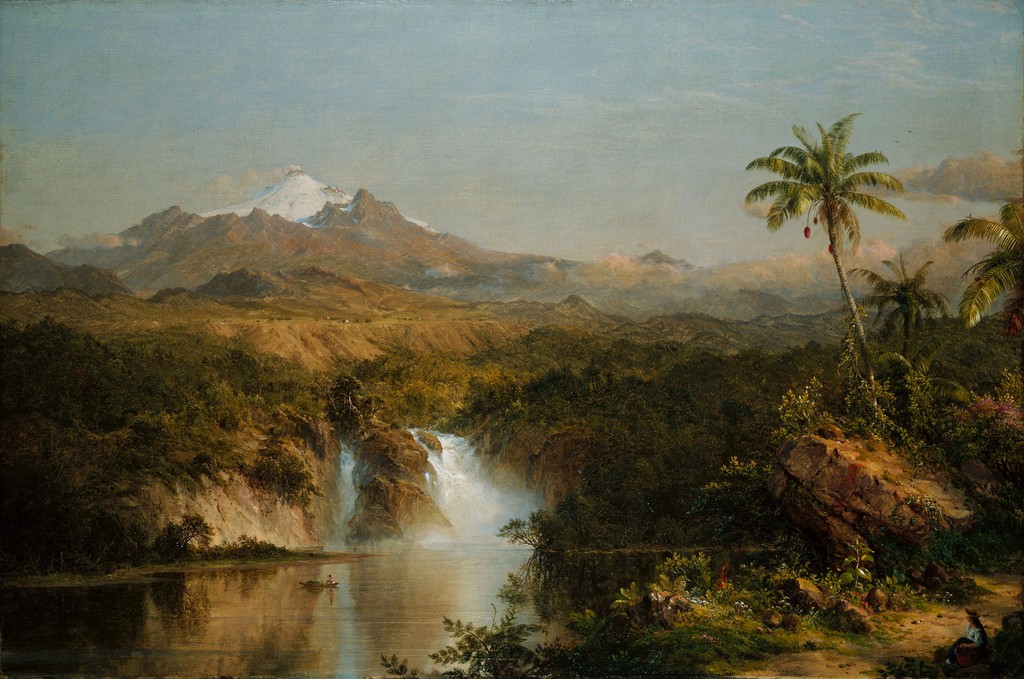
Frederic Edwin Church’s View of Cotopaxi of 1857 brings a distant, snow-covered mountain into a landscape of palms, falling water and small human figures. The painting belongs to the Art Institute of Chicago. Its restrained sky and intricate foreground offer a different experience from the larger, erupting Cotopaxi that Church painted in 1862. Looking closely at the Chicago picture reveals how much happens between the named summit and the viewer.[1]
At a Glance
- ArtistFrederic Edwin Church
- TitleView of Cotopaxi
- Date1857
- MediumOil on canvas
- Dimensions62.2 × 92.7 cm; 24½ × 36½ inches
- CollectionArt Institute of Chicago
- Accession number1919.753
- CreditGift of Jennette Hamlin in memory of Mr. and Mrs. Louis Dana Webster
- SignatureLower right, “F. E. Church ’57,” as recorded by the museum
This work across Church’s career
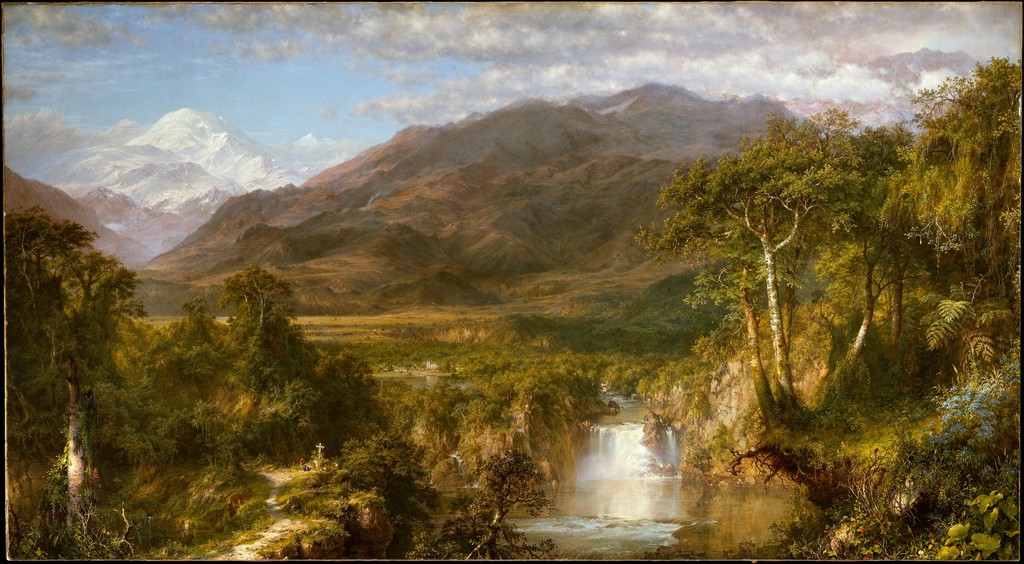
Tamaca Palms
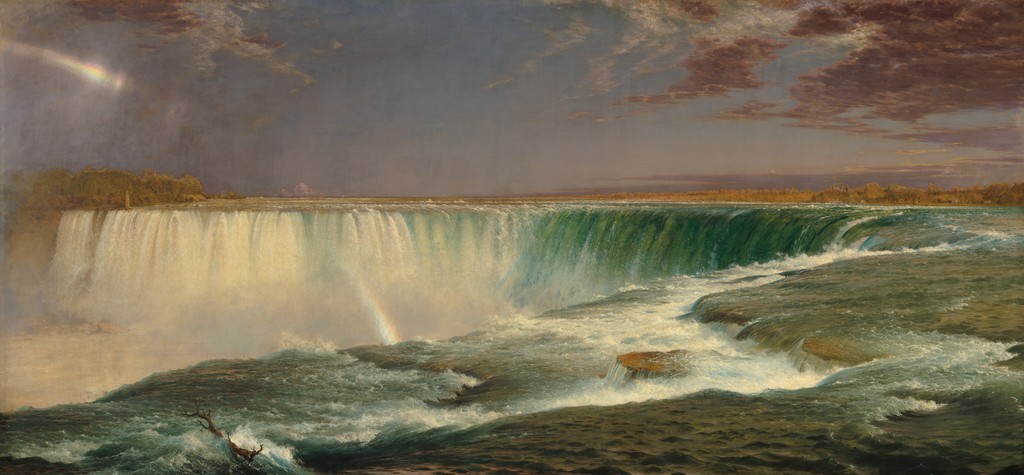
1854Niagara
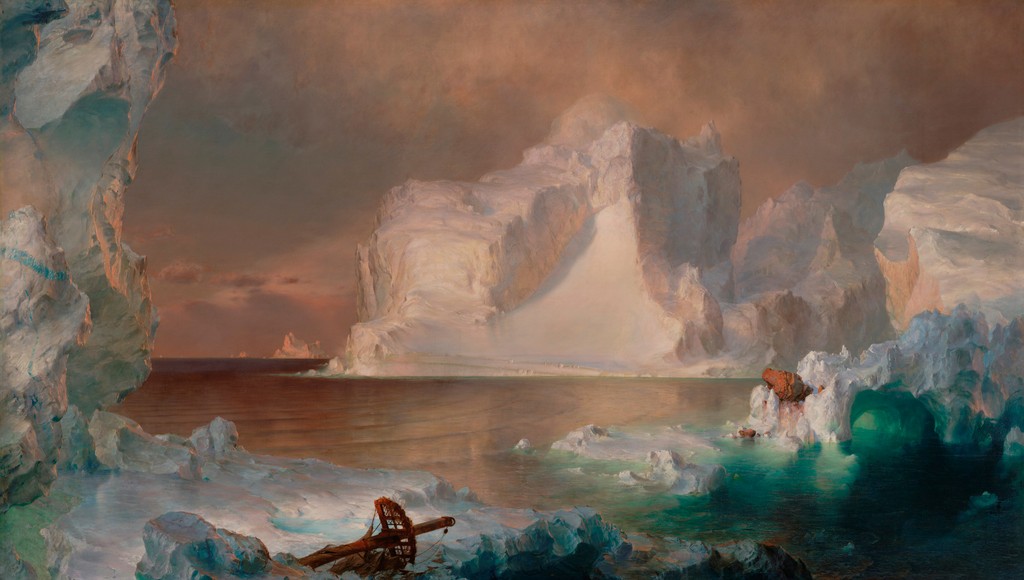
1857The Icebergs
1861; foreground mast added between mid-1862 and early 1863Cotopaxi
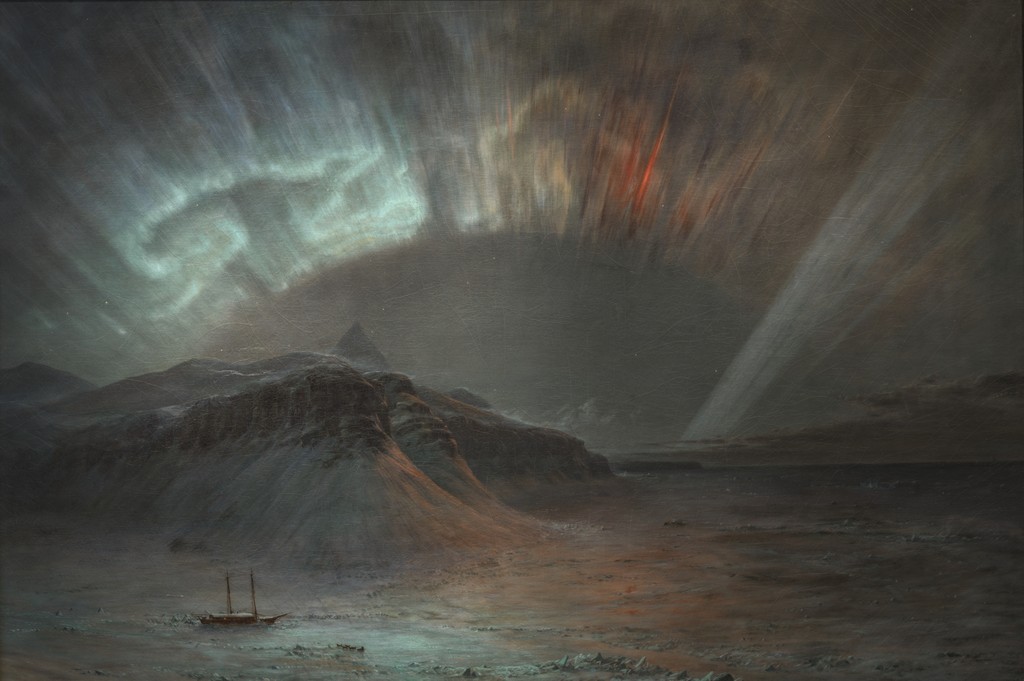
1862Aurora Borealis
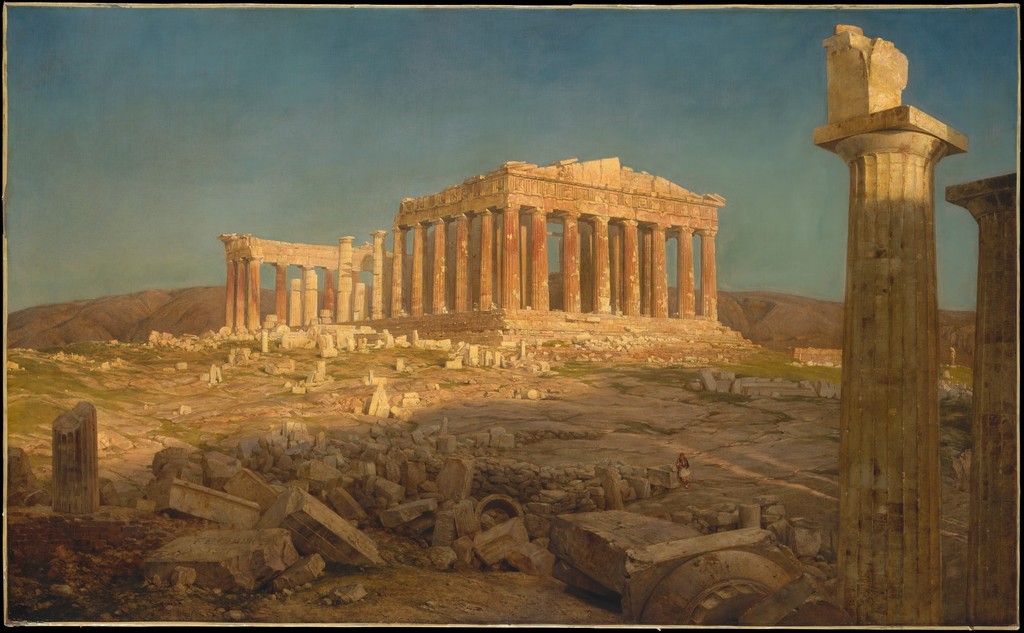
1865The Parthenon
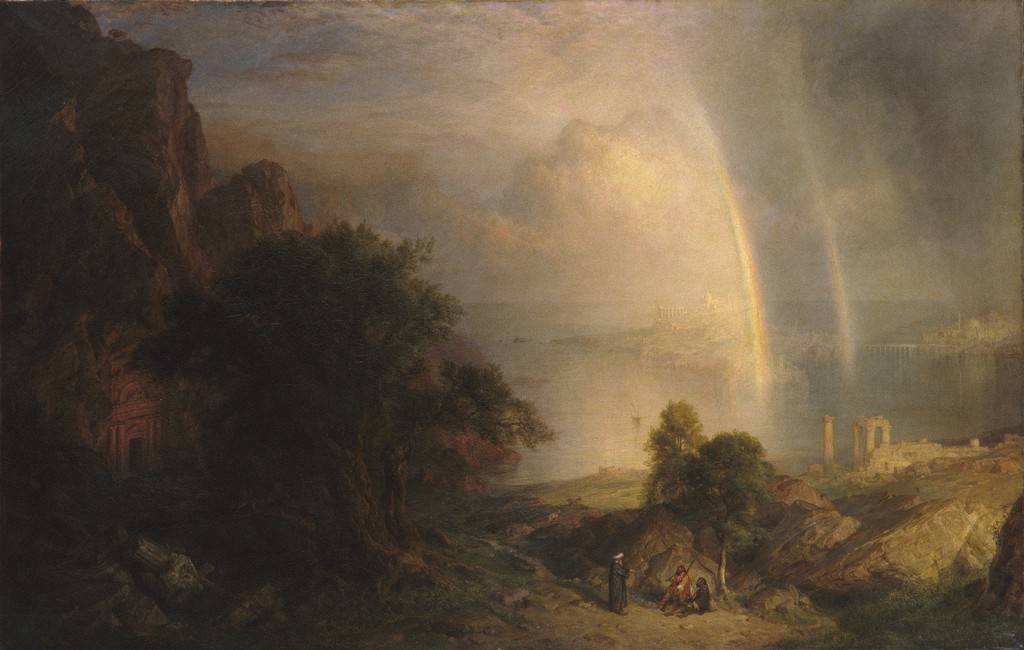
1871The Aegean Sea
About 1877Contents
- A studio painting before the second journey
- The summit and the space around it
- Falling water and a faint rainbow
- Palms, flowers and a path
- A more dramatic tropical landscape
- From a Chicago collection to the museum
- Distinguishing other Cotopaxi paintings
- A modern photograph and a different viewpoint
- How to look at View of Cotopaxi
- Annotated details
A studio painting before the second journey
The date matters because Church travelled to South America twice. Debora Rindge’s chronology records his first journey through Colombia and Ecuador with Cyrus W. Field in 1853, followed by another visit to Ecuador with the painter Louis Remy Mignot in 1857. View of Cotopaxi belongs to a period when earlier experience could feed new pictures and further travel could renew that experience.[2]
The Art Institute states that this canvas was completed in Church’s studio just before the second visit. It therefore precedes the observations and studies made during that expedition. A painting dated 1857 cannot automatically be treated as an on-the-spot record of the journey undertaken in the same year. Here, the museum’s sequence gives us a more precise way to understand the relationship between travel and finished work.[1]
Alexander von Humboldt’s interest in the connections between natural phenomena helps explain the breadth of Church’s attention. The Art Institute identifies that influence in the painting. Summit, vegetation and water share the view, inviting the eye to consider a landscape through several kinds of detail rather than through the outline of one mountain alone.
Annotated Details from View of Cotopaxi
The numbered points draw attention to visible features discussed in this article. Look from each detail back to the full composition. Frederic Edwin Church, View of Cotopaxi, 1857, oil on canvas, 62.2 × 92.7 cm. Art Institute of Chicago, Gift of Jennette Hamlin in memory of Mr. and Mrs. Louis Dana Webster, 1919.753. Faithful reproduction via Wikimedia Commons; public domain / Public Domain Mark 1.0. Source image. Faithful 2D reproduction of public-domain painting / PD-Art / PD-old-100-expired / PDM1.0. Numbered overview resized; detail crops added from the source master. No recolouring.
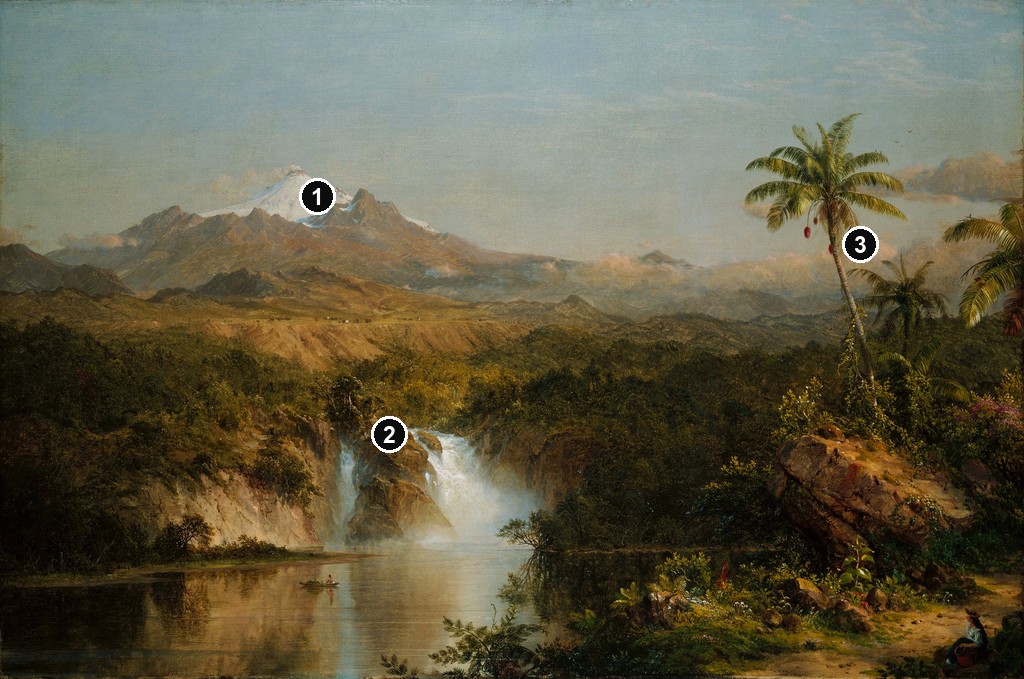
Details from VIEW OF COTOPAXI
These crops come directly from the verified source images. They preserve the original colours or printed tones; the numbered overview is a separate aid to looking.
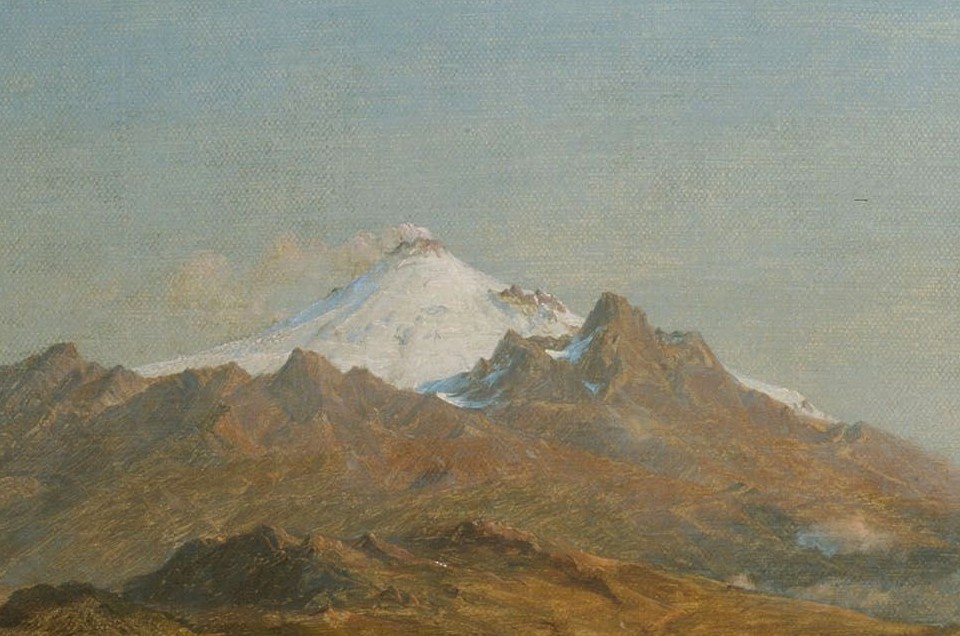
Distant summit
The snowy summit appears beyond several intervening slopes. Compare its pale, simplified form with the more detailed nearby landscape.
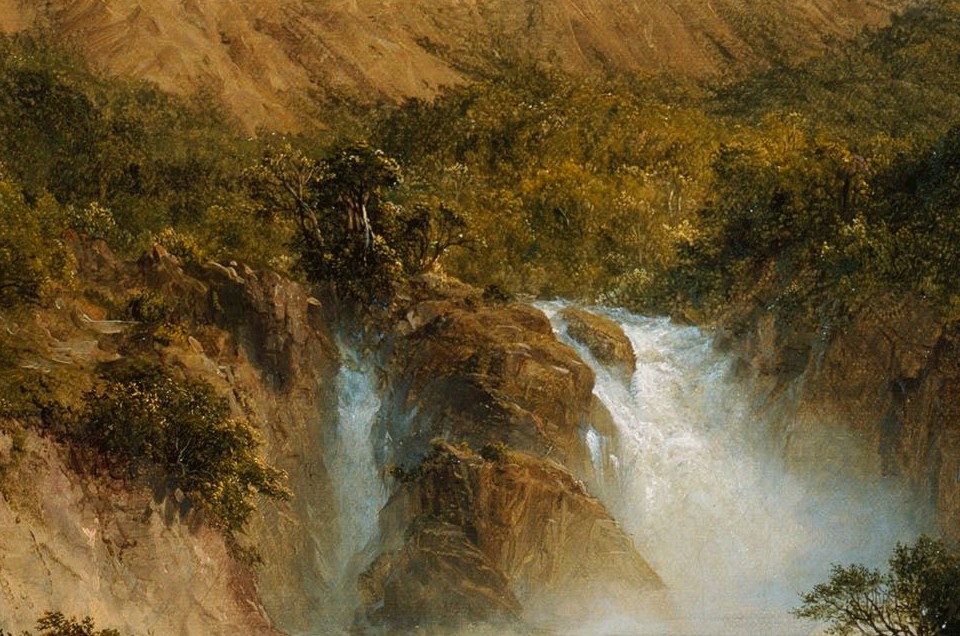
Divided waterfall
The falling water creates a bright break among darker banks. Its divisions draw attention to the structure of the foreground.
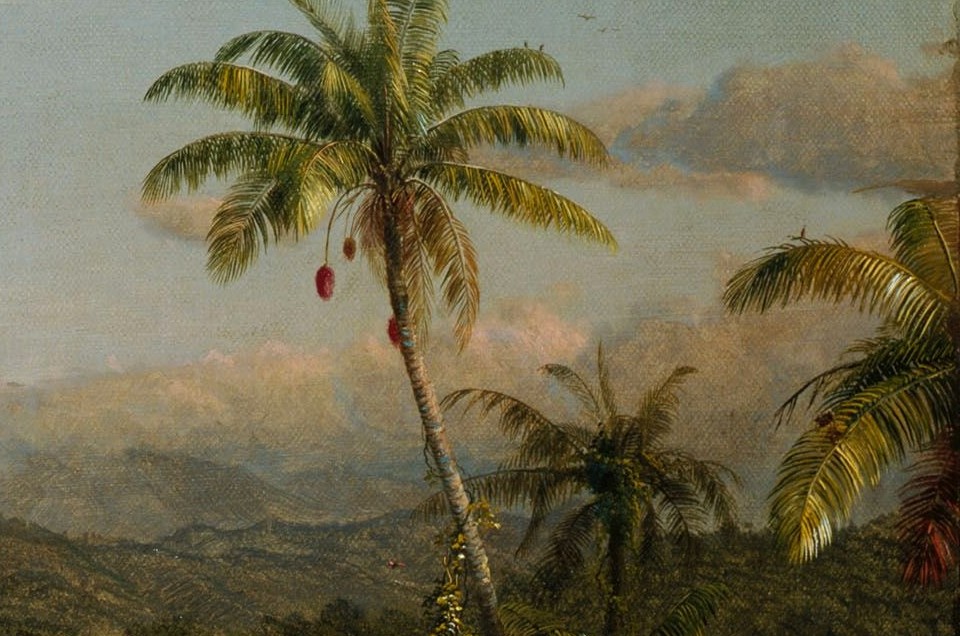
Right-hand palms
Tall palms rise along the right side of the view. Their trunks and crowns help frame the distant mountain without enclosing it completely.
The summit and the space around it
The white peak stands left of centre, behind a broken succession of darker ridges. Although the title directs us towards Cotopaxi, the mountain occupies only a small part of the canvas. Its pale upper slopes are easy to recognise against the sky, while nearer brown and grey forms partly screen the lower mountain. That overlap makes the summit feel remote.
The mountain’s placement also leaves room for a broad stretch of sky. Across this comparatively open area, small clouds and soft changes of tone have a gentler presence than the sharply described foreground. The contrast lets the eye rest after examining leaves and rocks. It also helps establish a scale of distance: near objects interrupt and overlap one another, while the peak appears beyond a much larger interval of air.
Moving down from the summit, the ridges become less regular and more crowded. Their angular outlines do not form a single continuous slope towards the viewer. Instead, the eye crosses layers of terrain before reaching the greener valley and its water. The picture gives us several stages of looking, each with its own shapes and textures.
Falling water and a faint rainbow
The waterfall near the centre is one of the brightest passages below the mountains. Water divides around a projecting rock, then falls into pale spray. Its broken shape contrasts with the calmer surface beneath it. The central rock remains dark enough to separate the streams and keep the cascade readable within the surrounding vegetation.
A faint rainbow appears in the mist near the base of the falls. It is a delicate detail compared with the broad white water above. Finding it changes the balance of the scene: what first appears to be a distant mountain landscape also contains a small, transient effect close to the foreground. The rainbow rewards a slower look without becoming a large emblem across the sky.
Below the cascade, the water spreads across the lower left. Reflections soften the difference between the banks and their surroundings. A small boat interrupts this surface, supplying a clear measure of human scale. The stiller water also gives the falling water somewhere to arrive; the cascade becomes part of a connected pictorial passage rather than an isolated spectacle.
Palms, flowers and a path
The right foreground holds a particularly dense assembly of forms. Tall palms lift their fronds into the open sky, while shorter growth gathers around rocks and a winding path. The tallest palm answers the distant mountain with a nearer vertical accent. Its silhouette is more branching and irregular than the summit, but both draw attention above the main band of terrain.
Lower down, individual leaves and touches of flower colour make this side of the painting feel close. Rocks give the vegetation a firm setting, and the light path offers an opening through it. These details are best approached as things to see within the composition; identifying every plant would require botanical evidence beyond resemblance in a reproduction.
A seated figure appears near the lower right, beside the path. Across the water, the boat provides another human presence. Neither occupies enough space to dominate the landscape, yet together they prevent it from becoming an unpeopled panorama. They also draw attention towards two different ways of moving through the scene, by land and by water. Their precise identities and thoughts remain outside what the image establishes.
A more dramatic tropical landscape
In his National Gallery of Art essay, Franklin Kelly places View of Cotopaxi among works that moved Church’s tropical painting towards a more rugged and dramatic treatment. Kelly describes dense vegetation at a foreground corner, a deep valley or river bed, and a rapid movement of the eye towards remote, jagged mountains. His account helps explain the distance between this picture’s abundant near growth and its more austere upper terrain.[2]
Kelly calls this movement towards the sublime: a landscape capable of suggesting grandeur and power. That reading does not depend on a spectacular eruption. Here, depth, falling water and the contrast between near vegetation and far mountains can produce a sense of magnitude within a canvas less than a metre wide. The viewer’s position feels close to small, readable things, while the land beyond them exceeds that immediate scale.
The Art Institute also interprets the painting through Christian ideas of divine power and through nineteenth-century American ambitions towards Latin America. These are the museum’s historical readings. They widen the questions we can ask about the view without assigning a single meaning to each palm, figure or cloud.[1]
Watch: Frederic Edwin Church
Choose a film to explore the artist’s work, its interpretation and its wider setting.
Frederic Edwin Church's "The Icebergs" on the Move at the DMA
Follow the Dallas Museum of Art as it moves Church’s large painting The Icebergs.
Watch on YouTubeFrom a Chicago collection to the museum
The Art Institute’s provenance begins with Walter Wright in Chicago in 1857. It then traces descent through the Webster and Hamlin family before the painting entered the museum in 1919. Its credit commemorates Mr. and Mrs. Louis Dana Webster through Jennette Hamlin’s gift. This ownership history places the picture in Chicago long before its arrival in the public collection.[1]
The museum’s original 1920 handbook provides a contemporary record of that arrival. Entry 547 lists the picture as South America, records Church’s signature and the date ’57, gives the canvas dimensions, and names the 1919 gift. Those details agree with the present object record. The broad geographical title was therefore part of the painting’s early museum history.[3]
This earlier title is useful when reading historical references. A catalogue entry headed South America can describe the same object now called View of Cotopaxi. The matching signature, dimensions and donor help establish that connection. The handbook documents a name used by the museum; it does not explain who originally chose that name or why it later changed.
Distinguishing other Cotopaxi paintings
Church returned to this subject repeatedly. The Detroit Institute of Arts holds Cotopaxi of 1862, a much larger oil canvas measuring 121.9 × 215.9 centimetres. Its dark plume, glowing sky, low sun and deep chasm give volcanic activity a far more prominent role. The museum explains that Church combined natural details from different places in that work to explore geological forces.[4]
Seen beside the Chicago picture, the Detroit painting makes the differences easy to follow. The later plume occupies a substantial part of the sky; the earlier view gives more space to the distant white peak and nearer greenery. Both contain falling water and small figures, but their arrangements and balance of attention differ. The later picture is a separate composition, rather than a larger version of this exact scene.
There is also a View of Cotopaxi dated 1867 in the Yale University Art Gallery. Yale’s record identifies an oil canvas measuring 27.9 × 45.7 centimetres, accession 1969.113.2. The shared title should therefore be read alongside date, collection and dimensions. Those details distinguish a small later painting from the 1857 Chicago canvas discussed here.[5]
For a fuller examination of the erupting landscape, see Church’s 1862 Cotopaxi. His earlier Andes of Ecuador provides another route into the relationship between tropical detail and mountainous distance.
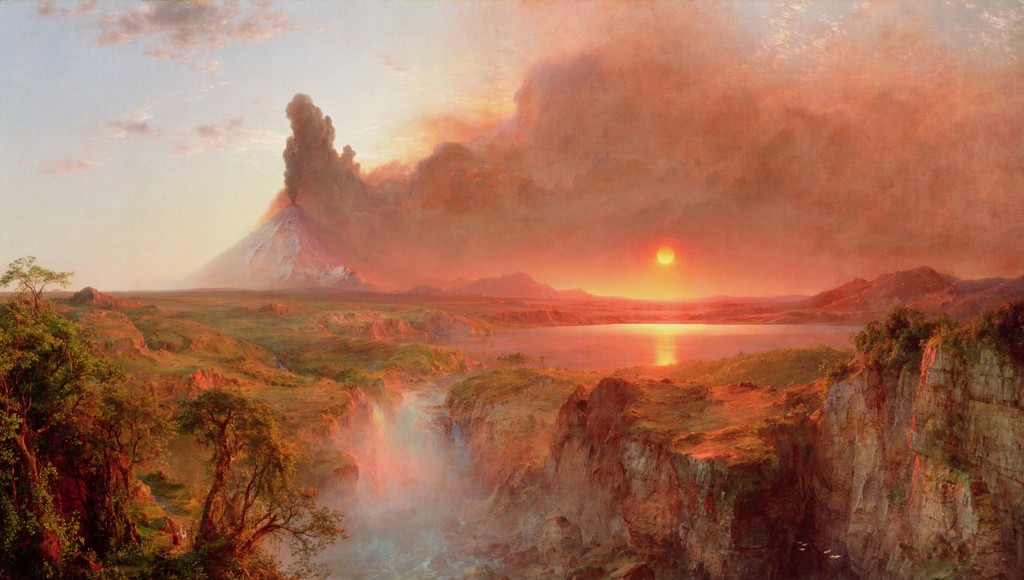
Frederic Edwin Church, Cotopaxi, 1862, oil on canvas, 121.9 × 215.9 cm. Detroit Institute of Arts, Founders Society Purchase, Robert H. Tannahill Foundation Fund, Gibbs-Williams Fund, et al., 76.89. Faithful reproduction via The Lost Gallery / Wikimedia Commons; public domain / Public Domain Mark 1.0. Detroit Institute of Arts, Founders Society Purchase, Robert H. Tannahill Foundation Fund, Gibbs-Williams Fund, et al., 76.89. Reproduction via Wikimedia Commons / The Lost Gallery.. Image source. Public domain / faithful reproduction of historic two-dimensional artwork. Resized; full source proportions retained.
A modern photograph and a different viewpoint
The supporting photograph by J. Miers was taken on 21 July 2010. Its creator’s record identifies Cotopaxi with Tambopaxi in the foreground. Open, rocky ground leads towards a white-capped cone, and a building appears at the right edge. The photograph offers a dated view of the mountain from a different position, rather than a reconstruction of Church’s landscape.[6]
Compare how the two images distribute attention. The photograph gives the cone a relatively direct approach across open terrain. Church’s picture asks the eye to cross water, foliage, rocks and ridges before reaching the summit. This comparison makes his composition easier to notice. It cannot establish that a particular palm, waterfall or boat belonged to the photographer’s location, or that Church painted from that exact spot.
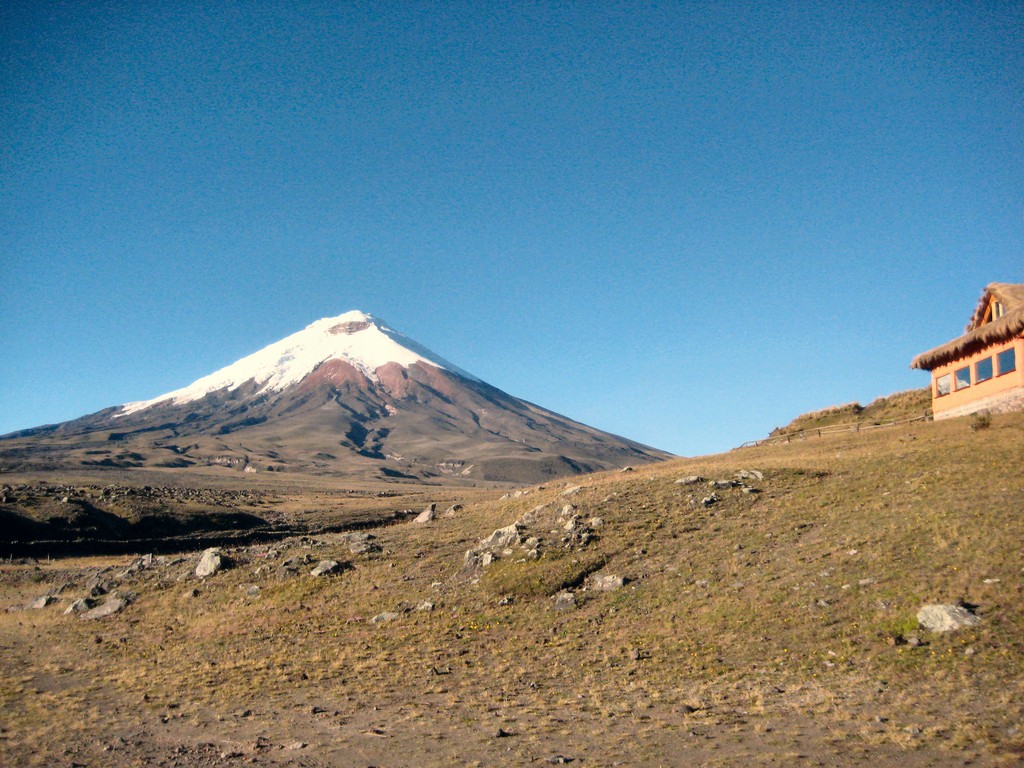
Cotopaxi with Tambopaxi in the foreground, photographed by J. Miers / (WT-shared) Jtesla16, 21 July 2010. Source: Wikimedia Commons. CC BY-SA 3.0. Modern view from a different position. J. Miers / (WT-shared) Jtesla16, CC BY-SA 3.0. Image source. CC BY-SA 3.0. Resized; full source proportions retained.
How to look at View of Cotopaxi
Begin with the pale summit, then follow the darker ridges down towards the valley. Find the divided waterfall and look for the faint rainbow in its spray. Next, move across the calmer water to the small boat. Finish with the palms and path on the right, where the seated figure gives the foreground another point of human scale.
Finally, take in the whole canvas again. The mountain named in the title is distant, while much of the painting’s visual richness lies closer to the viewer. That relationship gives the scene its breadth: a particular summit becomes the far point of a landscape full of different surfaces, movements and distances.
Artworks directory
A documented selection of Church’s works discussed across these articles, together with identified prints after his designs. This is not a catalogue raisonné. Repeated titles and aliases are reconciled; studies remain distinct from finished paintings. Some dates remain unconfirmed. Other makers are named where a print adapts Church’s work.
| Name | Date | Medium |
|---|---|---|
| Above the Clouds at Sunrise | 1849 | Oil on canvas |
| The Aegean Sea | About 1877 | Oil on canvas |
| The Andes of Ecuador | 1855 | Oil on canvas |
| Aurora Borealis | 1865 | Oil on canvas |
| Autumn in North America | Circa 1856 | Oil on board |
| Coast Scene | 1852 | Oil on canvas |
| Cotopaxi | 1862 | Oil on canvas |
| A Country Home | 1854 | Oil on canvas |
| El Khasné, Petra | 1874 | Oil on canvas |
| El Rio de Luz | 1877 | Oil on canvas |
| The Heart of the Andes | 1859 | Oil on canvas |
| The Icebergs | 1861; foreground mast added between mid-1862 and early 1863 | Oil on canvas |
| Jerusalem from the Mount of Olives | 1870 | Oil on canvas |
| Mount Ktaadn | 1853 | Oil on canvas |
| Our Banner in the Sky | 1861 | Oil paint over lithograph on paper, laid down on cardboard |
| The Parthenon | 1871 | Oil on canvas |
| Rainy Season in the Tropics | 1866 | Oil on canvas |
| Storm in the Mountains | 1847 | Oil on canvas |
| Syria by the Sea | 1873 | Oil on canvas |
| Tamaca Palms | 1854 | Oil on canvas |
| Tropical Scenery | 1873 | Oil on canvas |
| Twilight in the Tropics | 1874; signed and dated, according to Bonhams’ catalogue | Oil on canvas |
| Twilight in the Wilderness | 1860 | Oil on canvas |
| View of Cotopaxi | 1857 | Oil on canvas |
| Niagara | 1857 | Oil on canvas |
| Magdalena River, New Granada, Equador | 1853 | Graphite heightened with white on wove paper |
| Tamaca Palm, Colombia or Ecuador | May–October 1853 | Graphite on gray laid paper |
| Mixed Sketches with a Champan, Río Magdalena, Colombia | May 1853 | Graphite on gray laid paper |
| Study for Rainy Season in the Tropics | 1865–1866 | Graphite on ruled notepad paper |
| Al-Khazneh, Petra (study) | February–March 1868 | Oil and graphite on tan paperboard |
| The Great Fall, Niagara (Charles Risdon, after Church) | 1874 impression | Hand-coloured chromolithograph on paperboard |
| The Heart of the Andes (William Forrest, after Church) | 1862 | Engraving in black on wove paper |
| Our Heaven Born Banner (William Bauly, adapting Church’s motif) | circa 1861 | Colour lithograph |
| A Tropical Moonlight (wood engraving after Church) | 1879 publication | Wood engraving in American Painters |
| Off Iceberg, Newfoundland | June 1859 | Oil and graphite on paperboard |
| Parthenon at Night, Athens | April 1869 | Oil and graphite on tan paperboard |
| Jerusalem from the Mount of Olives (study) | 1 April 1868 | Oil and graphite study |
| Horseshoe Falls (study) | December 1856–January 1857 | Oil on paper mounted to canvas |
| Niagara Falls, from the American Side | 1867 | Oil on canvas |
| Study for The Heart of the Andes | 1858 | Oil study |
| Mount Chimborazo through Rising Mist and Clouds | 1857 | Oil study |
| Cotopaxi Erupting, Viewed from Quito, Ecuador | June 1857 | Oil and graphite on tan paperboard |
| Cotopaxi (painted for Cyrus Field) | 1855 | Painting |
| Chimborazo | 1864 | Painting |
| Twilight, A Sketch | 1858 | Oil on canvas |
| View of Baalbek | 1868 | Oil and pencil on board |
| Three Bedouins | Date unconfirmed | Oil study |
| Coast Scene, Mount Desert (later canvas) | 1863 | Painting |
| The Wreck | Date unconfirmed | Painting |
| Grand Manan Island, Bay of Fundy | Date unconfirmed | Painting |
| Summer in South America | circa 1853 | Painting |
| Evening in Vermont | Date unconfirmed | Painting |
| Home by the Lake | Date unconfirmed | Painting |
| Storm in the Blue Mountains, Jamaica | August 1865 | Painting |
| The Natural Bridge, Virginia | 1852 | Painting |
| The Vale of St. Thomas, Jamaica | 1867 | Painting |
| Tequendama Falls, near Bogota, New Granada | Date unconfirmed | Painting |
| Sunrise in Syria | Before the 1876 exhibition | Painting |
| Cuernavaca (oil study; descriptive title) | 1898 | Oil study |
| Olana window design (descriptive title) | Date unconfirmed | Watercolour and graphite |
| Olana dining-room stencil sketch (descriptive title) | Date unconfirmed | Oil and graphite |
| Olana house (with Calvert Vaux) | 1870–1872; later additions | Architecture |
| Olana designed landscape | From 1860; developed over decades | Designed landscape |
Frequently Asked Questions
It belongs to the Art Institute of Chicago, accession 1919.753. Check the museum’s current information when planning to see it.
The Art Institute states that Church completed this canvas in his studio just before his second visit in 1857.
They are separate works. The Chicago painting dates from 1857; Detroit’s larger Cotopaxi dates from 1862.
The 1920 handbook uses that title for entry 547. Its signature, dimensions and gift details match the museum’s present record of View of Cotopaxi.
Discussion
Look again at the images and ideas explored in View of Cotopaxi. These editorial prompts invite your own observations.
Where does your eye pause longest: the distant summit, the waterfall or the near vegetation? How do the boat and the seated figure change your sense of the landscape’s size?
Reader Insights
How does the waterfall guide your eye toward the summit?
What role does the faint rainbow play within the landscape?
How do the palms, flowers and path distinguish the nearby space from the distant mountain?
Join the Conversation
Share a detail, comparison or question about View of Cotopaxi below.
References
- Art Institute of Chicago, View of Cotopaxi, 1857, accession 1919.753: official object data, description, provenance and bibliography.
- Franklin Kelly, essay, pp. 52–53, and Debora Rindge, “Chronology,” pp. 161–164, in Kelly et al., Frederic Edwin Church, National Gallery of Art, 1989.
- George William Eggers, Handbook of Sculpture, Architecture, Paintings, and Drawings, Part II: Paintings and Drawings, Art Institute of Chicago, 1920, p. 56, entry 547, South America.
- Detroit Institute of Arts, Cotopaxi, 1862, accession 76.89: object record and interpretation.
- Yale Center for British Art, View of Cotopaxi, 1867, Yale University Art Gallery, accession 1969.113.2, institutional exhibition object record.
- J. Miers / (WT-shared) Jtesla16, Cotopaxi Volcano, photograph dated 21 July 2010, creator description and file record, Wikimedia Commons; CC BY-SA 3.0.
- Splash image source.
Frederic Edwin Church, View of Cotopaxi, 1857, oil on canvas, 62.2 × 92.7 cm. Art Institute of Chicago, Gift of Jennette Hamlin in memory of Mr. and Mrs. Louis Dana Webster, 1919.753. Faithful reproduction via Wikimedia Commons; public domain / Public Domain Mark 1.0. Image source. Faithful 2D reproduction of public-domain painting / PD-Art / PD-old-100-expired / PDM1.0. Resized; full source proportions retained.