 by Tom Gurney
Tom Gurney BSc (Hons) is an art history expert with over 20 years experience
Published on June 19, 2020 / Updated on October 27, 2026
Email: tomgurney1@gmail.com / Phone: +44 7429 011000
Tropical Scenery: Introduction
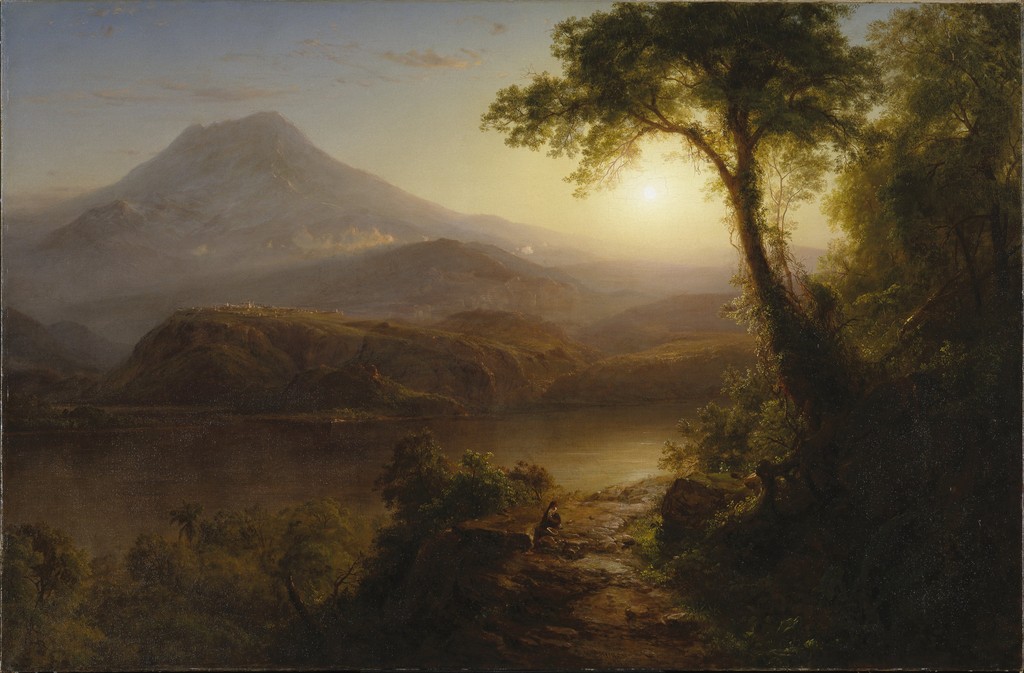
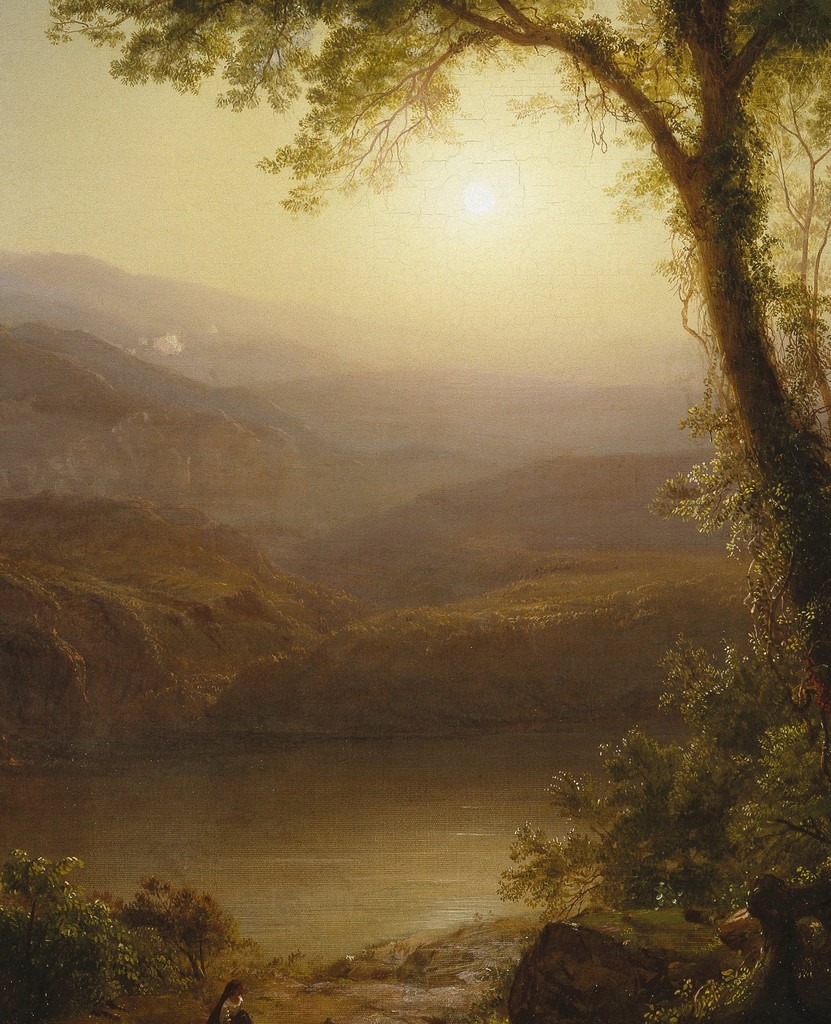
A mountain rises through hazy light on the left of Frederic Edwin Church’s Tropical Scenery. Across the water, a settlement occupies a plateau, while a large branching tree shelters the foreground on the right. A small seated figure occupies a ledge in a landscape whose scale extends far beyond its immediate surroundings.
Church painted this canvas in 1873. It belongs to the Brooklyn Museum, accession number 63.150. The warm light and carefully arranged distances make it a particularly inviting example of his later tropical imagery.[1]
At a Glance
- ArtistFrederic Edwin Church
- TitleTropical Scenery
- Date1873
- MediumOil on canvas
- Dimensions97.3 × 152.2 cm; 38 5/16 × 59 15/16 inches
- CollectionBrooklyn Museum, New York
- Accession number63.150
- CreditDick S. Ramsay Fund
This work across Church’s career
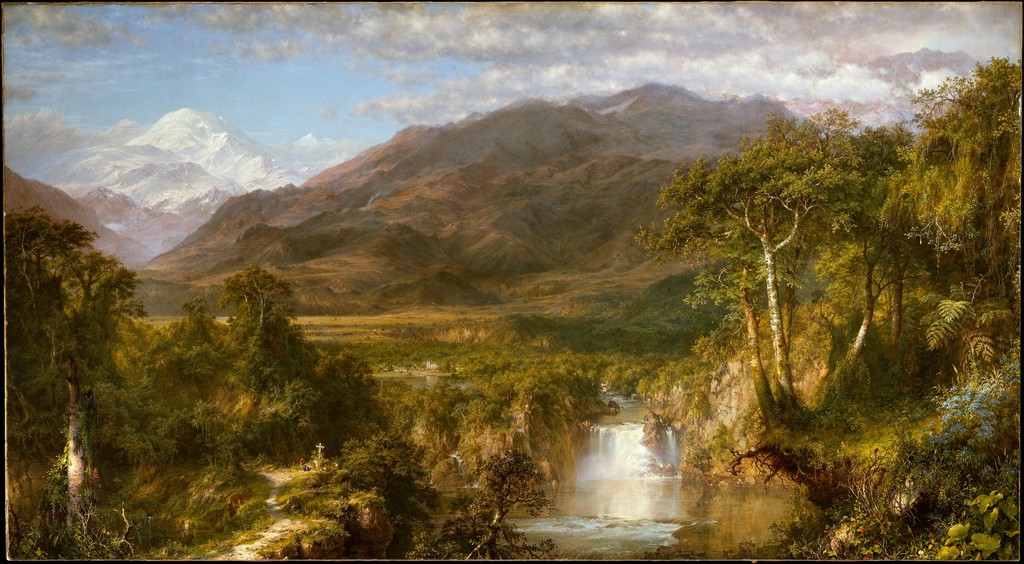
Tamaca Palms
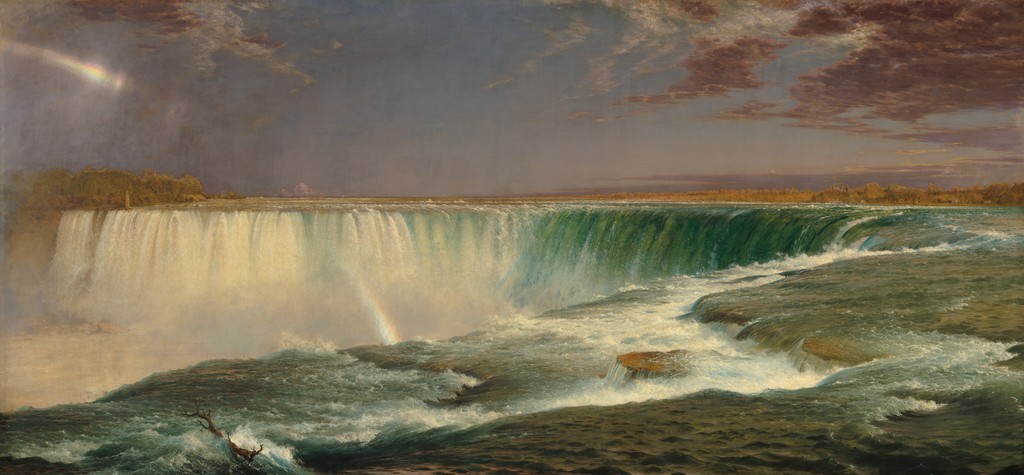
1854Niagara
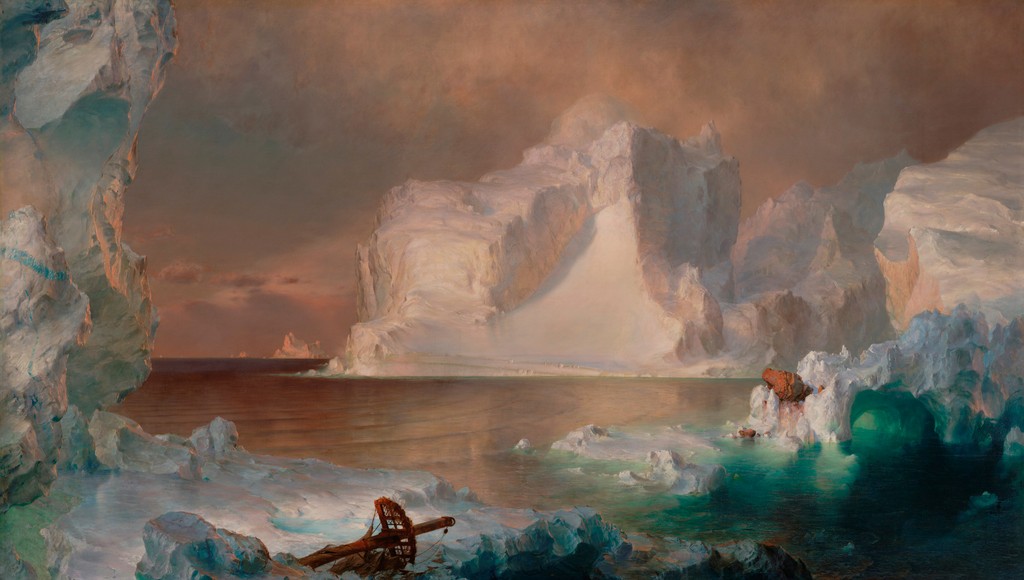
1857The Icebergs
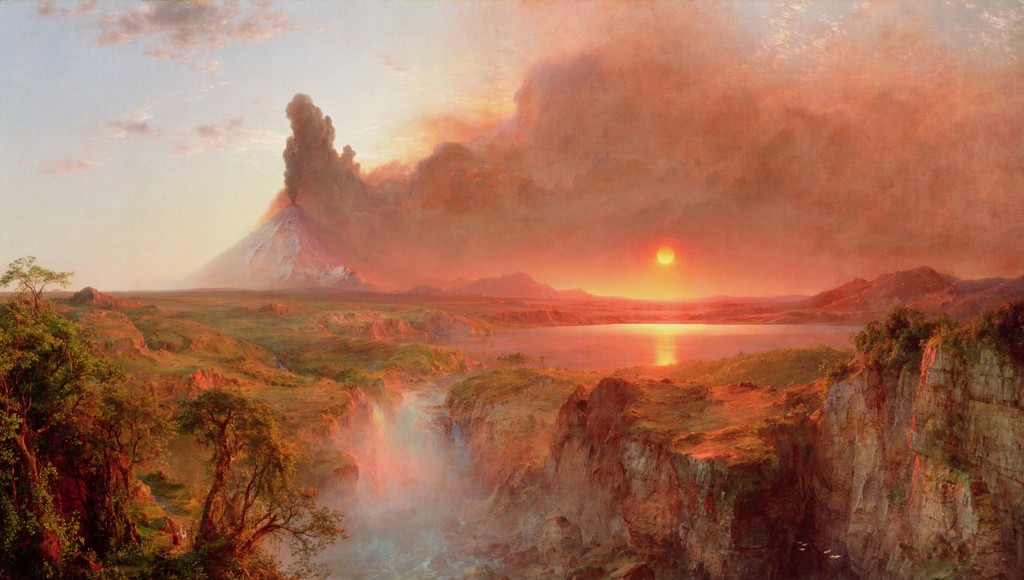
1861; foreground mast added between mid-1862 and early 1863Cotopaxi
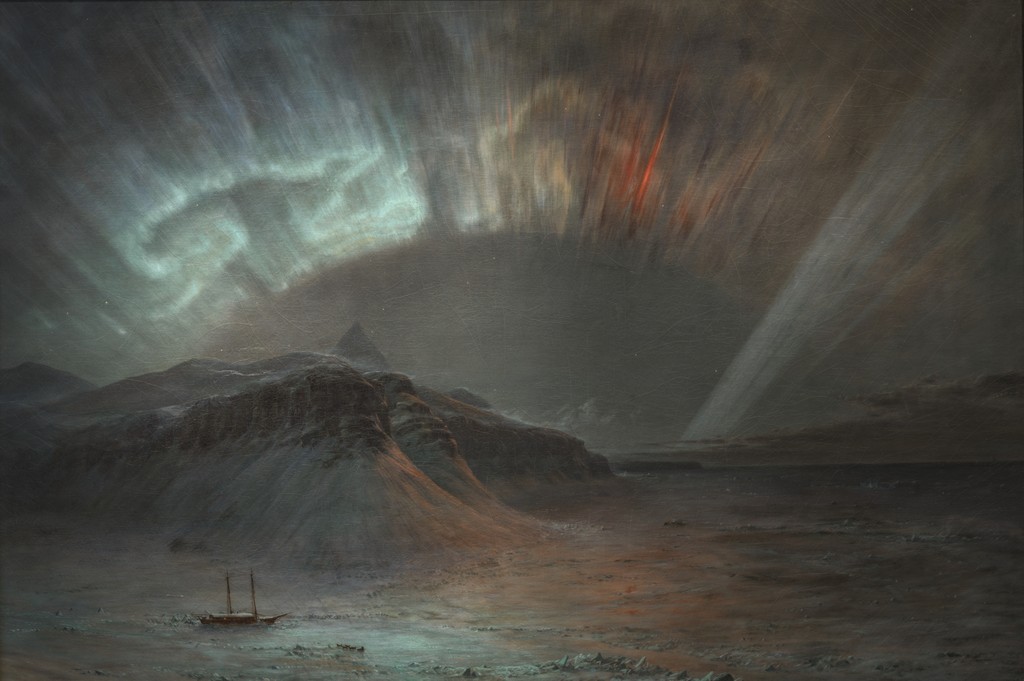
1862Aurora Borealis
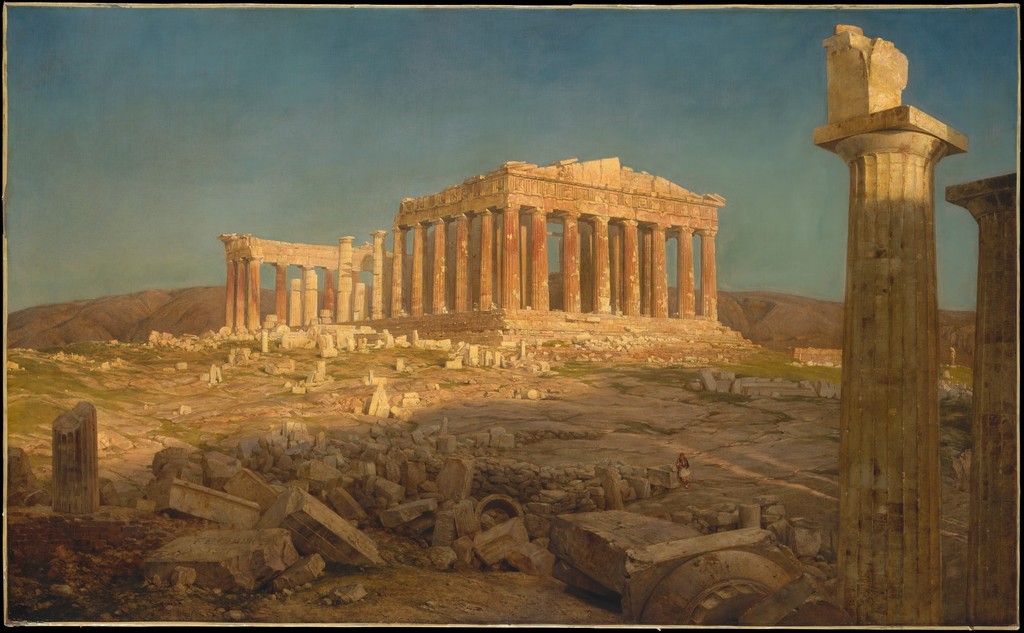
1865The Parthenon
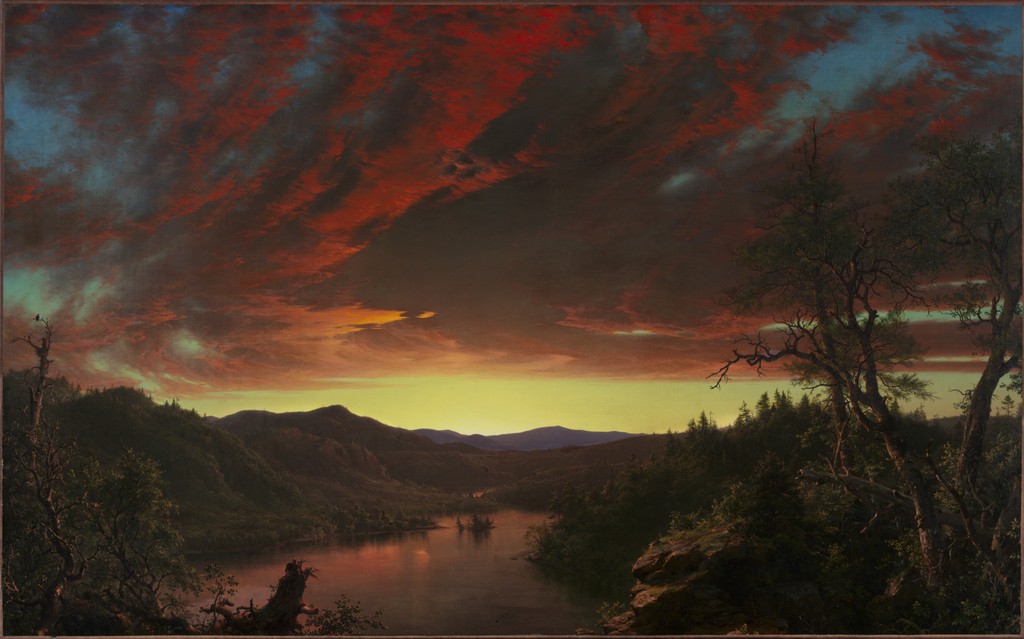
1871The Aegean Sea
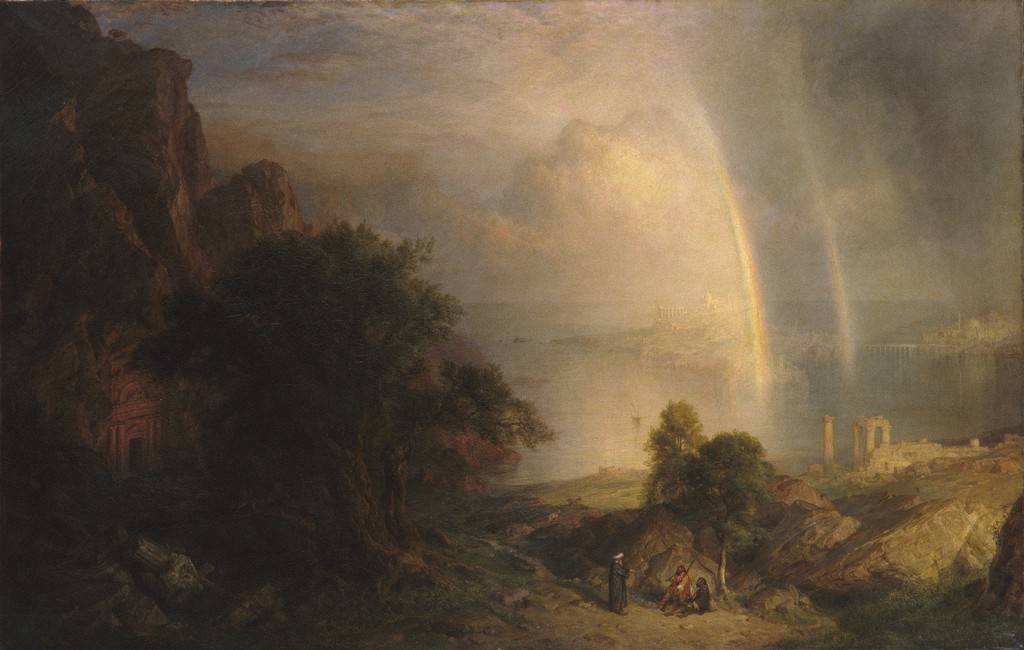
About 1877Contents
- A commission after the South American journeys
- The mountain and the descending ridges
- A branching tree frames the sun
- Still water holds the middle distance
- A seated figure and a distant settlement
- Observation, distance and remembered scenery
- Titles and collecting history
- Comparing Tropical Scenery with The River of Light
- Discussion Questions
- Annotated details
A commission after the South American journeys
Debora Rindge’s chronology in the National Gallery of Art’s 1989 Church catalogue lists this 1873 canvas as a commission for Robert Hoe, made long after Church’s South American journeys.[2]
That interval is useful when looking at the picture. Church continued to draw on tropical subjects after returning to the United States, and this landscape belongs to a later stage of that engagement. Its arrangement offers a coherent experience of distant mountain, inhabited plateau, quiet water and sheltered foreground. It need not be treated as the record of a single moment during a journey.
Annotated Details from Tropical Scenery
The numbered points draw attention to visible features discussed in this article. Look from each detail back to the full composition. Frederic Edwin Church, Tropical Scenery, 1873. Oil on canvas, 97.3 × 152.2 cm. Brooklyn Museum, Dick S. Ramsay Fund, 63.150. Faithful public-domain reproduction via Wikimedia Commons / Google Art Project; Public Domain Mark 1.0. Source image. Faithful two-dimensional reproduction of public-domain painting; PD-Art / PD-old-100-expired / Public Domain Mark 1.0. Numbered overview resized; detail crops added from the source master. No recolouring.
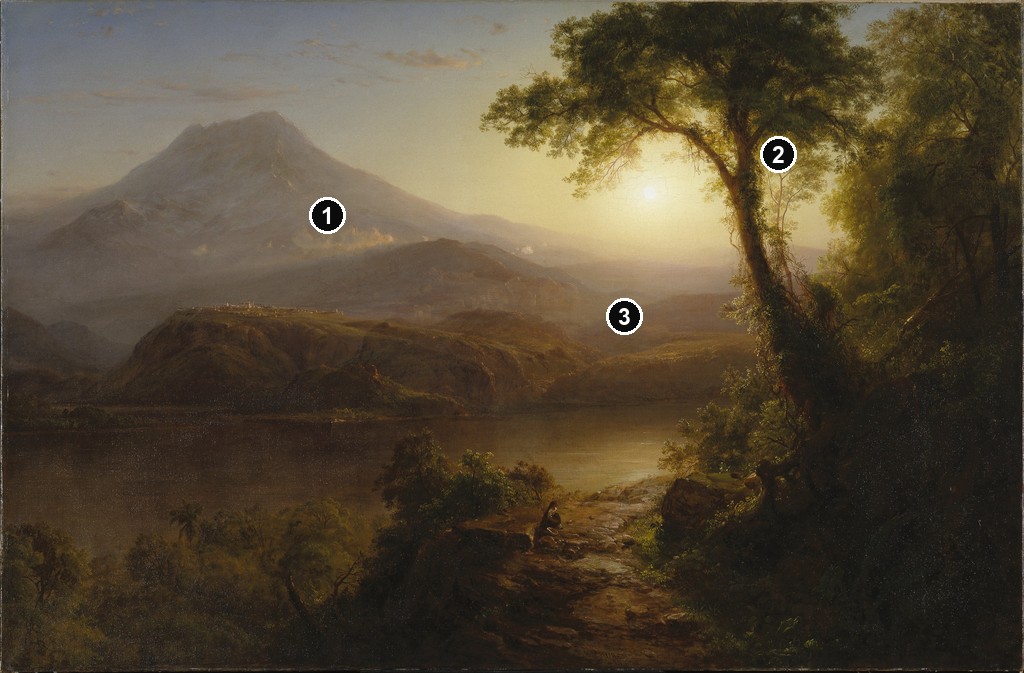
Details from TROPICAL SCENERY
These crops come directly from the verified source images. They preserve the original colours or printed tones; the numbered overview is a separate aid to looking.
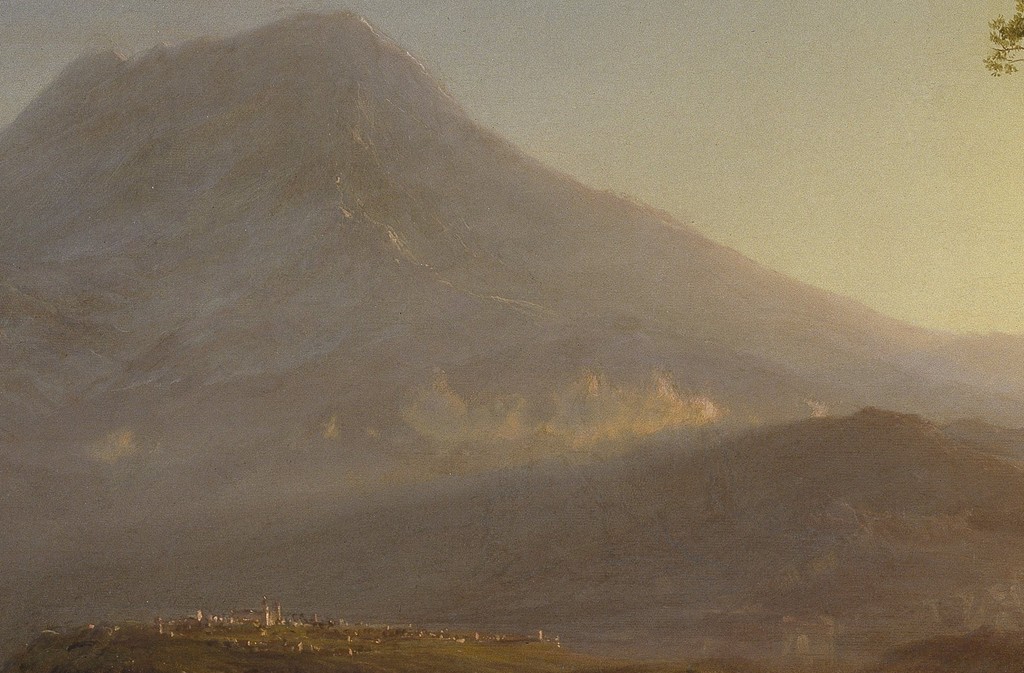
Mountain and ridges
A hazy mountain rises behind descending ridges. Each intervening plane changes in tone as the landscape approaches the foreground.
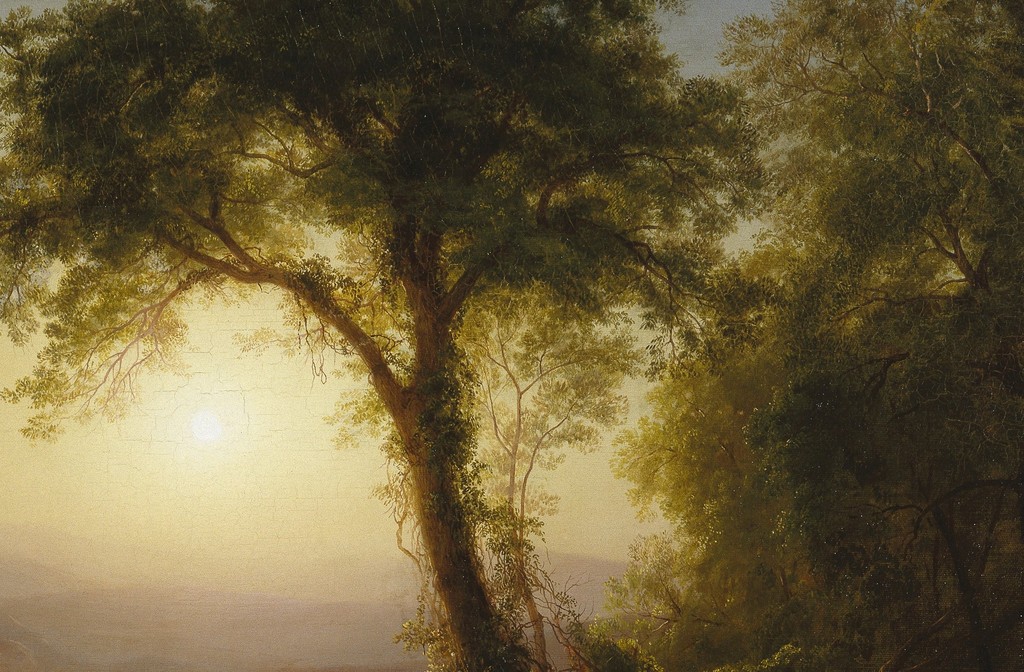
Branching tree
A large tree frames the right side of the landscape. Its spreading branches link the nearby dark space with the light surrounding the sun.
Sun and water
The low sun illuminates the sky above still water. The relationship between these bright passages gives the middle distance a quiet focus.
The mountain and the descending ridges
The principal mountain occupies much of the left half. Its upper outline is softened by haze, but the summit remains clearly distinguishable against the sky. Broad slopes descend toward lower ridges, creating a sequence of overlapping forms that carries the eye across the centre of the painting.
The mountain’s muted grey and brown tones differ from the darker vegetation close to the spectator. Its size is impressive, yet the softened surface makes it appear remote. Church can therefore give the peak considerable prominence without making it feel as close as the tree or ledge on the right.
Lower hills introduce intermediate distances. Some slopes catch warm light, while others remain shaded. These changes help separate one ridge from the next, even where their outlines are faint. Looking slowly across them reveals that the apparent simplicity of the large mountain depends on a more varied arrangement beneath it.
The settlement sits well below the summit, on a relatively level strip of elevated ground. Its small buildings provide another measure of scale. Their presence makes the mountain seem larger, while also giving the eye a place to pause between the broad upper slopes and the water below.
A branching tree frames the sun
The large tree on the right forms a counterweight to the mountain. Its trunk rises from the near bank and divides into substantial branches, spreading a canopy across the upper part of the canvas. Unlike the hazy peak, the tree presents a more immediate network of foliage, limbs and irregular edges.
A pale sun appears beneath the canopy, to the left of the trunk. The surrounding sky is bright and golden, so the small disk does not need a hard outline to attract attention. Dark leaves and branches make this light especially noticeable. Church brings the distant glow close to the silhouette of something standing beside us.
The tree also limits the view. Dense vegetation fills the right edge, while the canopy projects over the illuminated opening. That framing encourages the spectator to look outward from shade, rather than imagine floating above an entirely unobstructed panorama.
This balance gives the picture much of its character. The mountain supplies breadth and height; the tree creates enclosure. The sun draws the two into relation through light that passes between them. Together they make a scene that can feel extensive and sheltered at the same time.
Still water holds the middle distance
Water stretches across the lower middle of the painting. The darker left-hand area lies beneath the mountain and plateau, while a brighter passage opens toward the right, nearer the sun. Reflected light joins the water to the glowing atmosphere beyond it.
Its relatively quiet surface slows the movement through the picture. The mountain slopes descend, the tree branches spread, and the nearby ground is uneven; the water provides a broader, calmer area among those more complicated forms. It allows the surrounding shadows and highlights to remain distinct.
The far shore separates water from the plateau, but haze softens more distant boundaries. Church makes the scene readable without defining every transition equally sharply. The spectator can recognise the principal parts, then continue exploring the less certain spaces between them.
A seated figure and a distant settlement
The seated figure occupies the rocky foreground near the centre-right. Its position suggests a place from which to contemplate the view, although the picture does not supply a detailed explanation of the person’s circumstances. The figure is small beside the nearby tree and much smaller in relation to the mountain.
This scale makes human presence easy to overlook at first. Once noticed, however, the figure changes the experience of the foreground. The ledge becomes somewhere a person can occupy, and the distant light becomes a view that someone within the painting can also see.
The settlement across the water adds a different kind of habitation. Its buildings gather into a narrow cluster on the plateau, where their small vertical accents interrupt the surrounding hills. The near individual and distant settlement connect two human scales within the same landscape: a person pausing at its edge and a community established farther away.
Those details prevent the scenery from appearing wholly uninhabited. They also remain subordinate to the mountain, sky and tree. Church includes people and buildings without allowing them to become the principal drama of the composition.
Watch: Frederic Edwin Church
Choose a film to explore the artist’s work, its interpretation and its wider setting.
Frederic Edwin Church's "The Icebergs" on the Move at the DMA
Follow the Dallas Museum of Art as it moves Church’s large painting The Icebergs.
Watch on YouTubeObservation, distance and remembered scenery
Church’s first South American journey took him through Colombia and Ecuador in 1853 with Cyrus W. Field. He returned to Ecuador in 1857 with the painter Louis Remy Mignot. Rindge’s chronology records these itineraries, which preceded the Brooklyn canvas by twenty and sixteen years respectively.[2]
Art historian William H. Gerdts reads Tropical Scenery as a nostalgic return to South American experience. He draws attention to its lack of precise geological identification and to the presence of both the foreground figure and a small city on the plateau. His interpretation emphasises the distance between Church’s earlier travels and the later painting.[3]
The softened mountain and enveloping light make that reading persuasive. They invite recognition of a kind of landscape without supplying a firmly identified location. The picture’s effect rests on relationships between its parts: shelter and openness, nearby detail and distant haze, quiet water and imposing landforms.
Church’s drawings and studies show how sustained observation formed part of his practice. Recognising that background does not identify every feature in this canvas or prove that a particular surviving sketch was its direct preparation. The finished landscape can be appreciated through what Church has brought together here.
Titles and collecting history
The Smithsonian’s painting inventory records South American Landscape as an alternative title for Brooklyn’s Tropical Scenery. Its provenance lists Robert Hoe and a sale at Leavitt Art Galleries in New York on 28 February 1882, lot 156, followed by later owners and dealers.[4]
The catalogue separately illustrates Delaware Art Museum’s 1873 Tropical Scenery as number 48. Its prominent palms and arched bridge differ from Brooklyn’s mountain, branching tree and foreground figure. Collection names help distinguish two paintings with the same title and date.[2]
Comparing Tropical Scenery with The River of Light
Church returned to tropical imagery in El Rio de Luz, or The River of Light, painted in 1877 and now in the National Gallery of Art. There, wooded banks enclose a river that recedes toward a low sun and misty opening.[5]
Both works direct attention toward light beyond nearby vegetation. Their viewpoints produce different journeys for the eye. Brooklyn’s canvas looks across water toward an expansive mountainous setting; The River of Light draws the spectator along the water between enclosing banks. In each, the shadowed foreground makes the illuminated distance more compelling.
Return to Tropical Scenery and follow the view from the seated figure to the bright water, then across the plateau toward the mountain. Look finally at the tree branches over the sun. This sequence brings its different scales into relation and shows how much the painting’s calm depends on arrangement. Its appeal develops through the experience of moving between shelter, habitation and distance.
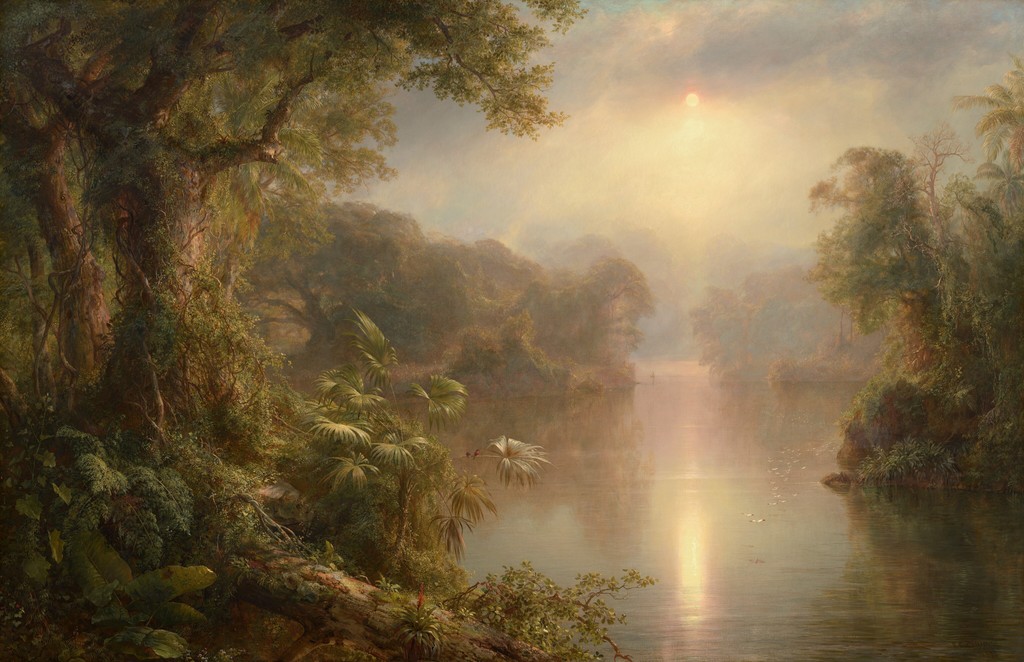
Frederic Edwin Church, El Rio de Luz (The River of Light), 1877. Oil on canvas, 138.1 × 213.7 cm. Courtesy National Gallery of Art, Washington, Gift of the Avalon Foundation, 1965.14.1. NGA Open Access, CC0. Image source. CC0 / NGA Open Access. Resized; full source proportions retained.
Discussion Questions
- How do the tree and mountain offer different kinds of scale and distance?
- What changes when you notice the seated figure and the settlement?
- How does the view across the water differ from the riverbank viewpoint in El Rio de Luz?
Artworks directory
A documented selection of Church’s works discussed across these articles, together with identified prints after his designs. This is not a catalogue raisonné. Repeated titles and aliases are reconciled; studies remain distinct from finished paintings. Some dates remain unconfirmed. Other makers are named where a print adapts Church’s work.
| Name | Date | Medium |
|---|---|---|
| Above the Clouds at Sunrise | 1849 | Oil on canvas |
| The Aegean Sea | About 1877 | Oil on canvas |
| The Andes of Ecuador | 1855 | Oil on canvas |
| Aurora Borealis | 1865 | Oil on canvas |
| Autumn in North America | Circa 1856 | Oil on board |
| Coast Scene | 1852 | Oil on canvas |
| Cotopaxi | 1862 | Oil on canvas |
| A Country Home | 1854 | Oil on canvas |
| El Khasné, Petra | 1874 | Oil on canvas |
| El Rio de Luz | 1877 | Oil on canvas |
| The Heart of the Andes | 1859 | Oil on canvas |
| The Icebergs | 1861; foreground mast added between mid-1862 and early 1863 | Oil on canvas |
| Jerusalem from the Mount of Olives | 1870 | Oil on canvas |
| Mount Ktaadn | 1853 | Oil on canvas |
| Our Banner in the Sky | 1861 | Oil paint over lithograph on paper, laid down on cardboard |
| The Parthenon | 1871 | Oil on canvas |
| Rainy Season in the Tropics | 1866 | Oil on canvas |
| Storm in the Mountains | 1847 | Oil on canvas |
| Syria by the Sea | 1873 | Oil on canvas |
| Tamaca Palms | 1854 | Oil on canvas |
| Tropical Scenery | 1873 | Oil on canvas |
| Twilight in the Tropics | 1874; signed and dated, according to Bonhams’ catalogue | Oil on canvas |
| Twilight in the Wilderness | 1860 | Oil on canvas |
| View of Cotopaxi | 1857 | Oil on canvas |
| Niagara | 1857 | Oil on canvas |
| Magdalena River, New Granada, Equador | 1853 | Graphite heightened with white on wove paper |
| Tamaca Palm, Colombia or Ecuador | May–October 1853 | Graphite on gray laid paper |
| Mixed Sketches with a Champan, Río Magdalena, Colombia | May 1853 | Graphite on gray laid paper |
| Study for Rainy Season in the Tropics | 1865–1866 | Graphite on ruled notepad paper |
| Al-Khazneh, Petra (study) | February–March 1868 | Oil and graphite on tan paperboard |
| The Great Fall, Niagara (Charles Risdon, after Church) | 1874 impression | Hand-coloured chromolithograph on paperboard |
| The Heart of the Andes (William Forrest, after Church) | 1862 | Engraving in black on wove paper |
| Our Heaven Born Banner (William Bauly, adapting Church’s motif) | circa 1861 | Colour lithograph |
| A Tropical Moonlight (wood engraving after Church) | 1879 publication | Wood engraving in American Painters |
| Off Iceberg, Newfoundland | June 1859 | Oil and graphite on paperboard |
| Parthenon at Night, Athens | April 1869 | Oil and graphite on tan paperboard |
| Jerusalem from the Mount of Olives (study) | 1 April 1868 | Oil and graphite study |
| Horseshoe Falls (study) | December 1856–January 1857 | Oil on paper mounted to canvas |
| Niagara Falls, from the American Side | 1867 | Oil on canvas |
| Study for The Heart of the Andes | 1858 | Oil study |
| Mount Chimborazo through Rising Mist and Clouds | 1857 | Oil study |
| Cotopaxi Erupting, Viewed from Quito, Ecuador | June 1857 | Oil and graphite on tan paperboard |
| Cotopaxi (painted for Cyrus Field) | 1855 | Painting |
| Chimborazo | 1864 | Painting |
| Twilight, A Sketch | 1858 | Oil on canvas |
| View of Baalbek | 1868 | Oil and pencil on board |
| Three Bedouins | Date unconfirmed | Oil study |
| Coast Scene, Mount Desert (later canvas) | 1863 | Painting |
| The Wreck | Date unconfirmed | Painting |
| Grand Manan Island, Bay of Fundy | Date unconfirmed | Painting |
| Summer in South America | circa 1853 | Painting |
| Evening in Vermont | Date unconfirmed | Painting |
| Home by the Lake | Date unconfirmed | Painting |
| Storm in the Blue Mountains, Jamaica | August 1865 | Painting |
| The Natural Bridge, Virginia | 1852 | Painting |
| The Vale of St. Thomas, Jamaica | 1867 | Painting |
| Tequendama Falls, near Bogota, New Granada | Date unconfirmed | Painting |
| Sunrise in Syria | Before the 1876 exhibition | Painting |
| Cuernavaca (oil study; descriptive title) | 1898 | Oil study |
| Olana window design (descriptive title) | Date unconfirmed | Watercolour and graphite |
| Olana dining-room stencil sketch (descriptive title) | Date unconfirmed | Oil and graphite |
| Olana house (with Calvert Vaux) | 1870–1872; later additions | Architecture |
| Olana designed landscape | From 1860; developed over decades | Designed landscape |
Frequently Asked Questions
The Brooklyn Museum’s canvas dates to 1873. Robert Hoe commissioned it.
It belongs to the Brooklyn Museum, accession number 63.150, with the credit Dick S. Ramsay Fund.
The sources discussed here do not securely identify the peak. Gerdts interprets the painting as a later return to South American experience rather than a geographically precise view.
No. Church completed two distinct works of that title in 1873. Delaware’s canvas has palms and an arched bridge; Brooklyn’s has the large left-hand mountain and branching right-hand tree.
Discussion
Look again at the images and ideas explored in Tropical Scenery. These editorial prompts invite your own observations.
Reader Insights
How do the descending ridges lead your eye through the landscape?
What role does the branching tree play around the sun?
How does the still water affect the relationship between the foreground and distant mountain?
Join the Conversation
Share a detail, comparison or question about Tropical Scenery below.
References
- Brooklyn Museum, via Google Arts & Culture. Tropical Scenery, 1873: museum-provided object metadata, dimensions and accession 63.150.
- National Gallery of Art. Frederic Edwin Church, exhibition catalogue, 1989: Debora Rindge, chronology pp. 161–162 and 169; distinct Delaware Tropical Scenery, catalogue 48, p. 124.
- William H. Gerdts. The Worlds of Frederic Edwin Church, Incollect, 25 September 2013: discussion of the 1873 Brooklyn canvas.
- Smithsonian American Art Museum, Inventories of American Painting and Sculpture. Tropical Scenery, Brooklyn Museum 63.150, control number IAP 35680009.
- National Gallery of Art. El Rio de Luz (The River of Light), 1877, accession 1965.14.1.
- Splash image source.
Frederic Edwin Church, Tropical Scenery, 1873. Oil on canvas, 97.3 × 152.2 cm. Brooklyn Museum, Dick S. Ramsay Fund, 63.150. Faithful public-domain reproduction via Wikimedia Commons / Google Art Project; Public Domain Mark 1.0. Image source. Faithful two-dimensional reproduction of public-domain painting; PD-Art / PD-old-100-expired / Public Domain Mark 1.0. Resized; full source proportions retained.