 by
Tom Gurney
Tom Gurney BSc (Hons) is an art history expert with over 20 years experience
Email:
tomgurney1@gmail.com
/ Phone:
+44 7429 011000
Alexander Hamilton by John Trumbull: Introduction
John Trumbull's portraits of Alexander Hamilton preserve more than one conception of the statesman. The National Gallery of Art holds two examples: a painting dated about 1792, connected with a likeness made during Hamilton's lifetime, and another dated about 1806, belonging to a posthumous portrait type. Their similar dimensions make the differences in the head, clothing and presentation especially instructive. [1] [2]
The earlier picture is often discussed in relation to the question of painting from life. The later one introduces a sculptural source and the demands of commemoration. Looking at them together reveals how Trumbull could return to a familiar subject through different models, commissions and versions. It also explains why a recognisable likeness does not establish how a particular canvas was produced.
At a Glance
- Artist John Trumbull.
- Earlier NGA portrait about 1792; oil on canvas, 76.2 × 60.5 cm; 1952.1.1, Gift of the Avalon Foundation.
- Later NGA portrait about 1806; oil on canvas, 77 × 61 cm; 1940.1.8, Andrew W. Mellon Collection.
- Earlier type related to the 1792 Chamber of Commerce full-length; the NGA catalogue considers this smaller canvas a likely early replica.
- Later type posthumous, related to the 1805 City Hall full-length and Ceracchi's sculptural likeness.
This work across John Trumbull’s career
The Death of General Mercer at Princeton
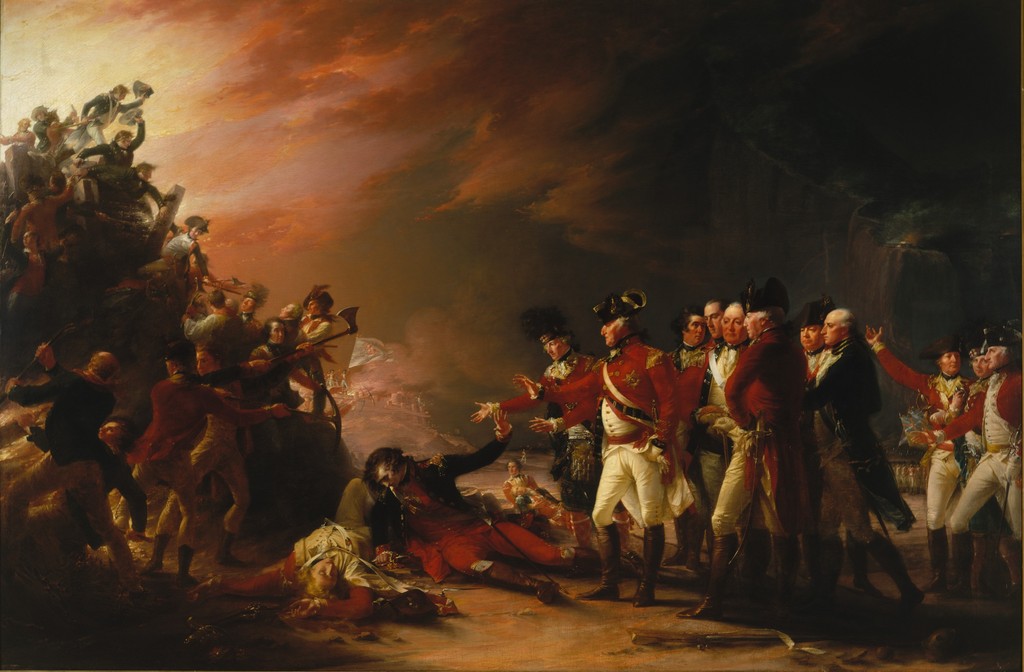
about 1787–1831; principal Yale versionThe Sortie Made by the Garrison of Gibraltar
1789; Met versionGeorge Washington before the Battle of Trenton
about 1792–94; Met versionAlexander Hamilton (current article)
about 1792; likely early NGA replicaThe Death of General Warren at Bunker’s Hill
after 1815–before 1831; MFA versionDeclaration of Independence
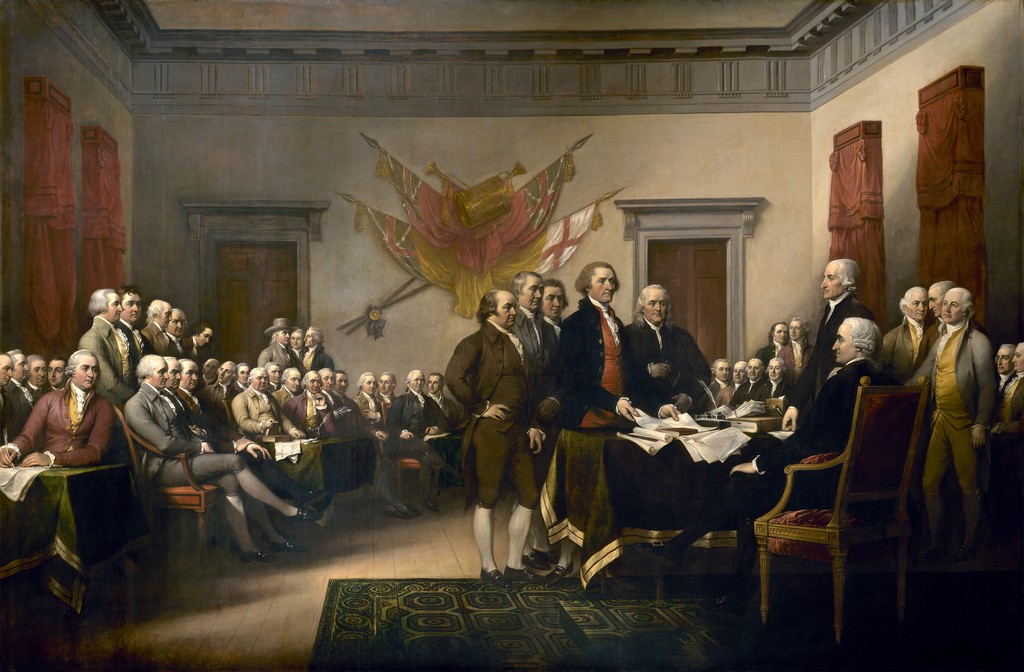
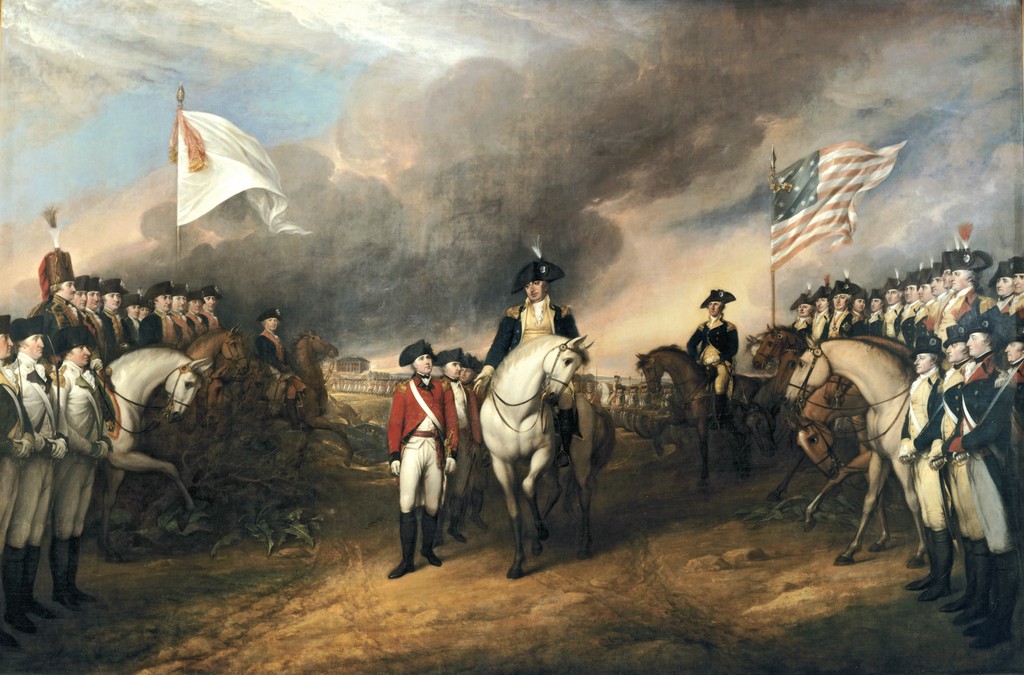
1817–18; Capitol canvasSurrender of Lord Cornwallis
1819–20Surrender of General Burgoyne
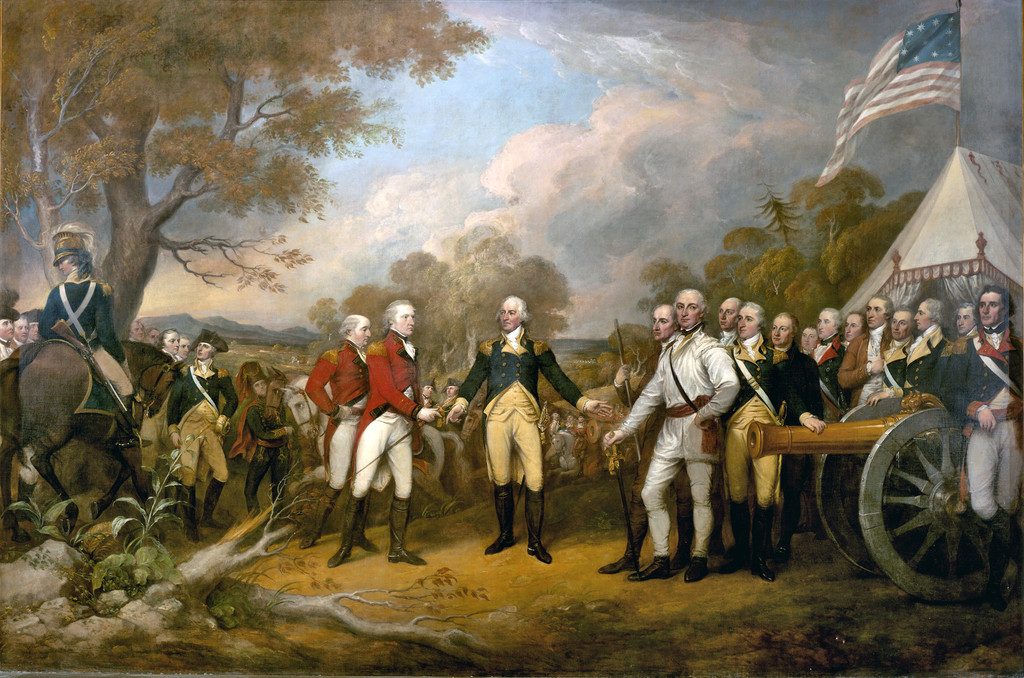
1821; Capitol canvasNotes and sources
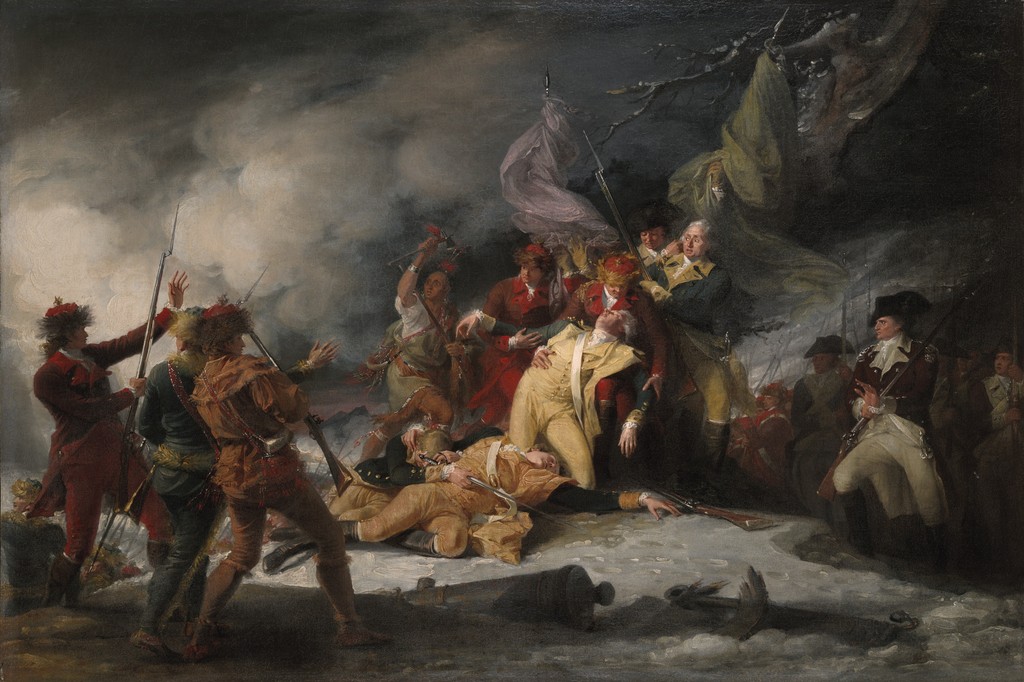
The Death of General Montgomery. Dates identify the particular canvas discussed in the article. [3]
The Capture of the Hessians at Trenton. Dates identify the particular canvas discussed in the article. [4]
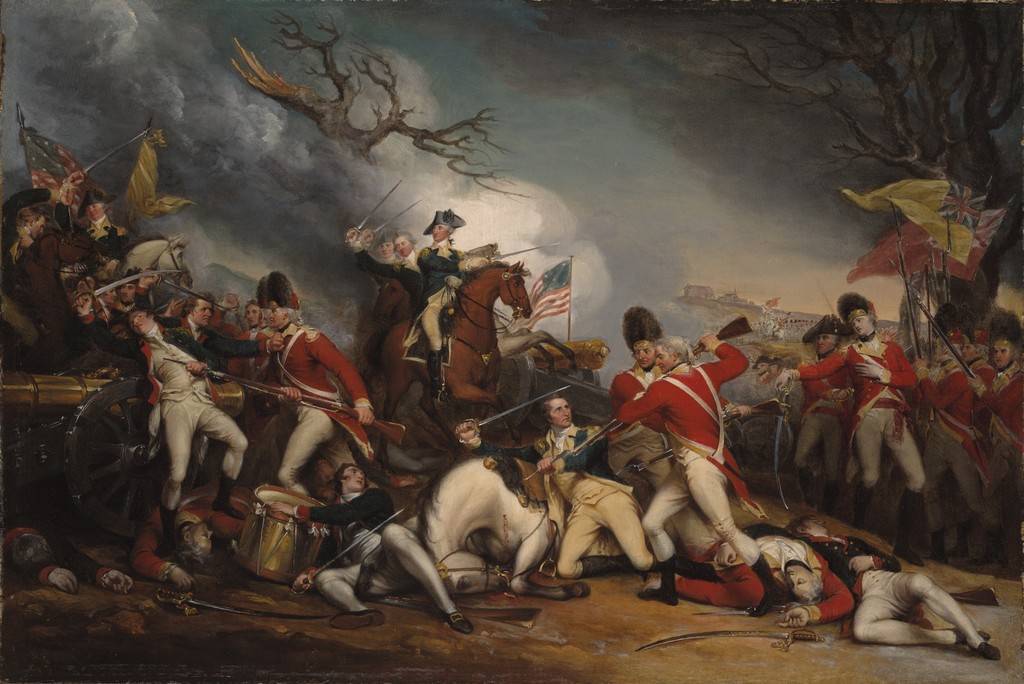
The Death of General Mercer at Princeton. Dates identify the particular canvas discussed in the article. [5]
The Sortie Made by the Garrison of Gibraltar. Dates identify the particular canvas discussed in the article. [6]
George Washington before the Battle of Trenton. Dates identify the particular canvas discussed in the article. [7]
Alexander Hamilton (current article). The NGA catalogue treats this as a likely early replica. [1] [8]
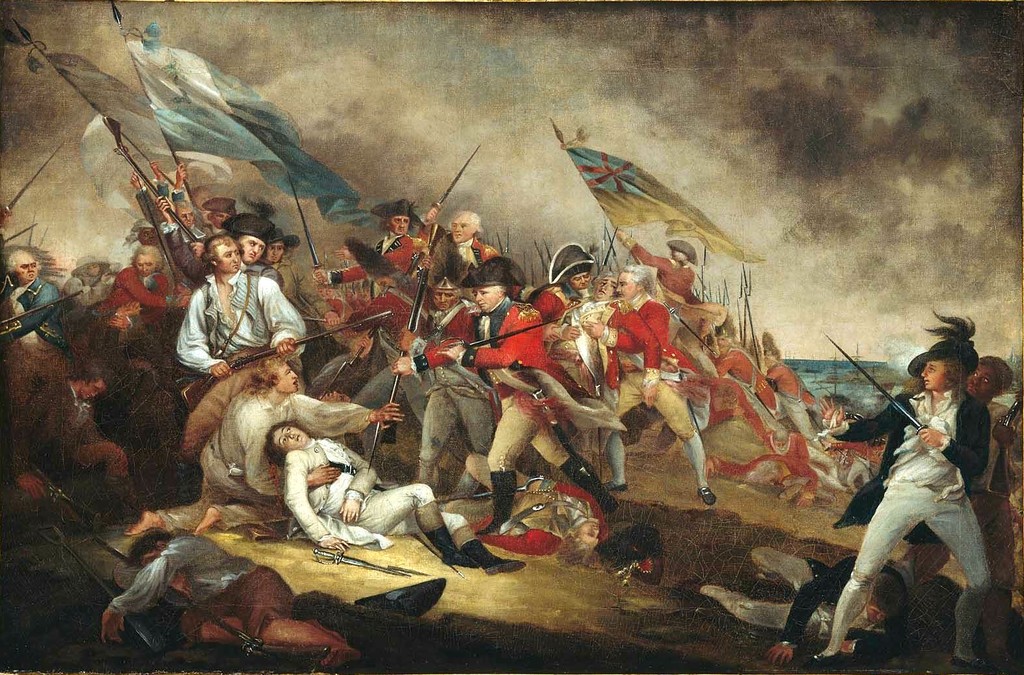
The Death of General Warren at Bunker’s Hill. Dates identify the selected later version. [9]
Declaration of Independence. Dates identify the particular canvas discussed in the article. [10]
Surrender of Lord Cornwallis. Dates identify the particular canvas discussed in the article. [11]
Surrender of General Burgoyne. Dates identify the particular canvas discussed in the article. [12]
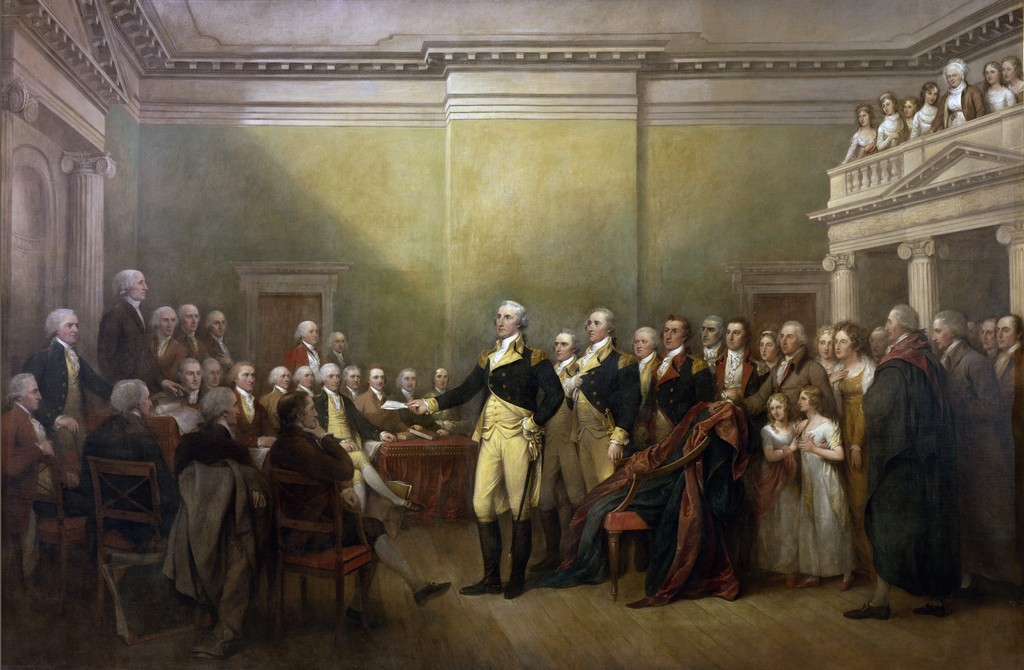
Washington Resigning His Commission. Dates identify the particular canvas discussed in the article. [13]
Contents
- The portrait of about 1792
- Face, turn and background
- What painting from life can mean
- Portraits after Hamilton's death
- The Ceracchi portrait type
- Attribution and provenance
- Hamilton within Trumbull's portrait practice
The portrait of about 1792
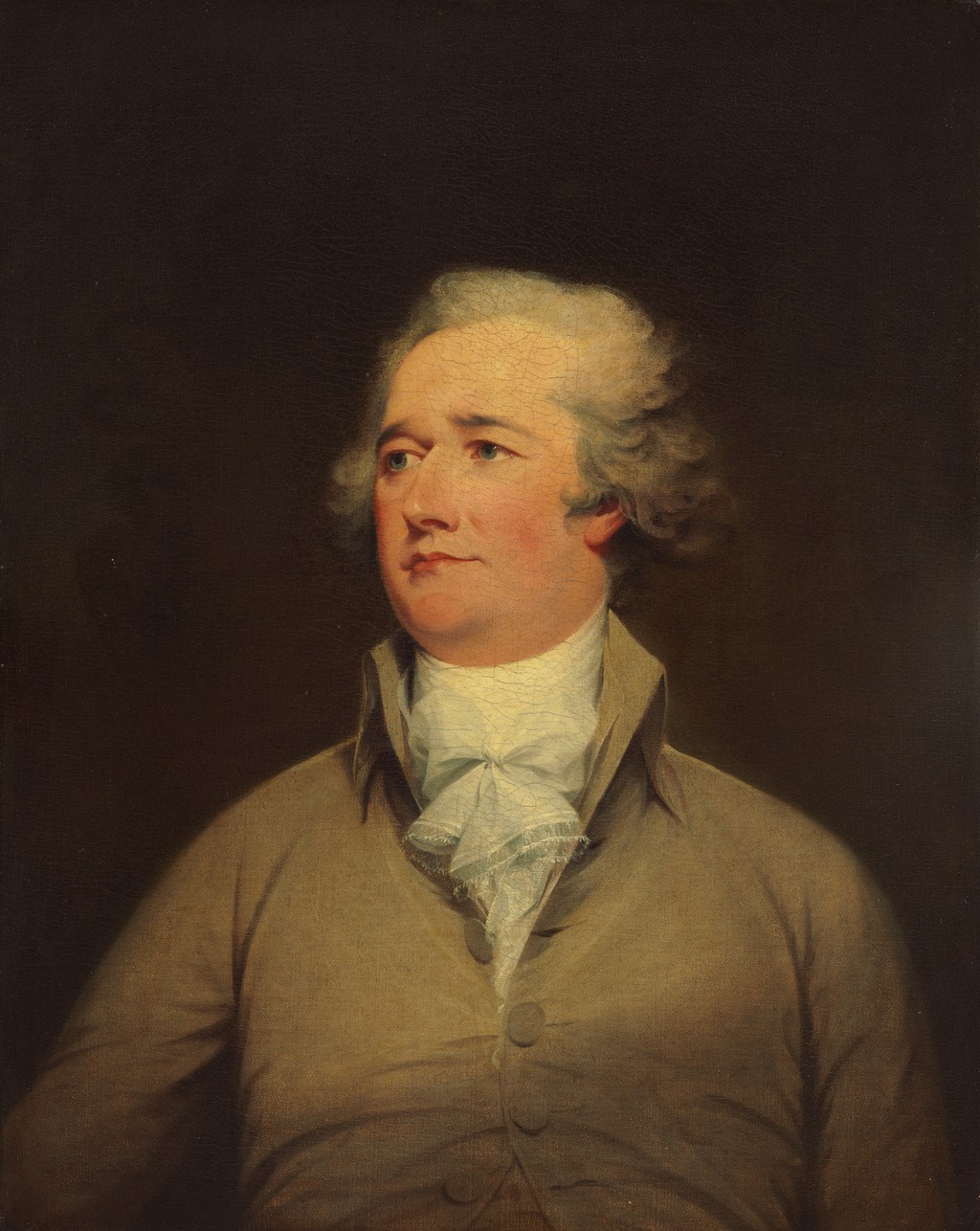
The earlier NGA painting measures 76.2 by 60.5 centimetres and presents Hamilton's head and upper body. His head turns towards the left of the image above a brown coat and elaborate white neckcloth. The dark setting gives the figure room without supplying a recognisable location. The canvas entered the collection in 1952 as a gift of the Avalon Foundation. [1]
Behind this compact image lies a larger civic commission. The NGA's systematic catalogue relates the portrait type to the full-length Hamilton commissioned by New York merchants for the Chamber of Commerce. Their request, made at the end of 1791, acknowledged his public service. Hamilton's reply, as discussed in the catalogue, preferred a straightforward representation of himself without tying the portrait to a particular political incident. [8]
Trumbull completed that full-length in 1792, painting Hamilton from life. A smaller bust portrait could carry the head and upper body beyond the public setting of the larger picture, while retaining elements of its design. The NGA painting belongs within that relationship. Its reduced field changes the encounter: the viewer meets the face at close range, with attention concentrated on expression, lighting and the movement of the shoulders. [8]
Face, turn and background
Light falls across Hamilton's forehead, cheek and white cravat. Warm colour in the face sets it apart from the cooler pale hair, while the brown coat gives the head a broad foundation. The eyes look beyond the edge of the composition. The result is composed and attentive, without the open gesture or surrounding objects that a full-length portrait might use to explain its subject.
The body nevertheless contains a suggestion of action. One arm extends towards the lower left, where the canvas cuts the movement short. The catalogue connects this feature with the full-length design. In the smaller picture it becomes a remnant of an arrangement whose wider setting is no longer visible. The relationship between head and torso therefore contributes to the question of the painting's origin. [8]
The white neckcloth provides another point of concentration. Its folds occupy the space between the face and coat, turning a necessary article of dress into an active shape. Against the restrained background, the passage helps carry the eye down from the head and back into the figure. Fine surface cracking visible in the museum image belongs to the surviving painting; it should not be confused with a deliberate pattern in Trumbull's design.
What painting from life can mean
The fact that Trumbull painted Hamilton during his lifetime does not establish that this smaller canvas was the work made at a sitting. The NGA's 1995 catalogue questions the older identification of the painting as the original life study. It proposes instead that the picture is an early replica related to the 1792 full-length. The distinction concerns the production of this object, rather than the authenticity of Trumbull's broader acquaintance with Hamilton. [8]
Several kinds of evidence inform the assessment. The pose and lighting follow the larger portrait, including the arm movement. Technical examination found none of the changes often encountered in portraits developed directly from a sitter. The catalogue considers these findings alongside the painting's handling and ownership history. No single absence of revision provides a universal test by which every portrait can be classified. [8]
The published technical notes describe coarse twill-weave canvas, a light ground and thin, blended paint, with more raised passages in the highlights and cravat. Infrared examination revealed an outline for an iris that is not visible at the surface. These are findings about this particular painting, reported in the catalogue, rather than observations that an ordinary reproduction can independently confirm. The wider style and technique article places them within Trumbull's practice. [8]
The materials also help distinguish objects that might otherwise be grouped under one title. The later NGA Hamilton is painted on coarse plain-weave fabric, rather than the twill of the earlier example. Its technical entry describes fabric attached to a plywood panel, a thin white ground and a reddish-brown preparatory layer. These features belong to the history of that surviving object; they do not establish a standard support or preparation for every portrait Trumbull painted. [8]
Trumbull himself described the earlier canvas as an original when borrowing it in 1832. The catalogue preserves that statement while questioning whether it means the canvas was the life study. An artist's description, the history of a portrait type and the evidence within a surviving object must be considered together. Here they support a more qualified account than the familiar idea of one original followed by uncomplicated copies. [8]
Portraits after Hamilton's death
Hamilton died in July 1804 after his duel with Aaron Burr. Later that year, New York's City Council commissioned Trumbull to paint another full-length portrait for City Hall. Completed in 1805, it gave the deceased statesman a new public image. The NGA's second Hamilton belongs to the bust-length replicas associated with this commission and is dated about 1806. [2] [8]
The later painting measures 77 by 61 centimetres, close to the size of the earlier example. A darker coat surrounds the bright stock and cravat, and the head turns more sharply. The stronger projection of the nose and the angle of the face give this version a different emphasis. Differences of colour and lighting contribute as much as the shared identity to the experience of comparing them. [2]
Posthumous portraiture required a source for the absent sitter. The later image answers that need through a likeness that Trumbull could adapt, rather than a new encounter with Hamilton. Its commemorative purpose does not make the painter's choices less active: the shape of the head still had to be translated into colour, light, clothing and a coherent painted figure.
Watch: John Trumbull
Choose a film to explore the artist’s work, its interpretation and its wider setting.
Moment of Discovery: John Trumbull’s “Declaration of Independence”
Discovery Park of America looks closely at Trumbull’s Declaration of Independence.
Watch on YouTubeThe Ceracchi portrait type
For the 1805 full-length, Trumbull based Hamilton's likeness on a bust by Giuseppe Ceracchi. The NGA catalogue records that Ceracchi had modelled Hamilton from life in 1791. Trumbull's posthumous portrait thus depended on another artist's direct encounter with the sitter, followed by the transfer of a sculptural likeness into painting. The NGA bust-length canvas repeats the head and shoulders of that new full-length design. [8]
The sculptural likeness had its own history before Trumbull used it. The catalogue records Ceracchi's model from life in 1791 and dates the marble version illustrated in the book to about 1794. By the time of the 1805 commission, this portrait already connected Hamilton's appearance with an earlier stage of his public life. Trumbull adapted that established image for a new commemorative purpose. [8]
The change of medium involved more than adding colour to a white head. In the NGA picture, the eyes catch light, the lips carry warm colour and the dark coat sets off the neck and face. A view taken slightly from below strengthens the presence of the head. These choices turn the sculptural source into a painted person with a particular bearing and relationship to the viewer. [8]
Trumbull produced several replicas of this type. The catalogue records payments in 1806 for two other examples, demonstrating that the design circulated through separate commissions. Their existence does not supply an identical production or ownership history for every version. The NGA painting needs to be followed through its own record, even when comparison with related portraits helps explain its date and appearance. [8]
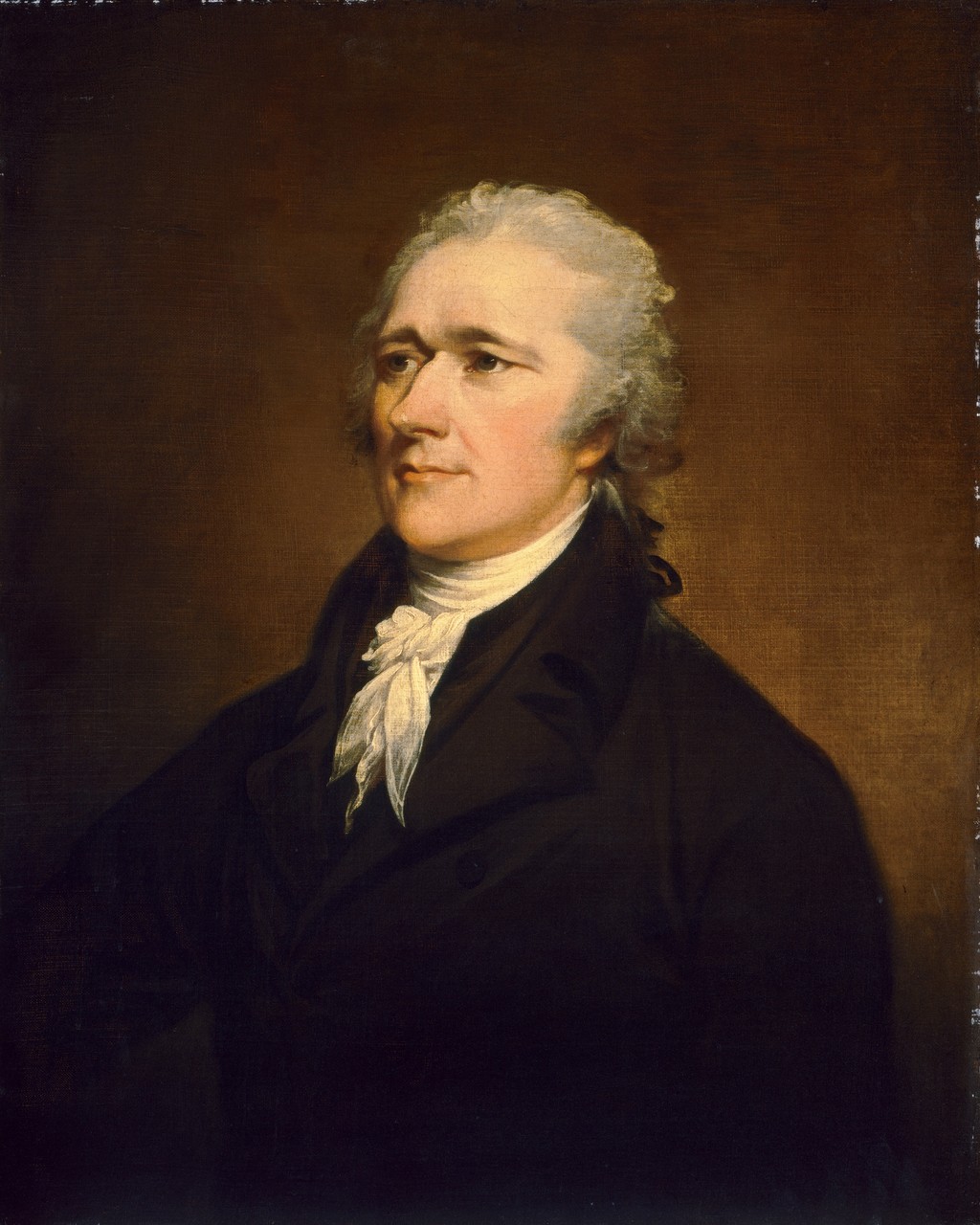
John Trumbull, Alexander Hamilton, about 1806. Oil on canvas, 77 × 61 cm. National Gallery of Art, Washington, 1940.1.8. Andrew W. Mellon Collection. Courtesy National Gallery of Art, Washington, CC0.
Image source
.
CC0 / Public domain
. Resized only; whole supplied image retained without appearance alteration.
Attribution and provenance
The earlier NGA canvas was owned by Oliver Wolcott, Hamilton's successor as Treasury secretary. It passed to Wolcott's son and was bought from his estate by William Jay in 1844. Its later presence among the Jay descendants encouraged an older assumption that it had belonged originally to John Jay. The documented Wolcott ownership changes that account. A family's later possession cannot by itself identify the person who first commissioned a picture. [1] [8]
The catalogue establishes Wolcott's possession by 1829, when he mentioned owning Hamilton's portrait among likenesses of friends. That evidence supplies a secure point in the painting's history without fixing the date when he first obtained it. The later sequence of inheritance and sale should not be read backwards as a complete account of the original transaction. [8]
The second painting has a different history. The NGA associates its early ownership, with qualifications, with the family of David Hosack, the physician who attended Hamilton after the duel. The catalogue explains uncertainties in the reported family transfers. This possible connection adds historical interest without making every link in the sequence equally secure. [2] [8]
At a 1931 auction, the later portrait appeared under John Vanderlyn's name. Research corrected the attribution to Trumbull, and the painting entered Andrew Mellon's collection. This change concerns the painter's identity, whereas the early picture's replica discussion concerns its place within Trumbull's production. Keeping the two questions distinct makes the histories of both paintings clearer. [2]
Hamilton within Trumbull's portrait practice
These two portraits show how a portrait could continue to develop after its first important commission. A public full-length generated a smaller image; a posthumous commission drew on sculpture and produced another family of replicas. The recognisable face moved between objects whose scale, setting and purpose were different. Repetition formed part of Trumbull's work rather than merely following it as an activity undertaken by others.
They also broaden the account of his portraits beyond the gathering of faces for historical scenes. Hamilton appears here as the subject of independent civic and personal images. Comparing the warm brown coat and softer turn of the earlier NGA canvas with the dark clothing and sharper turn of the later one brings those differences into view. The two portraits preserve a public figure through distinct acts of observation, adaptation and remembrance.
Artworks directory
Works discussed in these articles, including distinct versions and reproductive prints. Dates identify the particular object; titles and attributions follow the cited collections. This is not a catalogue raisonné.
Frequently Asked Questions
He painted the 1792 full-length from life. The NGA catalogue questions whether its smaller portrait of about 1792 was the life study, treating it instead as a likely early replica.
They belong to different portrait types. The later painting follows a posthumous full-length whose likeness was based on Ceracchi's sculpture.
It appeared under Vanderlyn's name at a 1931 auction, but research corrected the attribution to Trumbull.
Both belong to the National Gallery of Art in Washington. They have separate accession numbers, provenance records and gift credits.
Discussion
Look again at the images and ideas explored in Alexander Hamilton by John Trumbull. These editorial prompts invite your observations.
Compare the direction of the head, the light on the forehead and the area occupied by the neckcloth in the two paintings. Which differences most affect your impression of Hamilton's presence?
Reader Insights
How do the eyes and turned face engage the viewer?
What changes between the early and later Hamilton types?
What kinds of evidence help distinguish a replica from an original likeness?
Join the Conversation
Share a detail, comparison or question about Alexander Hamilton by John Trumbull below.
References
- National Gallery of Art , Alexander Hamilton , about 1792, 1952.1.1; object record, dimensions, gift credit and Wolcott-to-Jay provenance. View source
- National Gallery of Art , Alexander Hamilton , about 1806, 1940.1.8; object record, provenance qualifications and attribution history. View source
- Yale University Art Gallery via Wikimedia Commons, Death of General Montgomery,1786,1832.2,. View source
- Yale University Art Gallery / Wikimedia Commons, The Capture of the Hessians at Trenton,December26,1776,1832.5,. View source
- Yale University Art Gallery via Wikimedia Commons, The Death of General Mercer at the Battle of Princeton, January3,1777,1832.6.1,. View source
- Metropolitan Museum of Art, The Sortie Made by the Garrison of Gibraltar,. View source
- Metropolitan Museum of Art, George Washington before the Battle of Trenton,. View source
- Ellen G. Miles, with contributions by Cynthia J. Mills and others, National Gallery of Art , American Paintings of the Eighteenth Century , 1995, pp. 303–306 and 308–312; the portrait types, technical examination, replica assessment, Ceracchi source and ownership histories. View source
- Museum of Fine Arts, Boston, Death of General Warren at Bunker’s Hill,. View source
- Architect of the Capitol, Declaration of Independence,. View source
- Architect of the Capitol, Surrender of Lord Cornwallis,. View source
- Architect of the Capitol, Surrender of General Burgoyne,. View source
- Architect of the Capitol, General George Washington Resigning His Commission,. View source
- Splash image source.
John Trumbull, Alexander Hamilton, about 1792. Oil on canvas, 76.2 × 60.5 cm. National Gallery of Art, Washington, 1952.1.1. Gift of the Avalon Foundation. Courtesy National Gallery of Art, Washington, CC0. CC0 / Public domain . Resized only; full supplied image retained. No appearance adjustment.
View source