 by
Tom Gurney
Tom Gurney BSc (Hons) is an art history expert with over 20 years experience
Email:
tomgurney1@gmail.com
/ Phone:
+44 7429 011000
The Death of General Mercer at Princeton by John Trumbull: Introduction
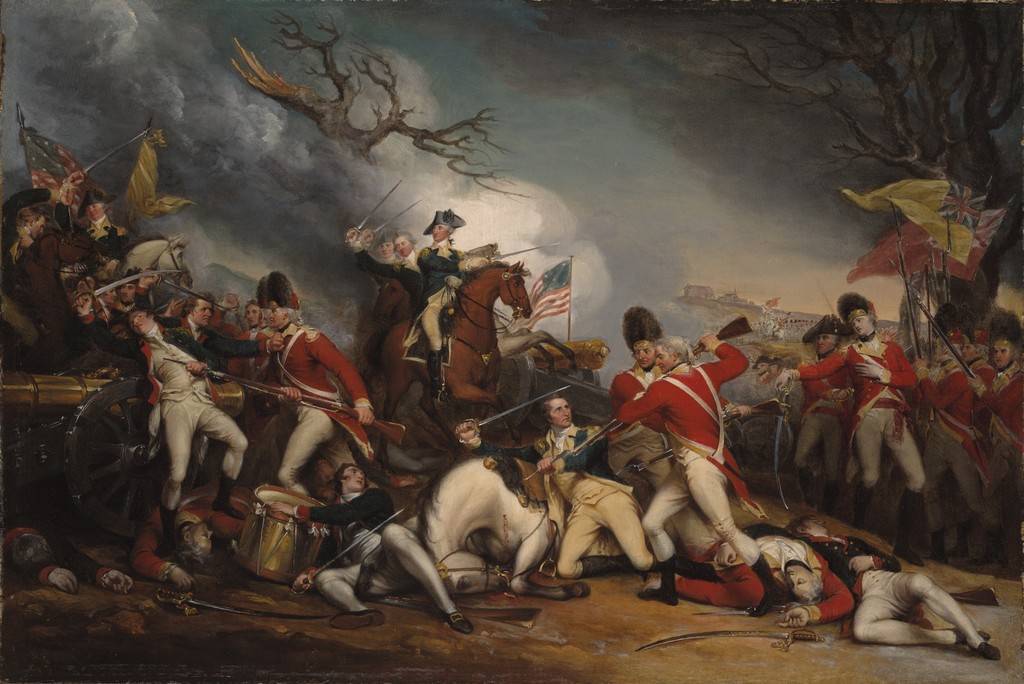
A fallen horse, an officer defending himself and the approach of Washington crowd into John Trumbull’s The Death of General Mercer at the Battle of Princeton, January 3, 1777 . The central encounter is violent and unresolved, while the mounted commander farther back points towards the recovery of the American position. Trumbull makes the danger to one man part of the changing fortunes of an army.
The principal painting at Yale University Art Gallery, 1832.6.1, developed between about 1787 and 1831. Its title dates the battle, not the making of the canvas or Mercer’s actual death. Mortally wounded on 3 January, the general survived until 12 January. The composition brings his injury and the wider battle into a single dramatic field. [1] [2]
At a Glance
- Artist John Trumbull.
- Principal canvas about 1787–1831; oil on canvas, 51.1 × 75.9 cm.
- Collection Yale University Art Gallery, 1832.6.1.
- Battle Princeton, 3 January 1777.
- Mercer’s death 12 January 1777, at the Thomas Clarke House.
- Portrait model Hugh Mercer Jr., sketched in April 1791.
- Separate unfinished version Yale University Art Gallery, 1832.6.2.
This work across John Trumbull’s career
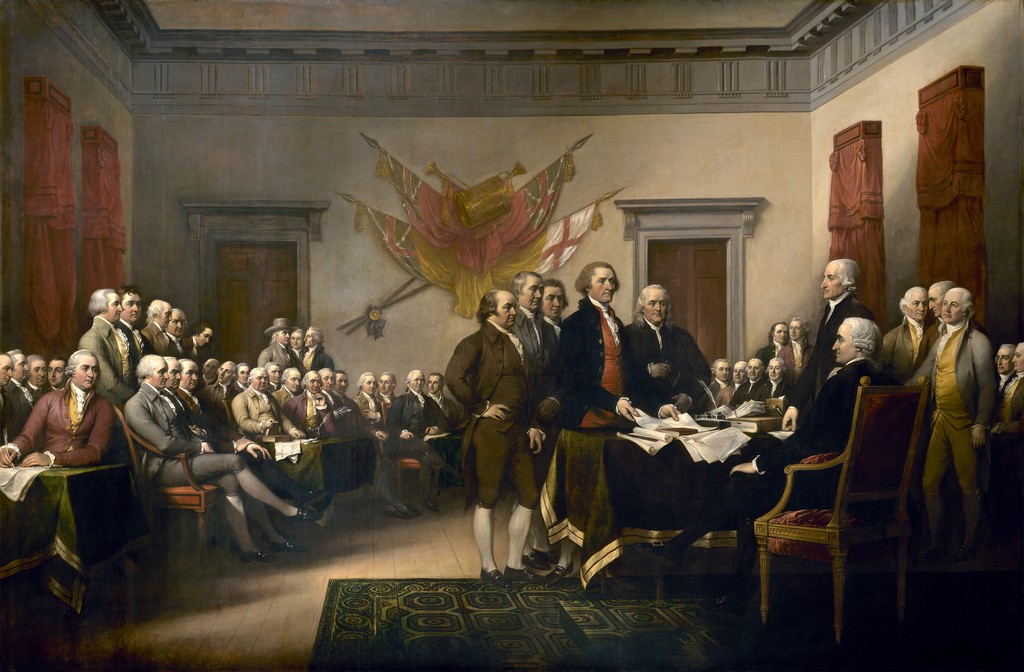
The Death of General Mercer at Princeton (current article)
about 1787–1831; principal Yale versionThe Sortie Made by the Garrison of Gibraltar
1789; Met versionGeorge Washington before the Battle of Trenton
about 1792–94; Met versionAlexander Hamilton
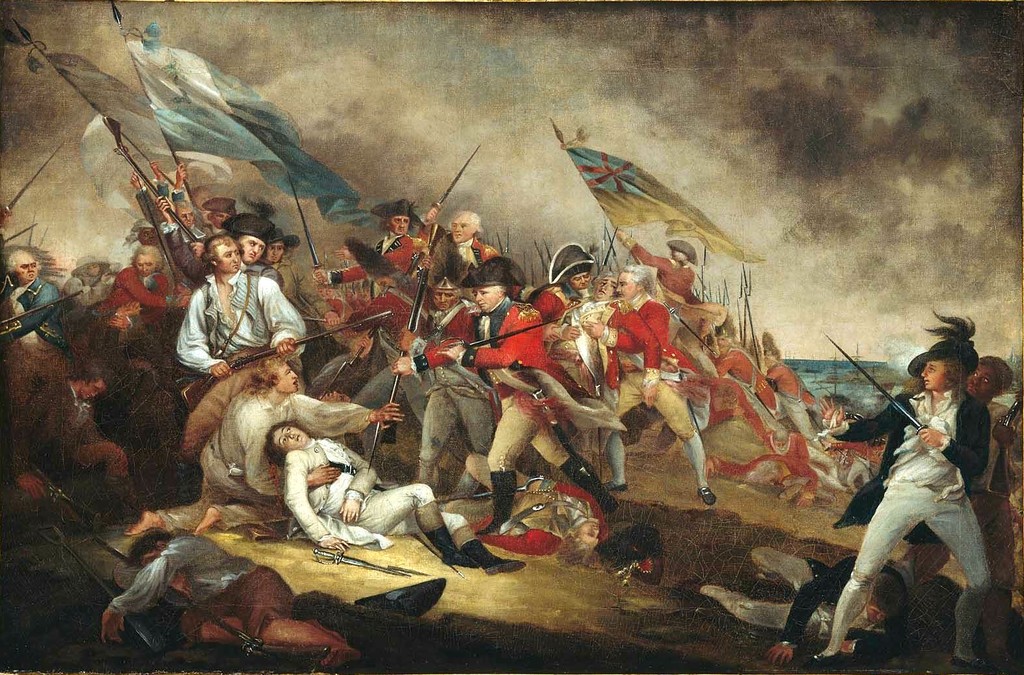
about 1792; likely early NGA replicaThe Death of General Warren at Bunker’s Hill
after 1815–before 1831; MFA versionDeclaration of Independence
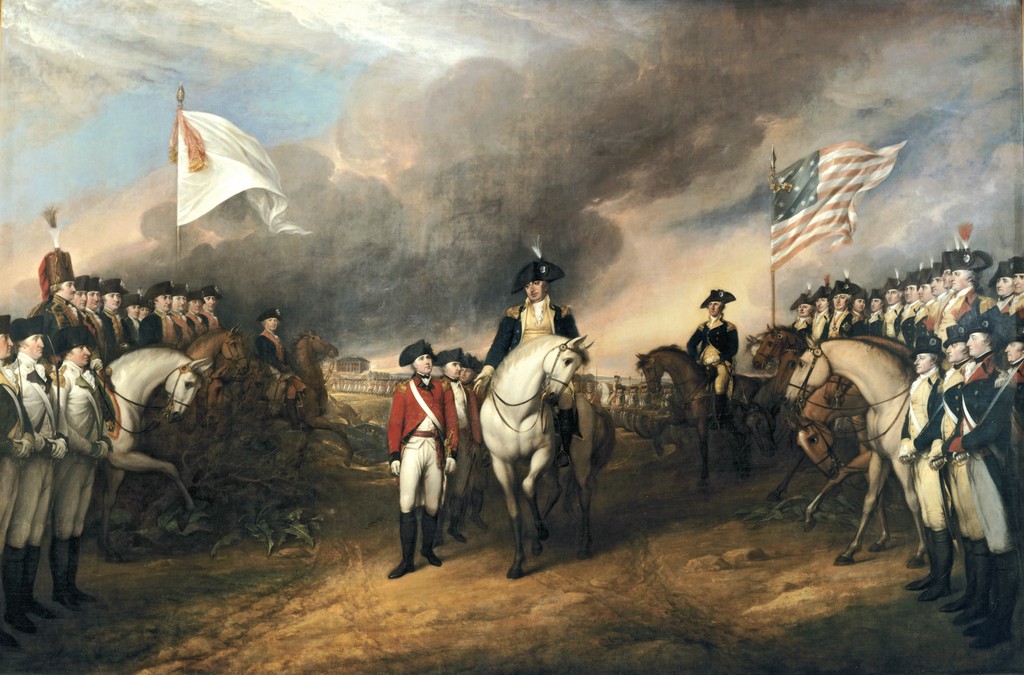
1817–18; Capitol canvasSurrender of Lord Cornwallis
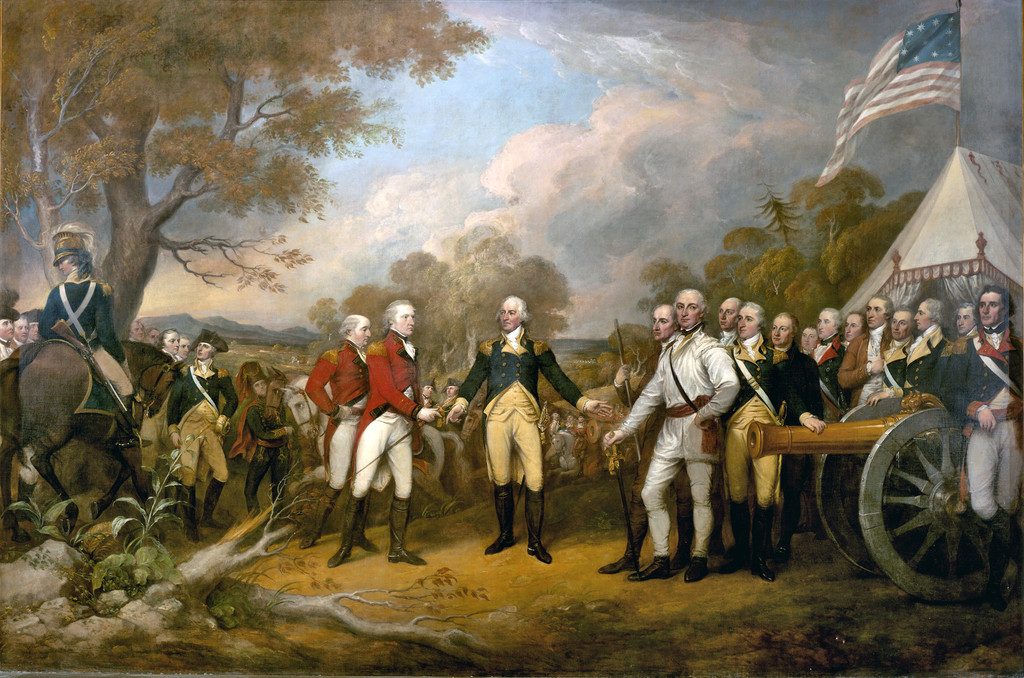
1819–20Surrender of General Burgoyne
1821; Capitol canvasNotes and sources
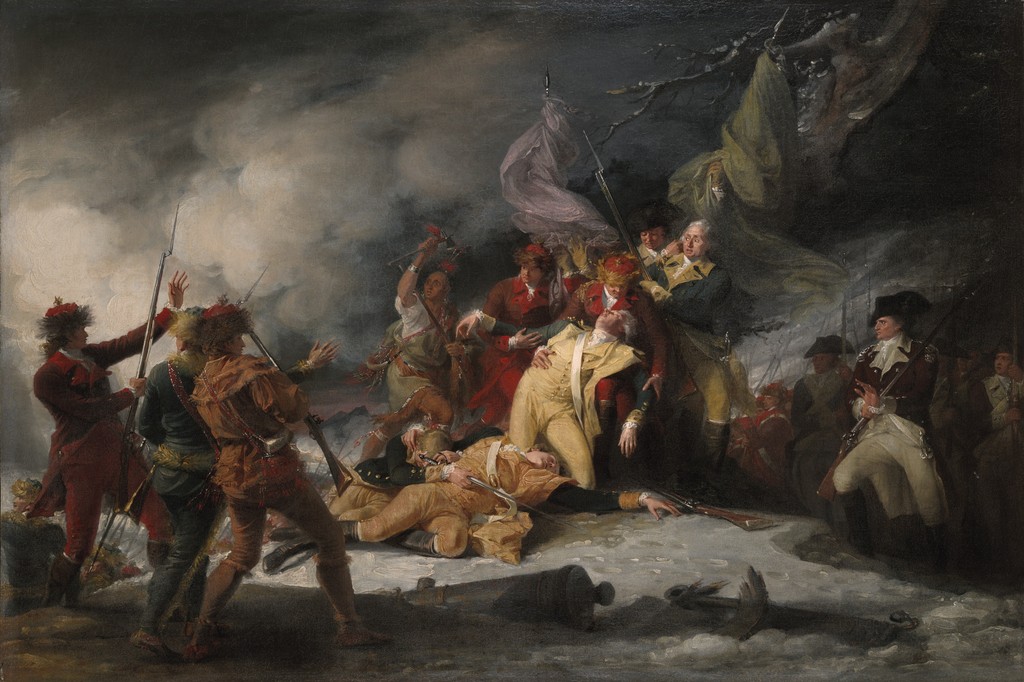
The Death of General Montgomery. Dates identify the particular canvas discussed in the article. [3]
The Capture of the Hessians at Trenton. Dates identify the particular canvas discussed in the article. [4]
The Death of General Mercer at Princeton (current article). Dates identify the particular canvas discussed in the article. [1]
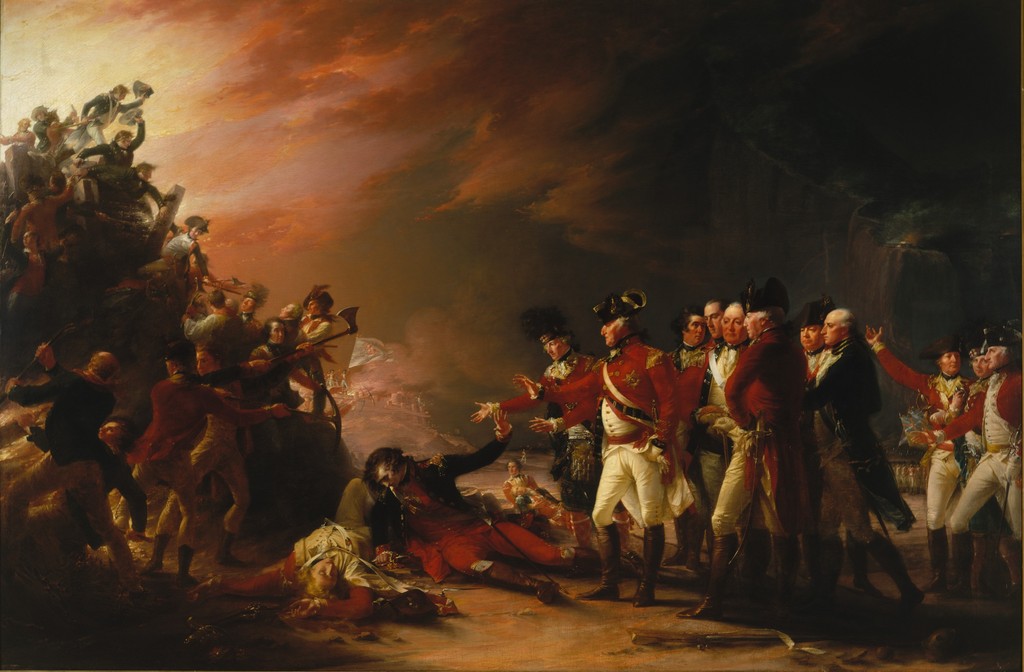
The Sortie Made by the Garrison of Gibraltar. Dates identify the particular canvas discussed in the article. [5]
George Washington before the Battle of Trenton. Dates identify the particular canvas discussed in the article. [6]
Alexander Hamilton. The NGA catalogue treats this as a likely early replica. [7] [8]
The Death of General Warren at Bunker’s Hill. Dates identify the selected later version. [9]
Declaration of Independence. Dates identify the particular canvas discussed in the article. [10]
Surrender of Lord Cornwallis. Dates identify the particular canvas discussed in the article. [11]
Surrender of General Burgoyne. Dates identify the particular canvas discussed in the article. [12]
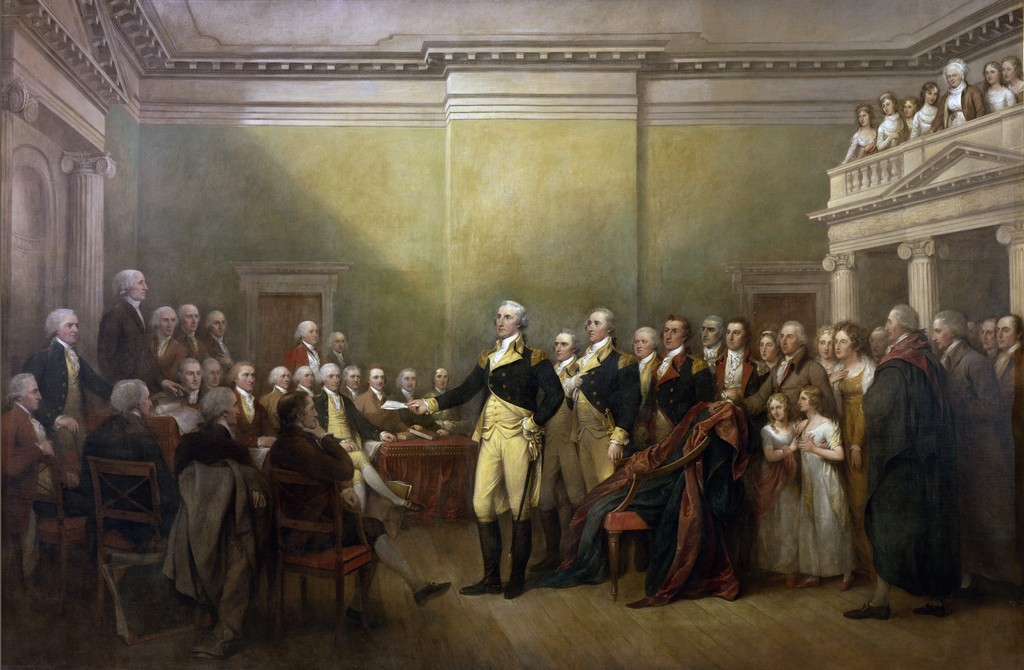
Washington Resigning His Commission. Dates identify the particular canvas discussed in the article. [13]
Contents
- Several actions in one field
- Mercer and the foreground struggle
- Washington as the distant commander
- The 1791 study of Mercer’s son
- A painting made across decades
- Complete and unfinished versions
- History, likeness and pictorial timing
- Annotated details
Several actions in one field
The foreground opens onto bodies, weapons and a collapsed white horse. Above them, red-coated soldiers advance with bayonets, while Washington appears on horseback in the space behind. The eye moves between close encounters at the lower edge and the command directing troops farther away. No single row of figures contains the whole subject.
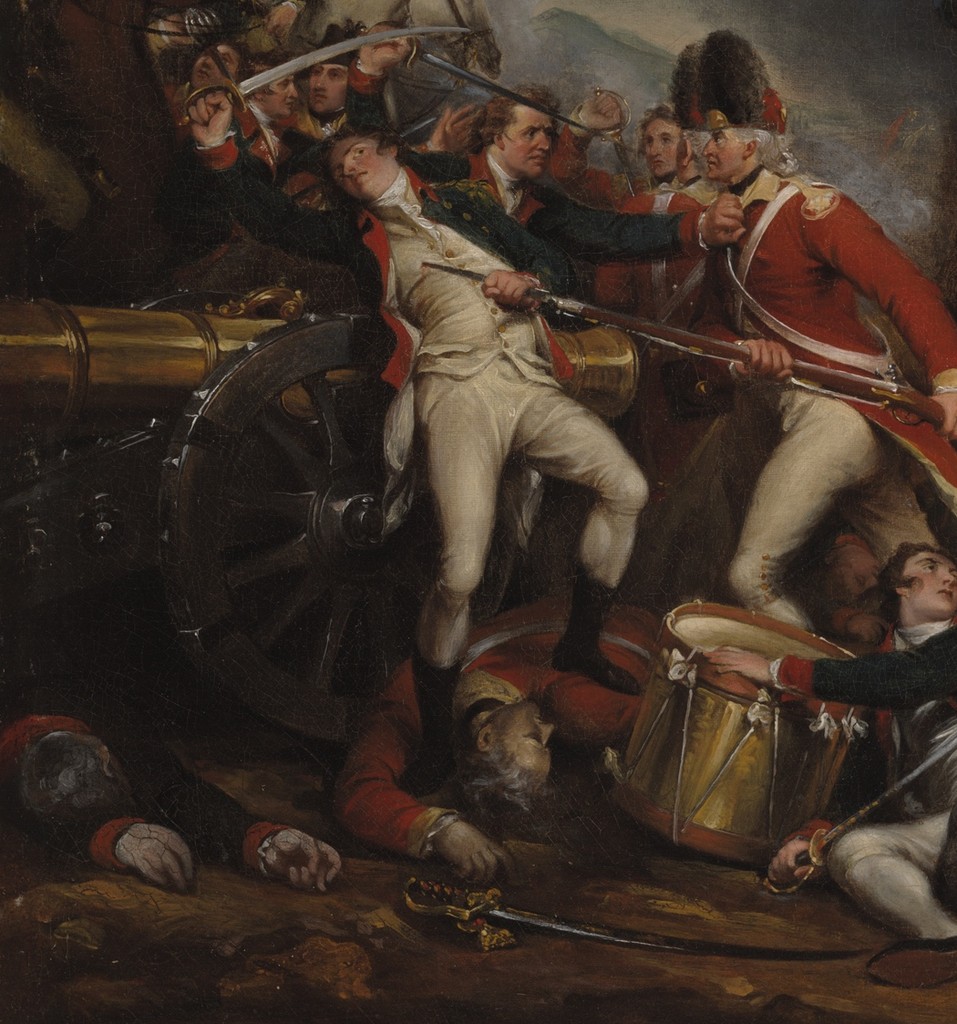
At the left, a cannon and men pressed around it create another focus of conflict. At the right, a cluster of soldiers and flags closes the scene. Smoke and bare branches cross the upper space, leaving a lighter opening behind Washington. The painting gathers separate actions within a landscape whose recession gives them different scales and degrees of urgency.
The branches add another set of sharp, uneven lines above the soldiers’ weapons. Their broken shapes reach into the smoke without enclosing a calm patch of landscape. At ground level, the scattered arms and fallen figures make the passage across the foreground difficult to follow. The picture withholds the broad, uncluttered meeting place familiar from Trumbull’s ceremonial surrenders.
The campaign helps explain that relationship. After the victory at Trenton on 26 December 1776, Washington faced Cornwallis at Assunpink Creek on 2 January. An overnight march brought the Americans towards Princeton, where fighting began the next morning. Mercer’s troops suffered a reverse before Washington intervened and the Americans secured victory. [14]
Trumbull’s arrangement lets the crisis and the response remain visible together. A viewer can recognise the vulnerability of the fallen general while also seeing the commander whose intervention helps turn the battle. The design offers a connected account of events through their placement within the picture.
Annotated Details from The Death of General Mercer at Princeton
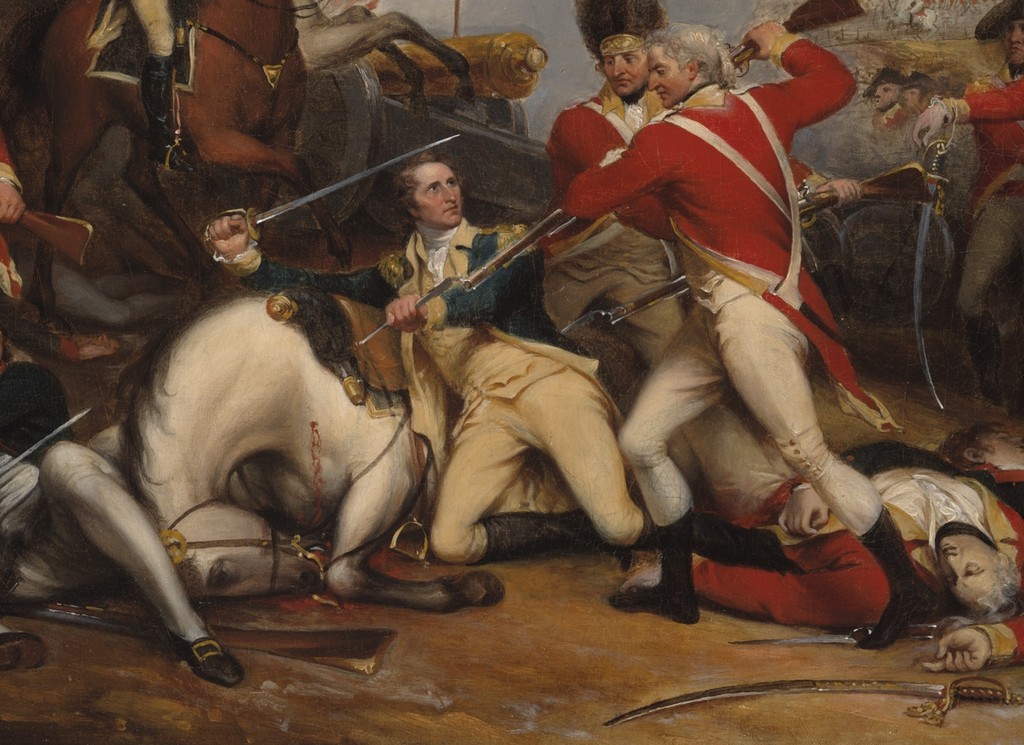
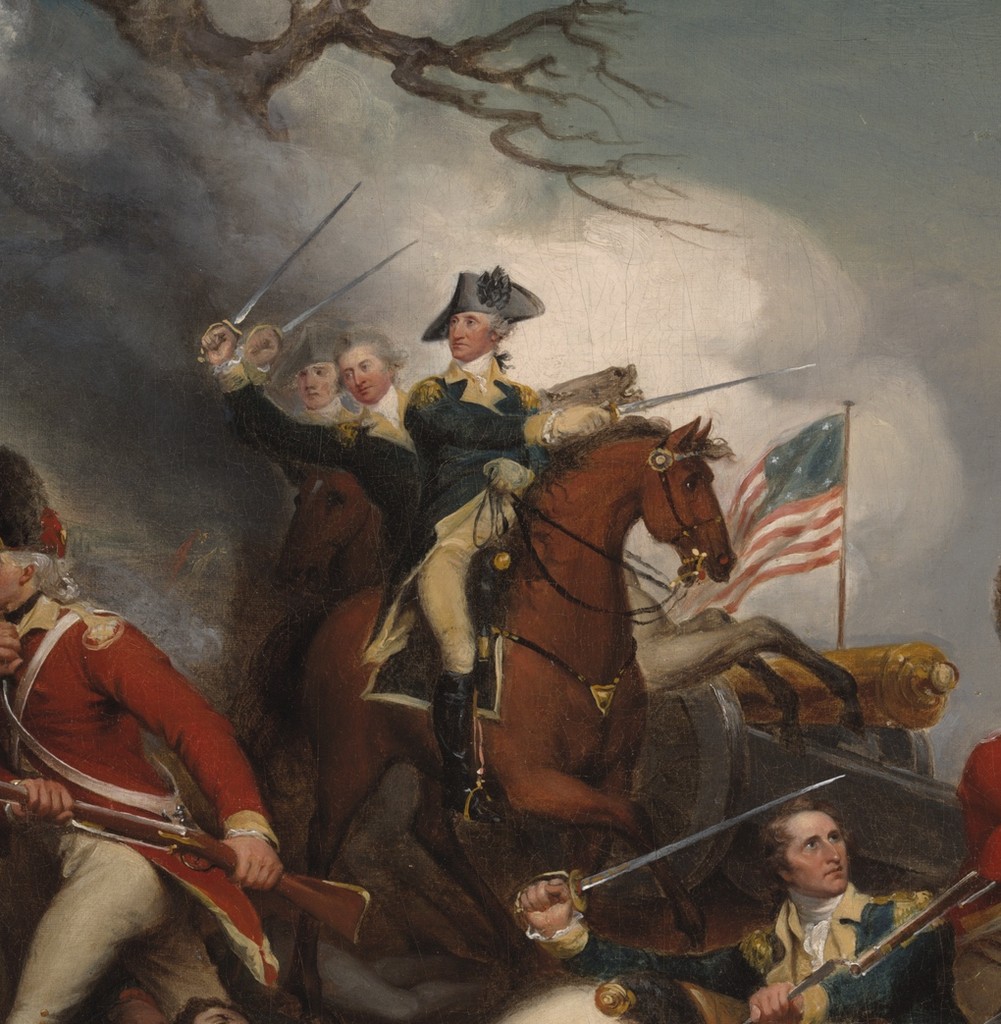
The numbered points identify visible features discussed in this article. Return from each detail to the whole composition. John Trumbull, The Death of General Mercer at the Battle of Princeton, January 3, 1777, about 1787–1831. Oil on canvas, 51.1 × 75.9 cm. Yale University Art Gallery, 1832.6.1. Mercer died on 12 January 1777. John Trumbull; Yale University Art Gallery, via Wikimedia Commons. Public domain. Image source. Public domain. Numbered markers added to a separate resized overview. Detail images are crops of the unchanged native source.
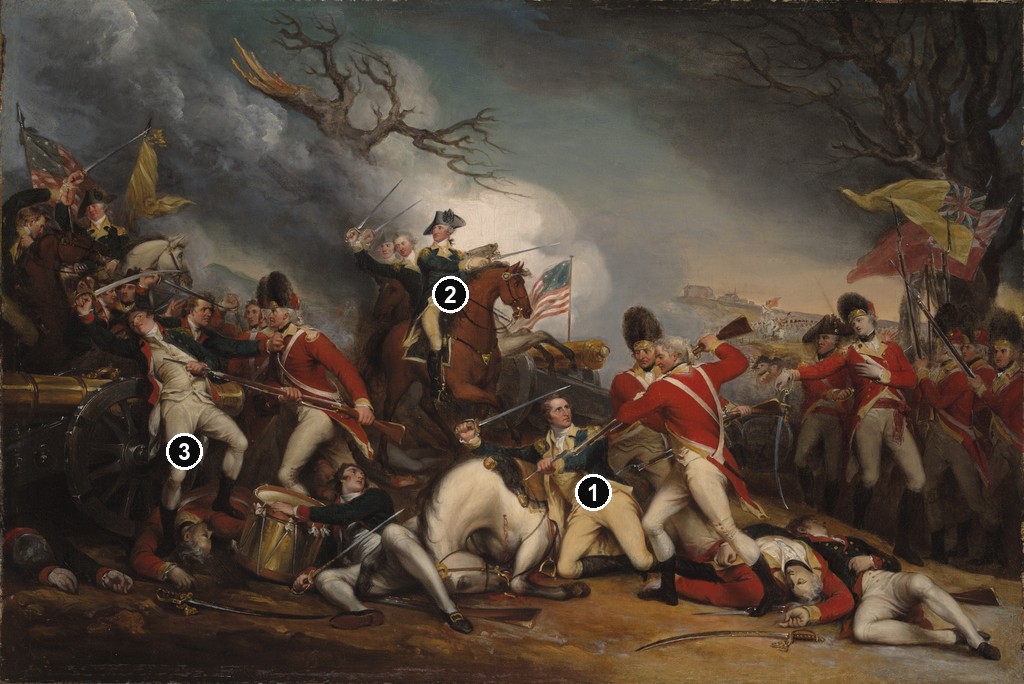
Details from THE DEATH OF GENERAL MERCER AT PRINCETON
Compare the cropped details with the complete images above. Notice how their colours, shapes and positions contribute to the larger compositions.
Mercer beside the fallen horse
The officer’s face turns upwards amid converging bayonets. The collapsed white horse fills the near ground, joining the man’s vulnerability to the great animal brought down beside him.
Washington above the struggle
The mounted commander rises against a pale opening in the smoke. His extended arm directs attention across the field, contrasting with the weapons that close around Mercer below.
Artillery and close combat
A cannon and tightly overlapping bodies occupy the left foreground. Weapons, sleeves and bent limbs lead the eye through another pocket of conflict beyond the principal struggle.
Mercer and the foreground struggle
Mercer kneels beside the fallen horse, his face turned upwards towards his attackers. His pale clothing brings the body forward against the darker mass of animals and men behind. A sword extends from his raised arm, while the soldiers’ weapons converge towards him. The spread of limbs and angled steel makes the encounter feel dangerously close.
The white horse occupies much of the lower centre. Its collapse removes the height and mobility associated with a mounted commander, leaving Mercer exposed among the feet of the advancing men. Trumbull connects human vulnerability with the great animal brought down beside him. The horse is both a substantial physical obstacle and an explanation for the officer’s position.
In the memoir’s catalogue, Trumbull recounts that Mercer’s horse was killed and that grenadiers attacked him before he could recover. His narrative then follows the American retreat and Washington’s advance. The account supplies the sequence that the painting condenses into its layered composition. [15]
The title’s reference to death should not be read as an exact depiction of Mercer’s final moments. He was taken to the Thomas Clarke House and died there nine days after the battle, as Princeton University Library’s Graphic Arts account explains. The painting makes the mortal wounding the principal image through which his death is remembered. [2]
Washington as the distant commander
Washington rises above the foreground struggle on a brown horse. His upright body and extended arm give a different direction to the movement below. Around Mercer, weapons converge inwards; around Washington, the gesture opens towards the field. The contrast allows the viewer to see threatened resistance and renewed leadership in one glance.
Distance does not diminish Washington’s role. The pale sky behind his head and the height of his mount give him a clear position above the crowded bodies. Trumbull reserves the closest emotional encounter for Mercer, while the mounted commander provides a second focus through which the battle’s outcome can be understood.
The Princeton Battlefield Society describes Washington bringing reinforcements forward and rallying faltering troops after the reverse suffered by Mercer’s men. Trumbull likewise made the counterattack a decisive action in his retrospective narrative. These accounts explain why Washington’s intervention belongs within a composition bearing another general’s name. [14] [15]
His position also differs from the isolated figure in George Washington before Trenton . Here his authority appears through an action within a crowded battle. The painting asks the viewer to follow the relationship between the wounded officer nearest us and the commander farther back.
The 1791 study of Mercer’s son
A small drawing now at the Metropolitan Museum of Art reveals how Trumbull approached the problem of Mercer’s likeness. The sitter was Hugh Mercer Jr., the dead general’s son. Trumbull sketched him twice at Fredericksburg, Virginia, in April 1791, using a living family member as the model for his father. The Met identifies the sheet as one of thirteen surviving studies for the painting. [16]
The drawing gives much more attention to the head than to the rest of the figure. The eyes, mouth, hair and shadow beneath the jaw are developed in graphite; the uniform, shoulders and arms remain lightly indicated. The turned head and upward gaze can be compared with the orientation of the officer in the painting.
The contrast in finish keeps attention on the sitter’s expression. Darker marks define the pupils and the mouth, while the larger areas of paper around the figure remain comparatively open. The lightly drawn clothing indicates a body without competing with the concentrated work on the head.
That comparison shows the difference between observing a sitter and placing a historical person within an action. The son’s features supplied a model, but the painted body had to struggle beside a fallen horse under attack. The study could help with the face while the larger design determined the figure’s pose, scale and relationship to the surrounding soldiers.
The sheet is therefore evidence of Trumbull’s method of reconstruction. It is not a portrait drawn from life of the father. The portraits article considers such differences between direct likenesses, borrowed models and the faces required by a historical composition.
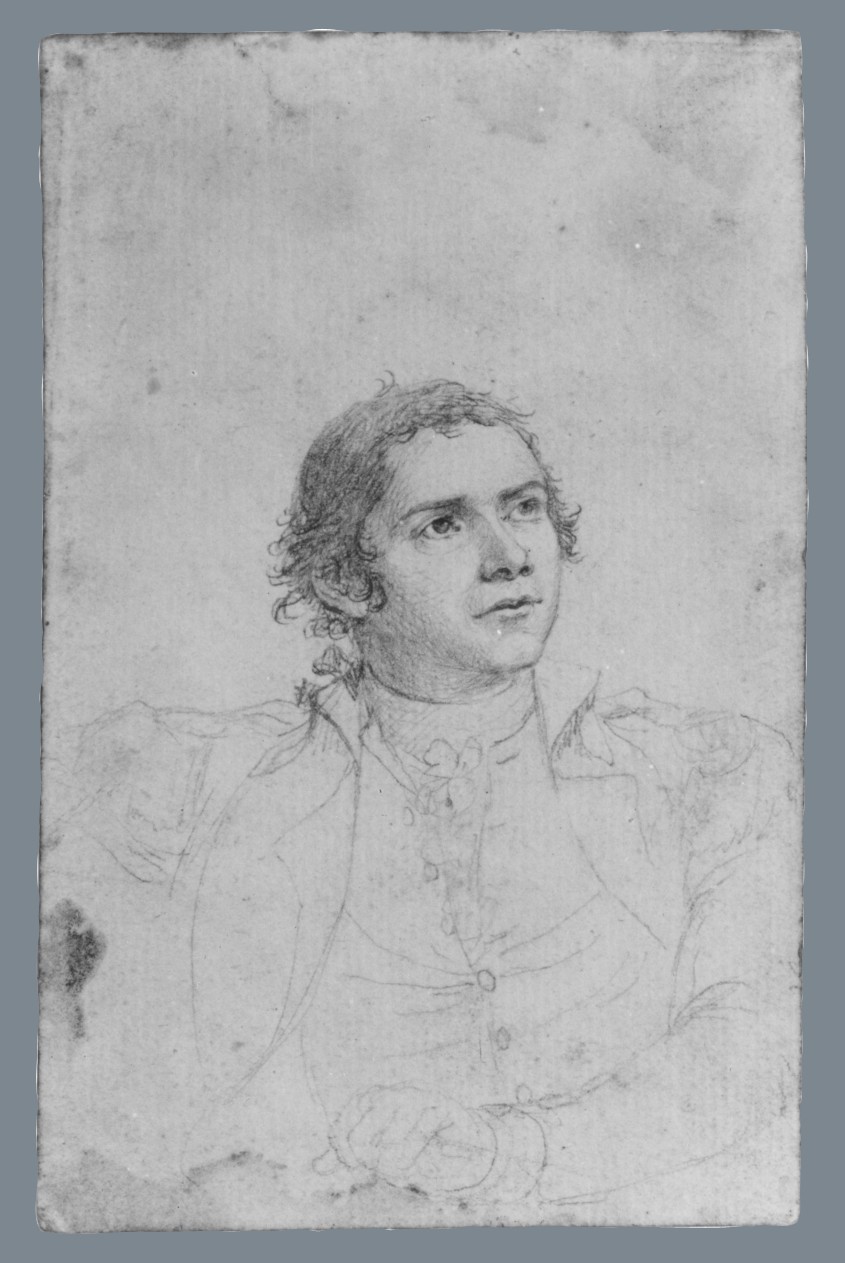
John Trumbull, Hugh Mercer, Jr., 1791. Graphite on off-white laid paper, 12.5 × 7.9 cm. The Metropolitan Museum of Art, 06.1346.2; Gift of Robert W. de Forest, 1906. Study of the son used as the father’s model. The Metropolitan Museum of Art. CC0.
Image source
.
CC0 / Public domain
. Resized only; full supplied image retained. No appearance adjustment.
Watch: John Trumbull
Choose a film to explore the artist’s work, its interpretation and its wider setting.
Moment of Discovery: John Trumbull’s “Declaration of Independence”
Discovery Park of America looks closely at Trumbull’s Declaration of Independence.
Watch on YouTubeA painting made across decades
The broad creation date attached to Yale’s principal canvas, about 1787–1831, places it within Trumbull’s long Revolutionary project. The 1791 portrait study falls inside that span. A picture planned in the years after the war could continue to receive material gathered later, rather than reaching its final form in one uninterrupted campaign of painting. [1] [16]
The dates describe different kinds of work. January 1777 belongs to the battle; April 1791 to the sittings with Mercer’s son; the much wider band belongs to the canvas’s development. Keeping those histories together allows the painting to be understood as an act of remembering and reconstruction undertaken over time.
The drawing also makes that labour tangible. A sheet only 12.5 by 7.9 centimetres could preserve a face for a composition containing horses, artillery, flags and numerous figures. Information gathered at an intimate scale became one element in an extensive scene of public history. [16]
The drawings and prints article follows the different roles such works on paper played. In this instance, the surviving study establishes a particular sitter and purpose, giving substance to the general idea that Trumbull collected likenesses for his historical paintings.
Complete and unfinished versions
The principal image discussed here is the worked composition numbered 1832.6.1 at Yale. It measures 51.1 by 75.9 centimetres and is painted in oil on canvas. Its broad date band and separate accession identify the object reproduced alongside the Mercer study. [1]
Yale also holds an unfinished version, 1832.6.2, recorded through its image carrier as dating to about 1786–88. That is a distinct canvas, rather than another title for the same painting. The two accession numbers are useful when comparing illustrations or encountering different dates attached to Trumbull’s Princeton subject. [17]
The unfinished work’s existence also cautions against treating a subject as though it had only one physical form. A design could be attempted, developed and revisited through different objects. The surviving portrait drawing adds another part of that history, with its own date, medium and purpose.
Neither the early date associated with an unfinished version nor the battle date in the title should replace the identification of the principal canvas. The work illustrated here joins a developed composition to the long process of gathering and arranging the materials of Revolutionary history.
History, likeness and pictorial timing
The scene’s force comes from the proximity of several dangers. A body is vulnerable beneath converging weapons, a horse has fallen, and other soldiers struggle along the edges. Above this immediate violence, the mounted Washington gives the picture a route towards the battle’s different outcome.
Those relationships distinguish it from the orderly exchange in The Capture of the Hessians . At Princeton the central action remains an attack; at Trenton the meeting of commander and wounded opponent directs attention towards mercy after resistance has ended. Both subjects turn a military event into a closely considered encounter between bodies and gestures.
Mercer’s painting carries several times within it: the attack, Washington’s intervention, the death that followed and the later sittings with the general’s son. Trumbull’s achievement lies in giving that collected history a readable pictorial form. The viewer confronts the officer’s danger first, then follows the wider field towards the action that will survive him.
Artworks directory
Works discussed in these articles, including distinct versions and reproductive prints. Dates identify the particular object; titles and attributions follow the cited collections. This is not a catalogue raisonné.
Frequently Asked Questions
He was mortally wounded that day and died at the Thomas Clarke House on 12 January.
His intervention and rallying of the Americans connect Mercer’s wounding with the wider battle and its outcome.
His son Hugh Mercer Jr., whom Trumbull sketched at Fredericksburg in April 1791.
That is the battle date. The principal Yale canvas is dated about 1787–1831.
Yes. The principal canvas is Yale 1832.6.1; a separate unfinished version is 1832.6.2.
Discussion
Look again at the images and ideas explored in The Death of General Mercer at Princeton by John Trumbull. These editorial prompts invite your observations.
Follow the eye from Mercer’s upward-turned face to Washington above him. How do the fallen horse, converging weapons and open patch of sky connect the foreground crisis with the action farther back?
Reader Insights
How does the fallen horse affect Mercer’s vulnerability?
Compare the drawn head of Mercer’s son with the officer in the painting.
How does the actual later death affect your reading of the battle scene?
Join the Conversation
Share a detail, comparison or question about The Death of General Mercer at Princeton by John Trumbull below.
References
- Yale University Art Gallery, via Wikimedia Commons , The Death of General Mercer at the Battle of Princeton, January 3, 1777 , 1832.6.1; main painting, date band, dimensions and image identification. View source
- Julie Mellby, Princeton University Library Graphic Arts , The Battle of Princeton and the [later] Death of Mercer , 29 September 2018; preparatory work and Mercer’s later death at the Thomas Clarke House. View source
- Yale University Art Gallery via Wikimedia Commons, Death of General Montgomery,1786,1832.2,. View source
- Yale University Art Gallery / Wikimedia Commons, The Capture of the Hessians at Trenton,December26,1776,1832.5,. View source
- Metropolitan Museum of Art, The Sortie Made by the Garrison of Gibraltar,. View source
- Metropolitan Museum of Art, George Washington before the Battle of Trenton,. View source
- National Gallery of Art, Alexander Hamilton, c1792,. View source
- National Gallery of Art / Ellen G. Miles with Cynthia J. Mills and other contributors, American Paintings of the Eighteenth Century,1995,Trumbull entries,. View source
- Museum of Fine Arts, Boston, Death of General Warren at Bunker’s Hill,. View source
- Architect of the Capitol, Declaration of Independence,. View source
- Architect of the Capitol, Surrender of Lord Cornwallis,. View source
- Architect of the Capitol, Surrender of General Burgoyne,. View source
- Architect of the Capitol, General George Washington Resigning His Commission,. View source
- Princeton Battlefield Society , The Battle of Princeton ; campaign sequence, Mercer’s reverse and Washington’s intervention. View source
- John Trumbull , Autobiography, Reminiscences and Letters , 1841, catalogue no. 23, pp. 421–424; retrospective account of Princeton. View source
- The Metropolitan Museum of Art , Hugh Mercer, Jr. , 1791, 06.1346.2; sitter, purpose, sittings, medium and dimensions. View source
- Yale University Art Gallery, via Wikimedia Commons , The Death of General Mercer at Princeton, unfinished version , 1832.6.2; separate object identification. View source
- Splash image source.
John Trumbull, The Death of General Mercer at the Battle of Princeton, January 3, 1777, about 1787–1831. Oil on canvas, 51.1 × 75.9 cm. Yale University Art Gallery, 1832.6.1. Mercer died on 12 January 1777. John Trumbull; Yale University Art Gallery, via Wikimedia Commons. Public domain. Public domain . Resized only; full supplied image retained. No appearance adjustment.
View source