 by
Tom Gurney
Tom Gurney BSc (Hons) is an art history expert with over 20 years experience
Email:
tomgurney1@gmail.com
/ Phone:
+44 7429 011000
John Trumbull Style and Technique: Introduction
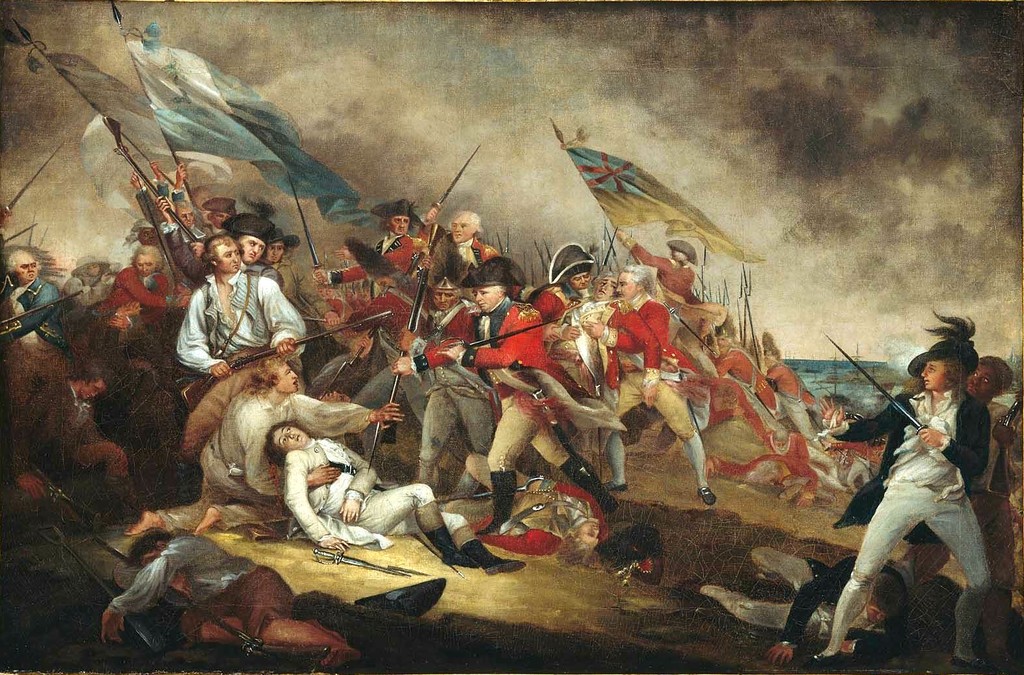
John Trumbull made historical events readable through carefully arranged bodies, recognisable faces and decisive contrasts of light. His paintings could turn a crowd into an ordered political assembly or concentrate a battle around the fate of a wounded man. Academic training helped him construct these scenes, while portrait studies and repeated versions gave him ways to refine their particulars.
His technique also varied with the object. A small oil portrait on wood, a canvas representing a single sitter and a monumental historical painting present different demands. Looking closely at those differences reveals more than a single description of his style as precise, dramatic or patriotic. The evidence includes visible brushwork, surviving studies, comparisons between versions and technical examinations published by museums.
At a Glance
- Artist John Trumbull, 1756–1843
- Principal practice History painting and portraiture in oil
- Important preparation Drawing, copying, portrait studies and compositional revision
- Recurring pictorial devices Grouped figures, diagonal movement, expressive gestures and contrasts of light
- Small portrait supports Wood as well as canvas
- Published technical examples The NGA's Hamilton portraits, 1952.1.1 and 1940.1.8
- Important distinction Changes between separate versions differ from changes discovered beneath one painting
- Related traditions British academic painting and the classical language of the figure
Contents
- Academic preparation and modern history
- Poses, diagonals and the dying hero
- Portrait studies and plausible likeness
- Light as a narrative guide
- Small oil pictures and monumental canvases
- Surfaces, supports and controlled detail
- Revisions between versions
- What the surviving evidence can show
Academic preparation and modern history
Trumbull's education with Benjamin West placed the events of the American Revolution within the ambitions of European history painting. This was a tradition that used composition, gesture and the human figure to give consequential subjects a compelling visual form. A painter did more than choose an important event: the bodies and actions had to establish why that event mattered.
John F. Weir's account describes Trumbull drawing and copying during his training, including work after West. It also records West's encouragement of the Revolutionary subjects and their reproduction through engraving. These activities linked the study of established artistic models with an ambition to create pictures of recent American history. The account draws heavily on Trumbull's later recollections and should be understood in that context. [1]
Kevin J. Avery's discussion of eighteenth-century American drawing identifies several tasks that preparation could serve: representing a historical person, developing an acting figure and organising the composition. They were related demands, but one successful likeness could not solve all three. The pose that made a body expressive and the placement that made a group legible still required work. [2]
Trumbull's connection with history painting therefore concerns a way of constructing meaning as well as a choice of subject. Military uniforms and familiar names brought recent events into the picture. The organisation of the scene gave those events the clarity expected of a public historical image.
Poses, diagonals and the dying hero
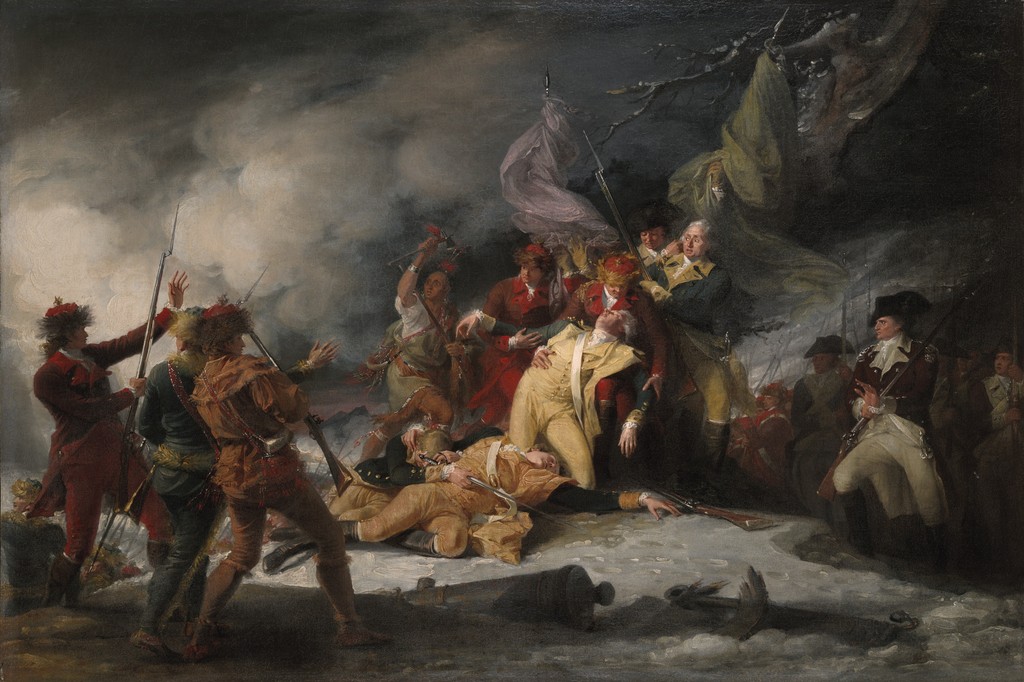
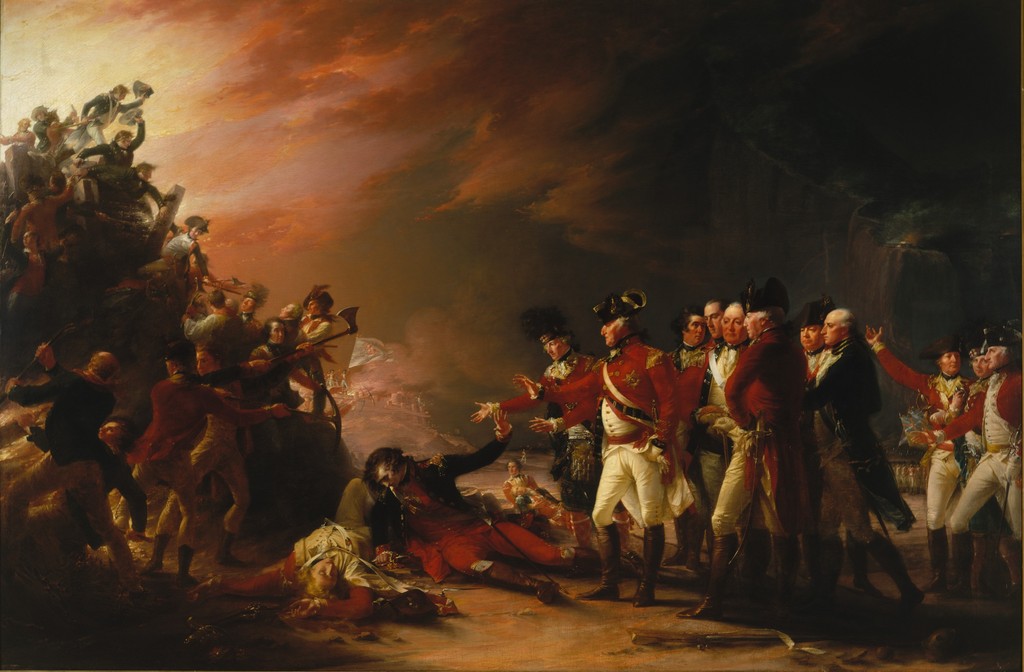
In The Sortie Made by the Garrison of Gibraltar , the 1789 Met canvas divides attention between several kinds of action. Figures climb and attack towards the upper left. A dying man occupies the foreground, while a group of officers gathers on the right. The movement across the picture connects violence, suffering and the commanding group's response. [3]
The standing officers present a different rhythm from the attacking figures. Their bodies form a more stable group, with faces close enough to invite individual attention. Outstretched hands link them to the dying Spaniard. At the left, raised limbs and weapons carry the eye upwards through a denser accumulation of movement. The foreground body interrupts that ascent and returns attention to the consequences of the action.
The Met catalogue connects Trumbull's dying Spaniard with a classical dying-warrior model and records Thomas Lawrence's role as a model for the figure. Such sources could contribute different things: an established bodily arrangement and a particular human likeness. Their combination helped turn the death into an expressive focus without making the figure a direct portrait of an observed battlefield moment. [4]
The classical reference does not require the modern uniform to disappear. Instead, the recognisable body and the contemporary setting support one another. The spectator can identify a recent military subject while reading suffering through a pose with a longer artistic history. This combination helps explain how Trumbull could make recent events resemble subjects worthy of the grand tradition.
Portrait studies and plausible likeness
The graphite drawing of Hugh Mercer Jr. shows preparation at a much smaller scale. Trumbull defines the head more emphatically than the coat and shoulders. The hair, eyes and shaded cheek establish a likeness, while the lightly outlined clothing leaves the body relatively open. The sheet concentrates on the information most needed from this encounter.
The Met identifies the drawing as a study for the Princeton painting and explains that the general's son modelled for his deceased father. Trumbull drew him in Fredericksburg in April 1791, years after the battle. The distinction between sitter and represented person is essential to understanding what this study contributed. [5]
In the finished composition, an individual likeness has to operate within a struggle involving weapons, horses and several simultaneous actions. A face that might be examined quietly on paper becomes one element in a scene designed to convey danger and a response to it. Its presence gives the image specificity, while its new setting depends on the painter's reconstruction.
The study also resists an assumption that every part of a preparatory drawing had to be equally finished. The concentrated face and looser body record different degrees of attention within one object. The contrast is useful precisely because it makes the purpose of the sheet visible. The drawings and prints article considers this example alongside the later translation of compositions into engraving.
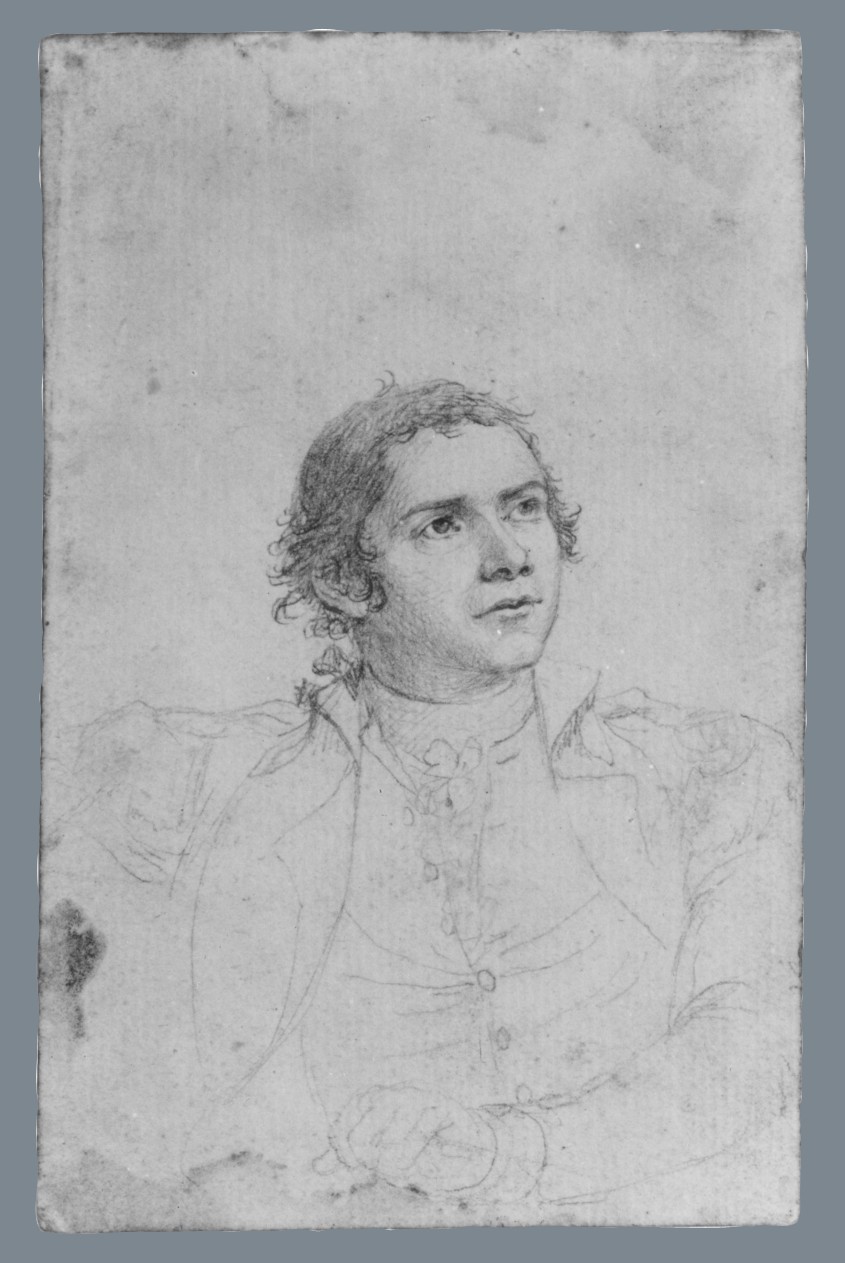
John Trumbull, Hugh Mercer, Jr., 1791. Graphite on off-white laid paper, 12.5 × 7.9 cm. Metropolitan Museum of Art, 06.1346.2. Gift of Robert W. de Forest, 1906. The Metropolitan Museum of Art, CC0.
Image source
.
CC0 / Public domain
. Resized only; full supplied image retained. No appearance adjustment.
Light as a narrative guide
Light helps Trumbull distinguish the important action from its surroundings. In the Gibraltar painting, the warm illumination does more than establish an atmosphere of fire and smoke. It gives the climbing figures a bright setting, separates parts of the central group and picks out pale clothing against dark forms. The eye can move between those illuminated areas while the large dark sky holds them within one scene.
The right-hand officers do not all receive equal emphasis. Faces and white breeches emerge from darker coats, and the outstretched hands become points of connection across the group. In the foreground, the dying man's red clothing and the pale body beside him create a different concentration of colour and light. These relationships allow several episodes to remain legible without giving every object the same prominence.
The contrast is an example of how chiaroscuro can serve narrative. It directs attention and models bodies, while the distribution of brightness connects separate parts of the action. A bright patch is meaningful through its relationship with what surrounds it; illumination alone does not identify a person or explain an event.
Portraits use the same broad resource more selectively. In the early NGA Alexander Hamilton , the face and white cravat emerge from a brown setting, concentrating attention on the sitter's head. The absence of a crowded historical scene makes small transitions around the cheek, hair and neckcloth carry more of the pictorial work. The lighting supports the presentation of an individual rather than the coordination of many participants. [6]
Small oil pictures and monumental canvases
Scale changes the encounter between a painting and its audience. The Met's 1788 Thomas Jefferson is an oil painting on mahogany measuring 11.4 by 8.3 centimetres. Its oval portrait invites close attention to the face, hair and dress. The rectangular panel surrounding that oval remains visible in the museum's photograph, preserving the physical character of a small painted object. [7]
The Met catalogue describes the contrasting textures produced by raised paint and transparent passages in Trumbull's small oils. Their dimensions do not make them technically identical to watercolour miniatures on ivory. Oil could retain variation in its surface even within an intimate likeness, and the small portrait was not simply a large canvas reduced to a convenient size. [4]
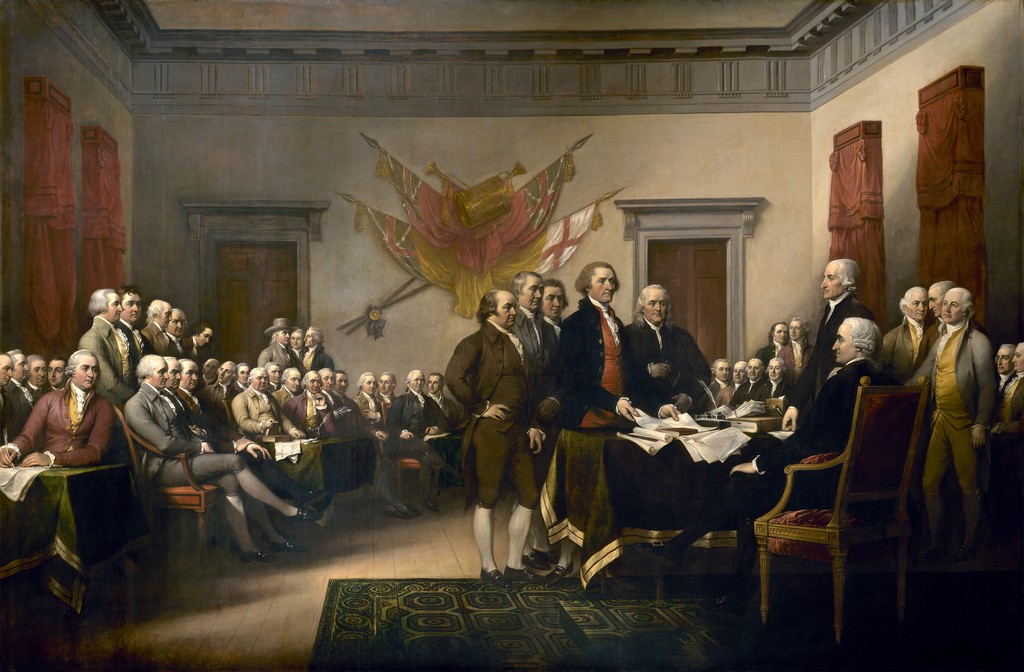
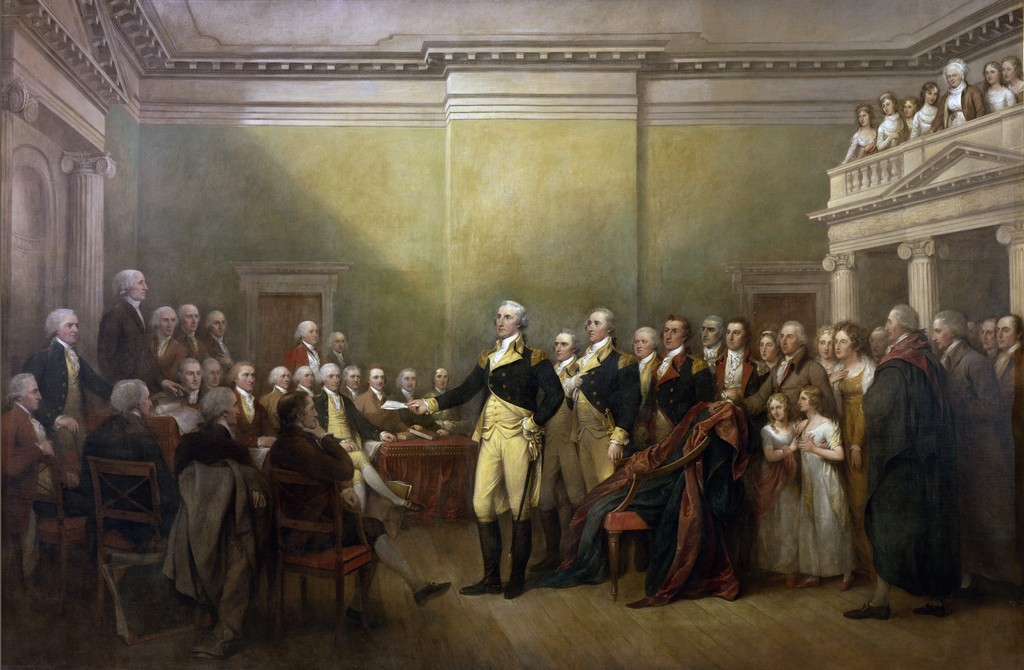
At the other extreme, the Capitol Declaration of Independence measures twelve by eighteen feet. The Architect of the Capitol dates its execution to 1817–18. Its portraits and carefully arranged committee had to operate within a monumental public picture, where the gathering could be read as a whole before a spectator attended to individual faces. [8]
The broad arrangement consequently matters at both scales, but it is encountered differently. A small portrait draws the viewer towards a concentrated likeness. A monumental assembly first establishes a room, a crowd and a central action. The Declaration article follows the relationship between that public canvas and the smaller Yale painting whose development preceded it.
Watch: John Trumbull
Choose a film to explore the artist’s work, its interpretation and its wider setting.
Moment of Discovery: John Trumbull’s “Declaration of Independence”
Discovery Park of America looks closely at Trumbull’s Declaration of Independence.
Watch on YouTubeSurfaces, supports and controlled detail
Published examination allows some of Trumbull's materials and procedures to be described more precisely. The NGA's 1995 catalogue records coarse twill-weave canvas beneath its Hamilton of about 1792. It describes thin, blended paint with more raised passages in the highlights and white cravat. Infrared reflectography revealed an iris outline that was not visible at the surface, although no traditional underdrawing was detected. [6]
The later Hamilton, dated about 1806, has a different support history. The same catalogue records plain-weave fabric mounted on plywood, a white ground and a reddish-brown preparatory layer. Its description distinguishes fluid, thinner shadows from more raised highlights. These are findings about the particular paintings examined, rather than a recipe that can be assigned to every Trumbull portrait. [6]
The contrast between broad areas and controlled detail is also visible in the reproductions. A dark coat can establish much of the body's presence without competing with the face. A white neckcloth, a catch of light or an edge beside the cheek can then become more prominent. The viewer's sense of finish depends partly on these differences in emphasis, rather than an identical density of marks across the canvas.
Raised paint, often called impasto , is only one part of that surface. Thin paint can supply a dark passage or a transition that makes the raised highlight more effective. The relative handling of adjacent areas is more useful to look for than an expectation that a precise portrait must have an entirely smooth surface.
Condition requires another distinction. The NGA catalogue records abrasion and past treatment as well as the artist's handling. A later mount, a repair or worn paint belongs to the object's subsequent history. Its present appearance cannot automatically be attributed to Trumbull's original choice, and a photograph alone does not establish the complete sequence of changes.
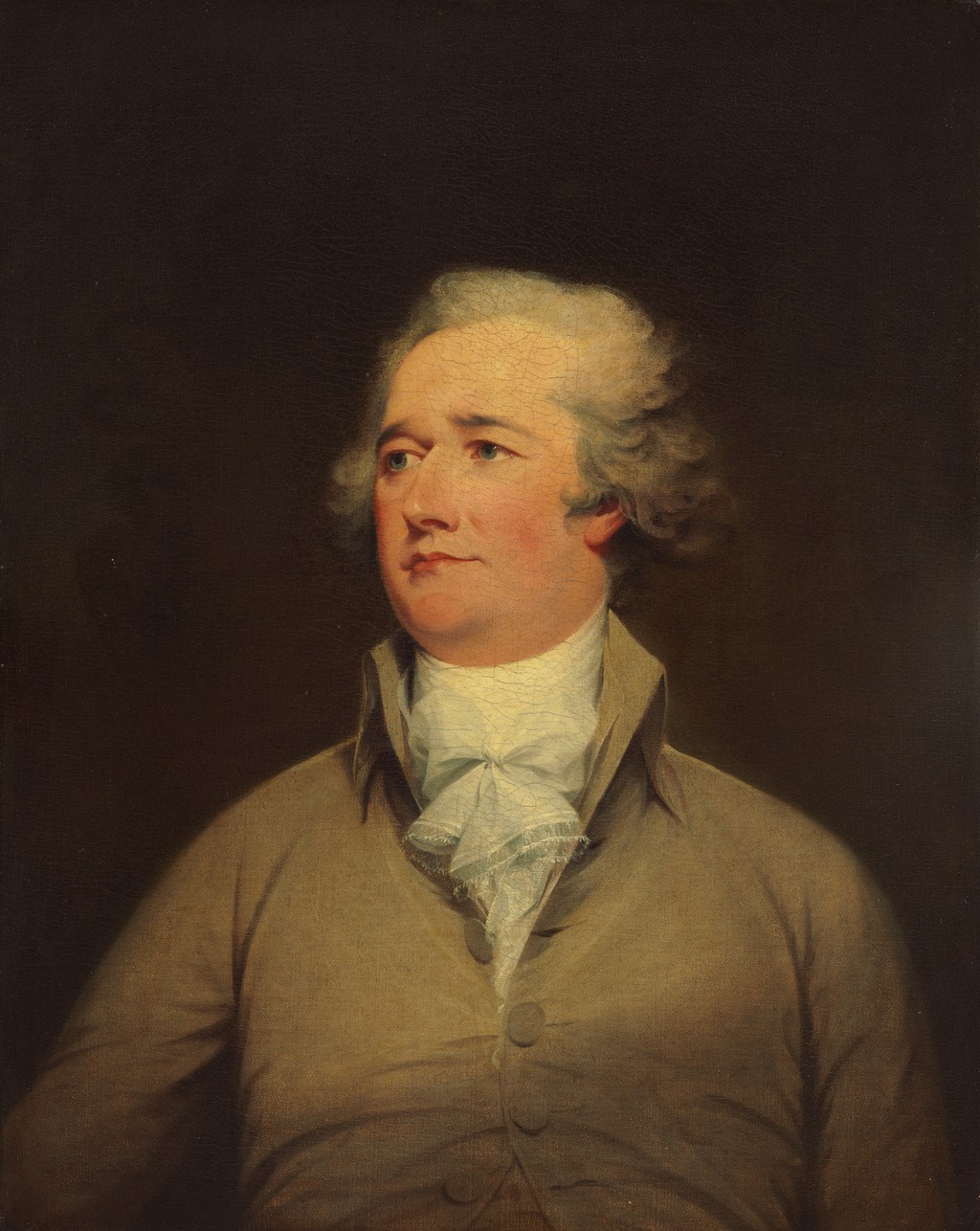
John Trumbull, Alexander Hamilton, about 1792. Oil on canvas, 76.2 × 60.5 cm. National Gallery of Art, Washington, 1952.1.1. Gift of the Avalon Foundation. Courtesy National Gallery of Art, Washington, CC0.
Image source
.
CC0 / Public domain
. Resized only; full supplied image retained. No appearance adjustment.
Revisions between versions
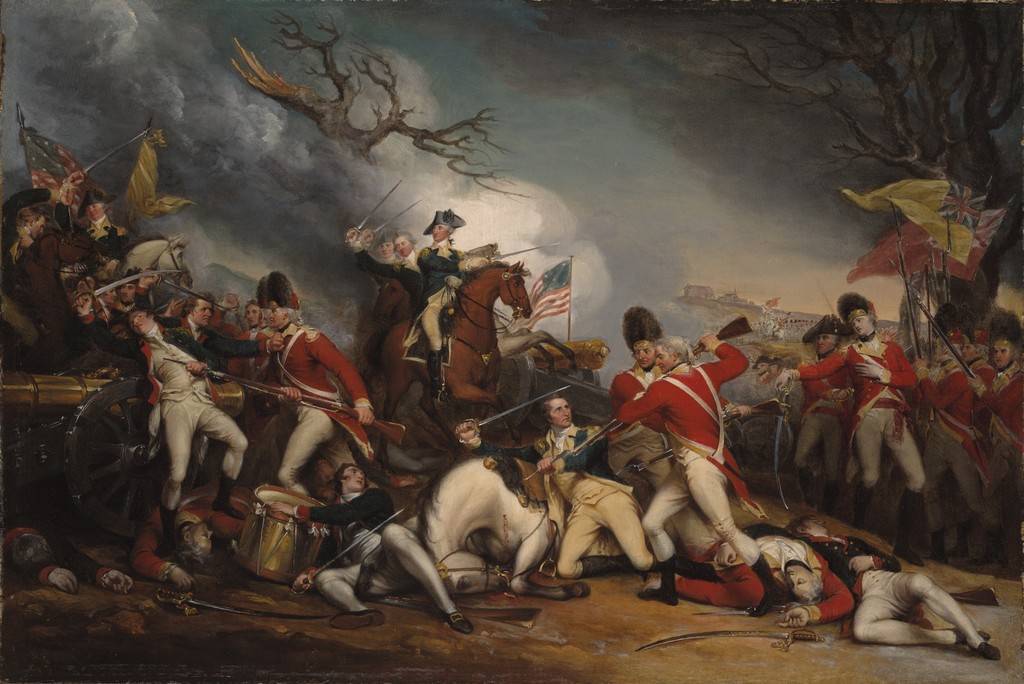
Separate versions show Trumbull reconsidering a composition. His Washington portrait provides a clear example. The Met owns a smaller canvas, dated about 1792–94, related to the full-size Yale portrait of 1792. The catalogue compares differences in the tree, landscape, sky and horse. Its account identifies a living tree and brown horse in the smaller version where the larger design had used a blasted tree and pale horse. [9] [4]
Such changes affect the balance of the image without removing its central conception. Washington still stands in uniform with a horse and attendant nearby. The particular tree, colour of the animal and surrounding weather contribute to the degree of agitation and the relationship between the figure and landscape. Repetition allowed the artist to preserve a design while adjusting its effect.
The Gibraltar sequence likewise involved changes in the dying Spaniard, the officers and the foreground as Trumbull moved towards the large 1789 canvas. The Met catalogue traces these compositional decisions across drawings and painted versions. It describes an evolving design, rather than a single image transferred mechanically from one support to another. [4]
These comparisons differ from discoveries made by looking beneath a painting's surface. A change between two canvases is evidence of different versions. An infrared finding concerns something recorded within the examined object. Both can inform an account of the artist's practice, but they do not establish the same kind of history. The distinction keeps the Washington portrait and the scientific evidence about Hamilton in their proper relationships.
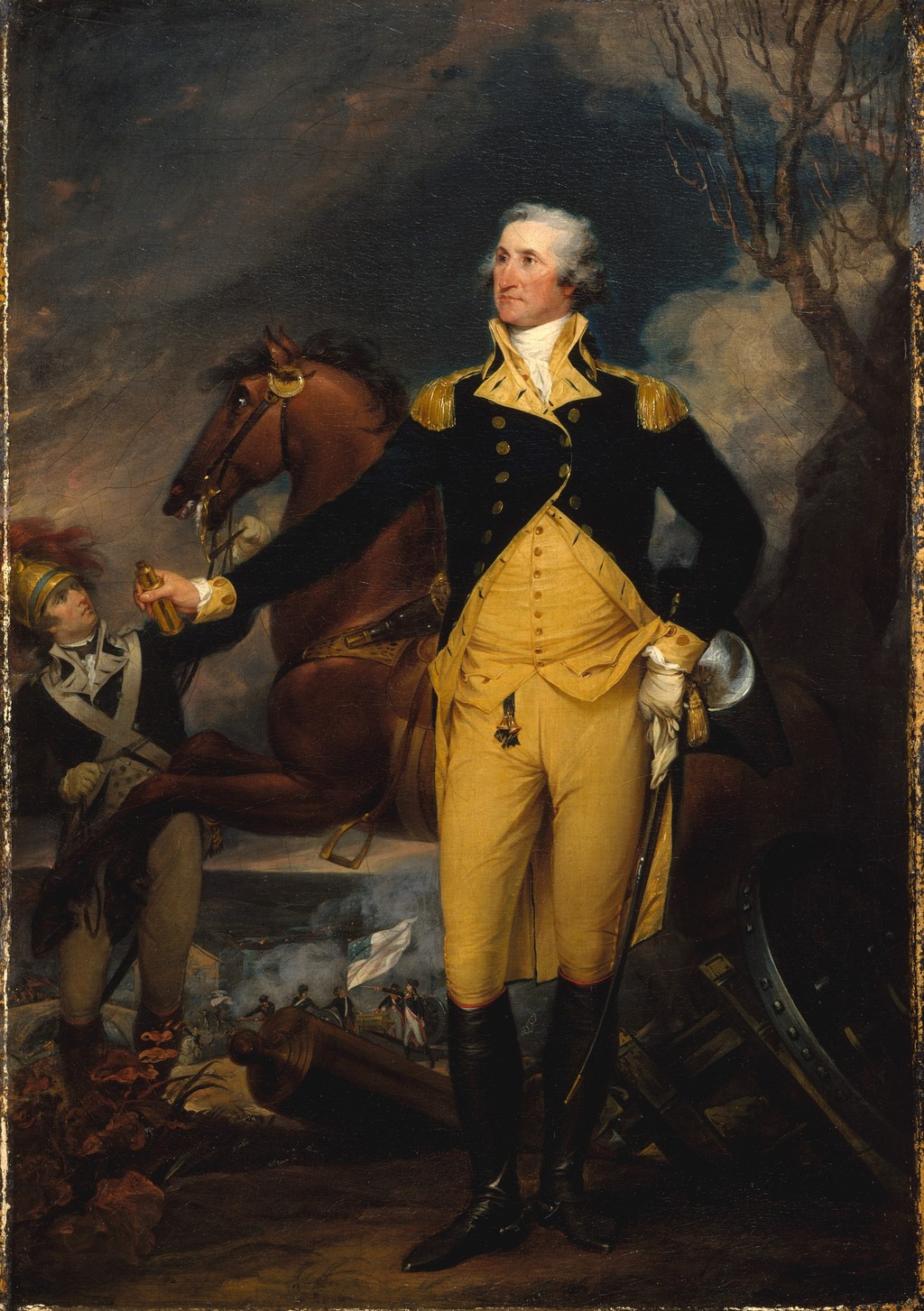
John Trumbull, George Washington before the Battle of Trenton, about 1792–94. Oil on canvas, 67.3 × 47 cm. Metropolitan Museum of Art, 22.45.9. Bequest of Grace Wilkes, 1922. The Metropolitan Museum of Art, CC0.
Image source
.
CC0 / Public domain
. Frame removed by cropping the original source photograph to the painting rectangle; no colour, contrast, retouching or perspective alteration. Original master retained.
What the surviving evidence can show
Trumbull's paintings bring several kinds of preparation together. A portrait study supplies a likeness; the arrangement of bodies makes an action understandable; light and colour distribute attention; the paint surface gives particular passages their presence. None of these elements needs to be treated as the sole explanation of the finished picture.
The early Hamilton illustrates how different evidence can change an interpretation. Older writers regarded it as a study painted directly from life. The NGA catalogue instead argues for an early replica, considering the pose, lighting, provenance and technical examination together. Its reasoning does not turn the absence of visible revisions into a universal test for identifying copies. The conclusion depends on the combination of evidence for that canvas. [6]
The same care benefits close looking. A gesture can be examined for its role in the composition without proving that it occurred at the historical event. A vivid likeness can be compared with a study without assuming that the sitter occupied the depicted position. Reading Trumbull's portraits and histories through these distinctions preserves both their artistic construction and the specific evidence about how they were made.
Artworks directory
Works discussed in these articles, including distinct versions and reproductive prints. Dates identify the particular object; titles and attributions follow the cited collections. This is not a catalogue raisonné.
Frequently Asked Questions
His practice included drawing, copying, portrait studies and revisions to compositions. The surviving Mercer study offers a specific example of a likeness gathered for a historical picture.
Not necessarily. The illustrated Met Jefferson is an oil painting on mahogany, and small scale should not be mistaken for a particular medium.
Yes. The NGA's published examination of its early Hamilton records an iris outline revealed through infrared reflectography, while reporting no traditional underdrawing.
The described tree, horse and landscape differences are comparisons between separate paintings. They should not be presented as hidden changes discovered beneath a single canvas.
Discussion
Look again at the images and ideas explored in John Trumbull Style and Technique. These editorial prompts invite your observations.
Begin with the light in the Gibraltar painting, then compare the more concentrated illumination of a Hamilton portrait. Which differences in pose, surface and surrounding space help each picture direct your attention?
Reader Insights
Which diagonal or gesture directs the action most clearly?
How does night light differ from the illumination of an assembly?
Which interpretations depend on technical evidence rather than appearance alone?
Join the Conversation
Share a detail, comparison or question about John Trumbull Style and Technique below.
References
- John F. Weir , John Trumbull: A Brief Sketch of His Life , 1901, pp. 13–27; training, copying and the Revolutionary project. View source
- Kevin J. Avery, Metropolitan Museum of Art , “Late Eighteenth-Century American Drawings,” 2003; preparatory drawing and narrative painting. View source
- Metropolitan Museum of Art , The Sortie Made by the Garrison of Gibraltar , 1789, 1976.332; object record and interpretation. View source
- John Caldwell and Oswaldo Rodriguez Roque, with Dale T. Johnson , American Paintings in the Metropolitan Museum of Art , volume I, 1994, especially pp. 203–208 and 216–217; small oils, Gibraltar and the Washington versions. View source
- Metropolitan Museum of Art , Hugh Mercer, Jr. , 1791, 06.1346.2; study, sitter and intended use. View source
- Ellen G. Miles, with contributions by Cynthia J. Mills and others, National Gallery of Art , American Paintings of the Eighteenth Century , 1995, pp. 303–306 and 308–312; technical notes and interpretation of Hamilton portraits 1952.1.1 and 1940.1.8. View source
- Metropolitan Museum of Art , Thomas Jefferson , 1788, 24.19.1; oil on mahogany and dimensions. View source
- Architect of the Capitol , Declaration of Independence ; scale and execution of the Capitol canvas. View source
- Metropolitan Museum of Art , George Washington before the Battle of Trenton , about 1792–94, 22.45.9; smaller version after the Yale portrait. View source
- Splash image source.
John Trumbull, The Sortie Made by the Garrison of Gibraltar, 1789. Oil on canvas, 180.3 × 271.8 cm. Metropolitan Museum of Art, 1976.332. The Metropolitan Museum of Art, CC0. CC0 / Public domain . Frame removed by cropping the original source photograph to the painting rectangle; no colour, contrast, retouching or perspective alteration. Original master retained.
View source