 by
Tom Gurney
Tom Gurney BSc (Hons) is an art history expert with over 20 years experience
Email:
tomgurney1@gmail.com
/ Phone:
+44 7429 011000
The Capture of the Hessians at Trenton by John Trumbull: Introduction
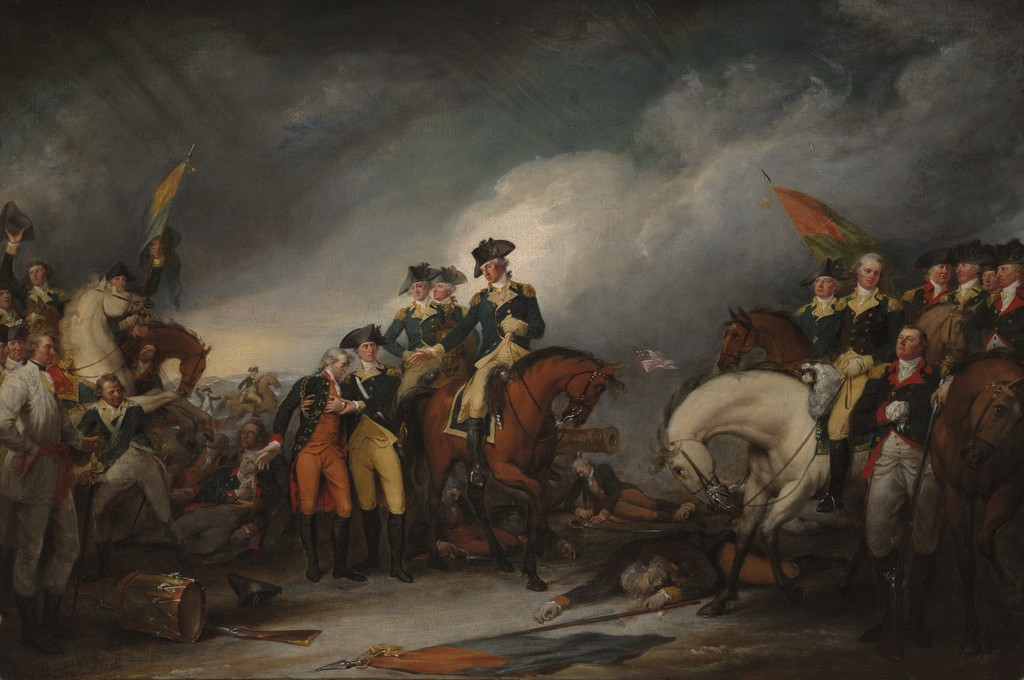
John Trumbull's The Capture of the Hessians at Trenton, December 26, 1776 presents victory through an encounter with a wounded opponent. Washington sits on horseback near the centre, looking towards the injured Hessian commander, Johann Rall. Around them, officers gather, wounded men occupy the foreground and captured equipment marks the army's defeat. The action has moved from overcoming the enemy to deciding how he should be treated.
The small oil painting at Yale, dated 1786–1828, belongs to Trumbull's sustained undertaking to represent the American Revolution. Its title gives the date of the battle; the canvas itself was developed years afterwards. The distinction matters because its arrangement combines historical people and military circumstances with a deliberate moral purpose. [1]
At a Glance
- Artist John Trumbull.
- Depicted event the American victory at Trenton, 26 December 1776.
- Painting date 1786–1828.
- Medium and dimensions oil on canvas, 51.1 × 76.2 cm.
- Collection Yale University Art Gallery, 1832.5.
- Central theme Washington's care for a wounded opponent as an example of mercy after victory.
This work across John Trumbull’s career
The Death of General Mercer at Princeton
about 1787–1831; principal Yale versionThe Sortie Made by the Garrison of Gibraltar
1789; Met versionGeorge Washington before the Battle of Trenton
about 1792–94; Met versionAlexander Hamilton
about 1792; likely early NGA replicaThe Death of General Warren at Bunker’s Hill
after 1815–before 1831; MFA versionDeclaration of Independence
1817–18; Capitol canvasSurrender of Lord Cornwallis
1819–20Surrender of General Burgoyne
1821; Capitol canvasNotes and sources
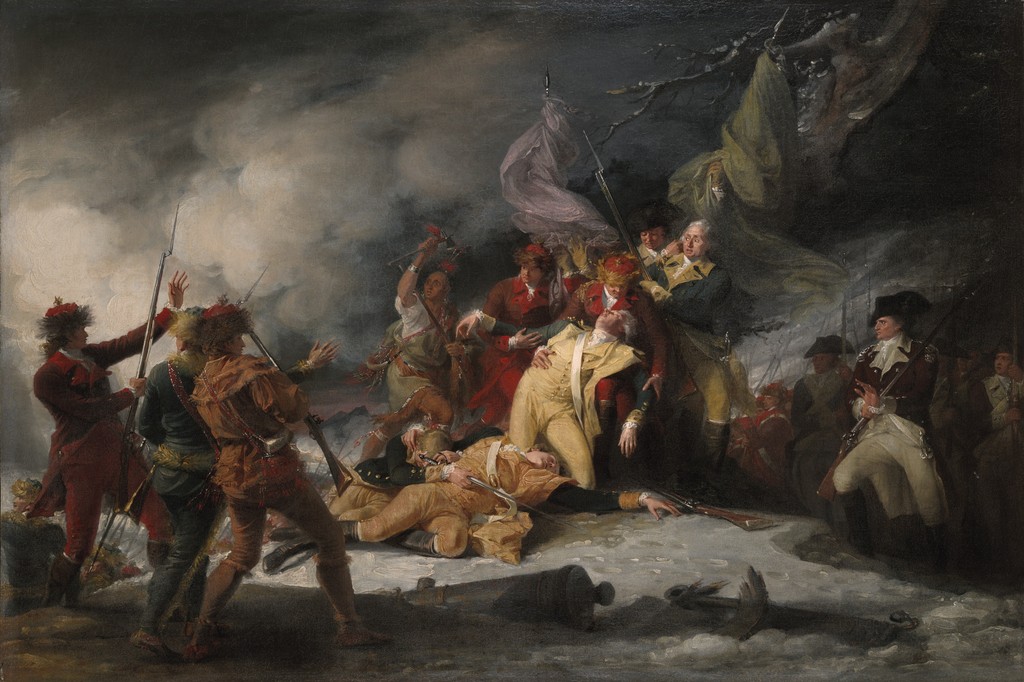
The Death of General Montgomery. Dates identify the particular canvas discussed in the article. [2]
The Capture of the Hessians at Trenton (current article). Dates identify the particular canvas discussed in the article. [1]
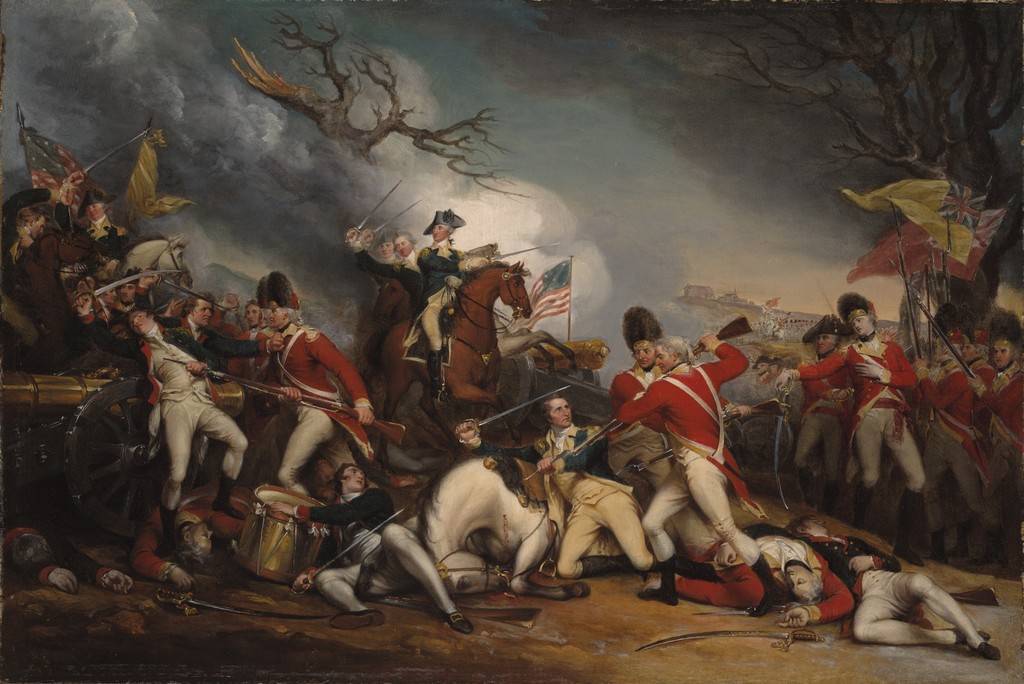
The Death of General Mercer at Princeton. Dates identify the particular canvas discussed in the article. [3]
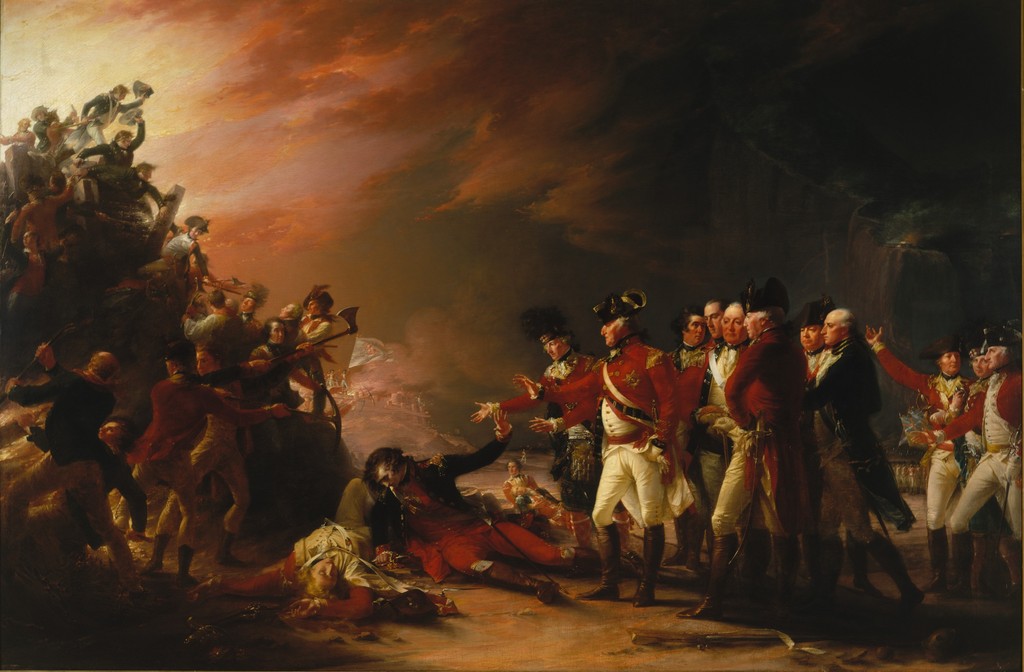
The Sortie Made by the Garrison of Gibraltar. Dates identify the particular canvas discussed in the article. [4]
George Washington before the Battle of Trenton. Dates identify the particular canvas discussed in the article. [5]
Alexander Hamilton. The NGA catalogue treats this as a likely early replica. [6] [7]
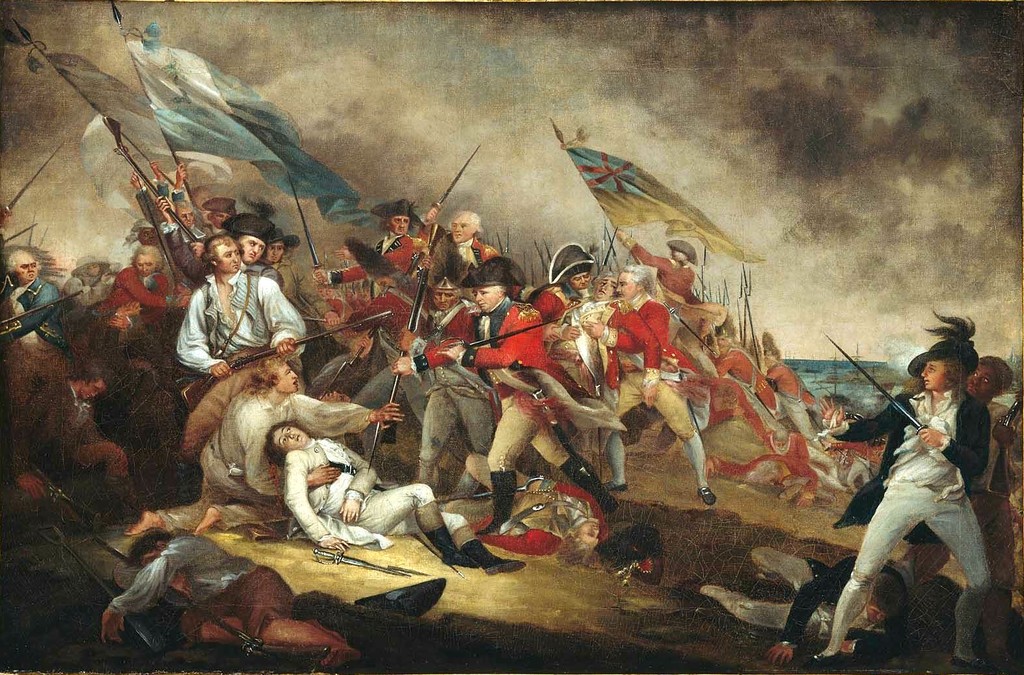
The Death of General Warren at Bunker’s Hill. Dates identify the selected later version. [8]
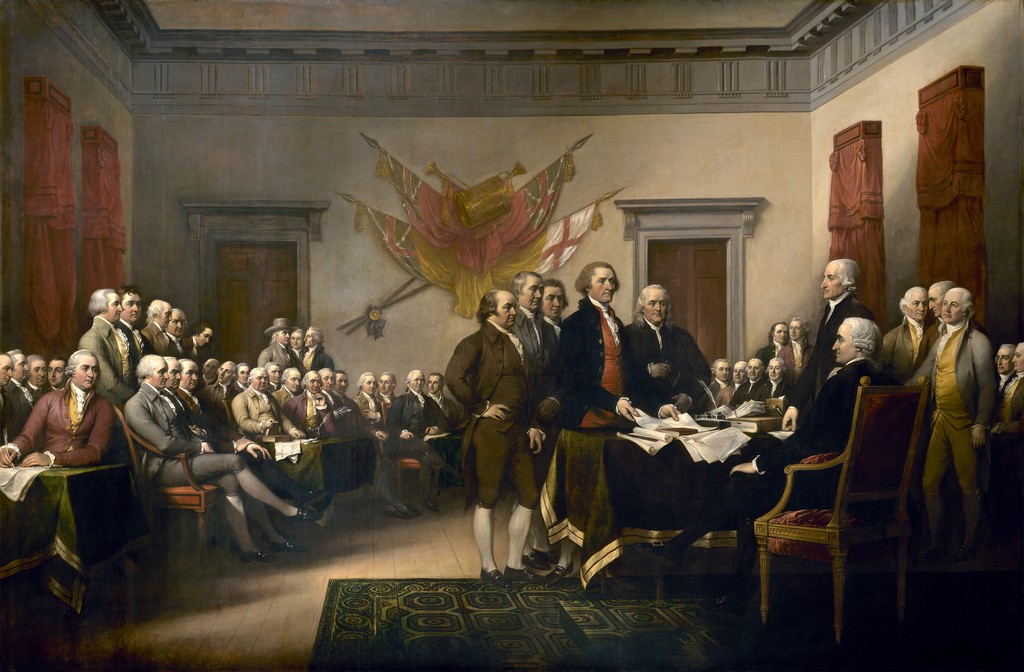
Declaration of Independence. Dates identify the particular canvas discussed in the article. [9]
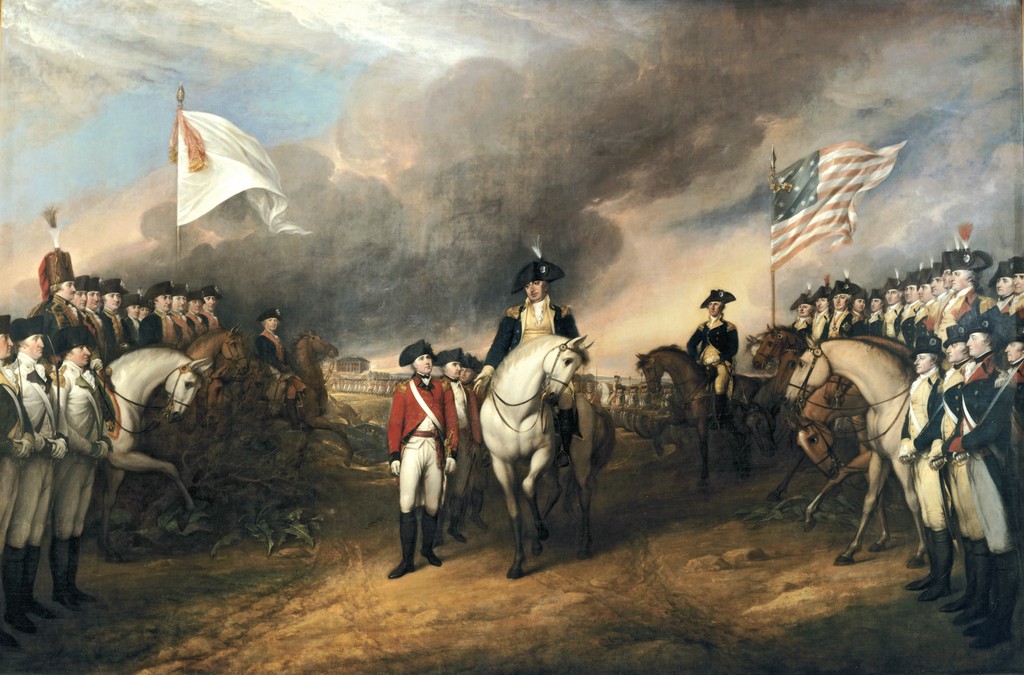
Surrender of Lord Cornwallis. Dates identify the particular canvas discussed in the article. [10]
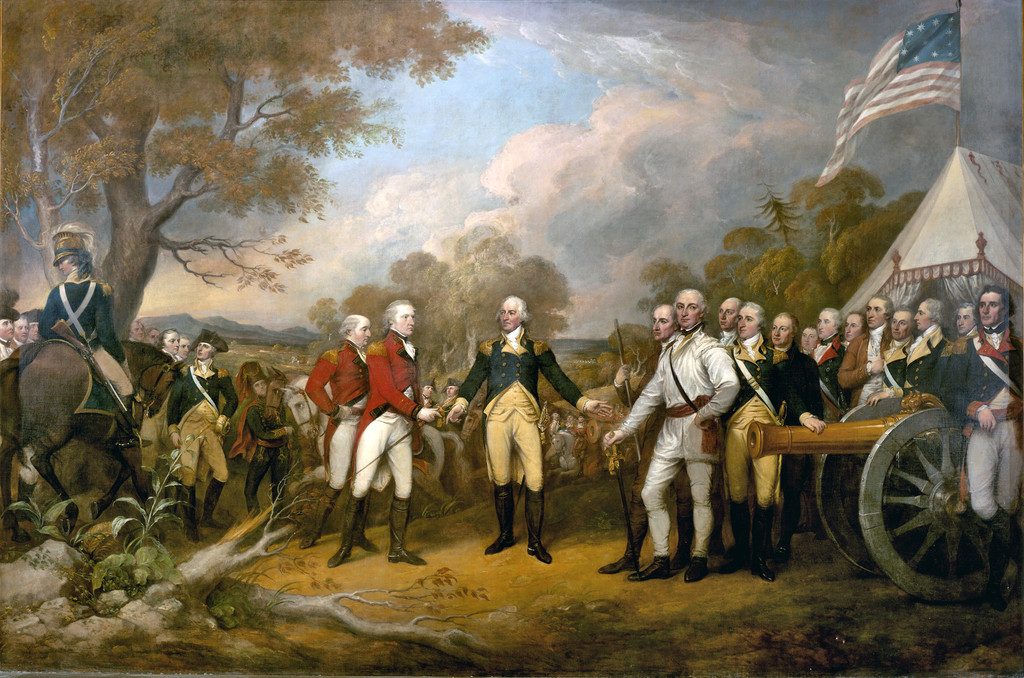
Surrender of General Burgoyne. Dates identify the particular canvas discussed in the article. [11]
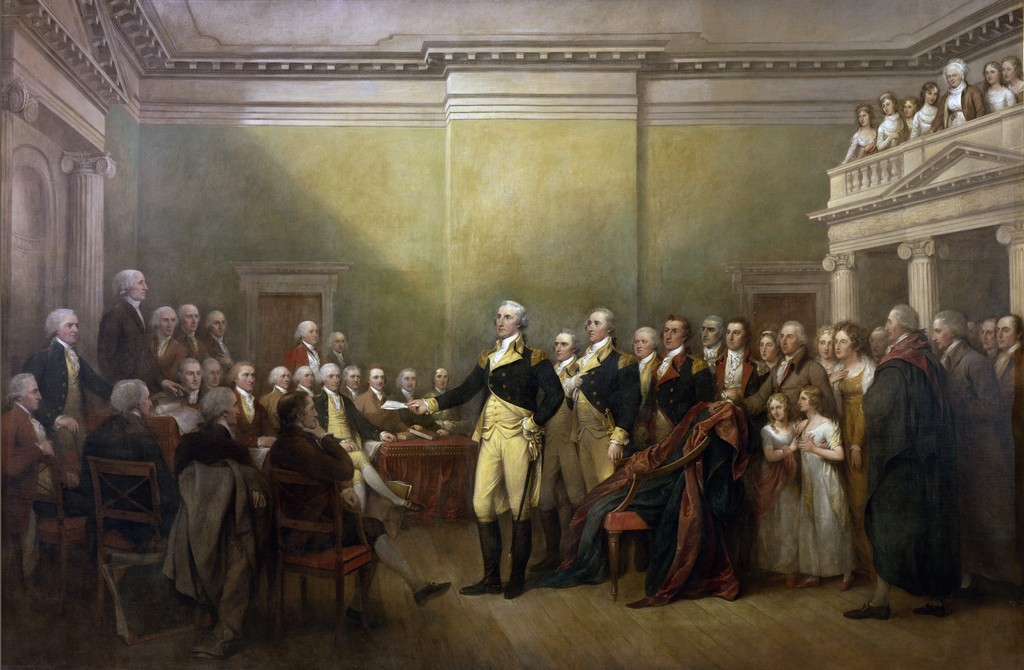
Washington Resigning His Commission. Dates identify the particular canvas discussed in the article. [12]
Contents
- Washington and the wounded Rall
- Victory expressed as restraint
- The battle of 26 December 1776
- A long-lived studio project
- Portraits and military witnesses
- Weather and the Christmas myth
- The Revolutionary series and related Washington images
Washington and the wounded Rall
Washington's mounted figure rises above the men standing beside him. The brown horse provides a broad centre for the composition, while the general's head and shoulders emerge against a lighter opening in the cloud. His position makes him immediately recognisable as the figure whose response gives the gathering its direction.
Rall stands to the left of the central horse, weakened and supported. His orange-red breeches and dark coat separate him from the yellow and blue clothing of the surrounding officers. One hand lies close to his body while the other arm extends outwards. He remains upright, but the position and assistance make his physical vulnerability visible.
Between the wounded man and Washington, another officer helps connect the encounter. The figures' hands and attention turn an arrangement of uniforms into a sequence of relationships. The viewer can follow the movement from the person needing aid to those able to provide it, then towards the commander whose authority frames the response.
Trumbull's late account of the subject names William Smith as the officer instructed to arrange care for Rall. That narrative explains the kindness the painter wanted the group to express. Its reported conversation belongs to the artist's retrospective description, rather than a newly discovered record of words spoken on the battlefield. [13]
Victory expressed as restraint
The painting's most direct explanation comes from Trumbull himself. In the gallery catalogue included in his 1841 memoir, he stated that he had chosen the subject “to show mercy and kindness to a fallen enemy”. The lesson was intended for soldiers of his own time and the future. The wounded opponent had become the person through whom the conduct of the victors could be judged. [13]
This purpose changes the significance of Washington's prominence. His command is expressed through concern for someone now within American power. Rall's defeat supplies the circumstances, but the victorious general's response supplies the example. The arrangement directs admiration towards the use of authority after resistance has ended.
The other wounded and fallen men extend that meaning beyond the central pair. A pale horse at the right bends above a body stretched close to the foreground. At the left, another injured figure receives attention amid the standing soldiers. These passages prevent the gathering from becoming simply a parade of successful officers. Physical suffering remains present beside the signs of victory.
The captured flag, drum and scattered equipment bring the conflict into the nearest space. Their low position contrasts with the upright officers and mounted commander. The viewer first encounters the material remains of the battle, then looks into the exchange that gives those remains a moral setting. Trumbull places an account of care within an image of military success.
The battle of 26 December 1776
Washington's attack on Trenton followed the crossing of the Delaware on Christmas night. The Continental Army reached the town on the morning of 26 December and surprised the Hessian garrison. Mount Vernon's account describes the defenders forming ranks and fighting after the alarm. The American victory came through an engagement in which Rall was mortally wounded and many of his soldiers surrendered. [14]
The Hessian regiments were German troops serving on the British side. Their presence gives the painting's title a more specific meaning than a general description of captured British soldiers. Rall represents an opposing force whose members are still presented as people entitled to care after defeat. [15]
The aftermath brought practical decisions about prisoners, wounded men and the condition of the American army. Mount Vernon records Washington's order for humane treatment of the captured Hessians and his decision to return across the river to Pennsylvania. This wider account supplies historical context for the particular act of compassion Trumbull made central to his composition. [14]
The canvas concentrates those circumstances into a single gathering. It does not attempt to follow every movement through the streets or represent every stage of the attack. The people and objects are arranged around a moment in which the battle's result is already evident and the treatment of the defeated becomes the main question.
A long-lived studio project
The Yale painting measures 51.1 by 76.2 centimetres, close to the compact format used for several of Trumbull's Revolutionary subjects. Its broad date range, 1786–1828, places it within a long period of work rather than identifying it with one brief sitting or the year of the battle. A small canvas could carry an ambitious subject whose development extended across the artist's career. [1]
In his memoir, Trumbull mentioned paper studies for Trenton and Princeton among the projects occupying him in the 1780s. These recollections connect the painting with the larger effort to organise the Revolutionary series. Drawings offered a way to test the arrangement before the individual figures and their relationships were settled in paint. [13]
The compact scale also served an intended means of circulation. In his gallery catalogue, Trumbull explained that the Revolutionary pictures were made small with the work of engravers in mind. The designs could therefore be conceived for an audience beyond the room containing the original oil paintings. The prospect of reproduction formed part of the undertaking from an early stage. [13]
The surviving image has a strongly ordered centre despite its many participants. Washington's horse anchors the scene; groups extend towards both edges; foreground bodies and objects create depth below them. The sky leaves space around the leading figures while clouds and distant activity keep the setting unsettled. The small dimensions do not produce a simple or crowded summary of the subject.
The drawings and prints article places such preparatory work within Trumbull's wider practice. Here, the finished arrangement shows how a historical design could gather different kinds of information into a clear encounter. The date range alone does not identify the year in which each visible detail was added.
Watch: John Trumbull
Choose a film to explore the artist’s work, its interpretation and its wider setting.
Moment of Discovery: John Trumbull’s “Declaration of Independence”
Discovery Park of America looks closely at Trumbull’s Declaration of Independence.
Watch on YouTubePortraits and military witnesses
Recognisable people were an important part of the Revolutionary project. Weir's early catalogue lists James Monroe, William Washington, Sullivan, Greene and Knox among the portraits in the Trenton painting, alongside Washington, Rall and Smith. The named figures gave the picture associations with people whose military roles extended beyond the particular exchange at its centre. [16]
Their presence also creates a question about historical representation. An assembled group of portraits does not by itself establish that every person occupied exactly that position at one instant. A painter can preserve a likeness while arranging the body, gesture and surrounding company for a narrative. Trumbull's effort to make individuals recognisable coexisted with the need to make the encounter understandable.
The differences in scale and pose keep the group varied. Some men stand beside the horses; others appear mounted or turn towards neighbouring figures. The faces form small points of attention within the larger movement. The portraits page considers the different uses to which Trumbull put likenesses, including their contribution to historical scenes.
Weather and the Christmas myth
The winter campaign has become closely associated with the story that the Hessians were defeated because they were drunk or hungover after Christmas celebrations. Trumbull's written account itself invokes holiday revelry as part of the explanation for surprise. That element of the memoir needs to be distinguished from its evidence about the artist's intended lesson. [13]
Washington Crossing Historic Park states that there is no evidence for the drunkenness story. It identifies exhaustion from repeated alarms and attacks as a possible factor, without making that the sole certain explanation. The defenders' condition cannot be reduced to an image of men unable to respond after a celebration. Mount Vernon's account describes their mobilisation and resistance once the firing began. [15] [14]
Trumbull's painting shows uniformed men, wounds and the aftermath of fighting. Its troubled sky helps bind the different groups within a common atmosphere. Those pictorial choices can be considered through their effect on the scene, while the circumstances of the winter march remain a separate question for historical evidence.
The Revolutionary series and related Washington images
The scene gives Washington a role different from that in George Washington before the Battle of Trenton . In the portrait, the commander's solitary decision and bearing dominate the design. In the Capture , his authority becomes visible through a relationship with a wounded enemy and the officers around them. The two pictures make leadership understandable through different kinds of action.
An especially useful comparison is The Sortie Made by the Garrison of Gibraltar . Trumbull gave that British victory a central encounter with a dying Spanish opponent. In both compositions, the defeated man's vulnerability helps define the conduct of the successful side. The national setting changes, while the painter's interest in exemplary treatment of an adversary remains recognisable.
The small Yale painting also has a different place in the series from the four monumental canvases commissioned for the Capitol Rotunda. Those subjects were the Declaration , the surrenders of Burgoyne and Cornwallis , and Washington's resignation of command . The Capture of the Hessians preserves another episode within the wider Revolutionary undertaking. [17]
Other Revolutionary pictures, including the death of General Mercer , place the cost of battle within a dramatic gathering of figures. The Capture of the Hessians belongs within this variety of subjects. Its distinctive contribution is to turn attention from winning the field towards the obligations that follow victory, giving Trumbull's stated lesson a form the viewer can follow through faces, hands and bodies.
Artworks directory
Works discussed in these articles, including distinct versions and reproductive prints. Dates identify the particular object; titles and attributions follow the cited collections. This is not a catalogue raisonné.
Frequently Asked Questions
It gives the date of the battle. The Yale painting is dated 1786–1828.
Johann Rall, whose treatment becomes the central encounter around which Trumbull organises the scene.
Trumbull explicitly described choosing the subject to teach soldiers kindness towards a defeated, wounded enemy.
Washington Crossing Historic Park finds no evidence for that familiar story. The defenders responded to the alarm and fought.
No. This is the smaller Yale painting from his Revolutionary series, rather than one of the four monumental Rotunda commissions.
Discussion
Look again at the images and ideas explored in The Capture of the Hessians at Trenton by John Trumbull. These editorial prompts invite your observations.
How do the wounded figures and captured equipment affect your reading of Washington's central position? Consider what would change if those foreground details were removed.
Reader Insights
Where do the figures’ gestures direct attention around Rall?
How does this encounter differ from a commander still under attack?
What does Trumbull’s stated lesson of mercy add to the scene?
Join the Conversation
Share a detail, comparison or question about The Capture of the Hessians at Trenton by John Trumbull below.
References
- Yale University Art Gallery, via Wikimedia Commons , The Capture of the Hessians at Trenton, December 26, 1776 , 1786–1828, 1832.5; image carrier, object metadata and public-domain reproduction record. View source
- Yale University Art Gallery via Wikimedia Commons, Death of General Montgomery,1786,1832.2,. View source
- Yale University Art Gallery via Wikimedia Commons, The Death of General Mercer at the Battle of Princeton, January3,1777,1832.6.1,. View source
- Metropolitan Museum of Art, The Sortie Made by the Garrison of Gibraltar,. View source
- Metropolitan Museum of Art, George Washington before the Battle of Trenton,. View source
- National Gallery of Art, Alexander Hamilton, c1792,. View source
- National Gallery of Art / Ellen G. Miles with Cynthia J. Mills and other contributors, American Paintings of the Eighteenth Century,1995,Trumbull entries,. View source
- Museum of Fine Arts, Boston, Death of General Warren at Bunker’s Hill,. View source
- Architect of the Capitol, Declaration of Independence,. View source
- Architect of the Capitol, Surrender of Lord Cornwallis,. View source
- Architect of the Capitol, Surrender of General Burgoyne,. View source
- Architect of the Capitol, General George Washington Resigning His Commission,. View source
- John Trumbull , Autobiography, Reminiscences and Letters , 1841, pp. 148, 408 and 418–420; preparatory projects, intended print circulation, retrospective narrative and the explicit purpose of mercy. View source
- Cody Lass, updated by Zoie Horecny, George Washington's Mount Vernon , Battle of Trenton , updated 10 April 2025; battle, surrender, treatment of prisoners and return across the Delaware. View source
- Washington Crossing Historic Park , Myths and Legends About the Crossing ; evidence concerning the drunken-Hessians story and the qualified fatigue explanation. View source
- John F. Weir , John Trumbull: A Brief Sketch of His Life , 1901, p. 68; the catalogue's list of portraits represented in the Trenton picture. View source
- Architect of the Capitol , John Trumbull ; the four selected Rotunda subjects and their monumental public setting. View source
- Splash image source.
John Trumbull, The Capture of the Hessians at Trenton, December 26, 1776. Painted 1786–1828. Oil on canvas, 51.1 × 76.2 cm. Yale University Art Gallery, 1832.5. John Trumbull; Yale University Art Gallery; Wikimedia Commons. Public domain. Public domain . Resized only; complete supplied painting image retained without appearance alteration.
View source