 by
Tom Gurney
Tom Gurney BSc (Hons) is an art history expert with over 20 years experience
Email:
tomgurney1@gmail.com
/ Phone:
+44 7429 011000
The Death of General Warren at Bunker’s Hill by John Trumbull: Introduction
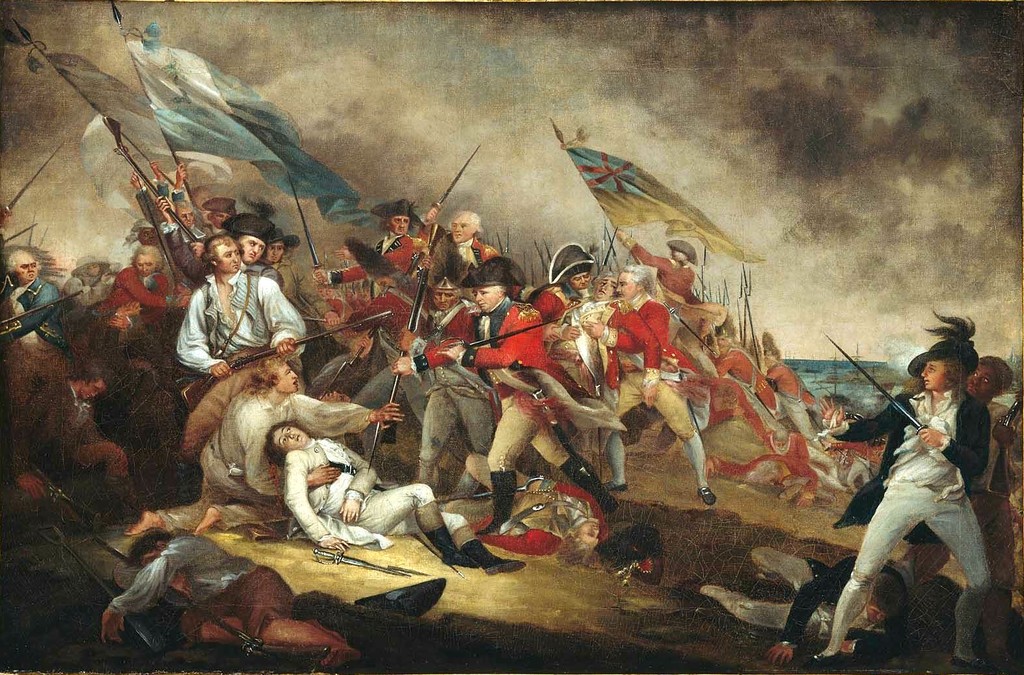
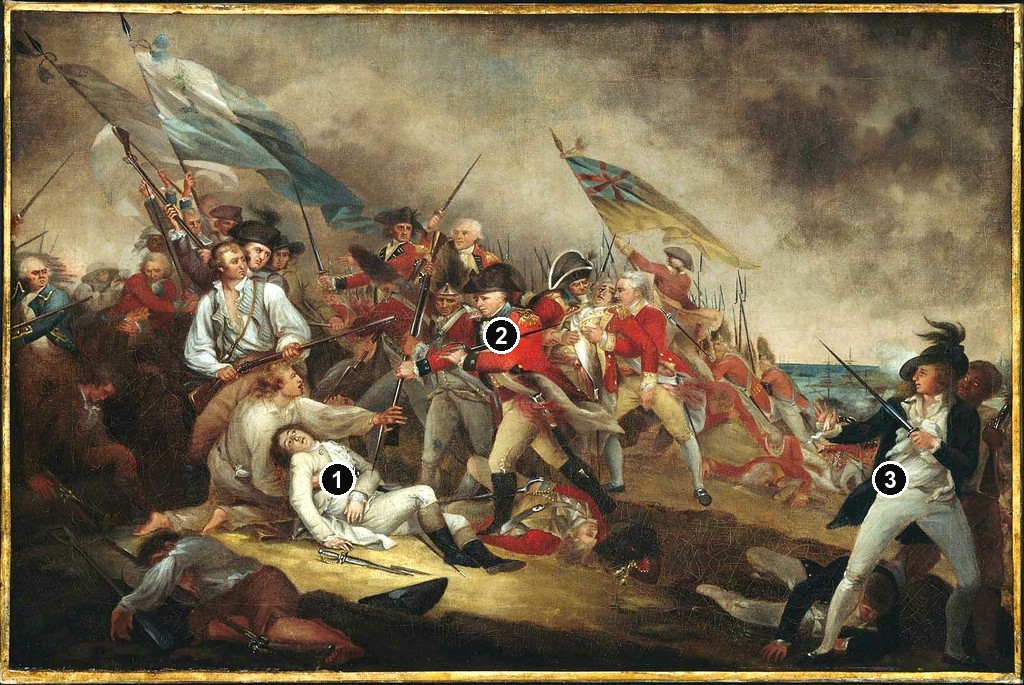
A British officer reaches across a soldier’s weapon to prevent a bayonet thrust towards the dying Joseph Warren. Around this interrupted act of violence, men fight, fall and withdraw beneath flags and smoke. John Trumbull’s The Death of General Warren at the Battle of Bunker’s Hill makes an attempted act of protection the centre of an American defeat.
Trumbull first completed the composition in 1786. The canvas illustrated here is a later version at the Museum of Fine Arts, Boston, dated after 1815 and before 1831. It represents the battle of 17 June 1775, placing the death of a leading revolutionary within a scene that gives both Americans and their British opponents individual roles. [1] [2]
At a Glance
- Artist John Trumbull.
- Original composition completed in 1786.
- Illustrated canvas after 1815–before 1831; oil on canvas, 50.16 × 75.56 cm.
- Collection Museum of Fine Arts, Boston, 1977.853; Gift of Howland S. Warren.
- Event Battle of Bunker Hill, 17 June 1775, including fighting on Breed’s Hill.
- Central subject Joseph Warren dying as John Small attempts to prevent a bayonet thrust.
- Black companion at right proposed identification as Asaba; not securely identified as Peter Salem.
This work across John Trumbull’s career
The Death of General Mercer at Princeton
about 1787–1831; principal Yale versionThe Sortie Made by the Garrison of Gibraltar
1789; Met versionGeorge Washington before the Battle of Trenton
about 1792–94; Met versionAlexander Hamilton
about 1792; likely early NGA replicaThe Death of General Warren at Bunker’s Hill (current article)
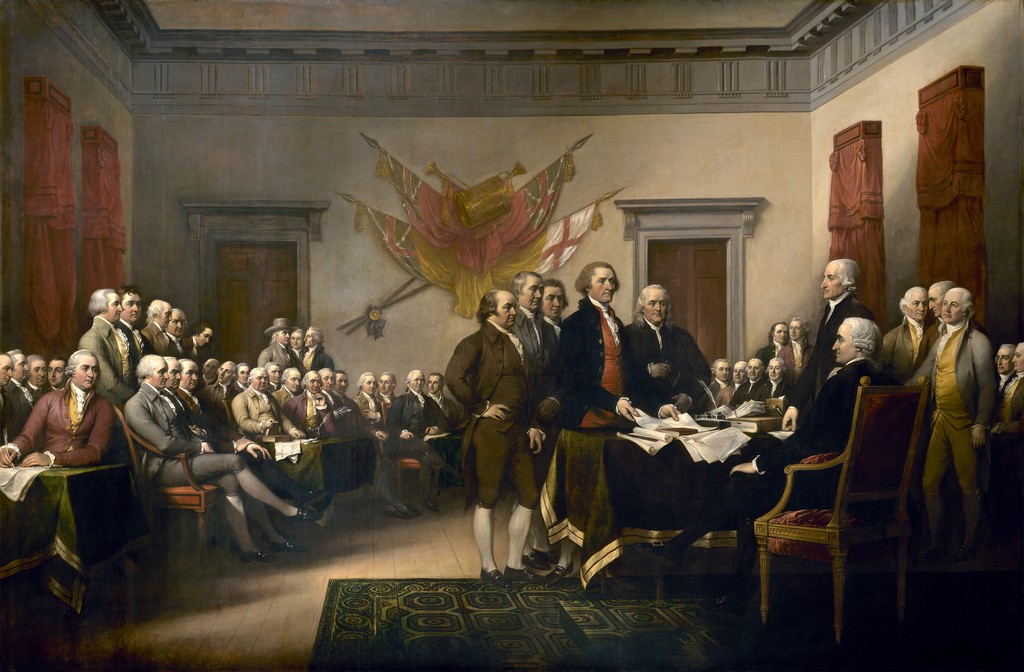
after 1815–before 1831; MFA versionDeclaration of Independence
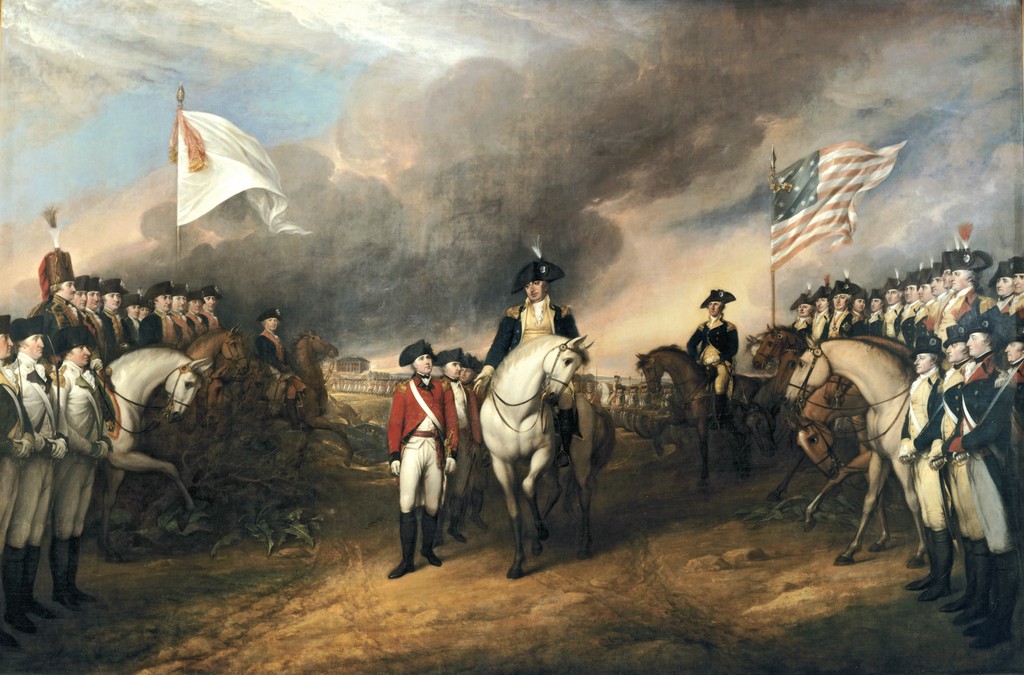
1817–18; Capitol canvasSurrender of Lord Cornwallis
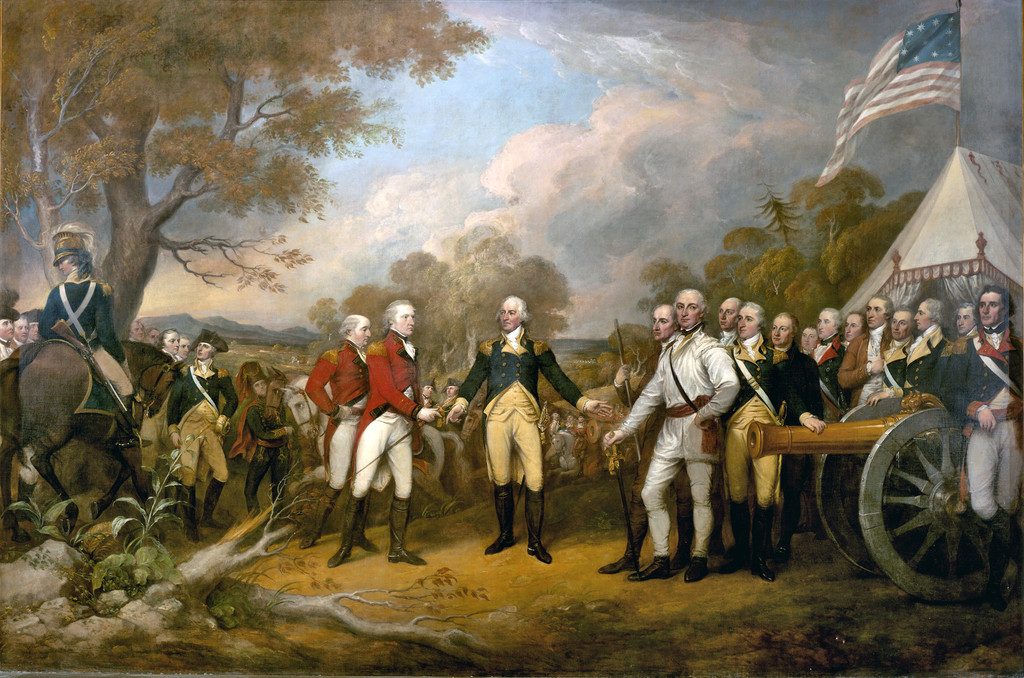
1819–20Surrender of General Burgoyne
1821; Capitol canvasNotes and sources
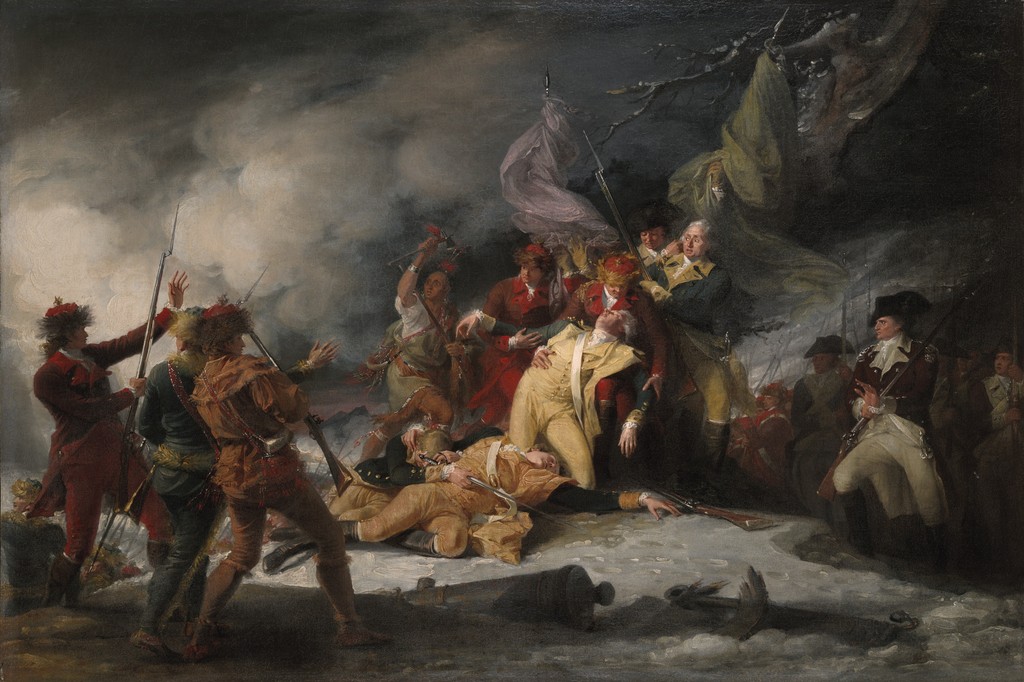
The Death of General Montgomery. Dates identify the particular canvas discussed in the article. [3]
The Capture of the Hessians at Trenton. Dates identify the particular canvas discussed in the article. [4]
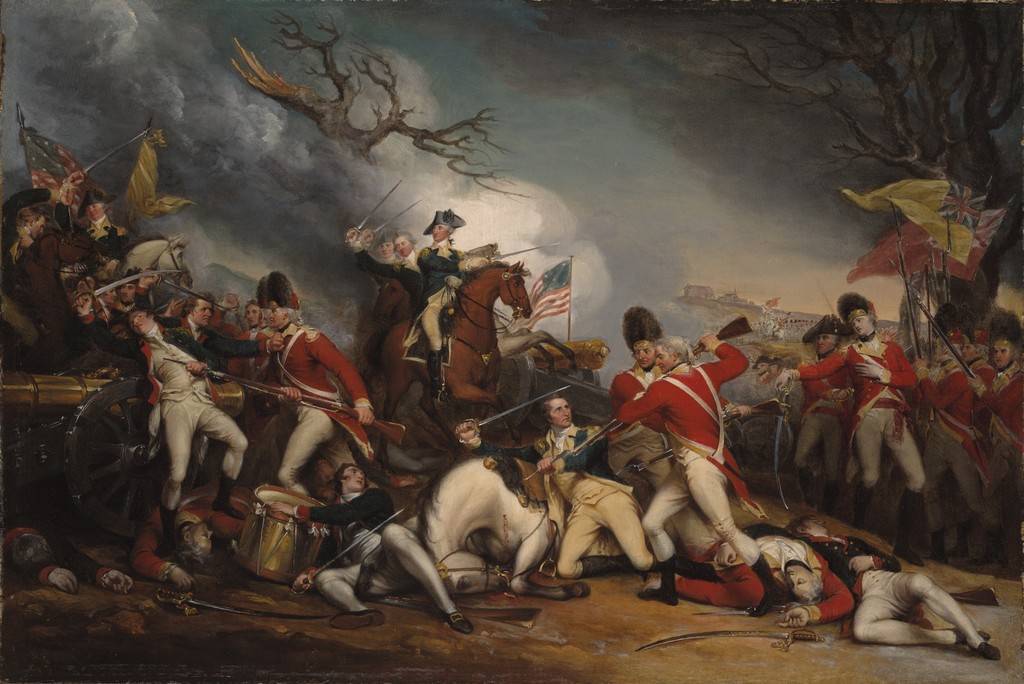
The Death of General Mercer at Princeton. Dates identify the particular canvas discussed in the article. [5]
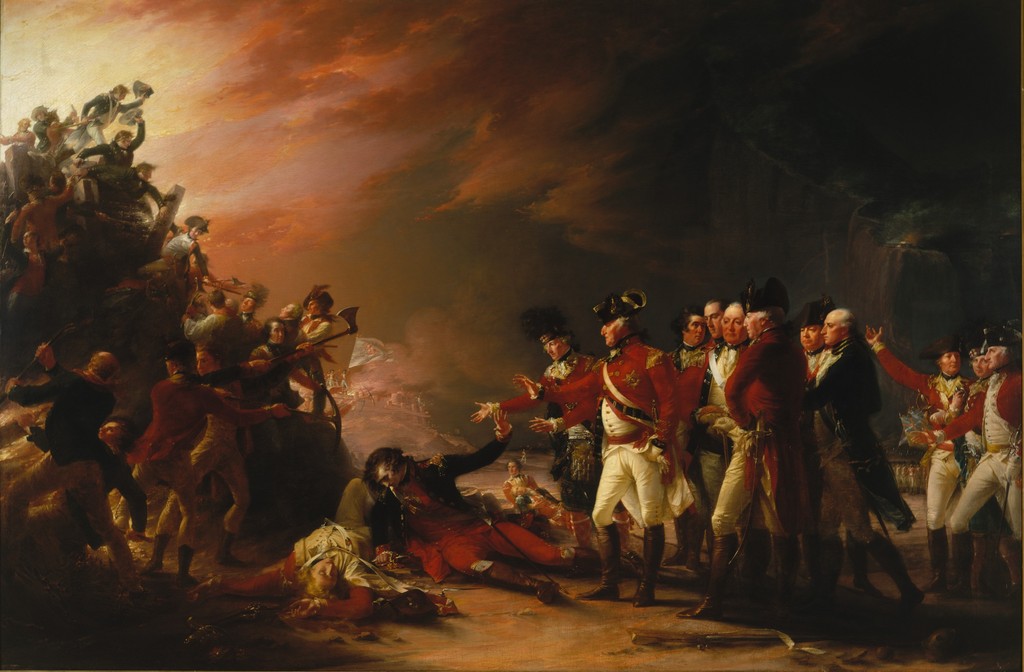
The Sortie Made by the Garrison of Gibraltar. Dates identify the particular canvas discussed in the article. [6]
George Washington before the Battle of Trenton. Dates identify the particular canvas discussed in the article. [7]
Alexander Hamilton. The NGA catalogue treats this as a likely early replica. [8] [9]
The Death of General Warren at Bunker’s Hill (current article). Dates identify the selected later version. [1]
Declaration of Independence. Dates identify the particular canvas discussed in the article. [10]
Surrender of Lord Cornwallis. Dates identify the particular canvas discussed in the article. [11]
Surrender of General Burgoyne. Dates identify the particular canvas discussed in the article. [12]
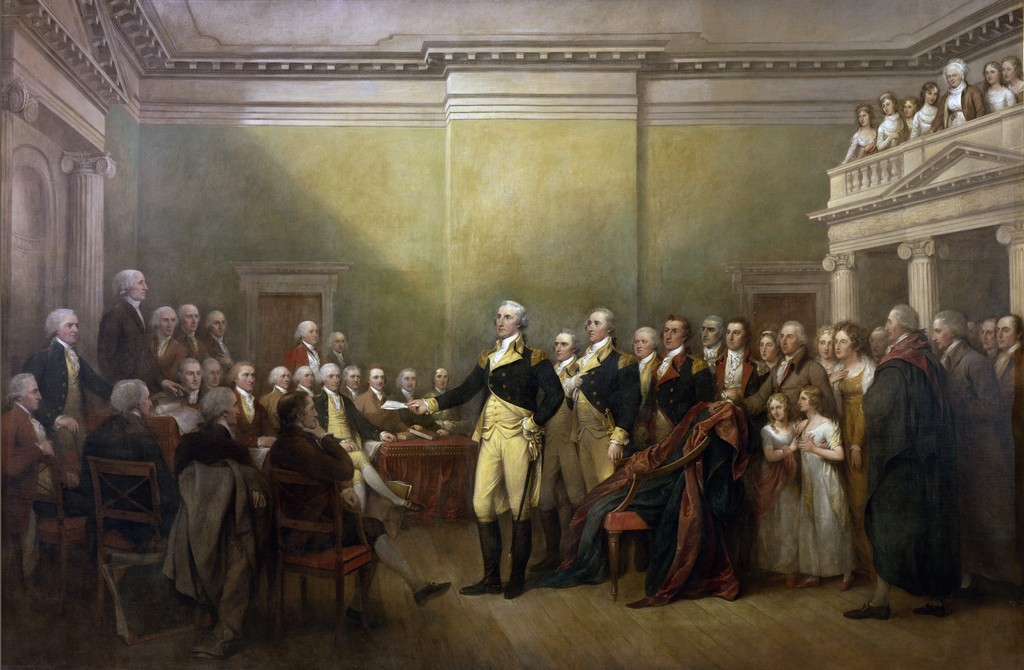
Washington Resigning His Commission. Dates identify the particular canvas discussed in the article. [13]
Contents
- The scene and its competing actions
- Warren and the protective gesture
- Smoke, flags and the retreat
- A distant witness, not a close eyewitness
- The early Revolutionary project
- British and American figures
- The Black figure and the limits of identification
- Versions, prints and later reputation
- Annotated details
The scene and its competing actions
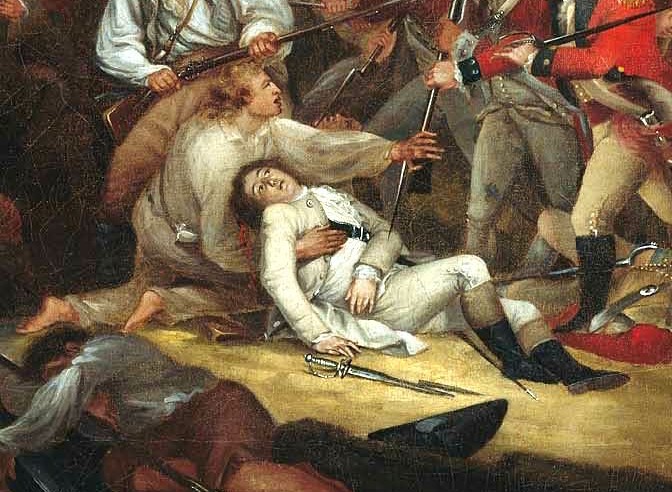
Warren’s pale figure lies low in the composition, supported by a kneeling man. Above them, the British advance presses across the picture through red coats, weapons and moving bodies. The contrast in height gives the fallen general a vulnerable position beneath a struggle that continues around him.
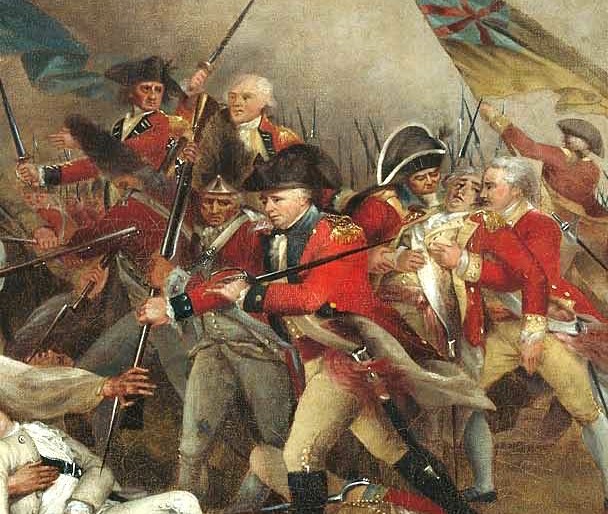
The central group has several directions of movement. A bayonet points towards Warren, the supporting man extends a hand, and the red-coated officer intervenes across the weapon. These intersecting lines make the viewer pause at the encounter before following the wider battle. The subject depends on an attempt to arrest a movement already under way.
Elsewhere, the action remains unsettled. Men at the left struggle or retreat; fallen bodies occupy the lower edge; an officer and a Black companion at the right turn back towards the scene. Raised flags give the gathering a military identity, but the bodies beneath them pull attention towards separate experiences of danger.
The historical battle ended in British possession of the field. Much of the fighting focused on the redoubt on Breed’s Hill, within the engagement known as Bunker Hill. The National Park Service’s account of the terrain describes fences, walls and hedges that obstructed the British approach. Trumbull concentrates the picture on human encounters near the final struggle, rather than explaining every part of that difficult landscape. [14]
The bodies nearest the lower edge also determine the viewer’s approach. There is no broad, empty strip of ground from which to survey the encounter comfortably. Fallen men and discarded equipment bring its consequences almost to the boundary of the image. Looking into the scene means passing over that foreground before reaching the hands and faces around Warren.
This concentration gives the scene its dramatic clarity. The eye does not have to follow a map of formations to recognise its principal conflict. An injured man requires care at precisely the moment when a victorious force is advancing over him.
Annotated Details from The Death of General Warren at Bunker’s Hill
The numbered points identify visible features discussed in this article. Return from each detail to the whole composition. John Trumbull, The Death of General Warren at the Battle of Bunker’s Hill, 17 June, 1775, after 1815–before 1831. Oil on canvas, 50.16 × 75.56 cm. Museum of Fine Arts, Boston, 1977.853; Gift of Howland S. Warren. Later version of the composition first completed in 1786. John Trumbull; Museum of Fine Arts, Boston, via Wikimedia Commons. Public domain. Image source. Public domain. Numbers added to a separate resized view of the original source photograph; its surrounding frame is retained. Detail images are crops of that original photograph.
Details from THE DEATH OF GENERAL WARREN AT BUNKER’S HILL
Compare the cropped details with the complete images above. Notice how their colours, shapes and positions contribute to the larger compositions.
Warren and his supporter
The pale reclining body rests against a supporting figure whose free arm reaches towards the weapons. The sweep from the head through the bent legs makes vulnerability the centre of the foreground.
The restraining hand
A red-coated officer reaches across the weapon aimed towards the wounded man. Extended arms and intersecting steel place an act of restraint within the surrounding violence.
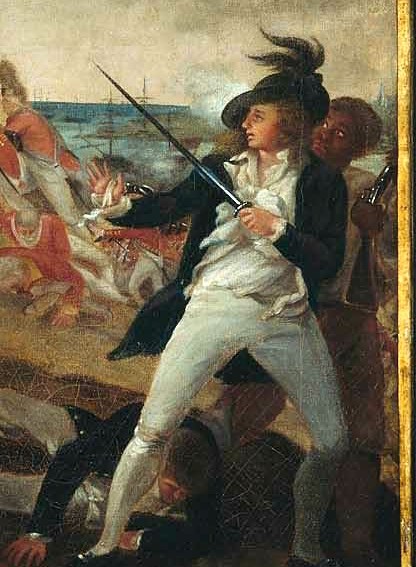
The pair at the right
Two figures stand close together at the right edge, with a long musket crossing their space. Their upward attention connects this quieter pair with the urgent action farther left.
Warren and the protective gesture
Warren’s white clothing is the brightest sustained area among the lower figures. His body slopes backwards, his face turned upwards and his strength apparently gone. The kneeling supporter’s arm holds him near the chest while another hand reaches towards the approaching weapon. The physical work of supporting the general makes the relationship immediately understandable.
Trumbull’s catalogue identifies the British officer who intervenes as John Small. He shows Small seizing the grenadier’s musket to prevent the bayonet from reaching Warren. The artist explains the action through the officer’s humanity towards an enemy, giving the attempted rescue a moral place within the military scene. [2]
The gesture is powerful because it crosses the direction of the attack. The same red uniform that places Small within the British force belongs to a man attempting to restrain one of its soldiers. Trumbull distinguishes conduct within the victorious army, allowing compassion and aggression to appear side by side.
His account of Warren recognising a friend as he dies belongs to the artist’s retrospective telling of the scene. The painting’s visible subject is the attempt to protect a wounded man; its gestures do not independently verify a final conversation or expression. Trumbull turns the episode into an exemplary encounter whose meaning can be read through the bodies.
The supported figure also has a familiar place within the traditions of European art. The MFA relates Trumbull’s composition to images of the Lamentation of Christ and to Benjamin West’s Death of General Wolfe . That comparison helps explain how a recent American subject could acquire the solemnity of an established heroic or sacred image. [1]
Smoke, flags and the retreat
Smoke stretches across the background and gathers above the combatants, leaving only limited views beyond. Its uneven mass prevents the eye from settling on a distant horizon. Against it, bayonets and flagpoles form thin, emphatic lines, while the flags spread into larger areas of fabric above the men.
The smoke also carries part of the battle that lies outside the immediate group. Trumbull states in his catalogue that the dark cloud indicates Charlestown burning, although the town itself is not shown. The background can therefore suggest the wider destruction without introducing a second detailed scene to compete with Warren’s death. [2]
The left side contains the movement of men whose position is becoming untenable. In the artist’s explanation, Israel Putnam orders a retreat while others continue resistance after their ammunition is exhausted. These actions establish the military circumstances surrounding the central loss: the Americans are being forced from the ground. [2]
The flags rise above a much less orderly exchange below. Their broad shapes hold the upper composition together, while the lower figures scatter attention across wounds, weapons and attempts to help. The contrast keeps the national and military scale of the subject visible without allowing it to overwhelm the men’s individual actions.
A glimpse of water and distant shore at the right opens beyond the smoke. It offers a different scale from the close figures, suggesting the setting around Boston rather than enclosing the whole battle within an anonymous cloud. The painting moves between a recognisable place and a deliberately concentrated drama.
A distant witness, not a close eyewitness
Trumbull was serving with the Connecticut troops at Roxbury when the battle took place. His memoir says that he saw the action from there. That position gave him a distant view of the event; it did not put him beside Warren at the moment represented in the painting. [2]
This difference matters when considering the extraordinary closeness of the scene. The viewer can read faces, see hands grip weapons and follow the interaction between specific people. Such proximity is the result of a composition made later, not a preserved view from the artist’s wartime position.
Military service nevertheless gave Trumbull a personal relationship to the Revolution. He had lived within the army whose struggle he later sought to commemorate. That experience could inform his interest in uniforms, command, action and individual conduct without making each painted incident something he had directly witnessed.
The picture joins that involvement with the training and ambitions of a historical painter. He chooses a moment, brings important participants close together and gives the scene a central moral action. The result asks to be read as an interpretation of the battle, with its own emphasis and structure.
Warren’s importance also extended beyond the field. A Boston physician and political leader, he had received a major-general’s commission shortly before the battle but was serving as a volunteer when he died. The painting commemorates the loss of a public figure whose significance was already larger than the military command implied by the title. [1]
The early Revolutionary project
In the account of his career appended to the memoir, Trumbull presents the 1786 Warren as his first substantial Revolutionary history painting. He describes a larger plan to preserve the appearance and actions of the people involved in the conflict. This subject made a recent death part of an undertaking to give the new nation a history in images. [2]
Its choice is revealing. The battle had ended in defeat for the provincial forces, yet the painter found a subject of enduring significance in Warren’s loss and Small’s intervention. The scene could honour courage without depending on an American victory at the end of the day.
The Montgomery painting offered another early subject organised around a dead commander and the response of those near him. The two scenes gave the Revolutionary project an emotional range extending beyond successful campaigns and formal ceremonies. Their central bodies gathered action and attention around an individual loss.
The early undertaking also involved the prospect of engravings. Trumbull’s 1790 subscription proposal paired prints after Warren and Montgomery , seeking an audience that could encounter the compositions beyond the original paintings. The history of these images therefore includes both artistic invention and the practical effort to circulate it. [2]
This route differs from the later Capitol commission, which selected the Declaration, the two great army surrenders and Washington’s resignation. Warren remained important to Trumbull’s work without becoming one of those four monumental Rotunda subjects. Its place in the early series should not be confused with the subjects finally installed in the Capitol. [1]
Watch: John Trumbull
Choose a film to explore the artist’s work, its interpretation and its wider setting.
Moment of Discovery: John Trumbull’s “Declaration of Independence”
Discovery Park of America looks closely at Trumbull’s Declaration of Independence.
Watch on YouTubeBritish and American figures
The painting distributes suffering and action across both sides. British officers advance through the upper group, while red-coated men also fall or require support. The uniform that identifies an opposing force does not prescribe a single emotional or moral role for everyone wearing it.
Trumbull’s catalogue names Howe and Clinton behind the principal encounter and identifies a wounded Pitcairn supported by his son. These identifications explain the figures the painter meant to represent. They should not be taken as proof that every depicted injury and meeting occurred together at the exact place shown. [2]
The artist’s arrangement makes individual recognition possible within a battle. Faces turn in different directions, standing figures rise behind those bent over or fallen, and hands perform distinct tasks. Even where a viewer does not know a name, the figure’s relationship to the event remains legible.
Small’s action is especially important within that distribution. It directs a British officer’s attention towards the endangered American, creating a connection across the military division. The supporter below and the restraining officer above act towards the same practical end from different positions in the conflict.
John Ferguson Weir’s 1901 account recognised the painting’s emphasis on humanity. In discussing the work, he reproduced Trumbull’s explanation and cited John Durand’s praise of the attempted rescue and the variety of the surrounding actions. This historical response shows how the scene’s moral encounter became central to its interpretation. [15]
The Black figure and the limits of identification
At the far right, the white-clothed officer with a plumed hat turns towards the centre while a Black man stands just behind him with a musket. The pair is physically separated from the principal group, yet their direction of attention connects them to Warren’s fall. Their position introduces another response to the crisis.
Trumbull described a wounded young American hesitating between continuing his retreat and returning to help his general. A Black companion attends him. Read through that explanation, the two figures are involved in a decision, rather than simply completing the edge of the composition. [2]
The companion has often been identified as Peter Salem, and sometimes as Salem Poor. These were different men, both associated with the battle. More recent interpretation at Yale and the MFA instead proposes Asaba, who was enslaved in Lieutenant Thomas Grosvenor’s household. The proposed name should retain its uncertainty. [1] [16]
The National Park Service’s Asaba account, drawn from George Quintal’s research, connects the proposal with Grosvenor household and local records. It notes that no known linkage connects Grosvenor with Peter Salem. This is an argument about historical relationships and evidence, rather than a name established merely by looking at the painted face. [17]
Yale also holds a separate oil sketch of Grosvenor and the companion, made in 1797 for Anne Flore Millet, Marquise de Bréhan, who admired the detail. Yale’s interpretation identifies Asaba as a proposed sitter and records his later presence as a free servant in the household. That separate work shows the pair receiving attention beyond the larger battle scene. [16]
The visible musket gives the Black figure an active relationship to the fighting. Discussing his possible identity adds to the reading of the scene, but uncertainty about the name should not erase his presence. The same care also prevents the painted detail from being used as proof of who fired a particular shot elsewhere in the battle.
Versions, prints and later reputation
The MFA canvas carries the accession 1977.853 and measures 50.16 by 75.56 centimetres. Its date, after 1815 and before 1831, belongs to a later commission from the Warren family. It descended within the family before Howland S. Warren gave it to the museum in 1977. [1]
This object history separates the illustrated canvas from the composition’s 1786 beginning. A familiar image can survive through several paintings, each with its own date, ownership and physical history. The later family version continued to commemorate Warren decades after the original had established the subject.
The subscription proposal adds another part of that history. It describes prints after Warren and Montgomery as the beginning of a projected series and sets out payment in advance and on delivery. The drawings and prints article considers the different forms through which Trumbull developed and circulated his subjects. [2]
The composition’s lasting force depends on the tension that remains unresolved at its centre. The victorious soldiers advance, the general cannot rise, and hands intervene around an approaching weapon. Trumbull makes restraint visible within violence, giving a defeated army’s loss an image through which courage and compassion can be considered together.
Artworks directory
Works discussed in these articles, including distinct versions and reproductive prints. Dates identify the particular object; titles and attributions follow the cited collections. This is not a catalogue raisonné.
Frequently Asked Questions
The composition began with the 1786 painting. The MFA canvas shown here is a later version dated after 1815 and before 1831.
Trumbull identifies the British officer restraining the soldier’s weapon as John Small. A kneeling man also supports Warren and reaches towards the threat.
He saw the battle from Roxbury at a distance. The close encounter in the painting is a later historical composition.
That identification has been repeated, but Yale, MFA and NPS research supports a proposed identification as Asaba. It should remain qualified.
No. Warren belongs to the earlier Revolutionary project and was not selected for the four monumental Rotunda works.
Discussion
Look again at the images and ideas explored in The Death of General Warren at Bunker’s Hill by John Trumbull. These editorial prompts invite your observations.
Compare the central effort to restrain a weapon with the hesitation of the pair at the far right. How does Trumbull distribute decisions about helping, fighting and withdrawing across the scene?
Reader Insights
Which hands or weapons create the scene’s central tension?
How does the pair at the right relate to the group around Warren?
How does the later MFA version belong to the history of an earlier design?
Join the Conversation
Share a detail, comparison or question about The Death of General Warren at Bunker’s Hill by John Trumbull below.
References
- Museum of Fine Arts, Boston , The Death of General Warren at the Battle of Bunker’s Hill, 17 June, 1775 , 1977.853; current object metadata, interpretation and provenance, with text revised by Erica E. Hirshler, June 2020. View source
- John Trumbull , Autobiography, Reminiscences and Letters , 1841, subscription proposal p. 339, series account pp. 407–408 and catalogue no. 3, pp. 409–413; retrospective account of the composition and distant view of the battle. View source
- Yale University Art Gallery via Wikimedia Commons, Death of General Montgomery,1786,1832.2,. View source
- Yale University Art Gallery / Wikimedia Commons, The Capture of the Hessians at Trenton,December26,1776,1832.5,. View source
- Yale University Art Gallery via Wikimedia Commons, The Death of General Mercer at the Battle of Princeton, January3,1777,1832.6.1,. View source
- Metropolitan Museum of Art, The Sortie Made by the Garrison of Gibraltar,. View source
- Metropolitan Museum of Art, George Washington before the Battle of Trenton,. View source
- National Gallery of Art, Alexander Hamilton, c1792,. View source
- National Gallery of Art / Ellen G. Miles with Cynthia J. Mills and other contributors, American Paintings of the Eighteenth Century,1995,Trumbull entries,. View source
- Architect of the Capitol, Declaration of Independence,. View source
- Architect of the Capitol, Surrender of Lord Cornwallis,. View source
- Architect of the Capitol, Surrender of General Burgoyne,. View source
- Architect of the Capitol, General George Washington Resigning His Commission,. View source
- Casimer Rosiecki, National Park Service , Fields of Deception—The Bunker Hill Battlefield ; battle, Breed’s Hill redoubt and difficult approach. View source
- John Ferguson Weir , John Trumbull: A Brief Sketch of His Life , 1901, pp. 49–51; historical discussion of the composition and its emphasis on humanity. View source
- Yale Center for British Art , Lieutenant Thomas Grosvenor (1744–1825) and His Negro Servant ; interpretation of the separate 1797 sketch and proposed Asaba identification. View source
- National Park Service , Asaba (Grosvenor) , updated 24 January 2025; account drawn from George Quintal’s research and the evidence behind the proposed identification. View source
- Splash image source.
John Trumbull, The Death of General Warren at the Battle of Bunker’s Hill, 17 June, 1775, after 1815–before 1831. Oil on canvas, 50.16 × 75.56 cm. Museum of Fine Arts, Boston, 1977.853; Gift of Howland S. Warren. Later version of the composition first completed in 1786. John Trumbull; Museum of Fine Arts, Boston, via Wikimedia Commons. Public domain. Public domain . Frame removed by cropping the original source photograph to the painting rectangle; no colour, contrast, retouching or perspective alteration. Original master retained.
View source