 by
Tom Gurney
Tom Gurney BSc (Hons) is an art history expert with over 20 years experience
Email:
tomgurney1@gmail.com
/ Phone:
+44 7429 011000
John Trumbull Portraits: Introduction
John Trumbull's portraits connect the public history of the American Revolution with much smaller encounters between a painter and a sitter. A face might be studied for inclusion in a crowded scene, repeated for a friend or patron, or given the commanding presence of a full-length portrait. His likenesses of Washington, Hamilton and Jefferson survive in different versions whose dates and purposes should be kept distinct.
The range is wider than a gallery of famous founders. Trumbull also painted merchants and their families, fellow artists and himself. Some pictures depend on an imposing setting; others concentrate attention on a head occupying only a few centimetres of painted wood. Together they reveal a portrait practice that served personal relationships, professional ambition and the construction of national memory.
At a Glance
- Artist John Trumbull, 1756–1843
- Principal portrait media Oil on canvas and small oil paintings on wood
- Important sitters George Washington, Alexander Hamilton, Thomas Jefferson and members of Trumbull's social and professional circles
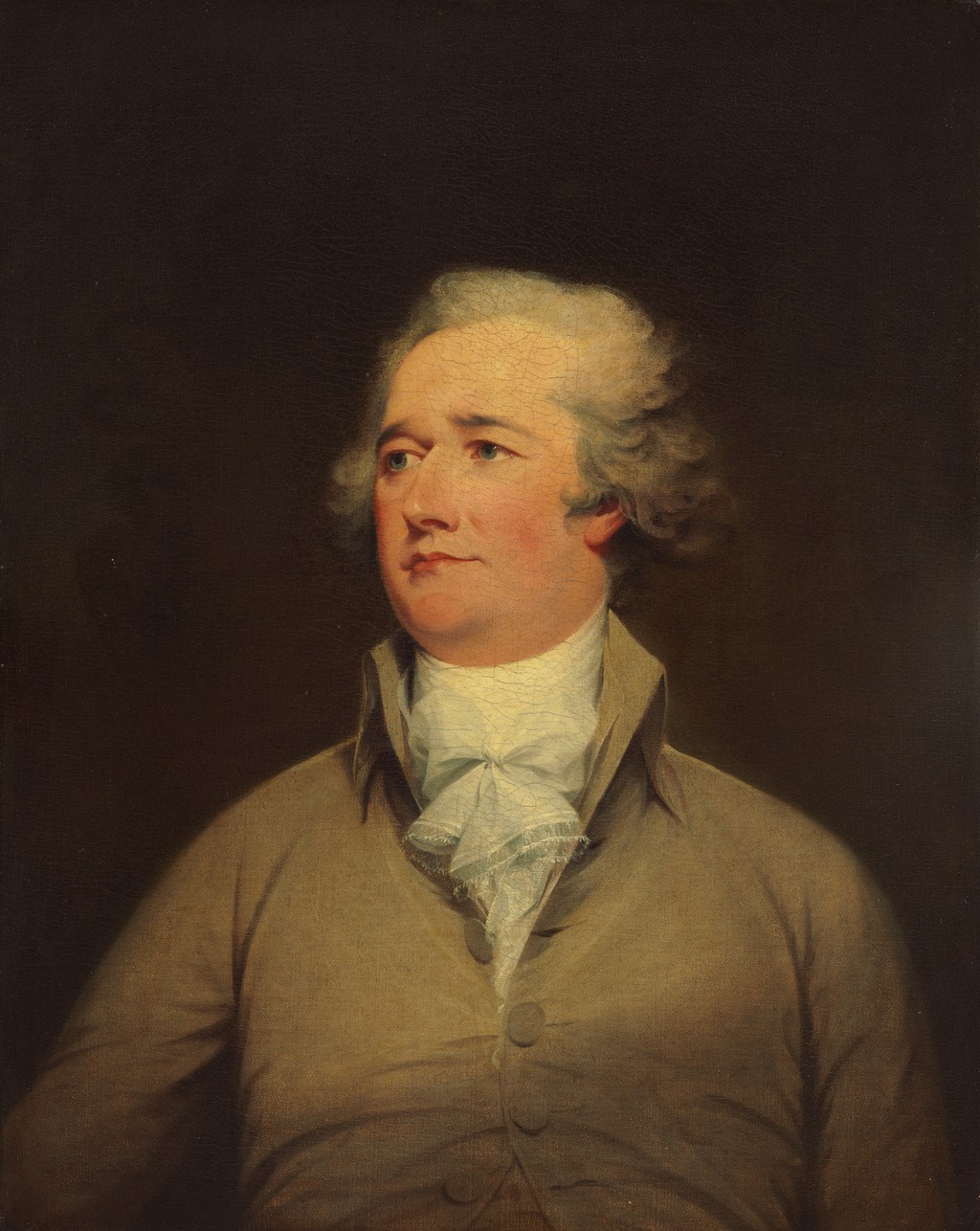
- Early illustrated Hamilton About 1792, National Gallery of Art, 1952.1.1
- Later Hamilton comparison About 1806, National Gallery of Art, 1940.1.8
- Illustrated Jefferson 1788, oil on mahogany, Metropolitan Museum of Art, 24.19.1
- Illustrated self-portrait About 1802, Yale University Art Gallery
- Important distinction A likeness gathered from a living model does not make an entire historical scene an eyewitness account
Contents
- Portraiture within national history
- Small oils and their materials
- Washington as a military commander
- Hamilton from life and after death
- Jefferson and an intimate commission
- Private sitters and changing identities
- Self-portrait and professional identity
Portraiture within national history
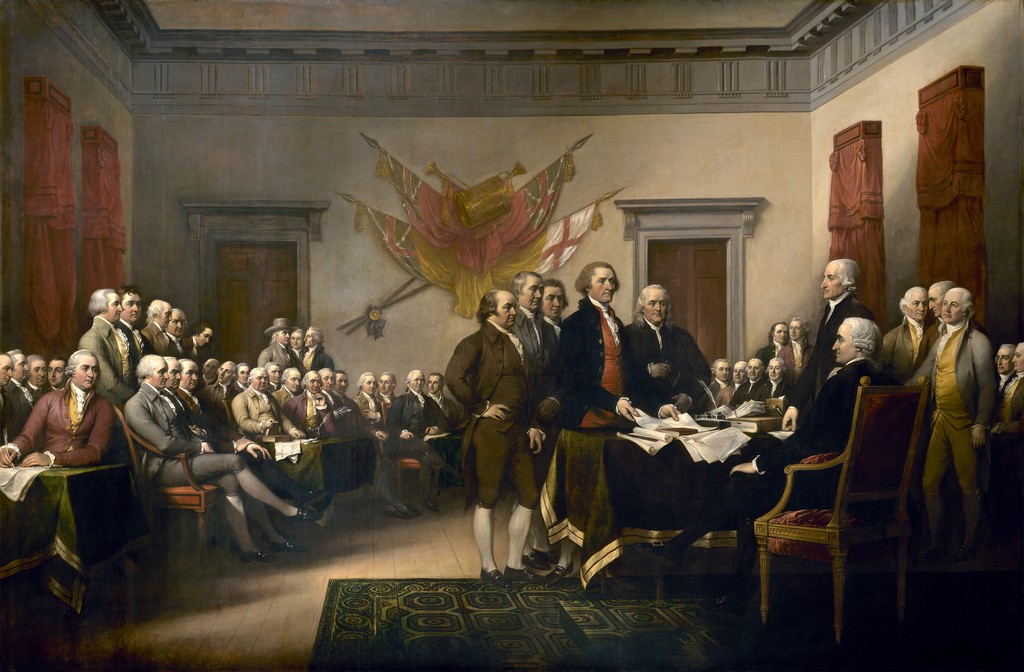
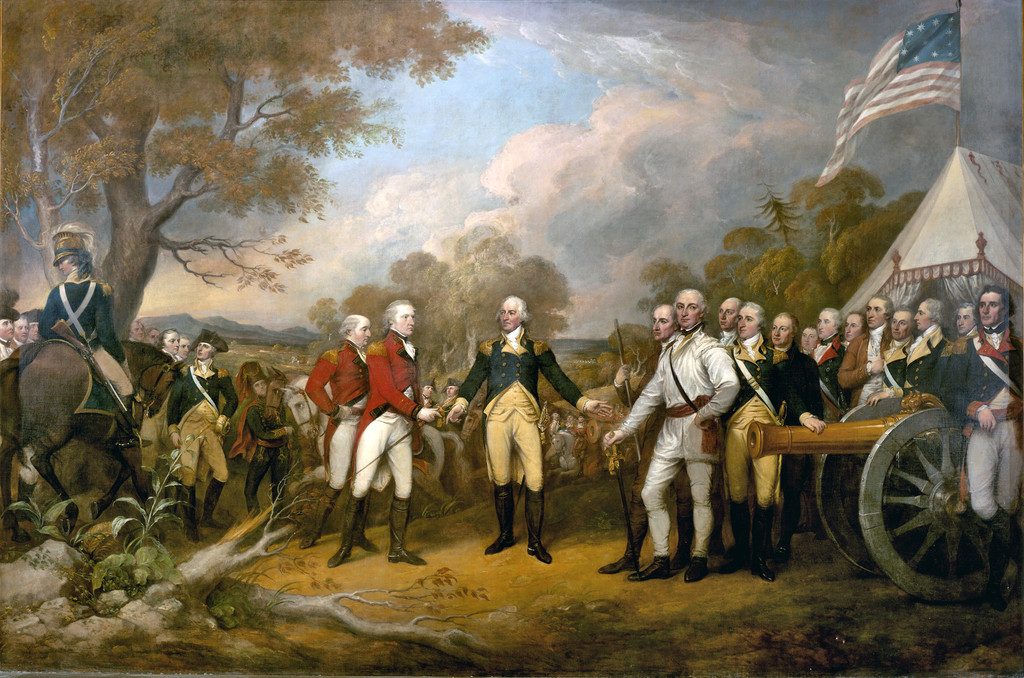
The heads distributed across Declaration of Independence are part of Trumbull's achievement as a portrait painter. The committee at the centre has to remain recognisable within an architectural interior, while the surrounding delegates retain their separate places in the gathering. The composition brings individual likenesses into the service of a collective image.
In his memoir, Trumbull described seeking portraits for his Revolutionary pictures. That work required travel, introductions and access to people whose political or military roles made their appearance important to the project. A picture eventually assembled in the studio could depend on encounters separated by considerable time and distance. [1]
Sometimes a living relative supplied a possible connection with a deceased subject. The Met's 1791 drawing of Hugh Mercer Jr. records such a case: Trumbull used the general's son as a model for his father in the Princeton painting. The sitter and the person ultimately represented were different individuals. This example makes the artist's effort to gather likenesses more interesting, while defining a limit to what they can establish. [2]
A portrait could consequently be both a record of observation and a resource for invention. Its contribution to a historical picture lay in the face it supplied; the surrounding action, arrangement and moment still required the painter's decisions. The drawings and prints page follows that movement from study to finished image.
Small oils and their materials
Trumbull's Thomas Jefferson at the Met measures just 11.4 by 8.3 centimetres. It is painted in oil on mahogany, with the head and upper body presented inside an oval field. The small size invites a close encounter: the pale hair, cravat and gold buttons become conspicuous against the darker coat, and the turn of the head gives the compact image a clear direction. [3]
The surrounding rectangular panel remains part of the object. In the museum's photograph, the oval does not erase the corners of the wood, and the surface carries visible wear and fine cracking. Those features belong to this particular surviving painting. A reproduction cropped to the oval would offer a different impression of its physical form.
Small scale alone does not identify a painting's technique. The Met's catalogue distinguishes Trumbull's small oils, with their contrasts of transparent paint and raised touches, from miniature portraits made in watercolour on ivory. A delicate likeness can be achieved through different materials, and the texture of oil paint remains relevant even when the dimensions are intimate. [4]
These small pictures also allowed a likeness to circulate separately from a larger composition. A head familiar within a national scene could acquire another role in a private collection. The change in scale altered how the image was encountered, without removing its relationship with the painter's broader historical undertaking.
Washington as a military commander
In George Washington before the Battle of Trenton , portraiture takes on the equipment of a military narrative. Washington stands in uniform, his yellow waistcoat and breeches bright against the dark coat and threatening sky. A horse and its attendant occupy the space beside him, while the landscape extends the portrait beyond the commander's body.
The general's upward gaze gives the image a different character from a straightforward presentation of official dress. His figure remains controlled as the horse supplies movement. Clothing, weather and setting work together to make leadership the picture's subject. The effect depends on more than a recognisable face.
The Met dates its smaller canvas to about 1792–94 and relates it to the full-size portrait at Yale made after Washington sat for Trumbull in Philadelphia in 1792. These are separate objects, even though they share a design. The Met picture measures 67.3 by 47 centimetres; it should not be mistaken for the large Yale canvas or the different portrait supplied for Charleston. [5]
The commission history exposes a question of purpose. According to the account discussed in the Met catalogue, the Charleston representative preferred a calmer likeness, and Trumbull painted a replacement. The dramatic portrait could express the artist's conception of Washington's military character while failing to answer the patron's expectation of an appropriate public image. [4]
Hamilton from life and after death
The National Gallery of Art's Alexander Hamilton , dated about 1792, offers a closer view of a public figure. Hamilton turns his head towards the left of the image, with pale hair, a white cravat and a warmly coloured face emerging from the brown setting. The coat and shoulders provide a broad foundation for the more closely described head. The portrait's force comes from this concentration rather than an elaborate scene. [6]
It belongs to the type established by Trumbull's 1792 full-length portrait for the New York Chamber of Commerce. The NGA's systematic catalogue identifies the smaller canvas as a likely early replica, questioning older claims that it was the original study from life. Its assessment considers the shared pose and lighting, together with technical examination that found none of the changes often associated with life portraits. The picture preserves an early likeness without proving that this particular canvas was painted at a sitting. [7]
The present NGA provenance begins with Oliver Wolcott, records the portrait passing to his son and then its purchase by William Jay in 1844. That sequence is more precise than assuming that an image later owned by the Jays had necessarily been commissioned by John Jay. The history of ownership and the history of production answer related but different questions. [6]
A second NGA Hamilton, dated about 1806, was made after the sitter's death. The head turns more strongly, the dark coat gives a sharper frame to the white neckcloth, and the features differ from those of the earlier image. The NGA catalogue relates it to Trumbull's 1805 full-length portrait, whose likeness draws on Giuseppe Ceracchi's sculpture. Trumbull's repeated subject therefore encompasses more than a single original copied without change. [8] [7]
The later picture also had an attribution history. The NGA records its appearance at a 1931 auction under John Vanderlyn's name and the subsequent identification as a Trumbull. Its account retains uncertainties in the earlier family transfers. The separate Hamilton article considers these versions and their histories in greater detail. [8]
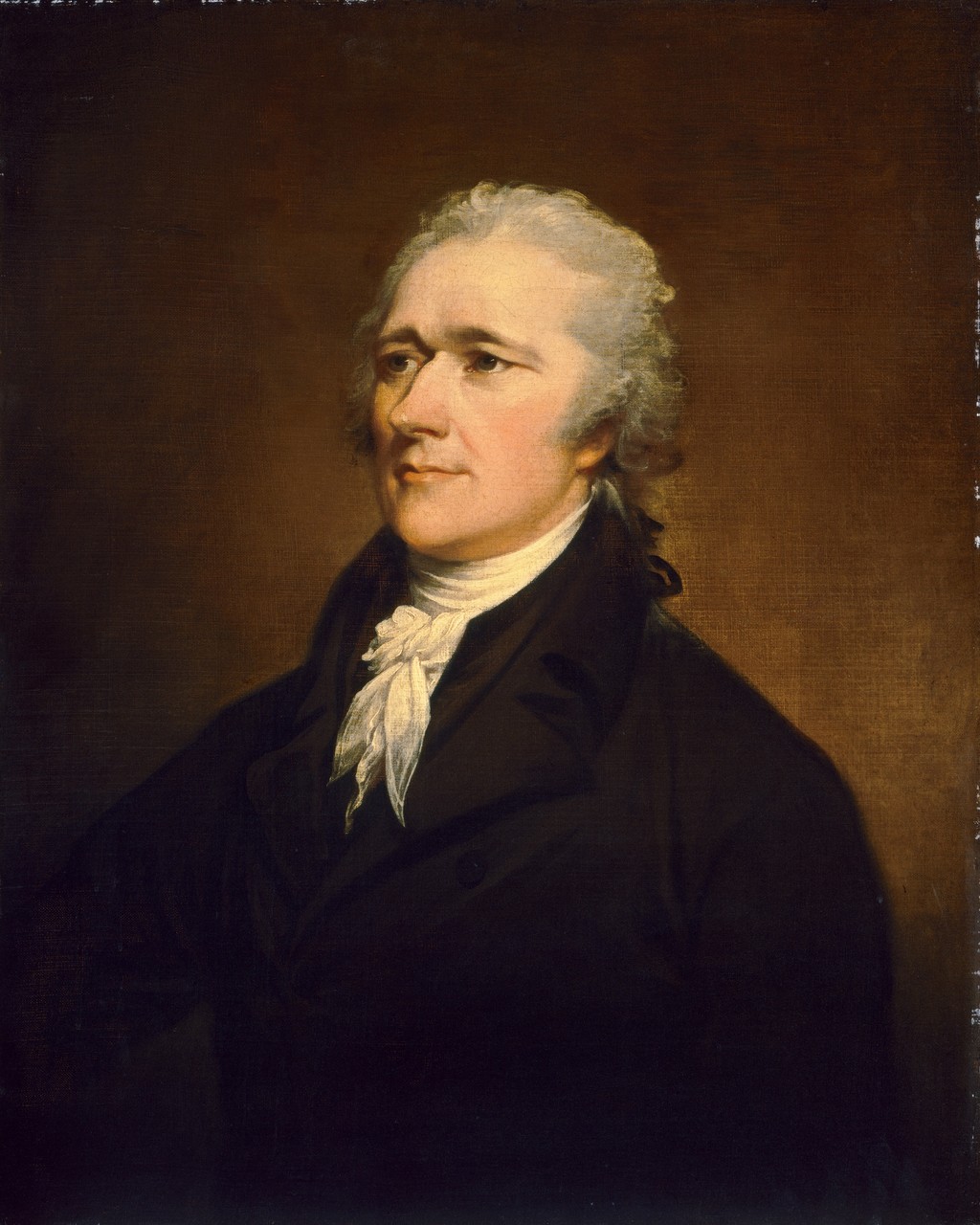
John Trumbull, Alexander Hamilton, about 1806. Oil on canvas, 77 × 61 cm. National Gallery of Art, Washington, 1940.1.8. Andrew W. Mellon Collection. Courtesy National Gallery of Art, Washington, CC0.
Image source
.
CC0 / Public domain
. Resized only; whole supplied image retained without appearance alteration.
Watch: John Trumbull
Choose a film to explore the artist’s work, its interpretation and its wider setting.
Moment of Discovery: John Trumbull’s “Declaration of Independence”
Discovery Park of America looks closely at Trumbull’s Declaration of Independence.
Watch on YouTubeJefferson and an intimate commission
The Met's small Jefferson was painted in 1788 for Angelica Schuyler Church, Jefferson's friend in London. The object links the statesman's familiar public image with a personal relationship. Its scale and destination give it a different setting from the grand assembly in the Declaration , even though the museum connects the two likenesses. [3]
The relationship between the portraits also involves a question of artistic sources. The Met's collection account describes a likeness taken from life during Trumbull's Paris visit and the small portrait made after the Declaration figure. In a 2026 essay, Andrew M. Davenport reports research by Laura Auricchio and Diane C. Ehrenpreis proposing that Trumbull likely used an earlier miniature from the studio of Adélaïde Labille-Guiard. The proposal qualifies a simple account of an entirely independent likeness. [3] [9]
The question concerns how the image was formed, rather than whether the Met painting is attributed to Trumbull. It also places the portrait within a larger exchange between artists, sitters and existing images. A likeness could draw authority from personal acquaintance while remaining open to comparison, adaptation and repetition.
Looking at the small panel preserves another part of that history: Jefferson appears as a carefully presented figure, with the bright cravat and buttons separating the head and coat. The image's intimacy does not make its arrangement casual. A private portrait could be as deliberate in its presentation as a public one.
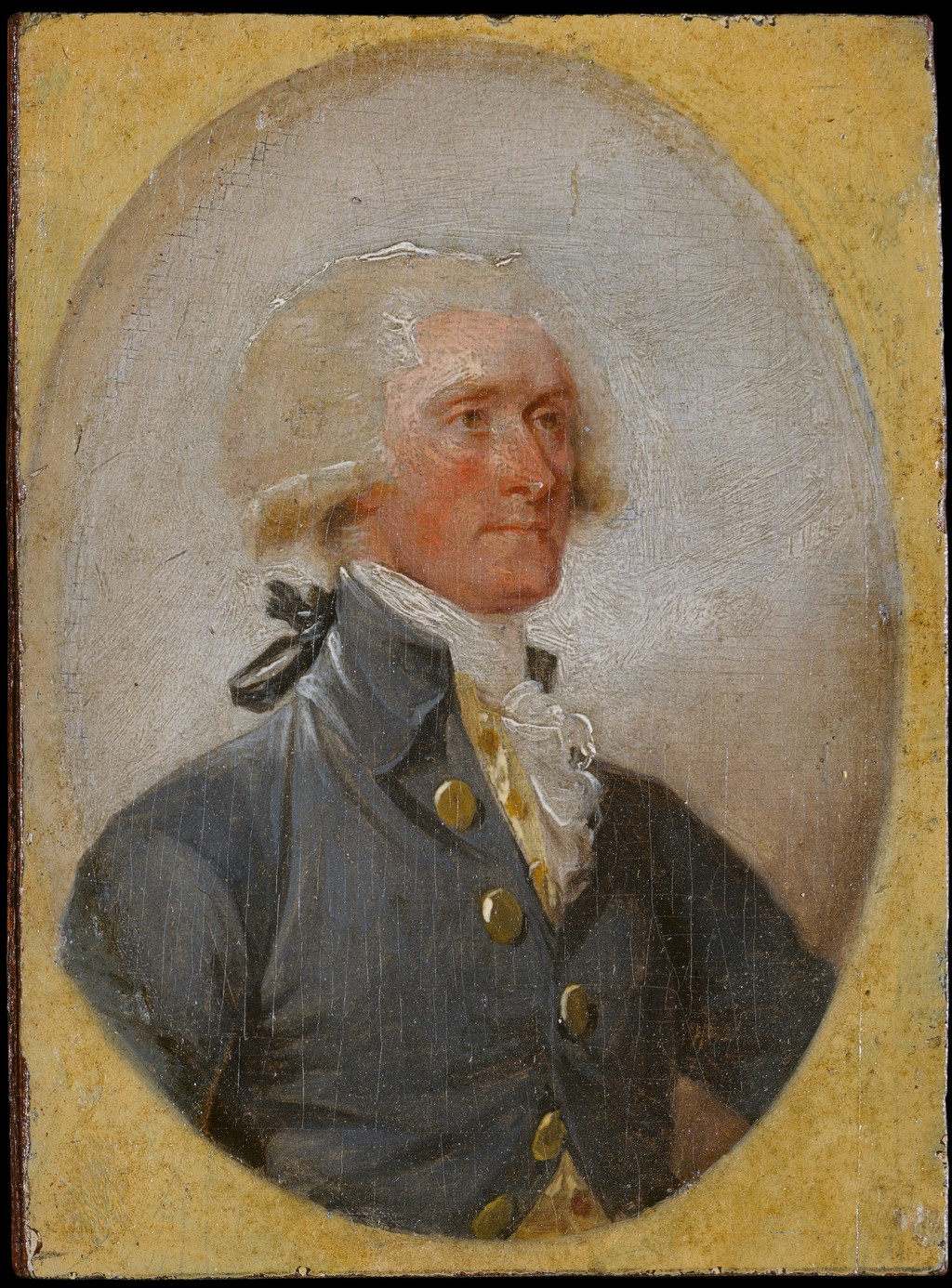
John Trumbull, Thomas Jefferson, 1788. Oil on mahogany, 11.4 × 8.3 cm. Metropolitan Museum of Art, 24.19.1. Bequest of Cornelia Cruger, 1923. The Metropolitan Museum of Art, CC0.
Image source
.
CC0 / Public domain
. Resized only; whole supplied image retained without appearance alteration.
Private sitters and changing identities
The portraits of John Murray and Mrs. John Murray extend Trumbull's work beyond the central figures of the Revolution. The Met dates them to about 1806 and identifies the sitters as the merchant and his wife, Hannah Lindley Murray. Their place within his portrait production reminds the viewer that a painter of national history also worked within networks of clients, acquaintances and families. [10]
Their names were not always correctly recorded. The portraits had been identified as Robert Murray and his wife before research in the twentieth century revised the identification. Such a change concerns the sitters, rather than automatically changing the artist's name. The appearance of a face does not, by itself, supply the documentary history needed to name it. [10]
The Met catalogue also treats Mrs. Murray's portrait as an independent composition, discussing differences between its design and handling and those of her husband's picture. Portraits associated by descent can invite comparison while preserving individual pictorial choices. Trumbull's private sitters deserve to be considered through those choices, alongside the history of the people represented. [4]
Self-portrait and professional identity
Trumbull's self-portrait of about 1802 at Yale makes his own artistic role visible. He turns towards the viewer above a dark coat and white neckcloth, with his hands, palette and brushes in the lower part of the composition. Books and red drapery complete a setting that differs from the spare backgrounds of the Hamilton portraits. [11]
The tools identify a working painter, while the arrangement gives that profession an assured public presence. The hands lead attention towards the objects that explain his activity; the face maintains the portrait's personal focus. It is an image through which Trumbull presents the maker of the other likenesses, rather than appearing only as the observer behind them.
Seen beside Jefferson, Hamilton and Washington, the self-portrait broadens the purpose of portraiture within Trumbull's career . A portrait could establish a profession, serve a friendship, answer a civic commission or preserve a likeness for a historical painting. The differences between these purposes help explain why his portraits vary so markedly in scale, setting and address.
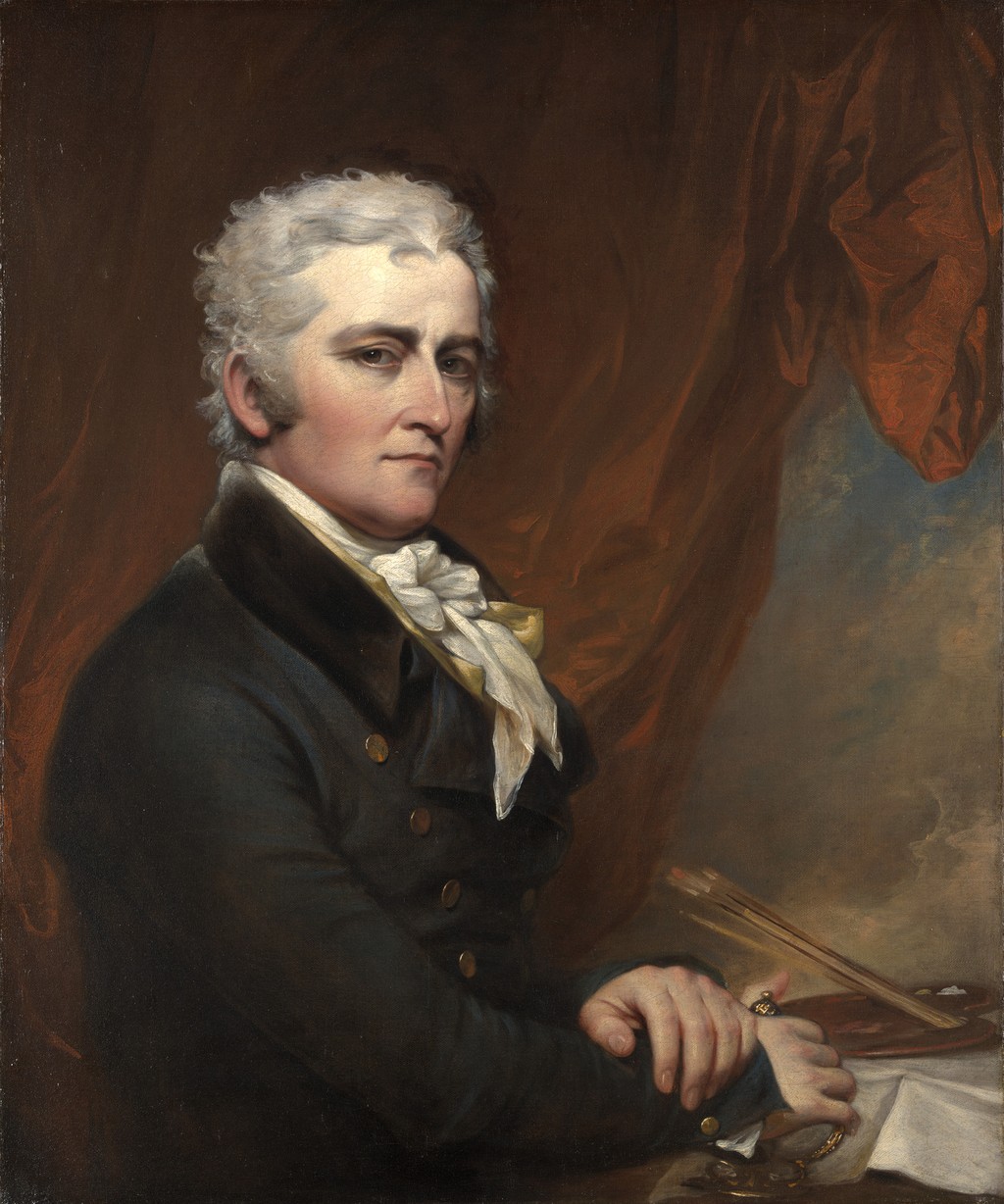
John Trumbull, Self-Portrait, about 1802. Oil on canvas, 75.5 × 62.3 cm. Yale University Art Gallery, 1981.129.1. Gift of Marshall H. Clyde, Jr. Yale University Art Gallery; faithful public-domain reproduction via Wikimedia Commons.
Image source
.
Public domain
. Resized only; full supplied image retained. No appearance adjustment.
Artworks directory
Works discussed in these articles, including distinct versions and reproductive prints. Dates identify the particular object; titles and attributions follow the cited collections. This is not a catalogue raisonné.
Frequently Asked Questions
Yes. His independent portraits and small likenesses form an important part of his work, alongside the portraits incorporated into historical paintings.
No. Their small scale does not change their materials. The Met's Jefferson, for example, is painted in oil on mahogany.
No. Early and posthumous portrait types survive, including the NGA paintings dated about 1792 and about 1806.
The discussion concerns the source of the likeness. The Met painting remains attributed to John Trumbull.
Discussion
Look again at the images and ideas explored in John Trumbull Portraits. These editorial prompts invite your observations.
Compare the small Jefferson, a Hamilton bust portrait and Washington in a military setting. How do the amount of surrounding space, the treatment of clothing and the direction of the gaze change the way each person is presented?
Reader Insights
How do hands and costume guide your attention towards a sitter?
What changes between the two Hamilton portraits?
How does a likeness serve a different purpose within a historical assembly?
Join the Conversation
Share a detail, comparison or question about John Trumbull Portraits below.
References
- John Trumbull , Autobiography, Reminiscences and Letters , 1841, pp. 402–408; portrait gathering and the gallery catalogue. View source
- Metropolitan Museum of Art , Hugh Mercer, Jr. , 1791, 06.1346.2; the son as a model for the deceased general. View source
- Metropolitan Museum of Art , Thomas Jefferson , 1788, 24.19.1; oil on mahogany, dimensions and the Angelica Schuyler Church commission. View source
- John Caldwell and Oswaldo Rodriguez Roque, with Dale T. Johnson , American Paintings in the Metropolitan Museum of Art , volume I, 1994, especially pp. 203–204, 216–222; small oils, Washington, Hamilton and the Murray portraits. View source
- Metropolitan Museum of Art , George Washington before the Battle of Trenton , about 1792–94, 22.45.9; relationship with the full-size Yale portrait. View source
- National Gallery of Art , Alexander Hamilton , about 1792, 1952.1.1; object record and documented Wolcott-to-Jay provenance. View source
- Ellen G. Miles, with contributions by Cynthia J. Mills and others, National Gallery of Art , American Paintings of the Eighteenth Century , 1995, pp. 303–306 and 308–312; the Hamilton types, early replica assessment and relationship with the full-length portraits. View source
- National Gallery of Art , Alexander Hamilton , about 1806, 1940.1.8; object record, provenance qualifications and attribution history. View source
- Andrew M. Davenport, Metropolitan Museum of Art , “Considering Young Jefferson,” August 11, 2026; the proposed earlier miniature source for the likeness. View source
- Metropolitan Museum of Art , Mrs. John Murray , about 1806, 22.76.2; the Murray family and revised sitter identification. View source
- Image source: Yale University Art Gallery, via Wikimedia Commons , Self-Portrait , about 1802; image, object identification and public-domain reproduction record. View source
- Splash image source.
John Trumbull, Alexander Hamilton, about 1792. Oil on canvas, 76.2 × 60.5 cm. National Gallery of Art, Washington, 1952.1.1. Gift of the Avalon Foundation. Courtesy National Gallery of Art, Washington, CC0. CC0 / Public domain . Resized only; full supplied image retained. No appearance adjustment.
View source