 by
Tom Gurney
Tom Gurney BSc (Hons) is an art history expert with over 20 years experience
Email:
tomgurney1@gmail.com
/ Phone:
+44 7429 011000
Declaration of Independence by John Trumbull: Introduction
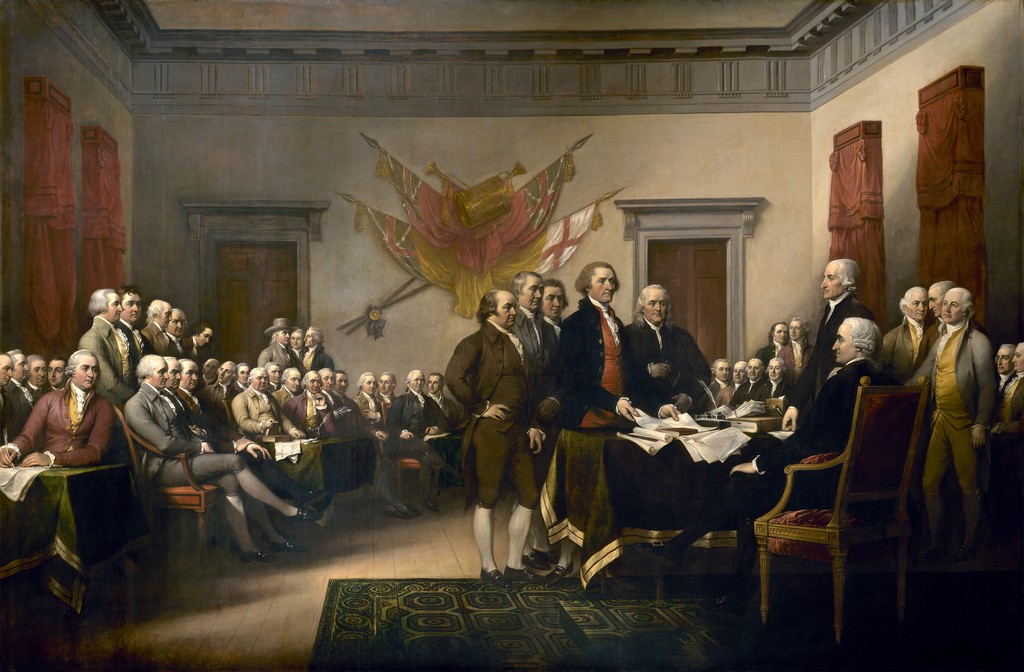
Five men stand before the president of Congress while their colleagues watch from the surrounding chairs. Thomas Jefferson places a document on the table, and the small movement of paper becomes the centre of an unusually quiet history painting. John Trumbull’s Declaration of Independence presents the submission of a draft, an action associated with 28 June 1776. It does not show the delegates gathering to sign the Declaration on 4 July. [1]
The distinction opens up much of the painting’s meaning. Trumbull wanted to preserve the likenesses of the people connected with independence, but he also needed to turn the work of an assembly into a compelling picture. He brought men together who had not all attended the same session, adjusted the room and gave the drafting committee a collective action. The result combines portrait collection with a deliberate representation of political history. [2]
The monumental canvas in the United States Capitol was painted in 1817–18. A smaller painting at Yale developed across a much longer period, and Asher Brown Durand’s engraving carried the design into another medium. Reading the central encounter, the gathered faces and the reconstructed room helps explain both the image’s enduring authority and its limits as evidence of a particular day. [1] [3]
At a Glance
- Artist John Trumbull.
- Principal Capitol canvas painted August 1817–September 1818; oil on canvas, 12 × 18 feet; installed in the Rotunda in 1826.
- Represented action presentation of the draft to Congress, associated with 28 June 1776.
- Drafting committee John Adams, Roger Sherman, Robert R. Livingston, Thomas Jefferson and Benjamin Franklin.
- President of Congress John Hancock.
- Capitol figures 47, including 42 of the 56 signers and 5 others.
- Yale canvas 1786–1820; oil on canvas, 53 × 78.7 cm; 1832.3.
- Illustrated engraving Durand after Trumbull, 1823; sixth state of six; Met 24.90.1514.
- Room photograph restored Assembly Room, 24 April 2005; Rdsmith4, CC BY-SA 2.5.
This work across John Trumbull’s career
The Death of General Mercer at Princeton
about 1787–1831; principal Yale versionThe Sortie Made by the Garrison of Gibraltar
1789; Met versionGeorge Washington before the Battle of Trenton
about 1792–94; Met versionAlexander Hamilton
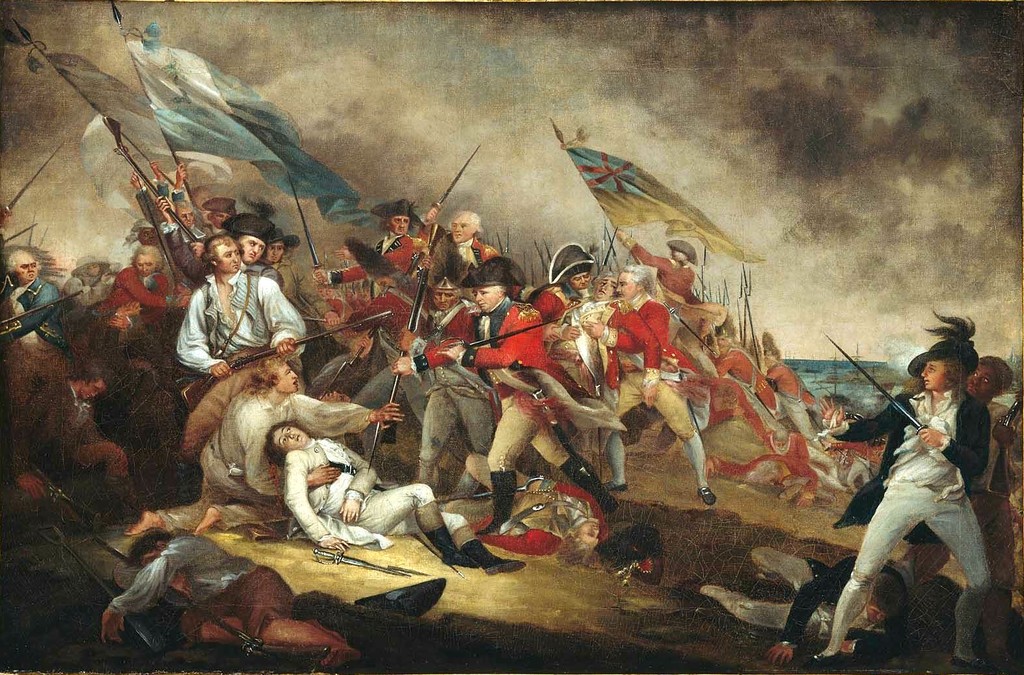
about 1792; likely early NGA replicaThe Death of General Warren at Bunker’s Hill
after 1815–before 1831; MFA versionDeclaration of Independence (current article)
1817–18; Capitol canvasSurrender of Lord Cornwallis
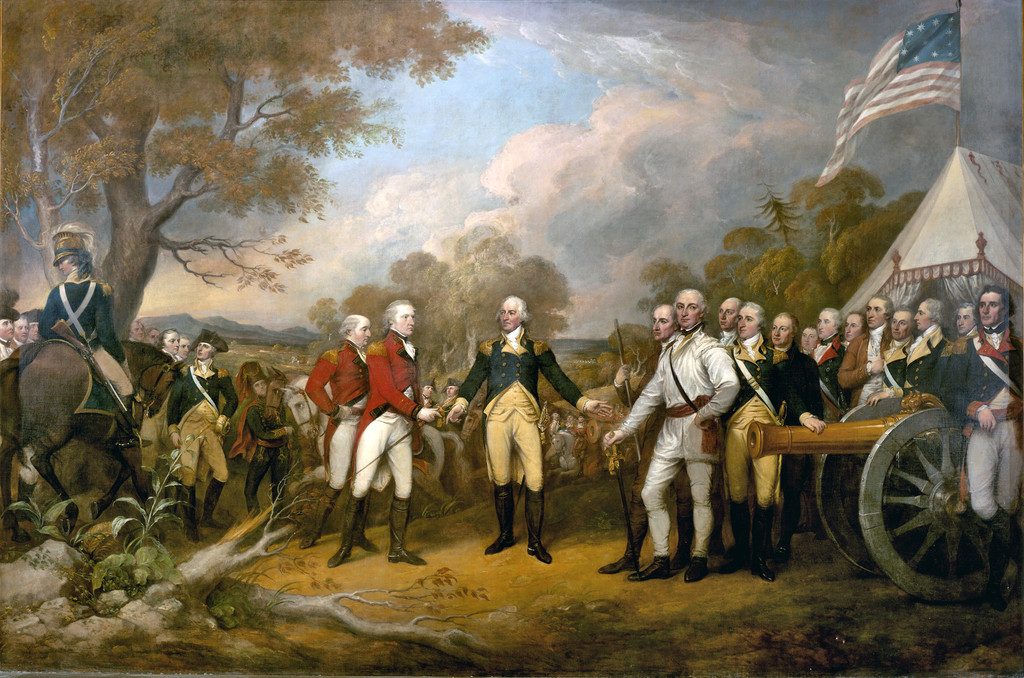
1819–20Surrender of General Burgoyne
1821; Capitol canvasNotes and sources
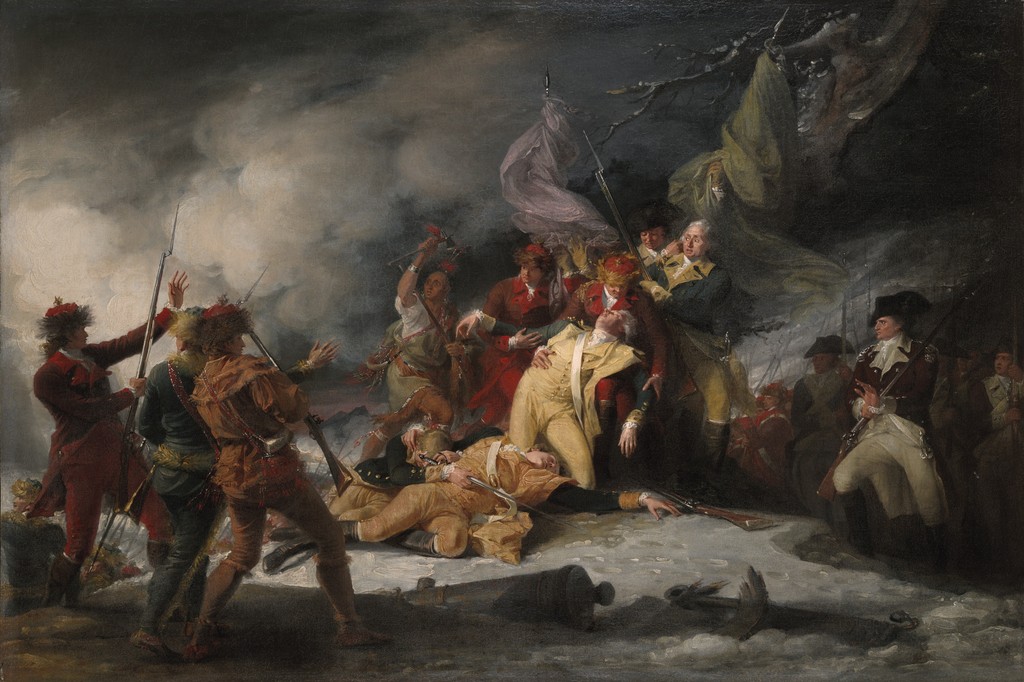
The Death of General Montgomery. Dates identify the particular canvas discussed in the article. [4]
The Capture of the Hessians at Trenton. Dates identify the particular canvas discussed in the article. [5]
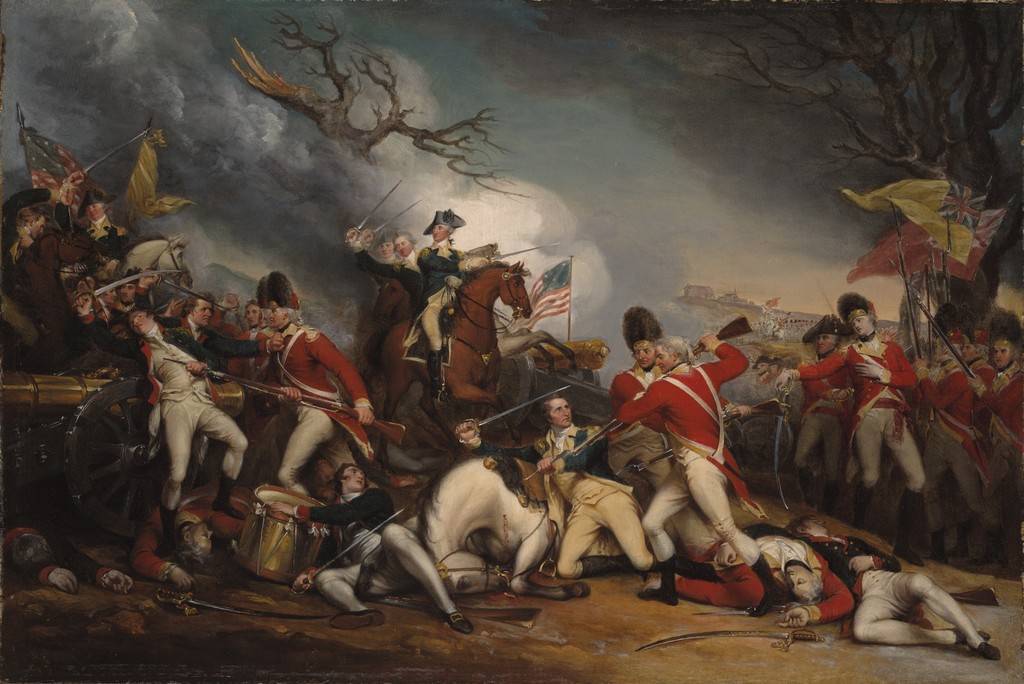
The Death of General Mercer at Princeton. Dates identify the particular canvas discussed in the article. [6]
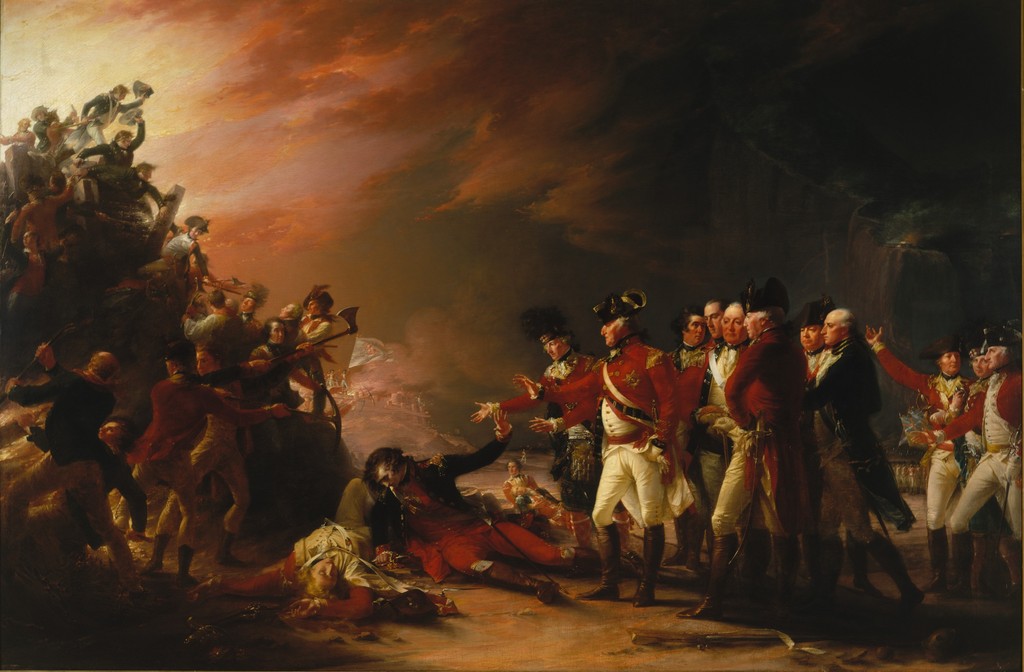
The Sortie Made by the Garrison of Gibraltar. Dates identify the particular canvas discussed in the article. [7]
George Washington before the Battle of Trenton. Dates identify the particular canvas discussed in the article. [8]
Alexander Hamilton. The NGA catalogue treats this as a likely early replica. [9] [10]
The Death of General Warren at Bunker’s Hill. Dates identify the selected later version. [11]
Declaration of Independence (current article). Dates identify the particular canvas discussed in the article. [1]
Surrender of Lord Cornwallis. Dates identify the particular canvas discussed in the article. [12]
Surrender of General Burgoyne. Dates identify the particular canvas discussed in the article. [13]
Washington Resigning His Commission. Dates identify the particular canvas discussed in the article. [14]
Contents
- The presentation of a draft
- June 28, July 2, July 4 and August 2
- Reading the committee and Hancock
- The other portraits and omitted delegates
- Paris, Jefferson and the small Yale painting
- The room and its deliberate alterations
- The monumental Capitol commission
- Exhibitions and early criticism
- Durand’s engraving and the problem of dates
- Annotated details
The presentation of a draft
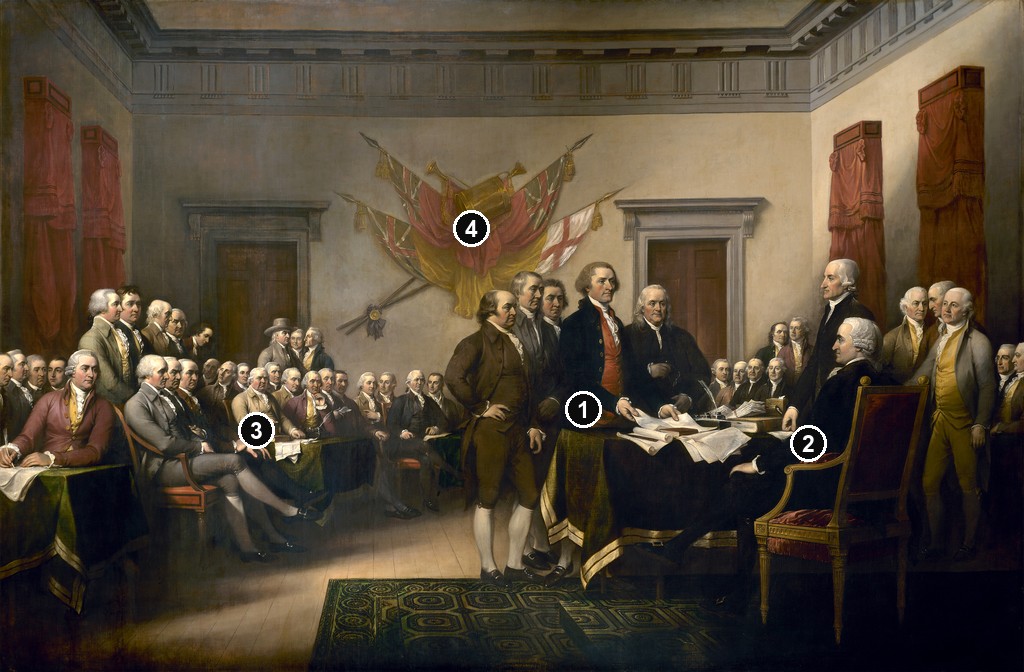
The central action is modest in its physical scale. Jefferson extends the draft towards the table where John Hancock sits as president of Congress. Papers already cover part of the cloth, and the document joins the material of an assembly at work. The scene makes a political undertaking visible through an act that would otherwise leave little trace in a crowded room.
Trumbull gives that act room to register. The drafting committee stands on a relatively open area of floor, separated from the densely arranged men along the walls. Their full-length bodies offer clear verticals, while the extended paper draws attention across the space between the standing group and the seated president. The action can be understood before the viewer has identified every face.
The open foreground also creates a position for the spectator. We look across the floor towards a ceremony arranged for our attention, without having to see past another row of delegates. Trumbull makes a legislative interior accessible as a public image. The distance between the viewer and the table becomes part of the painting’s measured, formal character.
The artist acknowledged a deliberate change in the reporting procedure. In the catalogue included in his memoir, he explained that he had made all five committee members advance together, rather than showing a chairman simply rising from his place. He considered the arrangement necessary to give variety to a subject governed by stillness and solemnity. [2]
His own phrase, “departure from custom, and perhaps fact,” is unusually revealing. Trumbull did not regard a literal sequence of ordinary parliamentary movements as the only basis for a historical picture. He sought an arrangement that could express the occasion’s dignity and make the committee’s role legible. The collective approach to the table supplies that arrangement. [2]
The painting’s calm is consequently an artistic achievement with a purpose. The men are neither arguing across the room nor celebrating an outcome already secured. Their attention converges on a proposal being placed before the assembly. Trumbull holds the scene at a point where collective action appears possible, while the significance attached to the document extends far beyond the visible gesture.
Annotated Details from Declaration of Independence
The numbered points identify visible features discussed in this article. Return from each detail to the whole composition. John Trumbull, Declaration of Independence, painted August 1817–September 1818. Oil on canvas, 12 × 18 feet. United States Capitol Rotunda. The scene represents presentation of the draft to Congress, associated with 28 June 1776. John Trumbull; Architect of the Capitol, via Wikimedia Commons. Public domain. Image source. Public domain. Numbered markers added to a separate resized overview. Detail images are crops of the unchanged native source.
Details from DECLARATION OF INDEPENDENCE
Compare the cropped details with the complete images above. Notice how their colours, shapes and positions contribute to the larger compositions.
The committee and the offered paper
The standing committee forms a compact group before the table. Jefferson’s pale hands and the paper carry the principal action across the dark coats, while the open floor makes the approach easy to follow.
Hancock and the table
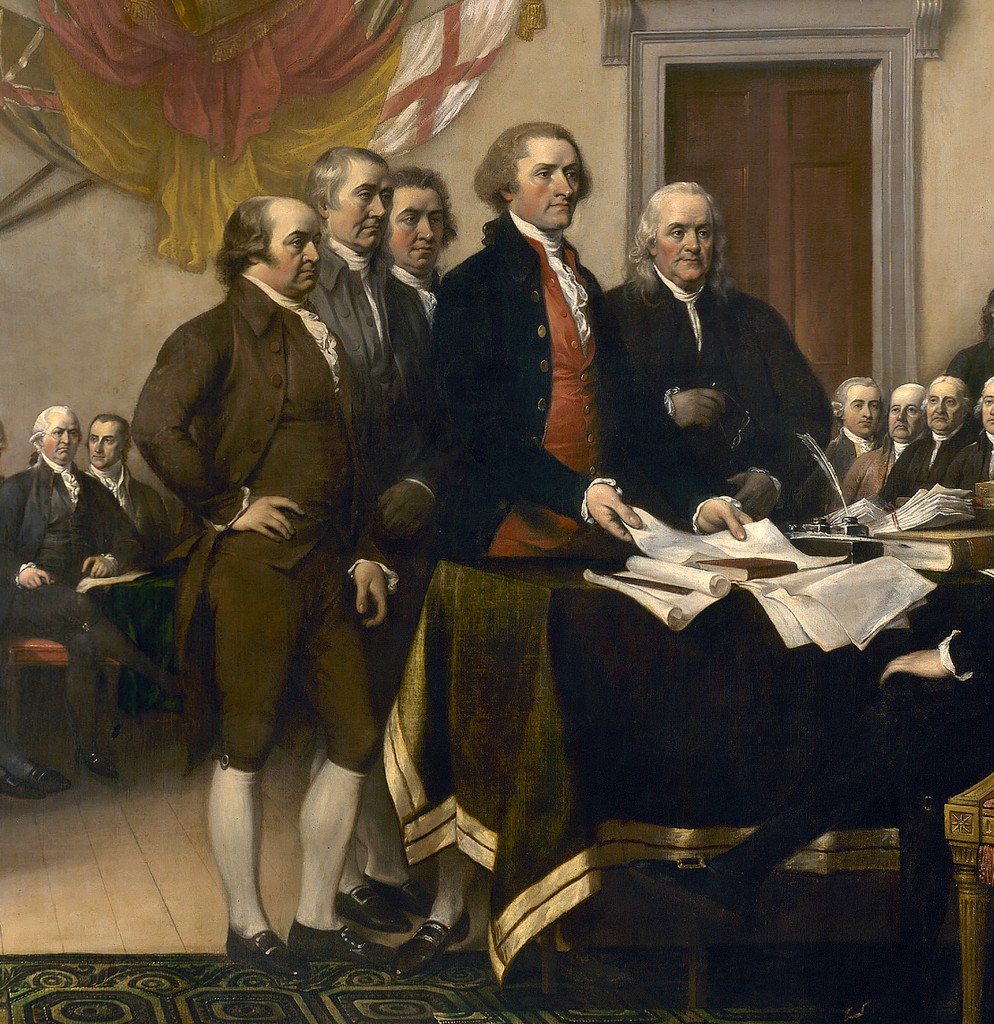
Hancock’s seated figure faces the standing committee across the papers. The chair, books and draped table give the small act of presentation a substantial setting.
The gathered delegates
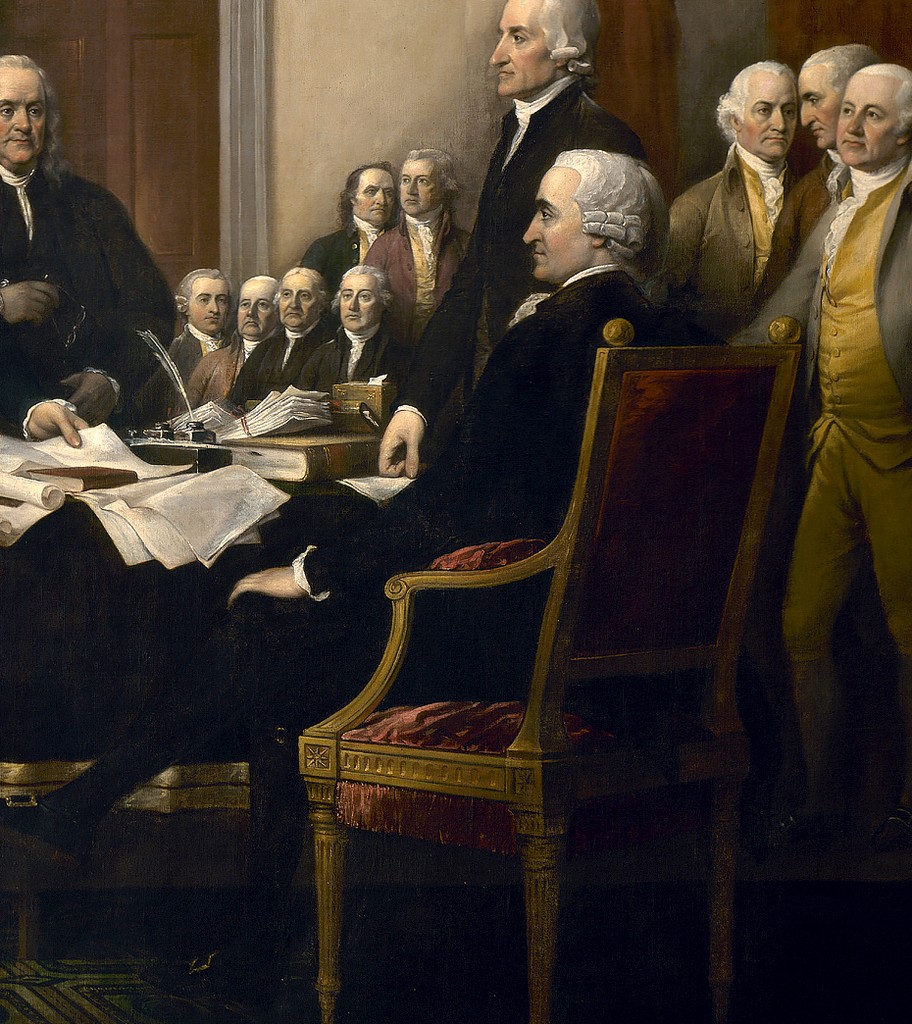
Rows of heads and differently turned bodies distribute attention through the left side of the assembly. Faces remain individual while the seated figures contribute to the larger scene of listening.
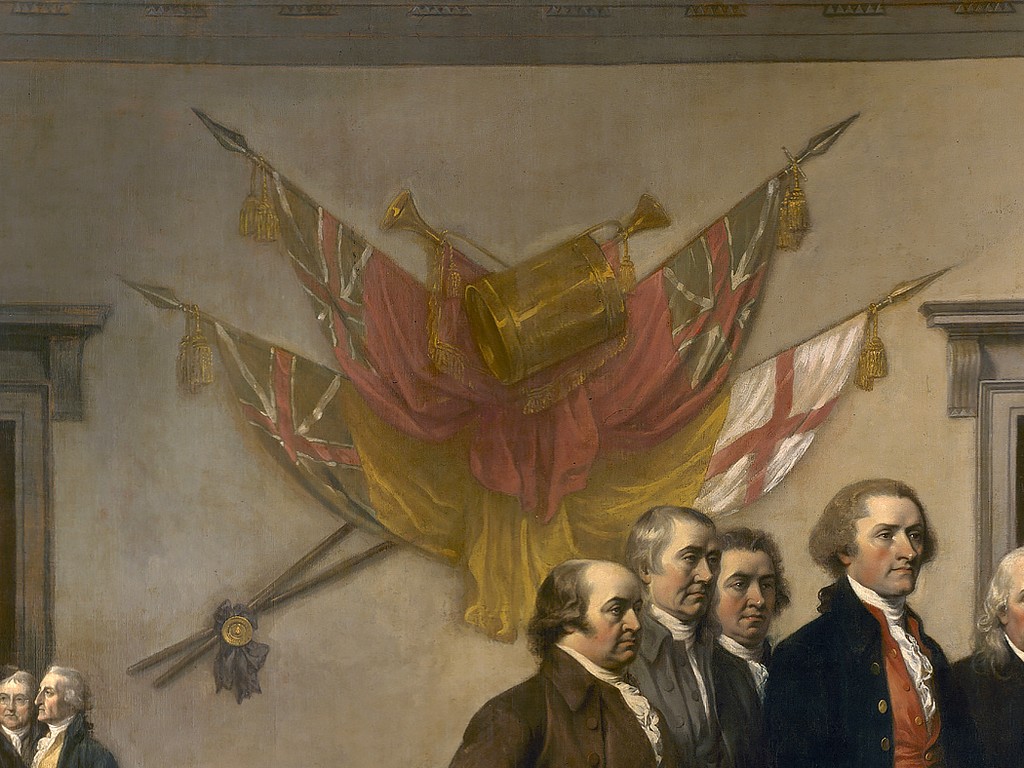
Flags and trophies on the wall
Folded flags, a drum and crossing shafts form a decorative cluster above the people. Their broad shapes occupy the high wall without competing with the paper presented below.
June 28, July 2, July 4 and August 2
Several different events sit behind the familiar title. The drafting committee was appointed on 11 June 1776 to prepare a statement explaining the colonies’ case for independence. Jefferson produced the principal draft, with changes from Adams and Franklin. The painting represents the committee presenting that work to Congress on 28 June. [1] [15]
On 2 July, Congress adopted the resolution declaring independence. It then considered the Declaration’s wording, making changes over the following days. The text was officially adopted on 4 July and sent to the printer John Dunlap. Adoption, printing and the earlier presentation were connected acts, but they were not one ceremony. [15]
Congress ordered the Declaration engrossed on parchment on 19 July. Most of the members signed that document on 2 August, with further signatures added later. The National Archives chronology separates these stages, showing why a picture of a document being delivered cannot automatically be read as a scene of all the signers putting their names to the finished parchment. [15]
The distinction also changes how we look at the central table. Jefferson’s hands carry the report towards Hancock; the committee stands beside him. There is no procession of men approaching in turn with pens. The arrangement belongs to the submission of a draft, even though the title and the painting’s later fame can encourage an association with the national anniversary.
That association is understandable. A single image can become the visual shorthand for a process extending across weeks. The Declaration’s preparation, the independence vote, adoption and signing all concern the same political undertaking, and later memory often gathers them around the best-known date. Trumbull’s picture supplies a room and a group of faces for an event whose actual development was less compact.
The smaller Yale painting retains July 4, 1776 within its historical title. That title belongs to the work’s identity and should be preserved when naming the object. It does not require the viewer to ignore the represented draft presentation. A historical title, a depicted action and a sequence of documented dates can coexist without being interchangeable. [3]
Reading the scene with those dates in mind makes its quietness more interesting. The men have reached a stage in an ongoing process, rather than the final instant in which every consequence has become settled. Trumbull gives the presentation a ceremonial clarity that allows a later audience to see it as part of the nation’s foundation.
Reading the committee and Hancock
The five men standing together are John Adams, Roger Sherman, Robert R. Livingston, Thomas Jefferson and Benjamin Franklin. Their positions give the drafting committee a clear collective presence, while differences of height, clothing and stance preserve the identities of its members. Hancock sits to their right, receiving the paper on behalf of the assembly. [1]
Adams stands prominently at the left front of the group. His brown clothing and pale stockings give his body a substantial vertical shape against the crowded delegates beyond. Jefferson’s taller figure, dark coat and red waistcoat draw attention nearer the table. Between and behind them, the other committee members complete a compact gathering of separate heads and shoulders.
Franklin’s shorter figure at the right brings the group towards the paper and the president’s desk. The arrangement does not make all five men equally conspicuous at the first glance. It establishes a shared task while letting the viewer move between the principal author, another prominent advocate and the colleagues whose work belongs to the same report.
The central document helps bind them together. Jefferson’s hands direct it towards the table, while the committee’s bodies give the movement a visible escort. Their position turns the drafting of words into a collective public responsibility. Even a viewer unfamiliar with the individual faces can recognise the relationship between a group offering a report and an assembly receiving it.
Hancock’s seated posture provides a counterpart to the standing men. The chair, table and surrounding papers establish the place from which he presides. His attention moves towards the committee, making the encounter a transaction between the report’s authors and Congress, rather than a portrait of Jefferson acting alone.
The painting also gives significance to ordinary details of dress. Coats, waistcoats, knee breeches and stockings distinguish the men through colour and shape without requiring crowns, armour or an elaborate allegory. Trumbull described the clothing as belonging to the period. The familiar forms of a recent generation become the costume of a national history painting. [2]
The long view of the legs, often noticeable when looking at the picture, follows from the decision to show the committee standing on an open floor. It gives their bodies room to act, but also exposes the difficulty of finding drama in an occasion with little physical movement. Trumbull answers that problem through the measured presentation, the spacing of the figures and the attention of those watching.
The other portraits and omitted delegates
The Capitol painting contains forty-seven individuals: forty-two of the fifty-six signers and five other people associated with the event. The gathering is therefore neither a complete collection of signers nor a record of everyone in the room on one date. The Architect of the Capitol explains that likenesses and the importance of the people represented helped determine the selection. [1]
Trumbull discussed the problem explicitly in his memoir. When he began the project, he had to decide whether to include only those present on the celebrated day, only supporters of the measure, or people who had opposed it. He also faced the practical question of what to do when someone had died without leaving a portrait he could use. [2]
He recalled consulting Adams and Jefferson. Their advice, as he reported it, treated the signatures as a general guide but allowed the inclusion of important dissenters, especially John Dickinson. The aim was to commemorate the people connected with the act, while preserving usable likenesses and avoiding purely invented faces that might cast doubt on the others. [2]
This policy gives disagreement a place within the composed room, even though the men are not visibly engaged in an argument. Dickinson’s inclusion, as explained by the artist, means that the assembly cannot simply be read as a row of people who all supported the same step at the same time. A calm picture may contain different positions without dramatising their conflict.
The Harvard Declaration Resources Project offers a useful example of the gap between attendance and inclusion: John Morton, present during the relevant proceedings and a signer, is absent from the image. The guide’s reconstruction is a reminder that being present, signing and appearing in Trumbull’s composition are separate questions. [16]
The physical arrangement also affects the meaning of inclusion. Some men have clear full faces in the foreground, while others appear between shoulders farther back. A person can be represented without receiving equal prominence. Portrait collection becomes a hierarchy of visibility once the likenesses enter a single composition.
The chairs, tables and standing clusters help the artist manage that difficulty. He varies the height of heads, turns faces across the room and leaves intervals through which smaller groups can be seen. The assembly feels populous without becoming a uniform pattern of identical seated bodies. Each face contributes to a larger impression of attentive company.
The count of forty-seven belongs specifically to the Capitol canvas. The Met’s interpretation of the related Durand print records forty-eight men. These figures should be read with their respective objects, rather than combined into a single universal number for every version of the image. The composition circulated through works whose details and catalogued histories require separate attention. [17]
Paris, Jefferson and the small Yale painting
The subject began to take shape while Trumbull was in Paris in 1786. In the memoir, he recalled bringing his early Revolutionary paintings to Jefferson, then the American minister in France. Jefferson approved the undertaking, and Trumbull began the Declaration with the benefit of his information and advice. [2]
This origin places the work at an interesting distance from its subject. An American legislative event was being reconstructed in a European capital a decade later, through the conversation of a participant and an artist developing his historical practice. Memory, portraiture and pictorial planning met before the design acquired its later public setting.
The smaller canvas now at Yale University Art Gallery is dated 1786–1820 and measures 53 by 78.7 centimetres. Its accession is 1832.3. The long span reflects the continuing work of obtaining likenesses and developing the painting, which had begun well before Congress commissioned the monumental version. [3]
The two canvases consequently resist a simple account of a finished original followed immediately by a larger copy. The small design already existed when the Capitol commission was secured, but its broad completion date extends beyond the making of the large canvas. Different objects could remain involved in the same undertaking at overlapping stages.
The change in scale also changes the encounter. A small painting gathers many likenesses within a field that a viewer can inspect closely. The monumental version makes the same basic arrangement part of a large architectural interior, where figures and spaces must remain legible from farther away. The histories are connected, but the works ask different things of their audiences.
Jefferson’s contribution had its own limits. His memory could provide information about the event and room, but a remembered sketch was not a measured record of every opening and furnishing. The advice of a participant did not remove the artist’s need to make choices about how the assembly should appear. The painting’s authority emerged from collaboration and construction together. [1]
The Paris beginning also helps explain why the Declaration belongs within Trumbull’s broader career, rather than standing apart as an isolated national symbol. The artist was studying European painting while developing subjects from the recent American war. His biography follows the travels and relationships through which that project took form.
Gathering likenesses
The faces were not all painted together in the room shown. Trumbull collected information through sittings and existing portraits in different places. His memoir names Adams in London, Jefferson in Paris, Hancock and Samuel Adams in Boston, Edward Rutledge in Charleston, George Wythe in Williamsburg and Josiah Bartlett in Exeter among the examples of that work. [2]
Those journeys made the picture a dispersed undertaking before its participants were gathered on canvas. A face observed in one city could later join people studied elsewhere. The finished room creates a shared light, scale and direction of attention for likenesses obtained through different encounters.
The long process also changed what was possible. People died, moved or could not provide a sitting, and a portrait might survive where the person no longer did. The artist’s stated preference for living models had to coexist with the practical demands of representing an earlier generation. Collecting a likeness and verifying its relationship to the person became central artistic tasks.
The Harvard guide records a family model in the case of Benjamin Harrison: Trumbull used the signer’s son rather than a surviving portrait of the father. That example qualifies any assumption that every face was observed directly from the historical person represented. It also shows how the painter’s pursuit of resemblance could involve different forms of evidence. [16]
The relationship between likenesses and finished compositions remains a subject of research. The Met’s small 1788 Thomas Jefferson , painted on mahogany, is closely connected with the image of Jefferson in Trumbull’s historical work. It is a separate portrait object, made for a different setting, rather than a fragment cut from the large Capitol canvas. [18]
In a 2026 Met essay, Andrew M. Davenport reports research by Laura Auricchio and Diane C. Ehrenpreis suggesting that Trumbull likely used a 1786 miniature from the studio of Adélaïde Labille-Guiard as a model for his Jefferson likeness. The proposal should retain that qualification. It complicates a straightforward story of direct observation without changing the attribution of Trumbull’s painting. [19]
The larger point can be seen in the finished assembly. Distinct faces appear to participate in one event, but their sources and dates need not be identical. The portraits article considers these differences in more detail, including the ways a likeness could be adapted between an individual portrait and a historical group.
Trumbull’s attention to the face also differs from his treatment of the body. The posture, costume and position of a figure had to serve the shared design, even when the head depended upon a particular sitter or earlier image. His task was to make the collected identities inhabit a room whose action could be read as a whole.
This is why the authenticity he valued should be understood precisely. Reliable likenesses could make the people recognisable without making the whole assembly a literal visual record. The painting brings the record of individuals into an arrangement shaped by the needs of historical art.
The room and its deliberate alterations
The architecture gives the assembly a stable enclosure. A long cornice runs across the top of the picture, doors interrupt the rear wall, and tall windows occupy the sides. Within that framework, the seated men form a broad band of heads while the standing committee rises into the space above. The room organises the gathering as much as the gestures do.
Trumbull based the interior partly on a sketch Jefferson made from memory in Paris. The Architect of the Capitol identifies differences in the number and placement of openings, together with more elegant furniture and altered window dressings. These changes belong to the making of the scene, rather than evidence that every painted detail once stood in the Assembly Room. [1]
The room’s most conspicuous addition is the arrangement of military trophies behind the committee. Flags and weapons spread across the wall, with their angled poles lifting the eye above the faces. Their folds and overlapping shapes give the large expanse of wall a centre related to the group below. The quiet presentation gains a visible connection to the war beyond the chamber.
Trumbull admitted embellishing the background in this way. He believed captured British trophies might have been displayed there, but his explanation remained a supposition. The memoir’s account supports the flags as an artistic choice; it does not establish their actual installation in that place at the represented meeting. [2]
The furnishings also carry pictorial weight. The president’s tall chair and covered table give the receiving side of the encounter an appropriate distinction. Chairs arranged along the sides offer variety through arms, backs and angled legs, while the carpet establishes a substantial foreground area near the table. These details help make a legislative report appear ceremonially important.
Light is distributed with similar care. The standing committee and the nearer faces remain readable against the wall, while the room’s edges contain more densely overlapping figures. The viewer can move from the central action into the surrounding assembly without losing the principal group. This is a composed experience of an interior, not merely an inventory of its contents.
The difference between portrait and architectural aims is essential. Trumbull could insist on likenesses while allowing the room greater freedom. The remembered faces, invented trophies and adjusted furnishings coexist because he wanted the picture to make a claim about the people and the significance of their undertaking. Accuracy in one part of the design did not oblige him to use the same method everywhere.
Watch: John Trumbull
Choose a film to explore the artist’s work, its interpretation and its wider setting.
Moment of Discovery: John Trumbull’s “Declaration of Independence”
Discovery Park of America looks closely at Trumbull’s Declaration of Independence.
Watch on YouTubeThe monumental Capitol commission
The commission of 1817 gave the design a new scale and destination. Congress authorised four paintings of major Revolutionary subjects, and the Declaration became the first of the large canvases Trumbull completed. The Capitol work measures twelve by eighteen feet and was painted between August 1817 and September 1818. [1]
Trumbull’s memoir recalls a discussion with President James Madison about the dimensions. The artist proposed smaller pictures, but Madison wanted works suited to the large room in which they would stand. The remembered conversation links scale with public architecture: the figures had to remain a substantial presence within the intended setting. [2]
The contract reproduced in the memoir set out four paintings at eight thousand dollars each. Its terms placed the artist’s long Revolutionary undertaking within a specific commission, with subjects, dimensions and payment. A design developed through personal study and portrait gathering would now contribute to the visual character of the national legislature. [2]
Enlargement changed the demands of the composition. The open floor, isolated committee and strong boundaries of table and chair could carry the main action across a large surface. The rows of portraits supplied detail for a closer viewer. The same picture had to make sense as a broad arrangement seen across a room and as a collection of individual faces.
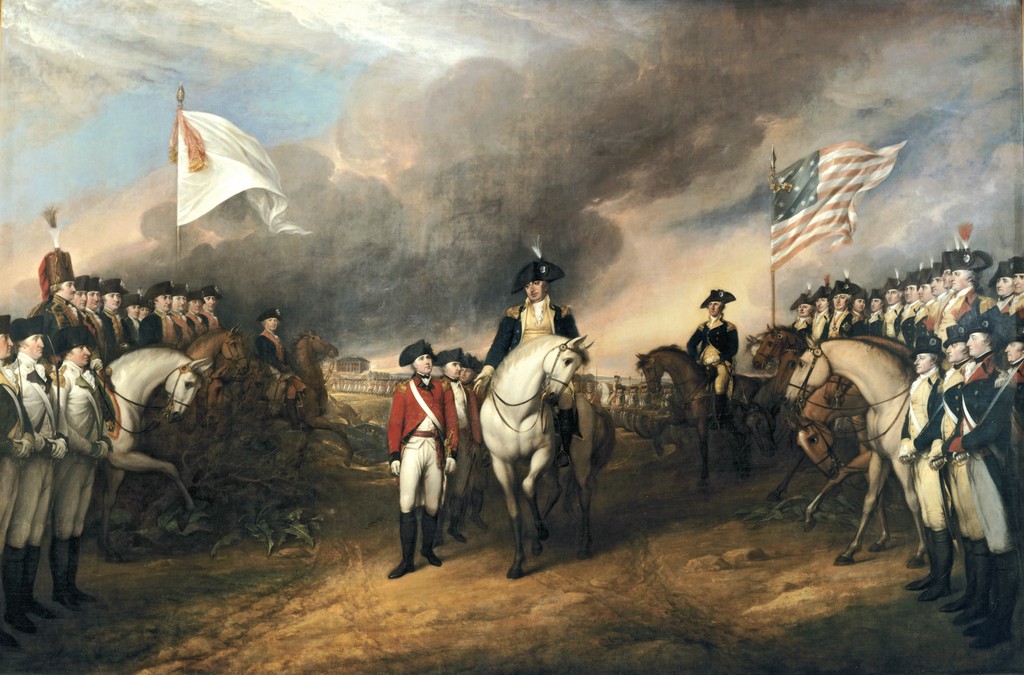
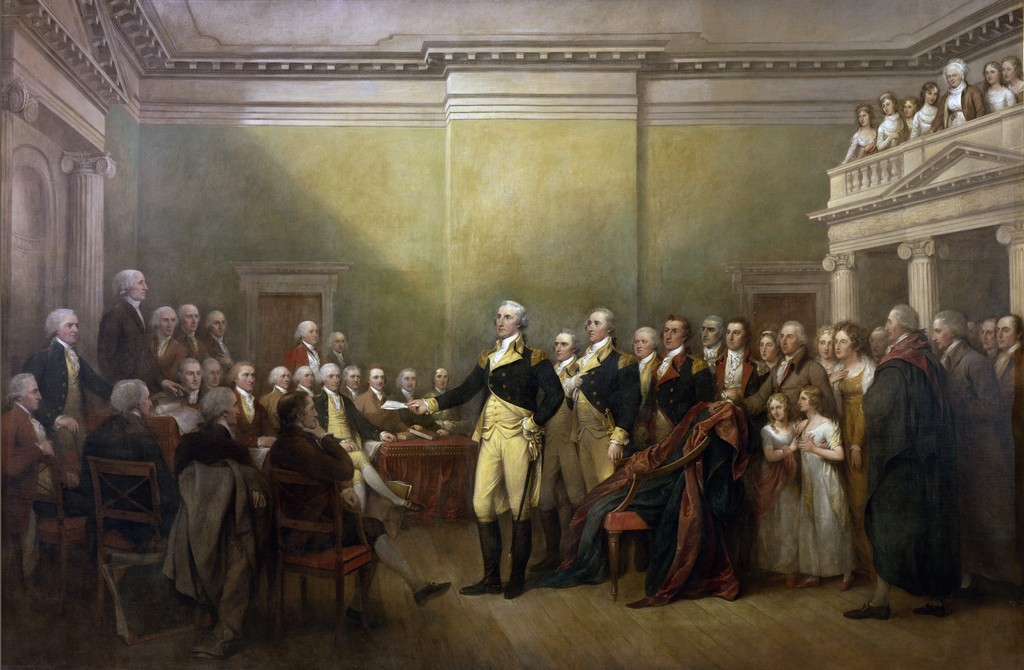
The other three subjects broadened that account. The Surrender of General Burgoyne and Surrender of Lord Cornwallis represented major military victories. Washington Resigning His Commission made the voluntary return of military authority the concluding action. In his memoir, Trumbull explained the subjects as a combination of military and civil events. [2]
The Declaration and Resignation have a particularly close pictorial relationship. Both centre on papers presented before a legislative body, with seated and standing men arranged around the act. Similar chairs reinforce their connection. One image concerns a statement submitted to Congress; the other shows a commander returning the appointment under which he served. [1]
The Capitol setting should remain distinct from the room depicted. Visitors encounter the painting in the Rotunda, but the scene represents the Pennsylvania State House in Philadelphia, now Independence Hall. Trumbull brought an earlier legislative interior into the later federal building, making the architecture of national government a home for the memory of its formation.
Exhibitions and early criticism
The monumental painting entered public view in New York on 5 October 1818, at the American Academy of Fine Arts. A tour took it to other cities before it reached the Capitol early in 1819. It was displayed or stored in different rooms there until installation in the Rotunda in 1826. The making, first exhibition and permanent placement were separate stages in its public life. [1]
The audiences were not unanimous in their response. John Quincy Adams’s letter to his father of 14 December 1818 praises the value of the gathered likenesses but questions whether the painting conveyed the subject’s magnitude. He saw a committee delivering a report where he wanted the viewer to grasp a transformation in the history of political rights. [20]
His criticism is especially revealing because it takes the visible action seriously. The paper presentation was understandable, yet he doubted whether that action could communicate the grandeur of everything associated with independence. The problem was not simply an incorrect face or piece of furniture. It concerned the ability of a quiet historical scene to make large consequences present to the eye.
Adams also asked his father not to circulate the criticism, out of regard for Trumbull, and allowed that simplicity might itself be a measure of moral sublimity. His letter combines disappointment, appreciation and uncertainty about the proper means of representing such a subject. It should not be reduced to an unqualified dismissal of the picture. [20]
Other criticism concerned the distribution of attention. In a January 1819 letter excerpted by the Harvard Declaration Resources Project, Benjamin Waterhouse objected to Samuel Adams’s relative obscurity beside the conspicuous Elbridge Gerry. Samuel Adams Wells later worried that the picture could confuse the history it commemorated. Those responses show that prominence and historical explanation mattered to early viewers as well as to later ones. [16]
The concerns expose different demands on the work. A collection of recognisable people might preserve memory without satisfying someone seeking a sublime national drama. A persuasive group arrangement could also appear unfair to a viewer with strong convictions about the importance of a particular participant. The placement of bodies and faces carried implications beyond the artist’s formal choices.
The canvas had a practical history alongside those debates. In a letter reproduced in his memoir, dated 18 February 1819, Trumbull warned John Quincy Adams about dampness in the Capitol room where the picture had been placed. He was concerned about the conditions around the newly arrived work. The episode adds the physical care of the object to its history as a public image. [2]
Later treatment continued after the Rotunda installation. The Architect of the Capitol records Trumbull’s cleaning and protective work in 1828 and cleaning of the Rotunda paintings in 2008. These dated interventions belong to the canvas’s long public life. Its present appearance should not be imagined as an untouched surface carried directly from the studio into the room. [1]
Durand’s engraving and the problem of dates
Asher Brown Durand translated the composition into a large engraving, extending its life beyond the painted canvases. Trumbull commissioned the plate for three thousand dollars. The Met explains that the engraved copyright date, 20 December 1820, belongs to a work that took three years to complete and was published late in 1823. The two dates describe different stages of its production. [21]
The impression illustrated here is the Met’s 24.90.1514, catalogued as the sixth state of six and dated 1823. Its image measures 51.3 by 76.7 centimetres, with a larger sheet surrounding it. The lettering beneath the picture forms part of the object, identifying the subject in addition to the figures and room represented above. [21]
Looking from the painting to the engraving reveals continuity without complete identity. The committee, table, rows of faces and trophies remain recognisable. Coats, floor and wall are translated through lines and changing densities of tone. Colour no longer performs the same work of separating the red waistcoat, dark coats, pale stockings and warm draperies.
The selected reproduction has a pink or purplish cast. That visible appearance belongs to the image shown here; it should not be treated as proof that all impressions had the same paper, ink or later condition. The full sheet and lower lettering remain visible so that the print can be encountered as a printed object rather than a cropped substitute for the painting.
Another Met impression, 2022.29, is catalogued as the fifth state of six, with a broader date of 1820–23. Its interpretation records forty-eight figures: forty-two signers and six others. It is a different impression from the illustrated sixth state, and its dimensions and state should not be transferred to that sheet. The forty-eight figure account also differs from the Capitol painting’s forty-seven. [17]
These distinctions explain why apparently conflicting labels can arise around a familiar design. A copyright inscription, completion, publication and the state of a plate are not the same kind of date or identity. Nor does a shared composition turn a small painting, a monumental canvas and several print impressions into one object with a single history.
Durand’s contribution belongs to the history of American engraving as well as to the reception of Trumbull. His work gave another artist’s arrangement a form that could circulate on paper. The drawings and prints article follows the wider relationship between Trumbull’s studies, painted designs and reproductive work, including the skilled labour required to carry a composition between media.
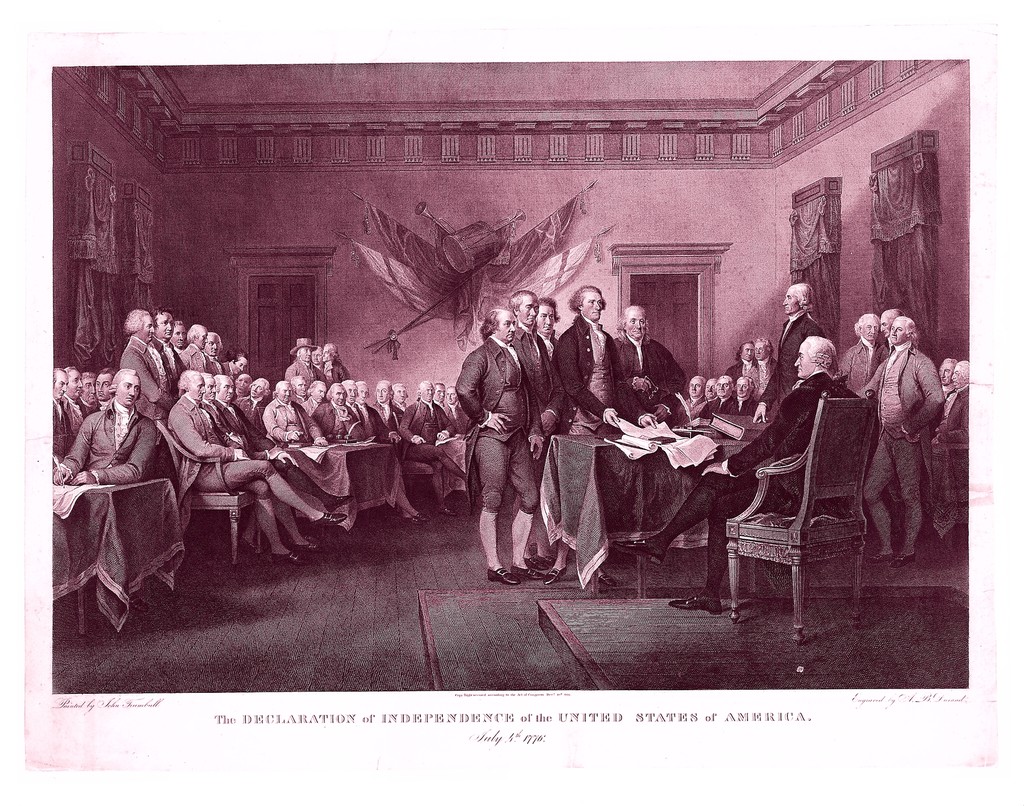
Asher Brown Durand, after John Trumbull, The Declaration of Independence of the United States of America, July 4, 1776, 1823. Engraving, sixth state of six; image 51.3 × 76.7 cm, sheet 60.6 × 81.3 cm. The Metropolitan Museum of Art, 24.90.1514; Bequest of Charles Allen Munn, 1924. The Metropolitan Museum of Art. CC0.
Image source
.
CC0 / Public domain
. Resized only; full supplied image retained. No appearance adjustment.
The restored Assembly Room in a modern photograph
The photograph accompanying this article provides another kind of encounter with the room. Taken by Rdsmith4 on 24 April 2005, it shows the restored Assembly Room at Independence Hall. It records a furnished historic interior at a modern date, rather than the untouched room of 1776 or the actual meeting represented by Trumbull.
Green cloth covers the tables, with papers, books, candlesticks and writing materials arranged across them. Dark chairs repeat along the rows, and a taller chair stands on the raised area at the end. The large windows, fireplace, wall panelling and chandelier make the room feel substantial as a working space, even without the assembly of people.
The view is taken from a different position from Trumbull’s painted scene, so the images should not be treated as directly matching plans. Their different furniture, distribution of tables and handling of light are nevertheless useful to compare. The photograph gives visible substance to the practical room; the painting arranges a group around a single act intended to be seen clearly.
The room’s modern appearance followed extensive historical work. The National Park Service describes preliminary furnishing completed in 1955 and architectural restoration finished in 1965. Researchers combined documentary evidence with investigation of the building, while craftspeople recreated elements that had been altered or lost. The photograph belongs to the history of that restoration. [22]
Surviving fragments played a role in the research. The NPS account describes evidence from woodwork, paint, floor joists and other features used to recover dimensions and details. The restored room therefore combines surviving material with reconstructed work. Its authority rests on investigation rather than on an assumption that nothing changed after the Continental Congress left. [22]
Trumbull and the restorers faced related questions from different positions. Each had to consider what an earlier room looked like through evidence that was incomplete or had changed. The painter’s overriding task was to make a historical subject effective as art. The restoration sought to recover the appearance of a place through documentary, architectural and material research.
The comparison helps locate the painting’s choices without dismissing them as incidental errors. The more elaborate furnishings, gathered trophies and open foreground serve the assembly he wants us to see. The modern photograph gives another basis for imagining the room’s scale and use, while reminding us that access to historic places also involves decisions about preservation and reconstruction.
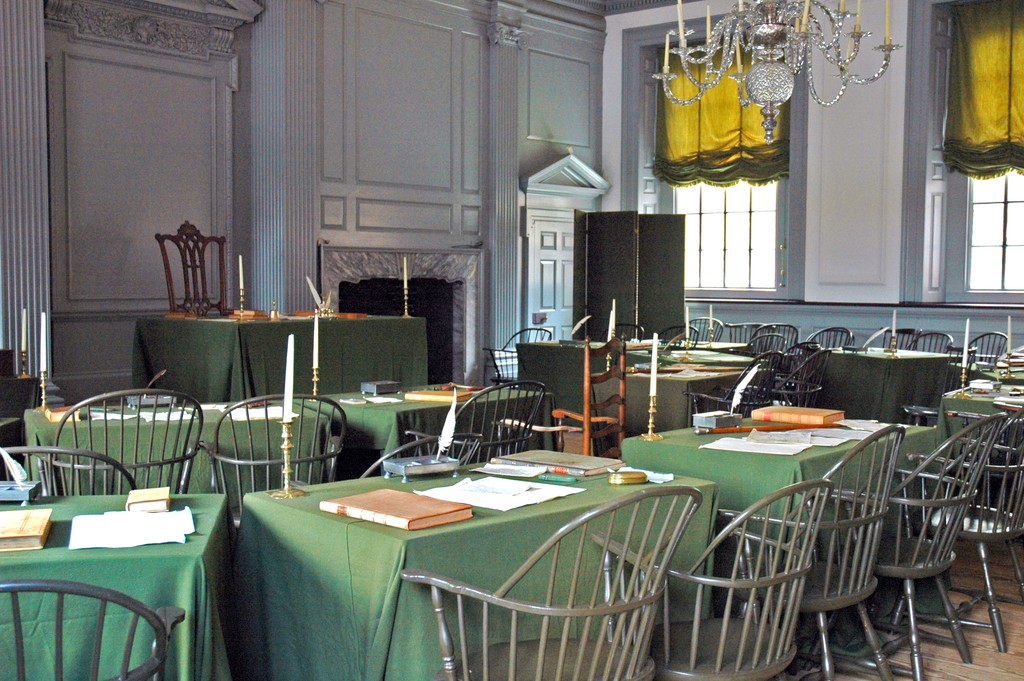
The restored Assembly Room, Independence Hall, Philadelphia, photographed 24 April 2005. Photograph by Rdsmith4. This is a modern view following twentieth-century restoration. Rdsmith4, via Wikimedia Commons, CC BY-SA 2.5. Resized from the original; full supplied view retained.
Image source
.
CC BY-SA 2.5
. Resized only; full supplied image retained. No appearance adjustment.
Public memory, reproductions and historical limits
The central arrangement has travelled far beyond the Capitol and Yale. The Architect of the Capitol records its adaptation on the reverse of the two-dollar bill and on postage stamps. Alongside engravings, these reproductions helped give a particular gathering of bodies and faces a place in the public imagination of independence. [1]
Repetition can make the arrangement seem familiar before a viewer knows what it represents. Jefferson, the committee and the seated president become recognisable components of a national scene. The painting’s very clarity makes it easy to treat the room as a transparent view into the past, even when its selection and arrangement require explanation.
The recurring signing misconception demonstrates the consequence. Knowing the famous image does not necessarily mean knowing the action, date or relationship between its people. The picture can successfully preserve a sense of solemn collective purpose while leaving viewers with mistaken assumptions about the event. Historical understanding requires reading the scene as well as recognising it.
The painting also has a narrower human scope than the world affected by the Declaration. It shows a formal assembly of men engaged in political work. The people beyond the room, and the different experiences through which the Revolution would be lived, are not gathered into that composed encounter. Its authority as an image should not be mistaken for completeness as a history.
John Quincy Adams’s early response remains useful here. He valued the likenesses while asking how a report presentation could convey the magnitude of its consequences. Trumbull’s answer, visible in the design and explained in his memoir, gave exceptional weight to recognisable people, solemn attention and a carefully staged act. The tension between those priorities is part of the work’s interest. [20] [2]
Reading the versions together adds another dimension. The smaller canvas preserves a long project of portrait gathering; the Capitol painting makes the design monumental; the engraving gives it a portable printed form; and the modern room photograph offers evidence of a place reconstructed through later research. Each provides a different route towards the subject rather than replacing all the others.
The paper at the centre remains a small object within a large room. Trumbull makes its passage towards the president carry the weight of a public undertaking, gathering distinct lives around a shared action. The painting becomes richer when that achievement is seen alongside the adjustments, omissions and later interpretations through which it acquired its familiar form.
Artworks directory
Works discussed in these articles, including distinct versions and reproductive prints. Dates identify the particular object; titles and attributions follow the cited collections. This is not a catalogue raisonné.
Frequently Asked Questions
It represents presentation of the draft on 28 June. Congress adopted the Declaration on 4 July, and most signatures on the engrossed parchment were added on 2 August.
The drafting committee: John Adams, Roger Sherman, Robert R. Livingston, Thomas Jefferson and Benjamin Franklin. They present the paper to John Hancock.
No. The Capitol canvas contains 42 of the 56 signers, together with five others.
The painting assembles people associated with independence rather than recording the attendance at one session. Portrait availability and Trumbull’s commemorative aims affected the selection.
In the United States Capitol Rotunda. The scene depicted is the Pennsylvania State House in Philadelphia, now Independence Hall.
The small Yale painting developed from 1786 to 1820. The monumental Capitol canvas was made in 1817–18, during the longer project.
The plate bears an 1820 copyright date. The Met records publication late in 1823 after three years of work.
It shows the restored Assembly Room in 2005. The furnishing and architectural restoration described here were completed in the twentieth century.
Discussion
Look again at the images and ideas explored in Declaration of Independence by John Trumbull. These editorial prompts invite your observations.
Compare the committee’s open foreground with the rows of tables in the modern photograph. How does each arrangement change your sense of the room’s purpose? Consider what Trumbull gained by moving all five committee members towards the president together.
Reader Insights
How do Jefferson’s hands and the open floor clarify the presentation?
How does the modern room photograph change your reading of the painted interior?
What did Trumbull gain by advancing the whole committee together?
Join the Conversation
Share a detail, comparison or question about Declaration of Independence by John Trumbull below.
References
- Architect of the Capitol , Declaration of Independence ; Capitol canvas, represented event, figures, room changes, exhibitions, installation, care and reproductions. View source
- John Trumbull , Autobiography, Reminiscences and Letters , 1841, pp. 96, 147–148, 164, 262–266, 278–279, 407–408 and catalogue no. 9, pp. 416–418; Paris, likenesses, commission, early care and the artist’s account of the composition. View source
- Yale Center for British Art / Yale University Art Gallery , The Declaration of Independence, July 4, 1776 , 1786–1820, 1832.3; small canvas, dimensions and development. View source
- Yale University Art Gallery via Wikimedia Commons, Death of General Montgomery,1786,1832.2,. View source
- Yale University Art Gallery / Wikimedia Commons, The Capture of the Hessians at Trenton,December26,1776,1832.5,. View source
- Yale University Art Gallery via Wikimedia Commons, The Death of General Mercer at the Battle of Princeton, January3,1777,1832.6.1,. View source
- Metropolitan Museum of Art, The Sortie Made by the Garrison of Gibraltar,. View source
- Metropolitan Museum of Art, George Washington before the Battle of Trenton,. View source
- National Gallery of Art, Alexander Hamilton, c1792,. View source
- National Gallery of Art / Ellen G. Miles with Cynthia J. Mills and other contributors, American Paintings of the Eighteenth Century,1995,Trumbull entries,. View source
- Museum of Fine Arts, Boston, Death of General Warren at Bunker’s Hill,. View source
- Architect of the Capitol, Surrender of Lord Cornwallis,. View source
- Architect of the Capitol, Surrender of General Burgoyne,. View source
- Architect of the Capitol, General George Washington Resigning His Commission,. View source
- National Archives , Creating the Declaration: A Timeline ; committee, independence resolution, adoption, engrossing and signing. View source
- Harvard Declaration Resources Project , Resources for Teachers: John Trumbull’s Declaration of Independence , 2018; selected attendance and portrait examples, and excerpts of Waterhouse’s and Wells’s early responses. View source
- The Metropolitan Museum of Art , Declaration of Independence , Durand after Trumbull, 1820–23, 2022.29; separate fifth-state impression and figure account. View source
- The Metropolitan Museum of Art , Thomas Jefferson , 1788, 24.19.1; separate portrait and relationship to Trumbull’s historical likeness. View source
- Andrew M. Davenport, The Metropolitan Museum of Art , Considering Young Jefferson , 11 August 2026; reported research concerning a likely source for Trumbull’s Jefferson likeness. View source
- John Quincy Adams to John Adams , 14 December 1818, Founders Online, Adams Papers, Early Access transcription; contemporary appreciation and private criticism. View source
- The Metropolitan Museum of Art , The Declaration of Independence of the United States of America, July 4, 1776 , Durand after Trumbull, 1823, 24.90.1514; illustrated sixth-state engraving, commission, copyright and publication. View source
- National Park Service , Restoring the Assembly Room ; furnishing research, architectural investigation and twentieth-century restoration. View source
- Splash image source.
John Trumbull, Declaration of Independence, painted August 1817–September 1818. Oil on canvas, 12 × 18 feet. United States Capitol Rotunda. The scene represents presentation of the draft to Congress, associated with 28 June 1776. John Trumbull; Architect of the Capitol, via Wikimedia Commons. Public domain. Public domain . Resized only; full supplied image retained. No appearance adjustment.
View source