 by Tom Gurney
Tom Gurney BSc (Hons) is an art history expert with over 20 years experience
Published on June 19, 2020 / Updated on October 2, 2026
Email: tomgurney1@gmail.com / Phone: +44 7429 011000
Kazimir Malevich (1879–1935) is remembered above all for Black Square, but his life cannot be compressed into the making of one painting. He grew up in what is now Ukraine, worked in Kursk and Moscow, took part in Futurist theatre, created and explained Suprematism, taught in Vitebsk and Petrograd, exhibited in Warsaw and Berlin, returned to teach in Kyiv, and made portraits and peasant paintings in his final years. Places, collaborators and political circumstances changed around the work. So did his explanations of what art could be. This biography follows the documented sequence while linking to the individual paintings where a closer reading of a physical object matters. [1], [4]
Several familiar summaries flatten that sequence. An early stage design connected to a black square is not the 1915 canvas in the Tretyakov Gallery. The artist's announcement that he would concentrate on theory after the white paintings did not prevent later painting. His return to figures cannot be explained by one motive alone. Even his birth year appears differently across museum catalogues. A reliable chronology has to preserve these tensions rather than edit them away. [1], [2], [3], [5], [6]
At a glance
- Full nameKazimir Severinovich Malevich; Polish and Ukrainian spellings also occur
- Born11 February 1879 Old Style / 23 February 1879 New Style, Kyiv, then in the Russian Empire
- Died15 May 1935, Leningrad
- Family contextParents of Polish origin; childhood and early experience in areas of present-day Ukraine
- Principal places of workKursk, Moscow, Petrograd/Leningrad, Vitebsk and Kyiv
- Known forDeveloping Suprematism and exhibiting the first Black Square in 1915
- Beyond oil paintingDrawings, prints, books, theatre, teaching, porcelain design, architectural models and theoretical writing
- Key groups and institutionsMoscow avant-garde exhibitions; Vitebsk art school and UNOVIS; State Institute of Artistic Culture
Malevich’s life in context
The bands locate documented places, people and work; they are approximate, not exclusive phases. Follow each source or artwork for detail.
Rerberg studio [1]
Moscow, c. 1905–10Goncharova and Larionov [1]
Moscow, c. 1907–14Kruchenykh and Matyushin [1]
Theatre, 1913Chagall and Vitebsk school [1]
1919–20Ermolaeva and Lissitzky [9]
UNOVIS, 1920–22Suetin and Chashnik [1]
Vitebsk to Petrograd, 1920sHugo Häring and western custody [12]
after Berlin, 1927Knife Grinder [7]
1912–13Victory over the Sun designs [1]
1913Black Square [5]
1915White on White [6]
1918The Non-Objective World [10]
1927 publicationRed Cavalry [15]
c. 1932Self-Portrait (The Artist) [13]
1933Contents
- Birth, family and the problem of dates
- Kursk, railway work and the pull of Moscow
- Moscow exhibitions and a language of rural figures
- Cubo-Futurism, speed and artistic collaborators
- 1915: exhibition, paintings and argument
- Revolution, the white works and the question of painting's end
- Vitebsk: teaching and UNOVIS
- Petrograd and Leningrad: institute, porcelain and architectons
- Warsaw and Berlin, 1927: a journey and the future of the paintings
- Return, Kyiv teaching and the 1929 exhibition
- Arrest, late work and the limits of a single explanation
- Death, commemoration and the continuing life of the work
- Frequently asked questions
Watch: Kazimir Malevich
Three short films place Black Square, the 1915 exhibition and Malevich’s later work in context.
Kazimir Malevich | TateShots
A curator introduces Black Square, the 0.10 exhibition and Malevich’s later work.
Watch on YouTubeBirth, family and the problem of dates
Malevich was born in Kyiv, then part of the Russian Empire. His parents were of Polish origin; his father worked in the sugar industry. His childhood was spent among towns and industrial-rural landscapes rather than in a single capital city. Those circumstances do not make the later peasant images simply autobiographical, but they make it misleading to begin his story with a sudden encounter with urban avant-garde painting. Rural work, buildings and seasonal rhythms belonged to his early world. [1], [3]
Many art catalogues give 1878 as his birth year, and a Malevich Society biography gives a February 1879 day that differs from the record used here. A reproduced Kyiv Roman Catholic parish register, read with the National Academy of Sciences of Ukraine's historical entry, supports 11 February 1879 in the local Julian calendar, equivalent to 23 February in the Gregorian calendar. The conversion explains two dates, not two births. Older institutional labels should be understood as part of the history of cataloguing him; they are not grounds for quietly replacing the register. [1], [2], [3]
His national description also needs historical precision. Kyiv is in Ukraine today and was in the Russian Empire at his birth. His family background was Polish. He later made and taught art in places now in Ukraine, Russia and Belarus, and showed work in Poland and Germany. “Russian,” “Ukrainian” or “Polish” may appear in collection labels for defensible reasons, but each alone leaves out part of a life that crossed languages, empires and later borders. This page therefore uses places, family context and dates wherever a single adjective would hide more than it explains. [1], [3], [4]
Kursk, railway work and the pull of Moscow
The family moved to Kursk in the 1890s. Malevich worked for the railway and practised art with a circle of friends. That combination matters: he did not pass straight from a conventional academy to radical geometry. He was learning to work while earning a living, pursuing art beyond a formal curriculum, and looking toward Moscow's collections and exhibition culture. His first attempts to enter that world involved visits and applications rather than an uncomplicated story of successful admission to the city's School of Painting, Sculpture and Architecture. [1]
The State Russian Museum's brief biographical entry says he studied at the Moscow School in 1904–05, while the Malevich Society's fuller chronology says he tried unsuccessfully to gain admission. Both identify his later study in Ivan Rerberg's private studio. Until the training records are reconciled, the safest public account is that he sought study in Moscow and learned in Rerberg's studio, without claiming a completed course at the School. This is a small but revealing example of why a life story should not treat every institutional capsule as interchangeable. [1], [4]
Malevich married Kazimira Zgleits in 1902, and they had two children, Anatolii and Galina. After the marriage ended, he married Sofia Rafalovich in 1909; their daughter was Una. Sofia died of tuberculosis in 1923. These facts make the life larger than an exhibition chronology, yet they should not be used as unearned explanations of individual shapes or colours. Surviving autobiographical accounts and family documents offer paths for fuller study, but the visible painting and a documented family event are different kinds of evidence. [1], [16]
Moscow exhibitions and a language of rural figures
By 1907 Malevich was exhibiting with the Moscow Association of Artists. In the following years he moved among Impressionist, Symbolist and Fauvist possibilities and joined contentious contemporary exhibitions. The Malevich Society records his participation in the Jack of Diamonds circle, the Donkey's Tail in 1912 and Target in 1913. He knew Natalia Goncharova and Mikhail Larionov, whose experiments with icons, popular images and rural motifs formed part of the environment in which he worked. None of these contacts means that one artist's canvas can be attributed to another's programme. They show an active network rather than a solitary preparation for a single breakthrough. [1], [4]
Peasant and labouring figures were central to some works before Suprematism. The Woodcutter, Taking in the Rye and Morning in the Village after Snowstorm retain recognisable people and activity, yet broad colour areas, insistent outlines and compressed space refuse a neutral descriptive view. These are distinct paintings with their own dates and collections. They can be placed together as a phase of inquiry without treating “peasant” as a single fixed style or making every figure a symbol of the same political idea. [1], [4]
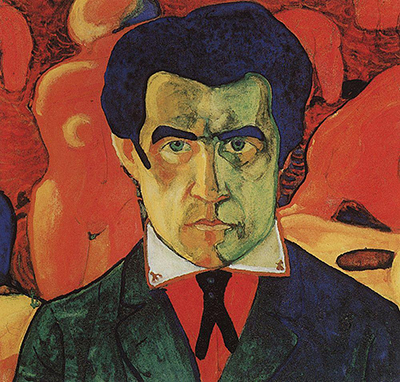
An early painted Self-Portrait likewise uses emphatic colour to construct a face. The site owner's high-resolution image matches an existing local page, but its exact museum object identity and date remain under review: a supplied file name says 1912, while a Tretyakov narrative identifies a closely matching early image as 1911. The portrait can illustrate the artist's early range without this biography claiming a secure inventory number that has not yet been established. It must not be confused with the 1933 Self-Portrait (The Artist) in the Russian Museum. [1], [13]
Cubo-Futurism, speed and artistic collaborators
Between roughly 1912 and 1914 Malevich tested how a painting could show movement and how an object could be divided into interacting planes. Yale's Knife Grinder repeatedly interrupts the worker, wheel and working space, giving motion a stuttering visual rhythm. MoMA's Woman with Pails: Dynamic Arrangement keeps a carrying figure present while colours and angled forms make the scene increasingly difficult to read as conventional depth. The museums' object records matter because later inscriptions and retrospective dates can complicate simple accounts of artistic progression. [7]
The surrounding artistic culture crossed media. Malevich designed and illustrated Futurist books, worked with poets and musicians, and debated how words and images might leave ordinary description behind. In 1913 he collaborated with Aleksei Kruchenykh and Mikhail Matyushin on the Futurist opera Victory over the Sun. The stage designs and costumes are a documented part of his experimentation. A dark-and-light square form in that theatrical context helps explain why Malevich later associated the origin of a square idea with 1913. It does not mean that the surviving Tretyakov oil painting was exhibited that year. [1], [4], [5]
The 1914 An Englishman in Moscow shows another line of experiment. Its recognisable objects and letters are arranged so that they cannot be gathered into an ordinary scene. The Stedelijk's later discovery of a related drawing helps connect the canvas to Malevich's “alogical” period, when disrupted relations among things could become an artistic method. Moving from this painting to Black Square is not a story of merely removing the final fish or face. It is a more difficult move from images whose objects no longer behave logically to a painting whose central shape asks to be read without a depicted object at all. [8]
1915: exhibition, paintings and argument
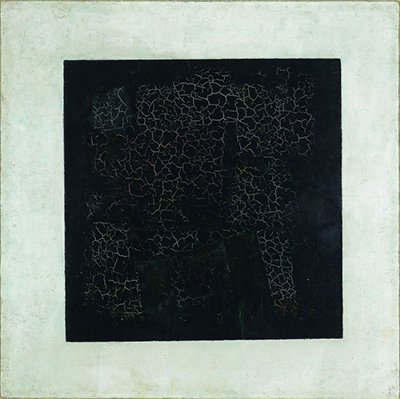
Malevich presented the first surviving Black Square at the 0.10 exhibition in Petrograd in December 1915. The Tretyakov Gallery identifies its physical canvas as a 1915 work. In the period installation photograph the square hangs high across the room's corner, surrounded by many other new compositions. Its placement invited comparison with a domestic icon corner, but what viewers saw was a dark painted quadrilateral in a pale field. It was a deliberate public encounter, not simply a theory written before a painting existed. [1], [5]
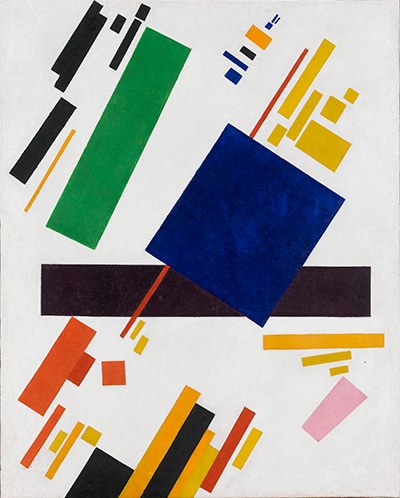
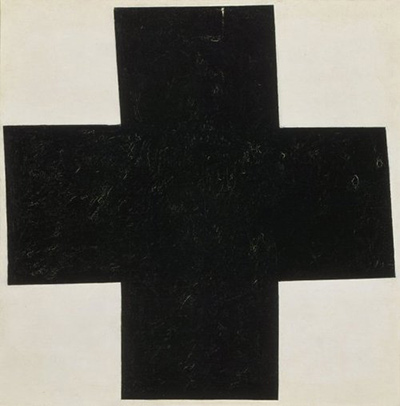
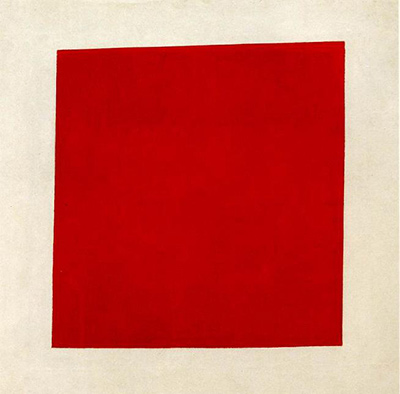
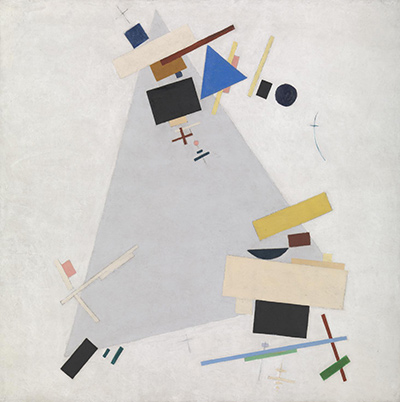
The new approach Malevich called Suprematism removed the depicted thing as the painting's required subject. Colour, geometric form and the relation to an open field could carry the work. His 1915 canvases were varied: Red Square, Black Cross and Suprematist Composition: Airplane Flying should not be imagined as copies of the black canvas in other colours. Their titles, forms, present collections and physical versions differ. Malevich's texts of the moment argued for a new painterly realism and a passage beyond inherited representation, but a life narrative should not turn changing writings into one timeless slogan. [1], [5], [10]
The moment also belongs to his colleagues and opponents. In the 1910s he took part in networks of artists and poets whose positions were not identical. The Russian Museum records the organisation of the Supremus group and proposed journal in 1916–17. Malevich's developing coloured compositions were made during war and revolutionary upheaval, while he continued to exhibit, write and organise. The fact that Black Square became an emblem afterward can make this working context invisible. The first exhibition showed a room of paintings, and his subsequent career would take Suprematist ideas well beyond an easel. [1], [4]
Revolution, the white works and the question of painting's end
After the February Revolution in 1917, Malevich took roles in new artistic organisations. The Malevich Society records his election to an arts department of the Moscow Soviet of Soldier Deputies and work in a commission for preserving art and antiquities after the Bolshevik takeover. Such appointments show that his life was entangled with the new public institutions, although they should not be flattened into a claim that each painting expressed a party line. He also designed for theatre and public events and wrote articles. [1]
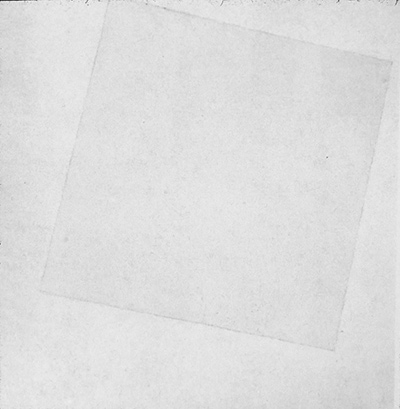
The Suprematist paintings changed as well. Single forms and pale grounds became increasingly important; the 1918 White on White in MoMA makes a tilted light square legible through delicate differences within white. Its apparent reduction is not the disappearance of painted decisions. Edges, tone and orientation remain. Around this period Malevich announced a move toward writing and philosophy, describing a new stage beyond his previous painting practice. The announcement is part of his thought, but it should not be presented as the date on which he ceased to make images or objects. Later drawings, designs, models and canvases make that reading untenable. [1], [6], [10]
His writing was not an afterthought to a finished style. Texts changed during publication and translation; titles that sound like final manifestos often belong to a specific year and audience. The Malevich Society's bibliography lists On New Systems in Art, Suprematism: 34 Drawings, God is Not Cast Down and the 1927 German Non-Objective World among important stages. A future theory and writings guide will take the arguments and editions one by one. This biography uses the publication sequence to show how closely writing, teaching and making were connected. [10]
Vitebsk: teaching and UNOVIS
In 1919 Malevich moved to Vitebsk, then in Belarus, to teach at the People's Art School established by Marc Chagall. The Malevich Society gives his arrival as 5 November. He attracted students and staff who wanted to work with the new visual language, among them Vera Ermolaeva and El Lissitzky. Early in 1920 a collective called UNOVIS, often rendered “Affirmers” or “Champions of the New Art,” formed around the group. Its identity was expressed through shared signs and work as well as individual paintings. Chagall's departure amid the school's tensions forms part of the institutional story; it need not be turned into a cartoon of two artists fighting over a single classroom. [1], [9]
UNOVIS brought Suprematist thinking into teaching, printing and the surrounding city. The Malevich Society records designs for posters, clothing, fabric, buildings and practical public items. MoMA's record for the 1921 publication The Path of UNOVIS lists several contributors, a useful material reminder that this was collective production. Students explored earlier pictorial methods before pursuing objectless art, according to the specialist biography. A pedagogy that moved through successive approaches could teach both historical comparison and experiment, not simply a rule to place squares on every surface. [1], [9]
The group was also situated within revolution and civil war. A MoMA study of UNOVIS posters connects its public visual programme to those conditions. That context does not mean every form has a fixed political translation. A black square used as a group sign, a painted canvas in an exhibition, a printed book illustration and a design on a façade were different objects with different viewers. Vitebsk is therefore essential to the biography because it shows how a language first encountered in paintings was tested through collective methods and public life. [1], [9]
Malevich wrote extensively in Vitebsk. Suprematism: 34 Drawings was published there in 1920; the title's number refers to a real printed sequence, not a general name for every abstract drawing he made. The publications helped circulate ideas at a time when original canvases were not easy to see across distant cities. They also require care from a present-day reader: editions, languages and later collected texts can alter how a short passage appears. The drawings and prints routes will separate unique works on paper from prints and book objects. [10]
Petrograd and Leningrad: institute, porcelain and architectons
Malevich and several students moved from Vitebsk to Petrograd in 1922. Among those named by the Malevich Society are Nikolai Suetin, Lazar Khidekel, Ilya Chashnik and Lev Yudin. In the city Malevich worked with the Museum of Artistic Culture and took part in its reorganisation as the State Institute of Artistic Culture, commonly called GINKhUK. An artist known for a single severe canvas was now building an institutional setting for research, teaching and experiment. [1]
His ideas took material forms that were not oil paintings. He made designs for porcelain at the State Porcelain Factory and developed plaster constructions he called architectons. Some were horizontal and others rose around a vertical axis; drawings for imagined spatial structures, or planits, relate to these questions. The models were not straightforward blueprints for buildings actually constructed. They were investigations into how volumes might be organised once familiar pictorial and architectural conventions were loosened. The biography records the project without claiming that every later abstract building derived directly from it. [1], [4]
The institute operated under increasing pressure. A 1926 newspaper attack portrayed it as a misuse of state resources, and it was closed later that year. Malevich continued to work in another institutional setting, but the closure marks a loss of support for the kind of experimental research he had been conducting. The change helps explain the stakes of his 1927 trip westward. It does not prove that he had already abandoned Suprematism or that one political event mechanically produced each later figure painting. [1]
Warsaw and Berlin, 1927: a journey and the future of the paintings
In March 1927 Malevich travelled through Poland and organised a Warsaw exhibition. He then went to Germany, where his work appeared in Berlin as a separate display within the Great Berlin Art Exhibition. The Malevich Society's exhibition list gives Warsaw in late March and a Berlin run beginning in May; its biographical narrative also records a visit to the Bauhaus in April. The trip brought his work and writings into direct contact with a western European audience and renewed the question of how Suprematism could be presented outside the places in which it had developed. [1], [11]
The journey changed the paintings' later lives. Called back to the Soviet Union, Malevich left many works behind in Berlin. Different objects then followed different chains of custody. Some eventually passed through architect Hugo Häring to the Stedelijk Museum in Amsterdam; some were shown or acquired elsewhere. A later Stedelijk settlement with Malevich's heirs affected particular works, not every painting associated with the 1927 trip. The Suprematist Composition page gives one canvas's specific provenance. A biography can describe the trip's importance while leaving accession-level ownership to each object's record. [1], [12]
His text The Non-Objective World appeared as a German Bauhaus book in 1927. The publication does not reduce the trip to a publicity exercise: a book could reach readers who would never stand before the canvases, while the physical works remained vulnerable to events beyond the artist's control. The western display and dissemination later became crucial to the preservation and study of Malevich's work. Yet the movement of objects has sometimes encouraged a misleading split between an “international” abstract Malevich and a separate late painter at home. Both were parts of one career. [1], [10], [12]
Return, Kyiv teaching and the 1929 exhibition
Malevich returned to a changing cultural climate. The Malevich Society records continuing accusations of formalism and counter-revolutionary thought; he also published in the Kharkiv journal Nova Generatsiia. After institutional setbacks, he taught at the Kyiv Art Institute for periods during 1929–30, as the Russian Museum's biography confirms. His return to the city of his birth as a teacher deserves attention in its own right, rather than appearing merely as a prelude to an arrest. [1], [4]
In November 1929 the Tretyakov Gallery opened a solo exhibition. The artist presented a retrospective account of his work, but some paintings then given early dates were made later. This is one reason a date written on a Malevich canvas cannot always be copied uncritically into a timeline. It may relate to the date of an idea, a desired place in an artistic sequence, or the artist's later retelling of his own career. Museums' technical and documentary research must guide the dating of a physical object. The practice also complicates the easy claim that his styles replaced one another in a simple order. [1]
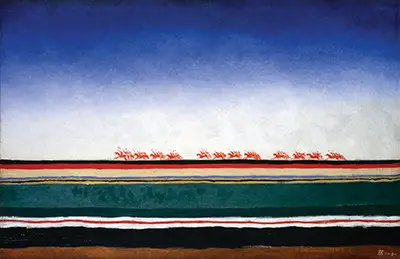
The later pictures revisited peasants, bodies and landscapes. Such themes had appeared before 1915, but a late figure can be made from colour divisions and flattened space learned through nonobjective painting. The Russian Museum dates Sportsmen to 1928–32; its four simplified figures are both recognisable people and a rhythm of strong coloured sections. The same museum dates Red Cavalry circa 1932 even though “1918” is inscribed on the work. Reading the inscription as the creation date would erase the later moment in which the painting was actually made. [1], [15]
Arrest, late work and the limits of a single explanation
Malevich was arrested in 1930 and held for approximately three months, according to the Malevich Society biography. His institute had closed earlier, and his possibilities for public work had narrowed. The Russian Museum also describes material hardship in its discussion of the circa-1930 Peasants. Such evidence makes political and economic pressure impossible to ignore. It does not, by itself, assign a precise hidden message to every faceless person or empty field. A responsible interpretation can say that particular paintings were made in this environment while continuing to examine what is actually visible in them. [1], [14]
Late figure paintings are diverse. The anonymous standing bodies in Sportsmen differ from the minute moving riders in Red Cavalry; neither is the same pictorial problem as a close portrait. Tretyakov's Girl with a Comb in Her Hair belongs to 1932–33 and shows attention to an individual face and the articulation of colour across hair, skin and dress. The biography should not turn all these works into evidence that the artist “gave up” on his own invention. Their formal choices show continuing work through questions of colour, surface and structure even when the subject changed. [13], [15]
The Russian Museum's 1933 Self-Portrait (The Artist) makes the shift especially clear. Malevich presents himself in elaborate historical dress, with a geometric order of white, black, red and green. The museum identifies this as a separate work with its own inventory number, ЖБ-1516. It is not the early painted head used elsewhere in this cluster. Comparing the two suggests how differently an artist could construct a public self-image over two decades. The comparison need not assume that the later costume was either a private joke or a simple surrender to traditional painting; the object and its moment allow a more open question. [13]
Death, commemoration and the continuing life of the work
Malevich died in Leningrad in May 1935. The Russian Museum's account of the 1933 self-portrait also describes the funeral organised by friends and students. A Suprematist coffin and a black-square sign on the vehicle carried his earlier visual language into that final public event. After cremation in Moscow, his ashes were buried at Nemchinovka, where a memorial designed by Nikolai Suetin included a black square. These details are more than picturesque afterlife: they show that the form remained a sign used by the people who knew him, alongside his late portraits and other work. [1], [13]
The international history of Malevich's reputation was shaped by uneven access to objects and archives. Works left in the West in 1927 had one fate; collections and documents in Soviet institutions had another. The Malevich Society notes that later access to archives changed scholarship on his life. Stedelijk research into the Khardzhiev collection has identified a preparatory drawing decades after the artist's death, and technical studies of canvases have corrected easy assumptions about date, layers and versions. A biography therefore remains a researched account, not a fixed legend completed in 1915. [1], [8], [12]
To continue from the life to the work, start with Black Square for the first canvas and its 1915 room; White on White for the 1918 reduction; An Englishman in Moscow for the alogical phase; and Sportsmen or Red Cavalry for late figures. The paintings guide will browse the larger corpus, while theory and writings will follow the texts by edition. The works reward being read as particular objects made across a changing life. [5], [6], [8], [15]
Selected chronology
| Year | Documented moment | Why it matters |
|---|---|---|
| 1879 | Born in Kyiv to a family of Polish origin | Old and New Style calendar dates must be converted correctly. [2], [3] |
| 1890s | Family in Kursk; railway employment and art practice | Art developed alongside paid work. [1] |
| 1907–13 | Moscow exhibitions; contact with Goncharova and Larionov | Different early visual languages and networks. [1], [4] |
| 1913 | Designs for Victory over the Sun | Theatre experiment associated with later square idea. [1], [4] |
| 1915 | First Black Square at Petrograd's 0.10 exhibition | Public presentation of Suprematism. [5] |
| 1918 | White paintings, including MoMA's White on White | Further transformation of form and field. [6] |
| 1919–22 | Vitebsk teaching and UNOVIS | Collective teaching, printing and public design. [1], [9] |
| 1922–26 | Petrograd/Leningrad institutional work and architectons | Research in museums, objects and spatial models. [1] |
| 1927 | Warsaw and Berlin exhibitions; German publication | International presentation and divergent object histories. [1], [10], [11] |
| 1929–30 | Kyiv teaching; Tretyakov retrospective; arrest | Late career under altered institutions and pressure. [1], [4] |
| 1932–33 | Late landscapes, figures and portraits | Representation returns in varied forms. [13], [15] |
| 1935 | Death in Leningrad and Suprematist funeral | The black-square emblem persisted among associates. [13] |
Questions about Malevich's life
What year was Kazimir Malevich born?
The reproduced Kyiv parish record and a Ukrainian scholarly historical entry support 1879, with 11 February Old Style corresponding to 23 February New Style. Some older museum records give 1878; even current specialist and museum summaries can differ on the precise day. [1], [2], [3]
Was Malevich Russian, Ukrainian or Polish?
He was born in Kyiv, then in the Russian Empire, into a family of Polish origin. He worked in places now in Ukraine, Russia and Belarus. A collection label may choose one adjective, but his biography is more accurately told through those specific family and geographic facts. [1], [3], [4]
Did he make Black Square in 1913?
He later linked the square idea to his 1913 theatre work. The Tretyakov Gallery's first surviving oil painting is dated 1915 and was shown that December. The stage design and canvas are distinct objects. [1], [5]
Did he stop painting after White on White?
No. He announced a turn toward theory and worked in writing, teaching and other forms, but he also later made canvases with peasants, figures and portraits. [1], [6], [13], [15]
Why did he return to figures?
The change happened amid institutional closure, political accusation, arrest and difficult living conditions. The documented pressure is important, while the paintings' subjects and structures vary too much to assign them all one motive. His early work had also included figures, so the late work revisited a theme as well as changing it. [1], [14], [15]
Documented Malevich collection records
Explore 665 catalogued source objects from museums and archives, including 87 exact links to local artwork pages. Records include works, print impressions, book components and archival items; they are not a deduplicated or complete oeuvre. Medium labels are grouped into broad English categories. Titles link to local artwork pages where available.
| Artwork title | Date | Medium |
|---|---|---|
| "Front line soldier" (Ratnik 1-go razriada) | Δεκαετία 1920 | Photograph |
| [Le Cheval blanc] | [circa 1930 - 1931] | Painting |
| [Sensation du danger] | [1930 - 1931] | Painting |
| A Game in Hell, Petrograd, 1913 (2nd expanded edition) | 1913 | Book |
| A Game in Hell: A Poem (Igra v adu: Poema) | 1914 | Book |
| A Peasant Woman Goes for Water | 1913 | |
| A pork-butcher came around to Lodz and we said "Good day." From Lodz to neighboring Radom he passed, and left behind one sorry ass. (Podoshel kolbasnik k Lodzi / my skazali : 'Pan dobrodzi!' Nu, a s Lodz'iu riadom Radom / i ushel s podbitym zadom.) | c. 1914 | |
| Alogisme 1. Portret Moskovskoy Damy (Alogisme 1. Portret van een Moskouse dame) | 1914 | Drawing |
| Alogisme 2. Vis, zaag, lepel, telegraafpaal | 1914 | Drawing |
| Alogisme 22. Malorossiyanin (Alogisme 22. Een kleine Rus) | 1915 | Drawing |
| Alogisme 23. Sobol, koshka (Alogisme 23. Sabel, kat) | 1915 | Drawing |
| Alogisme 29. Derevnya | 1915 | Drawing |
| Alogisme 3. Chastichnoe zatmenie (Alogisme 3. Gedeeltelijke eclips) | 1914 | Drawing |
| Alogisme 4. Apteka (Alogisme 4. Apotheek) | 1914 | Drawing |
| Alpha | 1923 / 1978 | Sculpture or object |
| An Austrian was going to Radzivily | 1914 | |
| An Austrian was going to Radzivily | 1914 | |
| Analytical Chart | 1924–27 | Drawing |
| Analytical Chart | 1924–27 | Drawing |
| Analytical Chart | 1924–27 | Drawing |
| Analytical Chart | 1924–27 | Drawing |
| Analytical Chart | 1924–27 | Drawing |
| Announcement for Malevich's lecture in Orenburg | 1917-1920 | |
| Apple Tree in Blossom | c. 1930 | Painting |
| Architecton Alpha | 1920 | Sculpture or object |
| Architecton Gota | 1923 (?) | Sculpture or object |
| Architectonische constructie | 1917 (versie ca. 1925) | Drawing |
| Architectons and Figurines | Späte 1920er Jahre | Sculpture or object |
| Architecturaal-kosmische compositie | 1920 (latere versie (1927?)) | Drawing |
| Architectural construction | ca. 1917 | Drawing |
| Aritmetica | 1913 | Drawing |
| Aritmetica | 1913 | Drawing |
| Arkhitekton Zeta | 1926 | Photograph |
| At Harvesting (Marfa and Vanka) | 1928-1929 | Painting |
| Aveniriens | vers 1931 - 1932 | Drawing |
| Aviator | 1914 | Painting |
| Aviator v Pobede nad solntsem (Vliegenier in Overwinning op de zon) | 1913 (versie ca. 1929) | Drawing |
| Baadsters op de rug gezien | 1910 | Painting |
| Back cover from Igra v adu (A Game in Hell) | 1913–14, published 1914 | Book |
| Back cover from Vzorval' (Explodity) | 1913 | Book |
| Bader | 1911 | Drawing |
| Betende Bäuerin | 1933 | Drawing |
| Biddende figuur | motief ca 1922, versie voor 1927 | Drawing |
| Birkenhain | um 1905 - 06 | Painting |
| Black Circle | c. 1923 | Painting |
| Black Cross | c. 1923 | Painting |
| Black quadrilateral | 1915 | Painting |
| Black Square | c. 1923 | Painting |
| Black Square and Circle | 1920-1921 | Drawing |
| Black Square and White Cylindrical Form | 1915 | Drawing |
| Black Square, Second State | 1915/20 | Drawing |
| Blacksmith | Study. 1933 | Painting |
| Blestifze (Pencils) | 1917–1918 | Drawing |
| Boer met baard | ca 1930 | Drawing |
| Boerenvrouw in het veld | ca. 1929-1930 | Drawing |
| Boerenvrouw met emmers | 1912 | Painting |
| Book of Selected Poems (Kniga izbrannykh Stikhotvorenii) | 1930 | Book |
| Boy (Vanka) | 1928–1929 | Painting |
| Boy wuth knapsack / Mal'chyk s rantsem | 1915 | |
| Brooch | 1920 | Sculpture or object |
| Brooch | 1920 | Sculpture or object |
| Bubnovy Valet 21. Boerenvrouw met kind | 1911-1912 (latere versie) | Drawing |
| Bubnovy Valet 40. Portret (van M.F. Larionov?) | 1910 | Drawing |
| Bubnovy Valet 41. Na uglu stoit apteka, lyubov sushit tseloveka (De drogist is op de hoek, van liefde droogt een man uit) | 1910-1911 (versie ca. 1930) | Drawing |
| Bubnovy Valet 42. Portret moei rodstvennitsy (Bubnovy Valet 42. Portret van mijn familielid) | 1911 | Drawing |
| Bubnovy Valet 43. Kop van een boer | 1912 (latere versie) | Drawing |
| Bubnovy Valet 44. Dansend paar | 1912 | Drawing |
| Bubnovy Valet 57. Lopende man | 1911 | Drawing |
| Bubnovy valet 8. Kop van een boer | 1912 | Drawing |
| Budetliyansky silach (Futuristische sterke man) | 1913 (versie 1915) | Drawing |
| Bêta | avant 1926 / 1978 | Sculpture or object |
| Car and Lady | Photograph | |
| Carpenter | 1928–1929 | Painting |
| Carré noir | [1923 - 1930] | Sculpture or object |
| Chelovek v ochkakh (Man met bril) | ca 1929 | Drawing |
| Compositie 1 z (Supremus nr. 67) | 1916 (versie jaren 1920) | Drawing |
| Compositie 10 t (Suprematisme: constructief moment) | 1917 | Drawing |
| Compositie 11 t (Supremus nr.18: constructievorming afhankelijk van de beweging naar een bol ) | 1916 | Drawing |
| Compositie 13 t (Supremus nr 38) | 1915-1916 | Drawing |
| Compositie 13 t (Supremus nr 38) | 1915-1916 (gedrukt 1920, annotaties jaren 1920) | |
| Compositie 14 t Oshchushchenie elektrichestva (Compositie 14 t Gevoel van electriciteit) | 1915 | Drawing |
| Compositie 15 k (Suprematisme) | 1916 (versie begin jaren 1920) | Drawing |
| Compositie 15 q (Supremus nr. 118) | 1918 | Drawing |
| Compositie 16 t (Suprematisme: groot zwart trapezium en vierkant tussen rechthoeken en lijnen) | 1915 | Drawing |
| Compositie 2 i (Suprematisme: gecombineerd gevoel: cirkel en vierkant) | 1916 (latere versie) | Drawing |
| Compositie 2 t (Verlengd vierkant met elementen overdwars) | 1915 (versie ca. 1920) | Drawing |
| Compositie 2 z Obshchushchenie magnita (Compositie 2 z Gevoel van een magneet) | 1916 (hernomen in 1919, versie jaren 1920) | Drawing |
| Compositie 3 t | 1916 | Drawing |
| Compositie 4 l Suprematisme van de geest | 1919 | Drawing |
| Compositie 4 t (Suprematisme: cirkel tussen rechthoeken en driehoeken) | 1916 | Drawing |
| Compositie 4 z (Supremus nr. 84) | 1916 (latere versie) | Drawing |
| Compositie 5 l Suprematisme van de geest | 1919 | Drawing |
| Compositie 6 d (Tekening verwant aan ‘Huis in aanbouw’) | 1915 | Drawing |
| Compositie 6 t Obshchushchenie vremeni (Compositie 6 t Gevoel van tijd) | 1916 | Drawing |
| Compositie 9 b. Fevralizm kak emotionizm (Compositie 9 b. Februarisme als emotionisme) | 1915 | Drawing |
| Compositie 9 h (Suprematisme: kruis en drie rechthoeken) | 1916 (versie 1920) | Drawing |
| Compositie 9 k (Suprematisme: zeven rechthoeken) | 1915 | Drawing |
| Compositie 9 t (Suprematisme: vier ruimtelijke elementen tegen een zwart trapezium) | 1915 | Drawing |
| Composition 1 e (Suprematisme: vierkant op diagonaal vlak) | 1915 | Drawing |
| Composition 1 t | [1916 / vers 1920] | Drawing |
| Composition 14 f | [1918] | Drawing |
| Composition 15 t | 1916 | Drawing |
| Composition 2 a | [1917 - 1918] | Drawing |
| Composition 3 z | [1919 / avant 1930] | Drawing |
| Composition 5 x | [été 1915] | Drawing |
| Composition 5 x | [été 1915] | Drawing |
| Composition alogique | [1915] | Drawing |
| Composition with La Gioconda (Partial Eclipse) | 1914 | Painting |
| Compositions 11 R | circa 1915–16 | Drawing |
| Construction 5 h | 1916 | Drawing |
| Costume study for the Budetlyan Athlete in Victory over the Sun | 1913 | Drawing |
| Cow and Violin | 1913 | Painting |
| Cow and Violin from On New Systems in Art (O Novykh Sistemakh Visk Usstve) | 1911–19 | |
| Croix [noire] | [1915] | Painting |
| Croix noire | [vers 1923 - 1926] | Sculpture or object |
| Dame | 1915 | Drawing |
| Dame an der Straßenbahnhaltestelle | 1913 | Drawing |
| Dame bij reclamezuil | 1914 | Painting |
| De gardist | 1913-1914 | Other |
| De houthakker (recto) / Boerenvrouwen in kerk (verso) | 1912 | Painting |
| De likdoornsnijder | 1911 | Drawing |
| De likdoornsnijder | 1911 | Drawing |
| De provincie | 1910 | Painting |
| De tuinman | 1911 | Painting |
| De vloerboeners | 1911 | Drawing |
| Der Häftling | 1930 | Drawing |
| Der Tod eines Menschen, gleichzeitig im Flugzeug und der Eisenbahn | um 1913 | |
| Desk and Room (legacy site: Bureau and Room) | 1913 | Painting |
| Dessin de Lissitzky d'après "Supremus n° 58, composition dynamique jaune et noire", 1916, de Malevitch | [1924] | Drawing |
| Deux plans de villes | [1916 / avant 1930] | Drawing |
| Deux plans en extension | [1916 - 1919] | Drawing |
| Diagramm | around 1917/1918 | Drawing |
| Die Hochzeit | 1903 | Other |
| Die Waschfrau | 1911 | Painting |
| Dorp | ca. 1906 | Other |
| Dorpje | 1908 | Drawing |
| Drei Köpfe | after 1930 | Drawing |
| Drie boerenvrouwen | 1917-1919 of eind jaren 1920 | Drawing |
| Drie figuren in een landschap | ca. 1928-1930 | Drawing |
| Drie naakte vrouwen en een kind, peren plukkend | 1909 | Drawing |
| Drie staande vrouwen | 1930 | Drawing |
| Drie vrouwenfiguren | ca 1905-1906 | Drawing |
| Druckstock für Holzschnitt | 1920 | |
| Dynamic Construction | 1923 | Photograph |
| Dynamic Figure from On New Systems in Art (O Novykh Sistemakh V Iskusstve) | 1911 | |
| Dynamic Suprematism | 1915/16 | Painting |
| Dynamisch suprematisme | 1917-1918 | Drawing |
| Een Engelsman in Moskou | 1914 | Painting |
| Een paar onder bomen | ca 1929 | Drawing |
| Elegant gezelschap in een park | ca 1908 | Drawing |
| Elementarer Suprematismus | 1917 | Drawing |
| Eléments d'architectone | [après 1924] | Drawing |
| Eléments non identifiés | [1923 - 1935] | Sculpture or object |
| Engelsman in Moskou | 1913-1914 | Drawing |
| Entwurf für das Gemälde 'Die roten Häuser' | 1910 | Drawing |
| Entwurf für die Bemalung der Pfeiler aus der Serie von Entwürfen für die Ausgestaltung des Roten Theaters in Leningrad | 1931 | Drawing |
| Entwurf für eine Deckenmalerei im Roten Theater in Leningrad | 1931 | Drawing |
| Eskiz k portretu Roslavtsa. Pesn golubym oblakam (Schets voor portret van de componist Roslavets. Lied van de blauwe wolken) | 1907-1908 | Drawing |
| Etude de paysan | fin 1911 | Drawing |
| Etyud suprematis 52 sistema A 4 | 1916-1917 (versie 1920-1927) | Drawing |
| Explodity (Vzorval') | 1913 | Book |
| Explodity (Vzorval') | 1913 | Book |
| Explodity (Vzorval) | 1913 | Book |
| Female Figure | 1928–1929 | Painting |
| Female portrait | ca. 1910-1911 | Painting |
| Female Torso | 1928–1929 | Painting |
| Female Torso | 1928-1929 | Painting |
| Figur mit ausgebreiteten Armen, ein Kreuz bildend | 1933 | Drawing |
| Figuren in Schwarz und Weiß | 1928/1930 | Drawing |
| Flower Seller | 1930 | Painting |
| Folio 1 from Igra v adu (A Game in Hell) | 1913–14, published 1914 | Book |
| Folio 15 from Igra v adu (A Game in Hell) | 1913–14, published 1914 | Book |
| Folio 17 verso from Igra v adu (A Game in Hell) | 1913–14, published 1914 | Book |
| Folio 18 from Igra v adu (A Game in Hell) | 1913–14, published 1914 | Book |
| Folio 19 from Igra v adu (A Game in Hell) | 1913–14, published 1914 | Book |
| Folio 19 from Vzorval' (Explodity) | 1913 | Book |
| Folio 20 from Igra v adu (A Game in Hell) | 1913–14, published 1914 | Book |
| Folio 23 from Vzorval' (Explodity) | 1913 | Book |
| Folio 25 from Igra v adu (A Game in Hell) | 1913–14, published 1914 | Book |
| Folio 27 from Igra v adu (A Game in Hell) | 1913–14, published 1914 | Book |
| Folio 27 from Vzorval' (Explodity) | 1913 | Book |
| Folio 29 from Igra v adu (A Game in Hell) | 1913–14, published 1914 | Book |
| Folio 31 from Vzorval' (Explodity) | 1913 | Book |
| Folio 32 verso from Igra v adu (A Game in Hell) | 1913–14, published 1914 | Book |
| Folio 34 verso from Igra v adu (A Game in Hell) | 1913–14, published 1914 | Book |
| Folio 37 from Igra v adu (A Game in Hell) | 1913–14, published 1914 | Book |
| Folio 4 verso from Igra v adu (A Game in Hell) | 1913–14, published 1914 | Book |
| Folio 7 from Igra v adu (A Game in Hell) | 1913–14, published 1914 | Book |
| Folio 9 from Igra v adu (A Game in Hell) | 1913–14, published 1914 | Book |
| Footballer / Futbolist | 1915 | |
| Four Squares | 1915 | Painting |
| Fragmenten van een tekst over het suprematisme | 1927 | Other |
| From Cubism and Futurism to Suprematism (Ot kubizma i futurizma k suprematizmu) | 1916 | Book |
| Front cover from Igra v adu (A Game in Hell) | 1913–14, published 1914 | Book |
| Fruit plukken / Overvloed | 1909 | Painting |
| Fuhrleute | 1909-1910 | Drawing |
| Full portrait of Malevich | 1931 | Photograph |
| Futuristische draak | 1913 | |
| Futurizm: dvizhenie cheloveka po lestnitse (Futurisme: beweging van een man op een trap) | 1919 | Drawing |
| Gebet II | um 1913 | |
| Gesellschaft in Zylindern | 1907 | Drawing |
| Girl in the Countryside | 1928–1929 | Painting |
| Girls in a Field | 1928-1929 | Painting |
| Gliad', pogliad' uzh blizko Visly. Nemtsev puchit, znachit kislo. | 1914/1918? | |
| Glyad, poglyad, uzh blizko Visly | 1914 | |
| Golgatha | around 1911 | Drawing |
| Gota | 1923 / 1978 | Sculpture or object |
| Gota 2-a | 1923 / 1978 | Sculpture or object |
| Grafik ... | ca. 1923 | Other |
| Grafik dvizheniya tvorcheskikh edinits v beskonechnosti | ca. 1923 | Other |
| Grammatica | 1913 | Drawing |
| Harvesting | Study for a painting. 1928–1929 | Painting |
| Head of a Peasant | Early 1930s | Painting |
| Head of a Peasant | 1928-1929 | Painting |
| Head of a Peasant | 1928–1929 | Painting |
| Hiëratisch suprematistisch kruis (groot kruis in zwart over rood op wit) | 1920-1921 | Painting |
| Houses of the Future Leningrad: Pilot's House | 1924 | Drawing |
| Huis, man, ladder | 1930-1931 | Drawing |
| Huit dessins suprématistes | [1917 / avant 1930] | Drawing |
| Huizen op het platteland | ca. 1906 | Other |
| Häuser und Kreuze (Golgatha) | 1930 | Drawing |
| I yu mane tor | ca. 1915 | Drawing |
| Igra v adu | 1914 | Other |
| Igra v adu (A Game in Hell) | 1914 | Book |
| Igra v adu (A Game in Hell) | 1914 | Book |
| Igra v adu (A Game in Hell) | 1914 | Book |
| Igra v adu (A Game in Hell) | 1913–14, published 1914 | Book |
| II | 1913 | Drawing |
| Illustration for the book by Aleksei Kruchenykh and Velimir Khlebnikov "Igra v Adu»" (2nd edition, Moscow 1914) | 1914 | |
| Ils vont à l'église | 1928 - 1932 | Drawing |
| Into Wagons of the French, German Corpses Were Tightly Wrenched; Their English Brothers Carried Kegs Stuffed with Germans Who Lost Their Legs | c. 1914 | |
| Izbornik stikhov s poslesloviem rechiaria. 1907–1914 gg. (A Selection of Poems with an Afterword by the Wordsmith: 1907–1914) | 1914 | Book |
| Jnitsa | 1913 | Drawing |
| K.Malevich, M.Matiushin, A.Kruchenykh, St.Petersburg, December 1913 | 1913 | Photograph |
| K.Malevich, M.Matiushin, A.Kruchenykh, St.Petersburg, December 1913 | 1913 | Photograph |
| K.Malevich, M.Matiushin, A.Kruchenykh, St.Petersburg, December 1913 | 1913 | Photograph |
| Kabarett | 1930 | Drawing |
| Kazimir Malevich lying seriously ill in his bed, shortly before he died | 1935 | Photograph |
| Kettle with lid | 1923 | Sculpture or object |
| Komposition mit einer Figur | after 1930 | Drawing |
| Konstruktion | around 1915 | Drawing |
| Kop van een boer, kruis, en landschap | 1928-1929 | Drawing |
| Kop van een boerenmeisje | 1912 | Painting |
| Kop van een boerenvrouw | 1913 | Drawing |
| Kopf | 1930 | Drawing |
| Kopf | around 1930 | Drawing |
| Kostüm für das Stück 'Maskenball' | 1913 | Drawing |
| Krestyanka (Boerenvrouw) | 1913 | |
| Krestyanka idet po vodu (Boerin haalt water) | 1913 | |
| Kubisme 25. Avtoportret (Kubisme 25. Zelfportret) | 1913 | Drawing |
| Kubisme 6. Wandklok | 1913 | Drawing |
| Kubisme 9. Molitva (Kubisme 9. Gebed) | 1913 | Drawing |
| Kubistische compositie | ca 1925 | Drawing |
| Kubistische figuur staand op de rug gezien | 1912-1913 (versie ca. 1925) | Drawing |
| Kubofuturistische compositie met piano | 1913-1914 | Painting |
| Kubosuprematismus | 1916/1920 | Drawing |
| Kuppel des Volkshauses in Leningrad | 1931 | Drawing |
| Lamp - Musical Instruments | Δεκαετία 1920 | Photograph |
| Lamp / Muziekinstrumenten | 1913 | Painting |
| Landscape | 1911 | Painting |
| Landscape | c. 1906 | Painting |
| Landscape with a White House | 1928–1929 in Gasper-Hulvat 2012; Christie’s groups work with early-1930s landscapes | Painting |
| Landscape with a Yellow House (Winter Landscape) | c. 1906 | Painting |
| Landscape with Five Houses | 1928–1929 | Painting |
| Landscape with house | c. 1905-1906 | Painting |
| Landschaft | around 1933/34 | Other |
| Landschaft (Der Winter) (Landscape (Winter)) | after 1927 | Painting |
| Lauf | 1917 | Drawing |
| Let's Grumble (Vozropshchem) | 1913 | Book |
| Liggende naakte vrouw met twee spelende kinderen | 1908 | Drawing |
| Lopende man met zaag onder de arm | ca. 1928-1929 | Drawing |
| Maaiende vrouw | 1913 | Drawing |
| Maaiende vrouw | 1913 | Drawing |
| Maaiende vrouw | 1913 | Drawing |
| Maaiende vrouw | 1912-1913 | Drawing |
| Magnetic construction | Drawing | |
| Magnetisch architectonische compositie | ca. 1920 (versie 1925-1926) | Drawing |
| Magnetischer Suprematismus | 1916 | Drawing |
| Male Portrait | 1933–1934 | Painting |
| Malevich archief | 1913-1927 | Other |
| Malevich with his students (UNOVIS) | Μάιος 1922 | Photograph |
| Man met zak | 1910-1911 | Painting |
| Manifesto handbill for the 0.10 exhibition | 1915 | Book |
| Mann in suprematistischer Landschaft | um 1930 - 31 | Painting |
| Mann mit Pferd | 1933 | Drawing |
| Manuscript with drawings, Page 27, 1 July 1916 | 1916 | Other |
| Maternity. Woman in Birth | 1908 | Drawing |
| Moederschap / Overvloed | 1910 | Painting |
| Morning in the Village after Snowstorm | 1912 | Painting |
| Muziekinstrument | 1913 | Drawing |
| Muziekinstrumenten | 1913-1914 | Drawing |
| Mystic Suprematism (Black Cross on Red Oval) | 1920–22 | Painting |
| Mysticus | 1930 | Drawing |
| Mystiek suprematisme (rood kruis op zwarte cirkel) | 1920-1922 | Other |
| Naakt met geheven handen | 1908 | Drawing |
| Nachtwandeling | 1909-1910 | Drawing |
| Nu i tresk-zhe, nu i grom-zhe byl ot niemtsev podlie Lomzhi. | 1914/1918? | |
| O Novykh Sistemakh V Iskusstve (On New Systems in Art) | 1919. (Prints executed 1910-1919). | Book |
| O novykh sistemakh v iskusstve. Statika i skorost' | 1919 | Other |
| O novykh systemakh v iskusstve. Statika i skorost' ( On New Systems in Art: Statics and Speed ) | 1919 | Book |
| O novykh systemakh v iskusstve: Statika i skorost’ (On New Systems in Art: Statics and Speed), Vitebsk | 1919 | Book |
| Ohne Titel | around 1904-1908 | Drawing |
| Ohne Titel | 1916 | Drawing |
| Ohne Titel | around 1931 | Drawing |
| Ohne Titel | 1916 | Drawing |
| Ohne Titel | around 1916 | Drawing |
| Ohne Titel (Untitled) | 1917–1930 | Drawing |
| Omslag van A. Kruchenykh en V. Khlebnikov, Igra v adu (Een spel in de hel) | 1913-1914 | |
| Omslag van Sezd Komitetov Derevenskoi Bednoty (Congres van Comités van Armoede op het Platteland) | 1918 | |
| Omslag van Troe (Het drietal) | 1913 | |
| Omslagontwerp voor Internatsional iskusstva (Internationale van de kunst) | 1918 | |
| Omslagontwerp voor N.N. Punin, Pervy tsikl lektsii (Eerste cyclus van lezingen) | 1920 | Drawing |
| Omslagontwerp voor Troe (Het drietal) | 1913 | Drawing |
| Ontwerp voor een architecton type 'Alfa' | ca 1925-1926 | Drawing |
| Ontwerp voor een architecton type Alfa | 1925-1929 | Drawing |
| Ontwerp voor een monument | ca. 1932-1933 | Drawing |
| Ontwerp voor een monument | ca. 1932-1933 | Drawing |
| Ontwerp voor een monument | ca. 1932-1933 | Drawing |
| Oogstende vrouwen/Het binnenhalen van de rogge II | 1912 | Other |
| Op de boulevard | 1910 | Painting |
| Opdoemende kruisvorm | 1917-1918 | Drawing |
| Ornements suprématistes | 1927 / 1978 | Sculpture or object |
| Ot kubizma i futurizma k suprematizmu. Novyi zhivopisnyi realizm (From Cubism and Futurism to Suprematism: New Painterly Realism) | 1916 | Book |
| Ot kubizma k suprematizmu. Novy zhivopisny realizm | 1916 | Other |
| Ot Sezanna do Suprematizma. Kritichesky ocherk | 1920 | Book |
| Ot Sezanna do Suprematizma. Kritichesky ocherk. | 1920 | Other |
| Paard en koets in beweging | 1913 | Drawing |
| Painterly Realism of a Boy with a Knapsack - Color Masses in the Fourth Dimension | 1915 | Painting |
| Painterly Realism of a Football Player—Color Masses in the 4th Dimension | Summer/fall 1915 | Painting |
| Patriotic poster against the Germans | 1914 | |
| Patriotic Poster Against the Germans | 1914 | |
| Patriotic Poster Against the Germans | 1914 | |
| Patriotic Poster Against the Germans | ||
| Patriotic propaganda postcard with verse by Vladimir Mayakovsky | 1914 | Book |
| Patriotic propaganda postcard with verse by Vladimir Mayakovsky | 1914 | Book |
| Patriotic propaganda postcard with verse by Vladimir Mayakovsky | 1914 | Book |
| Patriotic propaganda postcard with verse by Vladimir Mayakovsky | 1914 | Book |
| Patriotic propaganda postcard with verse by Vladimir Mayakovsky | 1914 | Book |
| Patriotic propaganda postcard with verse by Vladimir Mayakovsky | 1914 | Book |
| Patriotic propaganda postcard with verse by Vladimir Mayakovsky | 1914 | Book |
| Patriotic propaganda postcard with verse by Vladimir Mayakovsky | 1914 | Book |
| Patriotic propaganda postcard with verse by Vladimir Mayakovsky | 1914 | Book |
| Patriotic propaganda postcard with verse by Vladimir Mayakovsky | 1914 | Book |
| Patriotic propaganda postcard with verse by Vladimir Mayakovsky | 1914 | Book |
| Patriotic propaganda postcards with verse by Vladimir Mayakovsky | 1914 | Book |
| Paysanne | [1912 / 1932] | Drawing |
| Paysanne et deux enfants | [1911 / avant 1930] | Drawing |
| Peasant | Between 1930–1932 | Painting |
| Peasant bringing Water | 1912 (Thema), 1920er Jahre (Ausführung) | Drawing |
| Peasant in a Field | 1928–1929 | Painting |
| Peasant Woman | Early 1930s | Painting |
| Peasants | c. 1930 | Painting |
| Peasants | circa 1928 (NGA); 1928–1929 (Gasper-Hulvat) | Painting |
| Perfected Portrait of Ivan Kliun | 1913 | Painting |
| Peruyi Tsikl Lektsii | 1920 | Book |
| Pervyi tsikl lektsii chitannykh na kratkosrochnykh kursakh dlia uchitelei risovaniia (First Series of Lectures, Given at a Short-Term Course for Teachers of Drawing) | 1920 | Book |
| Plan d'éléments d'architectone | [après 1924] | Drawing |
| Planetaire constructie (magnetische kruisvorm) | 1916-1917 (ontwikkeld 1920-1922, latere versie (voor 1927)) | Drawing |
| Planetary-Architectural Suprematism | 1919-1920 | Drawing |
| Plate (folio 17) from Vzorval' (Explodity) | 1913 | Book |
| Plate (folio 21) from Igra v adu (A Game in Hell) | 1913–14, published 1914 | Book |
| Plate (folio 22) from Vzorval' (Explodity) | 1913 | Book |
| Po utru iz Lvova vyshli | 1914 | |
| Pobeda nad solntsem. Opera (Victory over the Sun: An Opera) | 1913 | Book |
| Podoshel kolbasnik k Lodzi | 1914 | Drawing |
| Pokhoronnoe byuro (Begrafeniskantoor) | 1914-1915 | Drawing |
| Porosiata | Saint Petersburg: 1913 | Book |
| Porosiata (Piglets) | 1913 | Book |
| Portrait of a Youth | 1933 | Painting |
| Portrait of M. V. Matyushin | 1913 in gallery-magazine object record; 1913–14 in Tretyakov education page | Painting |
| Portrait of the Artist’s Wife | 1933 | Painting |
| Portret M.V. Matyushina (Portret van M.V. Matyushin) | 1913 | Drawing |
| Portret stroitelya usovershenstvovan (Verbeterd portret van een bouwer) | 1913 | Drawing |
| Portret van de vader van de kunstenaar | ca 1902-1903 | Painting |
| Portret van een jonge vrouw (waarschijnlijk Sofia Rafalovitch) | 1908-1909 | Drawing |
| Portret van een man (Aleksei Morgunov?) | 1912 | Other |
| Portret van M.V. Matyushin | 1913 | Drawing |
| Prayer | 1913 | Drawing |
| Prayer | 1913 | |
| Prayer | Study for a fresco painting. 1907 | Painting |
| Prayer (plate, folio 19) from Vzorval' (Explodity) | 1913–14, published 1914 | Book |
| Primitiv (Schuhmacher) | 1910 | Drawing |
| Prografachnik | 1916 | Drawing |
| Projekt einer kosmischen Anlage | around 1917 | Drawing |
| Quadrat und Oval | 1915/1916 | Drawing |
| Quadrat und Viereck | 1914-1915 | Drawing |
| Red Cavalry | c. 1932 | Painting |
| Red House | 1932 | Painting |
| Red Square | Undated | Drawing |
| Red Square. Painterly Realism of a Peasant Woman in Two Dimensions | 1915 | Painting |
| Reicher Mann | around 1910 | Drawing |
| Relaxing (Society in Top Hats) | 1908 | Drawing |
| Reservist of the First Division | fall-winter 1914 | Painting |
| Roar!: Gauntlets of 1908-1914 (Riav!: Perchatki 1908-1914) | 1914 | Book |
| Rotes Quadrat auf Schwarz | around 1922 | Other |
| Samovar | 1913 | Painting |
| Schema I: Construction of Axes of a Model; Schema II: Cubist Structure (Construction); Schema III: Cubist Constructed Drawing from On New Systems in Art (O Novykh Sistemakh Visk Usstve) | 1919 | |
| Schets vooor de opera Voyna (Oorlog): Topor molodets ne brekhal (de jongeman Topor heeft niet gelogen) | 1918 | Drawing |
| Schets voor de opera Voyna (Oorlog): Bas, day stakan (Bas, geef me een glas) | 1918 | Drawing |
| Schets voor de opera Voyna (Oorlog): gekruisigde tegen een lichte achtergrond | 1918 | Drawing |
| Schets voor de opera Voyna (Oorlog): gekruisigde tegen een zwarte achtergrond | 1918 | Drawing |
| Schets voor de opera Voyna (Oorlog): interieur met figuur en hangend kruisbeeld | 1918 | Drawing |
| Schets voor de opera Voyna (Oorlog): Odin tikho (een stille) | 1918 | Drawing |
| Schets voor een architectonische structuur | 1920-1921 (versie 1923-1924) | Drawing |
| Schetsboekomslag | Drawing | |
| Schneider, Allogismus, Aushang | around 1915 | Drawing |
| Schnitter | 1909-1910 | Drawing |
| Schnitterinnen | 1909-1910 | Drawing |
| Schnitterinnen (Reapers) | 1909–1910 | Drawing |
| Schwarzes Viereck | 1914-1915 | Drawing |
| Scène uit Anathema | 1909-1910 | |
| Segodnyashnye sooruzheniya | 1920 (versie 1923-1924) | Drawing |
| Segodnyashnye sooruzheniya | 1923-1924 / 2010 | Other |
| Selected Verse, 1907–1914 (Izbornik stikhov, 1907-1914) | 1915 | Book |
| Self-Portrait | Study for a fresco painting. 1907 | Painting |
| Self-Portrait | 1910–1911 | Drawing |
| Self-Portrait (Artist) | 1933 | Painting |
| Shel avstriec v Radzivily | 1914 | |
| Sieg über die Sonne 1913-1973 | 1973 | |
| Sieg über die Sonne 1913-1973 | 1973 / 2010 | Other |
| Simultaneous Death in an Airplane and at the Railway | (1913) | |
| Simultaneous Death of a Man in an Airplane and on the Railroad (plate, folio 15) from Vzorval' (Explodity) | 1913–14, published 1914 | Book |
| Sketch for "Vertical Suprematist Construction»" | Undated | Drawing |
| Sketch for a Stage Curtain for the Opera Victory over the Sun | 1928 | Drawing |
| Sketch for Agit-Train | περ. 1918 | Drawing |
| Slovo Kak Takavoe (The Word as Such) | 1913 | Book |
| Slovo kak takovoe (The Word as Such) | 1913 | Book |
| Smert cheloveka odnovremmeno na aeroplane i zhel. doroge (De gelijktijdige dood van een man in een vliegtuig en op de spoorlijn) | 1913 | |
| Sportsmen | 1928–1932 | Painting |
| Square and Cone | 1915 | Drawing |
| Staande boer | 1928-1929 | Drawing |
| Staande boer met emmer | 1930-1932 | Drawing |
| Staande boer met zeis bij het hooien | 1928-1929 | Drawing |
| Staande duivel | 1913-1914 | |
| Staande figuur | 1927 | Drawing |
| Staande mannenfiguur | 1930-1931 | Drawing |
| Staande vrouw en man Kop en schouders Vijf figuren met twee suprematistische elementen | 1918 (latere versie) | Drawing |
| Staande vrouw met de armen over elkaar | ca 1930 | Drawing |
| Standing Figure | 1913 | Drawing |
| Standing Woman | circa 1930 | Drawing |
| Stikhi V. Maiakovskogo. Vypyt (The Poetry of V. Mayakovsky. [Vypyt]) | 1914 | Book |
| Still Life | c. 1910 | Drawing |
| Stroyuschiysya dom [House under construction] | 1915–16 (museum); reverse inscription 1914 distinguished from execution date | Painting |
| Studie für das Gemälde 'Die Rote Kavallerie' | 1930 | Drawing |
| Studie nach Picasso. Entwurf für das Bauhausbuch 'Die Gegenstandslose Welt' | 1926/1927 | Drawing |
| Studie nach Picasso. Entwurf für das Bauhausbuch 'Die Gegenstandslose Welt' | 1926/1927 | Drawing |
| Study for the rear curtain for Victory over the Sun | 1913 | Drawing |
| Study for the rear curtain for Victory over the Sun | 1913 | Drawing |
| Summer Landscape (Zomerlandschap) | circa 1929 | Painting |
| Suprematicheskoe postroenie N 118 (Suprematistische constructie nr. 118) | 1917-1918 (versie 1920) | Drawing |
| Suprematisch kruis (klein kruis in zwart over rood op wit) | 1920-1927 | Other |
| Suprematism | 1915 | Drawing |
| Suprematism | 1915 | Painting |
| Suprematism | 1915–1916 | Painting |
| Suprematism (Supremus No. 56) | 1915-16 | Painting |
| Suprematism (Supremus No. 58) | 1916 | Painting |
| Suprematism, 18th Construction | 1915 (artist's reverse inscription reads 1914) | Painting |
| Suprematisme | 1917-1918 | Drawing |
| Suprematisme van de geest | 1919 | Other |
| Suprematisme. Oplossende constructie, vorm 78 | 1918 (latere versie (1927)) | Drawing |
| Suprematisme: Compositie 5 c | 1915-1917 | Drawing |
| Suprematisme: drie overlappende rechthoeken | 1916-1917 (latere versie) | Drawing |
| Suprematisme: drie snijdende vlakken, vervagend | 1917-1918 | Drawing |
| Suprematisme: elementen in wisselwerking, vervagend | 1917-1918 | Drawing |
| Suprematisme: formatie van rechthoeken | 1916 (latere versie) | Drawing |
| Suprematisme: formatie van rechthoeken en vierkanten van verschillende grootte | 1916 (latere versie) | Drawing |
| Suprematisme: formatie van rechthoeken van verschillende grootte | 1916 (latere versie) | Drawing |
| Suprematisme: gevoelens van angst | 1917-1919 | Drawing |
| Suprematisme: in tweeën | 1917-1919 | Drawing |
| Suprematisme: krommingen en bogen | 1917-1918 | Drawing |
| Suprematisme: magnetische rechthoeken in stervorm Vier kaderlijnen | 1917-1919 | Drawing |
| Suprematisme: magnetische staven | 1917 | Drawing |
| Suprematisme: ovaal en rechthoek Twee staande vrouwen in een landschap Man met hoed (zogenaamd portret van Larionov?) Boer Vier figuren | 1916-1917 (latere versie) | Drawing |
| Suprematisme: Ovaal, boog en rechthoeken | 1917 | Drawing |
| Suprematisme: twee snijdende vlakken, vervagend | 1917-1918 | Drawing |
| Suprematisme: twee snijdende vlakken, vervagend Suprematisme: drie snijdende vlakken, vervagend | 1917-1918 | Drawing |
| Suprematisme: zwart vierkant en witte rechthoek met rode strepen | 1917-1919 | Drawing |
| Suprematismus | 1912-1913 | Drawing |
| Suprematist Composition | 1915 | Drawing |
| Suprematist composition | c. 1916 | Drawing |
| Suprematist Composition | 1916 | Photograph |
| Suprematist Composition | 1916 | Painting |
| Suprematist Composition with Plane in Projection | 1915 | Painting |
| Suprematist Composition: Airplane Flying | 1915 (dated on reverse 1914) | Painting |
| Suprematist Composition: White on White | 1918 | Painting |
| Suprematist Diagonal Construction 79 | 1917 | Drawing |
| Suprematist Drawing | (c. 1916-17) | Drawing |
| Suprematist Drawing | (c. 1916-17) | Drawing |
| Suprematist Element: Circle | (1923) | Drawing |
| Suprematist Elements: Squares | 1923 | Drawing |
| Suprematist interior decoration | 1920-1921 | Drawing |
| Suprematist Painting | 1916-17 | Painting |
| Suprematistisch schilderij (met zwart trapezium en rood vierkant) | 1915 | Other |
| Suprematistische compositie | 1915 (versie 1920-1927) | Drawing |
| Suprematistische compositie (met acht rode rechthoeken) | 1915 | Painting |
| Suprematistische compositie (met blauwe driehoek en zwarte rechthoek) | 1915 | Painting |
| Suprematistische compositie (met gele, oranje en groene rechthoek) | 1915-1916 | Other |
| Suprematistische Elemente im Raum | 1914-1915 | Drawing |
| Suprematistische Komposition | 1915-1916 | Drawing |
| Suprematistische Komposition | 1915/1916 | Drawing |
| Suprematistische Komposition (Suprematist Composition) | 1915 | Painting |
| Suprematistische schets | 1915-1920 | Drawing |
| Suprematistische Zeichnung (Plan eines Erdflugplatzes) | 1927 | Drawing |
| Suprematistisches Architekton | around 1926 | Sculpture or object |
| Suprematizm. 34 risunka | 1920 | |
| Suprematizm. 34 risunka (Suprematism: 34 Drawings) | 1920 | Book |
| Supremus No. 18 | 1916–1917 | Drawing |
| Supremus nr 51 | 1916 (versie 1920-1927) | Drawing |
| Supremus Nr. 38 | 1916 | Other |
| Supremus nr. 50 | 1915 | Other |
| Supremus nr. 58 | 1916 (versie begin jaren 1920) | Drawing |
| Sushchestvuet énergiya v sushchestve kot | ca. 1923 | Other |
| Sämann | 1910/1912 | Drawing |
| Tenhemelopneming van een heilige | 1907-1908 | Drawing |
| The Triumph of Heaven | 1907 | Painting |
| The UNOVIS way (Put' Unovisa) | Ιανουάριος 1921 | |
| The Word As Such (Slovo kak takovoe) | 1913 | Book |
| Third State of Being | designed in 1915, made in the 1920s | Drawing |
| Three Female Figures | Early 1930s | Painting |
| Threesome (Troe) | 1913 | Book |
| Thèmes pour des monuments architecturaux dans des parcs et sur des places | 1927 / 1978 | Sculpture or object |
| Tizian | around 1930 | Drawing |
| Tochil’schik Printsip Mel’kaniia (The Knife Grinder or Principle of Glittering) | 1912–13 | Painting |
| Toekomstige planits voor Leningrad. Het huis van de vliegenier | 1924 | Drawing |
| Toekomstige planits, huizen voor aardbewoners | 1920-1921 (versie 1923-1924) | Drawing |
| Toneelontwerp voor akte 1, scène 4 van Overwinning op de zon | 1913 | Drawing |
| Toneelontwerp voor Overwinning op de zon | 1913 (versie 1915) | Drawing |
| Torse féminin | [1908 / avant 1930] | Drawing |
| Torso (Figure with a Pink Face) | 1928–1929 | Painting |
| Torso (Prototype of a New Image) | 1928–1929 | Painting |
| Torso in a Yellow Shirt (Complicated Premonition) | c. 1932 | Painting |
| Transrationele compositie: geluiden | 1913 | Drawing |
| Trees | circa 1904 | Painting |
| Triple Portrait | Study for Socialist City (unexecuted). 1933 | Painting |
| Troe (The Three) | 1913 | Book |
| Troe (The Three) | 1913 | Book |
| Trois croix | vers 1930 - 1932 | Drawing |
| Trois dessins : tête de femme, buste et visage | [1908 / avant 1930] | Drawing |
| Troye | 1913 | Other |
| Tvorchestvo ne mozhet byt' svobodno | ca. 1923 | Other |
| Tvorchestvo ne mozhet byt' svobodno | ca. 1923 | Other |
| Twee duivels die een vrouw doormidden zagen | 1913-1914 | |
| Twee mannen in beweging | 1917-1918 of ca. 1930 | Drawing |
| Twee naakte vrouwen peren plukkend | 1909 | Painting |
| Twee vrouwen en een man tegen een lage horizon | 1930 | Drawing |
| Two figures with a stretcher | ca. 1930-1931 | Drawing |
| Two Male Figures | Early 1930s | Painting |
| Tête noire | vers 1930 | Drawing |
| Universal Landscape | 1913 | |
| UNOVIS Questionnaire | 1920 | |
| Untitled | 1920 | Drawing |
| Untitled | c. 1920 | |
| Untitled | αχρονολόγητο | |
| Untitled | Undated | Drawing |
| Untitled | Undated | Drawing |
| Untitled | 1913? | Drawing |
| Untitled (Suprematist Composition) | circa 1919–1926 | Drawing |
| Untitled (Suprematist Composition) | circa 1919–1926 | Drawing |
| Untitled (Suprematist Cross) | 1920, printed 1973 | |
| Untitled, Illustration for the book by Aleksei Kruchenykh and Velimir Khlebnikov "Igra v Adu»" (2nd edition, Moscow 1914) | 1913 | |
| Verdwijnend geel vlak | 1917-1918 | Painting |
| Verdwijnende constructie (diagonale balk met drie bogen in wit) | ca. 1917 | Other |
| Verdwijnende witte vlakken | 1917-1918 | Other |
| Verklarende kaarten over de theorie van het additionele of toegevoegde element in de schilderkunst | 1927 | Drawing |
| Verticale constructie, suprematisme | 1919-1920 (versie 1920-1925) | Drawing |
| Vier figuren in een landschap | ca. 1928-1930 | Drawing |
| Vijf geketende figuren op de rug gezien, geflankeerd door twee bewakers | 1910-1911 | Drawing |
| Vil'gel'mova Karusel' (Wilhelm's Carousel) | 1914 | |
| Vloerboeners | 1911 | Drawing |
| Voorstudie voor het omslag van het programma van het Congres van Comités van Armoede op het Platteland | 1918 | Drawing |
| Voorstudie voor het omslag van het programma van het Congres van Comités van Armoede op het Platteland | 1918 | Drawing |
| Voorstudie voor het omslag van Sezd Komitetov Derevenskoi Bednoty (Congres van Comités van Armoede op het Platteland) | 1918 | Drawing |
| Voorstudie voor het omslag van Sezd Komitetov Derevenskoi Bednoty (Congres van Comités van Armoede op het Platteland) | 1918 | Drawing |
| Voyna (Oorlog) | 1914 | Drawing |
| Vozropshchem (Let's Grumble) | 1913 | Book |
| Vrouw bij tramhalte | 1913-1914 | Other |
| Vrouw in lange jurk met kind | 1930 | Drawing |
| Vrouw met de armen over elkaar | 1931-1932 | Drawing |
| Vrouw met krant op schoot | 1904 | Other |
| Vrouw omgeven door vruchten | 1909 | Painting |
| Vrouwelijke figuur met uitgespreide armen | 1930? | Drawing |
| Vrouwenfiguur | 1909 | Drawing |
| Vrouwenfiguur met gespreide armen | 1930-1931 | Drawing |
| Vrouwenfiguur, vis, cirkel, kruis | ca. 1928-1930 | Drawing |
| Vsemirny peyzazh (Universeel landschap) | 1913 | Drawing |
| Vzorval | 1913 | Book |
| Vzorval' (Explodity) | 1913 | Book |
| Vzorval' (Explodity) | 1913 | Book |
| Vzorval' (Explodity) | 1913–14, published 1914 | Book |
| Wachthuisje, drie kruisen | ca 1930-1931 | Drawing |
| What a Rattle | 1914 | |
| Wilhelm Carousel | 1914 | |
| Windmills | ca. 1909-1910 | Painting |
| Wit suprematistisch kruis | 1920-1921 | Painting |
| Woman Reaper (front cover) from Slovo Kak Takavoe (The Word as Such) | 1913 | Book |
| Woman with Pails: Dynamic Arrangement | 1912-13 (dated on reverse 1912) | Painting |
| Woman Worker | 1933 | Painting |
| Women Bathers | Circa 1930 | Painting |
| Women Reapers (The Reapers) | 1928–1929; 1905 inscription separately documented by Gasper-Hulvat 2012 | Painting |
| Wraparound cover for the program S'ezd komitetov derevenskoi bednoty (Congress of Committees of Peasant Poverty) | 1918 | Book |
| Wäscherin | 1909-1910 | Drawing |
| Ya apostol novykh ponyaty b iskusstve (Ik, de apostel van nieuwe begrippen in de kunst | 1916 | Drawing |
| Zelfportret in twee dimensies | 1915 | Painting |
| Zeta | 1923 / 1978 | Sculpture or object |
| Zhnitsa (Maaiende vrouw) | 1913 | Drawing |
| Zittend naakt op de rug gezien | 1907-1908 | Drawing |
| Zwei Schwestern | around 1904-1906 | Drawing |
| «Живо заняли мы Галич...». | 1914 | |
| «Ну и треск же, ну и гром же...» | 1914 | |
| «Подошел колбасник к Лодзи...» | 1914 | |
| Весна – цветущий сад | 1928–1929 | Painting |
| Вильгельмова карусель | 1914 | |
| Голова крестьянина | Конец 1920-х | Drawing |
| Девочка под деревом. Этюд | 1932–1933 | Painting |
| Девушка с гребнем в волосах | 1932–1933 | Painting |
| Девушка с красным древком | 1932–1933 | Painting |
| Деревня. Три рисунка | 1928-1929 | Drawing |
| Динамический супрематизм | 1920 | Drawing |
| Динамический супрематизм. Аэроплан летит | 1920 | |
| Доктор Мабузо. Образец киноплаката | 1925–1926 | Painting |
| Ескіз розпису конференц-залу ВУАН в Києві (Sketch for the painting of the conference hall of the All-Ukrainian Academy of Sciences, Kyiv) | 1930 | Drawing |
| Женщина с граблями | 1930-1931 | Painting |
| Композиция с двумя прямоугольниками | 1920 | Drawing |
| Крестьянка | 1928-1929 | Drawing |
| Кубофутуризм. Динамическое ощущение натурщика. Авторская реплика композиций 1911 и 1919 года | Вторая половина 1920-х | Drawing |
| Кубофутуристический пейзаж | 1913 | Drawing |
| Лубок. «Вильгельмова карусель» | 1914 | |
| Лубок. «Глядь, поглядь, уж близко Висла» | 1914 | |
| Лубок. «Подошел колбасник к Лодзи» | 1914 | |
| Лубок. «Шел австриец в Радзивиллы» | 1914 | |
| На сенокосе | 1928-1929 | Painting |
| Пейзаж под Киевом | 1930 | Painting |
| Плащаница | 1908 | Drawing |
| Портрет А.А. Лепорской | Около 1933 | Painting |
| Портрет В.А. Павлова | 1933 | Painting |
| Портрет жены | 1934 | Painting |
| Портрет Н. Н. Пунина | 1933 | Painting |
| Портрет ударника (Краснознаменец Жарновский) | 1932 | Painting |
| Почтовая карточка «По утру из Львова вышли...» | 1914 | |
| Почтовая карточка. «Ах ты, милый город Люблин...» | 1914 | |
| Почтовая карточка. «Выезжали мы за Млаву...» | 1914 | |
| Почтовая карточка. «Выезжали мы из Ковны...» | 1914 | |
| Почтовая карточка. «Глядь, по глядь, уж близко Висла...» | 1914 | |
| Почтовая карточка. «Как заехали за Лык..» | 1914 | |
| Почтовая карточка. «Не ходи австриец плутом...» | 1914 | |
| Почтовая карточка. «Ну и треск, да ну и гром же...» | 1914 | |
| Почтовая карточка. «Скоро, скоро будем в Краков...» | 1914 | |
| Почтовая карточка. «Шел австриец в Радзивилы...» | 1914 | |
| Почтовые карточки | 1914 | |
| Принцип росписи стены | 1919 | Drawing |
| Сестры | 1930 | Painting |
| Смерть конного генерала | 1914 | Drawing |
| Станция без остановки. Кунцево | 1913-1914 | Painting |
| Супрематизм | 1920 | Drawing |
| Супрематизм | 1919 | Drawing |
| Супрематизм. Композиция с кругом | 1917-1918 | Drawing |
| Супрематическая композиция | 1917-1918 | Drawing |
| Три супрематических композиции | Начало 1920-х | Drawing |
| Туалетная шкатулка | 1913-1914 | Painting |
| Чашка (получашка) | 1923 | Sculpture or object |
| Чашка (получашка) «Супрематизм» | 1923 | Sculpture or object |
| Черный квадрат | 1929 | Painting |
| Черный квадрат (Black Square) | 1913 / circa 1932 in formal field; circa 1930–32 in museum essay | Painting |
| Черный супрематический квадрат | 1915 | Painting |
| ‘aF’ forma obema (‘aF’ vorm van volume) | 1915, versie 1924 of 1926 | Drawing |
Discussion
Which place or collaboration most changes how you understand a specific Malevich work?
Point to a dated record, a painting or a visible detail when sharing an interpretation.
Reader Insights
What does the difference between a painted date and a museum creation date change?
Which document would you use to test a familiar account of 1915?
How might the early and late figure paintings be compared without flattening their contexts?
Join the Conversation
Add a question or observation about a particular moment, person, document or artwork.
Frequently asked questions
Where was Kazimir Malevich born?
Malevich was born in Kyiv in 1879, then part of the Russian Empire. His family background and the places he worked are both important to his biography. [1]
When did Malevich present Suprematism?
He introduced a group of Suprematist paintings to the public at the 0.10 exhibition in Petrograd in December 1915. [1]
Did Malevich only make abstract art?
No. His career included early figurative pictures, geometric abstraction, and later images of figures and rural life. [1]
References
- The Malevich Society, “About the Artist”: specialist biography; birth day and Moscow School claim cross-checked below. View source.
- Kyiv Roman Catholic parish birth-register reproduction, archive F.1268, op.1, case 26, leaves 13v–14. View source.
- National Academy of Sciences of Ukraine, Encyclopedia of the History of Ukraine, Malevich entry. View source.
- State Russian Museum, Malevich artist record. View source.
- State Tretyakov Gallery, 1915 Black Suprematist Square, inv. 11925. View source.
- MoMA, Suprematist Composition: White on White, 1918, 817.1935. View source.
- MoMA, Woman with Pails: Dynamic Arrangement, 815.1935; Yale University Art Gallery, The Knife Grinder, 1941.553. View source.
- Stedelijk Museum, discovered drawing connected with An Englishman in Moscow. View source.
- MoMA, UNOVIS group and The Path of UNOVIS, 1921. View source.
- Malevich Society, writings by Malevich. View source.
- Malevich Society, selected exhibitions before 1935. View source.
- Stedelijk Museum, Malevich and the museum's collection. View source.
- State Russian Museum, Self-Portrait (The Artist), 1933, ЖБ-1516. View source.
- State Russian Museum, Peasants, c. 1930, Ж-9398. View source.
- Russian Museum, Sportsmen, Ж-9439 and Red Cavalry, Ж-9435; Tretyakov, Girl with a Comb in Her Hair, Инв. 20843. View source.
- Tate book record, Kazimir Malevich: Letters, Documents, Memoirs, Criticism: bibliographic context, not a directly consulted edition. View source.
- Splash image: Kazimir Malevich, early Self-Portrait. Reproduction supplied by the site owner, who identifies it as public domain. The pictured version is left undated until its museum object identity is confirmed.