


 by Tom Gurney
Tom Gurney BSc (Hons) is an art history expert with over 20 years experience
Published on June 19, 2020 / Updated on November 6, 2025
Email: tomgurney1@gmail.com / Phone: +44 7429 011000
Michelangelo’s Achim and Eliud Lunette
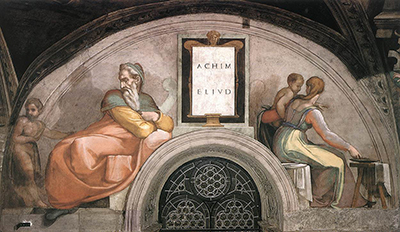
An old man sits as though thought has gathered into his body. His knees advance, his arms knot across them and one elbow pushes decisively towards the viewer. Across the window, a woman turns away from us to feed or tend a child. Michelangelo has placed stillness beside care, but neither half is truly inactive. Meditation tightens the old man’s pose; the woman’s reach makes ordinary nourishment part of sacred history.
The Achim and Eliud lunette belongs to the Ancestors of Christ painted around the Sistine Chapel between 1508 and 1512.[1][2] Its tablet supplies two names from Matthew’s genealogy. It does not securely identify the people beside it. That distinction is essential: the fresco is rich in human particularity precisely where biographical certainty ends.
At a Glance
- WorkAchim and Eliud
- ArtistMichelangelo Buonarroti
- Date1508–12, as part of the Sistine Ceiling campaign[2]
- TechniqueFresco
- LocationSouth-wall lunette, Sistine Chapel, Vatican City[1]
- ProgrammeAncestors of Christ
- Textual sourceMatthew 1:14–15[3]
- InscriptionACHIM / ELIUD
- Principal groupsAn elderly seated man; a woman attending a child
- Identity cautionThe Vatican Museums describes the identities as entirely uncertain[1]
- Governing contrastContemplative withdrawal and active care
Contents
- The Names in Matthew
- A Tablet Is Not a Portrait Key
- The Old Man’s Sculptural Knot
- Orange Drapery and a Cubic Seat
- A Mother Seen from Behind
- The Child and the Scale of Dependence
- Active and Contemplative Life
- Two Halves Divided by Architecture
- Waiting After the Exile
- Fresco, Distance and Finish
- What the Fresco Does Not Illustrate
- Artist Up Close
The Names in Matthew
Matthew places Achim and Eliud late in the genealogy: “Achim became the father of Eliud, Eliud the father of Eleazar.”[3] The sequence belongs to the generations after the Babylonian exile and before Joseph, Mary’s husband.
The Gospel provides names and succession but almost no narrative character. Michelangelo does not attempt to illustrate episodes that Matthew never tells. He gives the lineage duration through age, childhood, feeding and thought.
That translation matters. A genealogy can be read as a chain of male begetting, but the fresco makes descent dependent upon a woman’s labour and a child’s need. The inscription preserves the textual line; the bodies enlarge what continuation means.
A Tablet Is Not a Portrait Key
The central tablet looks authoritative. Capital letters set into painted architecture seem to promise that the adjacent figures can be named. Yet the Vatican explicitly says that it is difficult to decide whether the man represents Achim or Eliud, and whether either name should instead be associated with the child.[1]
This uncertainty applies across the ancestor lunettes. The figures are best understood as symbolic families placed within a named stretch of genealogy rather than portraits equipped with exact labels.[4]
Calling the old man “Achim” may be convenient in an image caption, but it goes further than the evidence. The responsible title is the tablet’s title: Achim and Eliud. Within the scene, “the elderly man,” “the mother” and “the child” are more accurate.
Uncertainty does not leave the image empty. Pose, colour, age and relationship remain visible facts.
The Old Man’s Sculptural Knot
The left figure is among the cycle’s clearest demonstrations of Michelangelo thinking like a sculptor while painting. Both knees press forward beneath the heavy cloth. The arms cross and interlock above them, and the projecting elbow turns that compact arrangement into a three-dimensional knot.[1]
His body is not relaxed in any simple sense. The head inclines and the expression appears meditative, but the limbs retain stored force. The Vatican’s account aptly distinguishes an appearance of abandonment from the energy inside the pose.[1]
Michelangelo builds this tension through opposition. The torso withdraws while the elbow advances. The legs form a stable base while the arms twist across them. The face belongs to old age; the construction retains monumental strength.
The result is not a heroic action but heroic attention. Thought has weight.
Orange Drapery and a Cubic Seat
The old man’s orange mantle falls in broad, heavy rhythms. Rather than dissolving the body, it amplifies the geometry of knees, arms and seat. The fabric responds to the seat’s block-like form and gives his silhouette architectural steadiness.[1]
This is one reason a reproduction cropped to the face misrepresents the figure. The meaning lies in the whole system: bent body, advancing knees, locked arms, drapery and support.
Colour also distinguishes him from the more domestic group opposite. Orange makes the meditative mass warm and visible at chapel distance. It prevents stillness from fading into the wall.
After conservation, such relationships became far easier to perceive. The Ancestors are not uniformly brown or sombre. Their emotional gravity often coexists with forceful colour.
A Mother Seen from Behind
On the right, the woman turns her back towards the viewer and directs her attention to the child. She reaches towards a dish set on a small stool in the foreground, apparently taking food.[1]
Michelangelo refuses the easy communication of a frontal face. We understand the woman through the direction of her torso, arm and hand. Her absorbed care is legible without theatrical expression.
The plate and stool pull the scene towards daily life. These are not generic emblems of maternity suspended in celestial space. Food must be reached, held and given. Sacred descent depends upon maintenance.
Her turned back also deepens the painted recess. Shoulder and arm lead inward towards the child while the stool projects towards us. The group has an intimacy that the viewer may witness but not enter.
The Child and the Scale of Dependence
The child is physically smaller but conceptually central. If the tablet records descent, the child shows it continuing. Yet the child is not a miniature adult or a secure portrait of either named ancestor.
Dependence organises the group. The woman’s movement answers hunger; the dish marks provision; the child’s position redirects her body away from display. Michelangelo makes nurture more important than direct address to the spectator.
This is one reason the term “Forefathers” can mislead. The Ancestors cycle is populated by mothers, children, partners and unnamed members of households. Its subject is genealogy embodied, not a row of patriarchs.
The child’s uncertain name does not diminish that role. Human continuity comes before individual fame.
Active and Contemplative Life
The Vatican suggests that the pairing may anticipate Michelangelo’s repeated contrast between active and contemplative life.[1] On one side, a woman performs an immediate act of care; on the other, an old man sits enclosed in meditation.
The comparison is illuminating when kept as an interpretation rather than a decoded allegory. Nothing identifies the figures formally as personifications. Their actions arise naturally from a family setting.
Michelangelo would later give the active and contemplative lives explicit sculptural form in Leah and Rachel for the tomb of Julius II. Here the opposition is quieter and less programmatic.
Nor is contemplation mere passivity. The old man’s twisted limbs convey inward pressure. Nor is activity grand public action. It is feeding a child. The fresco dignifies both modes by making each bodily exact.
Two Halves Divided by Architecture
The central tablet and window arch prevent the figures from forming one continuous room. Each group occupies its own curved half. Their relation is comparative rather than conversational.
That division creates the lunette’s rhythm. The old man faces inward from the left; the woman turns inward from the right. Both direct attention away from the outer edges, yet the tablet stands between them.
Writing separates and joins. ACHIM / ELIUD names the genealogical bond that the bodies cannot physically cross. Below, the real window cuts into the wall; above, painted architecture makes the families appear lodged within the chapel fabric.
Michelangelo uses a difficult format as meaning. Genealogy connects people whom time and architecture keep apart.
Waiting After the Exile
Achim and Eliud belong to Matthew’s post-exilic generations.[3] The Gospel moves through them quickly, but Michelangelo slows that succession into lived time.
The old man’s meditation has often encouraged readings of the Ancestors as humanity waiting for redemption. Such theology suits their place before Christ, but the gesture should not be treated as a fixed code. He may look weary, thoughtful or simply self-contained.
What the fresco unmistakably supplies is duration. Age has accumulated; a child still requires feeding. The promised future is carried through repetitive acts rather than miracles.
This modest temporal register distinguishes the lunettes from the ceiling’s central Genesis scenes. Creation, catastrophe and divine intervention unfold above; ordinary continuance persists below.
Fresco, Distance and Finish
Michelangelo painted the lunette on fresh plaster in sections. Once a day’s area was laid, decisions had to be translated into pigment before it dried. Preparation could occur through drawings and cartoons, but execution remained bound to time.
The forms were also designed for viewing from the chapel floor. The old man’s knees, elbow and orange mantle make a legible mass at distance. The woman’s turned torso and reaching arm establish action without requiring minute facial description.
Close photography reveals brushwork that the original spectator could not inspect. It is valuable, but it can make rapid passages look unfinished or detach details from their architectural task.
The fresco succeeds at several scales: a balanced lunette from below, opposed households at middle distance, and startlingly economical touches up close.
What the Fresco Does Not Illustrate
The biblical Achim and Eliud have no developed stories in Matthew. Attaching unrelated Old Testament episodes to the seated man or mother would therefore create false narrative specificity.
The scene also does not document Renaissance domestic life transparently. A plate, stool and act of feeding feel observed, but Michelangelo arranges them within an idealised sacred genealogy and a highly artificial architectural field.
Likewise, the mother’s turned pose is not evidence for a known sitter. “Studied from life” and “portrait of a named woman” are different propositions.
The work’s achievement is not archaeological illustration. It transforms sparse names into a persuasive human interval.
Artist Up Close
This lunette reveals Michelangelo’s range without thunder or spectacle. The same artist who painted God dividing light from darkness could make an old elbow, a dish of food and the back of a caring woman sustain an entire field.
The old man’s body has sculptural concentration, yet the scene depends equally on colour and on the temporal medium of fresco. Michelangelo is not drawing statues onto a wall. Orange cloth, soft flesh, shadow and architectural spacing create a specifically painted intelligence.
Most powerfully, he refuses to make lineage abstract. The names may belong to men, but descent takes visible form through feeding, ageing and dependence.
Achim and Eliud remain uncertain faces. Their humanity does not.
Frequently Asked Questions
Discussion
What details, sources or comparisons stand out to you in Achim / Eliud?
Reader Insights
Which formal detail changes how the work reads?
Which documented source or collection history feels most useful?
Which related Michelangelo work should readers compare next?
Join the Conversation
Add a source-led observation, comparison or question for other readers.
References
- Vatican Museums, Lunette Achim, Eliud,, View source.
- Vatican Museums, Sistine Chapel Ceiling,, View source.
- United States Conference of Catholic Bishops, Matthew, Chapter 1,, View source.
- Vatican Museums, Lunettes—South Wall,, View source.
- Vatican Museums, The Sistine Chapel Twenty Years Later: New Breath, New Light,, View source.