


 by Tom Gurney
Tom Gurney BSc (Hons) is an art history expert with over 20 years experience
Published on June 19, 2020 / Updated on November 6, 2025
Email: tomgurney1@gmail.com / Phone: +44 7429 011000
Michelangelo’s Asa, Jehoshaphat and Joram Lunette
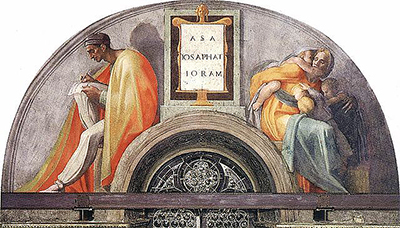
One side of this lunette turns writing into a physical labour. A thin old man bends over a sheet supported on his raised knee, reed pen advancing while his long neck and sharp profile follow the movement. Across the tablet, a mother gathers three children into a dense, affectionate knot. Text and touch, solitary record and bodily descent, face one another across a real window.
The Asa, Jehoshaphat and Joram lunette belongs to Michelangelo’s Ancestors of Christ in the Sistine Chapel.[1][2] The three names come from Matthew’s genealogy; none can be assigned conclusively to a particular painted body. The fresco’s meaning develops not from solving those identities but from the extraordinary contrast between an elderly writer and a family whose gestures almost overflow the curved field.
At a Glance
- WorkAsa, Jehoshaphat and Joram
- ArtistMichelangelo Buonarroti
- DateAbout 1511–12; within the 1508–12 ceiling campaign[2][4]
- TechniqueFresco
- LocationSistine Chapel, Vatican City
- ProgrammeAncestors of Christ
- Textual sourceMatthew 1:7–8[3]
- InscriptionASA / IOSAPHAT / IORAM
- Left groupAn elderly man writing on a sheet supported by his knee
- Right groupA mother with three children
- Identity cautionThe writer is traditionally called Jehoshaphat, not securely identified[1][4]
- Central themeWritten genealogy answered by embodied generation
Contents
- Three Kings in Matthew
- Why the Figures Cannot Be Named Securely
- The Old Writer
- Writing Inside a Genealogy
- Costume and the Idea of Biblical Time
- A Mother and Three Children
- The Kiss on the Cheek
- Nursing and Sacred Descent
- Yellow Across the Window
- Solitude and Contact
- The Lunette as an Architectural Problem
- A Surviving Drawing and the Work of Preparation
- From Wall to Print
- What Restoration Changed
- Artist Up Close
Three Kings in Matthew
Matthew’s genealogy places Asa, Jehoshaphat and Joram in the Davidic royal line: Abijah fathers Asa, Asa fathers Jehoshaphat, Jehoshaphat fathers Joram, and Joram is followed by Uzziah.[3]
The Hebrew Bible gives these kings extensive and morally differentiated reigns. Michelangelo does not illustrate their reforms, wars, alliances or failures. No crown, throne or episode establishes a particular royal biography.
This restraint is fundamental to the Ancestors cycle. The names carry scriptural and dynastic memory, while the adjacent people inhabit more universal conditions: writing, ageing, maternity, touch and dependence.
The royal genealogy is present, but its visual language is domestic rather than triumphal.
Why the Figures Cannot Be Named Securely
The tablet’s three names do not map neatly onto the fresco’s adults and children. The Vatican’s general account of the lunettes stresses that repeated efforts to connect inscriptions and figures have not produced certain identifications.[1]
The old man is traditionally described as Jehoshaphat.[4] That label may help trace the figure through older catalogues and prints, but “traditionally” carries the argument’s limit. A writing action is not proof of identity.
The mother and children are even less susceptible to a one-name solution. They may symbolise a family within this genealogical interval without illustrating the literal household of one king.
The fresco asks to be seen as a named field, not decoded as a cast list.
The Old Writer
Michelangelo shows the left figure in full profile, thin and aged. One leg extends while the other bends upward so that the knee can support his writing surface.[4]
The pose is ingenious because it makes the body into furniture. Thigh, knee and hand create a temporary desk. Writing is not disembodied intellect; it depends on balance, joints and pressure.
His head reaches forward on a long neck. A hooked nose, large ear and prominent throat sharpen the silhouette, while a grey cap encloses the bony skull.[4]
These features can appear caricatural when isolated. Within the whole, they concentrate attention. The entire body points towards the pen.
Writing Inside a Genealogy
The action has a special resonance beside an inscribed tablet. At the centre, Michelangelo paints fixed capital letters that authoritatively name the lineage. At the side, he paints writing in progress.
One text appears complete and public; the other is private and unfinished. The viewer cannot read the old man’s sheet. Its content matters less than the act of recording.
This relationship turns the lunette into a meditation on transmission. Genealogy survives through names written and copied, but life continues through bodies. The writer and mother embody those two systems.
It would be too specific to call the old man Matthew or a scribe composing the Gospel. The visual analogy is powerful without becoming literal narrative.
Costume and the Idea of Biblical Time
The writer wears a loose yellow mantle with shifting red and greenish shadows, pale trousers tied near the ankles, rose-coloured shoes and a grey cap.[4]
Older art-historical description has associated the tied trousers with an “Oriental” type. Such language reflects Renaissance strategies for marking distant biblical peoples, not reliable evidence of historical Jewish dress.
Michelangelo’s costume is imaginative and pictorial. It differentiates textures, brings bright colour to the elderly body and enlarges the figure’s silhouette.
The clothing also complicates the thin anatomy. Bones sharpen the face and neck, while the mantle creates broad volume around the torso. Frailty is housed within magnificence.
A Mother and Three Children
On the right, bodies gather closely enough to resemble an image of Charity.[4] One child is held against the woman, another climbs behind and embraces her neck while kissing her cheek, and a third nurses at her breast.[4]
The comparison with Charity arises from Renaissance personifications of a woman caring for several children. The fresco is not formally labelled as that allegory, but the resemblance captures its density of giving.
Every child establishes a different relation: held, embracing and feeding. The mother is therefore not a static centre with repeated accessories. Her body answers three simultaneous demands.
Michelangelo turns maternity into a composition of competing directions held together by touch.
The Kiss on the Cheek
The child reaching around the mother’s neck introduces an intimacy rare in monumental decorative painting. Its kiss is a small action, but it changes the group’s emotional structure.
Care does not flow only from adult to child. Affection returns. One child depends upon the breast; another actively embraces; the held child occupies a third degree of closeness.
This variety prevents the family from becoming a generic sign of fertility. They appear to have momentary relationships with one another.
The kiss also draws attention upward and backward, away from the obvious nursing motif. Michelangelo makes the group reward sustained looking even though it was painted high above the chapel floor.
Nursing and Sacred Descent
The nursing child makes generation bodily explicit. Matthew’s list is grammatically organised around fathers, but the survival of the line depends upon feeding and maternal labour.
Michelangelo does not isolate nursing as sentimental anecdote. It belongs within a muscular, crowded body. The mother turns, supports, receives and feeds at once.
The image can recall the Christian tradition of the nursing Virgin, yet this woman is not Mary. The genealogy precedes Christ, and no Marian attribute identifies her.
The echo works structurally: an anonymous ancestor’s care belongs to the long human history that makes the Incarnation possible.
Yellow Across the Window
Colour links figures that architecture separates. The woman’s yellow garment, modulated with orange, answers the yellow and warm shadows of the writer’s mantle.[4]
This chromatic rhyme prevents the lunette from breaking into unrelated halves. The groups remain emotionally and spatially separate, but colour supplies a common atmosphere.
Yellow also makes both forms legible from below. On the left it expands the thin old body; on the right it binds several children into the mother’s mass.
The same hue performs contrary tasks: isolation and cohesion. Michelangelo uses colour not as surface embellishment but as an organising force.
Solitude and Contact
Few ancestor lunettes stage opposition more clearly. The writer bends into his task without acknowledging another person. The family is almost entirely made of contact.
Yet the contrast is not simply cold intellect against warm love. Writing is a form of transmission, and the old man’s concentration possesses its own urgency. The family’s tenderness also contains strain: three children pull a single body in several directions.
Both halves describe labour. One preserves through marks; the other preserves through care.
The central genealogy depends upon both, even if the inscription names only men.
The Lunette as an Architectural Problem
The curved field narrows at both sides and is interrupted below by a window. Michelangelo responds by extending the old man’s leg along the lower boundary and compressing the family into a compact pyramid.
The tablet occupies the visual hinge. It cannot merely be removed in a crop without changing the work, because the inscription creates the distance the two groups answer.
Seen from the floor, the extended line on the left and clustered mass on the right establish a strong asymmetrical balance. Seen close, pen, kiss and breast offer intimate detail.
The work is therefore designed for alternating scales. Monumental structure carries domestic observation.
A Surviving Drawing and the Work of Preparation
A study associated with the lunette survives in the Ashmolean Museum, evidence that at least part of the composition was worked through on paper.[5] A preparatory drawing is not a reduced duplicate of the fresco. Its lines belong to a stage of testing, correction and transfer.
That distinction is especially useful for the writer’s complicated pose. Supporting a sheet on a raised knee requires the limbs to interlock convincingly. Drawing allows the artist to solve weight before the wet plaster imposes its deadline.
The fresco may look spontaneous, but immediacy is often the achievement of preparation.
Comparison also reveals change. Michelangelo’s final wall image responds to colour, distance and the exact curved field in ways a sheet cannot.
From Wall to Print
The old writer later circulated independently in prints after Michelangelo. Reproductive engraving could extract a single figure from the lunette and turn fresco colour into portable line.
Such circulation helped build Michelangelo’s European reputation as an inventor of powerful poses. It also encouraged details to acquire individual titles—sometimes the traditional name Joram or Jehoshaphat—even when the original tablet could not label them securely.
“After Michelangelo” is the correct authorship formula for these prints. The printmaker cut the plate; Michelangelo supplied the admired painted invention.
Reception can preserve a figure while simplifying the uncertainty of its original context.
What Restoration Changed
Darkened surfaces once made the Ancestors appear uniformly grave and earthen. Twentieth-century conservation revealed sharper yellows, pinks and changing shadows across the cycle.[6]
For this lunette, colour is inseparable from its argument. Warm hues relate the solitary writer to the intimate family, even as the window and tablet divide them.
Restoration did not answer who is Asa, Jehoshaphat or Joram. It recovered more of how Michelangelo made uncertainty visually coherent.
The treatment history should remain distinct from original execution. Modern visibility is the result of both sixteenth-century pigment and later conservation choices.
Artist Up Close
Michelangelo makes a genealogy about two kinds of inscription. One is written on the wall in Roman capitals; the other is written through living bodies.
The old man converts his knee into a desk. The mother becomes the centre of three different attachments. Nothing supernatural occurs, but the field contains an entire theory of continuity.
Its people remain unnamed because the tablet cannot solve them. That anonymity expands rather than reduces their reach. They can embody the recorder, the caregiver, the dependent child and the ageing mind through which history persists.
The kings’ names remain fixed. Human life moves around them.
Frequently Asked Questions
Discussion
What details, sources or comparisons stand out to you in Asa / Jehosaphat / Joram?
Reader Insights
Which formal detail changes how the work reads?
Which documented source or collection history feels most useful?
Which related Michelangelo work should readers compare next?
Join the Conversation
Add a source-led observation, comparison or question for other readers.
References
- Vatican Museums, Lunettes—South Wall,, View source.
- Vatican Museums, Sistine Chapel Ceiling,, View source.
- United States Conference of Catholic Bishops, Matthew, Chapter 1,, View source.
- Web Gallery of Art, Ancestors of Christ: Asa—Jehoshaphat—Joram,, View source.
- Ashmolean Museum, Study for the Lunette of Asa, Josaphat, and Joram,” WA1846.44,, View source.
- Vatican Museums, The Sistine Chapel Twenty Years Later: New Breath, New Light,, View source.