


 by Tom Gurney
Tom Gurney BSc (Hons) is an art history expert with over 20 years experience
Published on June 19, 2020 / Updated on November 6, 2025
Email: tomgurney1@gmail.com / Phone: +44 7429 011000
Michelangelo’s Azor and Zadok Lunette
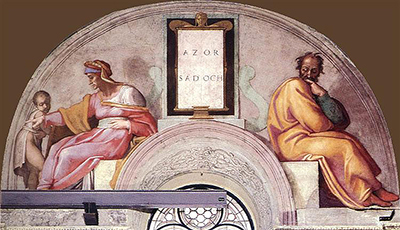
A woman points beyond the painted field. Beside her, a child who may have been writing or drawing turns slowly, as though interrupted. Across the window, a deeply lined man faces outward but seems mentally elsewhere. The fresco connects three directions of attention—outside, aside and inward—without explaining what anyone sees.
Michelangelo painted the Azor and Zadok lunette as part of the Sistine Chapel’s Ancestors of Christ.[1][2] Its figures cannot be securely assigned to the two names on the tablet. The Vatican Museums is unusually direct: in the absence of information about the people, attempts at identification are futile.[1] That limit makes close description more important, not less.
At a Glance
- WorkAzor and Zadok; the tablet uses the form SADOCH
- ArtistMichelangelo Buonarroti
- Date1508–12, within the Sistine Ceiling campaign[2]
- TechniqueFresco, with a green sleeve painted partly a secco[1]
- LocationNorth-wall lunette, Sistine Chapel, Vatican City[1]
- ProgrammeAncestors of Christ
- Textual sourceMatthew 1:14[3]
- Left groupA seated woman pointing beyond the field; a turning child
- Right groupA mature solitary man in an ochre-yellow mantle
- Identity cautionNo figure can be named securely[1][4]
- Distinctive featuresMulticoloured headdress, interrupted drawing or writing, extreme contrast between modelled body and rapidly painted face
Contents
- Azor, Zadok and the Post-Exilic Line
- Zadok, Sadoch and Spelling
- A Point Beyond the Frame
- A Child Interrupted
- The Woman’s Composed Torsion
- A Headdress Made of Colour
- The Solitary Man
- Body in Full, Face in Abbreviation
- The Green Sleeve and A Secco Paint
- Looking, Pointing and Not Seeing
- The Tablet as a Failed Explanation
- Families Rather Than Forefathers
- Colour, Cleaning and Modern Sight
- Artist Up Close
Azor, Zadok and the Post-Exilic Line
Matthew places Azor and Zadok in the generations after the Babylonian exile: Eliakim fathers Azor, Azor fathers Zadok, and Zadok fathers Achim.[3]
No narrative episode in the Gospel explains the fresco. Michelangelo does not supply attributes that would turn either ancestor into a recognisable biblical actor.
The names therefore operate as genealogy rather than biography. They locate the field in a chain leading towards Joseph and Christ, while the bodies turn that chain into lived human time.
The woman’s instruction, the child’s hesitation and the man’s thought are not illustrations of Matthew. They are forms of attention through which history feels inhabited.
Zadok, Sadoch and Spelling
The painted tablet and Italian institutional tradition use SADOCH; many English Bibles use Zadok. Azor may also appear as Asor in other languages.
These variants identify the same genealogical field. They arise from movement among Greek, Latin, Italian and English forms rather than from different frescoes.
The spelling issue becomes important in searches and catalogues, where Azor and Sadoch may seem separate from Azor and Zadok. They are title variants for one lunette.
Clarifying language is useful. Pretending that the spellings solve the people’s identity is not. The tablet names two generations; it does not say which, if either, is the mature man.
A Point Beyond the Frame
The seated woman extends a hand towards something outside the visible field.[1] Her gesture is precise enough to direct the child, but Michelangelo withholds its object.
This is a striking way to animate a confined architectural space. The painted world acknowledges something beyond itself, while the viewer must imagine what lies there.
The point may be instruction, warning or invitation. None can be proven. What is secure is a relationship of guidance: the woman has noticed something and asks the child to redirect attention.
Her gesture also opens the lunette psychologically. Other ancestor figures withdraw into private states; this woman connects the family to an unseen elsewhere.
A Child Interrupted
The Vatican suggests that the child may be writing or drawing and appears to turn with slowness or hesitation.[1]
Both qualifications matter. The object or action is not clear enough for certainty, and hesitation is an interpretation of movement rather than a documented emotion.
Still, the possibility adds a compelling sequence. The child has been absorbed in marks on a surface; the woman points; the body begins to turn. Attention moves from near to far.
Within a genealogy, drawing or writing has further resonance as transmission. Yet it should not be converted into a portrait of an artist-child or young Michelangelo. The fresco provides no such autobiographical key.
It shows learning in motion, not a named prodigy.
The Woman’s Composed Torsion
Her movement is complex without appearing forced. Legs, shoulders and head turn through different angles, but the whole remains settled.[1]
Michelangelo often creates power through extreme bodily torque. Here he demonstrates another skill: making a moderate turn carry social meaning. She points while remaining seated; her torso bridges the child and the unseen object.
The pose is “natural” not because it is uncomposed, but because composition has been absorbed into action. The viewer reads instruction before anatomy.
That economy is especially effective at chapel distance. Large directional lines—the inclined body and extended hand—communicate before smaller details emerge.
A Headdress Made of Colour
The woman wears an extraordinary multicoloured headdress combining ultramarine, vermilion and yellow with green and orange touches.[1]
Its chromatic variety does more than mark costume. The headdress concentrates colour around the source of the pointing gesture and gives the head visibility beneath the lunette’s curve.
The pink garment carries lilac shadows, a yellow border and a pale-green sash; a deeper yellow cloak folds over her arm.[1] These juxtapositions contradict the old idea of Michelangelo as a reluctant, monochromatic painter.
The costume should not be treated as an exact record of ancient dress or as proof of a particular ethnicity. It creates biblical distance through Renaissance invention while organising the fresco’s colour.
The Solitary Man
On the right, a mature man turns towards the viewer. Deep facial lines and an absorbed expression make him appear burdened by thought.[1]
Although he faces outward, he does not establish easy contact. The body is present; the mind seems withdrawn. This separation between direction and attention is one of Michelangelo’s subtlest effects.
The man is wrapped in an ochre-yellow mantle. Light and shadow model his body with strong plastic force, causing it to stand distinctly against the ground.[1]
He balances the more active pair opposite but does not respond to them. Their shared genealogy is architectural and textual, not conversational.
Body in Full, Face in Abbreviation
The mature man contains a remarkable difference in finish. His body is powerfully modelled, while the face—set farther back—is rendered with rapid lines and very little colour.[1]
This is not necessarily neglect. Michelangelo allocates detail according to distance, light and the needs of form. The mantle and torso must establish the major mass; a few marks can complete the recessed face.
Close photography may exaggerate the apparent discrepancy because it grants equal enlargement to passages designed for unequal visibility.
The contrast also produces expressive force. The body seems solid and near, while thought recedes into an economical face.
Finish becomes spatial language.
The Green Sleeve and A Secco Paint
The green sleeve was painted dry, or a secco, rather than entirely into wet plaster.[1]
True fresco binds pigment into fresh lime plaster as it cures. A secco additions sit differently on a dried surface and can permit colours or corrections that are difficult in wet plaster. They may also age or adhere differently.
This small technical fact prevents an overly pure account of Michelangelo’s method. A fresco can include dry finishing without ceasing to be a fresco.
The green sleeve has a strong compositional role because it interrupts the dominant ochre-yellow and gives the arm a clear boundary. Technique serves colour contrast.
Looking, Pointing and Not Seeing
The lunette is organised by incomplete acts of vision. The woman sees something beyond the frame. The child is turning but may not yet see it. The man faces us while remaining mentally inaccessible.
No gaze is fully shared. Even instruction creates delay.
This structure turns the ancestor theme into a study of knowledge across generations. One person points; another learns to redirect attention; a third carries accumulated thought alone.
That reading need not claim a fixed allegory. It follows visible relationships while preserving their open content.
Michelangelo makes uncertainty the fresco’s subject as well as its scholarly condition.
The Tablet as a Failed Explanation
At the centre, AZOR / SADOCH appears to promise clarity. Yet those names cannot tell us what the woman indicates, what the child makes or why the man looks troubled.
Writing anchors the field historically but does not exhaust it. This gap between label and life belongs to the whole Ancestors programme.
The window increases the separation. It divides the active pair from the solitary man, while the tablet bridges them only through descent.
Genealogy joins people across time without making them transparent to one another. The architecture gives that abstraction physical form.
Families Rather Than Forefathers
The title contains two male names, but the most explicit relationship occurs between a woman and child. They occupy a scene of teaching or shared attention unavailable in Matthew’s bare list.
Michelangelo repeatedly expands patriarchal genealogy into a world of unnamed women and children. Their lack of labels does not make them secondary. Here they generate the fresco’s only interpersonal action.
The solitary man may represent one named ancestor, yet his very isolation shows the insufficiency of treating the cycle as a sequence of male portraits.
Descent is social, even when the inscriptions are not.
Colour, Cleaning and Modern Sight
The headdress’s ultramarine and vermilion, the pink and lilac dress, and the green sleeve became newly forceful after the Sistine conservation campaign.[5]
Cleaning the chapel between 1979 and 1999 altered modern understanding of Michelangelo’s palette.[2] It also produced arguments about the removal of later materials and the interpretation of modelling.
For this lunette, conservation makes the relation between major masses and dry-painted accent particularly legible. It does not erase the object’s history; it is part of that history.
Modern viewers see a sixteenth-century fresco through the consequences of ageing, retouching, cleaning and illumination.
Artist Up Close
The Azor and Zadok lunette shows Michelangelo building an absorbing drama from redirection. The woman’s finger points beyond the painting. The child’s body follows late. The man’s gaze reaches outward while thought turns in.
Colour gives these movements intensity: an almost extravagant headdress, a green sleeve cutting through ochre, pink shifting into lilac.
Nothing identifies the people securely or completes their actions. That incompletion is not failure. It allows the fresco to embody a genealogy whose names survive while most individual lives remain unknowable.
Michelangelo paints the distance between being named and being known.
Frequently Asked Questions
Discussion
What details, sources or comparisons stand out to you in Azor / Sadoch?
Reader Insights
Which formal detail changes how the work reads?
Which documented source or collection history feels most useful?
Which related Michelangelo work should readers compare next?
Join the Conversation
Add a source-led observation, comparison or question for other readers.
References
- Vatican Museums, Lunette Azor, Zadok,, View source.
- Vatican Museums, Sistine Chapel,, View source.
- United States Conference of Catholic Bishops, Matthew, Chapter 1,, View source.
- Vatican Museums, Lunettes—North Wall,, View source.
- Vatican Museums, The Sistine Chapel Twenty Years Later: New Breath, New Light,, View source.