


 by Tom Gurney
Tom Gurney BSc (Hons) is an art history expert with over 20 years experience
Published on June 19, 2020 / Updated on November 6, 2025
Email: tomgurney1@gmail.com / Phone: +44 7429 011000
The Delphic Sibyl by Michelangelo
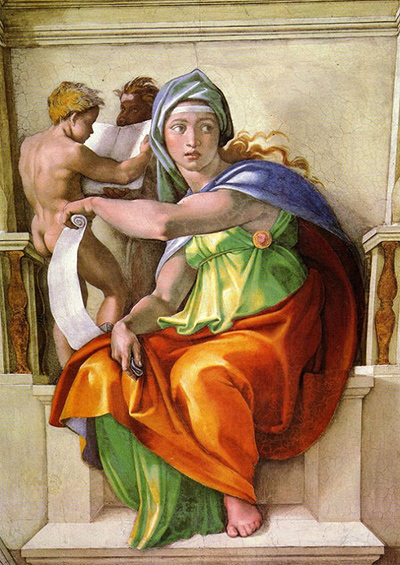
Michelangelo’s Delphic Sibyl has turned before her body can follow. A scroll lies across her raised arm, but her face looks outward with widened eyes, as though an unseen summons has interrupted reading. Behind her, two attendants manage another text. The instant is quiet, yet the whole enthroned body is reorganising around it.
The Delphic is one of five ancient prophetesses painted among seven Hebrew prophets on the Sistine Chapel ceiling.[1][2] Renaissance Christian tradition treated sibyls as pagan witnesses whose oracles could be aligned with the coming of Christ. Michelangelo gives that inherited claim a precise human form: revelation appears not as a supernatural emblem but as attention abruptly redirected.
At a Glance
- FigureThe Delphic Sibyl, labelled DELPHICA beneath her throne
- Artist and mediumMichelangelo Buonarroti; fresco
- SettingA monumental seer’s throne within the Sistine Chapel ceiling
- CampaignPainted for Pope Julius II during the 1508–1512 vault project[3]
- EnsembleOne of five sibyls alternating with seven prophets[2]
- Traditional originDelphi, the Greek sanctuary associated with Apollo’s oracle
- Defining actionTurning away from a scroll toward an unseen stimulus[1]
- CompanionsTwo smaller attendants behind the principal figure
- Visual characterYouthful face, alert gaze, crossed arms, layered green, orange and violet drapery
- Identity cautionThe inscription secures her name; it does not preserve a specific ancient oracle being spoken in this instant
- Chronology cautionHer location within the ceiling does not establish an exact isolated painting date
- Viewing cautionA face-only detail loses the scroll, attendants, throne and bodily turn that create the event
Contents
- Delphi and the Christian Sibyl
- The Instant of Turning
- The Scroll Across Her Arms
- Crossed Arms and Controlled Energy
- The Face and Gaze
- An Image of Hearing Without Sound
- Drapery as a System of Direction
- The Bare Foot
- The Two Attendants
- Fictive Architecture and the Name Tablet
- Youth Among the Five Sibyls
- Among Prophets and Sibyls
- Position Is Not Working Chronology
- Seeing Her from the Floor
- Restoration and Colour
- Why the Delphic Sibyl Matters
- Artist Up Close
Annotated Details from the Delphic Sibyl
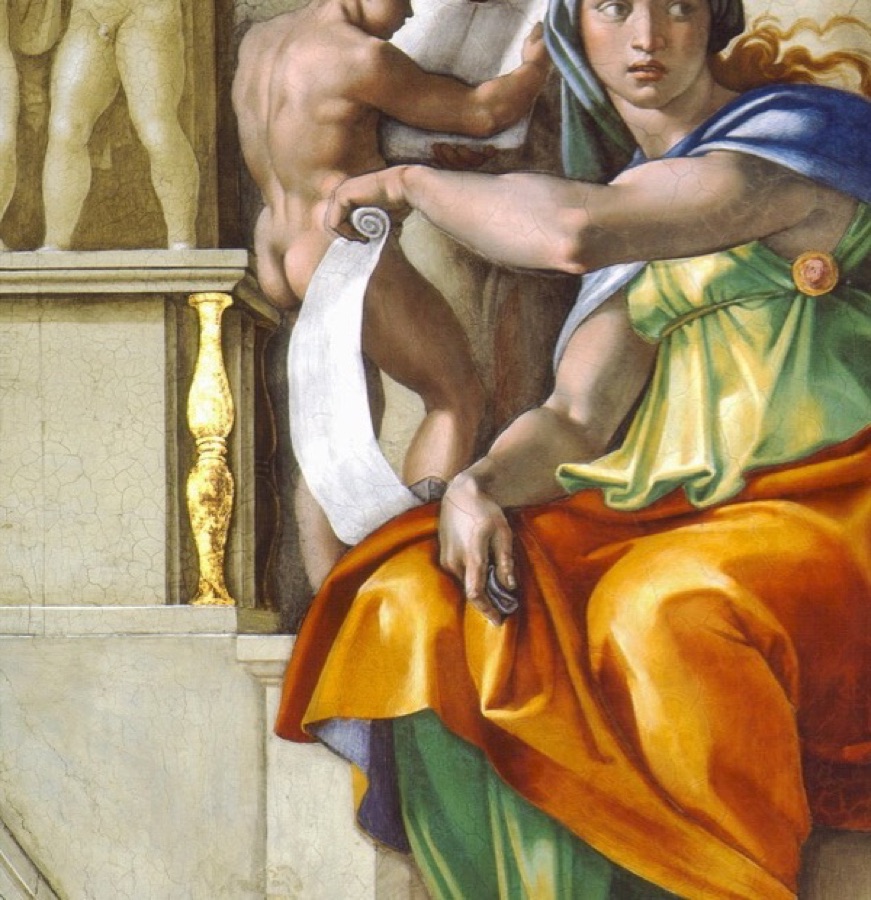
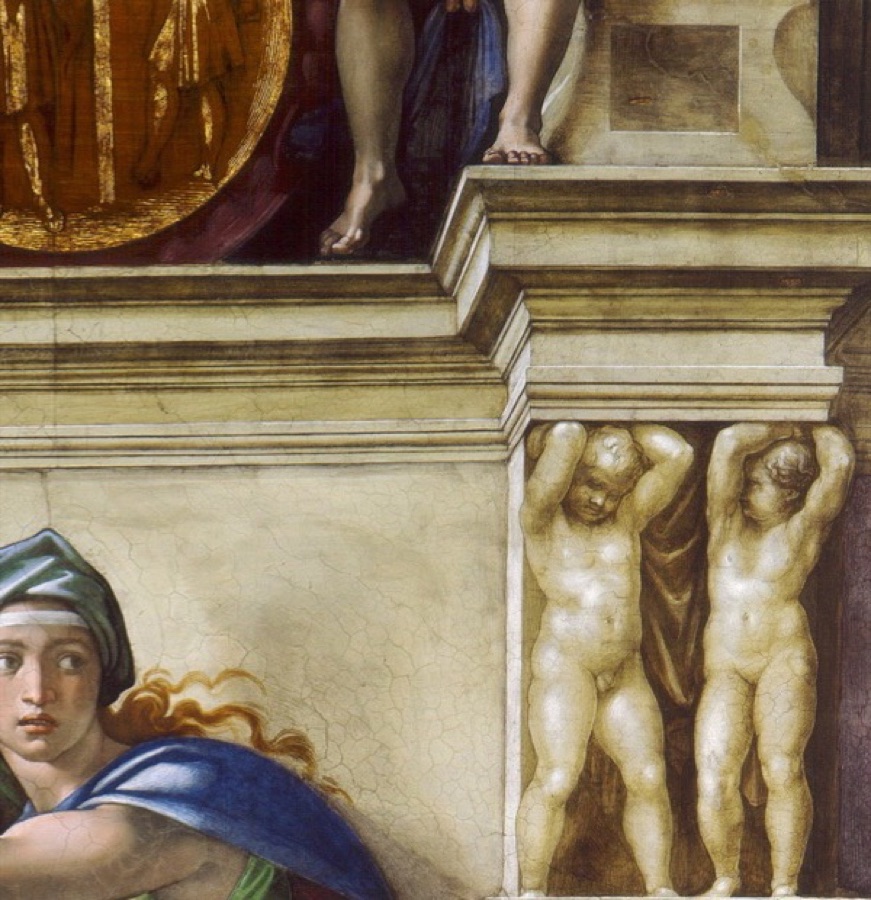
The annotated view focuses on the Delphic Sibyl’s alert turn, scroll and surrounding ceiling architecture. The approved image remains source-led and its source note is recorded in the references.[8]
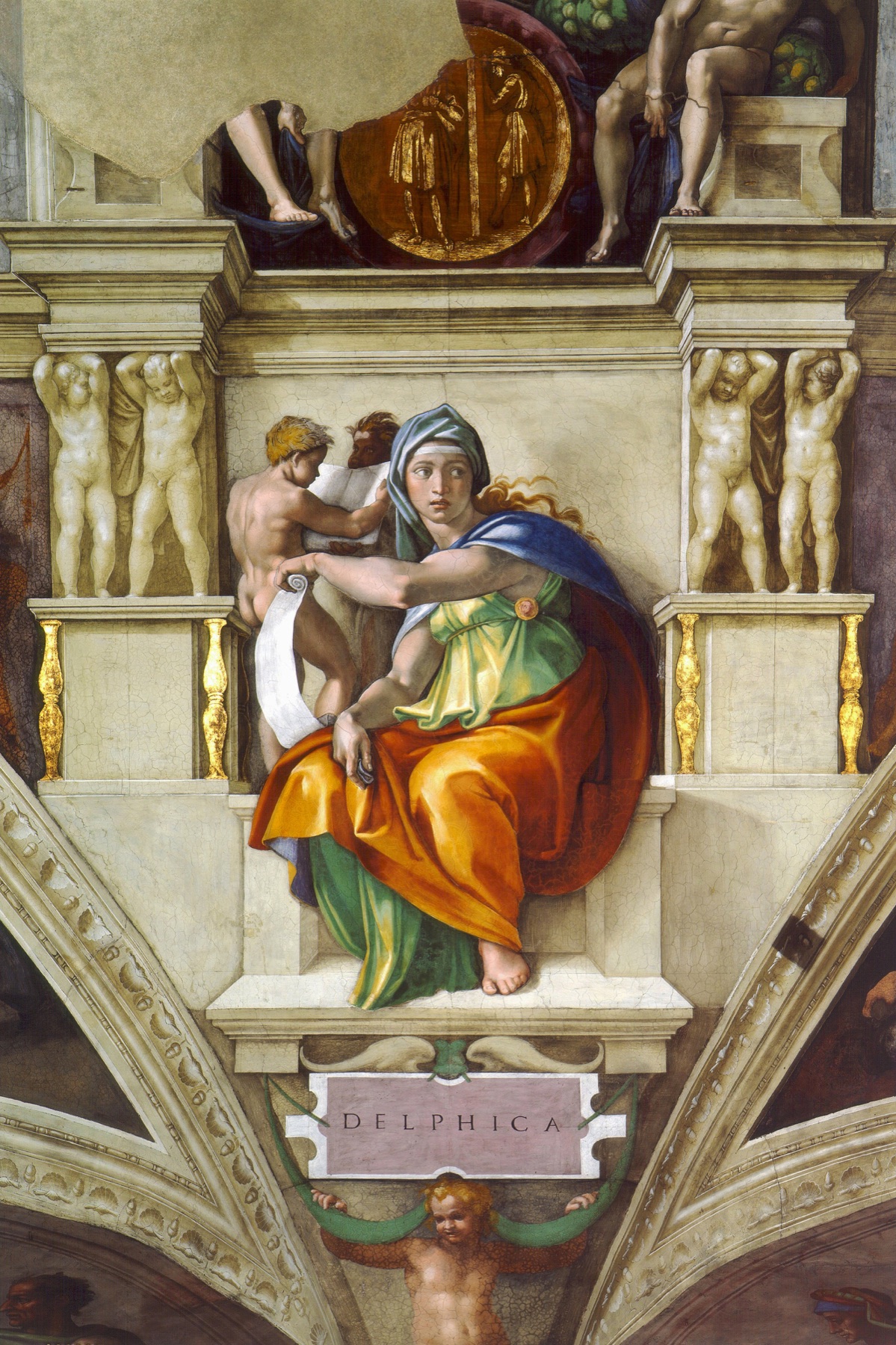
Details from THE DELPHIC SIBYL
Close looking brings the Sibyl’s turning movement and painted setting forward while keeping source and rights notes in the references.
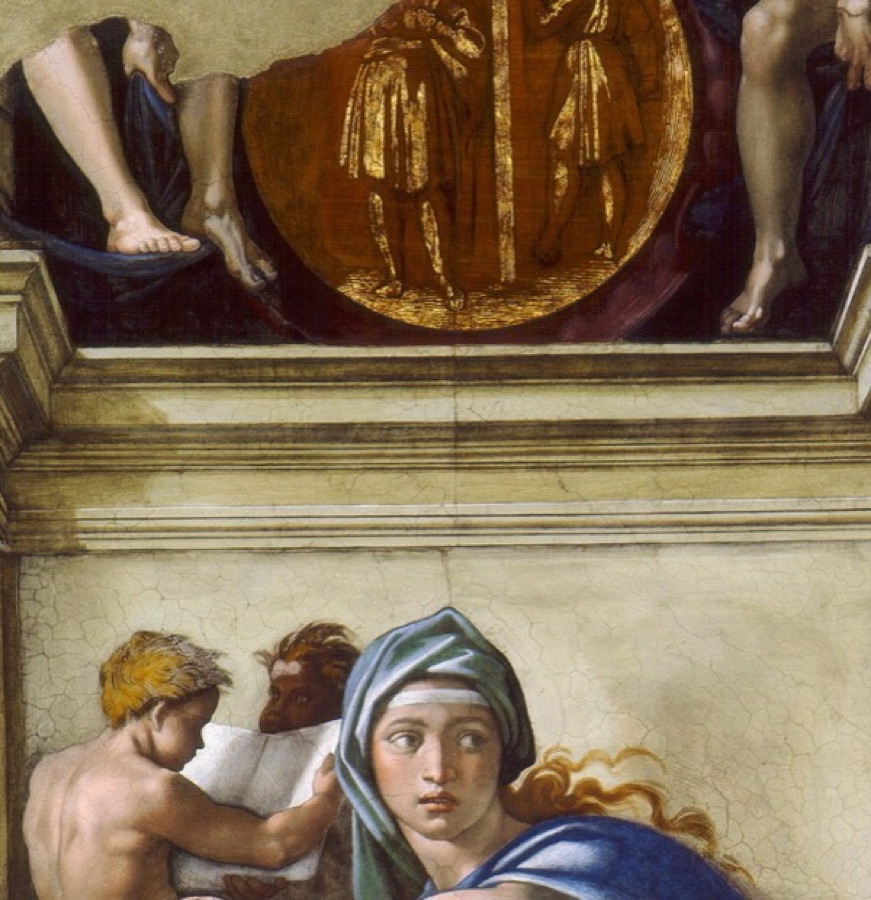
Turning head
The face turns away from the scroll, giving the figure her sense of sudden alertness.
Book and hand
The scroll and hand keep the prophetic theme visible even as the Sibyl’s attention moves elsewhere.
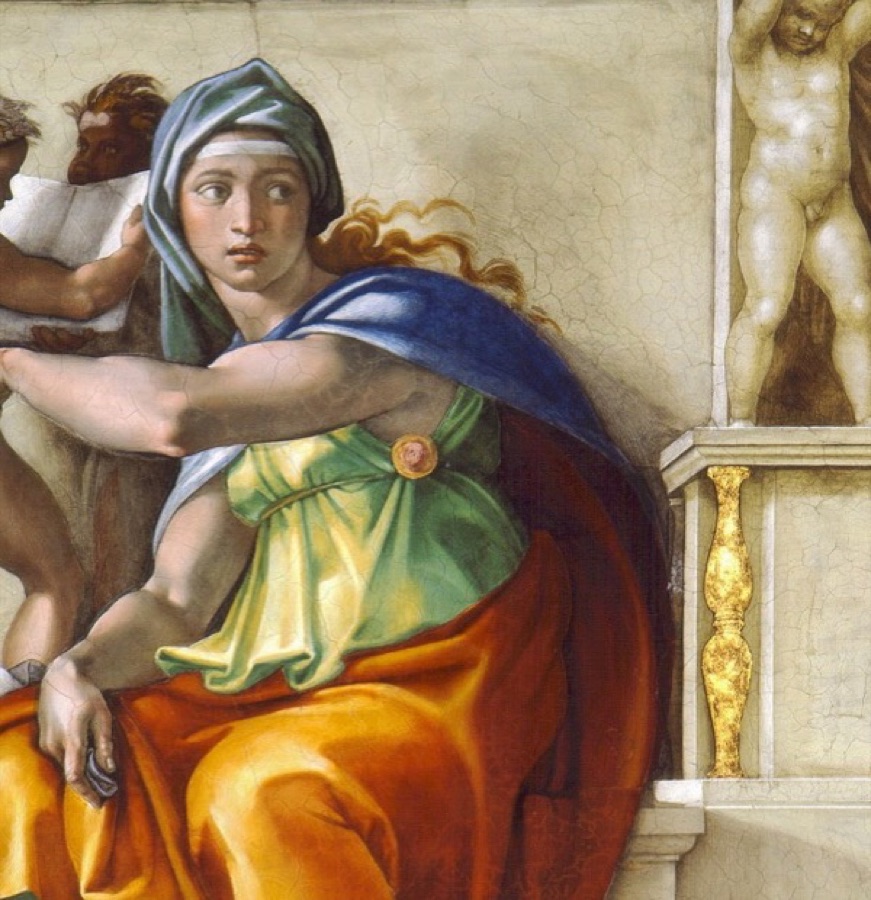
Arm and drapery
The arm, shoulder and coloured drapery make the seated body feel sculptural and active.
Attendant figures
The surrounding figures and architecture place the Sibyl inside the wider rhythm of the Sistine ceiling.
Delphi and the Christian Sibyl
In Greek antiquity, Delphi was the great sanctuary of Apollo, where the Pythia delivered oracular responses. The Renaissance category “Delphic Sibyl” belongs to a later tradition that gathered named prophetesses from different ancient places and connected selected utterances to Christian history.
Michelangelo does not reconstruct an archaeological Delphic sanctuary. No tripod, temple interior or recognisable Greek landscape establishes her location. The name tablet supplies geographic identity within a unified Roman chapel programme.
This distinction matters. The figure is not a portrait of one historically documented woman observed at Delphi. She is a Renaissance Christian image of pagan prophecy, shaped by the authority that ancient oracles held for humanist and theological culture.
Her inclusion beside biblical prophets therefore represents appropriation and reinterpretation. Classical antiquity is granted dignity while being placed inside a Christian account of fulfilment.
The Instant of Turning
The head has moved furthest. Eyes and face direct outward; shoulders begin to respond; the lower body remains firmly seated and angled within the throne. Michelangelo divides one turn across several anatomical stages.
This staggered motion gives the pose credibility. A body rarely rotates as a rigid block. Attention changes first, then muscle and weight follow. The Delphic Sibyl seems caught in the fraction of time between hearing and full response.
Her expression is alert rather than theatrical. The mouth rests nearly closed, and the brows do not exaggerate surprise. Revelation is conveyed through focused sight.
The effect becomes stronger because no visible source explains it. Michelangelo leaves a space beyond the fresco into which her attention extends. The chapel itself becomes the field of the unseen summons.
The Scroll Across Her Arms
A long scroll passes across the Sibyl’s forearms and descends in a pale strip. One hand steadies it near her lap while the opposite arm crosses above. The text is present, but her gaze has left it.
This creates a relation between written and immediate knowledge. The Sibyl does not discard the scroll; her body keeps contact with it during interruption. Prophecy can be preserved in words and renewed by attention.
The scroll’s light colour cuts across richer garments, making it legible at height. Its flexible form contrasts with the heavy codices of the Cumaean and Libyan Sibyls.
No extended inscription can be read on it from the chapel floor, and the Vatican description does not assign a particular surviving oracle to the sheet.[1] Its function is secure as prophetic text; its exact words remain open.
Crossed Arms and Controlled Energy
The Delphic Sibyl’s arms form a compact barrier before the torso. One extends horizontally, the other turns downward, and the scroll threads through their relation.
This crossing contains the figure’s movement. Her head may turn outward, but the arms prevent the body from exploding into the surrounding architecture. Energy is gathered rather than released.
Michelangelo uses powerful anatomy without making the Sibyl aggressive. Shoulders and forearms establish capacity; the gesture remains devoted to handling a text.
The combination challenges a false choice between strength and grace. Her monumentality comes from the exact coordination of both.
The Face and Gaze
The youthful face is framed by a striped or wrapped head covering, with strands and fabric creating a rhythmic border. Large eyes direct attention beyond the throne.
Her beauty has often encouraged reproduction as an isolated head. Such details reveal modelling and expression, but they can sentimentalise the figure by removing the muscular arms and textual apparatus below.
The face is not an independent portrait. Its alertness makes sense because the scroll is being left, attendants remain behind and the torso has not completed its turn.
Nor should likeness be converted into a named model without documentary evidence. Michelangelo’s individualisation creates presence; it does not supply biography.
An Image of Hearing Without Sound
The Delphic Sibyl’s eyes make her look visually alert, yet the turn can equally suggest that she has heard something. Michelangelo does not paint a speaker or an entering messenger. The cause of attention remains outside the niche.
That absence changes the chapel around her. Empty space is no longer neutral; it becomes the possible location of a word the observer cannot hear. Prophecy is staged through reception rather than through theatrical delivery.
Her closed mouth reinforces the interval. She has not begun to proclaim. The moment lies between intake and utterance, when meaning is still forming as attention.
The attendants’ continuing engagement with text makes the silence more complex. Written transmission persists behind her while the principal figure responds to something immediate. Michelangelo holds book, hearing and future speech within one arrested turn.
This suspended sequence explains why the Sibyl feels alive without exaggerated gesture. The action is internal but not invisible: it passes through neck, eyes and the delayed response of the torso.
Drapery as a System of Direction
Orange fabric spreads across the knees, green descends between the legs and a violet-dark mantle crosses the shoulder. Colour divides the seated mass into interlocking movements.
The upper mantle reinforces the head’s turn, while the broad orange over the lap stabilises the lower body. Folds record where fabric is compressed by knees, pulled across the torso or allowed to fall.
Michelangelo does not use clothing to conceal an already complete pose. Drapery is part of its mechanics. It directs the eye from foot to lap, across the arms and up toward the face.
Modern restoration renewed attention to such chromatic architecture, though photographic and screen conditions can alter hue substantially.[4][6]
The Bare Foot
One bare foot projects onto the ledge, a modest but important assertion of bodily presence. Toes rest near the fictive edge, connecting the colossal visionary to the architecture that appears to support her.
The foot helps locate weight. However suddenly the head turns, the figure remains seated and grounded.
It also breaks the abstraction of the throne. Skin meets painted stone, and the illusion of a body occupying real depth becomes persuasive.
From below, this projecting extremity can be more legible than small facial details. Michelangelo calibrates monumentality through such points of contact.
The Two Attendants
Behind the Sibyl, two smaller figures handle or attend to another scroll. One nude back is visible as the figure turns toward the text; another head rises beyond it.
Their quieter action forms a counterpoint to her interruption. The assistants remain involved with writing while the principal seer looks away.
The scale difference makes the Sibyl colossal, yet the attendants are not inert decoration. Their positions deepen the niche and keep textual labour active behind her.
The Vatican account supports their presence but does not give them personal names.[1] Calling them attendants or genii preserves their visual role without inventing identities.
Fictive Architecture and the Name Tablet
The Sibyl sits within a painted architectural frame bounded by paired supports and small nude figures. Beneath the ledge, the tablet marked DELPHICA anchors identification.
The name turns an otherwise generic prophetess into a geographically specific authority. It also functions at a different scale from the body: viewers may recognise the pose before they can read the letters.
Michelangelo makes flesh press against apparent stone. Arm, knee and foot approach the throne’s edges, while attendants occupy the shallow space behind.
The repeated throne system joins the twelve seers, but each figure tests it differently. The Delphic Sibyl’s contained turn makes a stable seat feel temporarily insufficient.
Youth Among the Five Sibyls
The Delphic Sibyl is among the youngest-looking seers. Her freshness contrasts sharply with the aged, muscular Cumaean and the withdrawn Persian.
Age in the ensemble does not form a simple hierarchy of wisdom. Youth can receive sudden insight; old age can sustain difficult study. Michelangelo distributes prophetic authority across different bodies.
Comparison with the Libyan Sibyl is especially revealing. Both are youthful and powerful, but the Libyan rotates through an enormous book while the Delphic answers an interruption with controlled upper-body movement.
The Erythraean Sibyl remains engaged with reading, and the Cumaean closes around a volume. Against them, the Delphic embodies the moment written attention becomes outward listening.
Youth also changes the temporal character of her prophecy. The aged sibyls suggest knowledge accumulated or endured; the Delphic suggests arrival. Her authority does not depend on visible longevity, but on the immediacy with which she receives and answers.
This contrast should not become a hierarchy in which freshness is valued above age. Michelangelo uses both to prevent revelation from belonging to one stage of life.
Among Prophets and Sibyls
The group overview establishes five sibyls alternating with seven prophets in the ceiling’s larger prophetic company.[2] Their monumental seats surround the central Genesis histories without entering those narratives.
This setting gives the Delphic Sibyl two simultaneous roles. She is an individual ancient prophetess and one member of a Christian chorus of anticipation.
Her turning pose makes that collective function active. The central stories unfold nearby, while she appears to register meaning beyond the scroll in her hands.
The figure should not be described as looking at one securely identified neighbouring scene unless sightline and vault orientation are demonstrated. An outward gaze creates relation without proving a specific target.
Position Is Not Working Chronology
The ceiling campaign began under contract in 1508, reached a first major completion point in 1510 and ended in 1512.[3] The Delphic Sibyl belongs to this overall history.
Her architectural position can assist location, but it does not yield a standalone date. Michelangelo planned and executed narrative compartments, seers, ignudi, medallions and painted architecture as interconnected work.
Stylistic comparison may place forms within broad development, yet an exact month or sequence of plaster sections requires technical evidence.
The responsible account therefore joins a firm campaign range to a deliberately cautious individual chronology.
Seeing Her from the Floor
At chapel distance, the orange lap, crossed arms and pale face create the principal pattern. Fine features and attendants become harder to distinguish.
A close photograph reverses this hierarchy. Eyes, hair, cracks and fingers dominate, while the body’s relation to the entire vault weakens. Smarthistory’s ceiling account emphasises the demanding scale of looking upward amid so much imagery.[5]
Both views reveal different intelligence. Distance proves the strength of silhouette and colour; enlargement shows how carefully the turn is assembled.
The most complete encounter moves between them and restores the labelled throne to the sequence of twelve.
Restoration and Colour
The Sistine Chapel’s modern conservation forms part of a longer institutional history.[4][6] Cleaning made the Delphic Sibyl’s bright garment relationships especially prominent to recent viewers.
The result does not mean every digital reproduction gives a neutral measure of colour. Orange can shift toward red, the mantle toward blue or violet and flesh toward warm or pale according to capture and display.
Surface cracking visible in close views belongs to the fresco’s age and conservation, not to the intended expression of the face.
Descriptions are most reliable when they attend to relative structure: warm lower garment, cool upper mantle, pale scroll and flesh set within painted stone.
Why the Delphic Sibyl Matters
The Delphic Sibyl matters because Michelangelo gives inspiration a duration shorter than a sentence. A head has turned, a scroll remains in hand and the body is about to follow.
She matters within the five sibyls because youth and beauty do not reduce intellectual authority. Her alertness is supported by formidable anatomy and disciplined pose.
Most importantly, the figure makes revelation an act of attention. Nothing spectacular enters the niche. The unseen becomes credible because a body responds to it.
Artist Up Close
Michelangelo understands interruption from the inside. The Delphic Sibyl’s body does not merely adopt a dramatic pose for display; its parts occupy successive stages of turning. Eyes arrive first, shoulders hesitate, hands maintain their work and feet retain weight. That physiological truth gives the theological claim its force. Inspiration is not painted beside her. It becomes visible as a change passing through attention.
Frequently Asked Questions
Discussion
What feels most powerful in Michelangelo's Delphic Sibyl: the turn from the scroll, the alert expression, or her place among the ceiling's prophets and sibyls?
Reader Insights
How does the scroll make the figure feel caught between reading and response?
Where should interpretation stop before it becomes an invented prophecy?
How does the figure change when seen beside the ceiling's prophets and Genesis scenes?
Join the Conversation
Compare the figure's expression, scroll and Sistine setting while keeping the Delphic Sibyl distinct from the wider ceiling programme.
References
- Vatican Museums, Delphic Sibyl”:, View source.
- Vatican Museums, Sibyls and Prophets”:, View source.
- Vatican Museums, Sistine Chapel Ceiling”:, View source.
- Vatican Museums, Sistine Chapel History”:, View source.
- Smarthistory, Michelangelo, Ceiling of the Sistine Chapel”:, View source.
- Vatican Museums, The Sistine Chapel Twenty Years Later: New Breath, New Light”:, View source.
- Annotated image source: Michelangelo, Delphic Sibyl, Sistine Chapel ceiling, 1508–1512. Page-ready image and detail crops prepared from Tom’s approved public-domain/PD-Art candidate, with source evidence recorded at Wikimedia Commons, File:DelphicSibylByMichelangelo.jpg, Crops preserve the approved source-led orientation for overlay review, View source.