


 by Tom Gurney
Tom Gurney BSc (Hons) is an art history expert with over 20 years experience
Published on June 19, 2020 / Updated on November 6, 2025
Email: tomgurney1@gmail.com / Phone: +44 7429 011000
Michelangelo’s Eleazar and Matthan Lunette
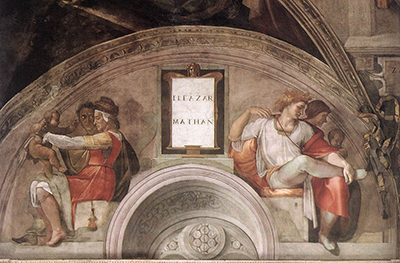
Six people inhabit this unusually dense lunette. On one side, a woman plays with a child on her knee while a man emerges behind them in alarm or surprise. On the other, a young man sits in twisting reflection as the heads of another woman and child appear from shadow. The tablet says ELEAZAR / MATHAN, but the painting refuses to become a neat pair of portraits.
The Eleazar and Matthan lunette stands close to the end of Matthew’s genealogy and may have been the first of Michelangelo’s ancestor lunettes to be painted.[1][2] It later became first in another history: trials on this field helped launch the modern cleaning of the Sistine lunettes.[3] Making and restoration therefore meet here with unusual force.
At a Glance
- WorkEleazar and Matthan; inscription ELEAZAR / MATHAN
- ArtistMichelangelo Buonarroti
- DateUsually about 1508 within the 1508–12 campaign; often considered the first lunette executed[1]
- TechniqueFresco, with later repairs
- LocationEntrance wall of the Sistine Chapel, Vatican City[1]
- ProgrammeAncestors of Christ
- Textual sourceMatthew 1:15[4]
- FiguresTwo groups of three
- Traditional identificationsYoung man as Eleazar; background man as Matthan; neither certain[1][5]
- Technical importanceEarly cleaning trials were carried out on this lunette[3]
- Distinctive evidencePentimenti, damaged and repaired plaster, keys and purse, high degree of finish
Contents
- The Last Generations Before Joseph
- Six Bodies, Two Names
- The Young Man on the Right
- White, Green, Violet and Red
- Pentimenti: A Face and Shoulder Reconsidered
- The Heads Behind Him
- The Woman and Playing Child
- The Startled Man
- Keys and a Purse
- Probably the First Lunette
- A Painted Window and Architectural Illusion
- Damage and Early Repair
- The Lunette That Began the Modern Cleaning
- Finish, Distance and the First Solution
- Artist Up Close
The Last Generations Before Joseph
Matthew writes that Eliud fathered Eleazar, Eleazar fathered Matthan, and Matthan fathered Jacob.[4] The next generation leads to Joseph, husband of Mary.
These names occupy a transitional place in the genealogy but lack independent Gospel stories. Michelangelo cannot illustrate deeds Matthew does not supply.
He instead constructs two families—or two generations within a broader family—whose gestures make descent immediate. A child wriggles; another peers from shade; adults hold, turn, start and think.
The field converts the abstract proximity of Christ into increasing human density.
Six Bodies, Two Names
Each side contains three figures, while the tablet offers only Eleazar and Matthan. That numerical mismatch should immediately discourage simple labelling.
Tradition often identifies the young man on the right as Eleazar and the background man on the left as Matthan.[1] The woman and child beside the latter may then be understood as his wife and Jacob; the two heads behind the young man form another household.
This arrangement is coherent but not proven by attributes or inscriptions attached to individuals. The Vatican’s general guidance describes the ancestor figures as symbolic family units and rejects certain name-to-body matches.[5]
Traditional names can organise discussion so long as they do not harden into fact.
The Young Man on the Right
The figure usually called Eleazar turns his head into profile while presenting much of his torso towards us.[1] One leg crosses; a raised arm reaches towards the shoulder; the other extends towards the ankle of the bent leg.
His body therefore travels in several directions. The hands mark upper and lower limits while the torso opens and the head withdraws.
The pose is relaxed in contour but mentally absorbed. It contrasts with the more rigid foreground woman opposite and with the startled man behind her.
Michelangelo makes thought mobile. Instead of enclosing meditation in a compact knot, he spreads it across a long chain of limbs.
White, Green, Violet and Red
The young man’s shirt is pale and open at the side, with green at the neckline. Apple-green breeches shift towards violet, while a red mantle falls loosely from shoulder to leg.[1]
These acid relationships became crucial to the modern rediscovery of Michelangelo’s colour. The figure does not depend on earth-toned sculptural modelling alone. Red, green, white and violet distinguish overlapping parts at architectural distance.
The looseness of the mantle also answers the turning pose. Fabric slips rather than binds, allowing the body to seem poised between rest and motion.
Colour performs anatomy.
Pentimenti: A Face and Shoulder Reconsidered
Technical examination has found changes in the profile and the height of the young man’s left shoulder.[1] Such pentimenti preserve the difference between first intention and final decision.
They do not mean that Michelangelo lacked preparation. Even a planned figure changes when enlarged, transferred and judged against an exact wall field.
The altered shoulder is especially telling because the pose depends upon the relation between head, torso and raised arm. A small shift changes both balance and expression.
Fresco is often described as unforgiving, but artists could revise contours while working and sometimes repair or overpaint. Material constraint prompted decisions; it did not eliminate them.
The Heads Behind Him
A woman in a dark headdress and a child appear behind the young man.[1] Their abbreviated presence completes a family without competing with the dominant figure.
Depth is achieved through overlap and differential finish. The foremost body receives colour and structural clarity; the heads in shade emerge with fewer means.
This hierarchy was designed for viewing from below. Close reproductions can make the secondary faces seem incomplete, but in the lunette they thicken the human population and darken the space behind the bright costume.
Genealogy extends backward literally as well as temporally.
The Woman and Playing Child
On the left, a woman seen in profile engages a lively child on her knee. She grasps its outstretched arms while the small body moves towards her.[1]
The exchange is reciprocal. Unlike infants who sleep or nurse elsewhere in the series, this child acts upon the adult and is answered.
The woman’s strong body and careful clothing give the play monumental weight. Domestic affection is not miniaturised; it becomes one of the chapel’s principal modes of human continuation.
If the child is traditionally called Jacob, the name remains a proposal. The observable truth is relationship—hands meeting, attention shared and weight supported.
The Startled Man
Behind the woman, a man turns with an expression described as astonished or apprehensive.[1] He does not simply complete a balanced trio. His reaction destabilises it.
What has surprised him is unknown. He may respond to the woman and child, to something outside the frame or to an emotional situation no longer recoverable.
Assigning him the name Matthan does not solve that expression. Matthew records descent, not this moment.
The unexplained reaction is characteristic of the Ancestors. Michelangelo paints highly specific psychological states without supplying narrative causes, creating an intensity beyond illustration.
Keys and a Purse
Along the stone seat hang a key and a small purse or bag attached by a cord.[1]
These objects pull the sacred genealogy into material life. Keys imply keeping, access and household responsibility; a purse suggests money or possessions. Neither needs to become a coded attribute for a named biblical person.
They also establish scale. Against large bodies and monumental drapery, the hanging objects remind us that this is a place where people sit and carry things.
Their survival in close view rewards the painter’s unusually high finish in this early field.
Probably the First Lunette
The Eleazar and Matthan field is often considered Michelangelo’s first ancestor lunette.[1] It was located near the entrance end where work on the ceiling campaign began.
Its density and finish support the sense of an artist establishing a method: six figures, careful accessories, complex colour and numerous spatial relations.
Later lunettes sometimes use broader, faster solutions. That does not create a simple decline in quality. Michelangelo learned what could be seen from below and adjusted effort to the programme’s scale and schedule.
An early field can therefore reveal both ambition and a problem not yet simplified.
A Painted Window and Architectural Illusion
Unlike many side-wall lunettes above real windows, this entrance-wall field is organised around an opening represented within the decorative system.[1]
The format still behaves architecturally. Central tablet and lower interruption split the households, while the curved upper edge compresses their heads and shoulders.
Michelangelo uses symmetry without repetition. Both sides contain three people, but one foreground adult is static and engaged with a child, while the other is mobile and solitary in attention.
Architecture establishes equality; psychology creates difference.
Damage and Early Repair
Part of the plaster was lost and repaired during the later sixteenth century, under papal campaigns associated with Pius IV and Gregory XIII.[1] Darker treatment in repaired areas became evidence of how rapidly the ceiling’s appearance changed.
This history matters because a fresco is not frozen at unveiling. Moisture, soot, structural movement, glue, repainting and repair mediate every later encounter.
Restorers must distinguish Michelangelo’s pigment from additions without pretending that centuries can simply be reversed.
The repaired field contains several historical surfaces at once.
The Lunette That Began the Modern Cleaning
Between 1980 and 1984, conservation trials included areas of the Eleazar and Matthan lunette.[3] Their results helped shape the larger cleaning of the lunettes and vault.
The choice made this field a testing ground twice: first for Michelangelo’s ancestor method, then for the modern restoration campaign.
Cleaning revealed pale pink-violet backgrounds and forceful, unexpected colour relationships. It also fed an international debate over whether removal of later materials changed Michelangelo’s intended modelling.
The page in the programme’s history is therefore double. It concerns both an artist beginning to paint and conservators deciding how the work could be seen again.
Finish, Distance and the First Solution
The lunette is more highly finished than many that followed.[1] Accessories, costume and small heads receive sustained attention.
That density may reflect Michelangelo discovering the correct threshold for visibility. Once scaffolding came down, he could judge which details survived from the floor and which labour had been optically unnecessary.
The idea does not require imagining a linear march towards careless speed. Later works often achieve more with fewer marks because the problem has been learned.
Here the abundance remains compelling. The eye can move from crossed leg to slipping mantle, from startled face to keys, and from playing hands to shadowed child.
Artist Up Close
The Eleazar and Matthan lunette contains the Ancestors cycle in miniature: named descent carried by unnamed bodies, family intimacy beside emotional distance, brilliant colour beneath theological gravity.
It also exposes Michelangelo’s adaptability. The sculptor models a torso with light, but the painter lets a red mantle and apple green conduct the pose. The monumental designer controls a vast wall, but the observer notices a key and a child’s fingers.
Later conservators encountered the same complexity when they tested how far accumulated darkness could be removed.
The field began one sequence in 1508 and another in the twentieth century. Both transformed how Michelangelo’s ceiling came into view.
Frequently Asked Questions
Discussion
What details, sources or comparisons stand out to you in Eleazar / Mathan?
Reader Insights
Which formal detail changes how the work reads?
Which documented source or collection history feels most useful?
Which related Michelangelo work should readers compare next?
Join the Conversation
Add a source-led observation, comparison or question for other readers.
References
- Web Gallery of Art, Eleazar—Matthan,, View source.
- Vatican Museums, Sistine Chapel Ceiling,, View source.
- Vatican Museums, The Sistine Chapel Twenty Years Later: New Breath, New Light,, View source.
- United States Conference of Catholic Bishops, Matthew, Chapter 1,, View source.
- Vatican Museums, Lunettes—North Wall,, View source.
- Pierluigi De Vecchi and Gianluigi Colalucci, Michelangelo: The Vatican Frescoes, Abbeville Press, 1996,, View source.