


 by Tom Gurney
Tom Gurney BSc (Hons) is an art history expert with over 20 years experience
Published on June 19, 2020 / Updated on November 6, 2025
Email: tomgurney1@gmail.com / Phone: +44 7429 011000
The Prophet Ezekiel by Michelangelo
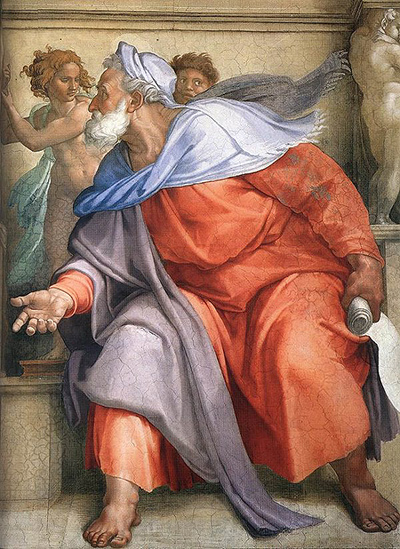
Michelangelo’s Ezekiel turns so abruptly toward an attendant that his broad mantle seems to follow a moment later. The prophet’s open hand reaches into the chapel, palm upward, while the other grips a rolled text. Behind him, a youthful figure raises one finger as if delivering urgent news. Reading has become exchange; prophecy appears in the instant a message demands an answer.
The Vatican Museums provide a dedicated identity for the fresco and describe the prophet’s animated turn.[1] Ezekiel sits among seven biblical prophets and five ancient sibyls on the Sistine Chapel ceiling.[2] His scriptural book was forged in exile and moves through visions of divine glory, responsibility, judgment and restoration.[8] Michelangelo avoids illustrating one vision and instead makes receptivity itself bodily.
Why keep Ezekiel separate from Ezechias? Ezekiel is the Sistine Chapel prophet route in this sequence, while Ezechias is a separate older page and not part of this refreshed prophet article. This page focuses on Michelangelo's Ezekiel and does not decide what should happen to that separate older page.
At a Glance
- FigureThe Prophet Ezekiel, labelled EZECHIEL
- Artist and methodMichelangelo Buonarroti; fresco
- SettingA fictive throne within the Sistine Chapel’s prophetic ensemble
- Campaign rangeJulius II’s ceiling project, 1508–1512[3]
- CompanySeven prophets and five sibyls around the central Genesis fields[2][4]
- Defining actionTurning toward a speaking or gesturing attendant[1]
- Left-hand gestureOpen palm extended outward in response
- Textual attributeA rolled scroll held in the other hand
- CompanionsTwo youthful attendants behind the prophet
- Colour structureRed-orange garment, violet mantle and pale blue-white head covering
- Name variantsEzekiel and the inscriptional form EZECHIEL
- Interpretive cautionThe visible conversation has no securely transcribed words
Contents
- Ezekiel in Exile
- A Turn Built from Several Speeds
- The Attendant’s Raised Finger
- The Open Palm
- Gesture Without a Transcript
- The Rolled Scroll
- Head Covering and Profile
- Red and Violet in Motion
- Feet Wide on the Ledge
- Two Attendants, Two Directions
- The Tablet EZECHIEL
- Isaiah and Ezekiel: Two Interruptions
- Ezekiel and the Delphic Sibyl
- Exile, Responsibility and Renewal
- Relation to the Genesis Centre
- Campaign and Chronology
- Looking Up at Ezekiel
- Material Afterlife and Restored Colour
- Why Ezekiel Matters
- Artist Up Close
Ezekiel in Exile
The Book of Ezekiel opens among exiles in Babylon with a complex vision of divine glory. It moves through prophetic signs, responsibility, Jerusalem’s fall and promises of renewal, including the valley of dry bones and a restored temple.[8]
This history makes communication central. Ezekiel receives, speaks, performs and interprets difficult messages to a displaced people.
Michelangelo does not paint wheels, living creatures, dry bones or temple measurements inside the throne. A scroll and urgent exchange stand for prophetic office more broadly.
The restraint prevents the figure from becoming an illustration of one spectacular chapter. His body embodies the readiness required across the book.
A Turn Built from Several Speeds
Ezekiel’s head reaches farthest toward the attendant. Shoulders and upper torso rotate, but knees and feet remain spread toward the front.
The mantle sweeps around the neck and across the body, recording movement after anatomy initiates it. Fabric seems to trail the turn.
This staggered response gives the pose temporal truth. A seated person reacts first with attention, then reorganises weight.
Michelangelo stretches that instant into a permanent exchange without making it look frozen.
The Attendant’s Raised Finger
One youth behind Ezekiel lifts an index finger while leaning forward. The gesture is compact but emphatic, and the prophet turns toward it.
The raised finger can indicate speech, warning or instruction. The Vatican description supports the conversational energy but does not give the attendant a name or quotation.[1]
Scale does not determine influence. A small companion activates one of the ceiling’s largest bodies.
The second attendant looks outward from behind, extending the chain of attention beyond the immediate exchange.
The Open Palm
Ezekiel’s near hand reaches low and outward, palm up, with fingers opened. It is one of the prophetic series’ most generous and questioning gestures.
The hand may ask, answer, receive or emphasise. Its meaning lies partly in refusing a single verbal translation.
Position carries the dialogue into the observer’s space. The attendant speaks behind, but the prophet’s response projects forward.
Michelangelo makes conversation triangular: youth, prophet and chapel.
Gesture Without a Transcript
The throne appears full of speech, yet Michelangelo gives no legible sentence to either participant. Communication survives through direction, distance and hands.
This absence is not a defect to be solved by inventing dialogue. It allows the scene to represent the condition of prophecy more broadly: a message arrives, the prophet turns and response begins.
The attendant’s pointed finger is narrow and assertive. Ezekiel’s open palm is broad and receptive. Their shapes establish different roles before facial expression is examined.
Because the actual words remain unknown, viewers must attend to the ethics of exchange. The prophet’s authority does not prevent questioning, and the smaller companion’s message is not diminished by scale.
The fresco makes language bodily while keeping its verbal content responsibly beyond recovery.
The Rolled Scroll
The opposite hand grips a rolled text near Ezekiel’s hip. A pale end and trailing strip make it visible against red clothing.
The scroll is closed at this instant, unlike Joel’s extended text. Ezekiel is not visibly reading because communication has redirected him.
Yet he does not discard the document. Hand remains firm around it, binding spoken message to written authority.
Object and gesture divide the body: text held inward, questioning palm offered outward.
Head Covering and Profile
A pale blue-white wrap rises around Ezekiel’s grey head, creating a distinctive silhouette. Beard and nose project in profile toward the attendant.
The wrap catches light and separates the face from the darker violet mantle. It also magnifies the head’s turn.
Age is visible in white beard and lined features, but the posture is energetic. Experience has not become withdrawal.
No portrait model is securely named by resemblance. The individual face serves prophetic identity rather than documentary likeness.
Red and Violet in Motion
Ezekiel’s red-orange tunic occupies much of the torso and lap. A violet mantle sweeps from shoulder across one leg, while paler fabric crosses above.
Colour separates the body’s directions. Red establishes forward mass; violet traces the turn; pale cloth crowns the exchange.
Folds across knees and waist make the seated body heavy enough for the upper rotation to feel forceful.
Modern conservation renewed visibility of these chromatic relations, although photographs differ in saturation and temperature.[5][7]
Feet Wide on the Ledge
Both bare feet rest apart near the edge of the throne. Their broad stance anchors the figure.
This lower stability counterbalances the open hand and turning head. Ezekiel can reach outward without appearing to fall.
Toes and soles also strengthen the illusion of a body occupying painted stone. Contact makes fictive architecture persuasive.
At ceiling distance, the triangular spread of legs and feet contributes strongly to silhouette.
Two Attendants, Two Directions
The speaking youth looks toward Ezekiel. The other face appears behind the prophet and directs attention elsewhere or outward.
These divergent gazes make the recess socially complex. Conversation has a primary line without enclosing every figure within it.
The attendants are smaller but not merely ornamental. They supply stimulus, depth and a counter-rhythm to Ezekiel’s mass.
Their lack of individual names should remain visible. Function is more secure than invented angelic biography.[1][2]
The Tablet EZECHIEL
The Latinised inscription beneath the throne uses EZECHIEL. Modern English ordinarily uses Ezekiel. Both identify the same prophet here.
The tablet matters because scroll, beard and attendants recur elsewhere. Name prevents a visual type from becoming anonymous.
Its Roman lettering integrates biblical authority into the ceiling’s classicising painted architecture.
At close range, inscription completes identification; from below, gesture and colour may arrive first.
Isaiah and Ezekiel: Two Interruptions
Isaiah also turns toward a youthful companion, but his response remains close to the face and book. The exchange feels measured.
Ezekiel opens across the throne. His hand travels farther, his torso leans and the attendant’s finger intensifies the communication.
Michelangelo distinguishes thought by amplitude. One prophet pauses; another demands or offers an answer.
The comparison demonstrates why dedicated study matters. Similar compositional premises generate different psychologies.
Ezekiel and the Delphic Sibyl
The Delphic Sibyl turns away from a scroll toward an unseen stimulus. Ezekiel responds to a visible attendant.
Her motion centres on gaze; his expands into hand and torso. Silence surrounds her, while his niche seems conversational.
Both make prophecy a transition rather than a possession. Knowledge arrives by redirecting attention.
The shared throne system permits comparison across biblical and pagan seers without erasing their different traditions.
Exile, Responsibility and Renewal
Ezekiel’s biblical context is collective crisis. The prophet speaks about judgment and individual responsibility while sustaining visions of national and sacred restoration.[8]
The fresco’s urgent exchange resonates with that communicative burden, though it should not be assigned to one chapter without evidence.
Open palm can suggest the difficulty of addressing a message that is both warning and promise.
Michelangelo makes theological tension bodily: text retained, question opened, answer still incomplete.
The prophet’s wide stance gives that tension durability. He is not swept away by the message; he turns from a secured base. Responsiveness and steadiness coexist, a useful image for a book that repeatedly joins devastating vision to the demand for accountable action.[8]
Relation to the Genesis Centre
The central ceiling histories concern origins and Noah.[4] Ezekiel belongs to a later scriptural period and occupies the surrounding interpretive architecture.
His turning body may seem to react to neighbouring images, but a particular sightline should not be claimed without demonstration.
The secure relation is structural. Genesis is encircled by later witnesses whose books and gestures interpret history in a Christian chapel.
Cropping the throne removes that temporal layering.
Campaign and Chronology
Michelangelo executed the Sistine vault under Julius II between 1508 and 1512.[3] Ezekiel belongs to that documented project.
No official public record used here isolates his painting to an exact day. Architectural placement and style do not automatically provide microchronology.
The throne also includes attendants and fictive stone whose labour belongs with the main body.
Chronological honesty leaves precise execution order to technical evidence while fully describing the surviving figure.
Looking Up at Ezekiel
From the chapel floor, red mass, pale head wrap, open hand and spread feet define the prophet. Fine expressions and the rolled scroll become clearer in close imagery.
Smarthistory emphasises the vault’s scale and visual abundance.[6] Ezekiel’s gesture is calibrated to cut through that density.
Viewpoint changes the hand’s apparent projection. Moving beneath the throne animates a turn already painted into the body.
Whole-throne and detail views should be reunited with his position among twelve seers.
Material Afterlife and Restored Colour
Modern conservation provides the historical frame for the bright reds, violets and blues visible now.[5][7] Older dark photographs created a different balance of form and colour.
Digital exposure can make the pale mantle almost white or blue and can exaggerate cracks across the red garment.
These variables affect reproduction, not the identity of the action. Open hand, turning profile and held scroll remain stable anchors.
The fresco’s material age deserves acknowledgment alongside its designed immediacy.
Why Ezekiel Matters
Ezekiel matters because Michelangelo turns prophecy into conversation. Authority is monumental, but it remains able to listen.
He matters because a scroll and open palm divide knowledge between what is held and what is offered.
Most importantly, the prophet’s turn makes thought public. An unseen text becomes an embodied exchange that extends toward everyone below.
Artist Up Close
Michelangelo makes response larger than speech. The attendant’s small finger starts the event; Ezekiel’s head turns, fabric follows and the open hand carries it out of the niche. The artist understands communication as a transfer of force between unequal bodies. Monumentality does not silence conversation—it amplifies it.
Frequently Asked Questions
Discussion
What seems most important in Michelangelo's Ezekiel: the turning exchange with the youthful companion, the prophet's role among the seers, or the figure's relationship to the Genesis scenes?
Reader Insights
How does Ezekiel change the rhythm after Prophet Isaiah?
What can the turn toward the youthful companion safely suggest?
How do the cited Ezekiel themes shape the figure without becoming a full scripture essay?
Join the Conversation
Compare Ezekiel's prophet role, visible exchange and relationship to the Genesis scenes while keeping the route focused on Michelangelo's painted figure.
References
- Vatican Museums, Prophet Ezekiel”:, View source.
- Vatican Museums, Sibyls and Prophets”:, View source.
- Vatican Museums, Sistine Chapel Ceiling”:, View source.
- Vatican Museums, Central Stories”:, View source.
- Vatican Museums, Sistine Chapel History”:, View source.
- Smarthistory, Michelangelo, Ceiling of the Sistine Chapel”:, View source.
- Vatican Museums, The Sistine Chapel Twenty Years Later: New Breath, New Light”:, View source.
- United States Conference of Catholic Bishops, Ezekiel, Chapter 1”:, View source.