


 by Tom Gurney
Tom Gurney BSc (Hons) is an art history expert with over 20 years experience
Published on June 19, 2020 / Updated on November 6, 2025
Email: tomgurney1@gmail.com / Phone: +44 7429 011000
Michelangelo’s Hezekiah, Manasseh and Amon Lunette
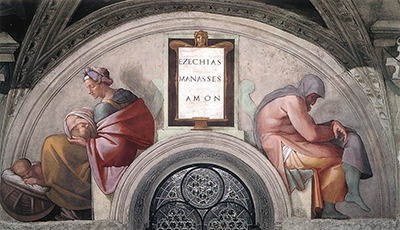
A young woman holds one child while rocking another in a wooden-and-wicker cradle with her feet. Her face and hands remain tenderly absorbed even as her body performs two acts of care. Back to back with her, a man folds forward beneath a violet-grey cloth, his face lost in shadow. One side sustains more than one life; the other seems nearly unable to sustain itself.
The Hezekiah, Manasseh and Amon lunette belongs to the royal genealogy preceding the Babylonian exile.[1][2] Traditional readings identify the bowed man as the penitent Manasseh and the woman as Meshullemeth, mother of Amon.[1] These names rely upon biblical association, not conclusive attributes. The emotional contrast—tender vitality against desolate withdrawal—is much more secure.
At a Glance
- WorkHezekiah, Manasseh and Amon
- ArtistMichelangelo Buonarroti
- DateAbout 1511–12[1]
- TechniqueFresco
- LocationSistine Chapel, Vatican City
- ProgrammeAncestors of Christ
- Textual sourceMatthew 1:9–10[3]
- Principal figuresWoman with infant and cradle child; bowed solitary man
- Traditional identitiesMeshullemeth and Manasseh[1]
- Identity cautionNot proven by the fresco
- Distinctive actionThe woman rocks a cradle with her feet while holding another child
- ReceptionHer group circulated in an engraving by Adamo Scultori[4]
Contents
- Three Kings Before Exile
- Hezekiah and Manasseh as Opposed Reputations
- The Man Usually Called Manasseh
- Manasseh’s Repentance as Context
- The Woman Commonly Called Meshullemeth
- Two Children at Once
- The Cradle
- Back to Back
- Colour Links Opposite Moods
- The Woman’s Hair
- Hezekiah in the Spandrel Above?
- Beside the Babylonian Break
- From Fresco to Engraving
- What Reproduction Changes
- Maternity and Moral History
- Sleep in Both Halves
- Artist Up Close
Three Kings Before Exile
Matthew says that Ahaz fathered Hezekiah, Hezekiah fathered Manasseh, and Manasseh fathered Amon.[3]
These kings carry radically different biblical reputations. Hezekiah is praised for reform; Manasseh is condemned for idolatry and bloodshed but, in Chronicles, later repents; Amon continues wrongdoing.
Michelangelo does not supply a royal chronicle. The bowed man’s remorse has encouraged identification as Manasseh, but expression alone cannot prove a historical person.
The names provide moral context while the image retains the open psychology of the Ancestors cycle.
Hezekiah and Manasseh as Opposed Reputations
Biblical history places an admired reforming king before a son remembered first for religious violence and only later for repentance.[5][7] The tablet therefore contains a dramatic reversal between generations.
Michelangelo does not assign visible moral types with certainty. If the woman’s family includes Hezekiah and the bowed man is Manasseh, nurturing vitality and penitential collapse would turn scriptural contrast into human mood.
That reconstruction is coherent, but it depends upon several unproven identifications. Its value lies in explaining reception, not in replacing the fresco’s ambiguity with a solved allegory.
The Man Usually Called Manasseh
The man sits with his back to the woman and folds forward. A violet-grey cloth covers his head and follows the curve of his spine.[1]
His face lies in shadow. He may be asleep, exhausted, grieving or absorbed in anguished thought.
Traditional interpretation reads penitence for Manasseh’s promotion of idolatry and persecution.[1] That reading gains support from the cloth’s penitential colour and the biblical story, but remains inferred.
Michelangelo paints remorse convincingly without giving it a definitive cause.
Manasseh’s Repentance as Context
Second Chronicles tells that Manasseh was taken captive, humbled himself and prayed; after restoration, he attempted reform.[5] The account made him an important example of late repentance.
If the bowed figure is Manasseh, his self-abandonment can evoke that history. Yet there is no chain, crown, idol or prayer gesture to establish the scene.
The best use of scripture is comparative. It explains why viewers saw penitence here, while the fresco itself remains non-narrative.
Context illuminates reception; it does not label the body.
The Woman Commonly Called Meshullemeth
The young woman is traditionally identified as Meshullemeth, mother of Amon.[1] Her name comes from the royal account rather than Matthew’s tablet.
Michelangelo gives her extraordinary practical concentration. She holds an infant against her body while using her feet to rock a cradle containing another sleeping child.[1]
Her lips remain slightly parted and her expression tender. Care involves the whole body: arms, chest, gaze and feet.
Even if the name is rejected, the figure is no generic mother. Her action is precisely observed.
Two Children at Once
The woman’s task distinguishes this lunette from other maternal groups. One child receives direct bodily contact; another receives rhythmic motion through the cradle.
Michelangelo makes simultaneous care legible without clutter. The held infant occupies upper body and gaze; the cradle extends attention downward.
This divided labour creates a small domestic system. Wood, wicker and feet transmit movement to a child the hands cannot presently hold.
Genealogy depends upon tools as well as affection.
The Cradle
The cradle appears constructed from wood and woven material.[1] Its practical specificity brings the sacred lineage into a recognisable household world.
It also transforms the woman’s pose. Her legs cannot simply support seated rest; feet must remain engaged with the object.
At chapel distance, the cradle may be less immediately visible than the large figures, but it explains their relation when seen closely.
Michelangelo hides an entire choreography of care beneath the monumental silhouette.
The cradle also represents delegated touch. The sleeping child is not held directly, yet the mother’s movement reaches it through wood and wicker. Technology extends the body’s capacity to care.
That practical intelligence deserves as much attention as the supposed king’s remorse. The most complicated action in the lunette belongs to an unnamed woman.
Back to Back
The two adults turn away from one another.[1] Their spatial separation is reinforced by the window and tablet, yet colour connects them.
The woman’s activity answers the man’s collapse. She distributes energy; he withdraws it. She sustains two children; he appears isolated from every relation.
This contrast can be moralised too easily as virtuous maternity versus guilty kingship. The fresco provides tenderness and desolation, not a written judgement.
Michelangelo’s emotional opposition is stronger because its cause remains unresolved.
Colour Links Opposite Moods
The woman’s rose mantle finds a slightly paler echo in the man’s tunic.[1] Her yellow skirt and green shirt answer deeper tones in his clothing and stockings.
These correspondences prevent emotional contrast from breaking the field in two. Colour remembers kinship where bodies refuse it.
The violet-grey cloth over the man has a pale delicacy compared with the blue-grey and white ribbons woven through the woman’s elaborate hair.[1]
Even penitence and vitality share a palette.
The Woman’s Hair
Blue-grey and white ribbons interlace through an elaborate coiffure.[1] The detail frames her face while testifying to Michelangelo’s interest in costume and grooming across the Ancestors.
It should not be treated as historically accurate royal Judean dress. The style belongs to Renaissance visual invention.
Its complexity contrasts with the man’s cloth-covered head. One head is actively arranged and visible; the other concealed.
Hair and fabric extend the field’s opposition between composed life and withdrawal.
Hezekiah in the Spandrel Above?
A traditional reconstruction places Hezekiah as a child with Ahaz and his mother in the triangular field above.[1]
The theory helps distribute three names across multiple family groups, but exact spandrel identities remain disputed.[2]
The upper and lower fields should be connected architecturally without being fused. A proposed Hezekiah child above does not prove Manasseh and Meshullemeth below.
Genealogical sequence is secure; individual placement is not.
Beside the Babylonian Break
This lunette sits next to Josiah, Jechoniah and Shealtiel, which follows it chronologically and marks the exile.[6]
Their adjacency breaks Michelangelo’s usual alternation between opposing walls, perhaps to emphasise the deportation.[6]
The bowed man can thus be seen near a larger historical descent into catastrophe. Still, his pose should not be retroactively turned into a literal premonition.
Architecture provides emphasis, not speech.
From Fresco to Engraving
Adamo Scultori engraved the woman with two children as part of a series of studies after Michelangelo.[4]
The print, made between 1547 and 1587, translates a coloured wall group into a small paper object measuring roughly 142 by 113 millimetres.[4]
It isolates maternity from the bowed man, tablet and chapel. What was one side of an emotional contrast becomes a self-sufficient image of care.
“After Michelangelo” preserves authorship correctly: Scultori made the engraving; Michelangelo invented the fresco group.
The British Museum records the impression as a unique state, on paper, approximately 142 millimetres high by 113 wide.[4] Such modest dimensions radically alter the encounter. A figure painted above a chapel window becomes something held close and studied privately.
The print’s survival also reveals selection. Scultori chose the active maternal group, not the named tablet or penitential man, as a sufficient demonstration of Michelangelo’s invention.
What Reproduction Changes
Engraving privileges contour and hatching. It can make the cradle structure clearer to close viewers while losing Michelangelo’s rose, yellow, green and violet links across the lunette.
Isolation also encourages a stable title such as “woman with two sleeping children,” avoiding uncertain names but reducing genealogical context.
The print demonstrates how Michelangelo’s figures acquired lives independent from the Sistine programme.
Reception preserves and reframes.
Engraving also stabilises edges that fresco light and distance soften. Wicker, garment folds and sleeping bodies become networks of line. What it clarifies materially it separates chromatically, since the carefully linked rose and violet tones vanish.
Neither medium is a neutral substitute for the other.
Maternity and Moral History
The kings on the tablet are judged extensively in scripture, yet the unnamed woman bears no moral biography. Her action is ethically legible through care rather than textual praise.
This creates an important imbalance. The named male line carries public sin, reform and succession; the female body performs the labour that lets any line continue.
Michelangelo does not necessarily set out to critique the genealogy. His image nevertheless makes its exclusions visible.
Sleep in Both Halves
The child in the cradle sleeps securely because another body maintains rhythm. The bowed man may also appear asleep, but no one tends him.
This resemblance makes the emotional opposition even sharper. Similar closed eyes or lowered faces can mean protected rest on one side and anguished abandonment on the other.
Michelangelo differentiates states less through facial expression than through relation. Sleep changes meaning according to whether care surrounds it.
Artist Up Close
The Hezekiah, Manasseh and Amon lunette stages two opposed relations to time.
The woman manages simultaneous needs, keeping rhythm for a sleeping child while holding another. The man seems trapped in thought about what has already happened.
Traditional names may explain why viewers saw penitence, but the fresco’s humanity exceeds them. It is about care that multiplies outward and remorse that folds inward.
Colour joins what posture separates.
Frequently Asked Questions
Discussion
What details, sources or comparisons stand out to you in Hezekiah / Manasseh / Amon?
Reader Insights
Which formal detail changes how the work reads?
Which documented source or collection history feels most useful?
Which related Michelangelo work should readers compare next?
Join the Conversation
Add a source-led observation, comparison or question for other readers.
References
- Web Gallery of Art, Hezekiah—Manasseh—Amon,, View source.
- Vatican Museums, Spandrels,, View source.
- United States Conference of Catholic Bishops, Matthew, Chapter 1,, View source.
- British Museum, Woman Seated with Two Sleeping Children, after Michelangelo,” V,2.30,, View source.
- United States Conference of Catholic Bishops, 2 Chronicles, Chapter 33,, View source.
- Web Gallery of Art, Josiah—Jechoniah—Shealtiel,, View source.
- United States Conference of Catholic Bishops, 2 Kings, Chapter 18,, View source.