


 by Tom Gurney
Tom Gurney BSc (Hons) is an art history expert with over 20 years experience
Published on June 19, 2020 / Updated on November 6, 2025
Email: tomgurney1@gmail.com / Phone: +44 7429 011000
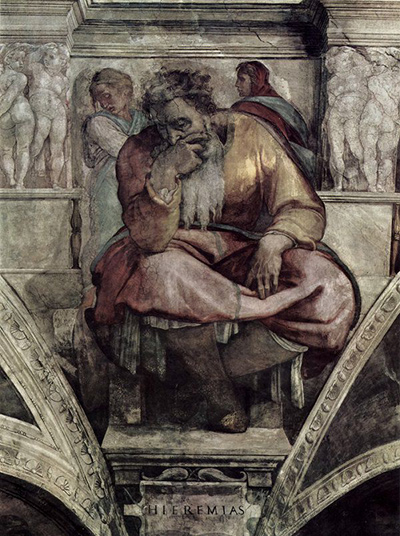
The Prophet Jeremiah by Michelangelo
Michelangelo’s Jeremiah does not read, speak or turn. He leans forward beneath the pressure of thought, one hand covering his mouth and supporting his bearded head while the other falls heavily across his lap. Two attendants remain behind, emotionally distant. The great prophet occupies his throne like someone for whom knowledge has become almost impossible to carry.
The inscription HIEREMIAS identifies Jeremiah among the seven Hebrew prophets and five ancient sibyls of the Sistine Chapel ceiling.[1] His biblical vocation joins warning, lament, Jerusalem’s destruction and hope for a new covenant.[7] Michelangelo selects no narrative episode. Instead, he creates an image of grief held inside a body that can neither fully collapse nor return to action.
How much can this page say about Jeremiah's mood or prophecy? The accepted sources support Jeremiah's identity and place in the Sistine Chapel prophet-and-sibyl system, but exact inscription, prophecy, mood, execution sequence and private-programme claims should not be asserted without direct route-specific evidence.
At a Glance
- FigureThe Prophet Jeremiah, inscribed HIEREMIAS
- Artist and techniqueMichelangelo Buonarroti; fresco
- SettingOne of twelve fictive prophetic thrones on the Sistine vault
- Commission spanJulius II’s ceiling campaign, 1508–1512[2]
- EnsembleSeven prophets alternating with five sibyls[1]
- Defining poseHead supported by one hand, torso bent forward, free hand resting on lap
- CompanionsTwo attendants behind, turned in different directions
- Colour structureYellow and red upper garments over a broad pink-red lap
- Scriptural associationsProphetic warning, lament, judgment, suffering and promised renewal[7]
- Expression caution“Melancholy” and “grief” describe visible affect; a modern clinical diagnosis would be inappropriate
- Portrait cautionThe often-repeated self-portrait interpretation is not secured by the institutional evidence used here
- Chronology cautionPosition after Daniel in the ensemble does not establish an exact working sequence
Contents
- Jeremiah’s Prophetic Burden
- Public Vocation, Private-Looking Grief
- Jeremiah and Lamentations
- The Hand Supporting the Head
- The Covered Mouth
- The Downcast Face
- The Free Hand on the Lap
- A Body Folding Forward
- Garments as Emotional Weight
- Feet Withdrawn Under the Throne
- The Two Attendants
- Solitude in Company
- The Tablet HIEREMIAS
- Jeremiah After Daniel
- Jeremiah Before Jonah
- Was Jeremiah a Self-Portrait?
- Melancholy Without Diagnosis
- Relation to the Genesis Histories
- Campaign and Dating Caution
- Seeing Jeremiah from Below
- Restoration and Surface
- Why Jeremiah Matters
- Artist Up Close
Jeremiah’s Prophetic Burden
The Book of Jeremiah presents a prophet called reluctantly, compelled to speak warning to Judah and entangled in the catastrophe of Jerusalem’s fall. It contains anguish, conflict, imprisonment, loss and promises of restoration, including a new covenant written on the heart.[7]
This range makes sorrow central without making it final. Jeremiah’s grief belongs to responsibility for a community and message, not private mood alone.
Michelangelo’s throne does not illustrate one confrontation, cistern or ruined city. The body accumulates the book’s burden more generally.
That restraint allows lament and hope to remain in tension. The prophet is bent but still present within the chapel’s history of salvation.
Public Vocation, Private-Looking Grief
Jeremiah’s sorrow appears private because his face withdraws and attendants fail to enter his concentration. His biblical vocation, however, is intensely public: he addresses rulers, priests and a threatened city, performs signs and suffers because his message is resisted.[7]
The fresco brings these scales together. A figure charged with communal warning occupies a pose associated with solitary thought.
This prevents grief from becoming self-absorption. What weighs on him can be understood as historical and ethical burden, not merely personal temperament.
Michelangelo’s enormous seated mass enlarges the consequences of that privacy. The prophet turns inward in a place built for collective worship.
Jeremiah and Lamentations
Western tradition has often connected Jeremiah with the Book of Lamentations and with mourning over Jerusalem. Modern scholarship distinguishes questions of authorship more carefully, so the fresco should not be treated as proof that Jeremiah wrote every lamenting text associated with him.
The visual connection remains historically understandable. Bowed head, silence and grief align with the prophet’s long reception as a mourner.
Recognising reception without turning it into documentary fact is important. Michelangelo’s figure can participate in a culture of “Jeremiah the lamenter” while its primary identity remains the prophet named by the tablet.
The pose gains depth from that tradition but does not need a specific open text because no book governs the visible action.
The Hand Supporting the Head
Jeremiah’s raised hand presses against cheek and mouth while the head bears down into it. Fingers partly obscure the face.
The gesture supports physical weight and suppresses speech simultaneously. A prophet defined by words appears unable or unwilling to release them.
This ambiguity is central. Hand may express thought, grief, fatigue or self-restraint without one label excluding the others.
Michelangelo makes an ordinary pose of contemplation monumental by showing how pressure passes from skull through palm, wrist and elbow.
The Covered Mouth
The mouth lies behind fingers and beard. Viewers cannot see whether lips are closed, trembling or forming words.
That concealment intensifies the silence. Jeremiah’s prophetic authority is known through inscription and scripture, yet the fresco withholds utterance.
Silence can suggest exhaustion after speech or the terrible interval before speaking again. The image does not decide.
It asks the body to communicate what a painted quotation would narrow.
The Downcast Face
Jeremiah’s eyes turn downward beneath a deeply shadowed brow. Grey hair and long white beard frame a face whose direction avoids both attendants and audience.
He is not asleep. The muscular tension of forehead, hand and shoulders makes inward attention active.
The lowered gaze also removes easy identification with a portrait sitter. We encounter a state before a likeness.
Michelangelo individualises grief while denying the mutual gaze through which conventional portrait presence is often built.
The Free Hand on the Lap
Jeremiah’s other hand rests heavily on the broad drapery across one thigh. Fingers relax downward rather than point or grasp.
Its passivity balances the intense supporting hand. One side of the body labours; the other surrenders.
The hand’s scale makes stillness visible from below. It appears too substantial to ignore even though it performs no narrative action.
Michelangelo demonstrates that an inactive limb can carry psychological meaning through weight alone.
A Body Folding Forward
Shoulders round, chest lowers and knees spread beneath the garment. The torso forms a large downward arc.
The throne prevents total collapse. Seat, feet and architecture retain the body within a defined structure.
This opposition creates pathos. Jeremiah can lean but not leave; contemplation has no easy escape.
Compared with Jonah’s backward expansion, the fold closes space around the prophet.
Garments as Emotional Weight
Yellow-orange sleeves and upper cloth surround a red torso, while a wide pink-red mass stretches across the lap. Darker fabric emerges beneath.
The colours are bright, yet the pose remains sombre. Michelangelo does not rely on darkness to signify grief.
Heavy folds make the lower body broad and immovable. Fabric pools across knees like accumulated burden.
Modern conservation renewed these chromatic contrasts, complicating older reproductions that equated Michelangelo’s seriousness with uniformly muted colour.[4][6]
Feet Withdrawn Under the Throne
Jeremiah’s feet sit beneath the broad lap, partly shadowed and less assertive than Ezekiel’s wide stance or Joel’s projecting foot.
Their withdrawal reinforces enclosure. The body does not reach toward chapel space.
Yet feet still make contact with the fictive platform, proving weight and preventing the figure from becoming a floating emblem of sadness.
Small variations in lower support help Michelangelo distinguish psychological orientation before a face is seen.
The Two Attendants
Behind Jeremiah, two smaller figures turn differently. One looks downward or toward the prophet; the other faces away, wrapped in darker cloth.
They do not console him visibly. Their distance makes his solitude sharper despite company.
The pair also add depth and contrasting verticality to a throne dominated by forward collapse.
The Vatican ensemble account leaves them unnamed.[1] Specific family, angelic or allegorical identities should not be asserted without evidence.
Solitude in Company
Jeremiah’s attendants reveal that being surrounded is not the same as being reached. He remains psychologically sealed within hand, beard and lowered gaze.
This condition distinguishes him from Ezekiel, whose attendant initiates exchange, and Isaiah, who turns responsively.
Michelangelo thus uses secondary figures to define different social states: conversation, interruption, support and isolation.
Jeremiah’s grief is not produced by literal emptiness. It persists in the presence of others.
That distinction makes the attendants ethically significant even though their identities are unknown. They show the limit of proximity: bodies can share a niche without sharing an inner state.
The fresco does not condemn them for failing to console. Their turned poses simply make Jeremiah’s enclosure measurable.
The Tablet HIEREMIAS
The inscription uses a Latin form of Jeremiah’s name. It anchors the figure within scripture while modern English titles use Jeremiah.
Name matters because the pose could otherwise become a generic personification of melancholy.
The tablet makes his inwardness historically and theologically specific: this is the prophet of warning, suffering and covenant.
Classicising letters, Hebrew identity and papal chapel architecture overlap in one label.
Jeremiah After Daniel
Daniel spreads his arms across books with active help from a small attendant. Jeremiah withdraws from text and rests his head in a hand.
The sequence moves from interpretation as work to knowledge as burden. Both are intellectual, but their energies oppose one another.
Daniel’s wide apparatus fills space; Jeremiah’s body creates a closed human chamber.
Michelangelo uses adjacency to show that prophecy has no single emotional register.
Jeremiah Before Jonah
Jonah, at the altar end, leans backward and looks upward. Jeremiah bends forward and down.
Their bodies create inverse arcs. Grief closes; revelation opens.
This does not make Jonah simply joyful or Jeremiah devoid of hope. It identifies different relations to unseen meaning.
The contrast gives the end of the prophetic sequence dramatic expansion after profound contraction.
Was Jeremiah a Self-Portrait?
The figure has often been linked speculatively to Michelangelo himself, partly because of its brooding mood and assumptions about the artist’s temperament.
Such identification is attractive but not proven by visible emotion. A psychological resemblance is not the same as facial or documentary evidence.
The Vatican ensemble source names Jeremiah and does not require a self-portrait for interpretation.[1]
Responsible discussion can note the tradition while refusing to make it fact. The prophet’s burden already has ample scriptural and visual meaning.
Melancholy Without Diagnosis
“Melancholy” is an art-historical and descriptive term for Jeremiah’s inward, burdened pose. It should not be converted into a modern diagnosis of depression.
Clinical categories require evidence unavailable for a painted biblical figure. The fresco offers gesture, expression and context.
Avoiding diagnosis does not flatten emotion. It permits precise description: lowered eyes, supported head, covered mouth, slack hand and folded torso.
The body’s visible facts are richer than a retrospective label.
Relation to the Genesis Histories
Jeremiah sits outside the nine central episodes from Creation to Noah.[3] His later prophetic time surrounds those origins within a Christian interpretive structure.
He does not visibly witness one Genesis scene in shared space. Fictive architecture establishes a separate register.
His sorrow nevertheless changes the emotional climate of the ceiling. Human beginnings are bordered by later awareness of judgment and loss.
An isolated crop preserves pathos while removing that historical layering.
Campaign and Dating Caution
Work on Julius II’s ceiling commission ran from the contract year of 1508 to completion in 1512.[2] Jeremiah belongs securely to this undertaking.
Public institutional chronology does not narrow the figure to a particular day. Placement between Daniel and Jonah is architectural, not a diary entry.
The throne includes attendants, inscription and painted stone that form part of the same fresco environment.
Chronological restraint protects the difference between what is visible and what is reconstructed.
Seeing Jeremiah from Below
At chapel distance, the broad pink lap, yellow shoulder and dark bowed head create the essential pattern. Fingers over the mouth and attendant glances require closer study.
Smarthistory emphasises the scale and density of the vault.[5] Jeremiah’s large closed silhouette reads within that abundance.
The pose may be overlooked because it lacks outward gesture. Patience is part of its encounter.
Whole-throne, ensemble and detail views reveal solitude at different levels.
Restoration and Surface
Vatican conservation history frames the figure’s present brightness and material condition.[4][6] Cleaning revealed colours more vivid than many older reproductions suggested.
Digital images differ in how deeply the face falls into shadow. Overexposure can flatten expression; excessive contrast can exaggerate gloom.
Cracks and surface changes belong to the fresco’s age. They should not be confused with intended wrinkles or tears.
The design’s emotional force survives through this conserved material history.
Why Jeremiah Matters
Jeremiah matters because Michelangelo gives sorrow monumentality without turning it into spectacle. The body barely moves, yet every part bears pressure.
He matters because prophetic authority includes grief, silence and the burden of knowledge. Not every message produces outward command.
Most importantly, the figure makes contemplation physical. Thought bends a colossal body and still cannot make it disappear.
Artist Up Close
Michelangelo can build enormous force from almost no action. Jeremiah’s head descends a few inches into his hand; the other hand releases effort; cloth spreads across the knees. These slight events create a gravity equal to the ceiling’s most violent turns. The artist understands that weight is emotional when a body has nowhere further to fall.
Frequently Asked Questions
Discussion
What seems most important in Michelangelo's Jeremiah: the prophet's place among the ceiling's seers, the figure's visual restraint, or the way Jeremiah links Daniel and Jonah in the prophet lane?
Reader Insights
How does Jeremiah continue the sequence after Daniel?
How does the figure work as part of the surrounding company of seers?
What can be said about Jeremiah without inventing exact text, mood or prophecy?
Join the Conversation
Compare Jeremiah's prophet role, visual restraint and place between Daniel and Jonah while keeping the route focused on Michelangelo's painted figure.
References
- Vatican Museums, Sibyls and Prophets”:, View source.
- Vatican Museums, Sistine Chapel Ceiling”:, View source.
- Vatican Museums, Central Stories”:, View source.
- Vatican Museums, Sistine Chapel History”:, View source.
- Smarthistory, Michelangelo, Ceiling of the Sistine Chapel”:, View source.
- Vatican Museums, The Sistine Chapel Twenty Years Later: New Breath, New Light”:, View source.
- United States Conference of Catholic Bishops, Jeremiah, Chapter 1”:, View source.