


 by Tom Gurney
Tom Gurney BSc (Hons) is an art history expert with over 20 years experience
Published on June 19, 2020 / Updated on November 6, 2025
Email: tomgurney1@gmail.com / Phone: +44 7429 011000
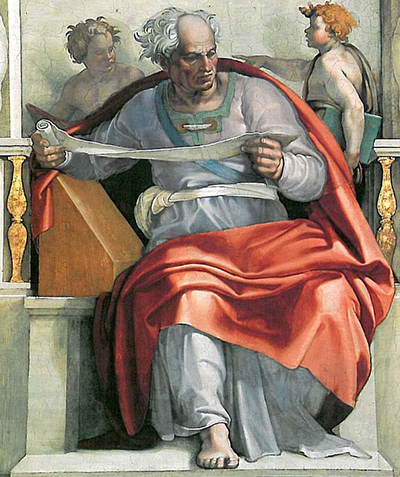
The Prophet Joel by Michelangelo
Michelangelo’s Joel holds a long scroll between widely separated hands and reads across its curve. His lined face turns downward, but the body remains open to the chapel: one foot advances onto the ledge, a red-orange mantle spreads over his lap and two attendants face away in different directions behind him. The prophet’s concentration is quiet, yet the scroll stretches it across space.
Joel is one of seven Hebrew prophets alternating with five ancient sibyls on the Sistine Chapel ceiling.[1] The name tablet below fixes his identity, while the scroll connects him broadly with the biblical book bearing his name—a text of catastrophe, repentance, divine spirit and restoration.[7] Michelangelo does not isolate one verse. He represents the sustained act of attending to prophecy.
How should Joel be read within Michelangelo's ceiling? Joel is a biblical prophet in the surrounding prophets-and-sibyls programme, not a central Genesis scene and not a free-standing biblical biography. The strongest evidence here is programme context, so the page avoids verse-level certainty.
At a Glance
- FigureThe Prophet Joel, labelled IOEL
- Artist and mediumMichelangelo Buonarroti; fresco
- Location typeA fictive prophetic throne on the Sistine Chapel vault
- Commission spanJulius II’s ceiling project, 1508–1512[2]
- EnsembleSeven prophets joined by five sibyls[1]
- AttributeA long, partly rolled scroll
- Defining actionReading while holding the text open between both hands
- CompanionsTwo smaller youthful attendants behind the seat
- Colour structureViolet tunic, red-orange mantle and pale sash
- Scriptural themesJudgment, return, the day of the Lord and the outpouring of divine spirit[7]
- Identity cautionThe name is secure; the exact verse on the painted scroll is not
- Chronology cautionA mapped position does not establish a precise individual execution date
Contents
- Joel in Scripture
- The Scroll Stretched Across the Body
- A Scroll That Contains Past and Future
- A Face Lowered in Concentration
- Hands at Opposite Ends
- The Open Seated Pose
- Red Mantle and Violet Tunic
- The Advancing Bare Foot
- The Attendants Looking Elsewhere
- The Tablet IOEL
- Joel and Zechariah
- Joel and Isaiah
- Prophet Among Sibyls
- Relation to the Central Genesis Histories
- Campaign and Dating Limits
- Looking Up at Joel
- Restoration and Surface
- Why Joel Matters
- Artist Up Close
Joel in Scripture
The Book of Joel begins with devastation described through locusts and failed harvest, moves into calls for communal repentance and evokes the day of the Lord. It also promises an outpouring of divine spirit and imagines renewed fertility.[7]
These themes gave Joel strong significance in Christian interpretation, especially where his language of spirit was connected with Pentecost. Yet Michelangelo does not paint locusts, a temple assembly or tongues of fire around the throne.
The scroll condenses textual authority without specifying one episode. Joel’s visible action is reading, not illustrating.
This distinction avoids turning every feature into a direct emblem of one verse. The fresco presents a biblical prophet through name, age and textual concentration.
The Scroll Stretched Across the Body
Joel’s scroll differs from the massive bound books held by several neighbouring seers. It is flexible, partially rolled and extended horizontally.
One hand grips a curled end while the other holds the opposite stretch. The distance between hands creates a line across the upper body and makes the act legible from below.
The scroll also requires continuous adjustment. Unlike a codex resting open, it must be held against its tendency to roll. Reading becomes an active management of material.
No legible passage can be securely assigned from ordinary viewing. Michelangelo makes textual form, rather than transcription, carry meaning.
A Scroll That Contains Past and Future
A scroll is read by exposing one portion while other writing remains rolled. Its material form makes revelation sequential: words already considered gather at one end, and unread words wait at the other.
Joel’s separated hands hold that temporal structure open. The pale strip between them is a present interval inside a longer text.
This makes the scroll especially apt for prophecy, which joins inherited warning to an expected future. Michelangelo need not paint a clock or narrative episode; the object itself embodies duration.
The curve also differs from a modern flat sheet. Tension remains visible. Understanding requires the prophet to keep working against closure, an understated physical analogy for interpretation itself.
A Face Lowered in Concentration
Joel’s aged face is shown almost frontally but turned down toward the scroll. Furrowed brow, compressed mouth and deep-set eyes suggest critical attention.
The expression is serious without theatrical grief. He appears to weigh what he reads.
Grey-white hair expands around the head while a bald crown catches light. Age is visible, but the posture does not collapse.
Compared with Zechariah’s profile, Joel offers more of his face to the chapel even while withholding eye contact.
Hands at Opposite Ends
The prophet’s hands are far apart, each performing a different grip. One encloses the rolled section; the other pinches or supports the unrolled length.
This asymmetry makes the scroll believable. The object has tension because fingers counter its curl.
Hands also set the rhythm of reading. The eye moves between them along the pale band, echoing the traversal of written lines.
Michelangelo enlarges this private coordination until it becomes the throne’s organising gesture.
The Open Seated Pose
Joel’s body faces outward more fully than many prophets and sibyls. Knees spread beneath drapery, and one bare foot advances on the ledge.
The open base supports the horizontal scroll. Upper concentration and lower stability cooperate.
His torso turns only slightly, allowing age and garment to produce mass without a dramatic spiral.
This relative calm is a form of variation. The twelve seers need intervals of sustained study between the more violent turns of Ezekiel, Isaiah and the Libyan Sibyl.
Red Mantle and Violet Tunic
A warm red-orange mantle sweeps around Joel’s shoulders and across the lap. Beneath it, a cooler violet garment descends toward the feet, cinched by a pale sash.
The mantle creates a circular enclosure behind the prophet, almost a painted halo of cloth without becoming a literal sacred aureole.
Warm colour moves forward; cooler cloth recedes and supplies depth. This chromatic ordering strengthened in visibility after modern conservation.[4][6]
Folds explain knee, waist and seat while preserving a broad silhouette at chapel distance.
The Advancing Bare Foot
One foot rests prominently at the front ledge, while the other remains more concealed by cloth. This uneven placement keeps the pose from becoming static symmetry.
The projecting foot asserts that Joel occupies the fictive architecture bodily. Toes meet the painted stone and imply weight.
Its visibility also links the lower figure to the observer. Head and scroll may be intellectually remote, but the body approaches.
Michelangelo often uses extremities to make illusion convincing; Joel’s grounded foot is one of the throne’s quiet anchors.
The Attendants Looking Elsewhere
Two youthful companions stand behind Joel. One shadowed face looks toward the prophet or scroll; the other, lighter figure turns outward in the opposite direction.
Their divergent attention contrasts with Joel’s single focus. The niche contains several simultaneous acts of looking.
They also deepen the space behind the circular mantle. Small bodies make the prophet larger without merely functioning as scale markers.
The Vatican group account does not provide personal identities for them.[1] They are best treated as attendants within the prophetic apparatus.
The Tablet IOEL
The name below the throne is essential because scroll and aged seer are not unique attributes. IOEL converts the figure from a prophetic type into the specific biblical Joel.
Roman lettering participates in the ceiling’s fictive stonework, joining image and inscription.
At full height, the body may register before the letters become readable. Identification therefore unfolds through scale: first seer, then name.
The tablet also protects against circular interpretation. Joel is known because the programme labels him, not because viewers have guessed one visual allusion.
Joel and Zechariah
Zechariah and Joel both appear as aged readers near the entrance end, but their relations to text differ. Zechariah closes around a heavy book; Joel extends a scroll across the body.
Profile concentration becomes broader frontal scrutiny. Attendants cluster close in both thrones yet turn differently.
The comparison shows Michelangelo varying textual media as well as anatomy. Bound leaves invite enclosure; a scroll invites span.
Neither figure is redundant. Together they establish sustained reading as a theme capable of multiple physical forms.
Joel and Isaiah
Isaiah, encountered next within the company, turns away from a book as an attendant gestures. Joel remains committed to his scroll.
The transition is psychological: concentration gives way to interruption. Michelangelo makes neighbouring thrones feel like successive experiments in attention.
That sequence should not be read as a continuous narrative in which one prophet hands a message to another. Each remains a distinct named visionary.
Their visual adjacency creates comparison rather than shared historical time.
Prophet Among Sibyls
Joel belongs to a company that alternates biblical men with ancient pagan prophetesses.[1] Renaissance Christian theology placed both groups in relation to the anticipated coming of Christ.
His scroll and scriptural identity give him a different source authority from the sibyls, even as Michelangelo grants all twelve comparable scale.
The common thrones produce visual parity; name tablets and texts preserve distinctions.
This balance allows the ceiling to gather traditions without pretending they are historically identical.
Relation to the Central Genesis Histories
The nine central fields narrate origins from Creation through Noah.[3] Joel is not a character in those episodes.
His throne surrounds them within another layer of time. Prophecy interprets a history that precedes the prophet by generations.
Book, scroll and inward thought slow the rapid narrative progression of the centre. The ceiling alternates events with acts of understanding.
A close crop can obscure this structural role; a whole-vault view restores it.
Campaign and Dating Limits
Michelangelo undertook the ceiling between 1508 and 1512 for Julius II.[2] Joel belongs securely to that monumental campaign.
The official history does not supply an exact date for the throne. Position along the vault and stylistic comparison can inform broad phase discussions, not a daily timetable.
Fresco also involves adjacent plaster sections and painted architecture, making isolation of one body partly artificial from the perspective of labour.
Responsible chronology gives the secure range and leaves narrower claims open.
Looking Up at Joel
From the chapel floor, the pale scroll, red mantle and forward foot organise perception. Facial expression and attendant glances become clearer only through enlargement.
The ceiling’s height and density make such layered legibility necessary; Smarthistory emphasises the physical demand of seeing the vault.[5]
A full-throne view retains the IOEL tablet and fictive frame. A face detail reveals concentration but loses the scroll’s span.
Movement between scales recovers Michelangelo’s double design for architectural recognition and close study.
Restoration and Surface
The Vatican’s conservation history frames the colours and surface visible today.[4][6] Cleaning renewed the contrast between orange-red, violet and pale scroll.
Digital files can alter those relations, pushing the mantle toward brown or saturated red. Cracks become more prominent under high magnification.
These conditions belong to reproduction and material age, not to Joel’s expression alone.
Stable analysis returns to posture, object and relative colour while acknowledging the fresco’s five-century afterlife.
Why Joel Matters
Joel matters because Michelangelo turns reading a scroll into a broad bodily action. Hands, eyes and feet stabilise a text that wants to curl shut.
He matters because quiet attention holds its own beside dramatic prophecy. Monumentality does not require upheaval.
Most importantly, Joel makes interpretation visible as persistence. His authority lies in continuing to read across the difficult span.
Artist Up Close
Michelangelo understands that concentration has mechanics. Joel’s hands counter the scroll’s curl, his foot secures the body and his mantle gathers the throne around the act. The pose feels calm only because every pressure has been balanced. Thought is not added to anatomy through facial expression; it is built through the way a whole body keeps a text open.
Frequently Asked Questions
Discussion
What seems most important in Michelangelo's Joel: his place among the prophets, the rhythm of the ceiling figures, or his relationship to the central Genesis scenes?
Reader Insights
How does Joel continue the sequence opened by Zacharias?
What do repeated seated prophets add to the structure of the ceiling?
How does Joel frame the central stories without becoming part of them?
Join the Conversation
Compare Joel's prophet role, ceiling setting and relationship to the Genesis scenes while keeping the route focused on Michelangelo's painted figure.
References
- Vatican Museums, Sibyls and Prophets”:, View source.
- Vatican Museums, Sistine Chapel Ceiling”:, View source.
- Vatican Museums, Central Stories”:, View source.
- Vatican Museums, Sistine Chapel History”:, View source.
- Smarthistory, Michelangelo, Ceiling of the Sistine Chapel”:, View source.
- Vatican Museums, The Sistine Chapel Twenty Years Later: New Breath, New Light”:, View source.
- United States Conference of Catholic Bishops, Joel, Chapter 1”:, View source.