 by Tom Gurney
Tom Gurney BSc (Hons) is an art history expert with over 20 years experience
Published on June 19, 2020 / Updated on August 8, 2026
Email: tomgurney1@gmail.com / Phone: +44 7429 011000
Michelangelo’s Manchester Madonna
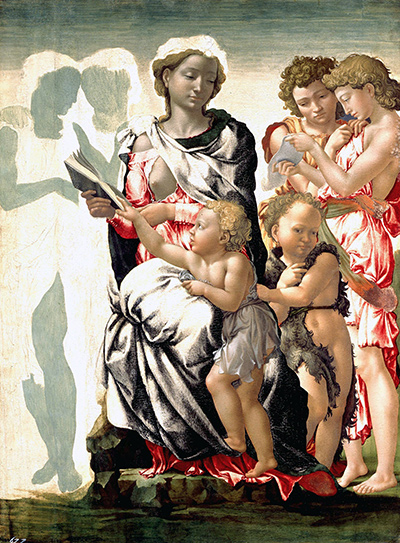
Michelangelo’s Manchester Madonna is a painting in the process of becoming. The Virgin and Christ Child occupy the centre, with the young Saint John and angels gathered close, but the panel never reached a uniform final surface. Some passages have acquired colour and bodily weight; others remain visibly provisional. Construction and sacred image coexist.
The National Gallery identifies the work as The Virgin and Child with Saint John and Angels, an unfinished egg-tempera painting on wood dating to about 1494.[1] Its familiar nickname comes not from its subject or origin but from the city where it attracted attention when exhibited in the nineteenth century. Now in London, it offers rare access to Michelangelo’s earliest activity as a panel painter.
That access must be handled carefully. An unfinished surface reveals stages of making, not the private reason that work ceased. It shows transferred design, underpainting and uneven development without supplying a diary of intention. The panel is compelling because it lets devotion, anatomy and process remain visible at once.
At a Glance
- ArtistMichelangelo Buonarroti
- Full titleThe Virgin and Child with Saint John and Angels
- Familiar nameManchester Madonna
- DateAbout 1494 in the National Gallery record
- MediumEgg tempera on wood
- StateUnfinished
- Current locationNational Gallery, London
- Principal figuresVirgin Mary, Christ Child and young Saint John the Baptist
- Additional figuresAngels clustered around the sacred group
- Technical importanceDifferent stages of design transfer, underpainting and colour remain visible
- Career positionAn early panel painted before the Vatican Pietà, David, the Doni Tondo and the Sistine ceiling
- Interpretive cautionIncompletion does not establish why Michelangelo stopped
Contents
- The Painting Behind the Nickname
- Mary, Christ and the Book
- Sacred Time Within an Unfinished Scene
- Saint John and the Surrounding Angels
- What the Unfinished Surface Reveals
- Colour Before Completion
- Why Did Michelangelo Stop?
- Bodies That Think Like Sculpture
- An Early Work Before the Famous Monuments
- The Small Painting Corpus
- What a Finished Version Cannot Be Assumed to Show
- Artist Up Close
The Painting Behind the Nickname
The name Manchester Madonna can obscure the painting’s full content. “Madonna” identifies Mary with Christ, but the National Gallery’s title also names Saint John and angels.[1] The group is more crowded and narratively charged than a two-figure devotional image.
The place-name belongs to reception. It does not mean Michelangelo painted the panel in Manchester or for a patron there. Like many conventional titles, it records the setting in which a work entered wider public recognition. The institutional full title restores the figures that the nickname compresses.
Mary anchors the composition. The children and angels approach from close range, reducing empty space and making the panel feel almost carved in relief. Bodies overlap rather than occupying separate intervals. Even in incomplete form, the arrangement establishes a powerful centre.
The object’s wooden support also matters. Unlike Michelangelo’s marble Madonnas, this group is built through layers laid upon a flat plane. Unlike fresco, it could be moved and viewed at intimate distance. Its survival helps correct the idea that Michelangelo moved directly from sculpture to vast walls without sustained engagement with portable painting.
Mary, Christ and the Book
Mary sits with a book open before or beside the central exchange. The book places reading and revelation within the maternal group. It may evoke scripture or prophecy, but the visible object does not name one passage. Its role is compositional as well as symbolic: planes of pages interrupt the bodies and give the Child something toward which to turn.
The Christ Child is not presented in placid isolation. His relation to the book and the other child creates attention across the group. The young Saint John, who will become Christ’s precursor, adds a future to the scene. The encounter can be understood through recognition and preparation without requiring a single narrated Gospel instant.
Mary’s bodily presence is unusually substantial. Drapery does not dissolve her into a patterned throne. Under cloth, knees, torso and arms organise the weight of the group. This sculptural quality is often associated with Michelangelo, but here it arises through painted modelling and the organisation of contours rather than actual volume.
Her expression should not be reduced to foreknowledge or melancholy without qualification. Seriousness may invite thoughts of Christ’s future Passion, but an unfinished face can also be altered by the absence of final modelling and colour. Formal relation comes before psychological certainty.
Sacred Time Within an Unfinished Scene
Madonna and Child images often hold several times together. The visible subject belongs to Christ’s infancy, while books, the Baptist and Mary’s gravity can direct thought toward his later ministry and death. The present tenderness acquires meaning through a future known to the viewer.
The Manchester Madonna intensifies this structure by bringing the children and book into a concentrated encounter. Saint John’s later role as precursor is not narrated, but his presence makes recognition possible. The open pages introduce text without making its words legible, allowing prophecy to be sensed rather than quoted.
Incompletion adds another form of time. Some figures appear closer to pictorial fulfilment than others. The devotional story seems ancient and complete, while the painted object remains visibly in progress. Sacred foreknowledge and artistic uncertainty occupy the same panel.
This does not mean Michelangelo deliberately used unfinishedness as a theological symbol. The work stopped for reasons that remain unknown. The effect arises in reception: material interruption now changes how a timeless subject is experienced.
The crowded bodies keep that experience immediate. There is little landscape into which the eye can escape. Attention circulates among Mary, the two boys, the book and angels, so the future of the story feels compressed into their present proximity.
Saint John and the Surrounding Angels
The young Baptist makes the scene more than a domestic mother-and-child group. Christian tradition understands John as the forerunner who recognises and announces Christ. In a childhood encounter, that future role is compressed into proximity between the boys.
The angels create a second circle of attention. They are not distant heavenly spectators; they enter the same crowded pictorial field. Their heads and bodies frame Mary, intensifying the sense that sacred meaning gathers around the central exchange.
Because the panel is unfinished, not every angel reaches the same degree of clarity. This unevenness can make some appear materially present and others almost like thoughts awaiting embodiment. The effect is striking, but its cause is technical state rather than proof that Michelangelo planned a hierarchy of visibility.
The close grouping also makes attribution of every gesture difficult from description alone. An arm or contour may belong to a neighbouring figure. Looking slowly at overlaps is essential, since the work’s density is one of its defining choices.
What the Unfinished Surface Reveals
The National Gallery identifies egg tempera on wood and preserves evidence of transferred design and underpainting.[1] These are not incidental deficiencies. They show how a planned composition moved toward coloured form.
A design could be transferred to the panel so that principal outlines governed later stages. Underpainting established tonal or chromatic foundations. Further layers modelled flesh, drapery and space. Where work ceased at different points, several parts of this sequence remain visible together.
The result resembles neither a finished painting stripped of colour nor a drawing simply enlarged. It is a layered object. Lines may serve construction beneath a passage elsewhere brought toward optical completion. The work permits comparison between an intended boundary and the paint that begins to transform it.
Michelangelo’s broader practice of disegno makes this especially significant. The term joins drawing to conception, describing the intellectual and practical organisation that could cross sculpture, painting and architecture.[2] The panel shows that process without implying a single method worked identically in every medium.
Visible beginnings also make the work vulnerable to overconfidence. It is tempting to identify every sequence of brushwork, assign each passage a precise order or decide exactly what the completed colours would have been. The object supports broad technical distinctions; detailed reconstruction requires the National Gallery’s scientific evidence.
Colour Before Completion
Because the painting is unfinished, colour does not operate with the uniform integration expected of a completed panel. Developed passages establish relationships among flesh, fabric and surrounding figures, while preliminary areas make the wooden support and underlayers more assertive.
This unevenness can produce a false hierarchy. A fully coloured figure may appear more important simply because it is more optically present. A lightly developed angel may recede even if the intended final composition would have given it comparable emphasis. Current visibility and intended significance are not identical.
Egg tempera encourages careful layering and controlled edges. It can produce clarity, luminosity and finely adjusted modelling, but the surviving object shows those qualities alongside stages before their full development.[1] The contrast is technical rather than a battle between inspiration and routine.
A hypothetical digital “completion” would necessarily choose colours, details and boundaries the panel no longer specifies. It might make the religious scene easier to read while erasing the evidence that makes the object exceptional. The unfinished painting is not merely a damaged preview of a lost masterpiece; it is the historical work that survives.
Colour also distinguishes painting from Michelangelo’s marble. In sculpture, illumination arrives from outside and changes as the viewer moves. Here Michelangelo could represent light and use hue to separate overlapping bodies. Where colour is absent, that pictorial differentiation remains suspended.
Why Did Michelangelo Stop?
No cited document supplies a certain reason. The panel may have lost its patronal purpose, encountered practical difficulties or been displaced by other work. An unfinished state records cessation, not motive.
Michelangelo’s youth makes biographical stories particularly tempting. The painting can be framed as an apprentice experiment, a rejected commission or evidence that he preferred sculpture. None follows automatically from the surface. Early mastery and incompletion are compatible.
The unfinished Entombment, also in the National Gallery, provides a useful parallel.[5] Both are substantial panel projects left unresolved, but they differ in date, subject and possible function. Repetition of incompletion does not prove one personal aversion to paint.
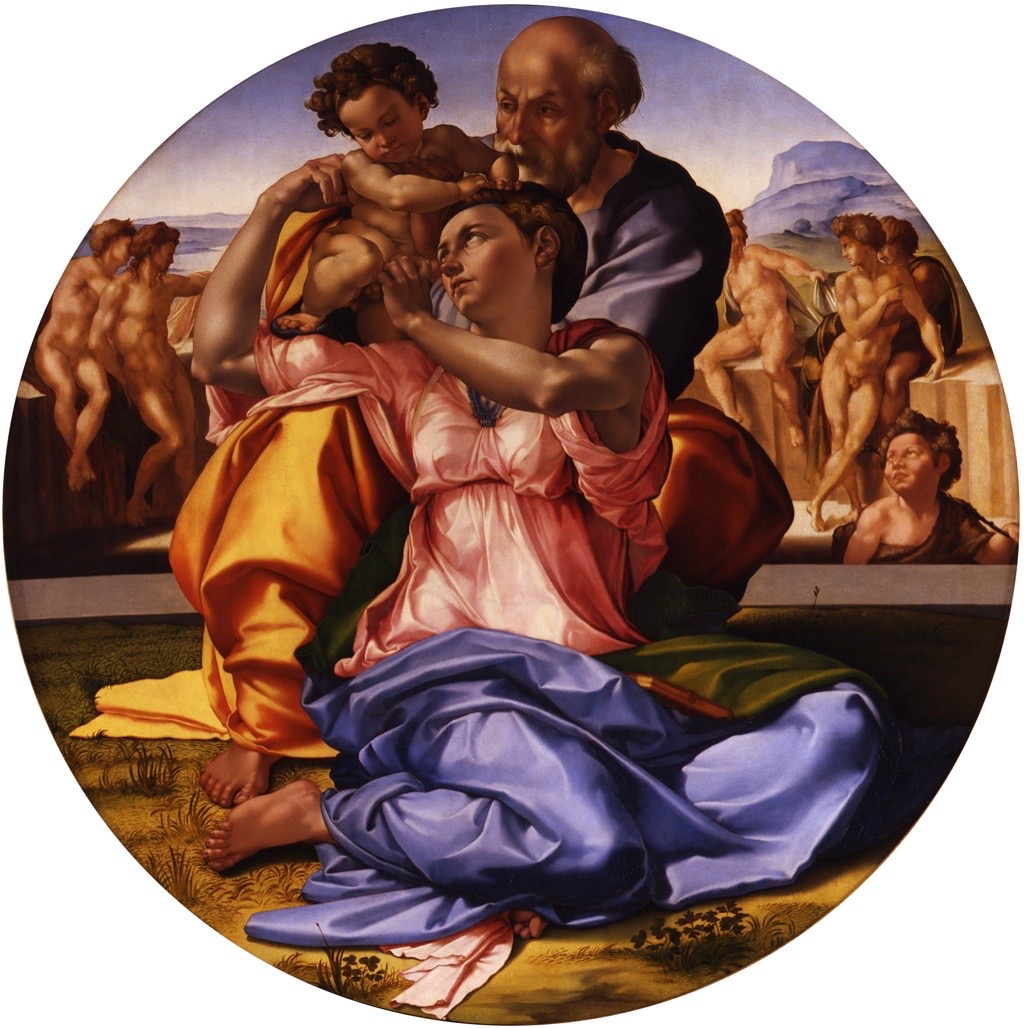
The finished Doni Tondo is equally important because it proves Michelangelo could bring a complex wooden panel to a highly resolved surface.[4] The London painting therefore should not be treated as evidence of technical incapacity. It represents one interrupted object within a small and varied painting corpus.
Bodies That Think Like Sculpture
The figures’ density often feels sculptural. Mary occupies the centre like a mass rather than a decorative silhouette. Children and angels press into her space, and their overlapping contours resemble bodies grouped within a shallow relief.
Yet painting offers resources marble does not. Colour can distinguish surfaces without cutting a gap. A painted body can overlap another while the wooden panel remains physically continuous. Light is represented rather than dependent entirely on gallery illumination.
This difference prevents “sculptural” from becoming a synonym for successful Michelangelo painting. The panel’s interest lies in his ability to translate bodily conception across media, not in pretending tempera is stone. The Met’s career study uses disegno to connect such invention without erasing material distinctions.[2]
The comparison with Sebastiano del Piombo’s Raising of Lazarus, which incorporated designs by Michelangelo, makes authorship across media still more complex.[3] Michelangelo could supply figure ideas without executing an entire painting. The Manchester Madonna, by contrast, is held as a work by Michelangelo, and its surface offers direct evidence of a panel’s development.
An Early Work Before the Famous Monuments
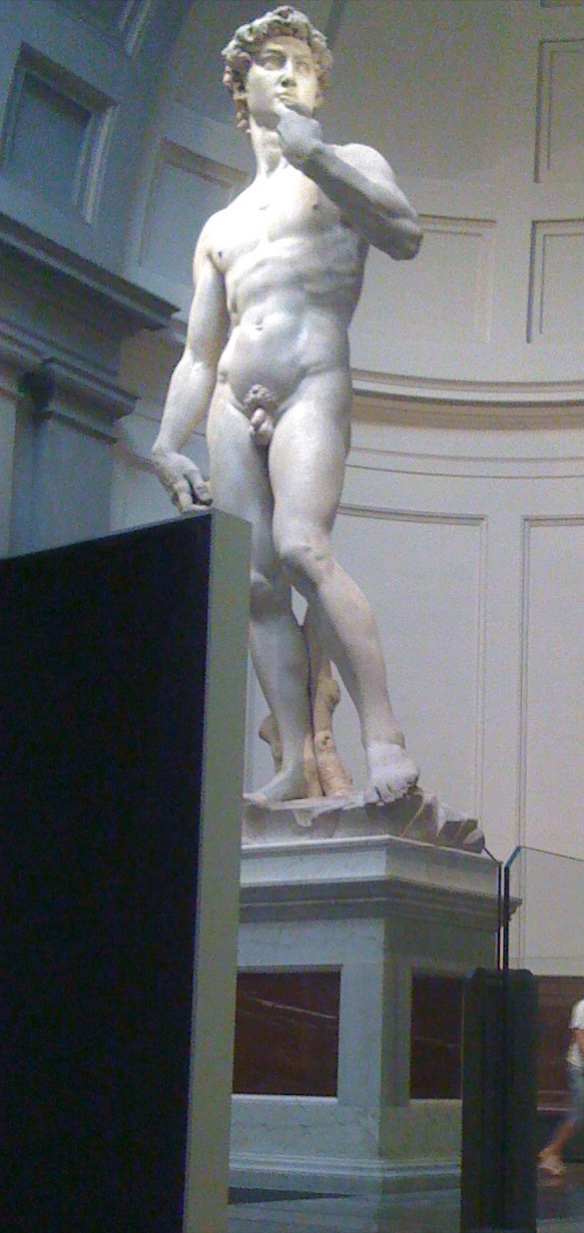
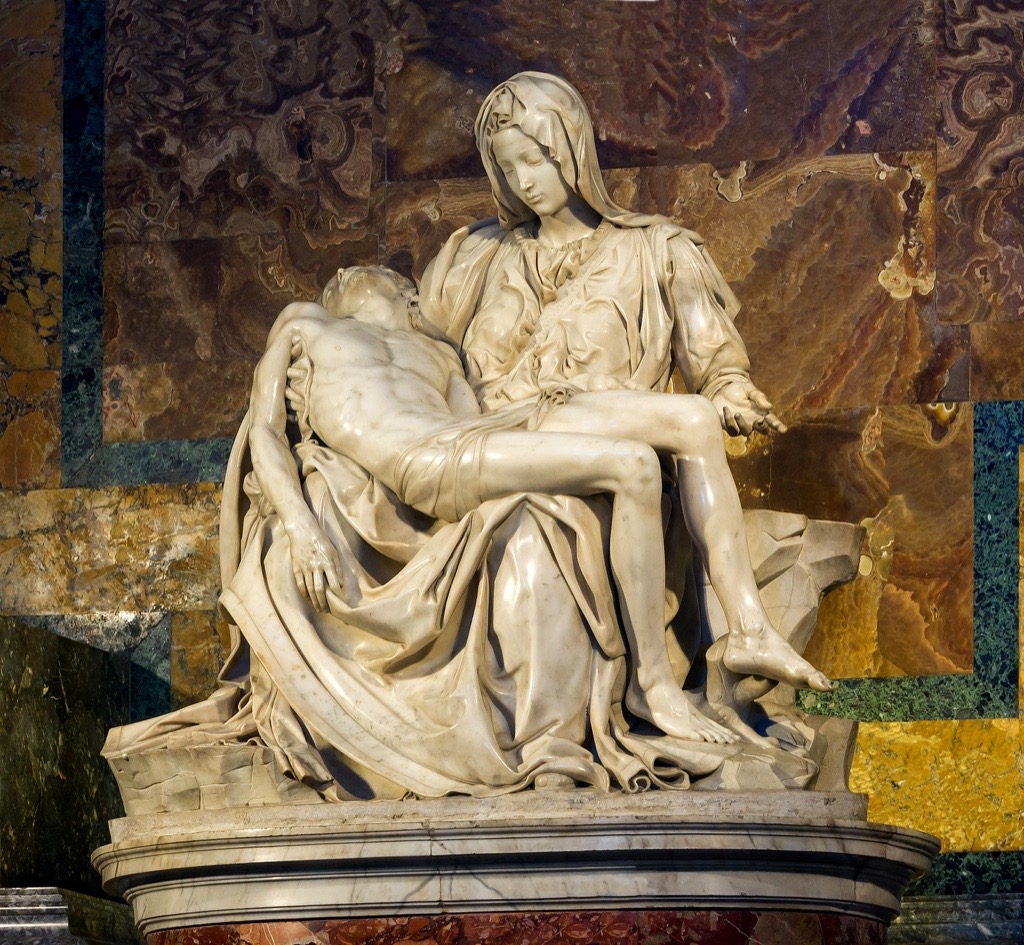
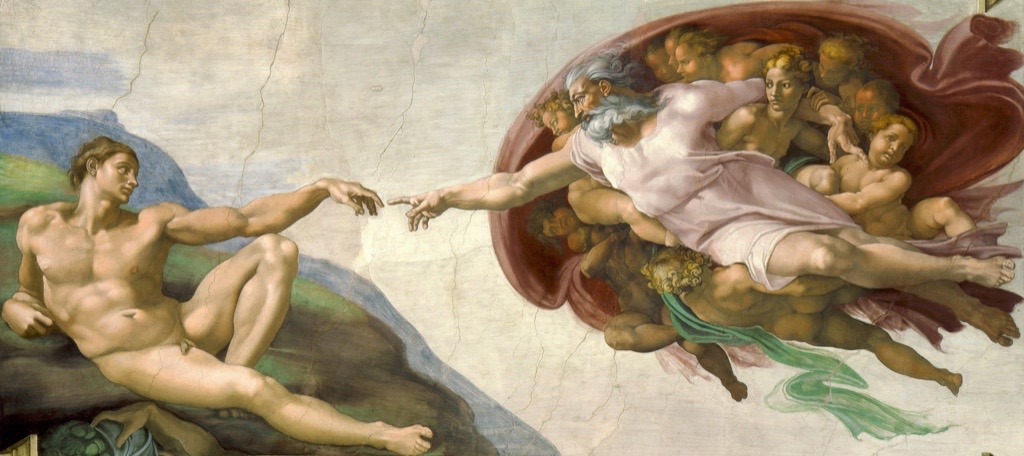
A date around 1494 places the painting close to the beginning of Michelangelo’s independent career.[1] The Vatican Pietà of 1498–1499, David of 1501–1504 and the Doni Tondo of the mid-1500s all lay ahead. The Sistine ceiling was more than a decade away.
Later fame can distort this position. Viewers recognise bodily forms that seem to anticipate mature Michelangelo and then treat the early panel as a coded preview. Development was less inevitable. The work belongs to a young artist making choices within Florentine traditions, sacred patronage and the possibilities of tempera.
The chronology nevertheless permits meaningful comparison. The panel already values compressed anatomy, difficult turns and interactions in which one body changes how another can be seen. These interests persist, but their later scale and purpose were not yet fixed.
The early date also distinguishes it from the Doni Tondo. Both centre Mary and Christ and use powerful bodies, yet one is unfinished and crowded with angels, the other a complete circular Holy Family with enigmatic nudes beyond.[4] Similarity of artist and sacred subject does not make one a rehearsal for the other.
The Small Painting Corpus
Michelangelo’s surviving independent panel paintings are few. The Manchester Madonna and Entombment at the National Gallery are unfinished.[1][5] The Uffizi’s Doni Tondo is the only finished panel accepted by its holding institution as surviving.[4]
The Torment of Saint Anthony at the Kimbell occupies a different evidential position because its attribution has its own scholarly history.[6] That distinction is valuable: “Michelangelo painting” is not a uniform category, and every object requires its holding record and attribution status.
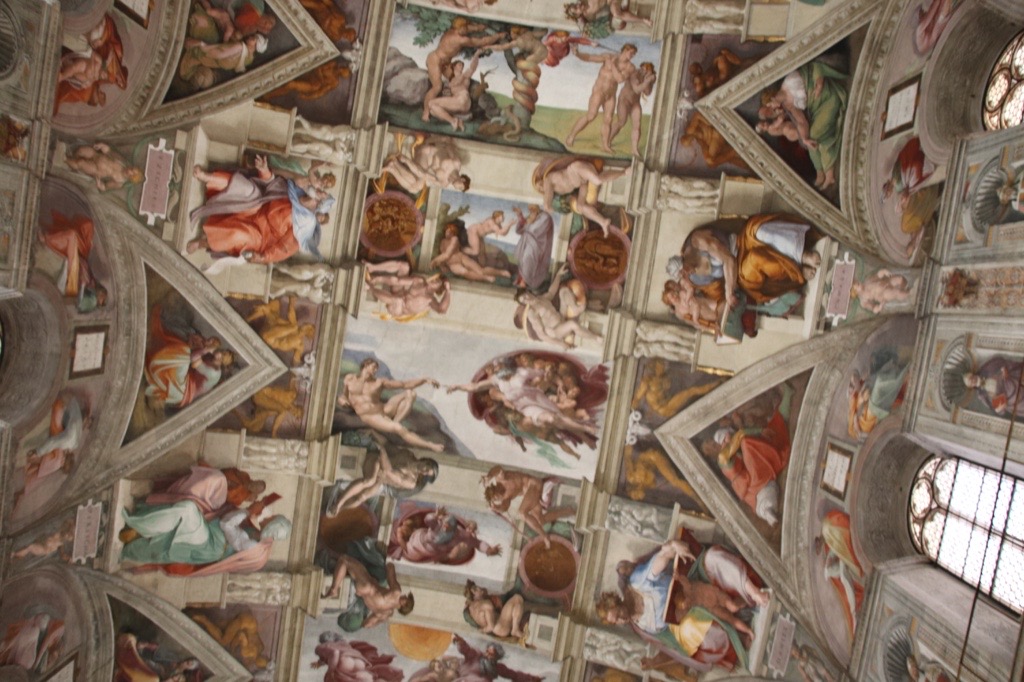
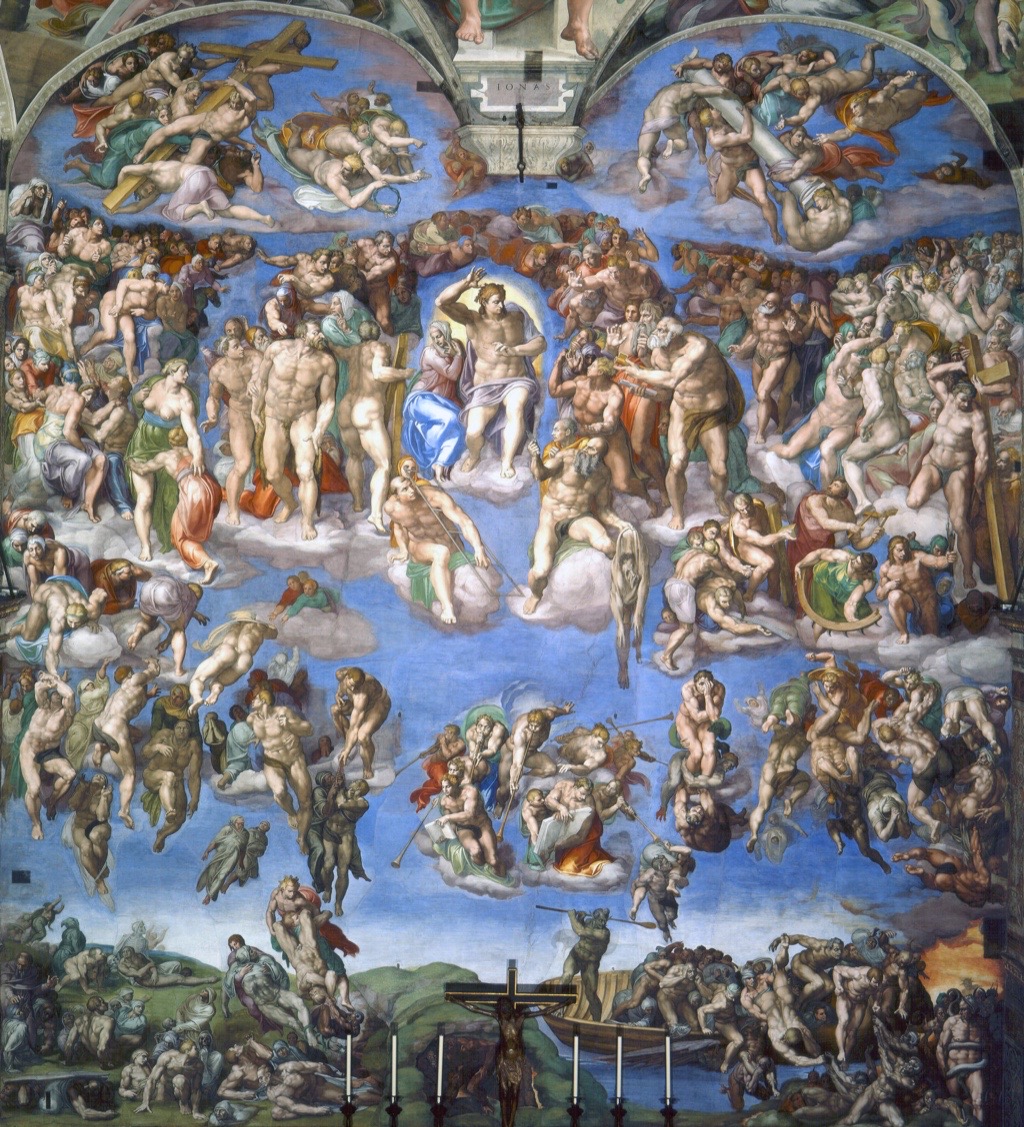
His frescoes belong to another material world. The Sistine and Pauline chapels demanded painting onto architecture, large teams of preparation, distant sightlines and vast narrative programmes. The Manchester Madonna is portable, intimate and unfinished. Its contribution is not that it miniaturises the ceiling but that it preserves a kind of evidence the finished fresco surface cannot.
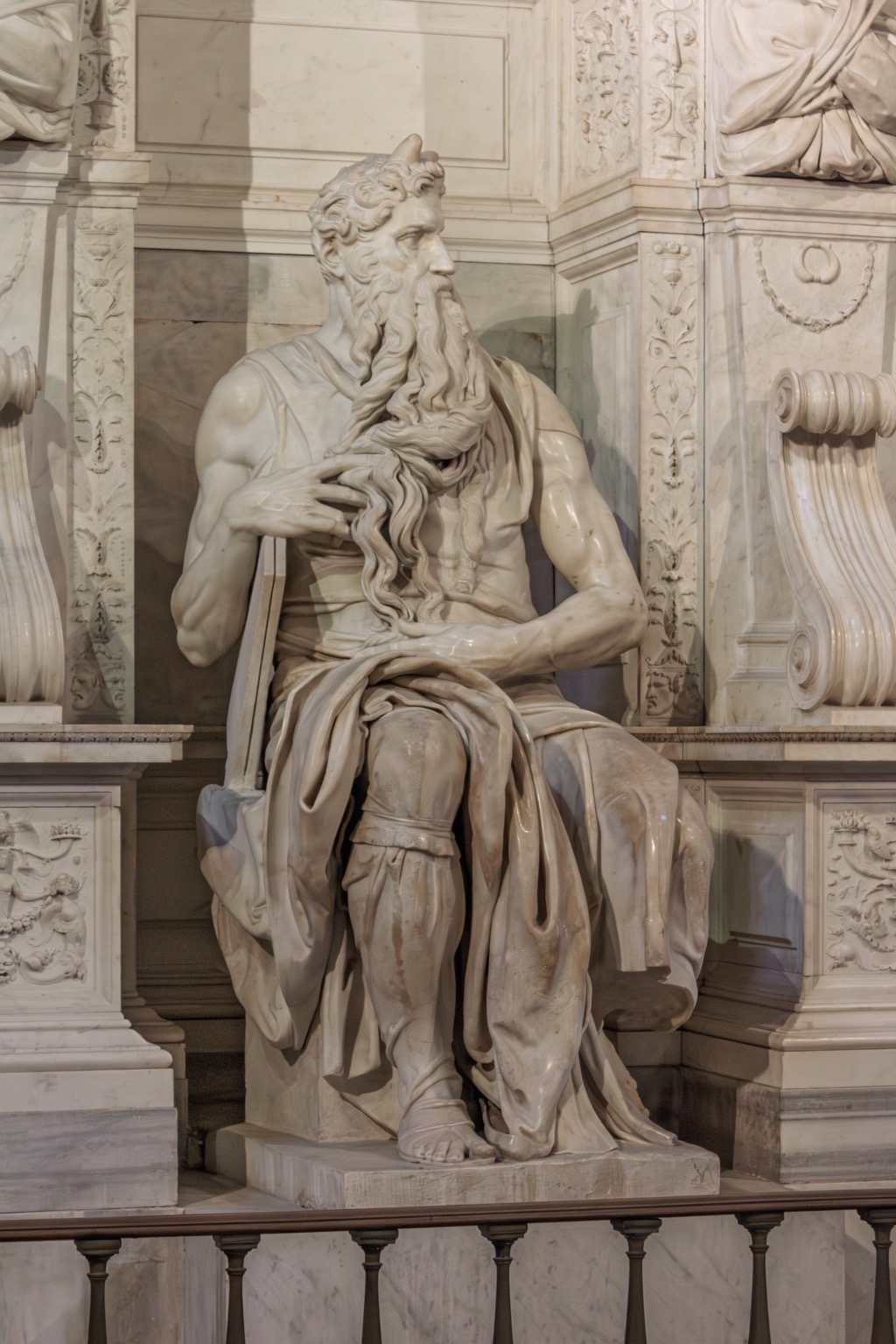
The work also remains separate from Michelangelo’s sculpted Madonnas. The Madonna of Bruges, Madonna of the Stairs, Medici Madonna, Pitti Tondo and Taddei Tondo address related figures through marble and relief. They expand comparison while retaining independent dates, commissions and object histories.
What a Finished Version Cannot Be Assumed to Show
The strongest temptation surrounding an unfinished work is to imagine that completion would simply polish what is already visible. Painting could have changed emphasis more radically. Added colour might clarify an angel, soften a contour, deepen a shadow or reorganise the balance of the whole.
Michelangelo could also have revised forms during later stages. Transferred outlines are evidence of design, not immutable borders. The final surface of the Doni Tondo demonstrates how fully paint can subordinate preliminary construction beneath colour and modelling.[4]
For that reason, the panel should be read in the conditional tense only where necessary. What Michelangelo established can be described: figures, overlaps, medium, transferred design and varied development. What he would have altered or completed remains unavailable.
That limit is not disappointing. It makes the painting an unusually honest record of art as contingency. A sacred subject can be carefully conceived, technically advanced and still fail to reach closure. Survival preserves the work’s achievement and its interruption together.
Artist Up Close
The panel catches Michelangelo between line and body. Transferred design establishes the conception; underpainting begins to give it substance; more developed colour makes selected forms optically present. Viewers see not a single instant of inspiration but a sequence of decisions distributed across the surface.
Its incompletion is therefore valuable without being romantic. The painting stopped for an unknown reason, yet what survives demonstrates that Michelangelo’s cross-media thinking was concrete and technical. Design becomes visible precisely where finish does not hide it.
Frequently Asked Questions
Discussion
How does an unfinished early panel change the way we read Michelangelo's painting?
Reader Insights
Does the unfinished panel feel closer to drawing, painting or sculpture?
How does this early panel differ from Michelangelo's later Madonna and Holy Family works?
What does the Manchester panel add to a Michelangelo cluster dominated by sculpture and fresco?
Join the Conversation
Place the Manchester Madonna between drawing, panel painting and later fresco. Which medium seems most visible in the unfinished surface?
References
- National Gallery, London, “The Manchester Madonna”:, View source.
- Metropolitan Museum of Art, Michelangelo: Divine Draftsman and Designer:, View source.
- National Gallery, London, “The Raising of Lazarus,” by Sebastiano del Piombo incorporating designs by Michelangelo:, View source.
- Uffizi Galleries, Holy Family, Known as the Doni Tondo”:, View source.
- National Gallery, London, “The Entombment or Christ Being Carried to His Tomb”:, View source.
- Kimbell Art Museum, The Torment of Saint Anthony”:, View source.