


 by Tom Gurney
Tom Gurney BSc (Hons) is an art history expert with over 20 years experience
Published on June 19, 2020 / Updated on August 8, 2026
Email: tomgurney1@gmail.com / Phone: +44 7429 011000
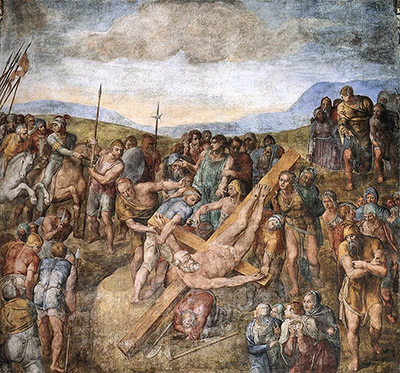
The Martyrdom of Saint Peter by Michelangelo
Peter’s cross has not yet reached the vertical. Labourers haul, brace and turn the great timber across a barren slope while the apostle hangs head downward, his old body exposed to gravity. He does not look towards heaven. Michelangelo twists Peter’s face out of the action until his eyes meet the chapel, making the condemned man the only figure who seems fully aware of being watched.
Also known as The Crucifixion of Saint Peter, the fresco was begun after Michelangelo completed The Conversion of Saul in 1545 and was finished in March 1550.[1] The two works face each other inside the Pauline Chapel. This was Michelangelo’s last fresco: an image of apostolic death painted for the private sanctuary in which papal authority contemplated its origins.[1]
How should this page handle the Martyrdom/Crucifixion title and Pauline Chapel setting? The inherited route uses Martyrdom of St Peter, while the Holy See source uses Crucifixion of Saint Peter. This page preserves both names, keeps the fresco in the Pauline Chapel, and separates it from the Sistine ceiling, Last Judgement and St Peter’s Basilica.
At a Glance
- WorkThe Martyrdom of Saint Peter, usually titled The Crucifixion of Saint Peter in institutional records
- Artist and techniqueMichelangelo Buonarroti; fresco
- DateBegun after July 1545 and completed in March 1550[1]
- SettingThe private papal sanctuary called the Pauline Chapel
- Commission and completionOrdered under Paul III Farnese but finished after his death in 1549
- SubjectThe execution of the apostle Peter on an inverted cross
- Canonical basisJohn 21:18–19 foretells a death by which Peter will glorify God[2]
- Traditional detailThe upside-down crucifixion comes from early Christian tradition, especially the apocryphal Acts of Peter[3]
- Chosen instantThe cross is being manoeuvred into place; the exact fastening of Peter remains materially debated[4]
- Central encounterPeter turns his face outward and meets the observer
- Paired historyMichelangelo’s Conversion of Saul on the opposing wall[1]
- Working evidenceA large cartoon fragment and a study for the kneeling excavator survive[6][7]
Contents
- Martyrdom, Crucifixion and Title
- What the New Testament Says
- The Upside-Down Cross in Tradition
- The Cross Not Yet Upright
- Is Peter Already Nailed?
- Peter’s Turning Head
- A Body Under Reversal
- The Men Who Raise the Cross
- The Kneeling Excavator
- Soldiers, Witnesses and the Encircling Crowd
- A Bare and Unstable Place
- A Fresco Designed for Oblique Viewing
- Peter Opposite Saul
- Peter and Papal Authority
- Was Another Peter Subject Planned?
- The Surviving Cartoon Fragment
- Completion, Illness and Patronal Change
- Restoration and the Historical Surface
- Peter’s Gaze and the Observer’s Position
- Copies, Covering and Later Memory
- Why The Martyrdom of Saint Peter Matters
- Artist Up Close
Martyrdom, Crucifixion and Title
Both common titles are accurate but emphasise different things.
The Crucifixion of Saint Peter identifies the method of execution and the visible cross. The Martyrdom of Saint Peter places that death within Christian witness: Peter dies because of the faith he professes.
Neither title should be confused with the crucifixion of Christ. The inverted cross, elderly victim and surrounding company distinguish the apostle’s death.
The form is derivative by Peter’s choice and different by Peter’s humility. Tradition holds that he requested inversion because he did not consider himself worthy to die exactly as Christ had.[3]
Michelangelo makes the difference visible before any inscription is needed. The cross is present, but the body runs headfirst towards the earth.
What the New Testament Says
The canonical New Testament does not narrate Peter’s execution.
At the end of John’s Gospel, the risen Christ tells Peter that when he is old, another will stretch out his hands, dress him and lead him where he does not wish to go. The evangelist explains that this indicated the kind of death by which Peter would glorify God.[2]
The passage supports expectation of martyrdom and was read as pointing towards crucifixion. It does not specify an inverted cross.
This distinction is essential. Michelangelo’s basic subject belongs to long Christian memory, but not every visual detail comes from the same textual authority.
The fresco joins the canonical prophecy of old age and compelled movement with a later account of the execution’s form.
The Upside-Down Cross in Tradition
The Acts of Peter, an apocryphal early Christian narrative, provides the influential account of Peter requesting crucifixion head downward.[3]
Oxford’s scholarly summary notes that the work survives through several textual components and tells of Peter’s return to Rome, arrest, inverted crucifixion and final discourse.[3]
“Apocryphal” does not mean irrelevant to art. It means the account stands outside the canonical New Testament and must be labelled accordingly.
By Michelangelo’s time, the inverted cross had become an established sign of Peter’s humility and martyrdom.
The image therefore depends on layered tradition: John supplies the prophetic framework; the Acts of Peter supplies the distinctive orientation; later devotional culture makes that orientation immediately recognisable.
The Cross Not Yet Upright
Michelangelo chooses the labour before the final display. The timber runs diagonally across the ground while men strain to raise or pivot it.
This decision avoids a stable emblem. Peter’s inverted cross is becoming rather than simply being.
The diagonal divides the gathering without organising it into calm symmetry. One end presses towards the lower field; the other rises among bodies and landscape.
The cross’s weight is demonstrated by response. Backs bend, arms pull and feet seek purchase on uneven soil.
Sacred history appears as manual work performed by executioners.
The horror lies partly in procedure: death is constructed through ordinary exertion.
Is Peter Already Nailed?
The restored surface has prompted a significant interpretation. The Vatican patrons’ account reports an absence of clearly foreseen nails and proposes that Michelangelo may show Peter offering himself upon the cross before final fastening, in accordance with his request for inversion.[4]
That reading should be presented as a conservation-based argument, not absolute fact. Reproductions and surface losses do not allow every contact point to be judged equally.
What is secure is that Peter’s body lies along the timber while it is being manoeuvred. The fresco suspends the exact division between preparation and execution.
This ambiguity deepens rather than weakens the scene. Peter is both vulnerable object of labour and active martyr consenting to a form of death.
His body is carried, yet his gaze remains self-possessed.
Peter’s Turning Head
Peter’s face is the emotional and theological centre. His body follows the diagonal cross, but his head turns sharply outward.
Conservation study found that Michelangelo changed the head’s orientation, replacing an earlier solution with the more dramatic address now visible.[4]
The change transforms the fresco. Without it, Peter might remain absorbed within his execution. With it, his martyrdom reaches beyond painted space.
His expression is not tranquil resignation. Brow, eyes and mouth register anger, interrogation, pain or stern awareness.
The Holy See’s restoration account describes him as looking out almost as if questioning the usefulness of his sacrifice.[1] That is an interpretation, but it captures the refusal of easy consolation.
Peter’s eyes make the observer answerable to what is happening.
A Body Under Reversal
Inversion reorganises the familiar hierarchy of the human figure. Feet rise; the head approaches earth; blood and weight are imagined moving in the wrong direction.
Michelangelo does not conceal Peter’s age. The torso is powerful but not youthful, and the face carries the cost of duration.
John’s prophecy specifically begins “when you grow old,” making age part of Peter’s final witness.[2]
The body is neither idealised away from suffering nor degraded into helplessness. It remains monumental while subject to other hands.
That combination makes the martyr difficult to sentimentalise. Peter is physically handled but spiritually unabsorbed.
His turn against the line of his own body becomes the last assertion of agency.
The Men Who Raise the Cross
Execution is distributed among several workers. No single villain monopolises responsibility.
One figure bends low, another grips the wood, others push or pull from different points. Their effort is coordinated without appearing ceremonially ordered.
Michelangelo gives these men the same anatomical seriousness he gives the saint. Muscular backs and legs make their work credible.
Beauty of execution does not confer moral beauty on the action.
The dispersal of labour is ethically unsettling. Each person may perform only one practical task, while together they kill.
Martyrdom emerges from a system of small exertions.
The Kneeling Excavator
Near the cross, a man crouches to prepare the ground for its base. His compact pose makes the mechanics of execution explicit.
The British Museum preserves Michelangelo’s study for this kneeling figure. Its identification connects a drawn bodily problem with the finished task of digging or clearing the socket.[6]
The figure’s low position also anchors the diagonal. While others lift, he works into the earth.
His action is almost mundane. That ordinariness intensifies the scene more than theatrical cruelty would.
Michelangelo knows that a cross cannot stand through symbolism alone. A hole must be made, weight transferred and wood secured.
Material necessity becomes moral pressure.
Soldiers, Witnesses and the Encircling Crowd
Armed men cluster to one side, while other groups watch, move away or gather along the slope. Spears and shields identify organised power.
The crowd does not form a unified audience. Some faces turn towards Peter; others address companions or look elsewhere.
This fragmented attention makes the event socially believable and spiritually bleak. A martyrdom can occur in public without producing universal recognition.
Several figures at the edges are cropped or squeezed by the boundary. Their partial appearance helps the gathering exceed the wall.
The landscape seems to continue beyond the frame, but no urban monument explains the setting decisively.
Michelangelo gives Peter witnesses while withholding the reassurance of a sympathetic chorus.
A Bare and Unstable Place
The ground rises and falls in dusty slopes. Distant mountains and a muted sky offer little refuge.
Earlier images of apostolic martyrdom could use recognisable Roman architecture to stabilise place. Michelangelo’s setting feels exposed and difficult to map.
The lack of a clear built environment turns attention towards action and movement through terrain.
It also allows the cross to become the principal structure. Wood replaces architecture.
Peter, traditionally associated with the “rock” upon which the Church is built, is executed on ground that seems visually unstable.
The paradox suits the Pauline Chapel: lasting institutional claims are contemplated through a scene of bodily vulnerability.
A Fresco Designed for Oblique Viewing
The Pauline Chapel is long and comparatively narrow. The two Michelangelo walls are encountered from angles and in movement rather than from an ideal distant centre.
William Wallace argues that frontal photographs exaggerate apparent anomalies of scale and placement. Michelangelo adjusted the histories for sequential, oblique experience.[5]
Peter’s outward gaze participates in that design. As an observer moves, the head can remain the point of address while the cross’s diagonal changes its apparent relation to surrounding bodies.
The cropped edges also make more sense when the wall is perceived as part of an inhabited passage.
Michelangelo does not offer one perfect place from which everything resolves.
The work is learned through approach, turn and departure.
Peter Opposite Saul
Across the chapel, Saul lies beneath a descending Christ. Here, no celestial apparition interrupts the sky.
The conversion is instantaneous and vertical: light falls, Saul collapses. Peter’s death is laborious and diagonal: men slowly raise a timber.
The two apostles move in opposite directions. Saul goes down before he can rise into mission. Peter is lifted downward towards death.
Both lose control of their bodily orientation.
Their responses differ because vocation and martyrdom occupy different moments. Saul looks towards the revelation that has found him; Peter looks towards the community that will inherit his witness.
The walls make apostolic identity a passage between being called and being spent.
Peter and Papal Authority
The Holy See describes the Pauline Chapel as a particularly intimate papal sanctuary dedicated to Peter and Paul. Peter represents the historical and juridical legitimacy claimed by Roman pontiffs.[1]
Michelangelo does not express that legitimacy through enthronement, keys or ceremonial splendour. He paints the founder at his most physically powerless.
This choice can seem paradoxical only if authority is imagined as domination. Within the martyr tradition, witness is authenticated through fidelity under death.
The inverted apostle supplies a severe model for papal office: primacy begins with a body that refuses equality with Christ and accepts abasement.
The fresco’s institutional meaning therefore depends upon humility, not triumphal portraiture.
Its location makes that challenge unavoidable for its most privileged observers.
Was Another Peter Subject Planned?
The official chapel history records that Vasari’s first edition referred to a Consignment of the Keys rather than a crucifixion. This may preserve an earlier plan pairing the calls of Peter and Paul, although Vasari could have erred.[1]
A keys scene would have emphasised commission and authority. The final martyrdom emphasises the cost of that commission.
The difference substantially alters the dialogue between walls. Saul’s beginning faces Peter’s end rather than a second beginning.
No surviving evidence permits a complete reconstruction of the change.
The uncertainty is worth preserving because it reveals that the final programme was chosen, not inevitable.
Michelangelo’s executed pair makes institutional foundation inseparable from sacrifice.
The Surviving Cartoon Fragment
A monumental fragment of the full-scale cartoon survives at the Museo e Real Bosco di Capodimonte in Naples. It represents a group of armed figures from the lower part of the fresco.[7]
The museum explains that the large sheet is assembled from nineteen pieces and retains perforations used in transferring the design by pouncing charcoal through the paper.[7]
This physical evidence corrects any idea that the late style resulted from casual improvisation or lost control.
At full scale, Michelangelo planned bodies and overlaps with extraordinary precision before they reached the wall.
The fragment also changes emphasis. Figures that may appear secondary in the completed scene received exacting preparation.
Late urgency coexists with disciplined design.
Completion, Illness and Patronal Change
Work on the Pauline Chapel was interrupted, including pauses connected with Michelangelo’s health in 1546. He was also carrying major architectural responsibilities.[1]
Paul III died in November 1549, only months before the crucifixion fresco was finished.
The British Museum notes that the work’s completion therefore came after the death of the patron whose name and apostolic devotion shaped the chapel.[6]
These conditions belong to the history of making, but they should not be converted automatically into a psychological key.
The fresco’s difficulty is not evidence that the aged artist could no longer compose. Its surviving studies and location-responsive structure argue the opposite.[5][7]
Michelangelo completed the image through physical strain and institutional transition.
Restoration and the Historical Surface
The Pauline Chapel underwent a long conservation campaign, with work on Michelangelo’s frescoes forming its final stage. The chapel reopened in 2009.[1]
Restorers removed dust, oil and later additions where evidence allowed, revealing firmer colour and many material details.[1][4]
The intervention also supported findings about Peter’s altered head and the disputed fastening of the body.
Conservation does not erase history. Abrasions, cracks and losses remain, while earlier modifications can be understood only through documentation.
The present surface is neither Michelangelo’s untouched wall nor a modern repainting. It is a conserved accumulation in which original work has been clarified where possible.
Any formal argument must respect that material complexity.
Peter’s Gaze and the Observer’s Position
The most lasting encounter is not with the men hauling the cross but with Peter’s eyes.
Because his head turns against his body, looking becomes resistance. Executioners control the timber; they do not control the direction of attention.
The gaze can accuse, question, exhort or ask for witness. Michelangelo does not specify one verbal message.
Its openness allows the apostle to address different occupants of the chapel—pope, cardinal, celebrant or attendant—without changing expression.
The observer cannot remain an invisible spectator. Peter appears to know that someone stands beyond the wall.
Martyrdom becomes a relation between the dying witness and those who benefit from his memory.
Copies, Covering and Later Memory
A near-contemporary drawing in the British Museum copies Peter and the soldiers beside him. It preserves the saint without the white loincloth now seen on the wall, which the museum associates with coverings added after Michelangelo’s death.[8]
The sheet must not be mistaken for a preparation by Michelangelo: its lack of revisions and its technique identify it as a copy after the finished invention.[8]
Precisely for that reason, it is valuable evidence of reception. Another artist isolated the reversed body and the difficult group around it, transmitting a wall that few people could access closely.
The museum notes that the Pauline frescoes were less widely influential than the Sistine works, perhaps partly because the private chapel was harder to enter and the late style harder to imitate.[8]
Their afterlife was nevertheless profound. The Holy See explicitly connects Michelangelo’s Peter with Caravaggio’s later treatment in the Cerasi Chapel.[1] Caravaggio would likewise make execution a heavy manual operation, though in a more compressed darkness.
Copy, covering and reinvention show three ways the image continued to change outside Michelangelo’s control.
Why The Martyrdom of Saint Peter Matters
The fresco matters because it denies martyrdom an effortless upward path. Peter is raised headfirst towards earth by men whose labour feels brutally ordinary.
It matters because planning, conservation and chapel viewpoint explain choices once dismissed as late awkwardness.
Most of all, Peter’s repainted turn converts an execution into an encounter. His body is reversed, but his attention is exact. The founding apostle does not disappear into history; he looks at the institution built upon his witness.
Artist Up Close
Michelangelo makes sacred death heavy. Timber must be shifted, soil opened and an old body surrendered to hands that treat it as a load. Against that machinery, Peter possesses only his gaze. It is enough to reorganise the entire wall. The saint looks outward from humiliation, turning the chapel’s occupants from spectators into inheritors—and perhaps defendants—of what his martyrdom made possible.
Frequently Asked Questions
Discussion
What details, sources or comparisons stand out to you in Martyrdom (Crucifixion) of St Peter by Michelangelo?
Reader Insights
Which formal detail changes how the work reads?
Which documented source or collection history feels most useful?
Which related Michelangelo work should readers compare next?
Join the Conversation
Add a source-led observation, comparison or question for other readers.
References
- Holy See, Office for the Liturgical Celebrations of the Supreme Pontiff, “The Pauline Chapel”:, View source.
- United States Conference of Catholic Bishops, John, Chapter 21”:, View source.
- Oxford Bibliographies, Acts of Peter”:, View source.
- Patrons of the Arts in the Vatican Museums, Pauline Chapel”:, View source.
- William E. Wallace, Narrative and Religious Expression in Michelangelo’s Pauline Chapel,” Artibus et Historiae 10, no. 19 (1989):, View source.
- British Museum, Kneeling Figure for the Martyrdom of Saint Peter, Museum number 1895,0915.502”:, View source.
- Museo e Real Bosco di Capodimonte, I cartoni di Michelangelo e Raffaello tornano nuovamente esposti”:, View source.
- British Museum, Copy after the Figure of Saint Peter, Museum number 1998,0214.6”:, View source.