


 by Tom Gurney
Tom Gurney BSc (Hons) is an art history expert with over 20 years experience
Published on June 19, 2020 / Updated on August 8, 2026
Email: tomgurney1@gmail.com / Phone: +44 7429 011000
Michelangelo’s Sistine Chapel Pendentives
At the four corners of the Sistine Chapel ceiling, Michelangelo placed stories of sudden deliverance: David overcoming Goliath, Judith carrying the head of Holofernes, Haman destroyed by the punishment he intended for others, and Israelites saved from poisonous serpents by looking upon the bronze serpent. The images do not sit in ordinary rectangles. They spread across curved triangular surfaces where wall and vault negotiate their meeting.
The Vatican Museums identify these corner fields as the pendentives and group their narratives around the salvation of the people of Israel.[1] Architecture and meaning reinforce one another. At points that bear and transition structural forces, Michelangelo painted crises turning toward rescue. Each corner is distinct, but together they establish a four-part frame of threat, reversal and preservation around the ceiling’s central histories.
How do Michelangelo's pendentives fit into the Sistine Chapel ceiling? They are four corner narratives, distinct from the central Genesis scenes, linked by the Vatican to Israel's deliverance, and positioned where the ceiling programme meets surrounding chapel zones.
At a Glance
- EnsembleFour narrative pendentives at the Sistine Chapel’s corners[1]
- PainterMichelangelo Buonarroti
- Medium and campaignFresco within Julius II’s 1508–1512 ceiling project[2]
- NarrativesDavid and Goliath, Judith and Holofernes, The Punishment of Haman and The Brazen Serpent[1]
- Shared themeDeliverance of Israel from enemies or mortal danger
- Biblical sources1 Samuel 17, Judith 13, Esther 7 and Numbers 21[7][8][9][10]
- Architectural formCurved triangular transition fields at the corners of the vault
- Key visual challengeFigures and stories must remain legible across distorted, oblique surfaces
- Programme relationDistinct from the nine central Genesis stories, prophets and sibyls, spandrels and lunettes[2][4][5][6]
- Narrative rangeIndividual combat, clandestine assassination, judicial reversal and collective epidemic rescue
- Identity cautionEach field carries a distinct story; “the pendentives” names an ensemble, not one continuous episode
- Viewing cautionFlattened photographs suppress curvature and the corner-to-corner relation
Contents
- What a Pendentive Is
- Four Stories of Deliverance
- David and Goliath
- Judith and Holofernes
- The Punishment of Haman
- The Brazen Serpent
- Four Kinds of Action
- Four Different Narrative Times
- Enemy Bodies and Threatened Bodies
- Christian Typology and Narrative Identity
- Bodies Fitted to Curved Triangles
- Corners as Thresholds
- Deliverance and Violence
- Women and Men as Agents
- Looking as a Saving Act
- Pendentives and the Genesis Centre
- Pendentives and Prophetic Thrones
- Pendentives and Spandrels
- Fictive Architecture and Real Curvature
- Campaign Chronology
- Viewing the Four as an Ensemble
- Restoration and Material History
- Why the Pendentives Matter
- Artist Up Close
What a Pendentive Is
In architecture, a pendentive is a curved triangular element that mediates between supporting walls or arches and a vault or dome above. In the Sistine Chapel, the term identifies the four large corner fields Michelangelo filled with narrative frescoes.[1]
Their form is neither a flat wall rectangle nor one of the ceiling’s regular central compartments. Curvature changes apparent proportions, and corners force observers to look obliquely.
Michelangelo responds by designing large, strongly directed bodies and clustered actions. Figures often approach edges or turn along diagonals established by the architecture.
Understanding the surface prevents a common error: treating each reproduction as though it were an independent easel picture designed for frontal viewing.
Four Stories of Deliverance
The stories span different biblical books and kinds of danger. David defeats a giant threatening Israel’s army.[7] Judith enters an enemy camp and kills its commander, Holofernes.[8] Esther’s enemy Haman is condemned through a reversal of his plot.[9] Israelites bitten by serpents receive a divinely appointed means of survival.[10]
No single protagonist appears across all four. Agency shifts from young male champion to widowed heroine, royal and judicial intervention, and a community required to look and live.
The shared structure is crisis reversed. Superior military force, siege, genocidal scheme and lethal plague are prevented from having the final word.
Michelangelo’s ensemble therefore explores salvation through incompatible-looking actions: striking, carrying, hanging and beholding.
David and Goliath
The David pendentive concentrates on close combat after the sling has brought Goliath down. David straddles or bends over the giant, raising the enemy’s sword for the decisive act.[1][7]
The story’s famous distance weapon is no longer the visual centre. Michelangelo chooses the moment when the young victor must grapple with a body vastly larger than his own.
This creates extreme compression. Limbs overlap, and the triangular surface presses the struggle inward. David’s victory is certain in scripture but physically arduous in paint.
The scene complements Michelangelo’s freestanding David without repeating it. The statue presents readiness before battle; the pendentive represents violent aftermath within sacred architecture.
Judith and Holofernes
Judith’s field uses continuous narrative and spatial separation. At one side, the beheaded Holofernes remains in or near the tent; Judith and her maid carry the severed head away.[1][8]
The heroine’s act has occurred, but danger persists. The women must transport evidence and escape the camp. A tray or container makes the burden visible.
Michelangelo contrasts the ordered teamwork of Judith and her attendant with the disrupted body behind. Fabric, poles and drapery define a temporary military interior.
The narrative’s female agency distinguishes this corner from David’s direct combat while preserving the ensemble’s deliverance theme.
The Punishment of Haman
Haman’s story comes from Esther, where a plot against the Jews is exposed and the royal favourite suffers the punishment prepared for Mordecai.[9]
Michelangelo’s pendentive is compositionally complex, with Haman’s powerful body stretched across a cross-like or scaffolded structure and additional episodes or figures distributed around him.[1]
The pose has encouraged Christian typological comparisons with crucifixion. Such readings belong to the chapel’s theological history, but Haman’s narrative identity must remain primary.
The corner turns political reversal into bodily suspension. Power that sought to destroy a people becomes helpless and displayed.
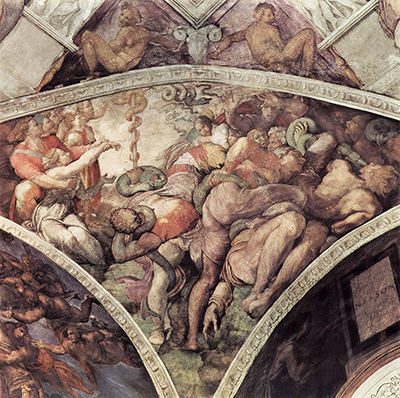
The Brazen Serpent
Numbers describes Israelites afflicted by fiery or poisonous serpents after speaking against God and Moses. At divine instruction, Moses makes a bronze serpent; those who look upon it survive.[10]
Michelangelo fills the pendentive with twisting bodies attacked by snakes, helped by companions or turning toward the saving image.[1] Danger and remedy occupy one crowded field.
Unlike David and Judith, there is no single human hero performing deliverance. Survival depends on response to a sign established through Moses.
The composition therefore multiplies states: bitten, struggling, carrying, looking and recovering. Collective crisis generates a dense anatomy of fear and aid.
Four Kinds of Action
David raises a weapon. Judith carries a burden. Haman is acted upon. The Israelites turn their sight.
These verbs give the ensemble variety while clarifying its unity. Salvation can require decisive force, courage after secrecy, justice through reversal or obedient perception.
Michelangelo does not standardise deliverance into one heroic pose. Each story generates its own bodily grammar.
The corners can therefore be compared without ranking them as variations of one model.
Four Different Narrative Times
The pendentives do not select equivalent instants. David acts just before a killing is completed. Judith occupies the dangerous aftermath of a killing already performed. Haman’s field compresses plot, reversal and punishment across a more complex narrative spread. The Brazen Serpent shows crisis and remedy operating simultaneously.
These temporal choices affect emotional response. Suspense can concern what is about to happen, whether escape will succeed, how justice arrives or which suffering bodies will turn toward survival.
Michelangelo therefore varies not only action but the amount of time each corner contains. One decisive interval can dominate a field, while another field distributes successive events.
The ensemble cannot be read like four consecutive frames. Its unity lies in thematic reversal, not synchronized chronology.
Enemy Bodies and Threatened Bodies
David’s and Judith’s enemies are represented through defeated bodies. Haman is himself the body under punishment. In the serpent field, threatened Israelites dominate while the cause of suffering coils among them.
This changes where sympathy and attention fall. A giant and commander remain visually powerful after defeat; Haman’s exposure raises questions about justice and spectacle; the bitten community generates identification with victims.
Deliverance is thus viewed from alternating positions: champion, heroine, condemned enemy and people in pain.
Michelangelo’s corners do not permit one simple emotional stance toward violence. They require observers to shift between triumph, horror, relief and unease.
Christian Typology and Narrative Identity
Christian interpreters connected these Hebrew Bible stories to salvation through Christ. The bronze serpent, for example, enters later typological reading, while Haman’s cross-like suspension and the deliverers David and Judith could join broader Christian patterns.
Typology explains part of the subjects’ importance in a papal chapel, but it must not erase the narratives themselves. Haman is not literally Christ, the bronze serpent is not a crucifix and Judith is not simply a substitute for another sacred figure.
The strongest reading preserves two levels: each scene’s own biblical identity and its later Christian interpretation within the ceiling.
Michelangelo’s visual forms can invite comparison without collapsing historical difference.
Bodies Fitted to Curved Triangles
Triangular fields narrow and expand unpredictably. Michelangelo places important masses where the surface offers breadth and uses limbs, weapons, poles or serpents to activate tapering zones.
Curvature further distorts a body seen in photographs. What appears stretched in a flat image may read correctly from the chapel floor.
The figures often seem to push against boundaries because their crises exceed orderly rectangular containment.
Architecture becomes part of narrative pressure. Corners are not backgrounds behind the stories; they determine how bodies can struggle within them.
Corners as Thresholds
The pendentives occupy transitions between vertical walls and the vault’s upper programme. They are spatial thresholds carrying histories of existential transition.
In each story, danger reaches a turning point. Goliath falls, Holofernes has been killed, Haman’s plot reverses and the serpent-bitten receive a means of life.
This relation between architectural and narrative transition is an interpretation grounded in placement, not a claim that Michelangelo left a written formula for the corners.
Its value lies in explaining why these stories feel appropriate to their demanding sites.
Deliverance and Violence
Three pendentives include severe bodily violence, and the fourth shows widespread suffering. Salvation is not presented as gentle escape.
This raises ethical and theological difficulty. Enemy bodies are killed or punished; a community suffers before relief becomes available.
Michelangelo does not soften those facts, but neither does he make gore the sole subject. Gesture, burden, reversal and collective response organise the images.
The ensemble belongs to sacred history whose triumphs are inseparable from judgment. Admiration for design should not erase violence’s human form.
Women and Men as Agents
David and Judith provide complementary deliverer figures. One acts in open combat after facing an armed champion; the other uses access, deception and courage within an enemy camp.[7][8]
Judith’s maid is also essential. The escape and handling of Holofernes’s head become collaborative rather than solitary.
The Brazen Serpent distributes action across men, women and children in a suffering community. Haman’s field shifts attention from deliverer to condemned enemy.
Michelangelo’s corners therefore resist an exclusively male solitary model of heroism.
Age and social position vary as much as gender. David is a youth without conventional military standing; Judith is a widow acting outside expected warfare; Esther’s story turns through a queen’s intervention; Moses’ community contains dependent bodies as well as leaders.[7][8][9][10]
Deliverance repeatedly comes through agents or responses that power initially discounts. The corners make reversal social before Michelangelo makes it anatomical.
Looking as a Saving Act
The Brazen Serpent is unique because vision determines survival. Those who look upon the bronze image live.[10]
Inside a chapel covered with images, this narrative gives looking theological stakes. An image can become an appointed medium of rescue within the biblical story.
The connection should not be used as a simplistic defence of every image. It does illuminate why bodily orientation and gaze matter so strongly in the crowded corner.
Observers below also look upward, but their act is not identical to the Israelites’ scriptural beholding. Analogy and narrative must remain distinct.
Pendentives and the Genesis Centre
The central nine stories begin with creation and end with Noah.[4] The pendentives come from later scriptural histories and occupy the corners rather than the narrative spine.
Their shared concern with preservation echoes the ark and Flood without making them Noah episodes. Different books, protagonists and times remain separate.
Genesis explains origins; the corner stories demonstrate later rescues within Israel’s history and its Christian interpretation.
The ceiling’s programme therefore surrounds beginnings with recurring danger and deliverance.
Pendentives and Prophetic Thrones
The prophets and sibyls sit in monumental niches along the vault.[6] The pendentives are narrative actions occupying curved corner fields.
One group embodies interpretation and anticipation; the other shows crises unfolding.
Their adjacency can make wide photographs confusing, especially where limbs from different pictorial levels seem close. Painted architecture defines boundaries.
Recognising those boundaries preserves the ceiling’s nested system rather than flattening every body into one crowd.
Pendentives and Spandrels
The Vatican distinguishes pendentives from spandrels or triangular “sails” associated with the ancestors of Christ.[5] Both occupy non-rectangular fields, which encourages mistaken naming.
The four corner pendentives carry dramatic biblical deliverances. Spandrels belong to a larger ancestral programme and show more domestic or genealogical groups.
Architectural location, institutional terminology and subject must all be checked before identifying a field.
This distinction is essential because “corner scene” and “triangular scene” are not interchangeable classifications.
Fictive Architecture and Real Curvature
Michelangelo’s painted mouldings, frames and supports interact with the actual chapel surface.[2] A photograph can make those fictive elements appear structural or make real curves appear painted.
The pendentives exploit this ambiguity. Bodies inhabit spaces that seem built yet are produced through pigment and perspective.
At the corners, real architecture asserts itself strongly, preventing the illusion from becoming a simple flat window.
Michelangelo’s design succeeds by cooperating with curvature rather than denying it.
Campaign Chronology
The ceiling was commissioned under Julius II, begun in 1508 and completed in 1512.[2] The four pendentives belong to this documented undertaking.
An exact simple order for all four should not be asserted from their biblical sequence because they do not form one chronology.
Technical study may distinguish plaster campaigns and phases, but the public institutional overview does not turn the corners into dated diary entries.
The strongest historical account combines the secure campaign range with careful individual identities.
Viewing the Four as an Ensemble
No single standing position reveals every pendentive with equal clarity. Corners are far apart and seen at different angles.
A diagram or complete ceiling view helps establish location, while dedicated photographs reveal the narratives. Neither view replaces the other.
Flattened images can disguise the challenge Michelangelo solved. Figures designed for oblique sight become strangely proportioned when isolated from curvature.
The proper method is comparative and architectural: locate, approach visually, inspect, then return each story to the four-corner frame.
Walking or turning within the chapel also changes sequence. No permanently privileged first corner controls the ensemble for every observer. Entrance, altar orientation and permitted movement shape encounter.
This decentralisation suits the four-part design. Meaning accumulates through remembered comparison across physical distance.
Restoration and Material History
The Vatican’s chapel history records modern restoration within a much longer history of use and conservation.[3] Cleaning changed the colours through which recent audiences understand the pendentives.
Large surface fields, cracks and prior interventions become conspicuous in close photography. From the floor, narrative masses and corner placement dominate.
Digital reproduction may brighten one field differently from another, complicating direct chromatic comparison.
The conserved frescoes are neither untouched sixteenth-century surfaces nor merely modern images. Their material continuity includes change.
Why the Pendentives Matter
The pendentives matter because Michelangelo uses the chapel’s hardest transitional surfaces for stories of transition under mortal pressure.
They matter because deliverance is never reduced to one body type or action. Youth, woman, condemned enemy and suffering community occupy different corners.
Most importantly, the four fields transform peripheral architecture into a theological frame. The ceiling’s corners do not merely hold the centre up; they insist that sacred history repeatedly turns at the edge of destruction.
Artist Up Close
Michelangelo treats architectural difficulty as narrative opportunity. Curved triangles could have received passive ornament. Instead, he makes them compress combat, escape, punishment and collective panic until bodies seem forced by the building itself. His genius lies not in pretending the corners are flat, but in discovering what kinds of stories their pressure can tell.
Frequently Asked Questions
Discussion
Which of the four pendentive subjects most clearly explains the group?
How does the corner location change the way you read the scenes?
What helps separate the corner narratives from the central Genesis panels?
Join the Conversation
Compare the four corner stories and their place in the Sistine Chapel ceiling while keeping the page focused on Michelangelo's pendentive group.
References
- Vatican Museums, Pendentives”:, View source.
- Vatican Museums, Sistine Chapel Ceiling”:, View source.
- Vatican Museums, Sistine Chapel History”:, View source.
- Vatican Museums, Central Stories”:, View source.
- Vatican Museums, Spandrels”:, View source.
- Vatican Museums, Sibyls and Prophets”:, View source.
- United States Conference of Catholic Bishops, 1 Samuel, Chapter 17”:, View source.
- United States Conference of Catholic Bishops, Judith, Chapter 13”:, View source.
- United States Conference of Catholic Bishops, Esther, Chapter 7”:, View source.
- United States Conference of Catholic Bishops, Numbers, Chapter 21”:, View source.