


 by Tom Gurney
Tom Gurney BSc (Hons) is an art history expert with over 20 years experience
Published on June 19, 2020 / Updated on November 6, 2025
Email: tomgurney1@gmail.com / Phone: +44 7429 011000
The Prophet Zechariah by Michelangelo
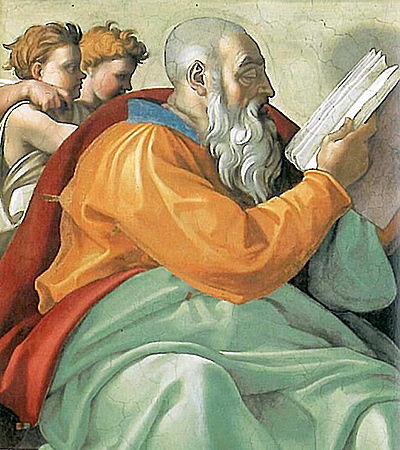
Directly above the Sistine Chapel entrance, Michelangelo’s Zechariah bends over a large open book. His bald head and white beard are seen in profile; layered green, orange and red garments expand across the throne; two youthful attendants peer from behind his shoulder. Visitors pass beneath a prophet who does not acknowledge them. The ceiling begins, from the entrance, with absorbed reading.
The figure is known both as Zechariah and Zacharias, an older English or Latinised form. The Vatican Museums use the prophet’s dedicated identity and place him opposite Jonah above the altar.[1][5] Michelangelo turns this end-to-end relation into a contrast between two prophetic modes: Zechariah inclines into text, while Jonah leans back toward vision.
Is Zacharias the same figure as Zechariah? Yes. Zacharias is the inherited page spelling, while Zechariah is the standard English form used for the prophet. Both names refer to the same Sistine Chapel figure.
At a Glance
- Preferred nameThe Prophet Zechariah
- VariantZacharias
- Artist and mediumMichelangelo Buonarroti; fresco
- LocationAbove the entrance wall of the Sistine Chapel[5]
- Opposite endJonah above the altar
- CampaignPainted within Julius II’s 1508–1512 ceiling undertaking[2]
- EnsembleOne of seven prophets joined by five sibyls[1]
- Attribute and actionLarge open book held close during sustained reading
- CompanionsTwo smaller attendants behind the prophet
- Visual characterAged profile, white beard, golden-orange sleeve, green lower garment and red mantle
- Name cautionZechariah and Zacharias denote the same figure here
- Portrait cautionClaims that the face represents Pope Julius II remain traditional speculation unless supported by stronger portrait evidence
Contents
- Zechariah in Scripture
- A Prophet at the Entrance
- The Large Open Book
- Profile and the Withheld Face
- Hands Holding Knowledge
- Drapery and Seated Mass
- The Two Attendants
- Aged Prophet and Youthful Company
- Zechariah and Jonah Across the Vault
- Relation to the Genesis Stories
- Was Zechariah a Portrait of Julius II?
- Name Variants: Zechariah and Zacharias
- Campaign and Execution Caution
- Seeing from Below
- Restoration and Material History
- Why Zechariah Matters
- Artist Up Close
Zechariah in Scripture
The biblical Book of Zechariah belongs to the prophetic writings and begins amid the post-exilic restoration of Jerusalem. It moves through calls to return, visions, symbolic actions and expectations of divine kingship.[6]
Christian interpretation connected passages from Zechariah with events in the life of Christ, including the king arriving humbly and later texts associated with suffering and mourning. This gave the prophet an important place in a chapel programme centred on Christian salvation.
Michelangelo does not paint one episode from the book. There is no horse vision, measuring line or entry into Jerusalem. The volume in Zechariah’s hands condenses the authority of the entire prophetic text.
The exact words on the painted leaves cannot be securely read from below. Identity and scriptural role establish meaning more firmly than attempts to reconstruct a visible verse.
A Prophet at the Entrance
Zechariah occupies the end above the entrance through which worshippers and visitors approach.[5] His position makes him a threshold figure, even though his attention remains inside the book.
This apparent indifference is powerful. He does not act as a greeter or guardian facing outward. Entering beneath him means passing under absorbed scriptural authority.
As observers move into the chapel and turn toward the altar, the prophetic and sibylline company unfolds along the sides. Zechariah’s closed concentration begins a spatial progression that ends in Jonah’s bodily openness.
The entrance position should not be confused with first place in working chronology or with the altar-to-entrance reading order of the central Genesis stories. Different systems overlap on the vault.
The Large Open Book
The book fills the space before Zechariah’s face. Thick leaves fan at the upper edge, and both hands support or separate its sides.
Its mass gives reading physical presence. The prophet’s shoulders incline, arms rise and gaze narrows. Text reorganises posture.
At chapel distance, pale leaves create a clear shape against flesh and coloured garments. Michelangelo scales the object for architecture as well as narrative identity.
The volume is not merely a generic prop. It defines Zechariah’s relation to revelation as study sustained over time.
Profile and the Withheld Face
Zechariah is shown largely in profile, with eyes directed toward the book. Bald scalp, brow, nose and long beard create a distinctive contour.
The withheld frontal face reinforces inwardness. Viewers see him seeing words rather than receiving his gaze.
Age appears through head and beard more than bodily weakness. Beneath the garments, the seated form remains immense.
Michelangelo thereby separates old age from fragility. Time lends the prophet gravity while reading keeps him active.
Hands Holding Knowledge
One hand grips the book’s outer edge; the other enters near the leaves, perhaps holding a place or turning a sheet. The difference makes the volume feel used rather than ceremonially displayed.
Fingers provide scale. Without them, the pale mass could seem weightless. Their pressure suggests material parchment or paper bound into a heavy codex.
The hands also narrow the space between book and face. Reading occurs inside a compact triangle of touch and sight.
This intimacy contrasts with the public scale of the throne. Michelangelo enlarges a private intellectual act until it governs an entrance wall.
Drapery and Seated Mass
A golden-orange sleeve advances from a red mantle, while blue-green cloth spreads broadly over the knees. Layers create an almost pyramidal seated mass.
The garments conceal much anatomy, but their folds reveal direction and weight. Cloth bunches near arms, widens over lap and drops toward the ledge.
Colour separates Zechariah from the pale fictive architecture and makes him legible from far below. Modern conservation renewed the brilliance of these relationships.[4]
The large green field below the book acts as visual foundation, balancing the intense small zone of head and leaves above.
The Two Attendants
Two young companions emerge behind the prophet’s shoulder. One places an arm around or before the other; both look toward the book or the surrounding action.
Their smooth faces and reddish hair contrast with Zechariah’s baldness and beard. Generations occupy one niche.
The attendants may suggest transmission, assistance or witness, but their exact identities are not named by the Vatican account.[5] Calling them angels or specific historical persons without evidence would narrow an intentionally open relation.
Their presence prevents the prophet’s reading from becoming absolute solitude. Knowledge has an audience even when the principal figure seems unaware of the chapel.
Aged Prophet and Youthful Company
The contrast across age is structural, not merely descriptive. Zechariah’s large body and book dominate; the youths occupy compressed background space.
Age aligns with sustained reading, while youth aligns with watching and learning. Yet the attendants are not simply students in a documented classroom.
Michelangelo uses bodily time to deepen prophecy. Text passes between generations even when no explicit handover occurs.
The group’s intimacy also softens the monumental throne. A public seer is accompanied by a small human cluster.
Zechariah and Jonah Across the Vault
Zechariah sits above the entrance; Jonah occupies the altar end.[1][5] Their long-distance opposition gives the ceiling a powerful prophetic axis.
Zechariah bends forward over a book. Jonah leans backward, looking upward, with the great fish identifying his story. One closes around text; the other opens into embodied vision.
Christian scripture presents Jonah as a sign connected to Christ’s death and resurrection. Zechariah’s writings were likewise interpreted christologically.[6] Their placement surrounds the vault with distinct modes of anticipation.
The comparison should remain visual and programmatic. It does not mean the prophets are shown conversing across the chapel.
Relation to the Genesis Stories
The central band narrates Creation, Adam and Eve, and Noah.[3] Zechariah does not inhabit those early biblical landscapes.
His throne belongs to the interpretive architecture around them. A later prophet reads within sight of origins, encouraging the chapel’s Genesis history to be understood through salvation.
This separation of pictorial levels is crucial. Painted stone frames the prophet; another frame contains the central stories; actual chapel architecture holds both.[2][3]
A close crop of Zechariah makes him appear autonomous. A whole-vault view restores his role as one voice among twelve.
Was Zechariah a Portrait of Julius II?
A tradition has associated the prophet’s face with Pope Julius II, Michelangelo’s patron. The age, bald head and powerful profile make the proposal visually tempting.
Resemblance alone is not secure identification. The Vatican’s dedicated account names Zechariah and does not require a papal portrait for the figure to function.[5]
Unless documentary, comparative and technical evidence establishes the likeness, “sometimes interpreted as” is safer than declaring it fact.
The distinction protects both identities: a biblical prophet in the painted programme and a pope whose portraits survive in other contexts.
Name Variants: Zechariah and Zacharias
Zechariah is the standard modern English form of the Hebrew prophet’s name. Zacharias appears through Greek, Latin and older English traditions.
Titles using either form can refer to Michelangelo’s same fresco. The variant should not create a duplicate object.
Using Zechariah as the main name aligns with contemporary biblical usage, while noting Zacharias preserves established search and catalogue language.
The inscription and location remain stable even as transliteration changes.
Campaign and Execution Caution
The Vatican documents Michelangelo’s vault project from the 1508 contract to completion in 1512.[2] Zechariah belongs securely within that campaign.
His entrance location does not prove he was the first or last seer painted. Fresco labour unfolds through plaster sections and adjacent architectural work whose precise order requires technical study.
Nor should a comparison of style be turned into a date more exact than evidence permits.
The firm historical statement is enough: Michelangelo designed the prophet as part of a multi-year transformation of the chapel ceiling for Julius II.
Seeing from Below
From the floor, book, bright sleeve, green lap and white beard create the clearest pattern. The attendants and fingers become harder to resolve.
The entrance position can also make the figure easy to miss when attention moves immediately toward altar and central scenes. To see him fully, a visitor must turn back or look up on entry.
Smarthistory’s account stresses the vault’s scale and the abundance competing for attention.[7] Zechariah answers with mass rather than outward gesture.
Close photographs recover the concentration in face and hands but should be reconnected to this threshold experience.
Restoration and Material History
The chapel’s conservation history includes the modern cleaning and study of the ceiling.[4] Renewed colours changed the balance familiar from older, darker reproductions.
Orange, green, red and pale book leaves now make the figure strongly chromatic, while cracks and repairs remain visible under enlargement.
Digital photographs vary in warmth and shadow. Beard can merge into pages or separate sharply according to exposure.
The fresco is both Michelangelo’s design and a material surface that has aged in an active sacred interior.
Why Zechariah Matters
Zechariah matters because Michelangelo makes an entrance monumental through inward attention. The prophet does not address those below, yet his reading controls the threshold.
He matters because age, book and attendants compress the transmission of knowledge into one throne. Prophecy is inherited, studied and watched.
Most importantly, his relation to Jonah gives the vault a long axis between text and vision. Michelangelo organises not only bodies, but different ways of knowing.
Artist Up Close
Michelangelo understands concentration as architecture. Zechariah’s book forms one wall of a private enclosure; beard, hands and inclined profile form the others. Vast drapery then enlarges that intimate space until it sits above a chapel door. The achievement is paradoxical: a man who appears not to notice us becomes unavoidable.
Frequently Asked Questions
Discussion
What feels most important in Michelangelo's Zacharias: the entrance-end placement, the reading book, or the way the prophet frames the Genesis scenes?
Reader Insights
How does Zechariah's position opposite Jonah shape the ceiling's two ends?
What does the open book suggest without turning the painted page into a literal transcription?
How does this prophet change when viewed beside the Genesis scenes and Sibyls?
Join the Conversation
Compare the figure's placement, book and Sistine setting while keeping Zacharias distinct from the wider ceiling programme.
References
- Vatican Museums, Sibyls and Prophets”:, View source.
- Vatican Museums, Sistine Chapel Ceiling”:, View source.
- Vatican Museums, Central Stories”:, View source.
- Vatican Museums, Sistine Chapel History”:, View source.
- Vatican Museums, Prophet Zechariah”:, View source.
- United States Conference of Catholic Bishops, Zechariah, Chapter 1”:, View source.
- Smarthistory, Michelangelo, Ceiling of the Sistine Chapel”:, View source.