



 by Tom Gurney
Tom Gurney BSc (Hons) is an art history expert with over 20 years experience
Email: tomgurney1@gmail.com / Phone: +44 7429 011000
Three Children Playing with a Donkey: Introduction
Three children surround a donkey in front of a fountain. One sits astride its back, another pulls at its bridle, and the third approaches from behind with a raised hat. Their movements turn an ordinary encounter into a small contest of wills. The animal occupies the centre, but the action runs through the whole group: from the lifted arm at the left, across the rider, to the taut line and braced legs at the right. Three Children Playing with a Donkey is a lithograph dated 1820 in the National Gallery of Art, Washington, whose catalogue names both Théodore Géricault and Nicolas-Toussaint Charlet as artists. [1]
The scene rewards attention because its light subject is so carefully organised. A donkey taking part in children's games might invite a quick smile, yet the image gives equal weight to effort, balance and resistance. The three children each do something different, and their actions converge on a creature that remains visibly separate from their intentions. Its extended head, unevenly placed ears and spread legs make it more than the passive support for a picturesque rider.
At a Glance
- ArtistsThéodore Géricault and Nicolas-Toussaint Charlet (joint catalogue credit) [1]
- Date1820 [1]
- MediumLithograph [1]
- CollectionNational Gallery of Art, Washington, Rosenwald Collection [1]
This work across Théodore Géricault’s career
The Severed Heads
1810s [2]Charging Chasseur
1812 [3]Horse Frightened by Lightning
c.1813–14 [4]The Raft of the Medusa
1818–19 [6]Portrait of a Kleptomaniac
c.1820–24 [8]The Epsom Derby
1821 [9]Contents
- A game built around resistance
- The fountain and the open ground
- A lithograph that keeps the character of drawing
- Two names in the catalogue
- Children watching, children acting
- Annotated details
A game built around resistance
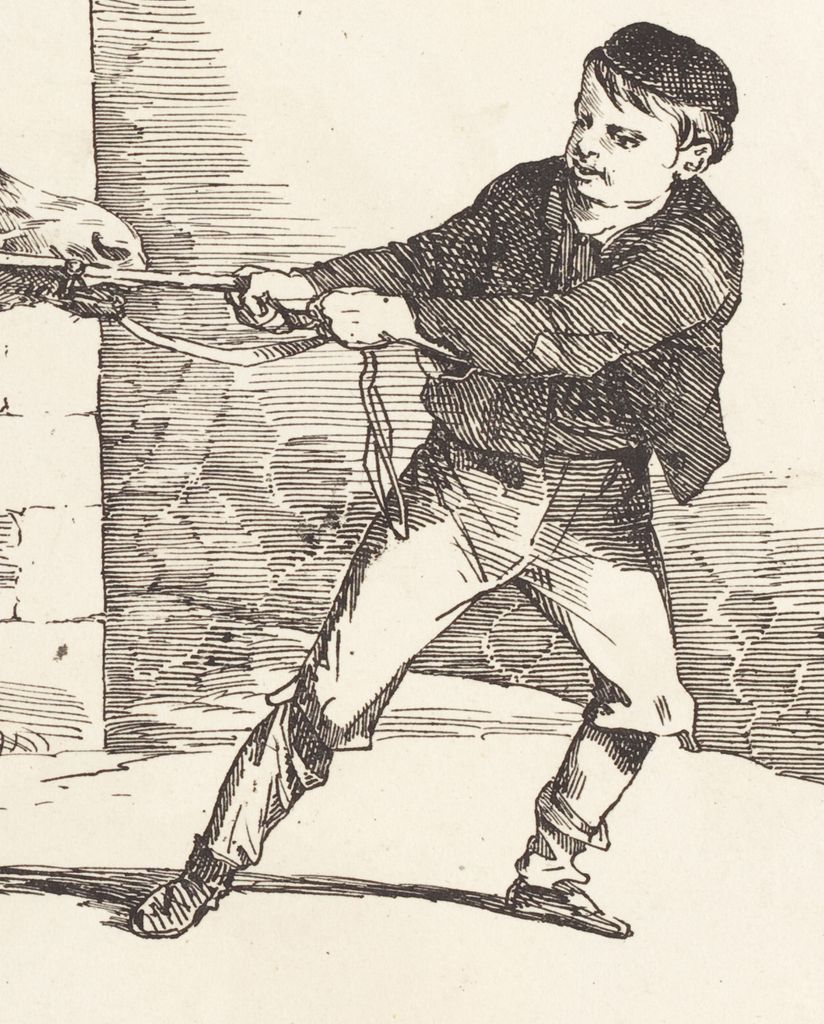
The child at the right has planted both feet far apart. His upper body leans back while his arms reach forward; the bridle connects that backward weight to the donkey's muzzle. This is the clearest direction of force in the composition. The line is thin, but it determines how we read a much larger area of the picture. Without it, the donkey might simply be walking. With it, the animal's stretched neck becomes part of a negotiation between forward movement and reluctance.
The rider contributes a second, less stable posture. He sits high on the donkey, with one boot hanging against its flank, and turns his face towards the child at the front. A short stick is visible in his hand. His upright torso contrasts with the pulling child's backward lean. The two figures appear engaged in the same activity, although their bodies meet its demands differently: one must remain seated while the other tries to produce movement from the ground.
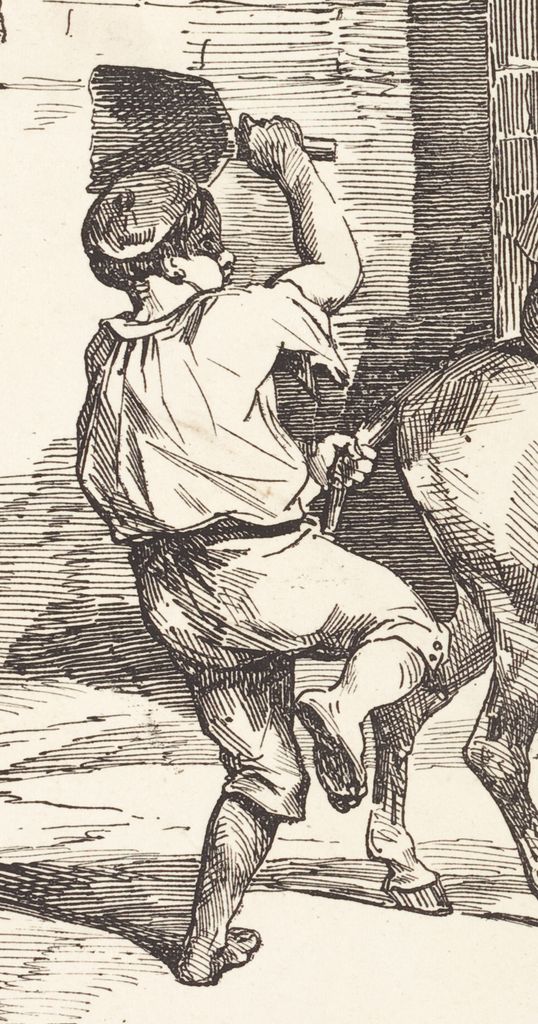
At the left, the third child lifts a hat above his head. His bent knee and raised arm add an upward rhythm to the largely horizontal action. The gesture can look comic, but it also suggests that the donkey is being encouraged or startled from behind. The title's word “playing” leaves room for this rough edge. We need not decide that the scene is either wholly affectionate or deliberately cruel to notice that the children's amusement depends on making an animal respond.
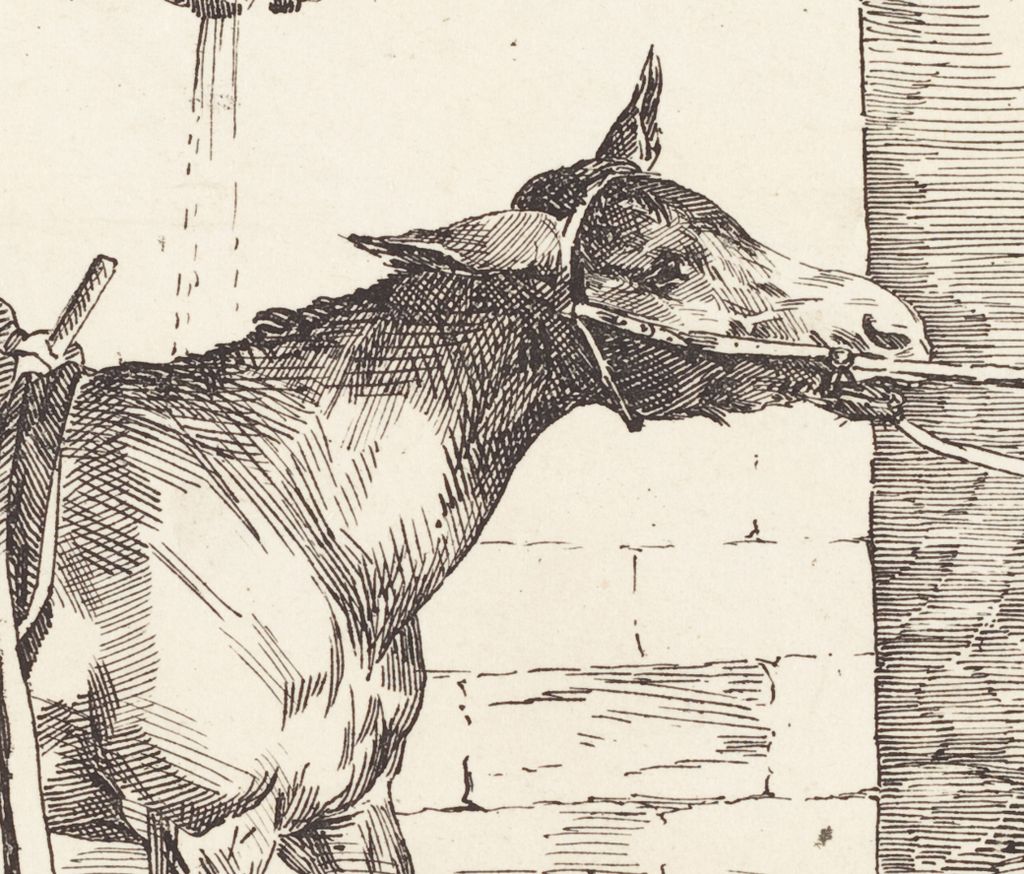
The donkey's body prevents the children from becoming three isolated character studies. Its long back joins the rider to the rear figure, while its neck reaches towards the child with the bridle. The legs below do not repeat a single mechanical pattern. Their different angles introduce the uncertainty of a step being taken, checked or redirected. Looking from the children's gestures down to the hooves changes the emphasis: apparent disorder above rests on a closely observed problem of animal balance.
No personal identities are established for the children in the collection record. The picture therefore offers no sound basis for treating them as Géricault's own children or as a portrait of an identifiable family. Its descriptive title directs attention to an activity shared by the figures, rather than to their names. [1]
The fountain and the open ground
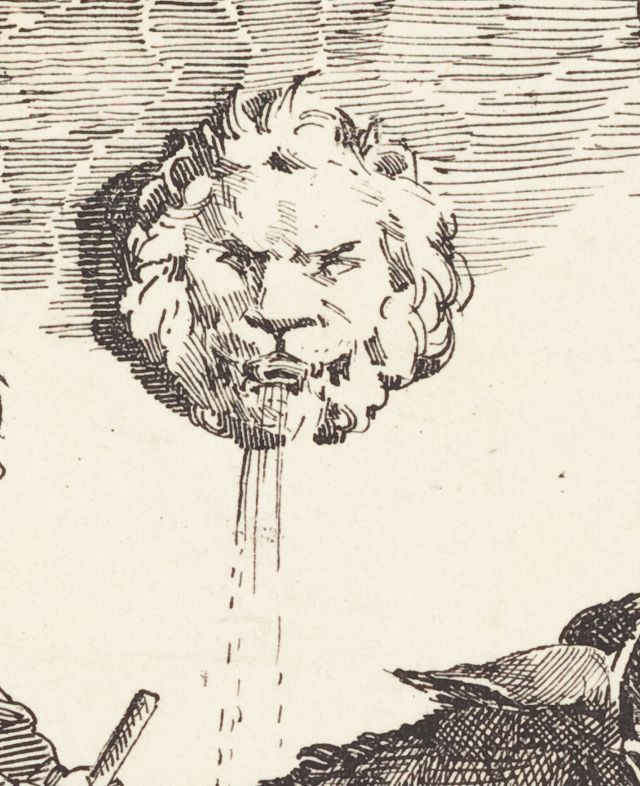
Behind the group, the fountain supplies a firm architectural centre. A lion's head projects from its broad rectangular face, with narrow streams descending from the mouth. Horizontal masonry joints and the heavy upper ledge give the structure a weight that contrasts with the restless bodies in front. The living donkey's long profile also makes a striking neighbour to the frontal, sculpted animal head above it. One is caught in an awkward moment; the other is fixed in stone.
The fountain does more than locate the children beside a source of water. Its vertical edges frame the rider and interrupt the long sweep of the donkey. At the right, the pulling child stands beyond the main face of the structure, so his backward movement opens the composition into comparatively empty space. At the left, wall and shadow gather around the raised hat. The architecture holds the group together while allowing its opposite ends to pull apart.
Much of the foreground is left pale. A few irregular marks suggest the surface of the ground, and stronger shadows fasten feet and hooves to it. These economical indications give the central action room to register. The scene has no enclosing rectangular border: its drawn edges loosen into the untouched paper. Charles Clément's 1866 catalogue likewise described the print as without lettering or a frame, identifying three children, an ass and a fountain in entry 42. The historical description and the visible composition agree on the subject. [10]
Watch: Géricault and The Raft of the Medusa
Three perspectives on Géricault’s best-known painting, its making and its historical setting.
Gericault, Raft of the Medusa
Smarthistory examines the composition and historical setting of The Raft of the Medusa.
Watch on YouTubeAnnotated Details from Three Children Playing with a Donkey
The numbered points identify visible features discussed in this article. Return from each detail to the whole composition. Three Children Playing with a Donkey Image source. CC0 / Public domain.
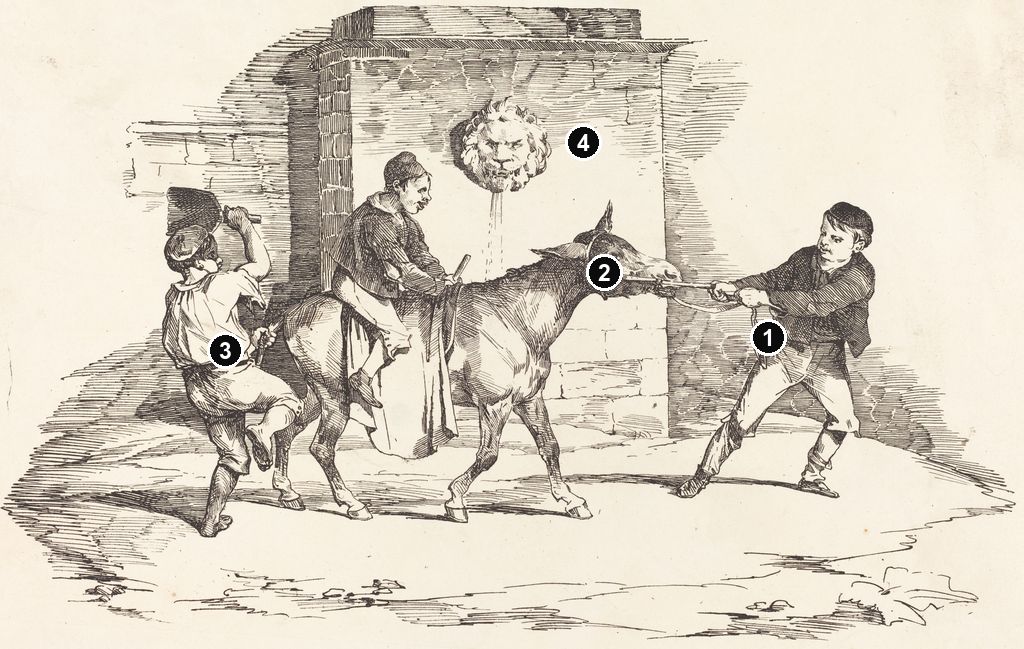
Details from THREE CHILDREN PLAYING WITH A DONKEY
Compare the cropped details with the complete images above. Notice how their colours, shapes and positions contribute to the larger compositions.
The pull of the bridle
The child leans backwards with feet spread wide, turning the narrow bridle into the clearest line of force.
An animal responding
The extended muzzle, differently angled ears and dark neck marks give the donkey a response of its own.
The raised hat
At the rear, a lifted hat and bent knee add an upward movement to the action running across the sheet.
Water and stone
A frontal lion mask sends thin streams down the fountain behind the restless group.
A lithograph that keeps the character of drawing
The print's tonal effects grow largely from lines. Closely spaced strokes darken the jackets and hats; more open hatching describes the donkey's rounded flank. Changes in direction distinguish cloth, masonry and animal anatomy without introducing colour. Particularly dense passages around the rider's torso give way to the light trouser leg beside it. Across the donkey, oblique strokes turn the chest and shoulder while longer marks describe the neck. The paper remains an active light throughout.
This is a different visual experience from a smooth wash of continuous tone. Individual marks remain readable even where they combine into shadow. The fountain's repeated horizontal strokes establish a steady background rhythm, against which the curved and angled marks of the figures feel more mobile. The image preserves the pleasure of following a drawing hand, while also being a printed impression that could exist in multiple examples.
Chantilly's museum account explains the ordinary lithographic process through drawing with greasy chalk or ink on prepared limestone. During printing, moisture keeps ink away from the non-drawn areas, and paper receives the inked design under pressure. That method allowed the artist's drawing language to reach a wider audience. [11] This particular composition belongs to a more specialised strand of experimentation. Clément grouped it among works drawn on prepared carton, a support he described as lighter and easier to transport than stone. He also recorded a carton used to print the children scene in the collection of His de La Salle. These are statements from his nineteenth-century catalogue, rather than a present-day location report. [10]
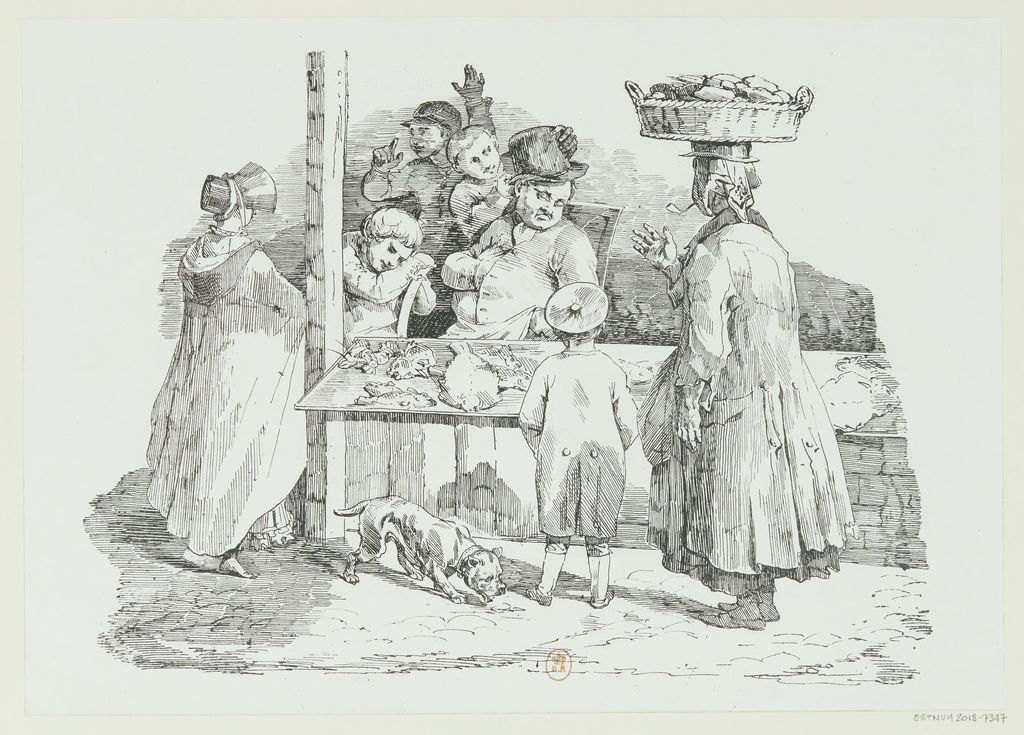
A related surviving object helps make the distinction between design support and finished print concrete. Christie's catalogued the original Sleeping Fish Seller drawing as pen and black lithographic ink on prepared stone paper, also called lithographic carton. Its 1997 essay, reporting Lorenz Eitner's assessment, associated such experiments with the practical demands of Géricault's English period and stressed the support's fragility. The carton is the object from which impressions were produced; it should not be confused with a sheet bearing the printed composition. [12] For the children scene, that distinction lets us connect its pen-like appearance with a documented experimental process without misidentifying the Washington lithograph as an original drawing.
Two names in the catalogue
The National Gallery's record identifies its impression as accession 1951.10.449 in the Rosenwald Collection. It gives Delteil number 25 and records only one state. Clément's number 42 belongs to a different catalogue sequence; the two numbers do not identify different scenes. Most consequentially, the current museum record gives both Géricault and Charlet the role of Artist. It does not explain which passages either man drew or assign one the role of printer. [1]
That joint credit deserves to remain visible. It would be misleading to turn the shared attribution into a detailed story of collaboration unsupported by the record. Nor can an argument concerning another image settle the question here. The Christie's essay on Sleeping Fish Seller reports Eitner's case for Géricault's authorship of that drawing, drawing on its handling and proposed chronology. His position concerns that object and reaches us through the auction essay; it does not establish a division of labour for Three Children Playing with a Donkey. [12]
Children watching, children acting
The comparison with The Sleeping Fish Seller is useful beyond the history of the technique. In that composition, children crowd around an adult who has fallen asleep at his stall. Faces and gestures gather behind his chair, while a child seen from the back stands before the displayed fish. A low, crouching dog brings animal life into the foreground. Here, by contrast, no adult anchors the scene. The children themselves generate its action, and the animal stands at its centre.
Both images find incident in an everyday setting, using a compact group rather than a broad panorama. Their humour relies on unequal awareness or unequal power: the fish seller sleeps amid activity, while the donkey must answer several demands at once. In the children print, the fountain's steady flow continues behind the group's effort. That quiet background makes the attempted movement seem all the more busy. The scene holds our interest through this exchange between human energy and animal resistance, made legible by a few taut connections, carefully placed bodies and the varied pressure of black lines on pale paper.
The Sleeping Fish Seller Image source. Public domain.
Géricault collection records
Seventy collection records include paintings, drawings and individual print impressions. Different impressions remain separate records; this selection is not a complete catalogue raisonné.
Frequently Asked Questions
The National Gallery of Art credits both Théodore Géricault and Nicolas-Toussaint Charlet as artists. Its record does not specify how they divided the work. [1]
The collection record establishes no personal identities for them. The title describes three children playing with an animal, rather than identifying a family portrait. [1]
Discussion
Look again at the images and ideas explored in Three Children Playing with a Donkey. These editorial prompts invite your observations.
Reader Insights
Follow the bridle from the donkey’s mouth to the child’s hands. How do his feet and shoulders make the pull visible?
Compare the living donkey’s head with the stone lion above it. How does the fountain change your sense of movement?
Look from the dark hatching on the jackets to the open foreground. Where does the untouched paper become part of the picture?
Join the Conversation
Share a detail, comparison or question about Three Children Playing with a Donkey below.
References
- National Gallery of Art, Three Children Playing with a Donkey (Trois enfants jouant avec un ane), 1820, Rosenwald Collection, accession 1951.10.449; Associated Names and artwork overview, including Delteil no. 25, only state. View source.
- Nationalmuseum, The Severed Heads, NM 2113; collection metadata and museum interpretation (Swedish). View source.
- Louvre, Charging Chasseur, INV 4885; collection metadata and museum interpretation (French/English interface). View source.
- National Gallery, Horse frightened by Lightning; collection metadata and museum interpretation (English). View source.
- Louvre, Wounded Cuirassier, INV 4886; collection metadata and museum interpretation (French). View source.
- Louvre, The Raft of the Medusa, INV 4884; collection metadata and museum interpretation (French). View source.
- Gary Tinterow / The Metropolitan Museum of Art, Géricault’s Heroic Landscapes: The Times of Day, Met Bulletin 48/3, Winter 1990–91; consulted main essay and relevant object entries (English). View source.
- Vlaamse Kunstcollectie, Portrait of a Kleptomaniac; collection metadata and museum interpretation (Dutch). View source.
- Louvre, Epsom, MI 708; collection metadata and museum interpretation (French/English interface). View source.
- Charles Clément, Catalogue de l'œuvre de Géricault: Lithographies, Paris, 1866, prepared-carton group and entries 41–42, printed p. 16 (digitised PDF p. 24); French. View source. (in French).
- Château de Chantilly, Géricault et la lithographie: Le romantisme à la française, virtual exhibition based on the 2018 exhibition curated by Nicole Garnier-Pelle, section “La lithographie”; French. View source. (in French).
- Christie's, Le Marchand de poissons endormi (The Sleeping Fish Seller), lot 226153, object details and 1997 lot essay reporting Lorenz Eitner's letter of 8 March 1997. View source.


