



 by Tom Gurney
Tom Gurney BSc (Hons) is an art history expert with over 20 years experience
Email: tomgurney1@gmail.com / Phone: +44 7429 011000
The Severed Heads: Introduction
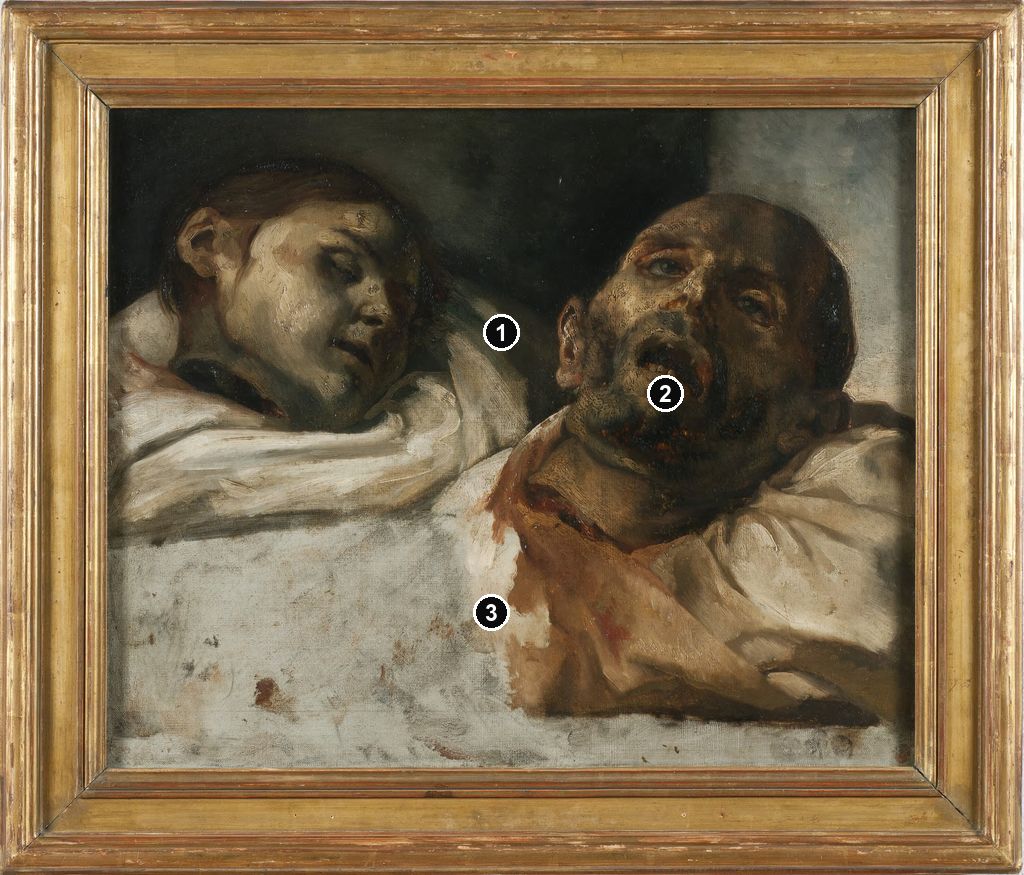
Two heads lie on white cloth, close enough to occupy almost the whole painted space. One turns sideways into the other; the second faces out, its neck ending abruptly above a stain that spreads towards the foreground. There is no executioner, no hospital attendant and no surrounding crowd to explain what has happened. Théodore Géricault gives the viewer the physical aftermath, presented with the concentrated attention usually reserved for a face in a portrait.
The Severed Heads belongs to the Nationalmuseum in Stockholm. The museum records it as an oil painting on canvas, measuring 50 × 61 cm, made during the 1810s. Its inventory number is NM 2113. Those modest dimensions matter: this is an encounter conducted at close range, rather than a public spectacle expanded across a monumental canvas. Its disturbing force comes from the meeting of recognisable human features with the evidence of bodily separation. [1]
At a Glance
- Date1810s [1]
- MediumOil on canvas [1]
- Size50 × 61 cm [1]
- CollectionNationalmuseum, Stockholm; NM 2113 [1]
This work across Théodore Géricault’s career
Charging Chasseur
1812 [2]Horse Frightened by Lightning
c.1813–14 [3]The Raft of the Medusa
1818–19 [5]Portrait of a Kleptomaniac
c.1820–24 [7]The Epsom Derby
1821 [8]Contents
- Two faces in a shallow space
- What the date and title tell us
- Flesh, cloth and the work of paint
- A still life that retains human likeness
- Other heads and anatomical fragments
- Death and the making of the Raft
- Horror, observation and political interpretation
- The painting in Stockholm
- Annotated details
Two faces in a shallow space
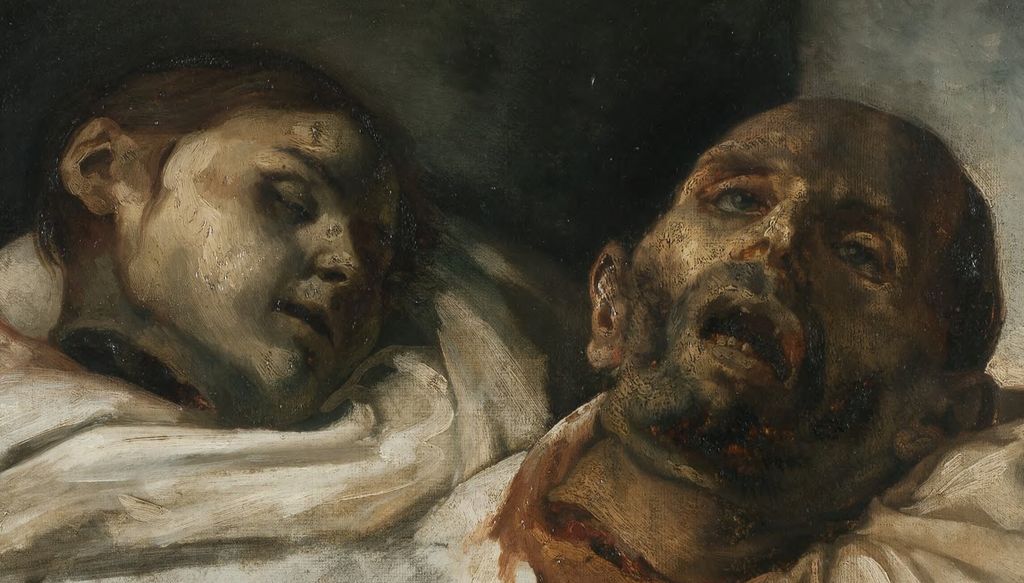
The arrangement is uneven. The head at the left sits farther back and lower in the surrounding folds, its face inclined towards the centre. Dark hair frames a relatively pale cheek; the mouth is slightly open, while the eye recedes into shadow. At the right, the bearded head rises more prominently above the cloth. The forehead, nose and open mouth give the face a stronger outward orientation. The two faces do not repeat a single type. Their differences in hair, facial structure and colouring remain conspicuous even within the darkness.
Géricault builds the picture around that difference. The left cheek forms a broad, light plane, while the right face is broken by the beard, moustache, eye sockets and mouth. One is approached obliquely, the other more frontally. Their proximity makes comparison unavoidable, but they never become an orderly pair of matching specimens. The eye moves back and forth between separate likenesses.
The background provides very little room in which to escape them. A dark field closes around the upper contours, with a paler passage towards the upper right. Nothing establishes the size of a room or the distance to a wall. Below, the cloth runs nearly to the lower edge. Its folds support the heads and connect them, but the surrounding space remains compressed. The viewer is placed before an arrangement, without the reassuring distance of an unfolding story.
That closeness also complicates the apparent relationship between the faces. Their juxtaposition can resemble a group portrait for an instant, yet there is no evidence that these people knew one another or shared a particular fate. Their meeting takes place within the painting. Reading affection, accusation or a remembered conversation into the arrangement would supply a biography that neither the picture nor the museum record can establish.
What the date and title tell us
The Nationalmuseum's date is the 1810s, a decade rather than a single year. That leaves room for the familiar association with the preparation of The Raft of the Medusa, but it does not certify 1818 or 1819 as the exact date of this canvas. The museum describes Géricault's related studies of heads and limbs obtained from Paris hospitals, and cautiously proposes a connection with his great shipwreck painting. Its interpretation is that such works allowed him to approach death closely enough to depict it convincingly. [1]
The title identifies the condition of the bodies, not the people. No names are supplied in the collection record. Nor does it document the individual circumstances in which both heads were severed. Géricault’s other subjects associated with execution cannot settle the history of these particular bodies.
There is a similar limit around purpose. A study can be an investigation without being a directly transferable component of a larger picture. In his Metropolitan Museum study of Géricault, Gary Tinterow emphasised how much remained uncertain about the reasons for the paintings of heads and limbs. That scholarly caution sits usefully beside the Nationalmuseum's proposed Raft connection: the association is persuasive, but the small canvas need not be reduced to a single practical task. [6]
This distinction changes how the work can be seen. If it is treated only as preparation, the viewer may search for a matching head in the finished masterpiece and overlook the decisions made here. Yet the paired arrangement, the different angles of the faces and the broad field of cloth constitute a complete visual problem. Whatever its place in Géricault's working process, the painting sustains attention on its own terms.
Annotated Details from The Severed Heads
The numbered points identify visible features discussed in this article. Return from each detail to the whole composition. The Severed Heads Image source. Public domain.
Details from THE SEVERED HEADS
Compare the cropped details with the complete images above. Notice how their colours, shapes and positions contribute to the larger compositions.
Two distinct faces
The different angles, hair and facial structures prevent the heads from becoming an interchangeable pair.
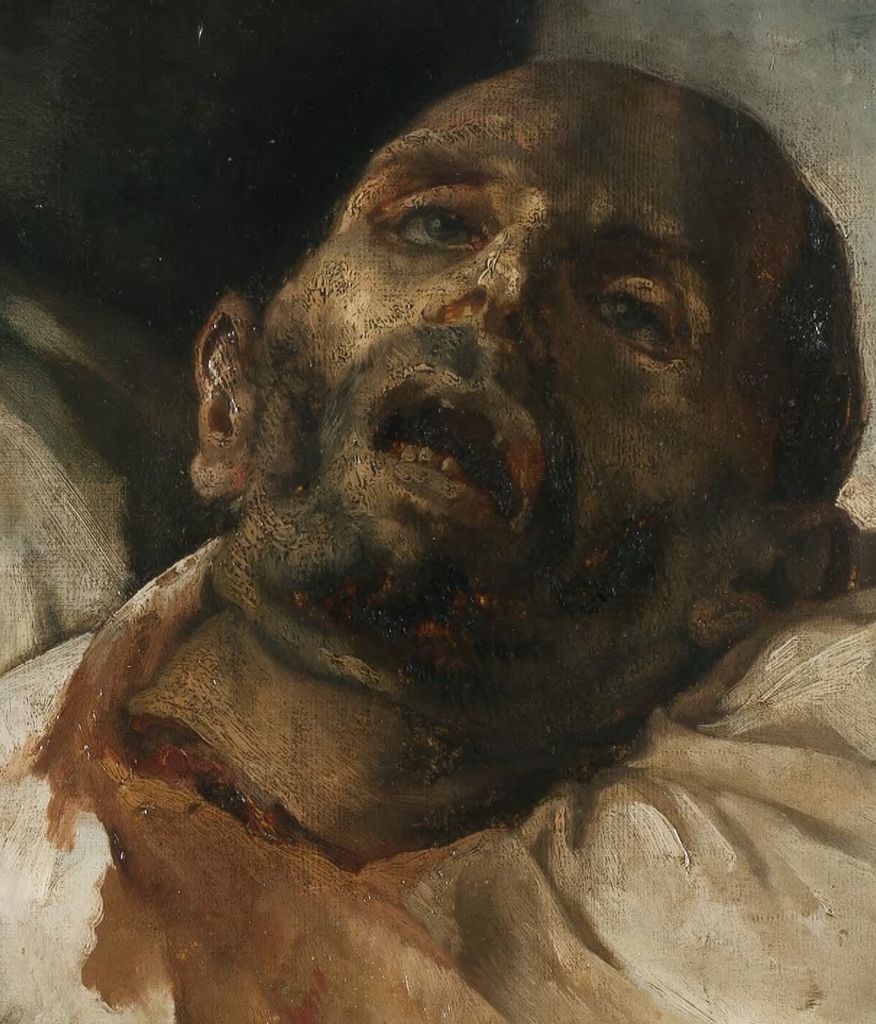
A face turned outward
The forehead, beard and open mouth give the nearer head a stronger outward presence.
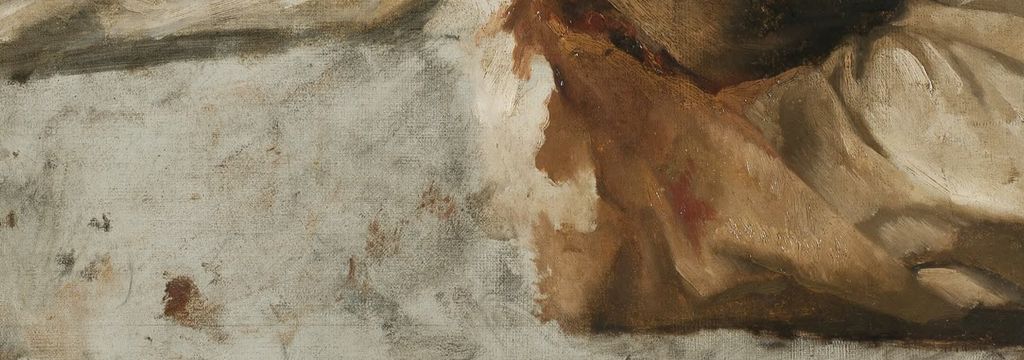
Cloth and stains
Light folds support the heads while exposing the red-brown marks beneath them.
Flesh, cloth and the work of paint
The flesh is far from uniformly pale. The left face combines light cream and grey-green passages with warm brown shadow. Across the bearded head, ochre, dull red and darker tones create a more uneven surface. The cooler colour around the cheeks and mouth meets the warmer, blood-marked area below the neck. These differences make the heads materially distinct without requiring the viewer to assign a medical explanation to each colour.
Light does not fall evenly across the features. It catches the projecting brow, nose and cheek, leaving the eyes and open mouths difficult to penetrate. At the right, small accents near the eyes are especially unsettling because they preserve the appearance of an eye as something that might return a look. This is a pictorial effect, not evidence of consciousness. The face remains legible even where the condition of the body makes any response impossible.
The cloth has an equally active role. Along the left it rises in a broad sweep beneath the jaw, then gathers between the heads. At the right it bunches into sharper folds beside the cheek and neck. Its light surfaces make the dark hair and facial contours easier to distinguish. They also expose the stains: small red-brown marks in the foreground lead towards the larger, warmer passage beneath the nearer head.
White cloth can suggest care, wrapping or a surface prepared for examination. Here those associations remain open. The painting shows cloth, folds and blood, but it does not identify a particular procedure or the person who arranged them. Visually, the fabric alternates between support and disclosure. It seems to cushion the heads while making their severance harder to overlook.
The reproduced surface also makes the act of painting visible. Broad strokes carry the changes of direction in the drapery; smaller touches define features within the dark faces. At a distance these passages assemble into convincing physical forms. Closer looking reveals decisions about edges, colour and emphasis. The horror does not arrive independently of the paint: it develops through the same means by which a painter makes any object appear solid, near and illuminated. These visible effects should be distinguished from laboratory findings about pigments or changes to the canvas, which the collection record does not provide.
A still life that retains human likeness
The two heads are motionless objects arranged within a bounded field. In that sense the painting approaches still life. Cloth, shadow, overlapping forms and carefully distributed light organise the composition as they might organise objects on a table. But the recognition of faces continually interrupts an impersonal reading. The viewer can identify ears, lips, eyelids and hair before fully taking in the exposed neck.
That sequence creates much of the work's unease. The face is familiar as the centre of a person's outward identity; here it persists after the body's continuity has been destroyed. Géricault does not need a gesture of mourning or an accompanying narrative to make that contradiction visible. The features themselves preserve differences between people whom the historical record leaves anonymous.
The effect also depends on restraint. Although the subject is violent, no blow is represented. There is no climax for the viewer to witness and then leave behind. Instead, attention rests on weight, colour and the relation between skin and cloth. The picture can provoke revulsion and sustained scrutiny at the same time. Neither response exhausts it: the first registers what has happened to the body, while the second discovers how insistently the painter has continued to look.
Watch: Géricault and The Raft of the Medusa
Three perspectives on Géricault’s best-known painting, its making and its historical setting.
Gericault, Raft of the Medusa
Smarthistory examines the composition and historical setting of The Raft of the Medusa.
Watch on YouTubeOther heads and anatomical fragments
A comparison with Head of a Guillotined Man at the Art Institute of Chicago shows how differently Géricault could organise a related subject. Chicago dates its painting to 1818–19 and identifies the support as panel, measuring 41 × 38 cm. Its account describes study from a corpse and the observation of decomposition, while saying that the head probably belonged to a convicted criminal. That probability concerns the Chicago work; it is not documentation of the identities in Stockholm. [9]
The Chicago head lies sharply on its side. Its closed eye, ear and long, slanting neck form an isolated mass against the darkness. Stockholm's two faces produce a more complicated movement of attention, from one likeness to another and from their juxtaposition to the shared cloth. Chicago makes the solitary head dominate its narrow field; Stockholm places separation and pairing in uneasy coexistence. The Art Institute also relates its work to the still-life tradition, a helpful comparison for understanding how ordinary conventions of arrangement can carry such difficult human material. [9]
The painting known here as Anatomical Pieces presents a further distinction. That work is the Louvre's RF 579, on loan to Rouen, catalogued as a lamp-lit study of arms and legs for The Raft of the Medusa, around 1818–19. It measures 37.5 × 46 cm. Its intersecting limbs create a knot of bodily forms, with severed ends and stained fabric bringing fragmentation to the foreground. The Louvre's explicit title connects that particular object with the Raft; it should not be silently treated as the title or documentary history of the Stockholm painting. [10]
There is also a separate canvas in Montpellier's Musée Fabre, inventory 876.3.38. The museum's account describes two legs seen from the feet and an arm with the clavicle, partly covered by blood-marked cloth. It proposes that medical students associated with the nearby Beaujon hospital supplied such anatomical material to Géricault. This remains a probable account of access, rather than a record naming each donor or subject. [11]
These comparisons clarify what makes The Severed Heads distinctive. In the limb paintings, recognition depends largely on the construction and relationship of body parts. Here it begins with individual faces. The same broad concern with bodily material produces a different kind of encounter when the part that remains is the part most readily associated with a person's likeness.

Head of a Guillotined Man
Death and the making of the Raft
The Nationalmuseum's proposed relationship with the Raft is easy to understand at the level of visible concerns. In the large shipwreck scene, inert bodies occupy the foreground while other figures rise towards a distant possibility of rescue. Géricault had to make bodily weight and the difference between activity and lifelessness convincing within one composition. The small canvas concentrates attention on physical presence without the movement, weather and distant horizon that organise the larger picture. [1]
The differences are as instructive as the resemblance. In the Raft, a body can be understood through its relation to another person: someone supports it, turns away from it or strains upwards nearby. In The Severed Heads, the arrangement supplies proximity but no surviving participant through whom to interpret the dead. No rescuer can enter the shallow field. The viewer has to confront what remains without the narrative movement towards a possible outcome.
The comparison suggests an investigation of death that extends beyond matching individual figures. The smaller picture exchanges the shipwreck’s suspended hope for an encounter without a possible outcome.
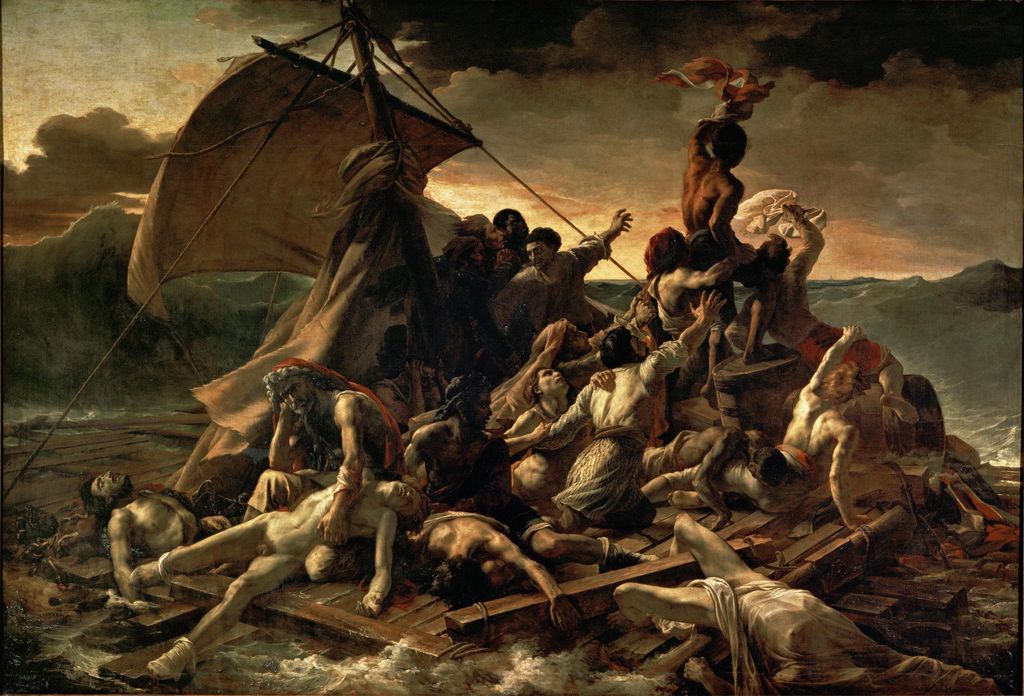
The Raft of the Medusa Image source. Public domain.
Horror, observation and political interpretation
Later exhibitions have offered different ways of understanding these paintings. The Schirn Kunsthalle's Géricault: Images of Life and Death, held in 2013–14, placed the studies of heads and limbs within an account of physical suffering and the modern individual. Its curatorial argument brought scientific observation together with Romantic attraction to disturbing subjects, challenging a simple opposition between realism and Romanticism. This is an interpretive framework for the work, rather than a statement of Géricault's recorded intentions. [12]
The Stockholm canvas makes that framework productive. Patient differentiation of flesh, hair and fabric does not cancel horror. It gives horror a particular form, in which the viewer is held by observation. Equally, the unsettling subject does not mean the painting abandons discipline for emotional display. Its concentrated arrangement requires attention to the same relationships of light, mass and surface found elsewhere in Géricault's art.
A more political emphasis appears in the Musée des Beaux-Arts de Lyon's 2006 exhibition dossier. In its section on sacrifice and killing, the exhibition interprets Géricault's anatomical arrangements in relation to opposition to capital punishment. That reading situates bodily fragmentation within a contemporary moral and political debate. It should remain attributed to the exhibition: the Stockholm canvas itself identifies neither a judicial case nor an explicit abolitionist message. [13]
Tinterow's account of hostile responses to Géricault's cadaver studies adds another dimension. He describes Ingres's objection to an art that represented bodily ugliness rather than an ideal of beauty. Read through that disagreement, the heads challenge expectations about what painting should ask an audience to contemplate. This concerns the reception of Géricault's anatomical imagery more broadly; it does not establish a documented early response to NM 2113 specifically. [6]
Tinterow also reports the opposite response from Delacroix, who admired the force of the cadaver studies and understood their challenge as a renewal of pictorial beauty. The disagreement matters because it reaches beyond whether the subject is acceptable. It concerns whether artistic value depends on idealising the body, or can emerge from confronting its damaged material reality. The competing positions help explain how a painting can be repellent in subject and compelling in its handling, without resolving that tension for every viewer. [6]
The painting in Stockholm
The Nationalmuseum acquired The Severed Heads in 1918 as a gift from a consortium of donors. The collection record preserves that institutional event much more securely than it preserves the lives of the people depicted. A century separates the decade assigned to the painting from its arrival in the museum, and the acquisition entry alone does not supply a complete history of the intervening ownership. [1]
The difference between an identifiable artwork and unidentified human subjects remains central to looking at it. The canvas can be measured, catalogued and compared with other paintings; the faces cannot be restored to named biographies on the same evidence. Géricault nevertheless gives them distinct appearances. That combination of individual likeness and historical anonymity makes the picture resist a comfortable explanation. The more carefully one looks at its construction, the harder it becomes to treat the heads as interchangeable material.
Géricault collection records
Seventy collection records include paintings, drawings and individual print impressions. Different impressions remain separate records; this selection is not a complete catalogue raisonné.
Frequently Asked Questions
The Nationalmuseum record does not name them or establish their individual circumstances. Specific criminal biographies are unverified. [1]
Nationalmuseum dates it to the 1810s. A precise year is not established by its current record. [1]
Discussion
Look again at the images and ideas explored in The Severed Heads. These editorial prompts invite your observations.
Reader Insights
How does the pairing of two distinct faces change the experience compared with the solitary Chicago head?
Follow the folds of cloth: where do they soften the encounter, and where do they expose bodily damage?
How do the competing responses reported from Ingres and Delacroix change what beauty might mean in this painting?
Join the Conversation
Share a detail, comparison or question about The Severed Heads below.
References
- Nationalmuseum, The Severed Heads / De avhuggna huvudena, NM 2113, collection metadata, description and exhibition text, Swedish, accessed 27 October 2026. View source. (in Swedish).
- Louvre, Charging Chasseur, INV 4885; collection metadata and museum interpretation (French/English interface). View source.
- National Gallery, Horse frightened by Lightning; collection metadata and museum interpretation (English). View source.
- Louvre, Wounded Cuirassier, INV 4886; collection metadata and museum interpretation (French). View source.
- Louvre, The Raft of the Medusa, INV 4884; collection metadata and museum interpretation (French). View source.
- Gary Tinterow / The Metropolitan Museum of Art, Géricault's Heroic Landscapes: The Times of Day, The Metropolitan Museum of Art Bulletin, vol. 48, no. 3, Winter 1990–91, introduction, printed p. 4, and discussion of the reception of cadaver studies, pp. 9–10, English. View source.
- Vlaamse Kunstcollectie, Portrait of a Kleptomaniac; collection metadata and museum interpretation (Dutch). View source.
- Louvre, Epsom, MI 708; collection metadata and museum interpretation (French/English interface). View source.
- Art Institute of Chicago, Head of a Guillotined Man, 1992.628, collection record, interpretive text and object data, English, accessed 27 October 2026. View source.
- Musée du Louvre, Étude de bras et de jambes, peinte à la lumière de la lampe, pour le Radeau de la Méduse, au Louvre, RF 579, collection record, French, accessed 27 October 2026. View source. (in French).
- Musée Fabre, Étude de pieds et de main, 876.3.38, collection essay, French, accessed 27 October 2026. View source. (in French).
- Schirn Kunsthalle Frankfurt, Géricault: Images of Life and Death, exhibition summary and catalogue description, exhibition 18 October 2013–26 January 2014, English. View source.
- Musée des Beaux-Arts de Lyon, Géricault: La folie d'un monde, 2006 exhibition press dossier, section 5, “Sacrifices et mises à mort,” p. 6, French. View source. (in French).


