 by
Tom Gurney
Tom Gurney BSc (Hons) is an art history expert with over 20 years experience
Email:
tomgurney1@gmail.com
/ Phone:
+44 7429 011000
George Frederick Cooke as Richard III by Thomas Sully: Introduction
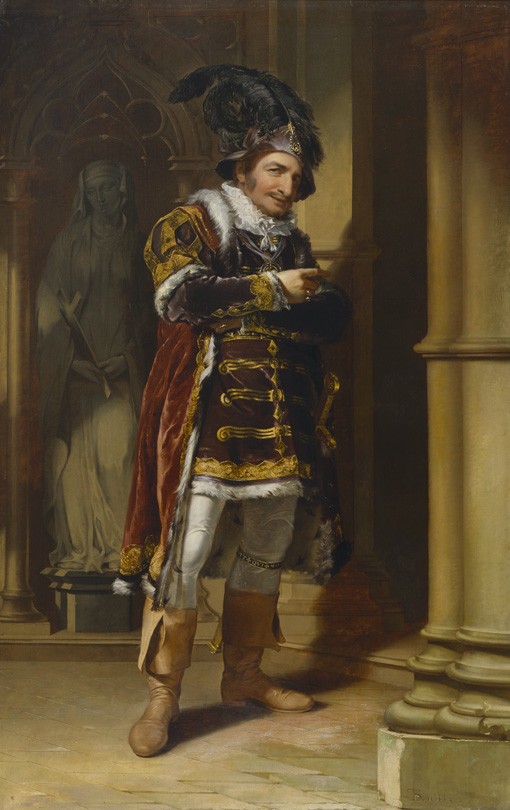
Thomas Sully’s George Frederick Cooke as Richard III represents an actor within a role. Cooke stands in elaborate costume, one hand raised across his body, beneath a broad plumed hat. The full-length canvas belongs to the Pennsylvania Academy of the Fine Arts, which dates it to 1811–1812. It is a likeness of a performer presenting a theatrical king, rather than an image made from life of the historical Richard III. [1]
The picture helped establish Sully’s early reputation in Philadelphia. The historical accounts connect it with subscribers, theatrical audiences and the Academy, giving it a public history beyond the encounter between one painter and one sitter. Its effect depends on that combination: a recognisable actor, the costume of a part and a large painted arrangement capable of sustaining attention away from the stage. [2]
At a Glance
- Artist Thomas Sully
- Title George Frederick Cooke as Richard III
- Date 1811–1812
- Sitter George Frederick Cooke, represented in a theatrical role
- Medium Oil on canvas
- Dimensions 94⅞ × 60½ in. (about 241 × 153.7 cm)
- Collection Pennsylvania Academy of the Fine Arts, Philadelphia
- Accession 1812.1
- Credit Gift of friends and admirers of the artist
This work across Thomas Sully’s career
Musidora
1813–35; Met panelThe Torn Hat
1820Portrait of the Artist
1821; Met canvasJohn Quincy Adams
1824; NGA oil studyQueen Victoria
1838; full-length Met canvasMother and Son
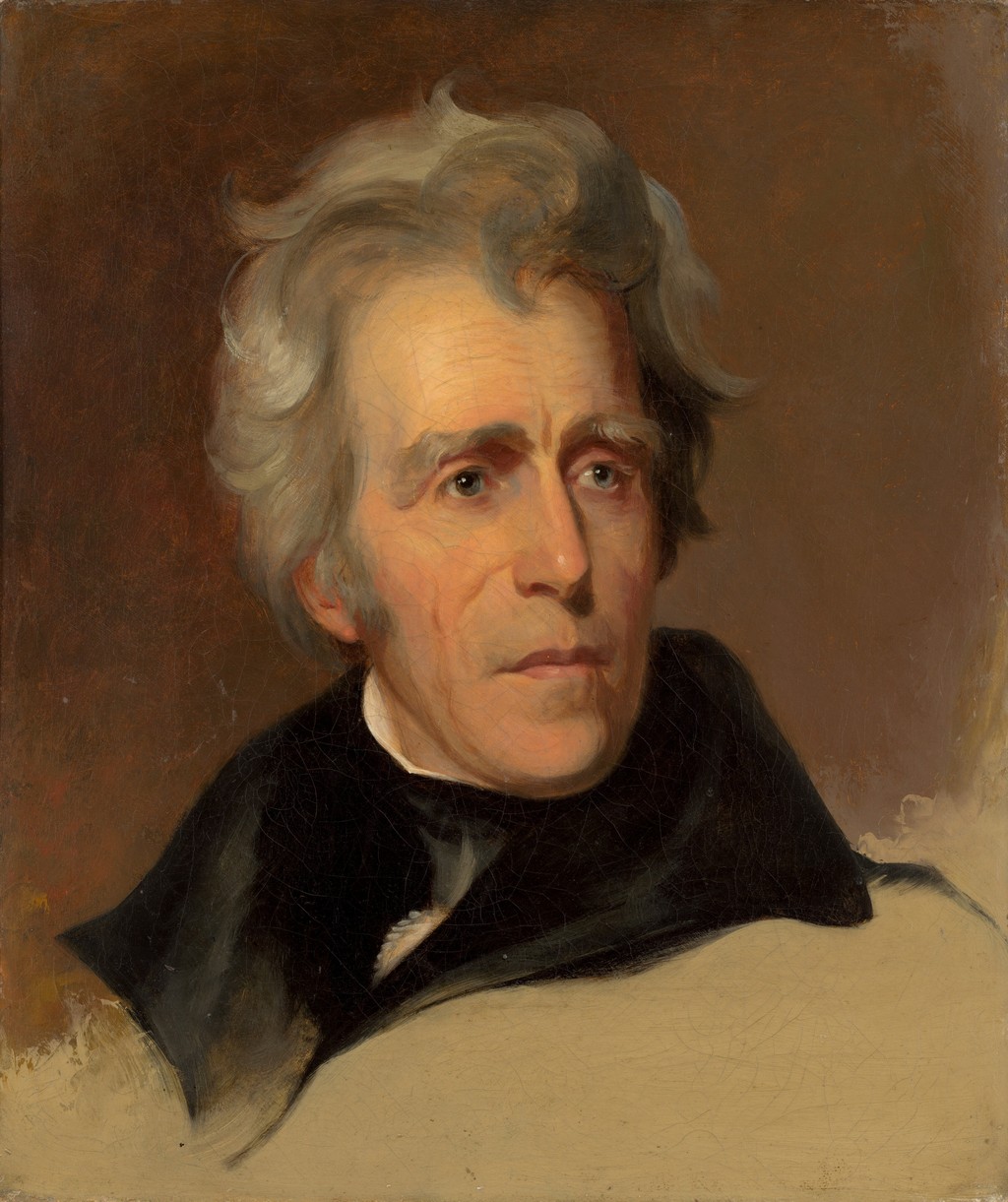
1840; inscription dateAndrew Jackson
1845; after the 1824 life portraitNotes and sources
George Frederick Cooke as Richard III (current article). Actor and theatrical role meet in an imposing full-length portrait. [1]
Musidora. A turned figure beside a pool belongs to a literary episode, not a named portrait sitter. [3]
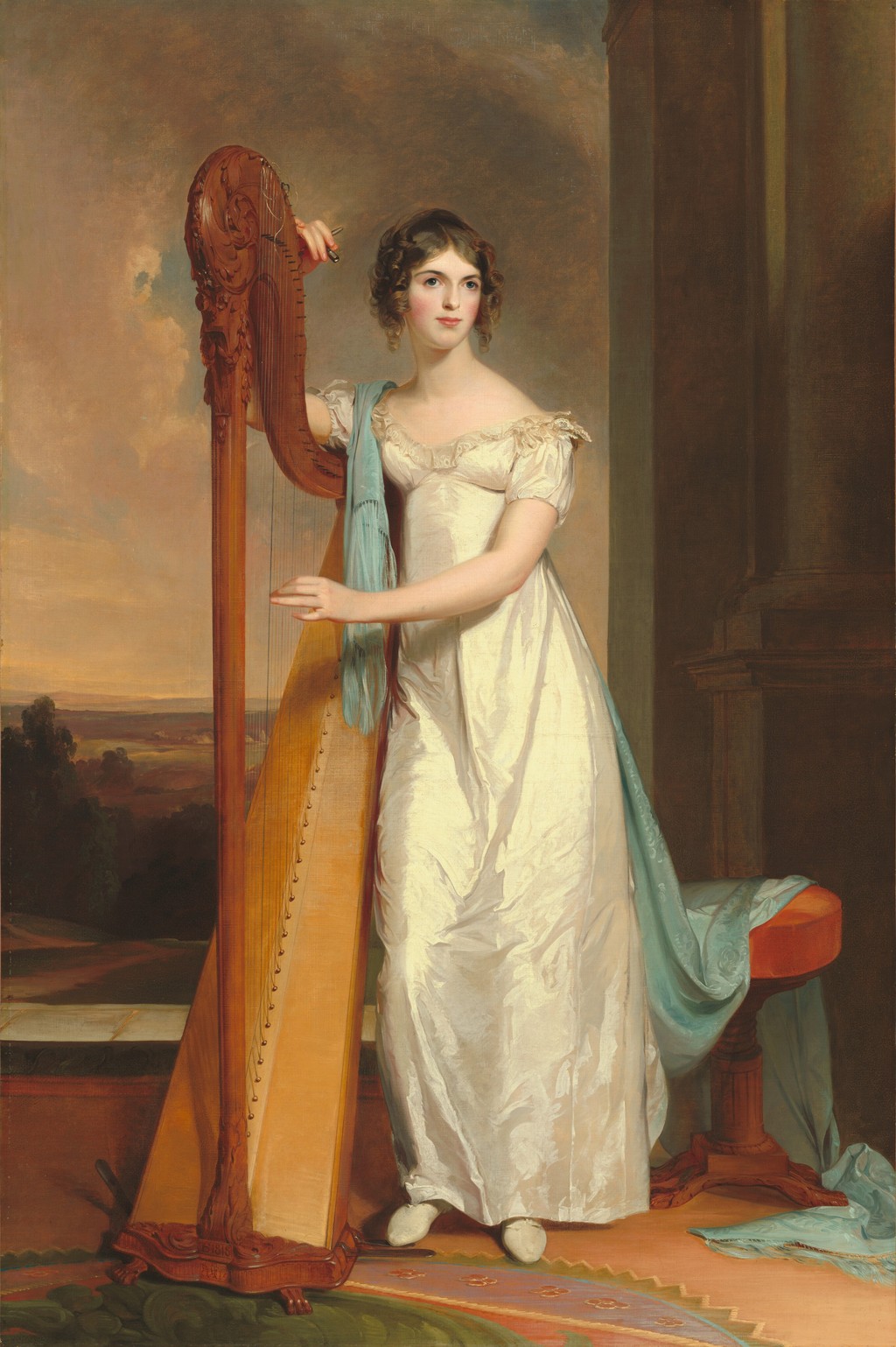
Lady with a Harp: Eliza Ridgely. The harp connects the sitter’s accomplishment with the arrangement of her body. [4]
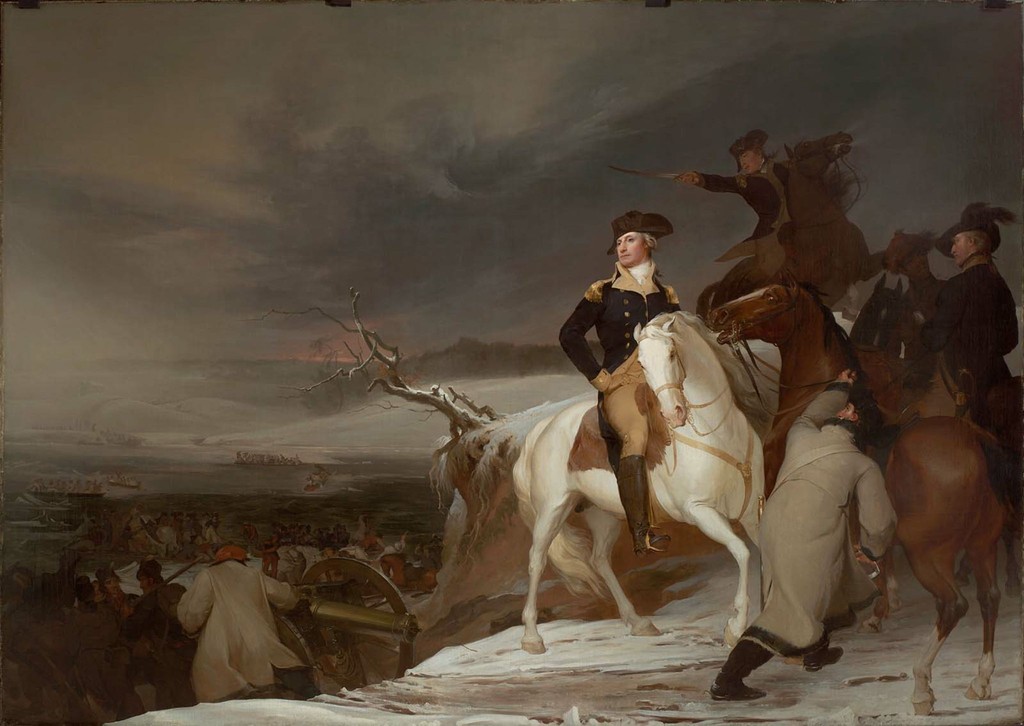
The Passage of the Delaware. Washington is mounted on shore while the crossing proceeds around him. [5]
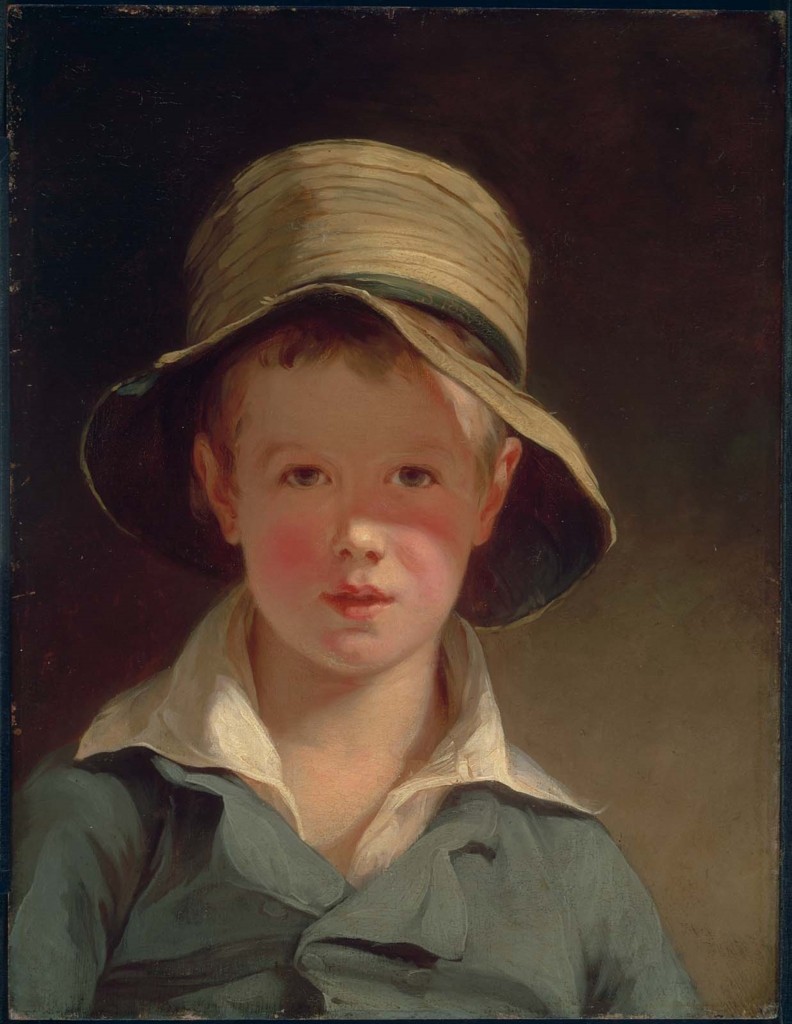
The Torn Hat. A worn hat and directed light give the artist’s son an informal presentation. [6]
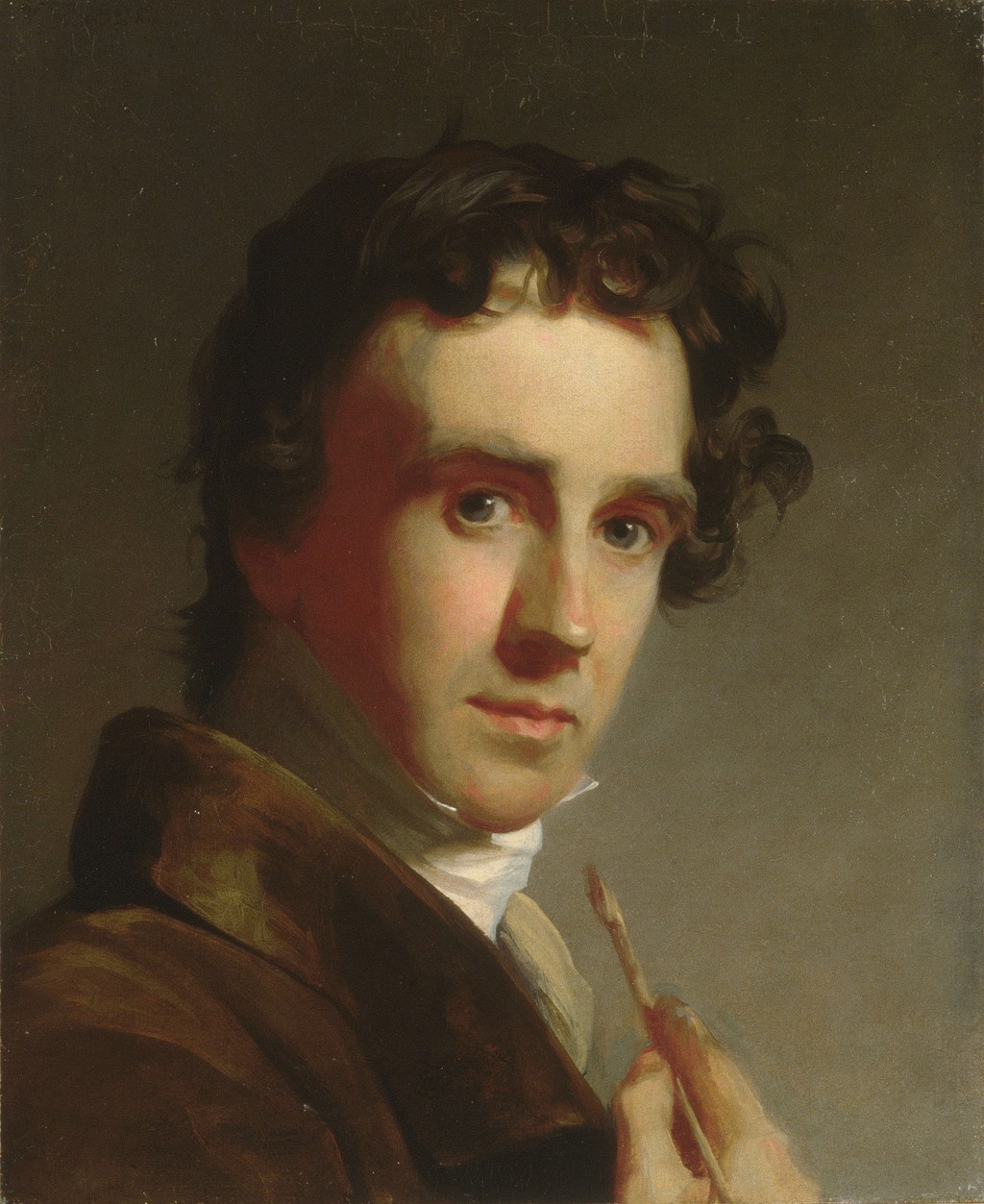
Portrait of the Artist. A raised brush joins the painter’s hand to the illuminated head. [7]
John Quincy Adams. A developed likeness supplied information for a larger portrait project. [4]
The David Children. The older children direct attention toward the reclining infant. [4]
The Vanderkemp Children. A portfolio and overlapping hands connect the three children. [4]
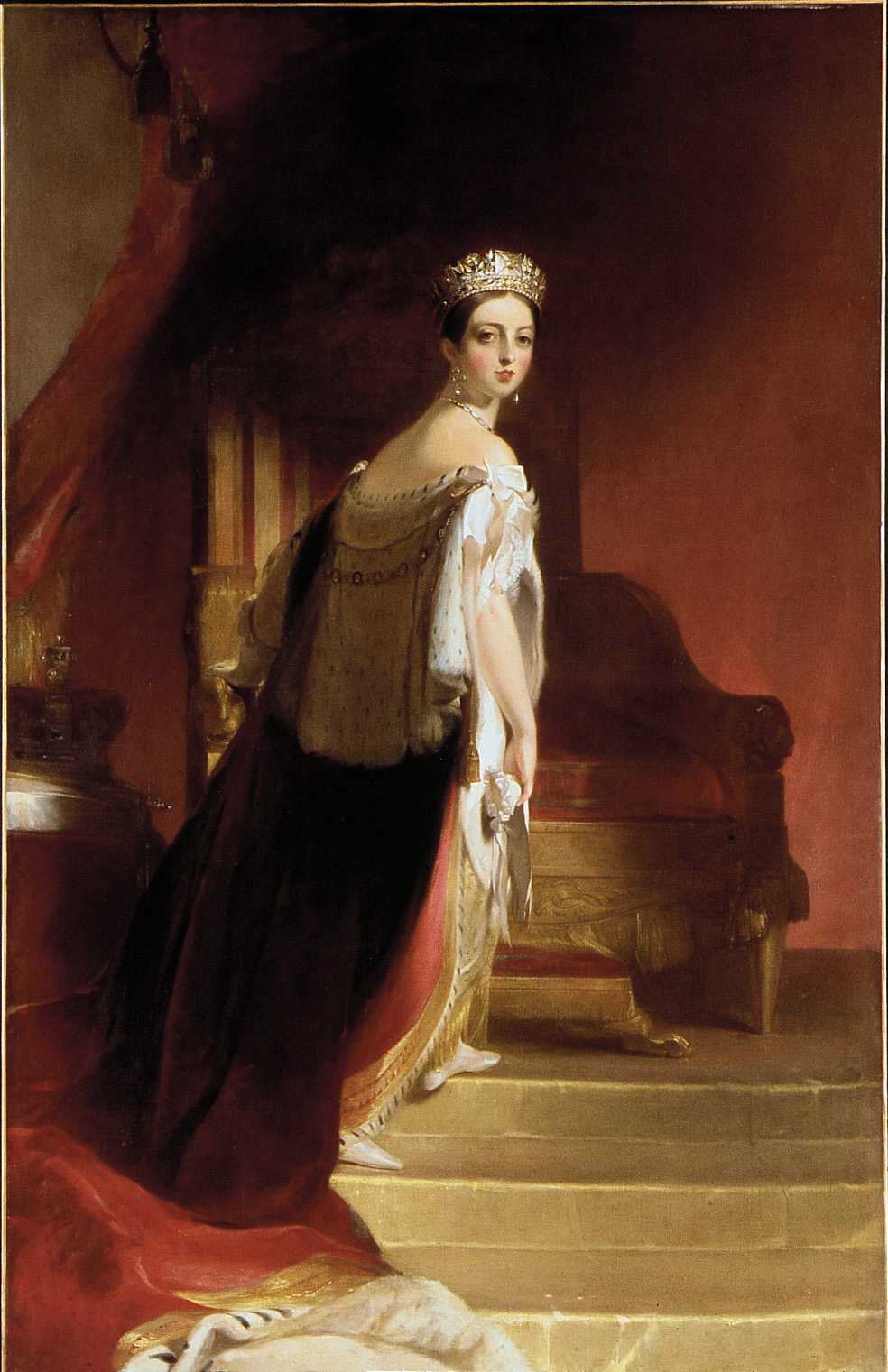
Queen Victoria. The royal likeness extends through robes, insignia and a ceremonial setting. [8]
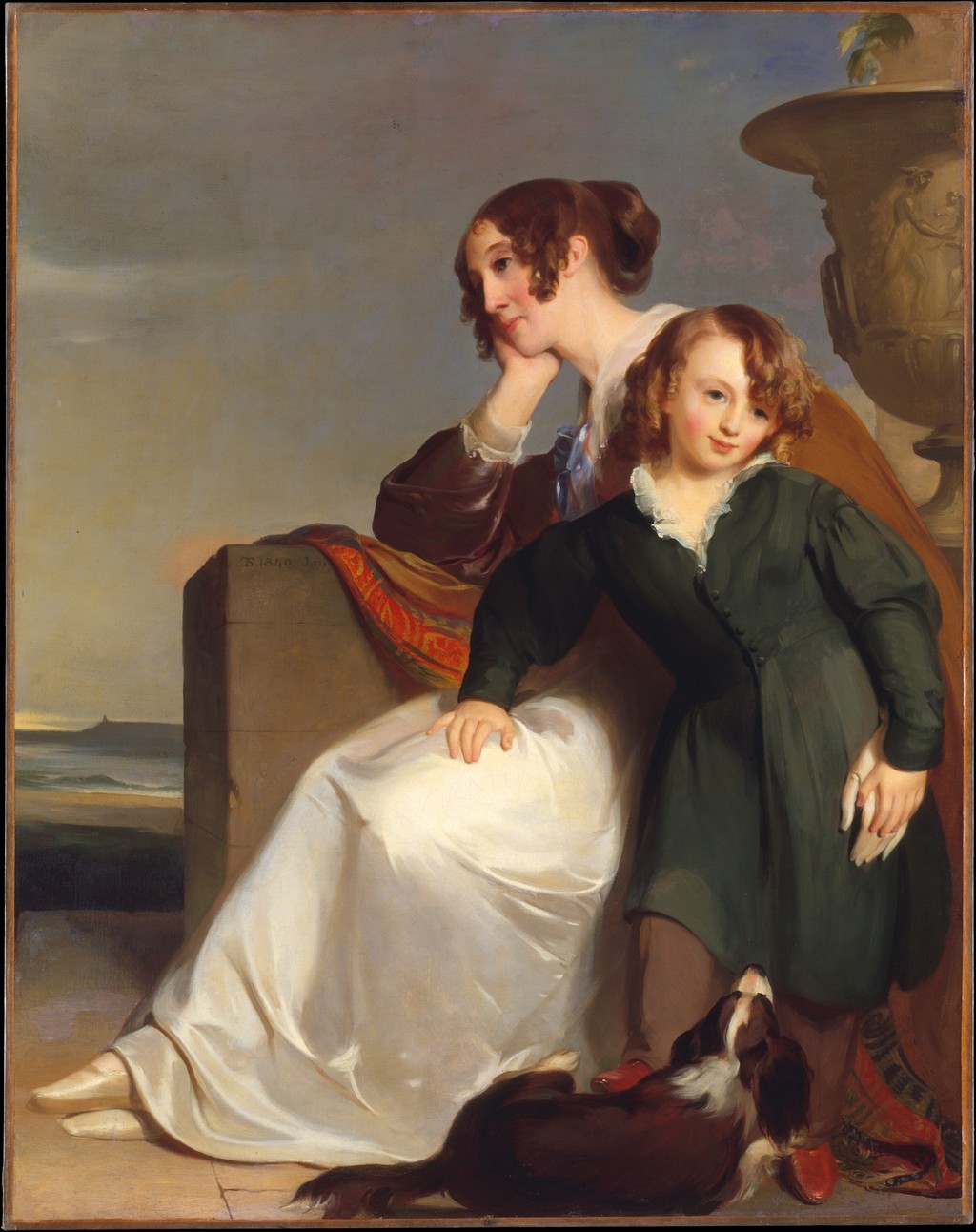
Mother and Son. Jane Darley and her son are connected through touch and differing gazes. [9]
The Coleman Sisters. Contrasting dresses, heights and gestures hold three individual likenesses together. [4]
Andrew Jackson. This later version must be distinguished from its earlier life source. [4]
Contents
- The actor and the character
- A large painting for a public reputation
- Costume, gesture and the floor beneath the figure
- Architecture and the figure at the left
- Subscribers, the Academy and the portrait’s audience
- Sully remembers watching Cooke
- A comparison with Captain Charles Stewart
- Other portraits and the surviving canvas
- Annotated details
The actor and the character
The title carries two identities. George Frederick Cooke is the person whose appearance Sully recorded; Richard III is the role through which the actor is presented. Recognising the distinction changes how the costume, gesture and expression are read. They belong to an image of performance, not to documentary evidence of a medieval ruler’s wardrobe or face.
Cooke’s features remain visible beneath the feathered hat. The head turns toward the viewer, while the body occupies a more oblique position. The raised hand crosses the chest and extends outward, giving the upper figure a clear action. The picture can suggest a performer addressing someone without requiring the viewer to identify one exact spoken line.
The costume enlarges the figure’s presence. Gold decoration articulates the dark garment, white trim separates passages of fabric, and the red cloak falls down one side. These areas give the body a sequence of contrasting surfaces. The face is relatively small within the whole canvas, but the surrounding costume directs attention back toward it.
Annotated Details from George Frederick Cooke as Richard III
The numbered points identify visible features discussed in this article. Return from each detail to the whole composition. The captions keep each work’s identity, date and medium separate.
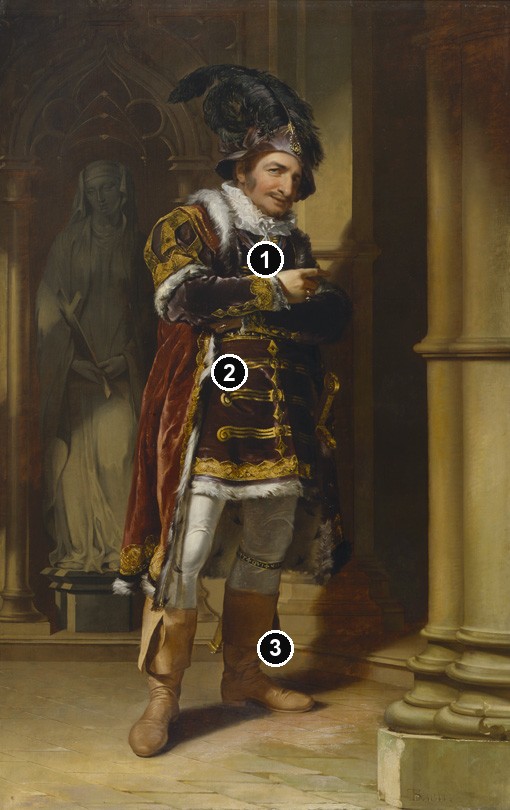
Cooke as Richard III
Thomas Sully, George Frederick Cooke as Richard III, 1811–1812. Oil on canvas, 94⅞ × 60½ in. Pennsylvania Academy of the Fine Arts, Gift of friends and admirers of the artist, 1812.1. No known copyright restrictions. Image source. No known copyright restrictions, as stated by PAFA. Numbers added to a separate overview; detail images cropped from the source. The complete unnumbered image is retained in this article.
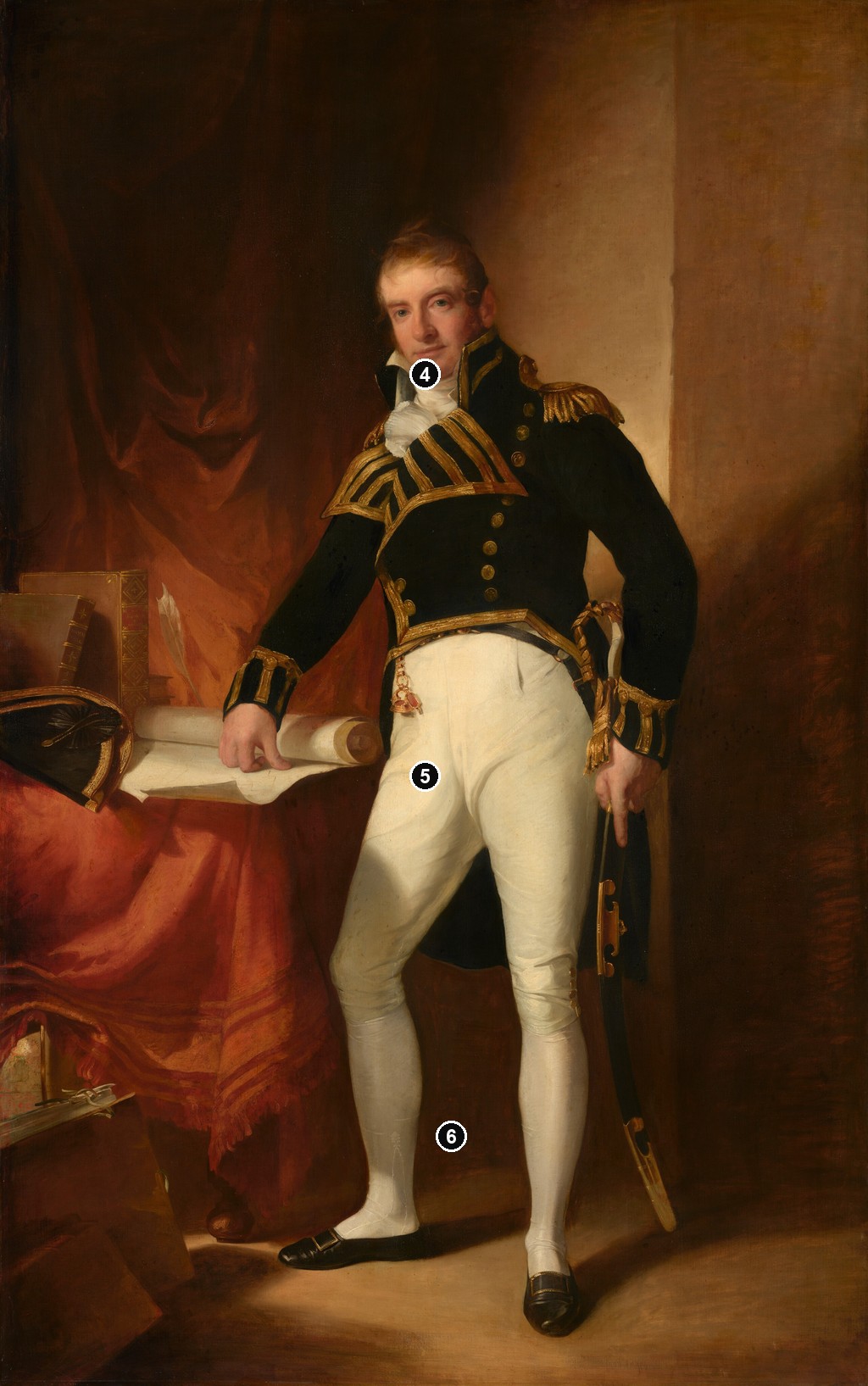
Captain Charles Stewart
Thomas Sully, Captain Charles Stewart, 1811–1812. National Gallery of Art, Washington, Gift of Maude Monell Vetlesen, 1947.4.1. CC0. Image source. CC0; National Gallery of Art Open Access. Numbers added to a separate overview; detail images cropped from the source. The complete unnumbered image is retained in this article.
Details from GEORGE FREDERICK COOKE AS RICHARD III
Compare the cropped details with the complete images above. Notice how their colours, shapes and positions contribute to the larger compositions.
Cooke as Richard III
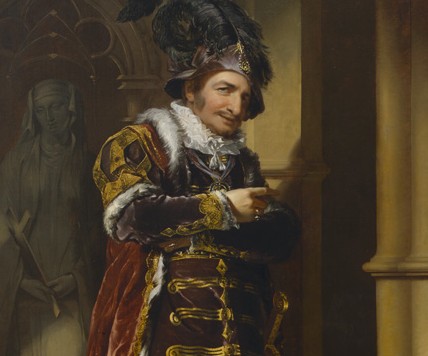
Head and upper figure
The feathered hat and turned face establish the upper silhouette, beside the darker background figure. This broad native crop supports a reading of pose and costume rather than microscopic paint handling.
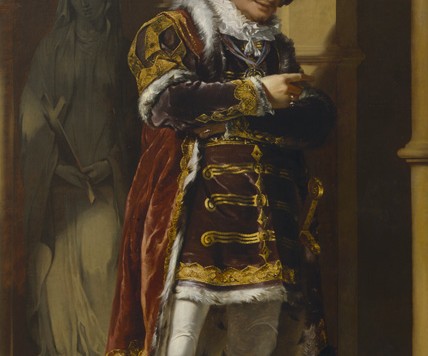
Crossed arms and costume
The folded arms lie across the decorated dark costume. Gold-coloured trim, pale sleeves and the red cloak create distinct bands around the compact upper body.
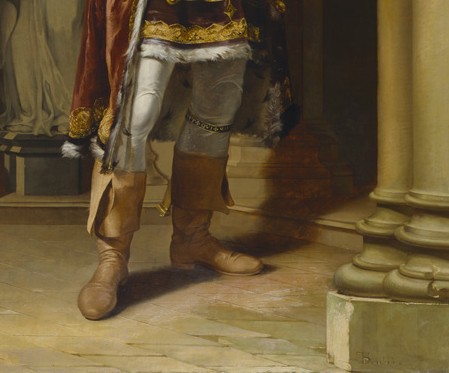
Boots and floor
The booted legs stand apart on the tiled floor beside the column base. This broad lower view shows how the theatrical figure occupies the architectural setting.
Captain Charles Stewart
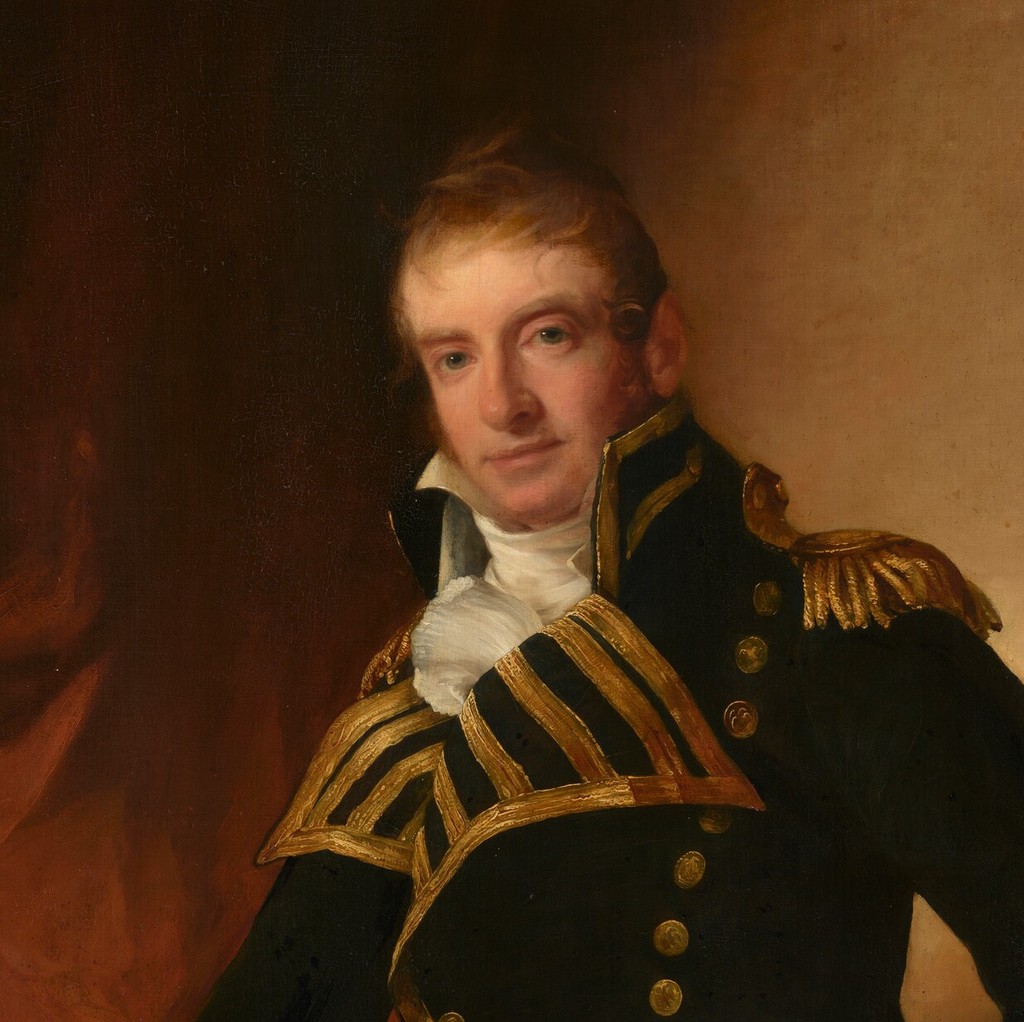
Face and naval dress
The face rises above the white neckcloth and gold-trimmed uniform. Compare this official dress with the theatrical costume in Cooke’s portrait, keeping their different purposes in view.
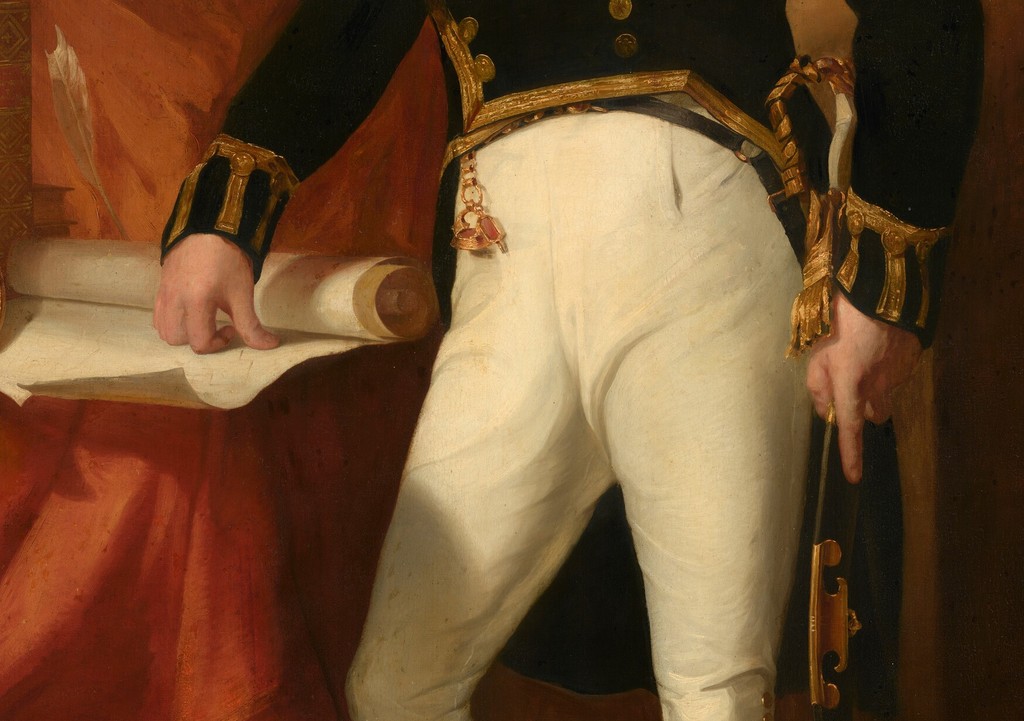
Hands and accessories
One hand rests beside a rolled paper while the other meets the sword. These separated actions organise the full-length pose and give its accessories a visible place.
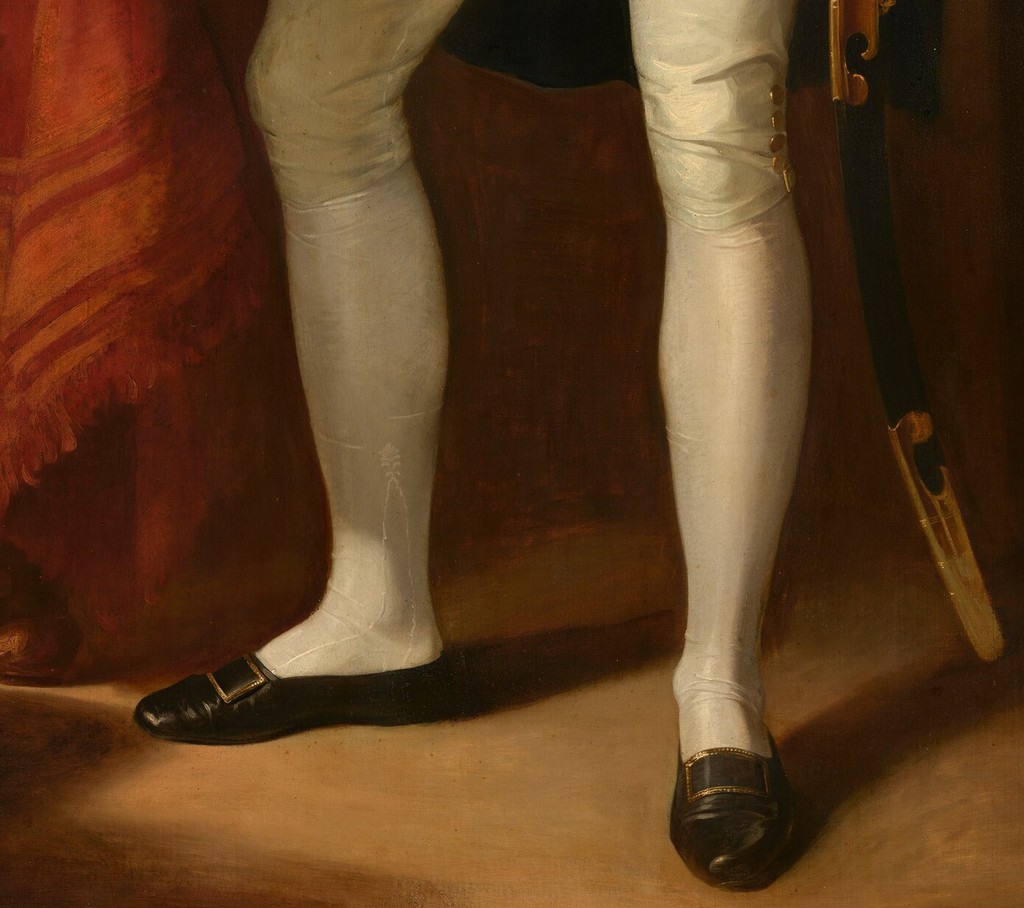
Standing silhouette
Pale breeches and stockings stand out against the darker setting. The separated feet and long downward line of the sword help anchor the full-length figure.
A large painting for a public reputation
At more than two metres high, the canvas gives Cooke a presence on a scale quite different from a small portrait head. The standing body, foreground floor and architectural setting all contribute to that effect. The viewer meets a figure whose space appears to continue beyond the narrow rectangle of the likeness alone.
The NGA catalogue supplies register-based dates of 13 April 1811 to 13 June 1812 for the Cooke portrait. It places the work alongside Sully’s full-length Captain Charles Stewart , painted over an overlapping period. Cooke therefore belongs to an important early phase of Sully’s work with the complete standing figure. [10]
It should not automatically be called his first full-length painting. Biddle and Fielding describe an earlier theatrical picture of William B. Wood in a role from The Robbers . That precedent shows Sully already exploring a relationship between portraiture, costume and dramatic action before the more celebrated Cooke canvas. [2]
Costume, gesture and the floor beneath the figure
The plumes make the top of the composition unusually animated. Their dark, irregular outline differs from the firmer forms of face, collar and shoulder below. Bright decoration on the sleeve and chest then draws attention toward the raised hand, where the gesture becomes the clearest action in the upper body.
Below the decorated garment, pale stockings or close-fitting leg coverings contrast with the darker boots. The legs stand apart, giving the figure a stable base. The floor extends around the feet and opens toward the viewer. This is important to the full-length effect: Cooke does not simply hover within a costume display, but occupies a legible standing position.
The red cloak creates a long passage along the left side of his body. Its weight and folds contrast with the sharper gold patterns across the torso. Following that fabric downward connects the head and shoulder with the lower part of the picture, helping hold the extensive figure together.
These details are most useful when read as part of an arrangement. A theatrical portrait must keep costume interesting without allowing ornament to replace the sitter. Here, the head, hand and stance remain readable through the richness of what surrounds them.
Architecture and the figure at the left
The painted setting contains substantial columns, arches and a stone-coloured standing figure behind Cooke. The columns frame the body while creating a sequence of verticals at different depths. Their bases meet the floor, giving the foreground enough structure to support the full-length pose.
The quieter figure at the left provides a different kind of presence. Its muted colour and still posture contrast with Cooke’s patterned costume and active hand. It contributes to the atmosphere without becoming an equally prominent second sitter.
The setting should not be treated as a verified photograph of the stage on which Cooke performed. The painting may preserve aspects of theatrical presentation while arranging them for the canvas. Without a securely identified production or scene, the architectural background and raised gesture are insufficient to assign a precise instant in the play.
Subscribers, the Academy and the portrait’s audience
Biddle and Fielding reproduce a letter in which Washington Irving described the project and a Philadelphia subscription. The account gives a proposed three-hundred-dollar payment and reports that the subscription filled rapidly. It places the portrait within a circle of people interested in both the performer and the painter. [2]
PAFA’s current credit line identifies the acquisition as a gift from friends and admirers of the artist. That wording should remain distinct from an assumption that Cooke privately commissioned and paid for the canvas himself. The work’s public support forms part of its history. [1]
The same historical biography describes the painting being displayed in a theatrical setting marked by mourning after Cooke’s death. Such an account shows how the image could stand for a performer beyond a single performance. A likeness made during his career could acquire a commemorative function when the living actor was no longer available. [2]
The canvas consequently had more than one possible audience. People who knew Cooke on stage could compare it with their memory of his appearance and gestures. Others could encounter it as a large theatrical portrait, reading the role through title, costume and setting. Its continued presence at the Academy gives that second encounter particular importance.
Watch: Thomas Sully
Choose a film to explore the artist’s work, its interpretation and its wider setting.
Thomas Sully: A Lesson in Conservation
The Columbus Museum explores the conservation of a painting by Thomas Sully.
Watch on YouTubeSully remembers watching Cooke
In a later recollection reproduced by Biddle and Fielding, Sully described his response to Cooke’s acting: “as the play advanced I grew enthusiastic.” He also recalled an improvised seat shared with a companion who repeatedly interrupted their seating arrangement in order to applaud. [2]
The anecdote is a recollection, not a transcript written during the performance. Its value lies in connecting the painter with the experience of watching the actor. Sully’s subject was someone he had encountered as a performer before presenting him through the different resources of paint.
The painting cannot reproduce a voice, a succession of speeches or the changing reactions of an audience. It selects a lasting bodily arrangement instead. A raised hand, tilted head and elaborate costume must carry an impression that theatre could develop over time. The anecdote and canvas therefore illuminate different parts of the relationship between performance and portraiture.
A comparison with Captain Charles Stewart
Sully’s Captain Charles Stewart , now at the National Gallery of Art, is another large standing portrait from 1811–1812. The two works overlap in execution and use costume, gesture and architecture to establish a public presence. One presents a naval officer in uniform; the other presents an actor in a part. [10] [4]
In the Stewart portrait, the dark coat, pale breeches, sword and nearby table define the figure’s place within an extensive setting. In Cooke, the plumed hat, patterned garment and cloak create a more ornate silhouette. Both require the painter to connect a relatively small face with a much larger body and room.
The comparison helps explain the range of Sully’s portraits . Full-length presentation was not reserved for royalty, nor did every dramatic pose indicate an actor. Its resources could be adapted to different public identities. Cooke’s theatrical costume is central to this picture, but the broader compositional problem belongs to Sully’s work beyond the theatre.
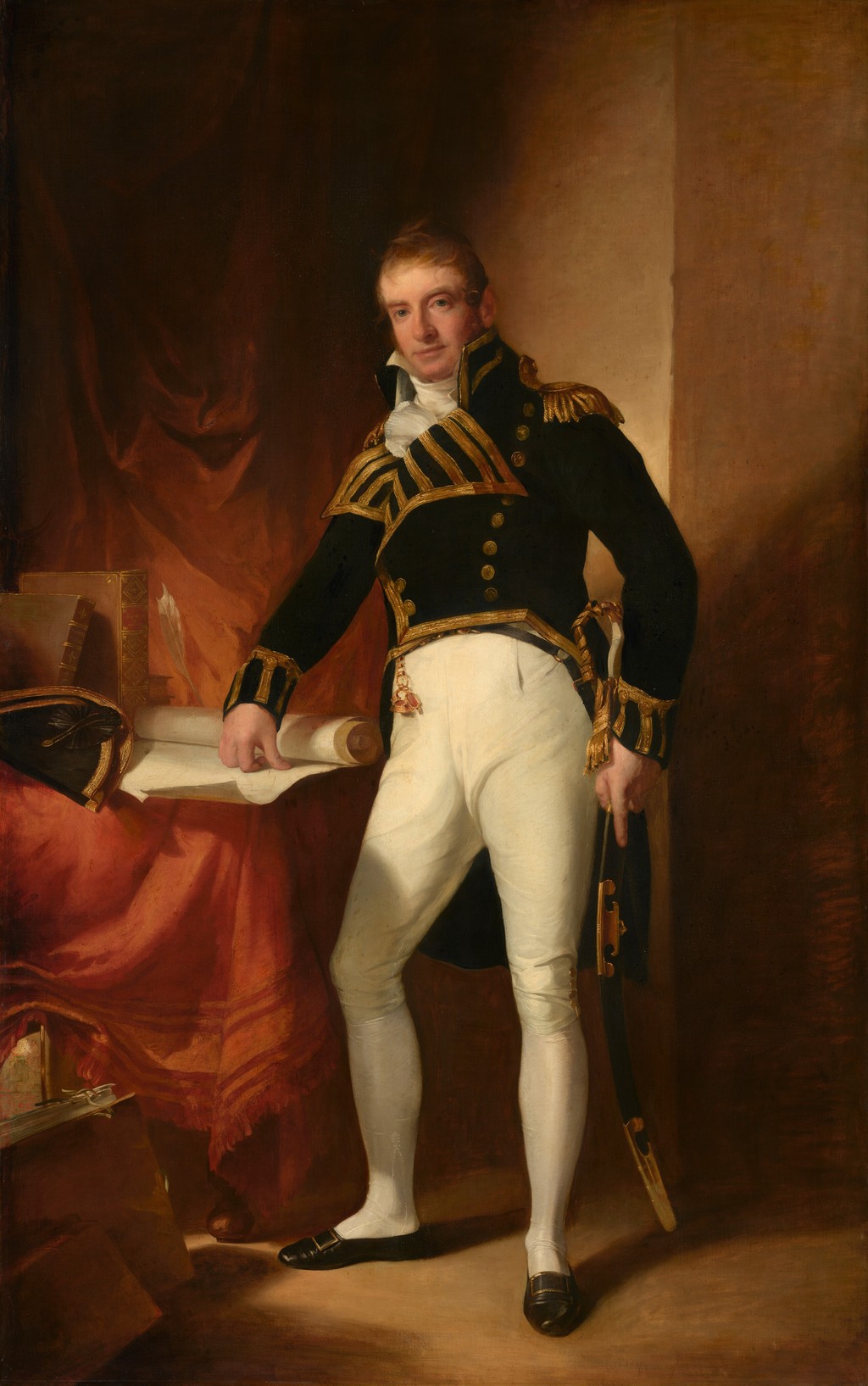
Thomas Sully, Captain Charles Stewart, 1811–1812. National Gallery of Art, Washington, Gift of Maude Monell Vetlesen, 1947.4.1. CC0.
Image source
.
CC0; National Gallery of Art Open Access
.
Other portraits and the surviving canvas
Sully’s later recollection describes three portraits of Cooke, including one dressed as a gentleman and a separate head. These should not be merged into the history of the full-length theatrical work. The current PAFA accession, 1812.1, identifies the large canvas discussed here. [2] [1]
The distinction returns attention to the role of costume. A portrait could preserve Cooke’s appearance without presenting Richard III; this painting makes that dramatic identity central. It gives an audience information about a particular aspect of his public life while leaving room for other images to present him differently.
The portrait’s lasting interest comes from how firmly it holds its two identities together. Cooke remains a particular person, while the role gives him a costume, attitude and setting beyond an everyday likeness. The viewer can attend to the actor, the represented king or the painter’s orchestration of both, without requiring the picture to become a literal record of a complete performance.
Artworks directory
A selection documented in the linked articles, with related studies and a print after Sully listed separately. Dates identify individual objects; Musidora’s date range does not imply continuous work. This is not a catalogue raisonné. The Drawing filter includes watercolour and reproductive printmaking.
| Name | Date | Medium |
|---|---|---|
| Captain Charles Stewart | 1811–1812 | Painting — oil on canvas |
| George Frederick Cooke as Richard III | 1811–1812 | Painting — oil on canvas |
| Musidora | 1813–35; Met panel | Painting — oil on wood |
| Lady with a Harp: Eliza Ridgely | 1818 | Painting — oil on canvas |
| The Passage of the Delaware | 1819 | Painting — oil on canvas |
| The Torn Hat | 1820 | Painting — oil on panel |
| Portrait of the Artist | 1821; Met canvas | Painting — oil on canvas |
| John Quincy Adams | 1824; NGA oil study | Painting — oil on canvas |
| John Quincy Adams (watercolour study) | 1824; Met 38.146.1 | Drawing — watercolour, black chalk and graphite on paper |
| John Quincy Adams (Durand after Sully) | 1826; PAFA 1876.9.184a | Drawing — etching and engraving on paper |
| The David Children | 1826 | Painting — oil on canvas |
| The Vanderkemp Children | 1832 | Painting — oil on canvas |
| Queen Victoria | 1838; full-length Met canvas | Painting — oil on canvas |
| Queen Victoria (life study) | 1838; Met 14.126.1 | Painting — oil on canvas |
| Mother and Son | 1840; inscription date | Painting — oil on canvas |
| The Coleman Sisters | 1844 | Painting — oil on canvas |
| Andrew Jackson | 1845; after the 1824 life portrait | Painting — oil on canvas |
Frequently Asked Questions
It represents George Frederick Cooke acting the role of Richard III, not the medieval king painted from life. [1]
The historical biography describes an earlier theatrical full-length of William B. Wood. Cooke should not be called the first without that qualification. [2]
It belongs to the Pennsylvania Academy of the Fine Arts, accession 1812.1. [1]
Discussion
Look again at the images and ideas explored in George Frederick Cooke as Richard III by Thomas Sully. These editorial prompts invite your observations.
Reader Insights
Which detail first establishes Cooke as a performer in a role: the hat, gesture, costume or setting?
How do the quieter stone-coloured figure and the richly dressed actor affect one another?
Compare Cooke with Captain Charles Stewart. What changes when the costume presents a theatrical identity rather than a naval one?
Join the Conversation
Share a detail, comparison or question about George Frederick Cooke as Richard III by Thomas Sully below.
References
- PAFA: George Frederick Cooke as Richard III , 1811–1812, 1812.1. View source
- Edward Biddle and Mantle Fielding: The Life and Works of Thomas Sully , 1921, chapter IV, especially pp. 22–24. View source
- Metropolitan Museum of Art, Musidora, 1813–35, 21.48. View source
- National Gallery of Art Open Data: current Captain Charles Stewart record , object 33748, 1947.4.1. View source
- Wikimedia Commons / MFA image source, The Passage of the Delaware: original image and PD-Art record. View source
- Wikimedia Commons / MFA source image, The Torn Hat: 16.104 image and PD-Art rights. View source
- Metropolitan Museum of Art, Portrait of the Artist, 1821, 94.23.3. View source
- Metropolitan Museum of Art, Queen Victoria,1838,2021.140. View source
- Metropolitan Museum of Art, Mother and Son, 1840, 14.126.5. View source
- National Gallery of Art: American Paintings of the Nineteenth Century , Part II, 1998, pp. 139–143. View source
- Splash image source.
Thomas Sully, George Frederick Cooke as Richard III, 1811–1812. Oil on canvas, 94⅞ × 60½ in. Pennsylvania Academy of the Fine Arts, Gift of friends and admirers of the artist, 1812.1. No known copyright restrictions. No known copyright restrictions, as stated by PAFA .
View source